A Visit to a New Zoo
I wanted to visit Sydney zoo a couple of weekends ago, on opening day, but discovered several days prior when I was looking at their website that they were sold out for the whole weekend. A mixed blessing, I thought, because I hate visiting zoos on days when it’s busy – for obvious reasons. I know from working at Taronga that during the week is much quieter, Tuesdays being the quietest . However, after Christmas Day it will be bedlam every day until the end of January (weather permitting). The first day I could take off from work was a Thursday, 13 days after the official opening. And while the crowds weren’t bad, there were other negatives to contend with.
Firstly, Sydney was having one of its hottest days in a long time. The temperature at the zoo was between 40 and 42ºC (104 -108ºF). And secondly, all the smoke that had blown in from the bushfires made it seem even worse. You could almost feel it, warm and dry, wrapped around you like a blanket and making you feel hotter than it actually was. Visibility was as low as 500 metres at one point. Asthmatics and respiratory-compromised people have been encouraged to stay indoors because of the poor air quality, and while I don’t fall into that category I would have stayed at home had it not been for the excitement of seeing a new zoo. Despite the external environment.
I arrived just after the 9:00am opening and found only about 20 cars in the carpark, and at the entrance three or four families were purchasing annual memberships. Upon passing through the entrance I found myself on a wide path (Primate Boulevard) with a couple of dozen other people scattered up and down it, but within the hour the zoo had filled up with more people and by the time I left four hours later I would estimate there were a few hundred people in the zoo. Some of them wearing face masks to combat the smoke.
Before talking about the animals and their exhibits I’ll give you a rough overview of the zoo itself and what I noticed.
According to Wikipedia, the zoo is 16 ½ hectares (41 acres) which is a little over half the size of Taronga (at 28 hectares or 70 acres), but it felt smaller than that – more like a quarter the size. So I looked at it on Google Earth when I got home and discovered the 16 ½ hectares includes the carpark and all the land up to the main road frontage. The zoo itself – including the backyard areas and the dam behind the savanna – is about 6 ½ hectares or 21 ½ acres and the carpark is a little over 3 hectares or almost 8 acres. Taronga may also seems larger because it’s on a steep slope and you’re often walking up hill, whereas Sydney Zoo is quite flat overall with only a couple of gentle slopes you hardly even notice. In fact, now that I think back, I don’t think I saw a set of stairs or even a single step anywhere in the zoo. Very wheelchair friendly.
The paths are wide and clean, and even inside the nocturnal/reptile house and the aquarium, although the passages were narrower than outside they were still wide enough. There are plantings everywhere which are new and will look good when they’re established but they are having to compete with the heat. Some shrubs are looking a little heat stressed and in some areas the grass is suffering and you can still see the edges where the strips of turf meet. Looked like parts of my lawn at home.
The last few weeks we have had some hot weather, and this day had already been forecast to be very hot, and the zoo was prepared. The paths are generally to wide to cover completely but there are a number of shelters around the zoo – most exhibits have at least one – and the roofs of these shelters have a few rows of misters constantly spraying a fine mist down onto the guests. Portable misters – something I’ve not seen before – consisting of a hose connected to a large fan blowing a fine mist were situated at a number of points around the zoo so you could stand in front of it and get misted. Plus there were several staff members (at least half a dozen, maybe more) wandering around the grounds in groups of three carrying a backpack full of water connected to a hose and they would walk up to people and offer to mist them. The hose was hidden inside a large plush snake with the mist coming out of its mouth, something I imagine was to encourage the small kids. Also round the zoo were a few stations where you could refill your water bottles with cold water (for free, of course).


The animals were not ignored either. I saw a keeper spraying down the branches and leaves in the koala exhibit and the koalas immediately went lay down on the wet branches, pushing the chest onto the cool dampness. I saw a keeper with a hose in the savanna exhibit spraying the ostriches which had followed him to the hose to get sprayed. The red pandas even had misting pipes attached up the trunk of their trees providing a fine spray in the area where they were resting. And pretty much all the animals had access to their off-display night quarters – just after I arrived I saw a couple of staff walking around the zoo with an armful of little notice stands which indicated if the enclosure was empty it was because the occupants were inside escaping from the heat. As a result, there were several animals I didn’t see for this reason. I should also mention that many of the enclosures had large pools or wide water moats so the animals could get wet if they felt like it. Out the back of the Savanna exhibit is a large dam, and I saw another two smaller bodies of water around the zoo that are not part of any exhibit.


That’s enough background, onto the animals. The images on Google Earth show the zoo under construction, but there’s enough detail for me to use the area function to calculate the size of some of the enclosures. These are close approximations as I had to judge where fences, moats or night quarters are that hadn’t at that stage been constructed. I’m also assuming Google Earths calculations are correct. So bear this in mind if you come across detailed exhibit specs in future that show an accurate figure. And I’m going to forget the hectares and just use acres as it’s something I’m more familiar with, and I suspect most other people are too. And smaller areas just become silly when you say that an exhibit is 0.03 hectares. As usual I’m including some of my photos to illustrate my visit, and I’ve tried to incorporate either the occupant or a visitor in the photo to give some idea of size. Some photos are not ideal as I had both the sun and the smoke to contend with.

So I started out as most people do on Primate Boulevard (see map above), a straight road about 100 metres long and 10 metres wide with the Zoo Entrance at one end and the Boulevard Eatery at the other. There are four sizeable primate enclosures on the boulevard (each around 1/5 acre, or almost 800 square metres), two on each side. On the right was an enclosure that had a pair of Brown Capuchins, but was big enough for a dozen –there may have been more inside. Unlike the other primate enclosures with their dead, branchless tree trunks, the Capuchins had a dead paperbark tree with branches that gave them a lot of climbing opportunities. Next to the Caps was an enclosure containing Sacred Baboons – I counted ten, including one mature male and another male that looked younger. In the heat, they weren’t all that active. Opposite the Baboons were four Black-handed Spider Monkeys, and next to them were three Chimpanzees – but there may have been more inside. Apart from the tree mentioned in the Capuchins, the enclosures all consisted of branchless dead tree trunks supporting elevated platforms (which also provided shade) and hammocks made out of woven fire-hoses. The exhibits have water moats, and the fence on the public side of the moat is glass, making it easier for the younger/shorter visitors to easily view the animals. In fact, glass fences have been used through the zoo as you will see in the images.


I followed the road to the left past the Chimpanzees towards the elephants and came to the first of two Meerkat exhibits. Despite being African desert dwellers, they appeared to be feeling the heat too and while some ventured into the sun for short periods, most were reclining in the shade of their logs or rocks.
Entering the South East Asian section the first exhibit was the Orangutans, a smaller enclosure than the other primates and with no Orangs in the exhibit. There is a window into a room in their nighthouse, but all I saw was one orang sitting in the doorway to another off-display area. When I came back a few hours later there was another orang sitting in the same doorway, and still nobody had ventured into their exhibit.
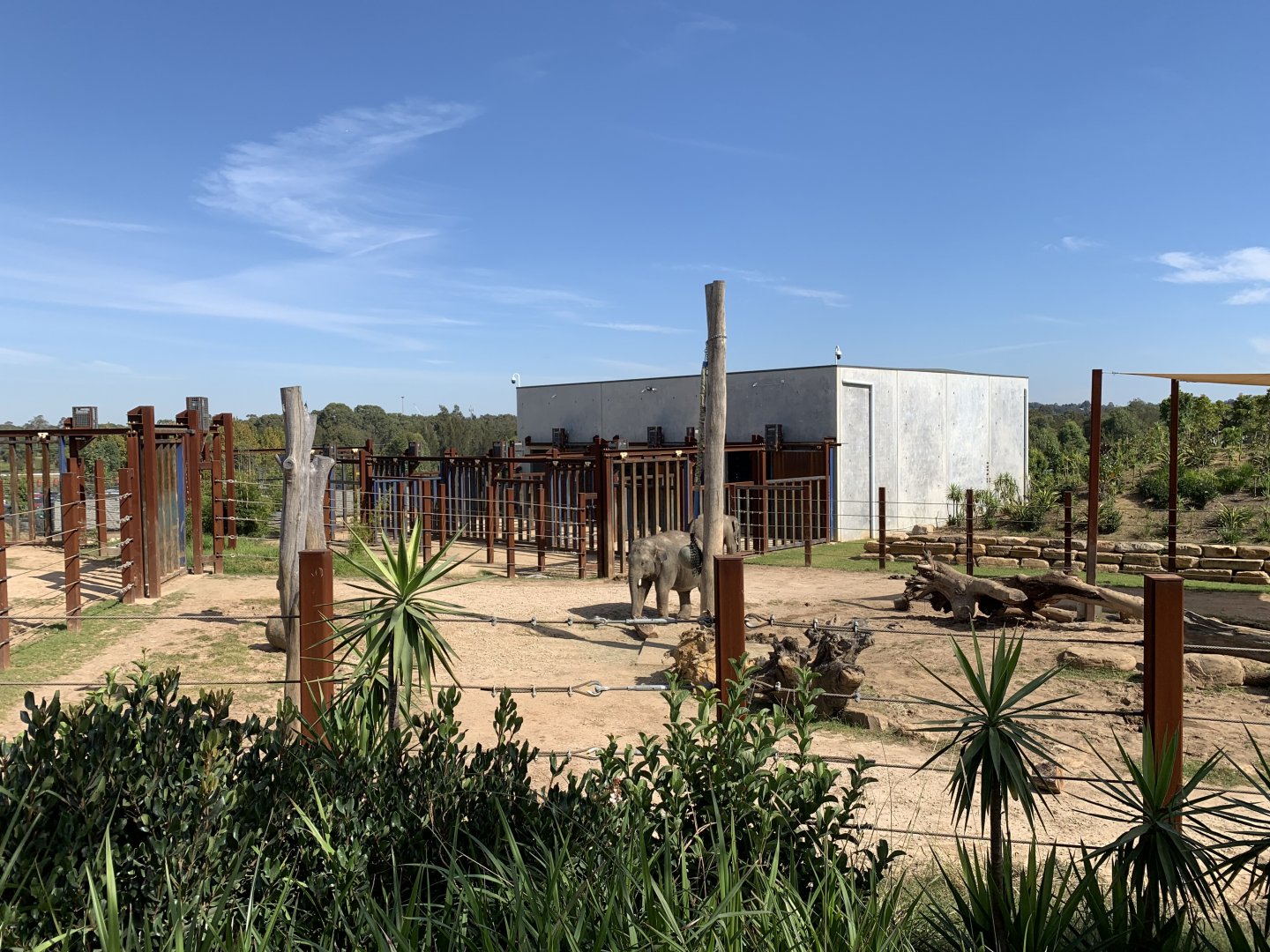
The Asian Elephant enclosure is about 1.25 acres in size, including the pool. Currently they only have one elephant, a female named Saigon who is a retired circus elephant. There is another pair of elephants on their way to the zoo but in the meantime she has three Water Buffalos to keep her company. I didn’t see the buffaloes – there was a sign saying they were off display today. Having said that, I wouldn’t be surprised if the buffaloes are moved at some point in the future and their enclosure utilised by the elephants (making the total area almost 1.5 acres).

Next to the orangutans, behind the Tiger Pool Café (which was closed), is a Sumatran Tiger cage (an actual cage), which was thickly grassed and bambooed, with a pool and a cave. Alongside this exhibit is a small grassed amphitheatre, and then a double enclosure for Red Pandas. I saw two sitting in a tree at the back in the second enclosure, and as a said earlier, with misters providing a cooling fine spray. The front enclosure appeared to be empty.
The African Hunting Dogs were all sheltering in a pipe in their exhibit (I’m assuming it was all of them – there were three). A large exhibit, longer than wide, well grassed and about 1/3 of an acre in size.


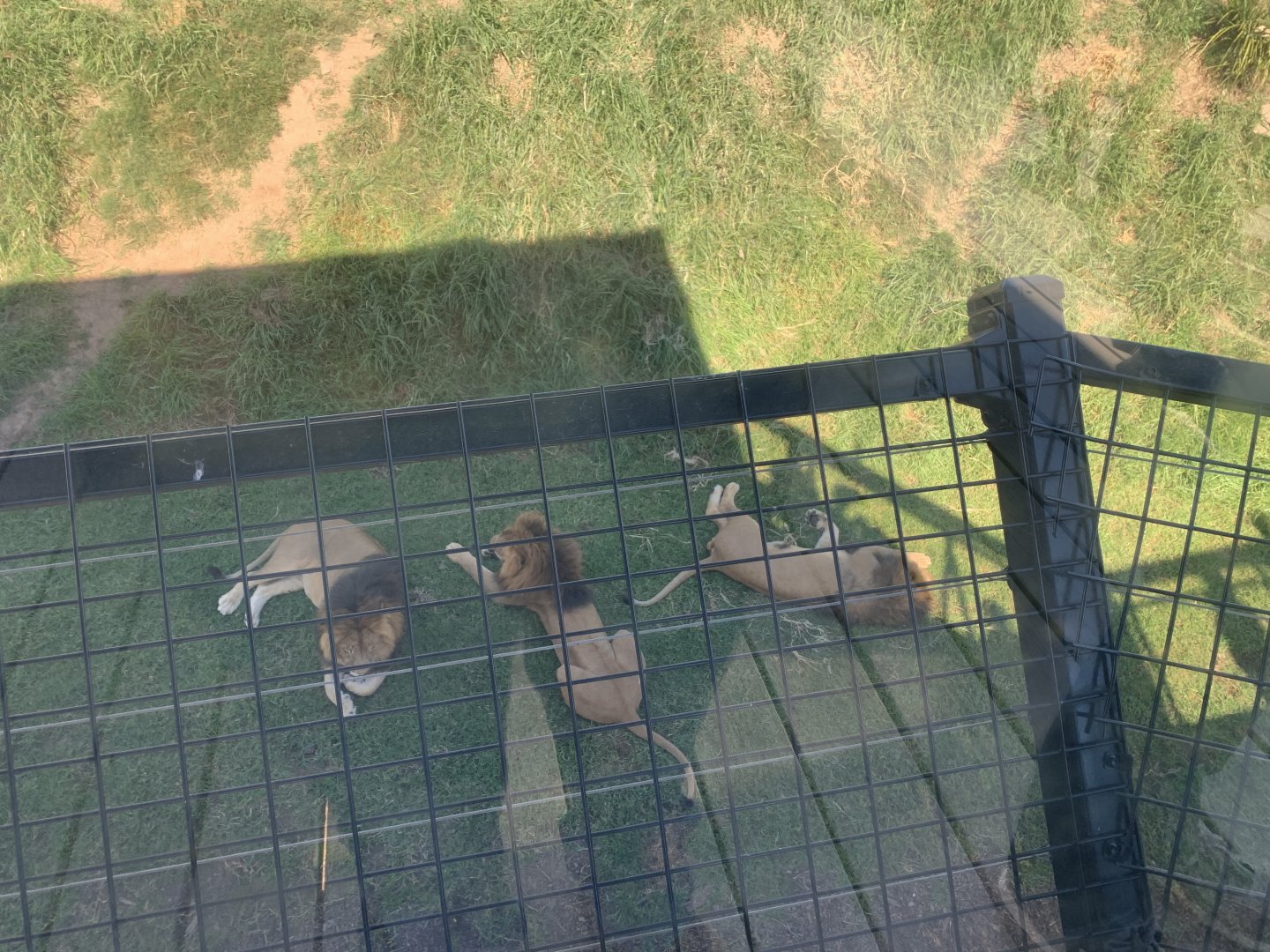
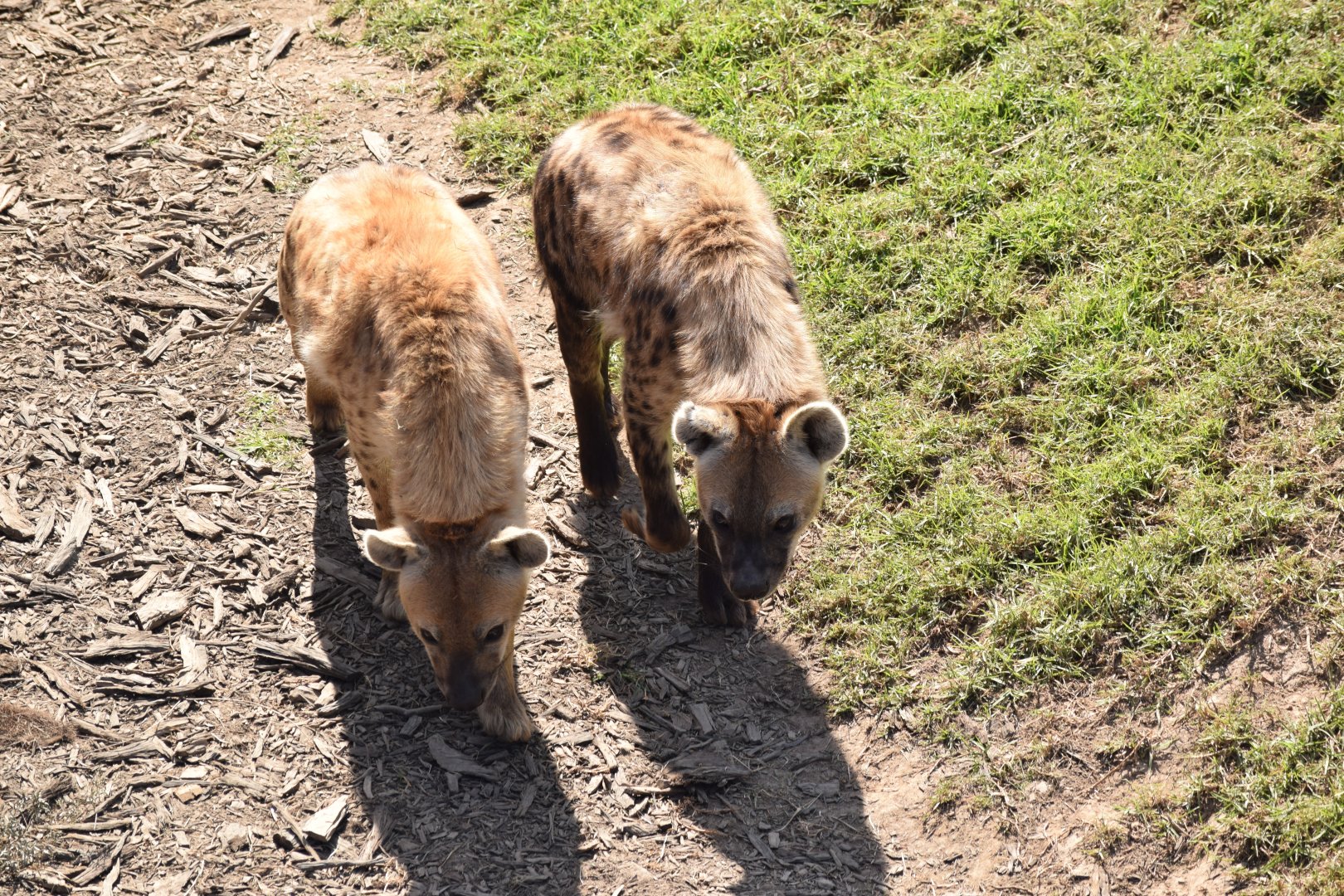
The path headed onto a boardwalk at this point. The next enclosure (0.17 acres) houses three Spotted Hyenas but they spent the day indoors. As the boardwalk is a fair height above ground level, this enclosure and the Lions next to it have large grassed hills in the exhibits to raise the animals not quite to the same level as the boardwalk, but you’re not looking directly down on the animals. There are four male lions in their 1/3 acre exhibit, all brothers from Western Plains Zoo.

On the other side of the boardwalk is an exhibit I’ve referred to as the Savanna, although I don’t know if this is what Sydney Zoo calls it. At 1.5 acres it’s certainly large enough for its current occupants – three Zebra, a couple of Ostriches and a Giraffe (no Blackbuck seen, and no labels, although they are marked on the map – possibly not arrived yet). I imagine this may be where the rhinos will go on display, when they arrive. At around midday I saw a couple of keepers in the exhibit putting out some feed, spraying the Ostriches and hanging a circular bottle of water on a tree which the zebras were somehow able to drink from. The zebras and ostriches were quite comfortable around the keepers, the ostriches following one to get the spray, and the other keeper I saw stroking a zebra on its head and neck, and when she walked off it followed her for a short distance.


The fence on either side of the boardwalk is about five feet high, and so that children (and short adults) can see the animals the fence is made of glass panes for much of the boardwalks length.
As I said at the beginning of this review, I try to avoid days with large numbers of visitors for the obvious reasons. But even days with only a few people you can still have encounters that mar your day slightly. Up till now I’d had a good day – anyone I’d dealt with had been polite, parents had called the kids back when they saw me attempting to take photographs of animals or exhibits, there were some loudish people in the nocturnal house who got a little excited watching the Spinifex Hopping Mice, or surprised at the Golden Brushtail, or articulate and talkative around the venomous snakes, but nothing out of the ordinary or overly annoying. But when I was on the boardwalk photographing the ostriches being sprayed I heard a voice about 20 feet away yell down at the keeper with the zebras:
“Hey! Is that a donkey?”
The keepers were obviously experienced because they both ignored him without showing any indications whatsoever that they had even heard him. So he tried again.
“HEY! Is that a DONKEY!”
Still no response from them. So he tried again. And a fourth time. I felt like saying ‘no, the only donkey is up here’. Having got no response he decided to give up and grinning idiotically at his three mates they started walking passed me on the boardwalk towards the Hunting Dogs. I had thought, generously, that maybe English wasn’t his first language, but his accent and the subsequent conversation he had with his mates confirmed that not only was he fluent, he almost certainly grew up in Australia. All four were early 20’s males and it took me a minute to correctly identify them to subspecies level.
At first I thought they might be Bogans (Homo sapiens bogani), an Australian species, but their behaviour was more idiotic than your average bogan. I ruled out the American Redneck (Homo s. erythrocollis) based on accent, and finally realised it was simply the Common Jerk (Homo s. thinkshesclever), a species almost cosmopolitan in its distribution (especially in zoos). I’m more familiar with the more common “What kind of animal are you?” and “Now there’s an endangered species” vocalisations, which is why I didn’t initially recognise the subspecies.
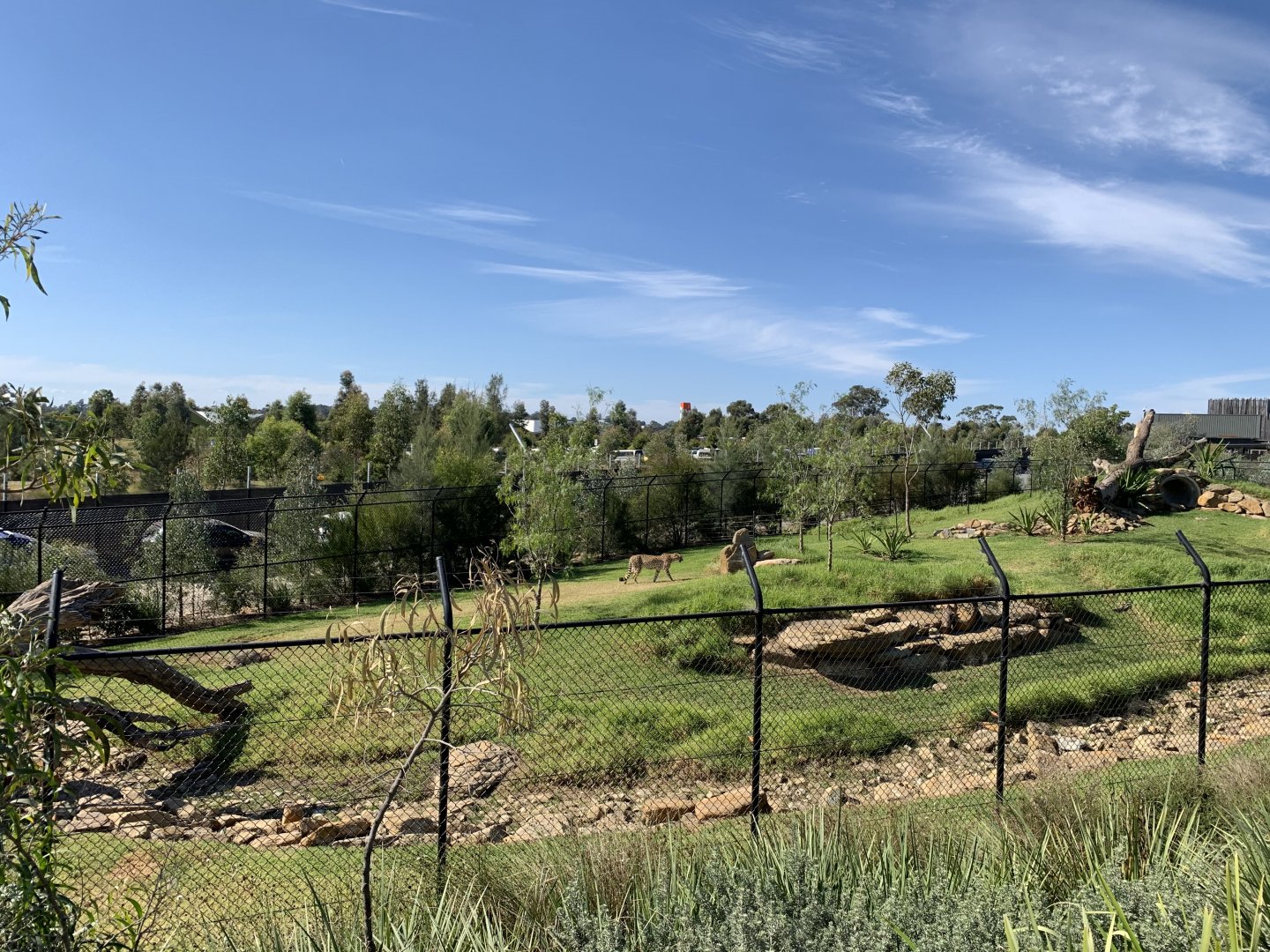
Following the boardwalk around past the Lion Deck Café (also closed – I guess only open on weekends and busy days) – I came to the Cheetah exhibit. Only one cheetah I could see, lying in the shade right at the back of the enclosure.

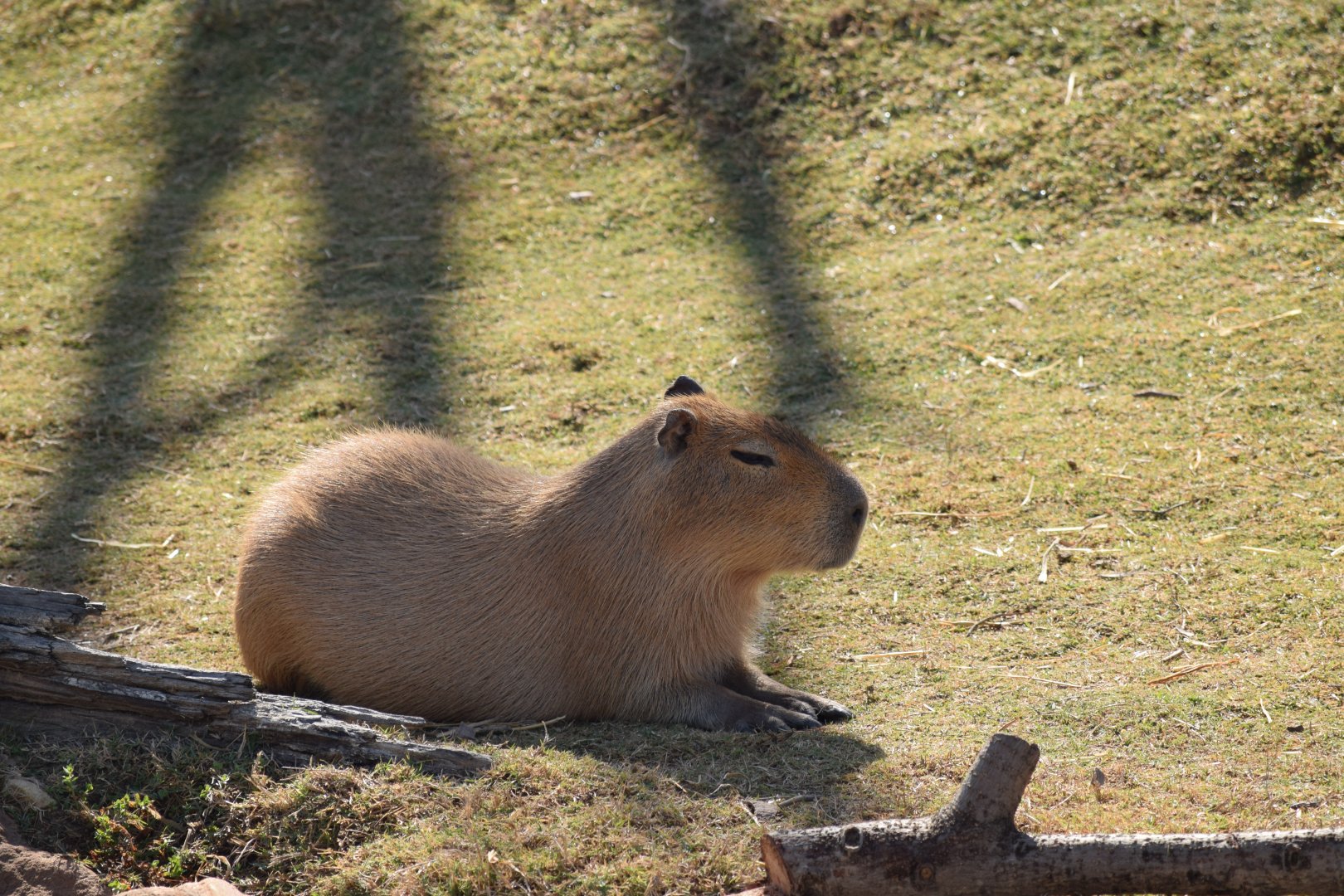
The next enclosure housed four Dromedaries, and opposite was an enclosure with a water feature for the Capybaras, but there were all inside, despite the two deep pools of barely running water. The lower pool was a greenish colour and looked a little dirty, but the upper pool was very clean.
Next to the Capybaras was a short road that led to the Red Pandas. In the middle of the road was a low wire fence comprised of two gates that were padlocked. There were no signs saying not to enter, so on the Capybara side I could walk right up to the fence, and on the Panda side I could walk right up to the fence. It seemed pointless to have the fence shut, as it seemed designed more to stop vehicular traffic, of which there was none.
Next to the Capybaras was a long enclosure with an extra wide moat for Sumatran Tigers. One was on display, but spent much of the time resting in the shade.

Opposite the tiger exhibit was the second of the Meerkat enclosures, right next to the Boulevard Eatery and you could sit next to the windows that made up one wall of the enclosure and have meerkats running around just a few inches from where you were sitting. However, this is an outdoor covered seating area and most of the patrons were indoors where the air conditioning made it a far more pleasant dining experience.


As zoo food outlets are notoriously expensive I thought I’d take a quick look at the prices in the Boulevard Eatery and was pleasantly surprised. Many of the items were cheaper than what I pay for the same items when I have lunch in the café/restaurants near my place of work. Pre-made sandwiches were $7.50, a box of Sushi was around$7.00, Vietnamese Rice paper rolls were $6.00 (and were longer than the ones I pay $8.50 for), Burgers were $12.50 and Fish and Chips were also $12.50.
Leaving the Eatery is the Cassowary enclosure. I’m not sure if they have them yet because there was material wrapped all round the enclosure, and there were no labels I could see either.
Beside the soon-to-be Cassowary exhibit was an enclosure with a large pool with underwater viewing for a Saltwater Crocodile, that I estimate to be about 3 metres long.
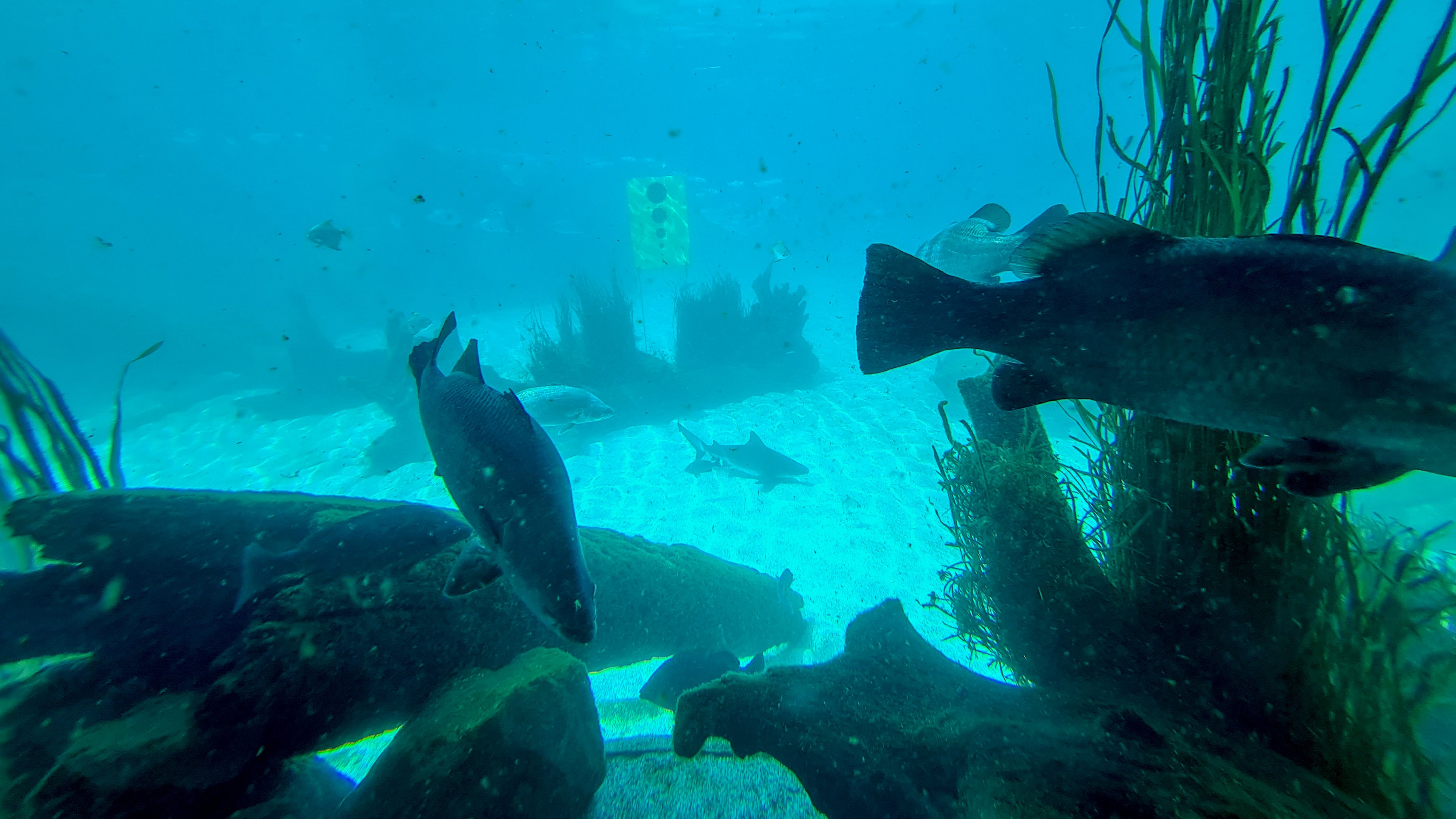
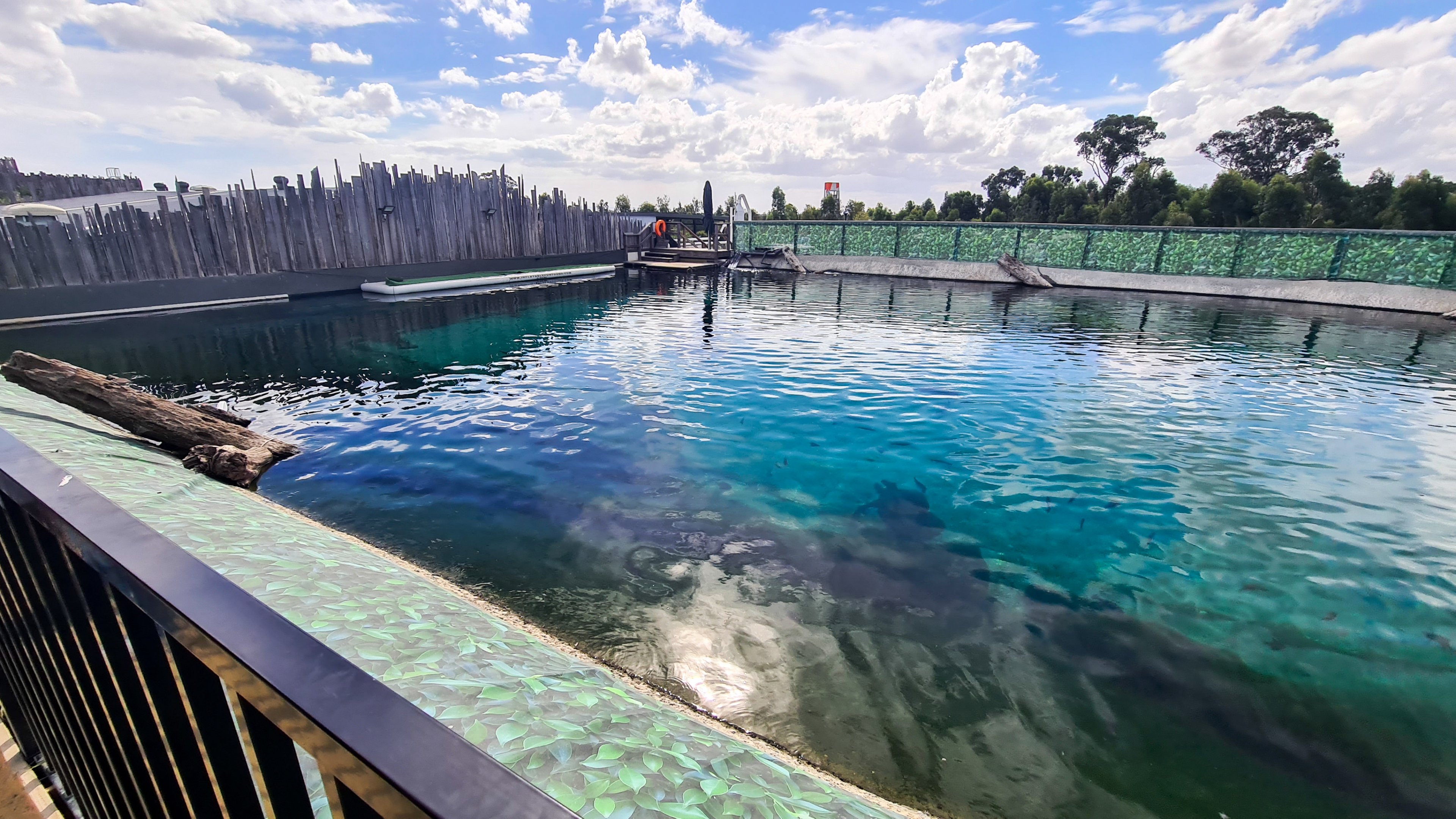
Next door is the Aquarium, which was very pleasant as it was several degrees cooler than outside, and there was no smoke inside either. The Aquarium has a total of nine tanks, all a decent size and all freshwater except the last. The first tank has Silver and Spangled Perch, Murray River Rainbowfish, Agassiz’s Glassfish and Eel-tailed Catfish. Other tanks hold Eastern Blue-eyes, Banded Rainbowfish, Indo-pacific Tarpon, Archerfish, Giant Glassfish, Long-finned Eel, Long-necked Tortoises, Saratoga and Barramundis. The last tank has ten Little Penguins. The final window is to an outdoor exhibit for Bull Sharks, but the window is covered and the pool is empty as the sharks have not arrived yet. I poked my camera behind the fabric sign covering the window and took a photo of what will become the shark exhibit, and then a photo from outside the aquarium where it looks like you'll also be able to see the pool. If you’re looking at the zoo on Googlemaps, the shark pool is the large white horse-shoe shaped structure in the top right.
I should probably mention the labeling: for much of the zoo the labels are large and colourful and are mounted in front of the exhibit. There have been lots of discussions over the years as to the look of labels and the information they contain, and while these labels contain only the most basic information, I don't think they're too bad. The labels in the Aquarium and Nocturnal/Reptile House are on monitors above the exhibits, and follow the same design format as the ones used outside. The only difference is that the ones inside on monitors change around every 20 seconds if there is more than one species in the enclosure.
The Aquarium exit led straight into the Australian section which was essentially one big walkthrough exhibit for macropods and emus, with exhibits for Common Wombats, Echidnas, Tassy Devils and Koalas, and the combined Reptile and Nocturnal House. The latter building can be seen on Googlemaps as the long grey structure on the right side of the zoo, that looks vaguely like a cylinder split in half. When Google next takes satellite images of the zoo you won’t see the building at all – because it’s buried under a hillside which is now covered in (heat-stressed) grass with a few rocks and logs.
Following the path into the building under the hill you first enter the Reptile part of the building, and although this isn’t the nocturnal part, and the exhibits are well-lit, the public area is darkened like a nocturnarium. This helps to cut down on reflections in the glass when taking photographs, however I also noticed outside when photographing the Meerkats through glass panels that there was virtually no reflections at all and I suspect they may be using glass with an anti-reflective coating. There were twenty-seven reptile enclosures, some quite large and others much smaller. The smaller ones were for snakes, which usually don’t need a lot of space. When looking at the reptile exhibits it reminded me of the reptile displays at Sydney Wildlife, in structure and decoration. I can’t list all the reptiles they have but I saw Boyd’s Forest Dragon, Lace Monitor, Perentie, Black-headed Monitor, Heath Monitor, Shingleback, Gidgee Skink, Diamond Python, Carpet Python, Centralian Python, Green Tree Python, Rough-scaled Python, Inland Taipan, Death Adder, Tiger Snake and Broad-headed Snake. This was followed by a darker corridor that had seven triangular enclosures (not pyramid shaped – the base and top of the tanks were triangular, connected by two panes of glass making up the walls, joined in front, and a solid back wall). Three of these enclosures on the right wall housed frogs – Green Tree, Magnificent and White-lipped – and the other four on the left had insects (Spiny Phasmid in two, Stick Insect and Giant Burrowing Cockroach). At the end of the corridor was a tank for Knob-tailed Geckos.
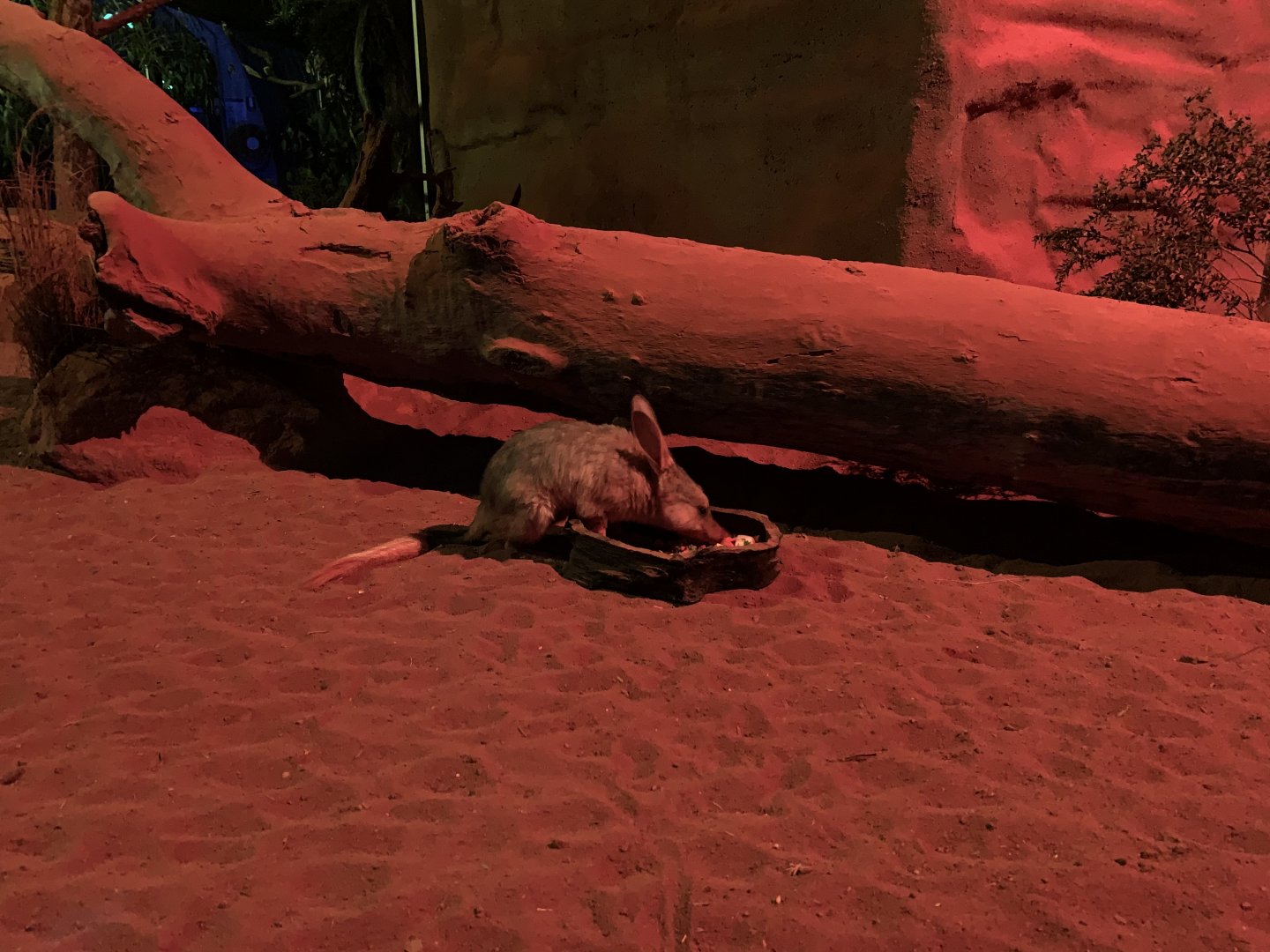
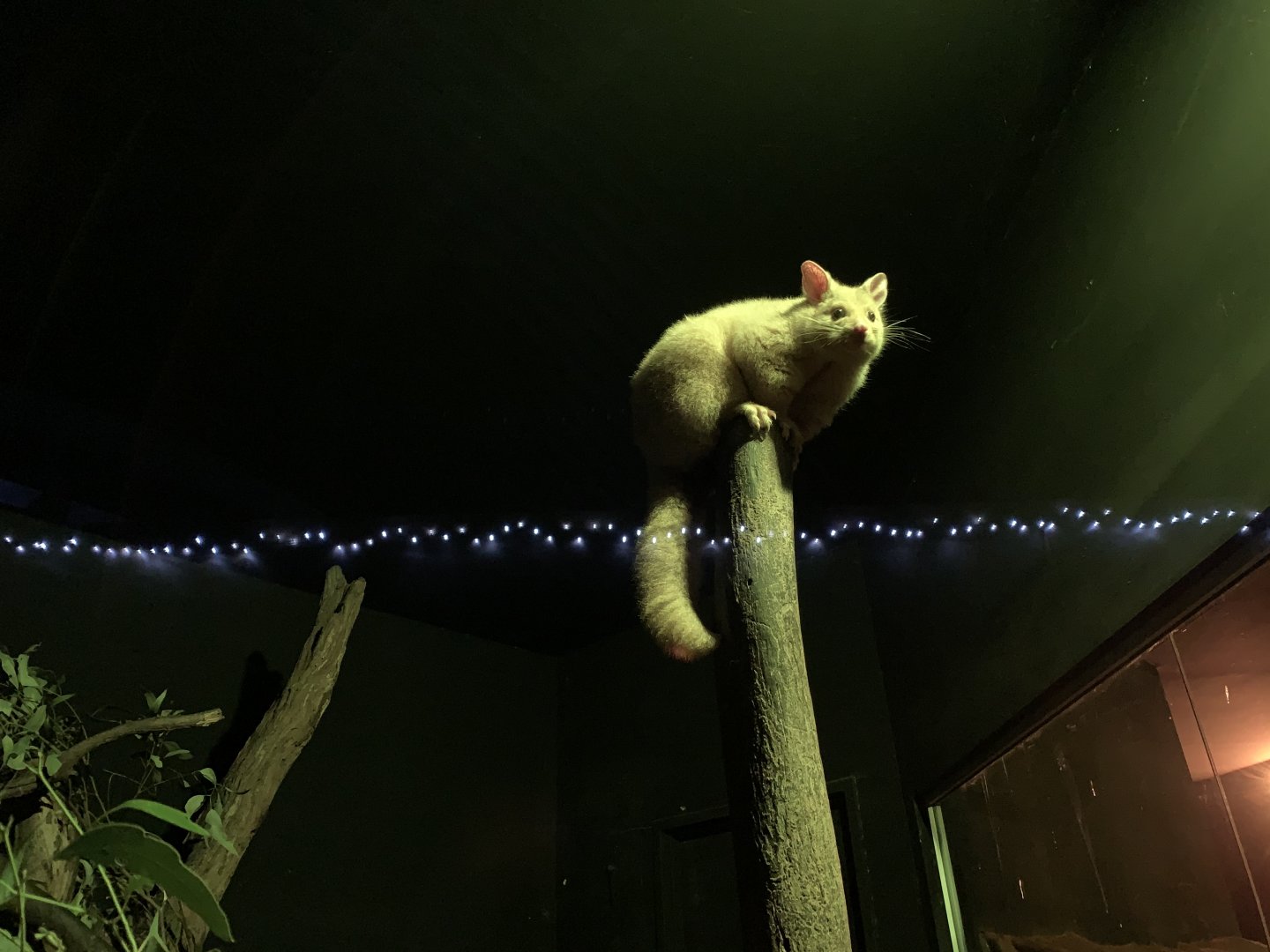
And then we entered the Nocturnal section, consisting of nine decent-sized cages containing Bilbies & Ghost Bats, Spinifex Hopping Mice, Red-tailed Phascogale, Potoroo & Ring-tailed Possum, Yellow-bellied Glider, Sugar Glider, Brush-tailed Possum (including a Tasmanian Golden Brushtail) and Spotted-tail Quoll. I spent 20 minutes trying to photograph the Phascogale because he was moving about, but he was so active he wouldn’t stop long enough for a photo.
As I said, outside the Reptile/Nocturnal House was essentially one big walkthrough enclosure with Yellow-footed Rock Wallabies, Emus (which were off display), Tammar Wallabies, Swamp Wallabies and Kangaroo Island Kangaroos. Apparently the KI Kangaroos are becoming a sought after macropod for walkthroughs as are they are more docile than the Eastern and Western Greys (or so I’m told). The kangaroos I saw all lying in the shade under a shelter, and the Swamp & Tammar Wallabies were all hiding in pipes or in any shade they could find. I couldn't see the Yellow-foots.
A large covered area for the public had what looked like an aboriginal display, and some staff/docents there to educate the public about aboriginal culture and their relationship with the environment and its fauna. At least, that’s what it looked like – I was too hot to stop and find out, but the guy playing a didgeridoo and another on the tapping sticks seemed to reinforce my assumption.
There were a number of open topped enclosures in this walkthrough, for Tasmanian Devils, Echidnas and Wombats, and not surprisingly I couldn’t see any of the occupants. The last enclosure was for Koalas, which I did see prostrating themselves on their freshly sprayed branches. None of these exhibits was remarkable – they all followed the same format that I’ve seen in many other zoos. The koala enclosure was essentially a shed with three metal walls and a roof, with some vertical tree trunks, horizontal branches connecting them, sprays of leaves in a pipe attached to the trunk, and a bowl of water on the ground. The front of the exhibit is a four foot high metal fence. And that’s all you need to exhibit Koalas. The Devils and echidnas had rectangular enclosures with low fences. The drop on the inside of the fence, however, was about five foot, but the substrate rose up in the middle of the enclosure bring the occupants to almost head height; the enclosures were well planted and looked pretty good.
The wombat exhibit was built up against a wall (which I think may have an off-display area). Wombat enclosures are notorious for looking bad because the occupants tend to dig up everything, move soil about the exhibit, and generally denude the enclosure of any greenery. This one was no exception but I noticed that, instead of soil in the exhibit, they appear to have filled it with mulch.
On leaving the walkthrough I noticed two things about the exit (which is the traditional airlock consisting of two separate gates to prevent the macropods and emus from escaping): firstly, there was a sizable gap between the first pair of gates and the second – almost five metres; and secondly, the gates opened inwards. The first point I think is good in that too many other zoos give you an airlock of about two metres which means it can get crowded between the gates if there are too many people, or a couple of strollers. The second point is, to me, common sense: if the gates open outwards from the exhibit, a kangaroo may lie against the gate and learn that pushing it will open it. It’s harder for them to open the gate if they have to pull on it. However I know of one zoo that had gates that open outwards: heavy counterweights were used to automatically close the gates when the public opened them, and to prevent the animals opening the gates the zoo made the weights heavier, meaning the animals had to push hard to open the gates. This meant the public had to push hard to open them too.
The last exhibit was for Dingos – a fenced grassy knoll with pipes for shade, logs and rocks. And I couldn’t see the dingos.
And that leads us back to the Entrance/Exit/Gift Shop. So I did another circuit around the zoo to take a few more photos of exhibits that I couldn’t get before because of the angle of the sun, and to look for animals I hadn’t seen because they were inside – but none of them had come out. When I left the zoo it was just on 1:00pm, so I spent about four hours there. Had I been in a hurry, I could have done it in less than one hour, but it was a new zoo and I took my time.
My overall opinion of the zoo? It’s not a bad little zoo, and will look better once the plants have become established and grown much taller. Could the enclosures be larger? Of course they could – but that would mean another species gets a smaller enclosure, or is lost from the zoo altogether. The current enclosures are of a good size – I’ve certainly seen much worse, in supposedly good zoos. Right now the zoo needs to start getting a financial return, so losing species at this point is not a wise move.
I was disappointed by their diversity of birds – I only saw two species, Ostriches and Penguins. They apparently also have Emus and soon Cassowaries. That’s a shame when there is plenty of room in the Australian walkthrough where a walkthrough aviary could be constructed. However, I don’t believe the focus of the zoo is on Australian fauna which can be seen in pretty much any fauna park in Australia (and Featherdale is just down the road and is predominantly birds). And Taronga certainly has a much greater diversity. I think Sydney Zoo is focussing on large exotic mammals, and is catering specifically for the Western Sydney population.
I know there is a another thread on the zoo which has received a number of criticisms based upon photographs and media reports. Having been there my view is that overall it’s not a bad zoo. That said, it has little to offer ZooChatters, but then ZooChatters are not their target demographic.
Although I found nothing really wrong with the zoo, there’s nothing I found really great about it either. The exhibits looked like so many other exhibits I’ve seen in dozens of zoos around the world, there was nothing that really sets them apart from other zoos in Australia. The boardwalk was a little different, but was reminiscent of the walkway over the lions at Melbourne Zoo, and many other places have elevated animal viewing. It probably gives you a better idea of how I feel when I tell you the things that most excited me were:
As I said, these are my opinions, and – as always – I strongly recommend anyone in Sydney to visit the zoo to form their own opinions. And preferably share them here.

Hix
I wanted to visit Sydney zoo a couple of weekends ago, on opening day, but discovered several days prior when I was looking at their website that they were sold out for the whole weekend. A mixed blessing, I thought, because I hate visiting zoos on days when it’s busy – for obvious reasons. I know from working at Taronga that during the week is much quieter, Tuesdays being the quietest . However, after Christmas Day it will be bedlam every day until the end of January (weather permitting). The first day I could take off from work was a Thursday, 13 days after the official opening. And while the crowds weren’t bad, there were other negatives to contend with.
Firstly, Sydney was having one of its hottest days in a long time. The temperature at the zoo was between 40 and 42ºC (104 -108ºF). And secondly, all the smoke that had blown in from the bushfires made it seem even worse. You could almost feel it, warm and dry, wrapped around you like a blanket and making you feel hotter than it actually was. Visibility was as low as 500 metres at one point. Asthmatics and respiratory-compromised people have been encouraged to stay indoors because of the poor air quality, and while I don’t fall into that category I would have stayed at home had it not been for the excitement of seeing a new zoo. Despite the external environment.
I arrived just after the 9:00am opening and found only about 20 cars in the carpark, and at the entrance three or four families were purchasing annual memberships. Upon passing through the entrance I found myself on a wide path (Primate Boulevard) with a couple of dozen other people scattered up and down it, but within the hour the zoo had filled up with more people and by the time I left four hours later I would estimate there were a few hundred people in the zoo. Some of them wearing face masks to combat the smoke.
Before talking about the animals and their exhibits I’ll give you a rough overview of the zoo itself and what I noticed.
According to Wikipedia, the zoo is 16 ½ hectares (41 acres) which is a little over half the size of Taronga (at 28 hectares or 70 acres), but it felt smaller than that – more like a quarter the size. So I looked at it on Google Earth when I got home and discovered the 16 ½ hectares includes the carpark and all the land up to the main road frontage. The zoo itself – including the backyard areas and the dam behind the savanna – is about 6 ½ hectares or 21 ½ acres and the carpark is a little over 3 hectares or almost 8 acres. Taronga may also seems larger because it’s on a steep slope and you’re often walking up hill, whereas Sydney Zoo is quite flat overall with only a couple of gentle slopes you hardly even notice. In fact, now that I think back, I don’t think I saw a set of stairs or even a single step anywhere in the zoo. Very wheelchair friendly.
The paths are wide and clean, and even inside the nocturnal/reptile house and the aquarium, although the passages were narrower than outside they were still wide enough. There are plantings everywhere which are new and will look good when they’re established but they are having to compete with the heat. Some shrubs are looking a little heat stressed and in some areas the grass is suffering and you can still see the edges where the strips of turf meet. Looked like parts of my lawn at home.
The last few weeks we have had some hot weather, and this day had already been forecast to be very hot, and the zoo was prepared. The paths are generally to wide to cover completely but there are a number of shelters around the zoo – most exhibits have at least one – and the roofs of these shelters have a few rows of misters constantly spraying a fine mist down onto the guests. Portable misters – something I’ve not seen before – consisting of a hose connected to a large fan blowing a fine mist were situated at a number of points around the zoo so you could stand in front of it and get misted. Plus there were several staff members (at least half a dozen, maybe more) wandering around the grounds in groups of three carrying a backpack full of water connected to a hose and they would walk up to people and offer to mist them. The hose was hidden inside a large plush snake with the mist coming out of its mouth, something I imagine was to encourage the small kids. Also round the zoo were a few stations where you could refill your water bottles with cold water (for free, of course).
Shelters with misters
Portable mister
A young girl getting misted
The animals were not ignored either. I saw a keeper spraying down the branches and leaves in the koala exhibit and the koalas immediately went lay down on the wet branches, pushing the chest onto the cool dampness. I saw a keeper with a hose in the savanna exhibit spraying the ostriches which had followed him to the hose to get sprayed. The red pandas even had misting pipes attached up the trunk of their trees providing a fine spray in the area where they were resting. And pretty much all the animals had access to their off-display night quarters – just after I arrived I saw a couple of staff walking around the zoo with an armful of little notice stands which indicated if the enclosure was empty it was because the occupants were inside escaping from the heat. As a result, there were several animals I didn’t see for this reason. I should also mention that many of the enclosures had large pools or wide water moats so the animals could get wet if they felt like it. Out the back of the Savanna exhibit is a large dam, and I saw another two smaller bodies of water around the zoo that are not part of any exhibit.
That’s enough background, onto the animals. The images on Google Earth show the zoo under construction, but there’s enough detail for me to use the area function to calculate the size of some of the enclosures. These are close approximations as I had to judge where fences, moats or night quarters are that hadn’t at that stage been constructed. I’m also assuming Google Earths calculations are correct. So bear this in mind if you come across detailed exhibit specs in future that show an accurate figure. And I’m going to forget the hectares and just use acres as it’s something I’m more familiar with, and I suspect most other people are too. And smaller areas just become silly when you say that an exhibit is 0.03 hectares. As usual I’m including some of my photos to illustrate my visit, and I’ve tried to incorporate either the occupant or a visitor in the photo to give some idea of size. Some photos are not ideal as I had both the sun and the smoke to contend with.
So I started out as most people do on Primate Boulevard (see map above), a straight road about 100 metres long and 10 metres wide with the Zoo Entrance at one end and the Boulevard Eatery at the other. There are four sizeable primate enclosures on the boulevard (each around 1/5 acre, or almost 800 square metres), two on each side. On the right was an enclosure that had a pair of Brown Capuchins, but was big enough for a dozen –there may have been more inside. Unlike the other primate enclosures with their dead, branchless tree trunks, the Capuchins had a dead paperbark tree with branches that gave them a lot of climbing opportunities. Next to the Caps was an enclosure containing Sacred Baboons – I counted ten, including one mature male and another male that looked younger. In the heat, they weren’t all that active. Opposite the Baboons were four Black-handed Spider Monkeys, and next to them were three Chimpanzees – but there may have been more inside. Apart from the tree mentioned in the Capuchins, the enclosures all consisted of branchless dead tree trunks supporting elevated platforms (which also provided shade) and hammocks made out of woven fire-hoses. The exhibits have water moats, and the fence on the public side of the moat is glass, making it easier for the younger/shorter visitors to easily view the animals. In fact, glass fences have been used through the zoo as you will see in the images.
Brown Capuchin enclosure - there are two capuchins in the tree.
Chimpanzee exhibit - there is a chimp on the ground sitting by the left pole of the centre structure.
I followed the road to the left past the Chimpanzees towards the elephants and came to the first of two Meerkat exhibits. Despite being African desert dwellers, they appeared to be feeling the heat too and while some ventured into the sun for short periods, most were reclining in the shade of their logs or rocks.
Entering the South East Asian section the first exhibit was the Orangutans, a smaller enclosure than the other primates and with no Orangs in the exhibit. There is a window into a room in their nighthouse, but all I saw was one orang sitting in the doorway to another off-display area. When I came back a few hours later there was another orang sitting in the same doorway, and still nobody had ventured into their exhibit.
The Asian Elephant enclosure is about 1.25 acres in size, including the pool. Currently they only have one elephant, a female named Saigon who is a retired circus elephant. There is another pair of elephants on their way to the zoo but in the meantime she has three Water Buffalos to keep her company. I didn’t see the buffaloes – there was a sign saying they were off display today. Having said that, I wouldn’t be surprised if the buffaloes are moved at some point in the future and their enclosure utilised by the elephants (making the total area almost 1.5 acres).
Next to the orangutans, behind the Tiger Pool Café (which was closed), is a Sumatran Tiger cage (an actual cage), which was thickly grassed and bambooed, with a pool and a cave. Alongside this exhibit is a small grassed amphitheatre, and then a double enclosure for Red Pandas. I saw two sitting in a tree at the back in the second enclosure, and as a said earlier, with misters providing a cooling fine spray. The front enclosure appeared to be empty.
The African Hunting Dogs were all sheltering in a pipe in their exhibit (I’m assuming it was all of them – there were three). A large exhibit, longer than wide, well grassed and about 1/3 of an acre in size.
African Wild Dogs. The shelter on the right is where the top image was taken.
The path headed onto a boardwalk at this point. The next enclosure (0.17 acres) houses three Spotted Hyenas but they spent the day indoors. As the boardwalk is a fair height above ground level, this enclosure and the Lions next to it have large grassed hills in the exhibits to raise the animals not quite to the same level as the boardwalk, but you’re not looking directly down on the animals. There are four male lions in their 1/3 acre exhibit, all brothers from Western Plains Zoo.
Lion Enclosure and viewing
On the other side of the boardwalk is an exhibit I’ve referred to as the Savanna, although I don’t know if this is what Sydney Zoo calls it. At 1.5 acres it’s certainly large enough for its current occupants – three Zebra, a couple of Ostriches and a Giraffe (no Blackbuck seen, and no labels, although they are marked on the map – possibly not arrived yet). I imagine this may be where the rhinos will go on display, when they arrive. At around midday I saw a couple of keepers in the exhibit putting out some feed, spraying the Ostriches and hanging a circular bottle of water on a tree which the zebras were somehow able to drink from. The zebras and ostriches were quite comfortable around the keepers, the ostriches following one to get the spray, and the other keeper I saw stroking a zebra on its head and neck, and when she walked off it followed her for a short distance.
This is the far right hand end of the exhibit, part of which is seen on the right of the previous image
The fence on either side of the boardwalk is about five feet high, and so that children (and short adults) can see the animals the fence is made of glass panes for much of the boardwalks length.
As I said at the beginning of this review, I try to avoid days with large numbers of visitors for the obvious reasons. But even days with only a few people you can still have encounters that mar your day slightly. Up till now I’d had a good day – anyone I’d dealt with had been polite, parents had called the kids back when they saw me attempting to take photographs of animals or exhibits, there were some loudish people in the nocturnal house who got a little excited watching the Spinifex Hopping Mice, or surprised at the Golden Brushtail, or articulate and talkative around the venomous snakes, but nothing out of the ordinary or overly annoying. But when I was on the boardwalk photographing the ostriches being sprayed I heard a voice about 20 feet away yell down at the keeper with the zebras:
“Hey! Is that a donkey?”
The keepers were obviously experienced because they both ignored him without showing any indications whatsoever that they had even heard him. So he tried again.
“HEY! Is that a DONKEY!”
Still no response from them. So he tried again. And a fourth time. I felt like saying ‘no, the only donkey is up here’. Having got no response he decided to give up and grinning idiotically at his three mates they started walking passed me on the boardwalk towards the Hunting Dogs. I had thought, generously, that maybe English wasn’t his first language, but his accent and the subsequent conversation he had with his mates confirmed that not only was he fluent, he almost certainly grew up in Australia. All four were early 20’s males and it took me a minute to correctly identify them to subspecies level.
At first I thought they might be Bogans (Homo sapiens bogani), an Australian species, but their behaviour was more idiotic than your average bogan. I ruled out the American Redneck (Homo s. erythrocollis) based on accent, and finally realised it was simply the Common Jerk (Homo s. thinkshesclever), a species almost cosmopolitan in its distribution (especially in zoos). I’m more familiar with the more common “What kind of animal are you?” and “Now there’s an endangered species” vocalisations, which is why I didn’t initially recognise the subspecies.
Following the boardwalk around past the Lion Deck Café (also closed – I guess only open on weekends and busy days) – I came to the Cheetah exhibit. Only one cheetah I could see, lying in the shade right at the back of the enclosure.
Cheetah enclosure - the cheetah is in the shade by the rear fence on the right.
The next enclosure housed four Dromedaries, and opposite was an enclosure with a water feature for the Capybaras, but there were all inside, despite the two deep pools of barely running water. The lower pool was a greenish colour and looked a little dirty, but the upper pool was very clean.
Next to the Capybaras was a short road that led to the Red Pandas. In the middle of the road was a low wire fence comprised of two gates that were padlocked. There were no signs saying not to enter, so on the Capybara side I could walk right up to the fence, and on the Panda side I could walk right up to the fence. It seemed pointless to have the fence shut, as it seemed designed more to stop vehicular traffic, of which there was none.
Next to the Capybaras was a long enclosure with an extra wide moat for Sumatran Tigers. One was on display, but spent much of the time resting in the shade.
Sumatran Tiger Exhibit - the tiger is in the bamboo on the left.
Opposite the tiger exhibit was the second of the Meerkat enclosures, right next to the Boulevard Eatery and you could sit next to the windows that made up one wall of the enclosure and have meerkats running around just a few inches from where you were sitting. However, this is an outdoor covered seating area and most of the patrons were indoors where the air conditioning made it a far more pleasant dining experience.
Meerkat exhibit with dining on the left. Meerkats visible at the back.
As zoo food outlets are notoriously expensive I thought I’d take a quick look at the prices in the Boulevard Eatery and was pleasantly surprised. Many of the items were cheaper than what I pay for the same items when I have lunch in the café/restaurants near my place of work. Pre-made sandwiches were $7.50, a box of Sushi was around$7.00, Vietnamese Rice paper rolls were $6.00 (and were longer than the ones I pay $8.50 for), Burgers were $12.50 and Fish and Chips were also $12.50.
Leaving the Eatery is the Cassowary enclosure. I’m not sure if they have them yet because there was material wrapped all round the enclosure, and there were no labels I could see either.
Beside the soon-to-be Cassowary exhibit was an enclosure with a large pool with underwater viewing for a Saltwater Crocodile, that I estimate to be about 3 metres long.
Next door is the Aquarium, which was very pleasant as it was several degrees cooler than outside, and there was no smoke inside either. The Aquarium has a total of nine tanks, all a decent size and all freshwater except the last. The first tank has Silver and Spangled Perch, Murray River Rainbowfish, Agassiz’s Glassfish and Eel-tailed Catfish. Other tanks hold Eastern Blue-eyes, Banded Rainbowfish, Indo-pacific Tarpon, Archerfish, Giant Glassfish, Long-finned Eel, Long-necked Tortoises, Saratoga and Barramundis. The last tank has ten Little Penguins. The final window is to an outdoor exhibit for Bull Sharks, but the window is covered and the pool is empty as the sharks have not arrived yet. I poked my camera behind the fabric sign covering the window and took a photo of what will become the shark exhibit, and then a photo from outside the aquarium where it looks like you'll also be able to see the pool. If you’re looking at the zoo on Googlemaps, the shark pool is the large white horse-shoe shaped structure in the top right.
I should probably mention the labeling: for much of the zoo the labels are large and colourful and are mounted in front of the exhibit. There have been lots of discussions over the years as to the look of labels and the information they contain, and while these labels contain only the most basic information, I don't think they're too bad. The labels in the Aquarium and Nocturnal/Reptile House are on monitors above the exhibits, and follow the same design format as the ones used outside. The only difference is that the ones inside on monitors change around every 20 seconds if there is more than one species in the enclosure.
The Aquarium exit led straight into the Australian section which was essentially one big walkthrough exhibit for macropods and emus, with exhibits for Common Wombats, Echidnas, Tassy Devils and Koalas, and the combined Reptile and Nocturnal House. The latter building can be seen on Googlemaps as the long grey structure on the right side of the zoo, that looks vaguely like a cylinder split in half. When Google next takes satellite images of the zoo you won’t see the building at all – because it’s buried under a hillside which is now covered in (heat-stressed) grass with a few rocks and logs.
Following the path into the building under the hill you first enter the Reptile part of the building, and although this isn’t the nocturnal part, and the exhibits are well-lit, the public area is darkened like a nocturnarium. This helps to cut down on reflections in the glass when taking photographs, however I also noticed outside when photographing the Meerkats through glass panels that there was virtually no reflections at all and I suspect they may be using glass with an anti-reflective coating. There were twenty-seven reptile enclosures, some quite large and others much smaller. The smaller ones were for snakes, which usually don’t need a lot of space. When looking at the reptile exhibits it reminded me of the reptile displays at Sydney Wildlife, in structure and decoration. I can’t list all the reptiles they have but I saw Boyd’s Forest Dragon, Lace Monitor, Perentie, Black-headed Monitor, Heath Monitor, Shingleback, Gidgee Skink, Diamond Python, Carpet Python, Centralian Python, Green Tree Python, Rough-scaled Python, Inland Taipan, Death Adder, Tiger Snake and Broad-headed Snake. This was followed by a darker corridor that had seven triangular enclosures (not pyramid shaped – the base and top of the tanks were triangular, connected by two panes of glass making up the walls, joined in front, and a solid back wall). Three of these enclosures on the right wall housed frogs – Green Tree, Magnificent and White-lipped – and the other four on the left had insects (Spiny Phasmid in two, Stick Insect and Giant Burrowing Cockroach). At the end of the corridor was a tank for Knob-tailed Geckos.
And then we entered the Nocturnal section, consisting of nine decent-sized cages containing Bilbies & Ghost Bats, Spinifex Hopping Mice, Red-tailed Phascogale, Potoroo & Ring-tailed Possum, Yellow-bellied Glider, Sugar Glider, Brush-tailed Possum (including a Tasmanian Golden Brushtail) and Spotted-tail Quoll. I spent 20 minutes trying to photograph the Phascogale because he was moving about, but he was so active he wouldn’t stop long enough for a photo.
As I said, outside the Reptile/Nocturnal House was essentially one big walkthrough enclosure with Yellow-footed Rock Wallabies, Emus (which were off display), Tammar Wallabies, Swamp Wallabies and Kangaroo Island Kangaroos. Apparently the KI Kangaroos are becoming a sought after macropod for walkthroughs as are they are more docile than the Eastern and Western Greys (or so I’m told). The kangaroos I saw all lying in the shade under a shelter, and the Swamp & Tammar Wallabies were all hiding in pipes or in any shade they could find. I couldn't see the Yellow-foots.
A large covered area for the public had what looked like an aboriginal display, and some staff/docents there to educate the public about aboriginal culture and their relationship with the environment and its fauna. At least, that’s what it looked like – I was too hot to stop and find out, but the guy playing a didgeridoo and another on the tapping sticks seemed to reinforce my assumption.
There were a number of open topped enclosures in this walkthrough, for Tasmanian Devils, Echidnas and Wombats, and not surprisingly I couldn’t see any of the occupants. The last enclosure was for Koalas, which I did see prostrating themselves on their freshly sprayed branches. None of these exhibits was remarkable – they all followed the same format that I’ve seen in many other zoos. The koala enclosure was essentially a shed with three metal walls and a roof, with some vertical tree trunks, horizontal branches connecting them, sprays of leaves in a pipe attached to the trunk, and a bowl of water on the ground. The front of the exhibit is a four foot high metal fence. And that’s all you need to exhibit Koalas. The Devils and echidnas had rectangular enclosures with low fences. The drop on the inside of the fence, however, was about five foot, but the substrate rose up in the middle of the enclosure bring the occupants to almost head height; the enclosures were well planted and looked pretty good.
The wombat exhibit was built up against a wall (which I think may have an off-display area). Wombat enclosures are notorious for looking bad because the occupants tend to dig up everything, move soil about the exhibit, and generally denude the enclosure of any greenery. This one was no exception but I noticed that, instead of soil in the exhibit, they appear to have filled it with mulch.
On leaving the walkthrough I noticed two things about the exit (which is the traditional airlock consisting of two separate gates to prevent the macropods and emus from escaping): firstly, there was a sizable gap between the first pair of gates and the second – almost five metres; and secondly, the gates opened inwards. The first point I think is good in that too many other zoos give you an airlock of about two metres which means it can get crowded between the gates if there are too many people, or a couple of strollers. The second point is, to me, common sense: if the gates open outwards from the exhibit, a kangaroo may lie against the gate and learn that pushing it will open it. It’s harder for them to open the gate if they have to pull on it. However I know of one zoo that had gates that open outwards: heavy counterweights were used to automatically close the gates when the public opened them, and to prevent the animals opening the gates the zoo made the weights heavier, meaning the animals had to push hard to open the gates. This meant the public had to push hard to open them too.
The last exhibit was for Dingos – a fenced grassy knoll with pipes for shade, logs and rocks. And I couldn’t see the dingos.
And that leads us back to the Entrance/Exit/Gift Shop. So I did another circuit around the zoo to take a few more photos of exhibits that I couldn’t get before because of the angle of the sun, and to look for animals I hadn’t seen because they were inside – but none of them had come out. When I left the zoo it was just on 1:00pm, so I spent about four hours there. Had I been in a hurry, I could have done it in less than one hour, but it was a new zoo and I took my time.
My overall opinion of the zoo? It’s not a bad little zoo, and will look better once the plants have become established and grown much taller. Could the enclosures be larger? Of course they could – but that would mean another species gets a smaller enclosure, or is lost from the zoo altogether. The current enclosures are of a good size – I’ve certainly seen much worse, in supposedly good zoos. Right now the zoo needs to start getting a financial return, so losing species at this point is not a wise move.
I was disappointed by their diversity of birds – I only saw two species, Ostriches and Penguins. They apparently also have Emus and soon Cassowaries. That’s a shame when there is plenty of room in the Australian walkthrough where a walkthrough aviary could be constructed. However, I don’t believe the focus of the zoo is on Australian fauna which can be seen in pretty much any fauna park in Australia (and Featherdale is just down the road and is predominantly birds). And Taronga certainly has a much greater diversity. I think Sydney Zoo is focussing on large exotic mammals, and is catering specifically for the Western Sydney population.
I know there is a another thread on the zoo which has received a number of criticisms based upon photographs and media reports. Having been there my view is that overall it’s not a bad zoo. That said, it has little to offer ZooChatters, but then ZooChatters are not their target demographic.
Although I found nothing really wrong with the zoo, there’s nothing I found really great about it either. The exhibits looked like so many other exhibits I’ve seen in dozens of zoos around the world, there was nothing that really sets them apart from other zoos in Australia. The boardwalk was a little different, but was reminiscent of the walkway over the lions at Melbourne Zoo, and many other places have elevated animal viewing. It probably gives you a better idea of how I feel when I tell you the things that most excited me were:
- the use of water for both the animals and public;
- a red-tailed phascogale;
- non-reflective glass;
- wide pathways with relatively level paths and no stairs;
- and the gates on the walkthrough exhibit.
As I said, these are my opinions, and – as always – I strongly recommend anyone in Sydney to visit the zoo to form their own opinions. And preferably share them here.
Hix
Last edited: