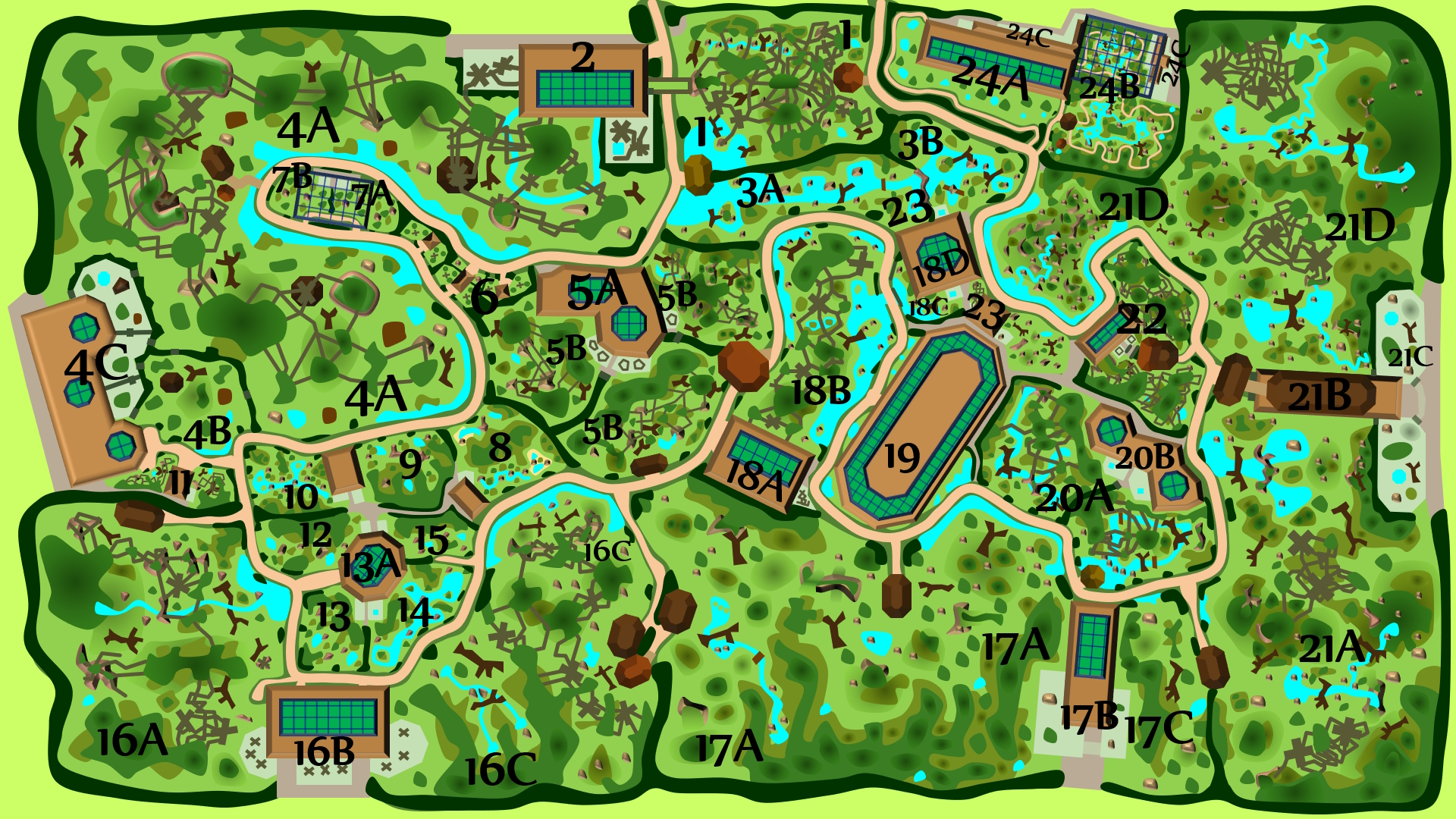
Uruguay - Fourth and final part of discussion of exhibits
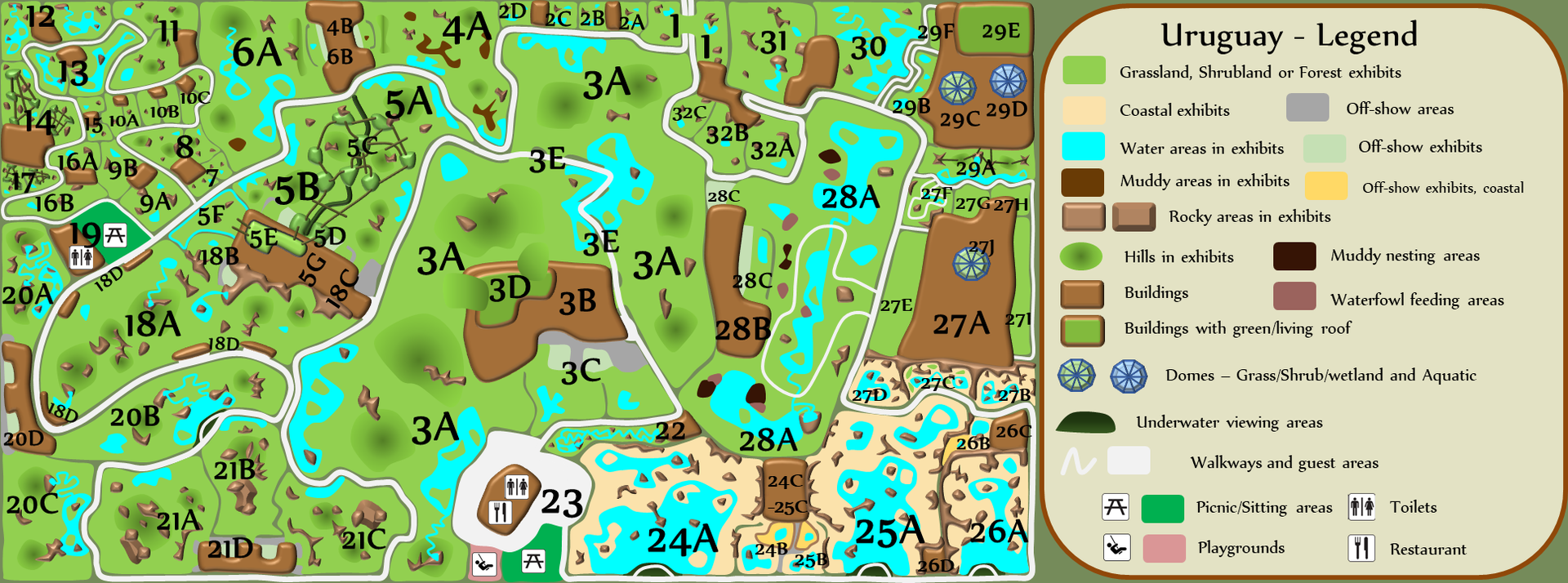
23 Guest area with Café Campo restaurant, terraces, playground and picnic meadow/sitting area
Visitor experience and facilities: Large concrete and glass building with brick wall finishing, with South American theming such as flags, decorations and signs and inscriptions in Spanish. Large wood and metal shade structure covering parts of the terrace. Terrace with tables, benches, chairs and umbrellas and/or trees for parts not covered by shade structure. Terrace will allow some viewing of nearby exhibits. The restaurant will offer hot dishes, salads, sandwiches, deserts and drinks. Some of the food offered will have South American and Uruguayan cuisine influences.
24 South American sea lion (Otaria flavescens) and 25 South American fur seal (Arctocephalus australis gracilis)
24A Main exhibit
24B Separation exhibits, on-show and off-show
24C-25C Pinniped building with indoor holding, medical and training areas
25A Main exhibit
25B Separation exhibits, on-show and off-show
24C-25C Pinniped building with indoor holding, medical and training areas
General description of exhibit: Pinniped exhibits.
Exhibit features, outdoors: Paved, rocky and sandy beaches around large pool and smaller pools. Largest pools will have substantial differences and gradients in depth and will reach a substantial depth at their deepest point, their floors will be partially covered with sand and gravels and they will feature some underwater rocks, partially covered in algae, as structural and decorative elements. Paved and/or rocky islands in pools. Small on-show and off-show separation exhibits with paved land areas and concrete pools.
Exhibit features, indoors: Concrete building with mock rock walls on sides viewable by the public and flat roof with skylights. Tiled or textured concrete indoor exhibits with concrete indoor pools and metal fencing and gates between exhibits. One large indoor exhibit viewable through windows for each species and several more off-show exhibits.
Visitor experience and facilities: Views across wood and metal mesh fencing or rock walls surrounding the exhibits, views through glass windows for outdoor and indoor exhibits, under water viewing area for both species.
Education: Species signage and signage about pinniped adaptations. Signage about training and management of captive pinnipeds.
Keeper facilities: Corridor between indoor exhibits. Target and medical training areas and veterinary care area for pinnipeds present.
26 Magellanic penguin and seabird aviary
26A Main aviary
26B Separation aviaries, on-show and off-show
26C Indoor housing
26D Coastal area filtration building with educational signage
- Magellanic penguin (Spheniscus magellanicus)
- Southern rockhopper penguin (Eudyptes chrysocome chrysocome) [Occurs as a vagrant to Uruguayan coast]
- Upland goose or Magellan goose (Chloephaga picta) [Occurs as a vagrant to Uruguayan coast]
- American oystercatcher (Haematopus palliatus)
- Gull-billed tern (Gelochelidon nilotica)
- Snowy-crowned tern (Sterna trudeaui)
General description of exhibit: Large coastal aviary housing penguins and seabirds.
Exhibit features, outdoors: Large coastal aviary with rock walls with platforms and perches on two sides and aviary mesh and viewing windows on the two other sides (alongside walkway). Large pool with sandy and rocky islands, sandy and rocky beaches, some dead trees and ‘driftwood’ present for perching and as structural and decorative materials. Nesting boxes and shelters for the penguins will be built into the rock walls and rock structures. Suitable nesting areas for the other species will also be provided.
Exhibit features, indoors: Indoor exhibits with paved or sandy land areas, paved concrete pools, wooden and mock rock perches and nesting boxes for the penguins. Three on-show indoor exhibits and four off-show indoor exhibits in wood-finished building with flat roof with skylights.
Visitor experience and facilities: Views through aviary mesh and through glass windows with shading huts. Underwater viewing area at the deepest end of the pool allowing visitors to see penguins swimming and diving. View into filtration building (largely hidden behind mock rock) with educational signage.
Education: Species signage and signage about different lifestyles and adaptations of different types of coastal and seabirds, signage about South American coastal habitats and signage about the equipment and technology used for the filtration and maintenance of marine exhibits next to the viewing window into the filtration building.
Keeper facilities: Service area in filtration building. Keeper corridors between indoor exhibits and separation exhibits. Double-door keeper accesses to outdoor exhibits. Large equipment accesses to outdoor exhibits.
27 Bird Building
General description of building: Large building with brick, mock rock or concrete outer walls, partially covered by climbing plants, and a roof with a decagonal dome with metal frames supporting a greenhouse roof (containing an indoor walk-through aviary), and several additional skylights, surrounded by roof areas partially covered with rolled roofing and partially with roofing layers topped with gravel. Interior walls decorated with murals, mock rock, bark or wood covering or climbing plants.
27A Bird Building with indoor aviaries of indoor/outdoor exhibits and smaller all-indoor bird exhibits (listed below)
Indoor aviaries (for discussion of indoor/outdoor aviaries see below)
- Black jacobin (Florisuga fusca)
- Black-throated mango (Anthracothorax nigricollis) [Occurs as a vagrant in Uruguay]
- Many-colored rush tyrant (Tachuris rubrigastra)
- Red-and-white crake (Laterallus leucopyrrhus) and Straight-billed reedhaunter (Limnoctites rectirostris)
- Purple-throated euphonia (Euphonia chlorotica)
- White-tipped plantcutter (Phytotoma rutila)
- Green-backed becard (Pachyramphus viridis)
- Blue-black grassquit (Volatinia jacarina)
- Wattled jacana (Jacana jacana)
- Ferruginous pygmy owl (Glaucidium brasilianum)
- Solitary cacique or Solitary black cacique (Cacicus solitarius)
General description of exhibit: Glass-fronted indoor aviaries.
Exhibit features, indoors: Small to medium-sized aviaries, based on grassland, shrubland/forest or wetland, with general look, size of branches, type and size of plants, number of individuals kept, number of exhibits, feeders and nesting materials and structures depending on the needs of the different species.
Visitor experience and facilities: Views through glass windows or through small aviary mesh. Decorations around viewing areas, planted areas in visitor area.
Education: Species signage and signage about specific elements of species biology, such as the adaptations of hummingbirds and jacanas. Signage about the birds, habitats and conservation issues of Uruguay and southern South America.
Keeper facilities: Keeper corridor behind aviaries with access doors.
27B First coastal aviary: Olrog's gull (
Larus atlanticus), 27C Second coastal aviary: grey-headed gull (
Chroicocephalus cirrocephalus cirrocephalus) and 27D Third coastal aviary: Parasitic jaeger, Arctic skua, Arctic jaeger or Parasitic skua (
Stercorarius parasiticus)
General description of exhibits: Coastal indoor and outdoor aviaries.
Exhibit features, outdoors: Aviaries with rock walls with platforms and at sides and backside and aviary mesh on the front side, alongside the walkway. Pools with sandy and rocky islands, sandy and rocky beaches, some dead trees and ‘driftwood’ present for perching and as structural and decorative materials. Aviary for grey-headed gulls will also feature areas with reeds, shrubs and small trees as this species also fairly commonly occurs in inland brackish or freshwater wetlands. Suitable nesting areas provided.
Exhibit features, indoors: Indoor exhibits with paved or sandy land areas, paved concrete pools, wooden and mock rock perches and platforms on the rocks. One on-show and one off-show indoor exhibit per species.
Visitor experience and facilities: Views through aviary mesh. Coastal decorations around viewing areas. Planted areas with species from coastal areas.
Education: Species signage, signage about adaptations and behavior of gulls and jaegers. Signage about South American coastal habitats.
Keeper facilities: Keeper corridor with access doors into both outdoor and indoor aviaries.
27E Larger indoor/outdoor aviaries
- Buff-fronted owl (Aegolius harrisii)
- Common potoo Poor-me-ones or Urutau (Nyctibius griseus)
- Ringed kingfisher (Megaceryle torquata)
- Toco toucan (Ramphastos toco) and Brown tinamou (Crypturellus obsoletus)
- Squirrel cuckoo (Piaya cayana)
- Plush-crested jay (Cyanocorax chrysops)
- Pampas flicker (Colaptes campestroides or Colaptes campestris campestroides)
General description of exhibit: Outdoor and indoor aviaries with appropriately sized aviary mesh.
Exhibit features, indoors outdoors: Larger indoor and outdoor aviaries, based on grassland, shrubland/forest or wetland, with general look, size of branches, type and size of plants, number of individuals kept, number of exhibits, feeders and nesting materials and structures depending on the needs of the different species.
Visitor experience and facilities: Views through aviary mesh. Decorations around viewing areas, planted areas in visitor area.
Education: Species signage and signage about specific elements of species biology, such as the bill of the toucan, brood parasitism versus ‘regular’ breeding in cuckoo species, the intelligence of corvid species and the adaptations of kingfishers and woodpeckers. Signage about the birds, habitats and conservation issues of Uruguay and southern South America.
Keeper facilities: Keeper corridor with access doors into both outdoor and indoor aviaries.
27F Walk-through parrot aviary
- Monk parakeet or Quaker parrot (Myiopsitta monachus monachus)
- Burrowing parrot, Burrowing parakeet or Patagonian conure (Cyanoliseus patagonus patagonus)
- White-eyed parakeet or White-eyed conure (Psittacara leucophthalmus)
- Dusky-legged guan (Penelope obscura)
General description of exhibit: Walk-through outdoor parrot aviary. Indoor parrot aviaries.
Exhibit features, outdoors: Large aviary with frame and mesh made of metal. Rocky areas with nesting cavities for the burrowing parrots. Spaces and materials for nest building by the monk parakeets provided. Nesting boxes for conures. Perches and platforms for the guans. Dead trees and branches, natural fiber ropes and nets. Some live trees and shrubs of fast-growing and/or resistant species. Feeding areas and enrichment material, both with and without food.
Exhibit features, indoors: Sandy or paved floor exhibits with metal mesh fronts, dead trees and branches, platforms, natural fiber ropes and nets, nesting cavities in rocks or logs and areas for monk parakeet nests. Feeders and enrichment materials. Three on-show and three off-show indoor exhibits, connected or separated as needed.
Visitor experience and facilities: Dirt walkway with low bamboo and wood fencing around it in outdoor aviaries. Indoor viewing through aviary mesh.
Education: Publicly viewable training area for parrots. Species signage. Signage about different methods of nesting used by the parrot species. Signage about the intelligence and adaptations of parrots, and about their training. Signage about the ins and outs of parrots as pets.
Keeper facilities: Keeper corridor with access doors into both outdoor and indoor aviaries. Equipment storage. Specialized training areas for parrots.
27G Medium-sized indoor/outdoor aviaries
- Grey-fronted dove (Leptotila rufaxilla) and Red-winged tinamou (Rhynchotus rufescens)
- Great kiskadee (Pitangus sulphuratus)
- American purple gallinule (Porphyrio martinicus) and Stripe-backed bittern (Ixobrychus involucris)
General description of exhibit: Outdoor and indoor aviaries with appropriately sized aviary mesh.
Exhibit features, indoors outdoors: Medium-sized indoor and outdoor aviaries, based on grassland, shrubland/forest or wetland, with general look, size of branches, type and size of plants, number of individuals kept, number of exhibits, feeders and nesting materials and structures depending on the needs of the different species.
Visitor experience and facilities: Views through aviary mesh. Decorations around viewing areas, planted areas in visitor area.
Education: Species signage and signage about specific elements of species biology, such as the bill of the toucan, brood parasitism versus ‘regular’ breeding in cuckoo species, the intelligence of corvid species and the adaptations of kingfishers and woodpeckers. Signage about the birds, habitats and conservation issues of Uruguay and southern South America.
Keeper facilities: Keeper corridor with access doors into both outdoor and indoor aviaries.
27H Nursery area (Indoor) Indoor raising and spare aviaries and Indoor/outdoor raising and spare aviaries, species held depending on necessity
General description of exhibit: Indoor nursery, indoor raising and spare aviaries, indoor/outdoor raising and spare aviaries.
Exhibit features, outdoors: Paved floor or sandy-floored aviaries with plants and perches able to be placed as needed. One aviary with outdoor pool present.
Exhibit features, indoors: Paved floor or sandy-floored aviaries with plants and perches able to be placed as needed. One aviary with indoor pool present.
Visitor experience and facilities: Many of these aviaries will be viewable to the public through viewing windows or through aviary mesh. View into the main nursery room with incubators for eggs and for small young birds through a window.
Education: Signage about eggs, about the raising of young birds and about conservation breeding. If juvenile of spare birds are kept, explanations provided.
Keeper facilities: Connection to keeper corridors servicing other parts of the complex. Desinfection facilities at entrance to area. Storage area and preparation area for juvenile bird feed and medication.
27I Smaller indoor/outdoor aviaries
- Maroon-bellied parakeet, Reddish-bellied parakeet, Maroon-bellied conure, Reddish-bellied conure or Brown-eared conure (Pyrrhura frontalis)
- Cattle tyrant (Machetornis rixosa)
- Pampas meadowlark (Leistes defilippii)
- Rusty-collared seedeater (Sporophila collaris) and Least seedsnipe (Thinocorus rumicivorus)
- Golden-billed saltator (Saltator aurantiirostris)
- Rufous hornero (Furnarius rufus rufus)
- Chalk-browed mockingbird (Mimus saturninus)
- Spot-winged falconet (Spiziapteryx circumcincta)
- Sulphur-bearded reedhaunter (Limnoctites sulphuriferus)
- Many-colored Chaco finch (Saltatricula multicolor), Picui ground dove or Picui dove (Columbina picui) and Spotted nothura (Nothura maculosa)
- Mottled piculet (Picumnus nebulosus)
- Burrowing owl (Athene cunicularia)
General description of exhibit: Outdoor and indoor aviaries with appropriately sized aviary mesh.
Exhibit features, indoors outdoors: Smaller-sized indoor and outdoor aviaries, based on grassland, shrubland/forest or wetland, with general look, size of branches, type and size of plants, number of individuals kept, number of exhibits, feeders and nesting materials and structures depending on the needs of the different species.
Visitor experience and facilities: Views through aviary mesh. Decorations around viewing areas, planted areas in visitor area.
Education: Species signage and signage about specific elements of species biology, such as the bill of the toucan, brood parasitism versus ‘regular’ breeding in cuckoo species, the intelligence of corvid species and the adaptations of kingfishers and woodpeckers. Signage about the birds, habitats and conservation issues of Uruguay and southern South America.
Keeper facilities: Keeper corridor with access doors into both outdoor and indoor aviaries.
27J Grassland/Shrubland/Freshwater wetland Dome, Indoor walk-through aviary
- Diademed tanager (Stephanophorus diadematus)
- Fawn-breasted tanager (Pipraeidea melanonota)
- Chestnut-backed tanager (Stilpnia preciosa)
- Blue-and-yellow tanager (Rauenia bonariensis)
- Saffron finch (Sicalis flaveola)
- Red-crested cardinal (Paroaria coronata)
- Pampa finch or Great pampa finch (Embernagra platensis)
- Ringed teal (Callonetta leucophrys)
- Spotted nothura (Nothura maculosa)
- South American painted-snipe (Nycticryphes semicollaris)
- White-necked stilt (Himantopus melanurus, H. himantopus melanurus or H. mexicanus melanurus)
General description of exhibit: Decagonal dome with grassland/shrubland/freshwater wetland indoor walk-through aviary.
Exhibit features, indoors: Sizable indoor walk-through area with ponds, reeds, shrubs, small trees and dead branches, mimicking a landscape of grassland, shrubland and freshwater wetland, with dirt walkways and boardwalks winding through it. Feeders.
Visitor experience and facilities: Dirt walkways and boardwalks providing different views.
Education: Species signage. Signage about the birds, habitats and conservation issues of Uruguay and southern South America. Signage suggesting where certain species might be found.
Keeper facilities: Connection to keeper corridors servicing other parts of the complex. Complex of small acclimatization, breeding and quarantine aviaries with keeper corridor, partially hidden by vegetation and decorative materials. Storage area. Bird kitchen for the entire building will be located near the dome.
28 River of the Painted Birds aviary
28A Main aviary with external viewing areas and walk-through road
28B Bird barn with viewing windows for some of indoor housing
28C Separation aviaries, on-show and off-show
- Chilean flamingo (Phoenicopterus chilensis)
- Black-necked swan (Cygnus melancoryphus)
- Coscoroba swan (Coscoroba coscoroba)
- Crested screamer or Southern screamer (Chauna torquata)
- Rufescent tiger-heron (Tigrisoma lineatum)
- Whistling heron (Syrigma sibilatrix)
- Southern lapwing (Vanellus chilensis)
- White-faced ibis (Plegadis chihi)
- Buff-necked ibis (Theristicus caudatus)
- Roseate spoonbill (Platalea ajaja)
- White-faced whistling-duck (Dendrocygna viduata)
- Muscovy duck (Cairina moschata)
- Cinnamon teal (Spatula cyanoptera)
- Chiloé wigeon (Mareca sibilatrix)
- Rosy-billed pochard (Netta peposaca)
- Lake duck, Argentine blue-bill, Argentine blue-billed duck, Argentine lake duck or Argentine ruddy duck (Oxyura vittata)
- Red shoveler (Spatula platalea)
- Yellow-billed pintail (Anas georgica)
- Dusky-legged guan (Penelope obscura)
General description of exhibit: Name of the aviary derives from one of the possible explanations for the name (Rio) Uruguay, namely that it derives from the language of the Guaraní people and means “River of the Painted Birds”. Very large walk-through aviary for a variety of colorful, mostly wetland and waterfowl type birds. For some species this aviary will allow the keeping of large breeding colonies.
Exhibit features, outdoors: Large wetland aviary with large ponds of varying depths with grassy or sandy islands, surrounded by grassy or sandy land areas and areas with shrubs and live trees. Dead trees and rocky areas present for perching. Nesting platforms provided for tree-nesting species, nesting boxes at different heights present for cavity nesters. Muddy nesting areas present for flamingo colony. Specific feeding areas present for the flamingos, either consisting or ponds such as at Planckendael (see link below) or of tub feeders on poles.
Exhibit features, indoors: Wood-finished stone barn. Indoor rooms with paved or sandy foors, branches, rocks and wooden platforms for perching, nesting and sleeping platforms, feeders and paved indoor pools. Three large indoor rooms viewable through viewing windows, several more off-show indoor rooms of varying sizes.
Visitor experience and facilities: Views through aviary mesh or through viewing windows with shade huts from outside of aviary. Walk-through area with gravel road and small wooden bridges allowing viewing of outdoor aviary and three on-show indoor rooms.
Education: Species signage. Signage about the birds, habitats and conservation issues of Uruguay and southern South America. Signage suggesting where certain species might be found.
Keeper facilities: Keeper corridor between indoor exhibits, main aviary and separation aviaries. Double-gated keeper doors. Large equipment access to main aviary.
Chilean flamingo feeding area, 2020-01-11 - ZooChat
Feeding Chilean flamingos (Phoenicopterus chilensis), 2021-04-20 - ZooChat
29 Aquarium, Terrarium and Coati complex
General description of building: Large complex with brick, mock rock or concrete outer walls, partially covered by climbing plants, and a roof with two decagonal domes with metal frames supporting a greenhouse roof, set above the largest exhibits in the aquarium and terrarium areas. The domes and additional skylights will be surrounded by roof areas partially covered with rolled roofing and partially with roofing layers topped with gravel. Interior walls decorated with murals, mock rock, bark or wood covering or climbing plants.
29A South American coati (
Nasua nasua) exhibits, indoor and outdoor
General description of exhibit: Indoor and outdoor exhibits for coatis.
Exhibit features, outdoors: Rocky outcroppings, large pool in moat/lower area with grassy islands, waterfall, hills, climbing structures made of wooden poles and platforms, branches, wooden and rope ladders and natural fiber ropes and nets, live trees and shrubs, feeders and enrichment materials, wooden shelters at different levels.
Exhibit features, indoors: Two tall mulch-floored main indoor exhibits with climbing structures and shelters similar to those used outdoors, viewable to the public. Lower off-show indoor exhibits with climbing structures and paved floors.
Visitor experience and facilities: Views across moat with pond and through glass window for outdoor exhibits, views through glass windows for indoor exhibit.
Education: Species signage. Signage about the invasive potential of coatis.
Keeper facilities: Keeper corridor with accesses to viewable indoor exhibits, off-show indoor exhibits and outdoor exhibit.
29B Outdoor reptile exhibits for use when weather allows, with indoor exhibits in building
- Southern D'Orbigny's slider or Southern black-bellied slider (Trachemys dorbigni dorbigni)
- Hilaire’s toadhead turtle or Hilaire’s side-necked turtle (Phrynops hilarii)
- Black spine-neck swamp turtle (Acanthochelys spixii)
- Broad-snouted caiman (Caiman latirostris)
- Argentine black and white tegu (Salvator merianae)
General description of exhibit: Outdoor exhibits for large reptiles, for use during warmer months of spring and summer.
Exhibit features, outdoors: Netted exhibits surrounded by viewing windows or stone walls coated with colored and textured concrete. Grassy or sandy areas, planted areas with shrubs and areas with rocks and logs surrounding ponds for semi-aquatic species. Exhibit with grass, mulch and leaf litter areas with rocks, logs, shrubs and small pool for tegus.
Visitor experience and facilities: Views through windows or across walls.
Education: Species signage and signage about adaptations of different species. Signage about benefit of giving reptiles natural sunlight when possible.
Keeper facilities: Keeper corridor between indoor and outdoor exhibits with access doors, with tunnels between exhibits beneath keeper walkway.
29C Terrarium exhibits with dome above some of the largest exhibits
Reptiles
- Southern D'Orbigny's slider or Southern black-bellied slider (Trachemys dorbigni dorbigni) [With outdoor access when weather allows]
- Hilaire’s toadhead turtle or Hilaire’s side-necked turtle (Phrynops hilarii) [With outdoor access when weather allows]
- Black spine-neck swamp turtle (Acanthochelys spixii) [With outdoor access when weather allows]
- Broad-snouted caiman (Caiman latirostris) [With outdoor access when weather allows]
- Argentine black and white tegu (Salvator merianae) [With outdoor access when weather allows]
- Argentine snake-necked turtle (Hydromedusa tectifera)
- South American rattlesnake, Tropical rattlesnake, Cascavel or Cascabel rattlesnake (Crotalus durissus terrificus)
- Uruguayan coralsnake (Micrurus altirostris)
- Pampas lancehead (Bothrops pubescens)
- Lichtenstein's green racer (Philodryas olfersii)
- Patagonian racer (Philodryas patagoniensis)
- Paraguay mabuya (Aspronema dorsivittatum)
- Uruguay marked gecko (Homonota uruguayensis)
- Schreibers's many-fingered teiid or Long-tailed little lizard (Cercosaura schreibersii)
Amphibians
- Argentine horned frog (Ceratophrys ornata)
- Uruguay harlequin frog (Lysapsus limellum)
- Schmidt's Uruguay tree frog (Julianus uruguayus)
- Uruguay redbelly toad (Melanophryniscus atroluteus)
- Campo Grande frog (Leptodactylus furnarius)
- D´Orbigny’s toad (Rhinella dorbignyi)
Invertebrates
- Argentine white-crested mantis (Stagmatoptera hyaloptera)
- Argentinian wood roach (Blaptica dubia)
- Harlequin beetle (Acrocinus longimanus)
- Violet-winged grasshopper (Tropidacris collaris)
- Uruguay black beauty tarantula (Grammostola quirogai)
- Uruguayan fiddler crab (Leptuca uruguayensis) [Mudflat exhibit]
General description of exhibit: Terrarium section with exhibits of different sizes.
Exhibit features, indoors: Exhibits with viewing windows. Large exhibits with sandy or paved beaches, grassy or sandy areas, planted areas with shrubs and areas with rocks and logs surrounding ponds for semi-aquatic species. Exhibits with grass, sandy, mulch and leaf litter areas with rocks, logs, shrubs, small pools and hides made of wood or mock rock for reptiles and terrestrial invertebrates. Similar, but wetter exhibits for frogs and toads. Number of terrariums per species depending on number of animals kept and social behavior of the species kept. At least two terrariums for solitary species. Separate exhibits for juvenile and young reptiles (such as turtles and caiman) and a viewable nursery with incubators and small to medium terrariums for eggs, hatchlings and young juveniles. Mudflat exhibit like the mudflat part of the exhibit for fiddler crabs at Burgers’ Zoo’s mangrove (see link below).
Visitor experience and facilities: Views through viewing windows from darker visitor area.
Education: Species signage. Signage about habitats and adaptations of different species. Signage about the ecological importance and role of and the importance of the preservation of reptiles, amphibians and invertebrates. Educational display of with view of some of climate control installations, and educational display on venomous snake safety and venom extraction/antivenom production.
Keeper facilities: Keeper corridor behind terrariums and between indoor and outdoor exhibits with access doors, with tunnels between exhibits beneath keeper walkway. Off-show breeding rooms for reptiles (two) and amphibians and invertebrates (one) and a room for the breeding of feeder insects. Off-show nursery space to viewable nursery space. Off-show terrarium quarantine room.
View of tidal mudflats and mangrove tree groves (Sep 16th, 2018) - ZooChat
View of tidal mudflats and mangrove tree groves (Sep 16th, 2018) - ZooChat
Burgers' Mangrove - Mudflat - ZooChat
29D Aquarium gallery, with dome above largest tank(s)
- Large marine tank under dome: Southern bluefin tuna (Thunnus maccoyii), Crevalle Jack (Caranx hippos), Longfin yellowtail (Seriola rivoliana), Yellowtail amberjack (Seriola lalandi), Southern eagle ray (Myliobatis goodei) and Bignose fanskate (Sympterygia acuta)
- Argentine hake (Merluccius hubbsi) and Argentine seabass (Acanthistius brasilianus)
- Argentine conger (Conger orbignianus)
- Smalleye hammerhead, Golden hammerhead or Curry shark (Sphyrna tudes)
- Striped smooth-hound (Mustelus fasciatus) and Red porgy or Common seabream (Pagrus pagrus)
- Southern pipefish (Syngnathus folletti)
- Sea nettle jellyfish Chrysaora lacteal
- Argentinian silverside (Odontesthes bonariensis)
- Large freshwater tank under dome: Golden dorado, River tiger or Jaw characin (Salminus brasiliensis), Barred sorubim (Pseudoplatystoma reticulatum), Oxydoras kneri, Porcupine river stingray (Potamotrygon histrix), Streaked prochilod (Prochilodus lineatus) and Boga (Megaleporinus obtusidens)
- Golden apple snail or Channeled apple snail (Pomacea canaliculata)
- Lenguado de río (Catathyridium jenynsii)
- Comb pike cichlid (Crenicichla lepidota)
- Uruguay tetra (Cheirodon interruptus), Blue leopard Corydoras, Mottled Corydoras or peppered Corydoras (Corydoras paleatus) and Buenos Aires tetra (Hyphessobrycon anisitsi)
- Biara (Rhaphiodon vulpinus)
- Hypostomus commersoni
- Dusky millions fish, Speckled mosquitofish or One-spot livebearer (Phalloceros caudimaculatus)
- One-sided livebearer (Jenynsia lineata)
- Uruguayan eartheater (Gymnogeophagus australis)
General description of exhibit: Aquarium gallery with tanks of various sizes, both marine and freshwater.
Exhibit features, indoors: Different-sized tank for marine and freshwater species, from very large mixed tanks under the dome to small one-species tanks. Tanks will have sandy or small gravel bottom. Marine tanks with artificial rocks as structural materials and seagrass and large seaweeds when possible. Freshwater tanks with rocks and logs as structural materials and with plants when possible. Jellyfish tank with specialized filtration and round corners. Viewable aquatic nursery room.
Visitor experience and facilities: Darkened viewing area with viewing of well-lit tanks and into main aquatic nursery room.
Education: Species signage. Signage about the equipment and technology used for the filtration and maintenance of freshwater and marine exhibits next to the viewing window into the filtration rooms. Signage about life cycles and reproductive biology of species next to aquatic nursery room.
Keeper facilities: Corridor behind and above the tanks. Freshwater and marine filtration rooms. Off-show nursery area and off-show aquatic quarantine and breeding rooms.
29E – Nocturnal house
- White-eared opossum (Didelphis albiventris)
- Big lutrine opossum (Lutreolina crassicaudata)
- Web-footed marsh rat (Holochilus brasiliensis)
- Waterhouse’s swamp rat (Scapteromys tumidus)
- Common vampire bat (Desmodus rotundus)
- White-lined broad-nosed bat (Platyrrhinus lineatus)
- Tropical screech owl (Megascops choliba)
- Nacunda nighthawk (Chordeiles nacunda)
General description of exhibit: Nocturnal house in building with green/living roof.
Exhibit features, indoors: Indoor nocturnal exhibits with reversed day/night cycles based on grassland, shrubland and open forest, with live plants such as grasses and shrubs (kept alive by reversed day/night cycle), dead plant parts and wooden climbing structures and shelters. Mock rock structures with shelters and artificial insect nests with enrichment feeding opportunities present. Suitable feeding, nesting and resting area present for all species. Semi-aquatic species will have sizable ponds. Bat species housed in an exhibit with one part cave, one part nocturnal grassland/shrubland/forest. Solitary species will have at least two on-show exhibits per species. One off-show holding exhibit per on-show exhibit.
Visitor experience and facilities: Nocturnal viewing corridor with signage and viewing windows into different exhibits.
Education: Species signage adapted to nocturnal set-up and signage about adaptations of different species to a nocturnal lifestyle.
Keeper facilities: Corridor with keeper access doors to different exhibits and to off-show holding exhibits. Kitchen and area with off-show exhibits for nocturnal animals present.
29F – Diurnal rodent indoor/outdoor exhibits
- Brazilian guinea pig (Cavia aperea)
- Pearson’s tuco-tuco (Ctenomys pearsoni)
- Collared tuco-tuco (Ctenomys torquatus)
- Long-nosed hocicudo (Oxymycterus nasutus)
General description of exhibit: Diurnal rodent exhibits.
Exhibit features, outdoors: Exhibits fenced by stone walls coated in colored and textured concrete and viewing windows, netted to prevent escape and predation. Exhibits with sandy, grassy or mulch floors, rocks, logs, grasses and shrubs, small hills and artificial dens and shelters.
Exhibit features, indoors: Glass-fronted exhibits with sandy or mulch floors, rocks, logs and artificial dens and shelters. Artificial burrows with a viewing window for visitors present.
Visitor experience and facilities: View across concrete-coated walls or through viewing windows.
Education: Species signage.
Keeper facilities: Small indoor corridor with access doors into both indoor and outdoor exhibits.
30 Maguari stork (Ciconia maguari) and American darter or Anhinga (Anhinga anhinga)
General description of exhibit: Wetland aviary.
Exhibit features, outdoors: Tall aviary with pools and creeks, grassy and sandy land areas and islands, wetland vegetation such as reeds, live shrubs and small trees, dead trees with platforms for perching and nesting.
Exhibit features, indoors: Sand-floored indoor rooms with wooden perches and resting/nesting platforms. Wood-finished barn shared with buzzard-eagles (exhibit number 31).
Visitor experience and facilities: View of outdoor aviary through mesh. View into one indoor room through a viewing window.
Education: Species signage and signage about foraging strategies and adaptations to aquatic and wetland lifestyles, including the adaptations of the darter to catch fish.
Keeper facilities: Double-gated access to outdoor aviary, corridor with access to indoor exhibits in barn. Keeper corridor between indoor exhibits.
31 Black-chested buzzard-eagle (Geranoaetus melanoleucus) and 32 Falcon and owl aviaries
32A Chimango caracara (
Milvago chimango)
32B Striped owl (
Asio clamator)
32C Aplomado falcon (
Falco femoralis)
General description of exhibit: Falcon and owl aviaries similar to raptor aviaries discussed above.
Exhibit features, outdoors: Similar to raptor aviaries discussed above.
Exhibit features, indoors: Similar to raptor aviaries discussed above. Buzzard-eagle mews set in wood-finished, slate roofed barn with skylights also housing indoor exhibits for maguari storks and darters (number 30). Falcons and owls share barn with mews for Harris's hawks (exhibit number 1).
Visitor experience and facilities: Similar to raptor aviaries discussed above.
Education: Species signage and signage about adaptations and hunting/foraging strategies of species.
Keeper facilities: Similar to raptor aviaries discussed above. Keeper corridor between indoor exhibits.
That is it for my discussion of my project on Uruguay. I do plan on doing further future speculative zoo design projects, but I haven't yet made a definitive decision on what my next project is going to be, although I am considering going for another part of South America for my next project. Any suggestions are very much welcome.

 This certainly is a blow to the sub-forum. Maybe we’ll see you back some other time.