KevinB's Exhibit and Zoo ideas and designs

I thank you both your nice comments.

Unfortunately I cannot see things the way you do. I am seeing a desire for highly realistic designs in terms of species selections and exhibit design and for great details and correctness in sizes and proportions of exhibits - something that I am just not able to do. And I saw an enormous need but no realistic way to improve my designs.

Even if I wanted to continue it is now already too late, as I have already destroyed all of my designs and notes.
:( This certainly is a blow to the sub-forum. Maybe we’ll see you back some other time.
 
The other reason is that I no longer feel that my types of ideas, designs and projects sufficiently fit in with the desired new direction for the speculative zoo design forum, and that I am unable to adapt them towards new directions.

If this thread did not fit with the new direction for the subforum, we wouldn't have moved it INTO SpecZoo to keep it open in the first place. It has been going perfectly well, trust me :)

I would suggest that this thread is in fact not only well within the spec. zoo guidelines but exemplary within the category, and absolutely excels in the design and clarity aspects.

Agreed.
 
:( This certainly is a blow to the sub-forum. Maybe we’ll see you back some other time.

If this thread did not fit with the new direction for the subforum, we wouldn't have moved it INTO SpecZoo to keep it open in the first place. It has been going perfectly well, trust me :)

Agreed.

Okay, well, I will not make any promises with regards to outcome, but I will promise I will think about these things again.

Even with all the documents gone I probably could still start again if I ever wanted to.
 
Okay, well, I will not make any promises with regards to outcome, but I will promise I will think about these things again.

Even with all the documents gone I probably could still start again if I ever wanted to.

I have thought about things again and I have decided to reverse my earlier decision.

I have now concluded my decision to retire the speculative design aspect of my hobby was an error and an overreaction, brought on by my struggles with autism spectrum disorder and anxiety and having had some bad days.I have also realized that taking the step of retiring these activitities right now will not help me in any way in an already difficult time.

The advice and support of the people replying to this thread and elsewhere has helped me feel a bit better and see things a bit differently, and I am going to try to restart my speculative zoo work again as soon as possible when I hopefully feel a bit better.

I want to and will try to make some changes and improvements to my designs and posts where I can and when I can, but I will probably restart/continue in much the same way.
 
Because of some health issues and struggles I am currently dealing with (both physically and mentally) it will likely be a while, a least a few weeks, before I will be able to get any new projects done.

I will however be doing research and writing down some ideas when I can.

I have already restarted my Expedition Congo - Savannas project and if anyone has any suggestions for that I very much welcome them.
 
Expedition Congo - Woodland Savannas - Part 1 of full discussion

Introduction


Things are improving only very slowly for me currently and I am only making slow progress with activities and projects. I have however completed my design and species list for the third and final of my project on the fauna of the Democratic Republic of the Congo (DRC).

I will however be cutting the full discussion of this project into a few parts/posts to be submitted at different times, but within a time frame as narrow as the circumstances will allow me to do so. This project became rather large and I just can't get a massive post with the full discussion done in one sitting right now. I think that this would still meet the criteria for this subforum, and I hope it indeed does.

I hope this project is liked, and that my continuation of speculative zoo design will be appreciated. I welcome constructive criticism and tips for improvement.

Discussion of areas, ecoregions and habitats researched for this project

This project focuses on the fauna of the woodland savannas, open tropical dry woodlands and (dry) forest-savanna mosaics of the northern (i.e. Garamba National Park) and southern DRC (Katanga province, including areas such as Upemba and Kundelungu National Parks).

The following WWF Ecoregions, either majorly or marginally, fall under the umbrella of the habitats and ecoregions researched for this project:
  • Angolan miombo woodlands
  • Central Zambezian miombo woodlands
  • East Sudanian savanna
  • Itigi–Sumbu thicket
  • Northern Congolian forest–savanna mosaic
  • Southern Congolian forest–savanna mosaic
  • Victoria Basin forest–savanna mosaic
  • Western Congolian forest–savanna mosaic
In the book "Habitats of the World: A Field Guide for Birders, Naturalists, and Ecologists" by
Iain Campbell, Kenneth Behrens, Charley Hesse, and Phil Chaon (Princeton University Press) the areas considered for this project are discussed under the following sections:
  • Guinea savannas
  • Miombo woodlands
  • Afrotropical tropical grasslands
  • Inselbergs, koppies and cliffs
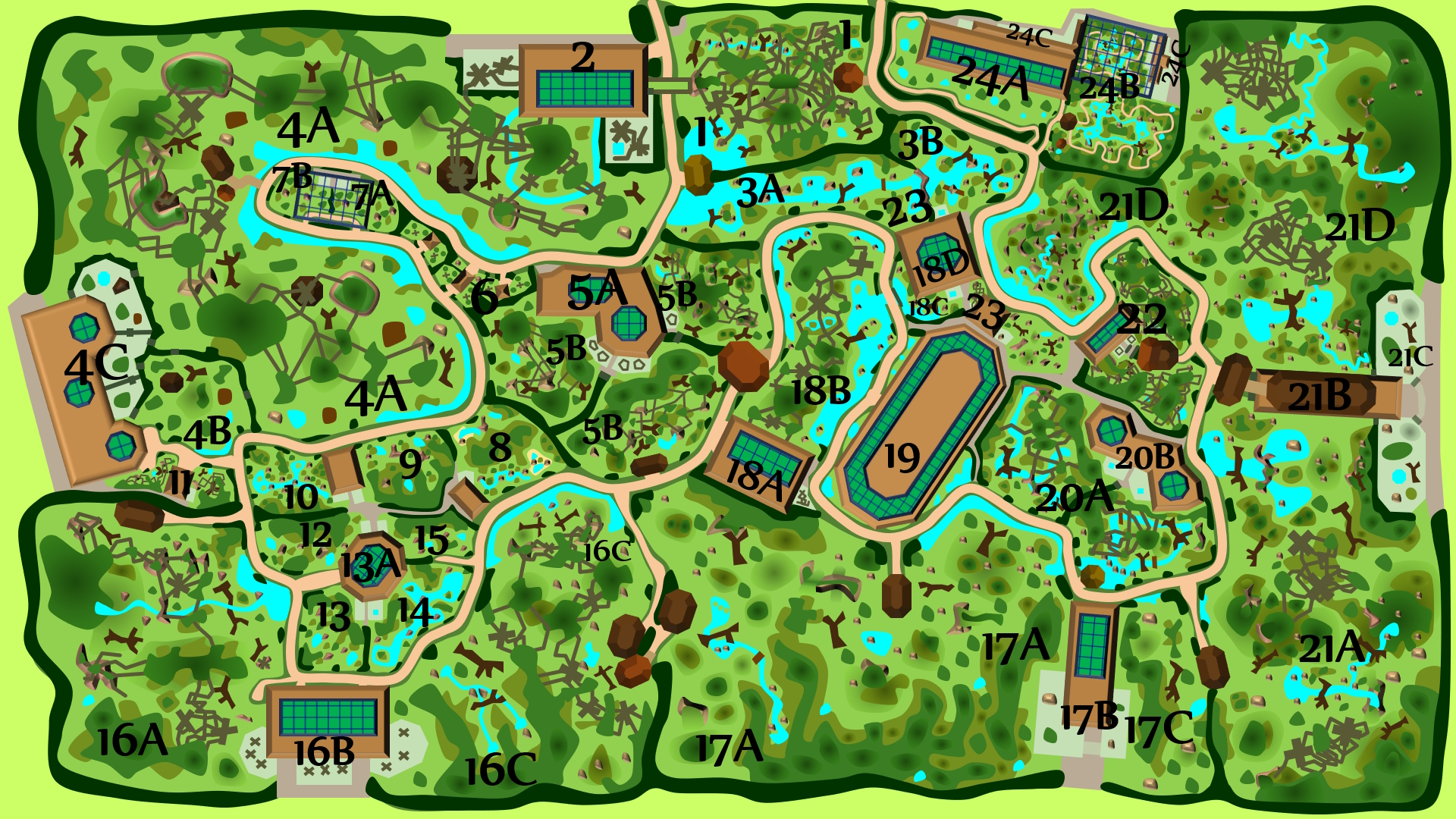
Design map with key

full


The full species list for this project can be found on this page,in the comments under the image:
Expedition Congo - Woodland savannas - ZooChat

Part 1 of discussion - Numbers 1 to 6

The numbers and number/letter combinations in the list below correspond to numbers on the map. In this species list dotted lists represent the different species housed in a mixed exhibit and striped lists represent species housed in different exhibits within a complex, such as an aviary block or a row of aquariums. For the colors and shapes on the map I added a map key to the design map.

1 - Garamba Aviaries


This area will start with an aviary block, housing bird species that occur in Garamba National Park and surrounding areas in the northeastern DRC, near the border with South Sudan. For the selection of the species I found the following two links very useful:

Biodiversity of the Garamba complex · iNaturalist
http://datazone.birdlife.org/site/f...-congo-the-democratic-republic-of-the/details

The aviaries in this block will be dry forest and savanna-oriented aviaries, made with metal frames and metal side and front mesh and nylon or metal netting. The features and furnishings of the aviaries will include short and tall grasses, sandy areas, live shrubs and small trees, mostly with small or medium-sized leaves, dead trees and branches, small pools and rocky areas. The indoor aviaries, located within the Garamba Savanna House (see number 2) will have large skylights, allowing live plants to also be featured indoors. The indoor aviaries will feature a fair amount of large plants, but rather than grassy floors they will have sandy or gravel floors. Suitable eating and nesting areas will be featured for all species both indoors and outdoor.

The indoor aviaries will be mostly viewable, but every indoor exhibit will also feature one or two smaller off-show aviaries that will be able to be separated or connected from/to the main aviaries as needed. There will be a keeper areas with accesses to the on-show and off-show indoor aviaries and the outdoor aviaries between each set of two exhibits.

Garamba Aviaries species list

- Piapiac (Ptilostomus afer)
- Black-bellied bustard (Lissotis melanogaster) and Blue-bellied roller (Coracias cyanogaster)
- African grey hornbill (Lophoceros nasutus)
- Emin's Shrike (Lanius gubernator)
- Orange-breasted bushshrike or Sulphur-breasted bushshrike (Chlorophoneus sulfureopectus)
- Yellow-billed oxpecker (Buphagus africanus langi)
- Grey-headed bushshrike (Malaconotus blanchoti)
- Eastern plantain-eater or Eastern grey plantain-eater (Crinifer zonurus)
- Dusky babbler (Turdoides tenebrosa)
- Common buttonquail, Kurrichane buttonquail, Small buttonquail or Andalusian hemipode (Turnix sylvaticus) and Red-headed lovebird (Agapornis pullarius)​

2 - Garamba Savanna

Named after Garamba National Park in the northeastern DRC, this will be a very large exhibit covering between 2.5 and 3 hectares (giving you an idea about how massive the whole area would be) focusing on the ungulates of the savannas and forest-savanna mosaics of the northern DRC. The focus species will be the Kordofan giraffe, and the outline of this area and the shape of the main walkway around it will be that of a Kordofan giraffe head. The final remaining population of giraffes in the DRC belongs to the Kordofan subspecies, and they are found in and near Garamba National Park, explaining why I choose to focus on this region for this exhibit.

2A – Garamba Savanna House with indoor paddocks and stalls and indoor viewing area

The outside of the Garamba Savanna House will have walls coated and plastered with concrete and small gravel in earthy brown and reddish tones. The roof will consist of large skylights to provide natural lighting into the indoor exhibits, with green/living roof sections around and between them. The indoor visitor areas will be finished with wood or rock work and will feature some vegetation as well as extensive educational signage.

The indoor paddocks and stalls for the giraffes and hoofstocks will be inspired by and to a substantial degree similar to the exhibits linked below. The indoor housing will consist of indoor paddocks and stalls of different sizes, both communal and individual, on-show and off-show, connected by corridors and remotely-operated gates. The floor of the indoor hoofstock and giraffes areas will consist of hard flooring, sand or mulch, and the indoor exhibits will feature rubbing areas, feeders, salt licks and drinking troughs.

African Hoofstock Stable - ZooChat
Giraffe House - ZooChat
Girafe house extension - ZooChat

2B – Holding and separation paddocks, on-show

Three separation paddocks with mesh-fencing will be viewable to the public, partially at a distance. These paddocks will be able to be used to hold animals between the stables and the main paddock, to give animals access to the main paddock or to separate animals. These paddocks will consist of hardstand flooring, short grass or sand, and small pools, rocky areas and a few trees for shade will also be present.

2C – Main paddock

Viewing for the main paddock will alternate between views across water or dry moats, views from elevated walkways and viewing through mesh fencing.

This large paddock will consist of a short grass or sandy floor with large open areas, interspersed with both solitary trees and groves of trees to evoke the idea of a woodland savanna with both open areas and areas of open forest. The trees will have protected trunks and will either be protected from the giraffes or be large enough to have canopies above giraffe height.The paddock will also feature some rocky and elevated areas. Different feeding areas with feeders at different heights will be present throughout the exhibits, both in locations close to the visitor areas and further away from visitors. Dispersed throughout the exhibit will be a number of shade structures and shelters, made of wood and/or metal with thatched roofs, and these structures will have different heights, the tallest being suitable for the giraffes.

2D – Garamba National Park Ranger stations education and viewing areas

Two of the main viewing areas for the Garamba Savanna will feature education and viewing areas themed like Garamba National Park ranger stations with a large hut containing and clad in theming and educational displays.

2E – Viewing bridge

Another viewing area for the Garamba Savanna will be an elevated viewing bridge with a metal base structure and a wooden top structure, much like the safari viewing bridge at Burgers Zoo (see the images linked below). This bridge will have viewing windows as well as open-fronted viewing areas, and will also feature educational signage. For giraffe safety reasons and to not have to make the bridge's structures excessively tall and obtrusive, the area contained within the bridge will not be accesible to the Kordofan giraffes, and only to the different antelope species.

Savanna, Burgers Safari - ZooChat
Safari viewing bridge (Sep 16th, 2018) - ZooChat
Safari - Second viewable separation paddock (Sep 16th, 2018) - ZooChat
Savanna, Burgers Safari - ZooChat

2F – Secondary paddock

This secondary paddock will have similar features as the main paddock, but it will only feature viewing across water and from an elevated walkway and it will be a lot smaller. This paddock will be able to be separated or connected to the main paddock and different on-show and off-show areas as needed. The main use of this paddock will be allowing separation, outdoor access and public viewing for larger groups of individuals.

2G – Off-show separation and holding yards

The Garamba Savanna complex will also feature a few off-show holding and separation yards.

2H – Off-show service area

The Garamba Savanna complex will feature a large off-show area with staff access gates, paved areas suitable for large transports, storage areas and areas for waste disposal.

Garamba Savanna species list:
  • Kordofan giraffe (Giraffa camelopardalis antiquorum)
  • Giant eland or Lord Derby eland (Taurotragus derbianus gigas)
  • Roan antelope (Hippotragus equinus langheldi)
  • Lelwel hartebeest or Jackson’s hartebeest (Alcelaphus buselaphus lelwel)
  • Uganda kob or Ugandan kob (Kobus thomasi or K. kob thomasi)
  • Bohor reedbuck (Redunca redunca)
3) Southeast African cheetah (Acinonyx jubatus jubatus)

The cheetah is now considered extinct in the DRC. The southern subspecies is regionally extinct in the DRC according to IUCN Red List, but it was present in southern regions until the second half of the 20th century, with Upemba National Park being the last stronghold and some sources still mentioning Upemba as part of cheetah range. Rumors of occasional sightings are reported and populations still exist in neighboring countries.

To take into account the social structure and reproductive biology of cheetahs, this breeding complex for Southeast African cheetahs will consist of three exhibits, with a separate building for each exhibit. Two of these exhibits will house breeding females, while the center exhibit will feature either a lone breeding male or a coalition of males, likely brothers.

The cheetah exhibits will have tall mesh fences as a barrier, with large viewing windows on the visitor side. The cheetah exhibit will feature tall and short grass areas, sandy areas, small pools, groves of shrubs and trees, logs and rocky areas and shelters, made from rocks and dirt or from wood and thatched roofs.

The cheetah buildings will be wood-finished brick structures, each featuring several indoor rooms with hard or sandy floors, sleeping boxes and platforms. The buildings for the female cheetahs will feature a nearly fully enclosed, very private maternity den into which even keepers will have little viewing.

The three cheetah exhibits will be connected by a series of metal mesh pens and corridors, to allow animals to be brought together for mating purposes.

There will be an interactive educational and interpretative area near the cheetah exhibits, which will feature one of those running courses, as well as an open-fronted hut with displays on cheetah anatomy and the conservation issues associated with cheetahs.

3A – Breeding female exhibit

3B – Breeding male or coalition of breeding males exhibit

3C – Breeding female exhibit

3D – Holding buildings, holding pens and corridors and pens connecting exhibits

3E – Interactive cheetah educational and interpretative area, including running course and cheetah anatomy and conservation displays

4) African leopard (Panthera pardus pardus)

For the leopard exhibits in this area I decided to go with something based on the leopard exhibits Lintworm discussed in his Europe's 100 must see exhibits thread.

Europe's 100 must see exhibits

The two African leopard exhibits will be open-topped, grassy or sandy exhibits with very tall metal mesh fences with hotwiring and large viewing windows, featuring live areas with tall and short grasses, shrubs and small trees, rocky areas, logs and wooden climbing structures, pools and shelters made from rocks and dirt or from wood and thatched roofs as structural elements and materials.

As one of the two leopard exhibits is located on the opposite side of the main walkway from the leopard holding building, there will be an overpass connecting this exhibit to the building and the other exhibit. This overpass will be inspired by the tiger overpass in the images linked below.

The leopard holding building will have a partial mock-rock wall at the front and will feature two viewable indoor dens with mulch floors, wooden climbing structures and rocky or wooden platforms with sleeping areas both underneath and on top. The building will also feature several off-show dens and a maternity den for the female leopard, with hard or sandy floors, climbing structures and platforms.

Jan. 2022 - Land of the Tiger - Tiger Overpass (Malayan/Sumatran) See the Tiger? - ZooChat
Jan. 2022 - Land of the Tiger - Tiger Overpass (Malayan/Sumatran) - ZooChat

4A – First African leopard exhibit

4B – Elevated leopard viewing area

4C – Leopard holding building and off-show area

4D – Leopard overpass bridge for connection and transfer between exhibits

4E – Second African leopard exhibit

5) Woodland Savannas Ecodisplay and Woodland Savannas Walk-through aviary

In a large, tall semi-arid tropical greenhouse the landscape and look of woodland savannas and dry forest-savanna mosaics will be recreated, with different vegetation and habitat types such as dry forest, tree and shrub groves, solitary trees, tall and short grass areas, shrub thickets, rocky areas, wet areas, creeks and pools represented in the landscaping of the greenhouse. Paved and sandy walkways and a few adventurous routes will wind through the different landscapes and vegetation types of the ecodisplay, past different exhibits and areas for the free-roaming species.

I originally wanted to include some plant species to be featured, but finding accurate information on the DRC's flora proved more challenging than I anticipated, and I also couldn't really find any information on the safety of tropical plants for zoo animals, so I decided not to.

Next to the greenhouse will be an outdoor walk-through aviary (with a separate visitor walkway loop), where the landscaping will attempt to replicate a savanna landscape through the use of plants native to the area in which the zoo is located (in my designs I usually go with the climate of Northwestern mainland Europe, as that is what I know). This aviary will have a metal frame, metal mesh sides and nylon, small mesh size top netting. The outdoor aviary will feature short and tall grassy areas, sandy and rocky areas, creeks and pools, shrubs and trees, dead trees and branches and feeding and nesting areas.

The greenhouse will feature a number of feeding areas in different locations and at different heights as well as a number of nesting areas oriented towards different species, and these will be placed both within direct viewing of visitors or direct proximity of the walkways, and in more private areas.

A number of free-ranging bird species will be housed in the greenhouse and the aviary. There will also be a number of other indoor-outdoor exhibits that the birds will have access to, as well as some separated exhibits. These will be discussed below the list of free-roaming bird species.

5A – Woodland Savannas Ecodisplay semi-arid tropical greenhouse, with free-roaming species

5B – Woodland Savannas Walk-through aviary, with free-roaming species

List of free-roaming species in 5A and 5B
  • Marungu helmeted guineafowl (Numida meleagris marungensis)
  • Coqui francolin (Peliperdix coqui or Campocolinus coqui)
  • Heuglin's spurfowl or Heuglin’s francolin (Pternistis icterorhynchus)
  • Shelley's francolin (Scleroptila shelleyi)
  • African comb duck or Knob-billed duck (Sarkidiornis melanotos)
  • Brown-chested lapwing (Vanellus superciliosus)
  • White-crested turaco (Tauraco leucolophus)
  • Ross's turaco or Lady Ross's turaco (Musophaga rossae)
  • Grey Go-away-bird or Grey lourie (Corythaixoides concolor)
  • Lesser blue-eared starling or Lesser blue-eared glossy starling (Lamprotornis chloropterus elisabeth)
  • Miombo rock thrush (Monticola angolensis)
  • Miombo scrub robin (Cercotrichas barbata)
  • Snowy-crowned robin-chat (Cossypha niveicapilla)
  • Bronze-tailed starling or Bronze-tailed glossy starling (Lamprotornis chalcurus)
  • Violet-backed starling, Plum-colored starling or Amethyst starling (Cinnyricinclus leucogaster verreauxi)
  • Vieillot's black weaver (Ploceus nigerrimus nigerrimus or P. nigerrimus)
  • Black-winged red bishop (Euplectes hordeaceus)
  • African green pigeon (Treron calvus)
  • Speckled pigeon (Columba guinea)
  • Red-throated bee-eater (Merops bulocki)
  • Böhm's bee-eater (Merops boehmi)
  • Miombo pied barbet (Tricholaema frontata)
5C – Zambian klipspringer (Oreotragus centralis or O. oreotragus centralis) and Yellow-spotted rock hyrax or Yellow-spotted bush hyrax (Heterohyrax brucei chapini), indoor and outdoor exhibits and off-show area

This will be a set of recessed exhibits with mock rock and glass walls, with a hard or sandy floor and with large mock rock structures, which will include dens and shelters. Mock rock will also disguise the holding and off-show areas. The exhibits will also feature some logs and branches and resistant small trees as structural materials. The exhibits will allow animals to fairly easily get out of each others sight or to seek shelter.

5D – Speke's hinge-back tortoise, Savanna hinge-back tortoise or Speke’s hinged tortoise (Kinixys spekii), indoor and outdoor exhibits and off-show area

Unlike the other exhibits in this area the tortoise exhibit will not be recessed. A relatively low wooden fence will fence off the tortoise paddocks, with off-show straw or wood shavings-floored dens for the tortoises hidden by mock rock. The tortoise paddocks will have different floor materials including mulch, leaf litter, sandy, short grass and paving, and will feature shaded areas (by vegetation or fencing), basking areas, large open walking areas and a paved feeding area, some small rocks and logs as structural materials and to allow animals to hide from each other, and a shallow pool.

5E – Aardvark (Orycteropus afer), indoor and outdoor exhibits and off-show area

A wall coated with colored and texture concrete will fence off the recessed aardvark exhibits (two exhibits indoor and two exhibits outdoors), which will have a sandy or mulch floor and will feature small pools, small mud wallows, large mock rock or mock termite mounds, logs and mock rock dens as structural materials. The off-show area will again be disguised by mock rock.

5F – Central Oribi (Ourebia ourebi hastata or O. hastata), indoor and outdoor exhibits and off-show area

The oribi exhibits will consist of recessed exhibits with sandy or short grassy floors, fences of wood and glass, featuring wooden shelters with thatched roofs, rocky areas and areas with tall grasses, shrubs and small trees. The off-show area will be disguised by mock rock and wood.

5G – Denham's bustard, Stanley bustard or Stanley's bustard (Neotis denhami) and Black coucal (Centropus grillii) aviaries, indoor and outdoor, and off-show area

These aviaries will be completely netted off from the ecodisplay, with an off-show area disguised by wood. The aviaries will feature a grassy or sandy floor, areas with tall grasses and shrubs, logs and dead branches.

5H – Large rocky outcropping and elevated viewing area

A large, partially vegetated rocky outcropping with be part of the support structure for an elevated viewing area. Several bird feeding areas will be situated on and around the rocky outcropping, with feeders viewable at both the ground and the elevated level. The elevated viewing area will also feature educational elements.

5I – Striped ground squirrel (Euxerus erythropus) and Straw-colored fruit bat (Eidolon helvum)

To prevent the squirrels from escaping this exhibit will have metal mesh sides and will basically consist of a large, deep concrete tub, filled with a suitable soil material, with the aviary structure built over/on the edge of it. The squirrels will have artificial dens made of concrete pipes and chambers, as well as having the opportunity to dig holes themselves.

Structural materials for the squirrels will consist of rocks and logs.

The support structures for the trees for the bats will be encased and supported with metal or concrete to prevent the squirrels from damaging those. A few small living trees and shrubs will be similarly protected from the squirrels.

The structures for the bats, other than the exhibit's top netting, will consist of a few live trees and a number of dead trees, as well as some natural fiber ropes and nets. There will be suitable bat feeders in different location.

The off-show aviary will have a brown brick front on the visitor side.

5J – Viewable acclimatization and separation aviaries

A series of relatively basic aviaries with dead branches and small shrubs, used to separate certain birds or for the introduction of new birds, as needed.

5K – Avian nursery

A room for the raising of young birds from the ecodisplay and other bird exhibits, featuring egg incubators and chick incubators as well as cages and small aviaries for young birds. An educational displays on bird reproduction and development as well as on captive breeding will be featured in this area.

5L – Nocturama and Rodent Rowe

Built in a space underneath a large rocky hill will be a Nocturama with a number of nocturnal exhibits as well as Rodent Rowe a series of rodent exhibits which will have different lighting, going from nocturnal back to diurnal at the exit of this area.

The nocturnal and rodent exhibits, which will all be glass-fronted, will have sandy or mulch floors and will feature materials and structures such as rocks, logs, fake termite mounds with holes, leaf litter, straw, wood shavings, wooden climbing structures, dead tree parts and branches, some live plants, dens and shelters and feeding platforms or areas, all adjusted to accommodate the needs and ecology of the species kept in specific exhibits. For example climbing or arboreal species will have the opportunity to climb or roost in tree-like structures, while burrowing species will have far thicker floor layers and much more extensive ground-level dens. The mole-rat exhibits will specifically feature dens and pipes with viewing windows and transparent plastic pipes, like the ones that are often featured in naked mole-rat exhibits. Viewable dens will also be featured for some other species, such as the rabbits and the springhares. These animals will of course also have some dens that will not be viewable to the public. For solitary species multiple exhibits, able to be connected or separated as needed, will be featured. Each exhibit will also have a small off-show area.

Species list for Nocturama (Nocturnal exhibits) and Rat Rowe with diurnal or (semi-)nocturnal rodent exhibits

- Senegal bushbaby, Senegal galago, Lesser galago or Lesser bush baby (Galago senegalensis)
- Mohol bushbaby (Galago moholi
- Bunyoro rabbit or Central African rabbit (Poelagus marjorita)
- Southern springhare or South African springhare (Pedetes capensis)
- African striped weasel (Poecilogale albinucha)
- Angolan fruit bat, Angolan rousette or Silky bat (Myonycteris angolensis)
- Kellen's African dormouse (Graphiurus kelleni)
- Fiery-necked nightjar (Caprimulgus pectoralis shelleyi)
- Pearl-spotted owlet (Glaucidium perlatum)
- Emin's gerbil or Emin's tateril (Taterillus emini)
- Silvery mole-rat, Silvery blesmol or Silky mole-rat (Heliophobius argenteocinereus)
- Mechow's mole-rat (Fukomys mechowii)
- Natal multimammate mouse (Mastomys natalensis)
- Typical striped grass mouse (Lemniscomys striatus luluae)​

5M – Sunbird and Butterfly walk-through exhibit

Netted off from the main ecodisplay area with the free-roamers, this exhibit will feature nectar, fruit and insect feeders, trees, shrubs and herbaceous plants with a far larger number of flowering plants and flowers compared to the main exhibit, some dead branches, rocky areas, a shallow pool and suitable nesting areas for the sunbirds. The off-show area will be covered with wood. A climatized room for butterflies to puppate and emerge from their chrysalises will be present.
  • Western violet-backed sunbird or Longuemare's sunbird (Anthreptes longuemarei)
  • Western Miombo sunbird (Cinnyris gertrudis)
  • Anchieta's sunbird (Anthreptes anchietae)
  • Splendid sunbird (Cinnyris coccinigastrus)
  • Gaudy commodore (Precis octavia octavia)
  • Yellow pansy (Junonia hierta)
  • African swallowtail, Mocker swallowtail or Flying handkerchief (Papilio dardanus dardanus)
  • Blue-spangled emperor, Guderian's Charaxes or Blue-spangled Charaxes (Charaxes guderiana guderiana)
5N – Resting area with seating areas and picnic tables, small playground, restrooms and food and drink vending machines

5O – Dry season creek bed adventure trail

A sand, gravel and mud route with different elevations, textures and levels of challenge, going through a mock-up of the bed of an almost completely dried up creek during the dry season.

5P – Wet season creek adventure trail

A trail that will cross a filled creek several types and via different types of paths, such as wading through (very) shallow water, a stepping stone walkway and a log and rope bridge.

5Q – Rocky hill adventure trail

A trail going onto the rocky hill above the nocturnal and rodent exhibits, featuring climbing paths of different steepness, rocky walkways, rocky stairs and a log and rope bridge above a chasm.

5R – Outdoor adventure trail

A trail featuring a living willow tunnel, creek passages similar to the ones on the wet season creek adventure trail, some uneven stairs and a log and rope bridge above a crevice.

5S – Indoor education area
5T – Outdoor education area

The greenhouse and the aviary will feature a large education area feature signage, media displays and (enlarged) three-dimensional representations of biological and ecological concepts and structures that are explained, but educational and identification signage will also be present in other locations, including signage focusing on certain ecological features or species.

As this project features several species that are no longer found in the DRC, or only in small parts of it, the education in these areas and in other parts of the project will focus also focus heavily on the effects of human activities and conflicts on wildlife, on ways to resolve these issues and on the role of zoos therein.

5U – Off-show area with technical and climate control rooms, storage areas, food and enrichment prep rooms and off-show aviaries

5V – Quail and passerine walk-through aviary

Netted off from the main ecodisplay area with the free-roamers, this exhibit will feature grain, seed and insect feeders, tall grasses trees, shrubs and herbaceous plants, lots dead branches, rocky areas, a very shallow pool and suitable nesting areas. The off-show area will be covered with wood.

  • Harlequin quail (Coturnix delegorguei delegorguei)
  • Black-chinned quailfinch or Red-billed quailfinch (Ortygospiza gabonensis fuscata or O. atricollis fuscata)
  • Locust finch (Paludipasser locustella)
  • Grey-headed oliveback or White-cheeked oliveback ((Nesocharis capistrata))
  • Black-crowned waxbill (Estrilda nonnula)
  • Dybowski's twinspot (Euschistospiza dybowskii)
  • Red-throated twinspot or Peters's twinspot (Hypargos niveoguttatus)
  • Red-cheeked cordon-bleu or red-cheeked cordonbleu (Uraeginthus bengalus)
  • African firefinch, Dark firefinch or Blue-billed firefinch (Lagonosticta rubricata)
  • Northern yellow white-eye or African yellow white-eye (Zosterops senegalensis kasaicus)
  • Red-winged pytilia (Pytilia phoenicoptera)
  • Exclamatory paradise whydah or Uelle paradise whydah (Vidua interjecta)

6) Southern lion (Panthera leo melanochaita, from population formerly classified separately as Southwest African lion or Katanga lion, Panthera leo bleyenberghi)

The exhibit for a pride of lions will have views over dry moats or a water area at the front and tall metal mesh fencing at the back and sides. The main exhibit will feature several large rocky outcroppings with dens and climbing opportunities. Other structural materials will include large logs/fallen trees, tall grass areas and areas with shrubs and live trees. The exhibit will be mainly grassy, but will also have some sandy areas.

The separation exhibit will be sand-floored and will feature logs and rocks as structural materials. This exhibit will have metal mesh fencing all around, with a viewing window on the visitor side. The lion building will be a house coated with colored and textured concrete. The largest indoor exhibit, with a sandy floor and featuring rocky and wooden platforms with dens underneath and structural materials, will be viewable to the public through a large window. A thatched roof structure will be built above this window to avoid glare on the window.

6A – Lion house with large communal indoor exhibit, viewable to the public, and holding and separation dens

6B – Lion outdoor separation exhibit

6C – Main lion outdoor exhibit

This ends part one of my discussion of this (rather large) project. I hope to post the next part soon.
 
Part 2 of discussion - Numbers 7 to 23

Design map with key


full


The full species list for this project can be found on this page,in the comments under the image:
Expedition Congo - Woodland savannas - ZooChat

The numbers and number/letter combinations in the list below correspond to numbers on the map. In this species list dotted lists represent the different species housed in a mixed exhibit and striped lists represent species housed in different exhibits within a complex, such as an aviary block or a row of aquariums. For the colors and shapes on the map I added a map key to the design map.

Discussion

7) Small mammal building and exhibits


This will be a mock rock building surrounded by open-topped exhibits with glass or mock rock walls for the mongoose and mesh or glass-fronted, netted exhibits for the squirrels and the elephant shrews.

The floors of the exhibits, both indoors and outdoors, will consist of sandy or fine gravel material, while structural elements will include logs, rocks and mock rock structures, fake termite mounds, artificial dens, areas suitable for digging, climbing structures made from branches and natural fiber ropes and nets and wooden shelters at different levels, depending on the species. These materials will be used both indoors and outdoors, and the main and largest indoor exhibits for each species will be viewable through a window. Each species will additionally have one or more smaller off-show dens.

- Common slender mongoose, Black-tipped mongoose or Black-tailed mongoose (Herpestes sanguineus)
- Common dwarf mongoose (Helogale parvula)
- Congo rope squirrel (Funisciurus congicus)
- Gambian sun squirrel (Heliosciurus gambianus)
- Short-snouted elephant shrew or Short-snouted sengi (Elephantulus brachyrhynchus)​

8) Savanna Monkeys

Three monkey islands with large rocky hills, open grassy areas, scattered large trees, climbing structures made from wooden poles, large dead trees parts and natural fiber ropes and nets and wooden shelters and feeding and enrichment platforms at different heights will house three monkey species native to woodland savannas.


8A – Malbrouck (Chlorocebus cynosuros) island

8B – Kinda baboon (Papio kindae) island

8C – Eastern Patas monkey (Erythrocebus patas pyrrhonotus) island

8D – Savanna monkey house
The exterior of the savanna monkey house will consist of large concrete poles and beams clad in mock rock, with large, tall glass window fronts between them, on both sides. The roof of this building will have a green/living roof, aside from the areas covered by the roof top viewing area.

The indoor monkey exhibits will have a mulch, sandy or paved floor and will feature rock structures and climbing structures with platforms similar to those on the islands. For each monkey species there will be two rooms viewable to the public, able to be connected or separated as needed as well as allowing animals to get away from each other when they feel the need to, and a number of off-show and holding rooms.

8E – Roof-top monkey viewing and education areas and access/exit routes​

9) The Watering Holes Building

9A – The Watering Holes Building

9B – The Watering Holes Terraces​

9C – Playground area

9D – Off-show areas for deliveries and waste disposal
The Watering Holes Building will be a large four-storey building with outside walls clad in stones in earthy and sandy colors and with large windows, areas with climbing vegetation and a green/living roof with skylights for the animal exhibits on the top floor.

A large portion of the ground floor/first floor of The Watering Holes Building will be taken up by a large self-service restaurant area serving a variety of drinks and dishes such as sandwiches, salads, fast food and hot dishes with a focus on sustainably sourced and ecofriendly foods and drinks that are also satisfying to customers (such as vegetarian fast food), with the restaurant kitchen and associated food storage areas as well as an off-show area for deliveries and waste disposal near it. Another large portion of this floor will be taken up by parts of the indoor eating areas and a block of toilets/restrooms.

At the ground level The Watering Holes Building will be largely surrounded by terraces for outdoor eating. These terraces will offer viewing of several of the surrounding exhibits, including the Garamba Savanna exhibit, the Sable antelope exhibit, the rhinoceros exhibits and the monkey islands. Parts of these terraces will have covered eating areas with thatched roof structures resting on big wooden poles, like the ones in African village at Pairi Daiza or a bit like the observation hut at Doué, of which I have linked images below. Underneath these structures picnic benches will be present. There will also be open eating areas with picnic benches, where large umbrellas with prints promoting conservation organizations active in preservation of African species and habitats will be available for visitors to open if they so desire.

View in the African village, 2019-10-04 - ZooChat
African lion exhibit and African village huts, 2020-09-02 - ZooChat
New carnivores crater - Upper part of the main observation hut - ZooChat

The second floor of The Watering Holes Building will be taken up by more indoor eating areas, with viewing windows offering viewing of the surrounding areas and exhibits, an indoor play area and a block toilets/restrooms.

A portion of the third floor of The Watering Holes Building will be the location of the education rooms for group, outreach, guiding and small-scale conference and training activities and another block of toilets/restrooms. Another portion of this floor will house staff offices, meeting rooms and staff restrooms.

The fourth and top floor will house a museum area with natural history and human history displays and a terrarium section with large and smaller terrariums and a terrarium nursery. This floor will also include several large panoramic viewing windows allowing panoramic overhead viewing of large portions of the woodland savanna area.

The terrariums on the top floor will have skylights to provide natural lighting and additional artificial lighting. The terrariums will also have large glass fronts. The terrariums will be based on woodland savanna habitats, featuring floors of sand, gravel or mulch, live plants ranging from grasses and herbs to shrubs, logs, branches and rocks as structural materials and shelters, small pools and backdrops consisting of mock rock and savanna habitat murals. The terrarium nursery will be a room with incubators and terrariums of different sizes. Educational displays on reptilian reproduction and development as well as display on technical issues involved with the keeping of reptiles and on venomous reptile safety will be featured here.

Fourth floor terrariums
- Black-necked spitting cobra (Naja nigricollis)
- Black mamba (Dendroaspis polylepis)
- Puff adder (Bitis arietans arietans)
- Rhombic night adder, Demon night adder, Cape night adder, African night adder or Cape viper (Causus rhombeatus)
- Savannah monitor or Bosc’s monitor (Varanus exanthematicus)
- Flap-necked chameleon (Chamaeleo dilepis)
- Common agama, Red-headed rock agama or Rainbow agama (Agama agama)
- Finch’s agama (Agama finchi)
- African five-lined skink or Rainbow mabuya (Trachylepis quinquetaeniata)
- Falk's blue-headed tree agama (Acanthocercus cyanocephalus
- Two-spotted assassin bug (Platymeris biguttatus)
- Common spiny flower mantis (Pseudocreobotra wahlbergii)
10) Rhinoceros Conservation Center

This area, focusing on the breeding and conservation of African rhinoceroses, will house a breeding herd of Southern white rhinoceros or Southern square-lipped rhinoceros (Ceratotherium simum simum), used here as a stand-in for the functionally extinct Northern white rhinoceros C. s. cottoni. The last known population of the northern subspecies was found in Garamba National Park, northeastern DRC, against the border with South Sudan, where they were last seen in 2006, with the last signs of their presence were seen in 2007, as well as a male and one or two females of the South-central black rhinoceros or South-central hook-lipped rhinoceros (Diceros bicornis minor), which was formerly found in the southeastern DRC, but is now regionally extinct in that part of Africa, but can still, although now critically endangered, be found further south.

With white rhinoceroses being more gregarious and to my understanding a larger herd being generally required for breeding purposes, their area will be larger and will consist of a large main paddock and two smaller paddocks, able to connected or separated as needed. The more solitary and aggressive black rhinoceroses will be housed in smaller exhibits, which will be more similar in size.

The white rhinoceroses will also be housed in a mix with antelopes, which in this case will be bachelor/surplus males. The species kept here will vary based on need, but the exhibits will be suitable for antelope ranging from reedbuck to kudu size.

The antelope will have a separation paddock which the rhinoceroses will be unable to access, and will have access to all three exhibits even when the rhinoceroses are separated, by the use of poles set at a distance too narrow for rhinoceroses to move through or through narrow barriers in fencing. For both rhinoceros species the connection of the different exhibits will happen via a series of off-show paddocks and yards adjacent to the rhinoceros house.

The rhinoceros exhibits will consist of open grassy and sandy areas with scattered trees with protected trunks, and will feature several large pools with water as well as several sizable mud wallows. Rhinoceros-proof feeding areas and shade structures or shelters will be present in all exhibits. Logs and rocks will used as additional structural materials. The rhinoceros exhibits will feature some low hills, and separation from the visitor will be done with water-filled moats or dry moats.

The rhinoceros building will be a grey concrete building with parts of the outside textured with a pattern inspired by rhinoceros skin and parts painted with conservation-oriented or African landscapes-inspired murals. Two off-show service areas with staff access gates, paved areas suitable for large transports, storage areas and areas for waste disposal will be present at the southern end of the rhinoceros building, on either side of the visitor access to the rhinoceros house.

The indoor antelope paddocks will be similar to those discussed earlier for the Garamba Savanna. The indoor rhinoceros paddocks will be mulch, sand or hard floored and will feature eating and drinking troughs, mineral licks, soft bedding areas for sleeping and scratch posts. There will be several indoor pools as well as an indoor mud wallow for both rhinoceros species. Many of the indoor rhinoceros paddocks will be viewable to the public, but there will also be several off-show indoor paddocks.

Next to the main southern white rhinoceros paddock and between the two largest south-central black rhinoceros paddock will be two viewing and education areas, featuring mock-ups of rhino ranger and rhino poacher camps. The education here and within the rhinoceros house will focus on the rhinoceros conservation and poaching crisis, on conservation efforts and on the role of zoos in rhinoceros conservation.

10A – Southern white rhinoceros, main paddock​

10B – Southern white rhinoceros viewing and education area with mock-up ranger and poacher camps​

10C – Southern white rhinoceros, second paddock​

10D – Southern white rhinoceros, third paddock​

10E – Separation paddock for bachelor/surplus male antelopes [Varying species composition] housed with Southern white rhinoceros herd​

10F – Southern white rhinoceros off-show service area​

10G – Southern white rhinoceros off-show paddocks connecting publicly viewable paddocks​

10H – Southern white rhinoceros, South-central black rhinoceros and Bachelor/Surplus male antelopes house​

10I – South-central black rhinoceros off-show service area​

10J – South-central black rhinoceros off-show paddocks connecting publicly viewable paddocks​

10K – South-central black rhinoceros, first paddock​

10L – South-central black rhinoceros, second paddock​

10M – South-central black rhinoceros, third paddock​

10N – South-central black rhinoceros viewing and education area with mock-up ranger and poacher camps​

11) Spotted hyena (Crocuta crocuta)

The spotted hyena clan will have a main exhibit and a smaller exhibit with features similar to those of the earlier discussed cheetah and lion exhibits. The second smaller exhibit will be mainly used for the hyenas, but if possible or required it will also be able to be used as a spare large carnivore exhibits, with some indoor dens in a compartment separated from the hyena dens.

These exhibits will have tall mesh fences as a barrier, with large viewing windows on the visitor side. The hyena exhibits will feature tall and short grass areas, sandy areas, small pools, groves of shrubs and trees, logs and rocky area and artificial dens and shelters, made from rocks and dirt or from wood and thatched roofs.

The hyena building will be a wood-finished brick structure, featuring several indoor rooms with hard or sandy floors, sleeping dens and a few rocks and logs. The building will feature a nearly fully enclosed, very private maternity den into which even keepers will have little viewing. The two largest hyena indoor exhibits will be viewable to the public through a large window. A thatched roof structure will be built above this window to avoid glare on the window.

11A – First and main spotted hyena exhibit

11B – Spotted hyena house – With spotted hyena dens and separate spare large carnivore indoor dens

11C – Second spotted hyena exhibit – Or spare large carnivore exhibit​

12) Zambian sable antelope (Hippotragus niger kirkii), Puku (Kobus vardonii) and Sharpe's grysbok or Northern grysbok (Raphicerus sharpei) [Indoor housing for exhibit 12 will be discussed under number 18]

The main exhibit will be a large paddock with large open, grassy areas and several groves of trees and shrubs, large water-filled moats and dry moats, some sandy areas,, some low hills, some rocky areas and some large logs. The exhibit will feature different feeding and shelter structures with thatched roofs, of different sizes, as well as several wooden shelters with thatched roofs.

The separation paddock will be a sandy paddock with a pool, a rocky area, a feeding and shelter structure and a shelter.

12A – Main exhibit​

12B – Separation paddock​

13) Caracal (Caracal caracal) and Serval (Leptailurus serval) exhibits

Pairs of caracals and servals will be housed in tall, netted exhibits with walls made of wood or mock rock. The exhibits will feature fake termite mounds, rocky areas, a pool, live trees and shrubs and climbing structures made with branches, tree parts and wooden poles as structural materials. The floor of the exhibits will be grassy or sandy and some areas with tall grasses or herbaceous plants will be present.

The caracal and serval house will be a building with wood finishing indoor and outdoor, with indoor exhibits similar to the ones linked below, at an animal sanctuary in Belgium, with floors of sand of wood shavings, wooden platforms and dens and climbing structures made from branches, tree parts and wooden poles. There will be two large on-show indoor rooms for both species, and several more off-show dens.

Serval indoor exhibit 1 - ZooChat
Serval indoor exhibit 2 - ZooChat

13A – Caracal and Serval house with indoor exhibits with viewing windows and off-show indoor dens

13B – First Caracal exhibit

13C – Second Caracal exhibit

13D – First Serval exhibit

13E – Second Serval exhibit​

14) African wild dog, African painted dog or African hunting dog (Lycaon pictus)

The African wild dog has probably been extirpated from the DRC since the 1990’s, with the most recent sighting having taken place in 1986 in Upemba National Park. The species, while endangered, is however still found in neighboring countries and other African countries.

The main viewing for the African wild dog pack will be from a long recessed wood-finished viewing tunnel with viewing windows. In a few places of this tunnel there will not be viewing windows, as the tunnel will be covered with dirt, vegetation and structural materials in these areas to serve as overhead animal crossing areas. The roof of the tunnel will also be covered with dirt, vegetation and structural materials, allowing it to be part of the animals' habitat. I based the concept idea for this tunnel on the Eurasian wolf exhibit with a viewing tunnel at GaiaZoo, of which I have linked a few images below.

Eurasian wolf exhibit viewing tunnel, 2019-03-30 - ZooChat
Tunnel underneath the Eurasian wolf exhibit (Oct 13th, 2018) - ZooChat
Eurasian wolf exhibit, 2019-03-30 - ZooChat
Eurasian grey wolf exhibit (May 2nd, 2015) - ZooChat

Aside from this tunnel there will also be a smaller viewing area with a water-filled moat. Aside from the water moat area the outer barriers of the African wild dog exhibit will consist of tall mesh fences. The African wild dog exhibit will feature tall and short grass areas, sandy areas, small pools, groves of shrubs and trees, logs and rocky areas and artificial dens and shelters, made from rocks and dirt or from wood and thatched roofs.

The separation pen for the African wild dogs will be a sandy pen with tall mesh fences and a viewing windows, rocks and logs and an artificial den. The African wild dog building will be a wood-finished brick structure featuring several indoor rooms with hard or sandy floors, sleeping boxes and some rocks and logs. Two indoor rooms will be viewable to the public, and several more will be off-show. A nearly fully enclosed, very private maternity den into which even keepers will have little viewing will be present.

14A – Main exhibit

14B – Recessed viewing tunnel with viewing windows and overhead crossing areas with earth mounds for the African wild dogs

14C – Separation pen

14D – African wild dog house, with indoor den with viewing window and off-show indoor dens​

15) Side-striped jackal (Lupulella adusta)

The exhibit for a family group of side-striped jackals will be a smaller version of the African wild dog exhibit.

15A – Main exhibit

15B – Recessed viewing tunnel with viewing windows and overhead crossing areas with earth mounds for the Side-striped jackals

15C – Separation pen

15D – Side-striped jackal house, with indoor den with viewing window and off-show indoor dens​

16) Southern warthog (Phacochoerus africanus sundevallii) , Cape porcupine or South African porcupine (Hystrix africaeaustralis) and Banded mongoose (Mungos mungo)

The Cape porcupine exhibit will have a sand or gravel floor and will feature fake termite mounds, rocks, logs and dens made of rocks and dirt, of mock rock or of partially buried concrete sewer pipes structural materials. A few small trees with protected trunks and root zones will be present. The main indoor room for the porcupines will be similar, but without trees and with only sewer pipes and mock rock used for the dens. There will also be several off-show dens for the porcupines.

The outdoor exhibit which the banded mongoose will have to their own will be an open-topped exhibit with glass or mock rock walls, a sandy or fine floor, structural elements including logs, rocks and mock rock structures, fake termite mounds, artificial dens and wooden shelters and areas suitable for digging. The main indoor room for the mongoose will have similar features and be made with similar materials. Smaller off-show dens will also be present.

The banded mongoose group will have an exhibit (indoor and outdoor) entirely to themselves, but they will also have access to the Cape porcupine and Southern warthog exhibits, unless a serious reason exists to close off this access.

The warthogs will have a larger main and a smaller separation exhibit with sandy and gravel floors, scattered trees with protected trunks and root zones, sizable mud wallows, rocky areas, pools, logs and dens made from concrete sewer pipers or rocks and dirt.

The indoor housing for the warthogs will consist of sand or mulch-floored pens with feeders , drinking bowls and wooden dens for sleeping or farrowing. There will be two on-show indoor warthog pens and several more off-show pens.

16A – Cape porcupine exhibits [With access for banded mongoose]​

16B – Southern warthog, Cape porcupine and Banded mongoose house – Cape porcupine and Banded mongoose indoor housing, with viewing windows for main dens​

16C – Banded mongoose exhibit [With connections to Cape porcupine and Southern warthog exhibits for access as desired or possible]​

16D – Southern warthog, Cape porcupine and Banded mongoose house – Southern warthog indoor housing, with viewing windows for main dens​

16E – Southern warthog exhibits [With access for Banded mongoose]​

17) Small and medium predator building and exhibits

The ratel, genet and polecat exhibits will be netted exhibits with glass fronts.

The genet outdoor exhibit will be a tall arboreal exhibit with live plants, climbing structures and wooden platforms and shelters at height. The indoor exhibit will be similar, but with far fewer live plants.

The ratel and polecat exhibits will basically be larger versions of the mongoose exhibits, and alo a bit similar to the porcupine exhibit discussed above.

The exhibits, indoor and outdoor, for the Pousargues's mongoose will be similar to the mongoose exhibits discussed above.

- Central African honey badger (Mellivora capensis cottoni)
- Angolan genet or Miombo genet (Genetta angolensis)
- Striped polecat, African polecat, Zorilla, Zorille, Zoril, Cape polecat or African skunk (Ictonyx striatus)
- Pousargues's mongoose or African tropical savannah mongoose (Dologale dybowskii)​

18) Katanga Antelope House with communal and individual stalls per species, visitor area, keeper areas and off-show service area including an off-show spare paddock

The indoor paddocks and stalls for the antelopes will be inspired by and to a substantial degree similar to the exhibits linked below. The indoor housing will consist of indoor paddocks and stalls of different sizes, both communal and individual, on-show and off-show, connected by corridors and remotely-operated gates. The floor of the indoor antelope areas will consist of hard flooring, sand or mulch, and the indoor exhibits will feature rubbing areas, feeders, salt licks and drinking troughs. The indoor paddocks specifically for the duikers will additionally feature shelters made from straw mats and logs as structural materials.

African Hoofstock Stable - ZooChat
Giraffe House - ZooChat
Girafe house extension - ZooChat

19) Zambezi greater kudu or Southern greater kudu (Tragelaphus strepsiceros strepsiceros, Strepsiceros zambesiensis or Strepsiceros strepsiceros zambesiensis) and Common duiker, Grey duiker or Bush duiker (Sylvicapra grimmia splendidula)

The main exhibit will be a large paddock with large open, grassy areas and several groves of trees and shrubs, large water-filled moats and dry moats, some sandy areas,, some low hills, some rocky areas and some large logs. The exhibit will feature different feeding and shelter structures with thatched roofs, of different sizes, as well as several wooden shelters with thatched roofs. The exhibit will feature some vegetated areas only accessible to the duikers.

The separation paddock will be a sandy paddock with a pool, a rocky area, a feeding and shelter structure and a shelter.

19A – Main exhibit​

19B – Separation paddock, viewable at a distance​

20) Chobe bushbuck (Tragelaphus ornatus or T. scriptus ornatus) and Red-flanked duiker (Cephalophus rufilatus)

The main exhibit will be a large paddock with some open, grassy areas and several large groves of trees and shrubs, large water-filled moats and dry moats, some sandy areas,, some low hills, some rocky areas and some large logs. The exhibit will feature different feeding and shelter structures with thatched roofs, of different sizes, as well as several wooden shelters with thatched roofs. The exhibit will feature some vegetated areas only accessible to the duikers.

The separation paddock will be a sandy paddock with a pool, a rocky area, a feeding and shelter structure and a shelter.

20A – Main exhibit​

20B – Separation paddock, viewable at a distance​

21) Katanga Aviaries

This area will start with an aviary block, housing bird species that occur in in the Katanga region (and former province, now split into the Tanganyika, Haut-Lomami, Lualaba, and Haut-Katanga provinces) in the southeastern DRC. For the selection of the species I found the following two links very useful:

Katanga Check List
http://datazone.birdlife.org/site/f...-congo-the-democratic-republic-of-the/details

The aviaries in this block will be dry forest and savanna-oriented aviaries, made with metal frames and metal side and front mesh and nylon or metal netting. The features and furnishings of the aviaries will include short and tall grasses, sandy areas, live shrubs and small trees, mostly with small or medium-sized leaves, dead trees and branches, small pools and rocky areas.

The indoor aviaries for this aviary block will be located in a wood-finished brick structure built in complex with and immediately adjacent to the viewing area for the large aviary discussed under number 22. The indoor aviaries will have large skylights, allowing live plants to also be featured indoors. The indoor aviaries will feature a fair amount of large plants, but rather than grassy floors they will have sandy or gravel floors. Suitable eating and nesting areas will be featured for all species both indoors and outdoor.

The indoor aviaries will be mostly viewable, but every indoor exhibit will also feature one or two smaller off-show aviaries that will be able to be separated or connected from/to the main aviaries as needed. There will be a keeper areas with accesses to the on-show and off-show indoor aviaries and the outdoor aviaries between each set of two exhibits.

21A – Outdoor aviaries​

21B – Indoor aviaries and keeper areas for the Katanga aviaries, in structure built in complex with and right next to the covered viewing area for the ground hornbill/kite/marabou/pied crow/vulture aviary, with that viewing area also serving as the viewing area for the indoor aviaries, through viewing windows​

Katanga aviaries species list

- Meyer's parrot (Poicephalus meyeri matschiei)
- Southern white-faced owl or Southern white-faced scops owl (Ptilopsis granti)
- African scops owl (Otus senegalensis senegalensis)
- Crested barbet (Trachyphonus vaillantii)
- Anchieta's barbet (Stactolaema anchietae)
- Arrow-marked babbler (Turdoides jardineii)
- Gorgeous bushshrike or Four-coloured bushshrike (Telophorus viridis)
- Souza's shrike (Lanius souzae)
- Bronze-winged courser or Violet-tipped courser (Rhinoptilus chalcopterus)
- Pale-billed hornbill (Lophoceros pallidirostris)​

22) Ground hornbill, Kite, Marabou, Pied crow and Vulture aviary

This will a very large aviary, partially with mock rock walls with aviary mesh above it and partially with tall aviary mesh walls. The building with the indoor exhibits will also have a mock rock front on the aviary side. The aviary will be mostly open, with a grassy or sandy floor and with large rocky hills and mock rock structures, some large dead trees and branches for perching and some scattered areas with tall grasses, tall herbaceous plants or with shrubs and small trees. Platforms and paved areas on the ground for carcass feeding, which will take place regularly in different forms in this aviary, will be present, as will be large nesting platforms.

The main viewing area will be a covered, but open-fronted area, not completely separated from the aviary, something along the line of what exists at the Rotterdam Zoo, of which I have linked a few photos below. However aside from viewing of the vulture aviary and education on vultures and the other species housed, will also include viewing windows into the indoor aviaries for the Katanga aviary block, discussed above.

Vulture and large bird aviary viewing area (Nov 10th, 2018) - ZooChat
Vulture walk through aviary - ZooChat

The building with the indoor exhibits for this aviary will have a mock rock front on the aviary side and brick walls on the other sides. The indoor exhibits, several of which will be viewable through windows with a thatched roof glare-prevention covering, and several more of which will be off-show, will consist of rooms with sandy or gravel flooring, with indoor pools, rocky areas, platforms and large branches.

22A – Covered viewing area, also doubling as a viewing area for the indoor aviaries for the Katanga Aviaries, number 21​

22B – Main aviary​

22C – Ground hornbill, Kite, Marabou, Pied crow and Vulture house with indoor aviaries with viewing windows and off-show indoor aviaries​

22D) – Off-show separation aviaries​

Species list
  • Abyssinian ground hornbill or Northern ground hornbill (Bucorvus abyssinicus)
  • Yellow-billed kite (Milvus aegyptius parasitus)
  • Marabou (Leptoptilos crumenifer)
  • Pied crow (Corvus albus)
  • White-headed vulture (Trigonoceps occipitalis)
  • Lappet-faced vulture or Nubian vulture (Torgos tracheliotos)
  • Hooded vulture (Necrosyrtes monachus)
  • African white-backed vulture (Gyps africanus)
23) Raptor aviaries

The final part of this project will be an area with different sized aviaries, housing raptor-type birds.

Between each set of two aviaries will be a set of wood-finished mews, with at least one indoor aviary with a viewing window and one off-show indoor aviary per aviary. These mews will have a sand or gravel floor and will include wooden perches, platforms, rocks and small indoor pools. For some species straw or branch mats will also be included to mimick vegetation.

The outdoor aviaries will include large mock rock structures, live trees and shrubs, a grassy floor with tall and short grasses, sandy areas, pools and waterfalls, dead trees and branches for perching and platforms for perching, sleeping and nesting. The aviary housing secretary birds will be proportionately far less dense on rocky areas and off-ground perches, and heavier on tall vegetation and shrubs, to accommodate the ground-dwelling nature of this species. However smaller perches and shrubs to accommodate the rollers living with the secretary birds will also be included.

23A – Martial eagle (Polemaetus bellicosus)​

23B – Martial eagle and bateleur mews, on-show with viewing window and off-show​

23C – Bateleur (Terathopius ecaudatus)​

23D – Wahlberg’s eagle (Hieraaetus wahlbergi)​

23E – Wahlberg’s eagle and Augur buzzard mews, on-show with viewing window and off-show​

23F – Augur buzzard (Buteo augur)​

23G – Secretary bird (Sagittarius serpentarius) and Lilac-breasted roller (Coracias caudatus)​

23H – Secretary bird, Lilac-breasted roller and African harrier-hawk mews, on-show with viewing window and off-show​

23I – African harrier-hawk or Gymnogene (Polyboroides typus)​

23J – Grasshopper buzzard (Butastur rufipennis)​

23K – Grasshopper buzzard and African pygmy falcon mews, on-show with viewing window and off-show​

23L – African pygmy falcon (Polihierax semitorquatus)​

That is it for the discussion of my Expedition Congo - Woodland savannas project, and therefore this project now comes to an end.

I have not yet decided what my next project will be, or even really whether I am going to do another project, although that is fairly likely.

And while I do have some ideas I am considering, I do welcome suggestions for projects that people would like to see, or topics people would like to see me work on.
 
Last edited:
Good day everyone,

I just want to let everyone know that I am currently fairly inactive at ZooChat and with regards to the zoo hobby in general, as for real life personal and (mental) health reasons I right now largely lack the energy to actively do things like gallery postings, fantasy zoo work or actively participating in threads.

I am not sure when and to what extent I will be able to resume my zoo-related activities and activity on ZooChat, but it is already clear that it will be a longer and slower process than I originally thought or want it to be.

I do however still have the intention and will be actively trying to the extent possible to resume as much zoo-related activities as possible, as soon as possible.

If anyone has any suggestions for future projects or things I might want to look at, they are welcomed.
 
Good day everyone,

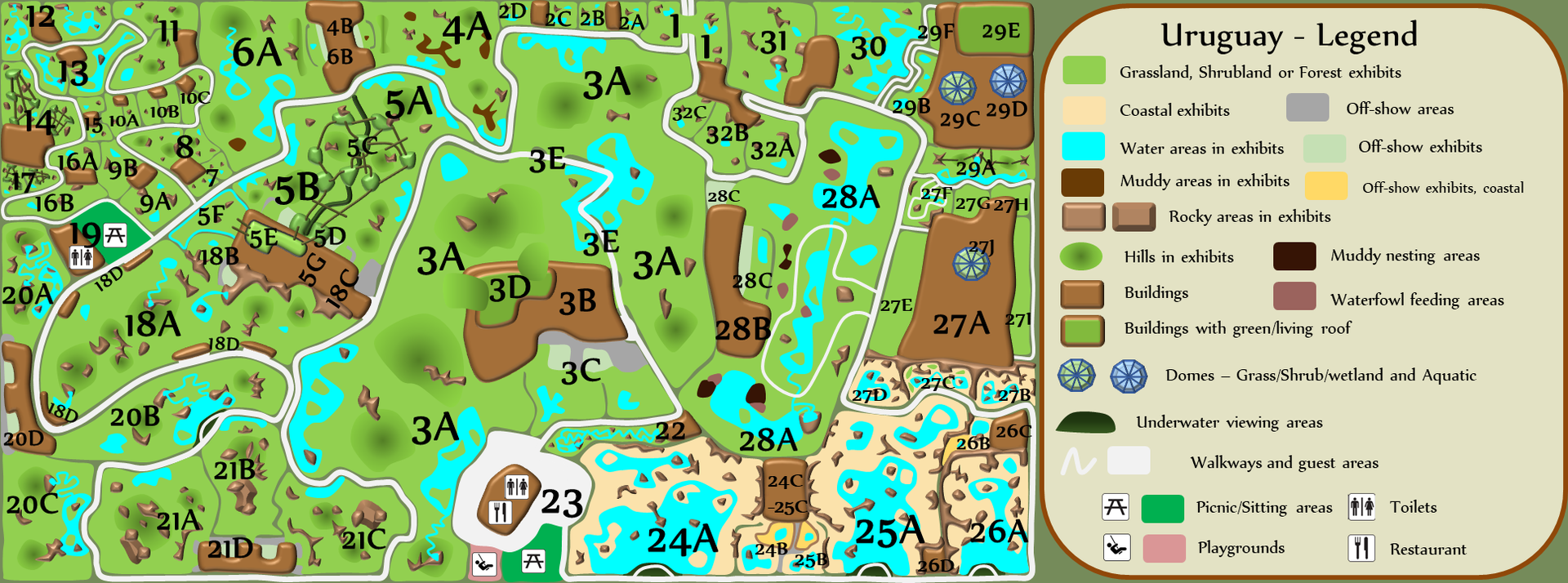
I know that it has been a really long time since I posted my previous project. For various reasons it took me a really long time to restart doing these projects. But I am happy to say that I have finally done another fantasy zoo project, on the country of Uruguay in southern South America.

For time and energy reasons I will be cutting the full discussion of this project into a few parts/posts to be submitted at different times, but within a time frame as narrow as possible. I don't think I can get a massive post with the full discussion done in one sitting right now. I believe this still meets the criteria for this subforum. The full species list has already been posted in a comment in the gallery, see the link below.

Tonight I will be discussing the exhibits 1 through 10.

Uruguay

This project focuses on the country of Uruguay, which is entirely covered by the WWF Ecoregion "Uruguayan savanna" and by the habitat "Pampas and campo" as discussed in "Habitats of the World: A Field Guide for Birders, Naturalists, and Ecologists" by Iain Campbell, Kenneth Behrens, Charley Hesse, and Phil Chaon (Princeton University Press).


The numbers and number/letter combinations in the list below and in the comment under the design in the gallery correspond to numbers on the map. In this species list dotted lists represent the different species housed in a mixed exhibit and striped lists represent species housed in different exhibits within a complex, such as an aviary block or a row of aquariums or terrariums. For the colors and shapes on the map I added a map key to the design map.

Below I will discuss the different exhibits.

1 Harris’s hawk

The Harris's hawk (Parabuteo unicinctus) is most well-known from the arid regions of the southern USA and Mexico,but it also occurs in vast parts of South America, including Uruguay. A group of these raptors will be housed in a wood-framed, metal mesh aviary constructed in two parts, with a wood-framed mesh passage overhead the entrance and exit walkways. The barn, which the hawks will share with the falcons and owls in exhibits 32A, 32B and 32C, will be a wood-finished building with a slate roof with skylights and viewing windows for visitors into some of the indoor mews, which will have a sand floor and will feature perches, platforms and tubs for bathing and drinking. The outdoor aviary for the hawks will feature rocky areas with perches and platforms and different wooden perches, as well as small pools and scattered live shrubs and small trees. The floor of the aviary will consist of grass and herbs of different lengths, interrupted by sandy or gravel areas.

2 Southern lapwing and songbird aviaries

Four aviaries and two wood-finished barns will house pairs of Southern lapwings (Vanellus chilensis), which is Uruguay's national birds, and pairs or groups of different songbird species. The aviaries will feature shallow pools, sandy and grassy beaches and areas with grasses, herbaceous plants and shrubs of various heights and some dead branches for perching for the songbirds. The barn will feature some viewable indoor exhibits with sand floors, small indoor pools and plants in pots, branches and reed mats to provide shelter and perching areas. Suitable nesting areas and materials will be provided for all species.

2A Southern lapwing (Vanellus chilensis) and Marsh seedeater (Sporophila palustris)
2B Southern lapwing (Vanellus chilensis) and Saffron-cowled blackbird (Xanthopsar flavus)
2C Southern lapwing (Vanellus chilensis) and Strange-tailed tyrant (Alectrurus risora)
2D Southern lapwing (Vanellus chilensis) and Hooded siskin (Spinus magellanicus)

3 Large mixed pampas/campo/Uruguayan savanna paddock

With pampas used here as a general term for temperate and subtropical South American grasslands, which are by some sources split up into the temperate pampas and the subtropical campo.

This largest exhibit will be a large mixed exhibit with five mammal species and one large flightless bird species. It will be a large grassy exhibit with several large ponds with islands, several hills, some rocky and sandy areas and a relatively small number of scattered trees with protected trunks. This exhibit will consist of two main sections, connected by several land and water tunnels underneath the main visitor walkway.

Indoor housing for the animals housed in this paddock (species listed below) will be provided in a large building, the exterior of which will consist of natural stone and wood-finished walls or large glass windows, and a roof which will partially consist of a green/living roof covered with grass, fenced and with access ramps to provide additional living space for the animals, and partially of a flat, gravel-covered roof with skylights.

The different indoor paddocks will have mulch floors or tiled floors covered with straw or wood shavings, and will feature indoor pools and structural elements such as logs, wooden shelters, feeders and enrichment materials, depending on the needs of the different species. The separating walls will be made of wood and metal mesh. The building will have an indoor viewing area, allowing viewing into some of the indoor exhibits, which will be occupied by individuals of one or more species as possible. The visitors will view the indoor exhibit through glass windows.

This mixed paddock will have two on-show separation paddocks, as well as a few smaller off-show separation paddocks, connected by off-show corridors.

Viewing of the exhibit by visitors will alternate between views across dry or wet moats and views over or through wood, stone or mesh fences.

3A Main paddock
3B Pampas/Campo animal building with indoor visitor area
3C Separation paddocks for large mixed paddock, Off-show paddocks and Off-show keeper and animal areas and corridors
3D Partial green/living roof, fenced and with access ramps for animals, part of living space for animals
3E Land and water tunnels underneath walkway connecting two sections of paddock
  • Greater rhea (Rhea americana)
  • Giant anteater (Myrmecophaga tridactyla)
  • Uruguayan Pampas deer (Ozotoceros bezoarticus uruguayensis)
  • Capybara (Hydrochoerus hydrochaeris)
  • Brown brocket deer or Gray brocket deer (Mazama gouazoupira)

4 Collared peccary (Pecari tajacu)

This species was extirpated in Uruguay, but has since been reintroduced into Uruguay.

The main exhibit will have a grassy, dirt, sandy or mulch floor and will feature scattered trees and shrubs with protected trunks and main root zones, hilly areas, muddy areas, pools, rocky areas, logs and shelters made from stacked rocks or logs with a covering of dirt. Enrichment feeders will be placed in different spots in the exhibit. The peccaries will also have sand-floored on-show and off-show paddocks with a muddy area.

The back wall of the peccary paddock and the separation exhibit will consist of metal mesh fencing, while on the visitor side the exhibit will feature lower stone walls and a dry or wet moat.

The marsh deer, brocket deer and peccary barn will be a red brick building with a thatched roof with skylights. No indoor viewing will be provided for these exhibits. The indoor paddocks will be mulch or straw floored with wood and metal fencing. Shelters will be provided mainly for the small brocket deer and the peccaries.

4A Main collared peccary paddock
4B and 6B Collared peccary, Marsh deer and Brown brocket deer barn with indoor housing and outdoor separation paddocks

5 Maned wolf (Chrysocyon brachyurus) and Black-and-gold howler monkey (Alouatta caraya)

This large exhibit will have tall fences, and the viewing areas will consist of views through mesh fencing or of large viewing windows, set underneath a viewing hut with a thatched roof to lessen glare on the windows as much as possible.

The ground level of these exhibits will consist of grasses and herbs of various lengths, scattered shrubs and small trees, small pools, rocky areas, some logs and shelters, either small barns with thatched roofs or rock and/or log shelters covered with dirt. The two main maned wolf exhibits will be separated by a wood and stone wall which the howler monkeys will be able to climb over, or cross via the overhead climbing structures.

For the howler monkeys the exhibits will feature elevated areas with stacked rock or steep dirt walls, covered with live shrubs and trees and with climbing structures consisting of dead trees parts and branches, wooden poles both horizontal and vertical, wooden platforms, natural fiber nets and ropes, rope ladders and fire hose. Enrichment and feeding platforms and shelters for the monkeys will also be provided.

These overhead climbing structures will connect different elevated areas and will also connect these climbing structures to the indoor housing, to a cage with climbing structures on top of the building's roof and to a small island which will be exclusive to the monkeys. The island and the roof-top cage will feature climbing structures similar to the ones described above.

On the maned wolf/howler monkey sides the house, which these mammals will share with the birds from exhibit 18, will have an outer wall coated and plastered with concrete and gravel in earthy and naturalistic brown tones.

One indoor exhibit for the maned wolves and two indoor exhibits for the howler monkeys will be viewable to the public from an indoor viewing area with viewing windows. The indoor maned wolf exhibits will have mulch or straw floors and will feature logs and wooden shelters. The indoor howle monkey exhibits will be much taller, with mulch floors and climbing structures similar to the outdoor ones. Off-show holding exhibits and training areas will be present for both species.

5A First maned wolf exhibit, with howler monkey access and howler monkey climbing structures above
5B Second maned wolf exhibit, with howler monkey access and howler monkey climbing structures above
5C Elevated areas and climbing structures with access for howler monkeys only
5D Howler monkey and maned wolf separation exhibits, on-show and off-show
5E Roof-top cage for howler monkeys, connected to separation cages and to small howler monkey island
5F Small outdoor island for howler monkeys only
5G Maned wolf, Howler monkey and large bird building with indoor visitor area [Building shared with exhibit 18, Quebrada de los Cuervos aviary]

6 Marsh deer (Blastocerus dichotomus) and Brown brocket deer or Gray brocket deer (Mazama gouazoupira)

The marsh deer is a species that was likely extirpated in Uruguay, but historical records exist. The marsh deer and brocket deer paddock will be a smaller version of the large mixed paddock, but with a slightly higher proportion of water.

The marsh deer, brocket deer and peccary barn will be a red brick building with a thatched roof with skylights. No indoor viewing will be provided for these exhibits. The indoor paddocks will be mulch or straw floored with wood and metal fencing. Shelters will be provided mainly for the small brocket deer and the peccaries.

6A Main Marsh deer and Brown brocket deer paddock
6B and 4B Collared peccary, Marsh deer and Brown brocket deer barn with indoor housing and outdoor separation paddocks

7 Molina’s hog-nosed (Conepatus chinga)

The skunks will have two exhibits, able to be connected or separated as needed, and a red brick and slate roof barn shared with the Pampas foxes (number 8). The two exhibits will have a grassy or mulch floor and will feature a small pool, logs, wooden or log shelters and concrete dens, rocks and live shrubs.

8 Pampas fox

The foxes will have two exhibits, able to be connected or separated as needed, and a red brick and slate roof barn shared with the skunks (number 7). The floor of the two exhibits will consist of grasses and herbs of various lengths, and the exhibits will feature hilly areas, a small pool, logs, wooden or log shelters and concrete dens, rocks and live shrubs and small trees.

9 Raptor aviaries, with shared barn

These aviaries and the barn will be very similar to the Harris's hawk aviary described above, minus the mesh tunnel above the visitor area.

9A Great black hawk (Buteogallus urubitinga)
9B Savanna hawk (Buteogallus meridionalis)

10 Small cat exhibits

A breeding pair of three small cat species, listed below, will be kept in a series of six tall netted exhibits and three wood finished, wooden slate roofed barns, featuring grassy floors with different heights of grass and herbs, rocky areas, live shrubs and small trees and climbing structures made from wood and tree parts. Shelters at different heights and enrichment feeding options will be provide. Only the indoor housing for the male cats will be viewable to the public.

The indoor small cat exhibits will look somewhat like this serval indoor exhibit:
Serval indoor exhibit 2 - ZooChat

10A Muñoa's pampas cat (Leopardus munoai)
10B Geoffroy's cat (Leopardus geoffroyi)
10C Margay (Leopardus wiedii)

I hope to continue the full discussion of the different remaining exhibits as soon as possible.
 
Last edited:
Uruguay - Part 2 of description

Today I am trying something new that I thought of yesterday - a schematic to perhaps make the full description easier, quicker and more standardized.

Today's post is shorter and discussed fewer of the exhibits than yesterday's.


11 Crab-eating fox (Cerdocyon thous)

General description of exhibit: Small canine exhibit with mesh fencing with overhangs and hotwiring, glass windows and stone walls
Exhibit features, outdoors: Grass or mulch floor, grasses and herbs of various heights, shrubs and small trees, logs and rocks, small ponds, hilly areas, dens consisting of rocks and/or logs and dirt or of buried concrete elements.
Exhibit features, indoors: Brick barn with wooden slate roof. Indoor dens with mulch floor, logs and wooden nesting and sleeping boxes and facilities for drinking and (enrichment) feeding. One on-show den and several off-show dens.
Visitor experience and facilities: Views through mesh and views across dry moat.
Education: Species signage, including attractive signage explaining the name "crab-eating".
Keeper facilities: Double gated general keeper accesses and large equipment accesses to outdoor exhibits, small corridor with equipment storage, remotely operated sliding doors for animals and doors into dens in the barn.

12 Crab-eating raccoon (Procyon cancrivorus)

General description of exhibit: Mesh fencing with overhangs and hotwiring, glass windows and stone walls will enclose forested wetland exhibits.
Exhibit features, outdoors: Pools with islands, grass or mulch floors, grasses,herbs and wetland vegetation of various heights, shrubs and small trees, logs and rocks, climbing structures made from wooden poles and trees parts, shelters at different levels, made of wood and/or logs. Enrichment feeding facilities present.
Exhibit features, indoors: Mulch floors, wooden climbing structures and platforms, wooden shelters/nesting boxes and indoor ponds. Enrichment feeding facilities present. Set in brick barn with slate roof. One on-show den, several off-show dens.
Visitor experience and facilities: Views across fencing or through glass windows.
Education: Species signage, including discussing broader diet than name suggests, different habitats in which it occurs and differences between crab-eating and common North American raccoon.
Keeper facilities: Double gated general keeper accesses and large equipment accesses to outdoor exhibits, small corridor with equipment storage, remotely operated sliding doors for animals and doors into dens in the barn.

13 Neotropical river otter (Lontra longicaudis)

General description of exhibit: Mesh fencing with overhangs and hotwiring, glass windows and stone walls will enclose a wetland exhibit.
Exhibit features, outdoors: Similar to the crab-eating raccoon exhibits, but with an even higher proportion of water and without the climbing structures.
Exhibit features, indoors: Mulch floors, logs, wooden shelters/nesting boxes and indoor ponds. Enrichment feeding facilities present. Set in brick barn with slate roof. One on-show den, several off-show dens.
Visitor experience and facilities: Views across fencing or through glass windows.
Education: Species signage and signage about Neotropical wetland ecology and conservation.
Keeper facilities: Double gated general keeper accesses to outdoor exhibits, small corridor with equipment storage, remotely operated sliding doors for animals and doors into dens in the barn.

14 Southern tamandua (Tamandua tetradactyla straminea) and Greater naked-tailed armadillo (Cabassous tatouay)

General description of exhibit: Arboreal insectivorous mammal exhibit with ground-level facilities for ground-dwelling insectivore. Netted exhibits with views through metal mesh fencing or glass windows.
Exhibit features, outdoors: Netted exhibits with live shrubs and small trees, elevated areas with stacked rock walls (some of these including dens for the armadillos and the tamanduas) and wooden climbing structures. Mulch or grass floor. Recreations of insect nests in the climbing structures and at ground level, serving as enrichment feeders.
Exhibit features, indoors: Wood-finished brick building with a partial slate and partial skylight/greenhouse roof, shared with the porcupines and armadillos of exhibit number 17. Mulch floors, wooden climbing structures and platforms, wooden shelters/nesting boxes at height and at ground level, and enrichment feeders in shape of insect nests and plant parts, both at ground level and in climbing structures. Two on-show indoor exhibits, several more off-show dens.
Visitor experience and facilities: Viewing huts above/around them to prevent glare as much as possible. Views through metal mesh or through glass viewing windows.
Education: Species signage, with specific focus on adaptations of species to feeding on insects.
Keeper facilities: Double gated general keeper accesses to exhibits, small corridor with equipment storage, remotely operated sliding doors for animals and doors into dens in the barn.

15 Lesser grison (Galictis cuja furax)

General description of exhibit: Similar to the previously discussed skunk exhibits. Small mammal exhibits with wooden and stone walls and glass viewing windows.
Exhibit features, outdoors: Grassy or mulch floor, small pool, logs, wooden or log shelters, dens made from buied concrete elements, rocks, live shrubs. Enrichment feeders provided.
Exhibit features, indoors: Wood-finished barn with slate roof. Dens with mulch or straw floor with logs and wooden shelters and nesting boxes. Enrichment feeders provided. One indoor den viewable to the public and three additional off-show dens.
Visitor experience and facilities: View across walls or through viewing windows.
Education: Species signage. Education about the different locomotion styles among terrestrial mammals and about the anal scent glands of mustelids and other carnivore groups such as skunks and otters, and their noxious and foul-smelling secretions.
Keeper facilities: Double gated general keeper accesses to outdoor exhibits, double safety doors leading directly from outside to indoor dens.

I hope to continue the full discussion of the different remaining exhibits as soon as possible.
Double gated general keeper accesses exhibits, small corridor with equipment storage, remotely operated sliding doors for animals and doors into dens in the barn.
 
Last edited:
Uruguay - Part 3 of description

16 Raptor aviaries


16A Roadside hawk (Rupornis magnirostris)
16B Crane hawk (Geranospiza caerulescens)

General description of exhibit: Wood-framed, metal mesh aviaries.
Exhibit features, outdoors: Grass floor with sandy areas, grass and herbs of different heights. Rocky areas with perches and platforms, different wooden perches and platforms, small pools, scattered live shrubs and small trees.
Exhibit features, indoors: Shared wood-finished, slate roofed barn with skylights containing indoor mews, one on-show and at least one off-show mew per species. The mews will have a sandy floor and will feature perches, platforms and tubs for bathing and drinking.
Visitor experience and facilities: Views through mesh.
Education: Species signage. Signage about senses and hunting strategies of South American raptors.
Keeper facilities: Double gated general keeper accesses to outdoor aviaries, small corridor with equipment storage and access doors to indoor mews in the barn.

17 Paraguayan dwarf hairy porcupine (Coendou spinosus) and Southern long-nosed armadillo (Dasypus hybridus)

General description of exhibit: Arboreal herbivorous mammal exhibit with ground-level facilities for ground-dwelling insectivore. Netted exhibits with views through metal mesh fencing or glass windows.
Exhibit features, outdoors: Netted exhibits with live shrubs and small trees, elevated areas with stacked rock walls (some of these including dens for the armadillos and the tamanduas) and wooden climbing structures. Mulch or grass floor. Recreations of insect nests in the climbing structures and at ground level, serving as enrichment feeders.
Exhibit features, indoors: Wood-finished brick building with a partial slate and partial skylight/greenhouse roof, shared with the tamanduas and armadillos of exhibit number 14. Mulch floors, wooden climbing structures and platforms, wooden shelters/nesting boxes at height and at ground level, and enrichment feeders in shape of insect nests and plant parts, both at ground level and in climbing structures. Two on-show indoor exhibits, several more off-show dens.
Visitor experience and facilities: Viewing huts above/around viewing windows to prevent glare as much as possible. Views through metal mesh or through glass viewing windows.
Education: Species signage, with specific focus on adaptations to arboreal or ground-dwelling lifestyles.
Keeper facilities: Double gated general keeper accesses to exhibits, small corridor with equipment storage, remotely operated sliding doors for animals and doors into dens in the barn.

18 Quebrada de los Cuervos aviary

18A Main aviary
18B Separation aviaries, on-show and off-show
18C Maned wolf, Howler monkey and large bird building with indoor visitor area [Building shared with exhibit 5, Maned wolf and howler monkey exhibit]
18D Covered viewing huts at side of aviary
  • American black vulture (Coragyps atratus)
  • Turkey vulture (Cathartes aura)
  • Lesser yellow-headed vulture (Cathartes burrovianus)
  • King vulture (Sarcoramphus papa)
  • Long-winged harrier (Circus buffoni)
  • Yellow-headed caracara (Daptrius chimachima)
  • Red-legged seriema (Cariama cristata)
General description of exhibit: Named for the protected landscape of Quebrada de los Cuervos ('Ravine of the Crows', named for the faintly crow-like New World vultures) in the Treinta y Tres Department of Uruguay, this will be a very large aviary with vultures, small raptors and seriemas, inspired by the landscape of Quebrada de los Cuervors (see the links below).
Exhibit features, outdoors: A large, tall aviary with rocky and grassy hills and (mock) rock outcroppings of different sizes. The floor of the aviary will be mostly covered with grass and herbs of various lengths, with some areas with coarse sand. There will be several shallow pools, two small creeks and three small waterfalls. Dead trees, wooden platforms and rocky areas will provide perching and nesting and sleeping platform space. Feeding platforms, suitable for prey items ranging from rodents to large carcass pieces, will be provided both at ground and elevated levels. An on-show and an off-show separation aviary, partially separated from and hidden behind a mock rock structure, will be present.
Exhibit features, indoors: Set in building shared with the maned wolves and black-and-gold howler monkeys. This side of the building will have a mock rock exterior wall with platforms and perches. The indoor mews set in the building, some of which will be viewable from an indoor public viewing area and some of which will be off-show, will have a sandy floor and will feature perches, platforms and tubs for bathing and drinking.
Visitor experience and facilities: Views through glass windows for indoor housing. Views through the aviary's outer mesh or through mesh from several wood and thatched roof viewing huts at the side of the aviary.
Education: Species signage and large signage about the biology and the ecology of the different species. Signage about the Quebrada de los Cuervos and the landscapes and habitats of Uruguay.
Keeper facilities: Keeper corridor with storage facilities behind the mews. Off-show outdoor area with access to separation aviaries and main aviary. Keeper access to different aviaries with double safety gates, mesh doors into indoor mews. The indoor area will also have the facilities for the care of non-parent raised and sick birds.

Paisaje protegido Quebrada de los Cuervos y Sierras del Yerbal - Wikipedia, la enciclopedia libre
Quebrada de los Cuervos - Wikipedia
Quebrada de los Cuervos - Google Search

19 Toilet building and Picnic/Sitting area

Visitor experience and facilities: A brick building with a slate roof housing men's, women's and disabled toilets and a child care room. A shortly-mowed meadow with regularly spaced trees to provide shade, picnic benches with a table and regular sitting benches, surrounded by mixed planted areas and a hedge with native species.

20 Jaguar (Panthera onca) [Extirpated in Uruguay]

20A First jaguar exhibit
20B Second jaguar exhibit
20C Third jaguar exhibit
20D Jaguar building with indoor dens and off-show outdoor cages

General description of exhibit: Three large exhibits and a building for jaguars.
Exhibit features, outdoors: Three large outdoor exhibits with tall fences and viewing windows, with pools and creeks of varying depths, waterfalls, rocky areas, hills, wooden climbing structures and platforms, wooden and rock/log and dirt shelters and vegetation varying from long grass and herbs to shrubs and small trees. Enrichment feeding opportunities present. Two off-show outdoor holding cages with climbing structures and platforms. One of the exhibits will have an underwater viewing area.
Exhibit features, indoors: A concrete and brick building with a flat roof with skylights and a suitable roofing material. Several indoor holding exhibits with tiled or mulch floor, wooden climbing structures and platforms. Maternity dens present, fully enclosed even from keepers but with livestreaming cameras for observation and display to the public. Two on-show indoor exhibits and several more off-show indoor holding areas.
Visitor experience and facilities: Views through mesh, through viewing windows with shade huts or views across fences and wet and/or dry moats from elevated visitor areas. Indoor viewing through viewing windows.
Education: Signage about jaguar biology, ecology and conservation.
Keeper facilities: Keeper corridor with overhead animal passages, safety equipment, a target training wall and hatches for safe feeding. Outdoor keeper area with large gate accesses to different areas and exhibits.

21 South American cougar (Puma concolor concolor)

21A First cougar exhibit
21B Second cougar exhibit
21C Third cougar exhibit
21D Cougar building with indoor dens, off-show outdoor cages and access tunnels to outdoor exhibits overhead keeper areas

General description of exhibit: Three large exhibits and a building for cougars.
Exhibit features, outdoors: Three large outdoor exhibits with tall fences and viewing windows, similar to the jaguar exhibits but much rockier and with a much lower proportion of water. Exhibits will feature small pools, extensive rocky areas, hills, wooden climbing structures and platforms, wooden and rock/log and dirt shelters and vegetation varying from long grass and herbs to shrubs and small trees. Enrichment feeding opportunities present. Two off-show outdoor holding cages with climbing structures and platforms. One of the exhibits will have an underwater viewing area.
Exhibit features, indoors: A concrete and brick building with a flat roof with skylights and a suitable roofing material. Several indoor holding exhibits with tiled or mulch floor, wooden climbing structures and platforms. Maternity dens present, fully enclosed even from keepers but with livestreaming cameras for observation and display to the public. No indoor viewing for the cougars.
Visitor experience and facilities: Views through mesh, through viewing windows with shade huts or views across fences and wet and/or dry moats from elevated visitor areas.
Education: Signage about cougar biology, ecology and conservation.
Keeper facilities: Keeper corridor with overhead animal passages, safety equipment, a target training wall and hatches for safe feeding. Outdoor keeper area with large gate accesses to different areas and exhibits.

22 Coypu or Nutria (Myocastor coypus)

General description of exhibit: Relatively long and narrow semi-aquatic rodent exhibit.
Exhibit features, outdoors: Large central creek and smaller creeks surrounding and surrounded by islands and land areas, either grassy, sandy or mulch covered, logs and rocks as structural materials, mock rock and concrete structures as dens. Tiled feeding areas. Small trees and shrubs with protected trunks and roots to provide shade.
Exhibit features, indoors: Brick barn with slate roof and viewing windows with tiled or straw-floored indoor exhibits with logs and branches, wooden and stone shelters and indoor pools. One large on-show den, a few more off-show dens.
Visitor experience and facilities: View through viewing windows and across stone wall surrounding the exhibit.
Education: Species signage, including signage about the nutria's semi-aquatic biology and ecology and about the invasive potential of this species in different regions of the world.
Keeper facilities: Gates broad enough to bring fairly large equipment into outdoor exhibit and double doors into indoor dens.

I hope to post the full discussion for the remaining exhibits as soon as possible.
 
Uruguay - Fourth and final part of discussion of exhibits


23 Guest area with Café Campo restaurant, terraces, playground and picnic meadow/sitting area


Visitor experience and facilities: Large concrete and glass building with brick wall finishing, with South American theming such as flags, decorations and signs and inscriptions in Spanish. Large wood and metal shade structure covering parts of the terrace. Terrace with tables, benches, chairs and umbrellas and/or trees for parts not covered by shade structure. Terrace will allow some viewing of nearby exhibits. The restaurant will offer hot dishes, salads, sandwiches, deserts and drinks. Some of the food offered will have South American and Uruguayan cuisine influences.

24 South American sea lion (Otaria flavescens) and 25 South American fur seal (Arctocephalus australis gracilis)

24A Main exhibit
24B Separation exhibits, on-show and off-show
24C-25C Pinniped building with indoor holding, medical and training areas

25A Main exhibit
25B Separation exhibits, on-show and off-show
24C-25C Pinniped building with indoor holding, medical and training areas

General description of exhibit: Pinniped exhibits.
Exhibit features, outdoors: Paved, rocky and sandy beaches around large pool and smaller pools. Largest pools will have substantial differences and gradients in depth and will reach a substantial depth at their deepest point, their floors will be partially covered with sand and gravels and they will feature some underwater rocks, partially covered in algae, as structural and decorative elements. Paved and/or rocky islands in pools. Small on-show and off-show separation exhibits with paved land areas and concrete pools.
Exhibit features, indoors: Concrete building with mock rock walls on sides viewable by the public and flat roof with skylights. Tiled or textured concrete indoor exhibits with concrete indoor pools and metal fencing and gates between exhibits. One large indoor exhibit viewable through windows for each species and several more off-show exhibits.
Visitor experience and facilities: Views across wood and metal mesh fencing or rock walls surrounding the exhibits, views through glass windows for outdoor and indoor exhibits, under water viewing area for both species.
Education: Species signage and signage about pinniped adaptations. Signage about training and management of captive pinnipeds.
Keeper facilities: Corridor between indoor exhibits. Target and medical training areas and veterinary care area for pinnipeds present.

26 Magellanic penguin and seabird aviary

26A Main aviary
26B Separation aviaries, on-show and off-show
26C Indoor housing
26D Coastal area filtration building with educational signage
  • Magellanic penguin (Spheniscus magellanicus)
  • Southern rockhopper penguin (Eudyptes chrysocome chrysocome) [Occurs as a vagrant to Uruguayan coast]
  • Upland goose or Magellan goose (Chloephaga picta) [Occurs as a vagrant to Uruguayan coast]
  • American oystercatcher (Haematopus palliatus)
  • Gull-billed tern (Gelochelidon nilotica)
  • Snowy-crowned tern (Sterna trudeaui)
General description of exhibit: Large coastal aviary housing penguins and seabirds.
Exhibit features, outdoors: Large coastal aviary with rock walls with platforms and perches on two sides and aviary mesh and viewing windows on the two other sides (alongside walkway). Large pool with sandy and rocky islands, sandy and rocky beaches, some dead trees and ‘driftwood’ present for perching and as structural and decorative materials. Nesting boxes and shelters for the penguins will be built into the rock walls and rock structures. Suitable nesting areas for the other species will also be provided.
Exhibit features, indoors: Indoor exhibits with paved or sandy land areas, paved concrete pools, wooden and mock rock perches and nesting boxes for the penguins. Three on-show indoor exhibits and four off-show indoor exhibits in wood-finished building with flat roof with skylights.
Visitor experience and facilities: Views through aviary mesh and through glass windows with shading huts. Underwater viewing area at the deepest end of the pool allowing visitors to see penguins swimming and diving. View into filtration building (largely hidden behind mock rock) with educational signage.
Education: Species signage and signage about different lifestyles and adaptations of different types of coastal and seabirds, signage about South American coastal habitats and signage about the equipment and technology used for the filtration and maintenance of marine exhibits next to the viewing window into the filtration building.
Keeper facilities: Service area in filtration building. Keeper corridors between indoor exhibits and separation exhibits. Double-door keeper accesses to outdoor exhibits. Large equipment accesses to outdoor exhibits.

27 Bird Building

General description of building: Large building with brick, mock rock or concrete outer walls, partially covered by climbing plants, and a roof with a decagonal dome with metal frames supporting a greenhouse roof (containing an indoor walk-through aviary), and several additional skylights, surrounded by roof areas partially covered with rolled roofing and partially with roofing layers topped with gravel. Interior walls decorated with murals, mock rock, bark or wood covering or climbing plants.

27A Bird Building with indoor aviaries of indoor/outdoor exhibits and smaller all-indoor bird exhibits (listed below)

Indoor aviaries (for discussion of indoor/outdoor aviaries see below)

- Black jacobin (Florisuga fusca)
- Black-throated mango (Anthracothorax nigricollis) [Occurs as a vagrant in Uruguay]
- Many-colored rush tyrant (Tachuris rubrigastra)
- Red-and-white crake (Laterallus leucopyrrhus) and Straight-billed reedhaunter (Limnoctites rectirostris)
- Purple-throated euphonia (Euphonia chlorotica)
- White-tipped plantcutter (Phytotoma rutila)
- Green-backed becard (Pachyramphus viridis)
- Blue-black grassquit (Volatinia jacarina)
- Wattled jacana (Jacana jacana)
- Ferruginous pygmy owl (Glaucidium brasilianum)
- Solitary cacique or Solitary black cacique (Cacicus solitarius)​

General description of exhibit: Glass-fronted indoor aviaries.
Exhibit features, indoors: Small to medium-sized aviaries, based on grassland, shrubland/forest or wetland, with general look, size of branches, type and size of plants, number of individuals kept, number of exhibits, feeders and nesting materials and structures depending on the needs of the different species.
Visitor experience and facilities: Views through glass windows or through small aviary mesh. Decorations around viewing areas, planted areas in visitor area.
Education: Species signage and signage about specific elements of species biology, such as the adaptations of hummingbirds and jacanas. Signage about the birds, habitats and conservation issues of Uruguay and southern South America.
Keeper facilities: Keeper corridor behind aviaries with access doors.

27B First coastal aviary: Olrog's gull (Larus atlanticus), 27C Second coastal aviary: grey-headed gull (Chroicocephalus cirrocephalus cirrocephalus) and 27D Third coastal aviary: Parasitic jaeger, Arctic skua, Arctic jaeger or Parasitic skua (Stercorarius parasiticus)

General description of exhibits: Coastal indoor and outdoor aviaries.
Exhibit features, outdoors: Aviaries with rock walls with platforms and at sides and backside and aviary mesh on the front side, alongside the walkway. Pools with sandy and rocky islands, sandy and rocky beaches, some dead trees and ‘driftwood’ present for perching and as structural and decorative materials. Aviary for grey-headed gulls will also feature areas with reeds, shrubs and small trees as this species also fairly commonly occurs in inland brackish or freshwater wetlands. Suitable nesting areas provided.
Exhibit features, indoors: Indoor exhibits with paved or sandy land areas, paved concrete pools, wooden and mock rock perches and platforms on the rocks. One on-show and one off-show indoor exhibit per species.
Visitor experience and facilities: Views through aviary mesh. Coastal decorations around viewing areas. Planted areas with species from coastal areas.
Education: Species signage, signage about adaptations and behavior of gulls and jaegers. Signage about South American coastal habitats.
Keeper facilities: Keeper corridor with access doors into both outdoor and indoor aviaries.

27E Larger indoor/outdoor aviaries

- Buff-fronted owl (Aegolius harrisii)
- Common potoo Poor-me-ones or Urutau (Nyctibius griseus)
- Ringed kingfisher (Megaceryle torquata)
- Toco toucan (Ramphastos toco) and Brown tinamou (Crypturellus obsoletus)
- Squirrel cuckoo (Piaya cayana)
- Plush-crested jay (Cyanocorax chrysops)
- Pampas flicker (Colaptes campestroides or Colaptes campestris campestroides)​

General description of exhibit: Outdoor and indoor aviaries with appropriately sized aviary mesh.
Exhibit features, indoors outdoors: Larger indoor and outdoor aviaries, based on grassland, shrubland/forest or wetland, with general look, size of branches, type and size of plants, number of individuals kept, number of exhibits, feeders and nesting materials and structures depending on the needs of the different species.
Visitor experience and facilities: Views through aviary mesh. Decorations around viewing areas, planted areas in visitor area.
Education: Species signage and signage about specific elements of species biology, such as the bill of the toucan, brood parasitism versus ‘regular’ breeding in cuckoo species, the intelligence of corvid species and the adaptations of kingfishers and woodpeckers. Signage about the birds, habitats and conservation issues of Uruguay and southern South America.
Keeper facilities: Keeper corridor with access doors into both outdoor and indoor aviaries.

27F Walk-through parrot aviary
  • Monk parakeet or Quaker parrot (Myiopsitta monachus monachus)
  • Burrowing parrot, Burrowing parakeet or Patagonian conure (Cyanoliseus patagonus patagonus)
  • White-eyed parakeet or White-eyed conure (Psittacara leucophthalmus)
  • Dusky-legged guan (Penelope obscura)
General description of exhibit: Walk-through outdoor parrot aviary. Indoor parrot aviaries.
Exhibit features, outdoors: Large aviary with frame and mesh made of metal. Rocky areas with nesting cavities for the burrowing parrots. Spaces and materials for nest building by the monk parakeets provided. Nesting boxes for conures. Perches and platforms for the guans. Dead trees and branches, natural fiber ropes and nets. Some live trees and shrubs of fast-growing and/or resistant species. Feeding areas and enrichment material, both with and without food.
Exhibit features, indoors: Sandy or paved floor exhibits with metal mesh fronts, dead trees and branches, platforms, natural fiber ropes and nets, nesting cavities in rocks or logs and areas for monk parakeet nests. Feeders and enrichment materials. Three on-show and three off-show indoor exhibits, connected or separated as needed.
Visitor experience and facilities: Dirt walkway with low bamboo and wood fencing around it in outdoor aviaries. Indoor viewing through aviary mesh.
Education: Publicly viewable training area for parrots. Species signage. Signage about different methods of nesting used by the parrot species. Signage about the intelligence and adaptations of parrots, and about their training. Signage about the ins and outs of parrots as pets.
Keeper facilities: Keeper corridor with access doors into both outdoor and indoor aviaries. Equipment storage. Specialized training areas for parrots.

27G Medium-sized indoor/outdoor aviaries

- Grey-fronted dove (Leptotila rufaxilla) and Red-winged tinamou (Rhynchotus rufescens)
- Great kiskadee (Pitangus sulphuratus)
- American purple gallinule (Porphyrio martinicus) and Stripe-backed bittern (Ixobrychus involucris)​

General description of exhibit: Outdoor and indoor aviaries with appropriately sized aviary mesh.
Exhibit features, indoors outdoors: Medium-sized indoor and outdoor aviaries, based on grassland, shrubland/forest or wetland, with general look, size of branches, type and size of plants, number of individuals kept, number of exhibits, feeders and nesting materials and structures depending on the needs of the different species.
Visitor experience and facilities: Views through aviary mesh. Decorations around viewing areas, planted areas in visitor area.
Education: Species signage and signage about specific elements of species biology, such as the bill of the toucan, brood parasitism versus ‘regular’ breeding in cuckoo species, the intelligence of corvid species and the adaptations of kingfishers and woodpeckers. Signage about the birds, habitats and conservation issues of Uruguay and southern South America.
Keeper facilities: Keeper corridor with access doors into both outdoor and indoor aviaries.

27H Nursery area (Indoor) Indoor raising and spare aviaries and Indoor/outdoor raising and spare aviaries, species held depending on necessity

General description of exhibit: Indoor nursery, indoor raising and spare aviaries, indoor/outdoor raising and spare aviaries.
Exhibit features, outdoors: Paved floor or sandy-floored aviaries with plants and perches able to be placed as needed. One aviary with outdoor pool present.
Exhibit features, indoors: Paved floor or sandy-floored aviaries with plants and perches able to be placed as needed. One aviary with indoor pool present.
Visitor experience and facilities: Many of these aviaries will be viewable to the public through viewing windows or through aviary mesh. View into the main nursery room with incubators for eggs and for small young birds through a window.
Education: Signage about eggs, about the raising of young birds and about conservation breeding. If juvenile of spare birds are kept, explanations provided.
Keeper facilities: Connection to keeper corridors servicing other parts of the complex. Desinfection facilities at entrance to area. Storage area and preparation area for juvenile bird feed and medication.

27I Smaller indoor/outdoor aviaries

- Maroon-bellied parakeet, Reddish-bellied parakeet, Maroon-bellied conure, Reddish-bellied conure or Brown-eared conure (Pyrrhura frontalis)
- Cattle tyrant (Machetornis rixosa)
- Pampas meadowlark (Leistes defilippii)
- Rusty-collared seedeater (Sporophila collaris) and Least seedsnipe (Thinocorus rumicivorus)
- Golden-billed saltator (Saltator aurantiirostris)
- Rufous hornero (Furnarius rufus rufus)
- Chalk-browed mockingbird (Mimus saturninus)
- Spot-winged falconet (Spiziapteryx circumcincta)
- Sulphur-bearded reedhaunter (Limnoctites sulphuriferus)
- Many-colored Chaco finch (Saltatricula multicolor), Picui ground dove or Picui dove (Columbina picui) and Spotted nothura (Nothura maculosa)
- Mottled piculet (Picumnus nebulosus)
- Burrowing owl (Athene cunicularia)​

General description of exhibit: Outdoor and indoor aviaries with appropriately sized aviary mesh.
Exhibit features, indoors outdoors: Smaller-sized indoor and outdoor aviaries, based on grassland, shrubland/forest or wetland, with general look, size of branches, type and size of plants, number of individuals kept, number of exhibits, feeders and nesting materials and structures depending on the needs of the different species.
Visitor experience and facilities: Views through aviary mesh. Decorations around viewing areas, planted areas in visitor area.
Education: Species signage and signage about specific elements of species biology, such as the bill of the toucan, brood parasitism versus ‘regular’ breeding in cuckoo species, the intelligence of corvid species and the adaptations of kingfishers and woodpeckers. Signage about the birds, habitats and conservation issues of Uruguay and southern South America.
Keeper facilities: Keeper corridor with access doors into both outdoor and indoor aviaries.

27J Grassland/Shrubland/Freshwater wetland Dome, Indoor walk-through aviary
  • Diademed tanager (Stephanophorus diadematus)
  • Fawn-breasted tanager (Pipraeidea melanonota)
  • Chestnut-backed tanager (Stilpnia preciosa)
  • Blue-and-yellow tanager (Rauenia bonariensis)
  • Saffron finch (Sicalis flaveola)
  • Red-crested cardinal (Paroaria coronata)
  • Pampa finch or Great pampa finch (Embernagra platensis)
  • Ringed teal (Callonetta leucophrys)
  • Spotted nothura (Nothura maculosa)
  • South American painted-snipe (Nycticryphes semicollaris)
  • White-necked stilt (Himantopus melanurus, H. himantopus melanurus or H. mexicanus melanurus)
General description of exhibit: Decagonal dome with grassland/shrubland/freshwater wetland indoor walk-through aviary.
Exhibit features, indoors: Sizable indoor walk-through area with ponds, reeds, shrubs, small trees and dead branches, mimicking a landscape of grassland, shrubland and freshwater wetland, with dirt walkways and boardwalks winding through it. Feeders.
Visitor experience and facilities: Dirt walkways and boardwalks providing different views.
Education: Species signage. Signage about the birds, habitats and conservation issues of Uruguay and southern South America. Signage suggesting where certain species might be found.
Keeper facilities: Connection to keeper corridors servicing other parts of the complex. Complex of small acclimatization, breeding and quarantine aviaries with keeper corridor, partially hidden by vegetation and decorative materials. Storage area. Bird kitchen for the entire building will be located near the dome.

28 River of the Painted Birds aviary

28A Main aviary with external viewing areas and walk-through road
28B Bird barn with viewing windows for some of indoor housing
28C Separation aviaries, on-show and off-show
  • Chilean flamingo (Phoenicopterus chilensis)
  • Black-necked swan (Cygnus melancoryphus)
  • Coscoroba swan (Coscoroba coscoroba)
  • Crested screamer or Southern screamer (Chauna torquata)
  • Rufescent tiger-heron (Tigrisoma lineatum)
  • Whistling heron (Syrigma sibilatrix)
  • Southern lapwing (Vanellus chilensis)
  • White-faced ibis (Plegadis chihi)
  • Buff-necked ibis (Theristicus caudatus)
  • Roseate spoonbill (Platalea ajaja)
  • White-faced whistling-duck (Dendrocygna viduata)
  • Muscovy duck (Cairina moschata)
  • Cinnamon teal (Spatula cyanoptera)
  • Chiloé wigeon (Mareca sibilatrix)
  • Rosy-billed pochard (Netta peposaca)
  • Lake duck, Argentine blue-bill, Argentine blue-billed duck, Argentine lake duck or Argentine ruddy duck (Oxyura vittata)
  • Red shoveler (Spatula platalea)
  • Yellow-billed pintail (Anas georgica)
  • Dusky-legged guan (Penelope obscura)
General description of exhibit: Name of the aviary derives from one of the possible explanations for the name (Rio) Uruguay, namely that it derives from the language of the Guaraní people and means “River of the Painted Birds”. Very large walk-through aviary for a variety of colorful, mostly wetland and waterfowl type birds. For some species this aviary will allow the keeping of large breeding colonies.
Exhibit features, outdoors: Large wetland aviary with large ponds of varying depths with grassy or sandy islands, surrounded by grassy or sandy land areas and areas with shrubs and live trees. Dead trees and rocky areas present for perching. Nesting platforms provided for tree-nesting species, nesting boxes at different heights present for cavity nesters. Muddy nesting areas present for flamingo colony. Specific feeding areas present for the flamingos, either consisting or ponds such as at Planckendael (see link below) or of tub feeders on poles.
Exhibit features, indoors: Wood-finished stone barn. Indoor rooms with paved or sandy foors, branches, rocks and wooden platforms for perching, nesting and sleeping platforms, feeders and paved indoor pools. Three large indoor rooms viewable through viewing windows, several more off-show indoor rooms of varying sizes.
Visitor experience and facilities: Views through aviary mesh or through viewing windows with shade huts from outside of aviary. Walk-through area with gravel road and small wooden bridges allowing viewing of outdoor aviary and three on-show indoor rooms.
Education: Species signage. Signage about the birds, habitats and conservation issues of Uruguay and southern South America. Signage suggesting where certain species might be found.
Keeper facilities: Keeper corridor between indoor exhibits, main aviary and separation aviaries. Double-gated keeper doors. Large equipment access to main aviary.

Chilean flamingo feeding area, 2020-01-11 - ZooChat
Feeding Chilean flamingos (Phoenicopterus chilensis), 2021-04-20 - ZooChat

29 Aquarium, Terrarium and Coati complex

General description of building: Large complex with brick, mock rock or concrete outer walls, partially covered by climbing plants, and a roof with two decagonal domes with metal frames supporting a greenhouse roof, set above the largest exhibits in the aquarium and terrarium areas. The domes and additional skylights will be surrounded by roof areas partially covered with rolled roofing and partially with roofing layers topped with gravel. Interior walls decorated with murals, mock rock, bark or wood covering or climbing plants.

29A South American coati (Nasua nasua) exhibits, indoor and outdoor

General description of exhibit: Indoor and outdoor exhibits for coatis.
Exhibit features, outdoors: Rocky outcroppings, large pool in moat/lower area with grassy islands, waterfall, hills, climbing structures made of wooden poles and platforms, branches, wooden and rope ladders and natural fiber ropes and nets, live trees and shrubs, feeders and enrichment materials, wooden shelters at different levels.
Exhibit features, indoors: Two tall mulch-floored main indoor exhibits with climbing structures and shelters similar to those used outdoors, viewable to the public. Lower off-show indoor exhibits with climbing structures and paved floors.
Visitor experience and facilities: Views across moat with pond and through glass window for outdoor exhibits, views through glass windows for indoor exhibit.
Education: Species signage. Signage about the invasive potential of coatis.
Keeper facilities: Keeper corridor with accesses to viewable indoor exhibits, off-show indoor exhibits and outdoor exhibit.

29B Outdoor reptile exhibits for use when weather allows, with indoor exhibits in building

- Southern D'Orbigny's slider or Southern black-bellied slider (Trachemys dorbigni dorbigni)
- Hilaire’s toadhead turtle or Hilaire’s side-necked turtle (Phrynops hilarii)
- Black spine-neck swamp turtle (Acanthochelys spixii)
- Broad-snouted caiman (Caiman latirostris)
- Argentine black and white tegu (Salvator merianae)​

General description of exhibit: Outdoor exhibits for large reptiles, for use during warmer months of spring and summer.
Exhibit features, outdoors: Netted exhibits surrounded by viewing windows or stone walls coated with colored and textured concrete. Grassy or sandy areas, planted areas with shrubs and areas with rocks and logs surrounding ponds for semi-aquatic species. Exhibit with grass, mulch and leaf litter areas with rocks, logs, shrubs and small pool for tegus.
Visitor experience and facilities: Views through windows or across walls.
Education: Species signage and signage about adaptations of different species. Signage about benefit of giving reptiles natural sunlight when possible.
Keeper facilities: Keeper corridor between indoor and outdoor exhibits with access doors, with tunnels between exhibits beneath keeper walkway.

29C Terrarium exhibits with dome above some of the largest exhibits

Reptiles

- Southern D'Orbigny's slider or Southern black-bellied slider (Trachemys dorbigni dorbigni) [With outdoor access when weather allows]
- Hilaire’s toadhead turtle or Hilaire’s side-necked turtle (Phrynops hilarii) [With outdoor access when weather allows]
- Black spine-neck swamp turtle (Acanthochelys spixii) [With outdoor access when weather allows]
- Broad-snouted caiman (Caiman latirostris) [With outdoor access when weather allows]
- Argentine black and white tegu (Salvator merianae) [With outdoor access when weather allows]
- Argentine snake-necked turtle (Hydromedusa tectifera)
- South American rattlesnake, Tropical rattlesnake, Cascavel or Cascabel rattlesnake (Crotalus durissus terrificus)
- Uruguayan coralsnake (Micrurus altirostris)
- Pampas lancehead (Bothrops pubescens)
- Lichtenstein's green racer (Philodryas olfersii)
- Patagonian racer (Philodryas patagoniensis)
- Paraguay mabuya (Aspronema dorsivittatum)
- Uruguay marked gecko (Homonota uruguayensis)
- Schreibers's many-fingered teiid or Long-tailed little lizard (Cercosaura schreibersii)​

Amphibians

- Argentine horned frog (Ceratophrys ornata)
- Uruguay harlequin frog (Lysapsus limellum)
- Schmidt's Uruguay tree frog (Julianus uruguayus)
- Uruguay redbelly toad (Melanophryniscus atroluteus)
- Campo Grande frog (Leptodactylus furnarius)
- D´Orbigny’s toad (Rhinella dorbignyi)​

Invertebrates

- Argentine white-crested mantis (Stagmatoptera hyaloptera)
- Argentinian wood roach (Blaptica dubia)
- Harlequin beetle (Acrocinus longimanus)
- Violet-winged grasshopper (Tropidacris collaris)
- Uruguay black beauty tarantula (Grammostola quirogai)
- Uruguayan fiddler crab (Leptuca uruguayensis) [Mudflat exhibit]​

General description of exhibit: Terrarium section with exhibits of different sizes.
Exhibit features, indoors: Exhibits with viewing windows. Large exhibits with sandy or paved beaches, grassy or sandy areas, planted areas with shrubs and areas with rocks and logs surrounding ponds for semi-aquatic species. Exhibits with grass, sandy, mulch and leaf litter areas with rocks, logs, shrubs, small pools and hides made of wood or mock rock for reptiles and terrestrial invertebrates. Similar, but wetter exhibits for frogs and toads. Number of terrariums per species depending on number of animals kept and social behavior of the species kept. At least two terrariums for solitary species. Separate exhibits for juvenile and young reptiles (such as turtles and caiman) and a viewable nursery with incubators and small to medium terrariums for eggs, hatchlings and young juveniles. Mudflat exhibit like the mudflat part of the exhibit for fiddler crabs at Burgers’ Zoo’s mangrove (see link below).
Visitor experience and facilities: Views through viewing windows from darker visitor area.
Education: Species signage. Signage about habitats and adaptations of different species. Signage about the ecological importance and role of and the importance of the preservation of reptiles, amphibians and invertebrates. Educational display of with view of some of climate control installations, and educational display on venomous snake safety and venom extraction/antivenom production.
Keeper facilities: Keeper corridor behind terrariums and between indoor and outdoor exhibits with access doors, with tunnels between exhibits beneath keeper walkway. Off-show breeding rooms for reptiles (two) and amphibians and invertebrates (one) and a room for the breeding of feeder insects. Off-show nursery space to viewable nursery space. Off-show terrarium quarantine room.

View of tidal mudflats and mangrove tree groves (Sep 16th, 2018) - ZooChat
Burgers' Mangrove - Mudflat - ZooChat

29D Aquarium gallery, with dome above largest tank(s)

- Large marine tank under dome: Southern bluefin tuna (Thunnus maccoyii), Crevalle Jack (Caranx hippos), Longfin yellowtail (Seriola rivoliana), Yellowtail amberjack (Seriola lalandi), Southern eagle ray (Myliobatis goodei) and Bignose fanskate (Sympterygia acuta)
- Argentine hake (Merluccius hubbsi) and Argentine seabass (Acanthistius brasilianus)
- Argentine conger (Conger orbignianus)
- Smalleye hammerhead, Golden hammerhead or Curry shark (Sphyrna tudes)
- Striped smooth-hound (Mustelus fasciatus) and Red porgy or Common seabream (Pagrus pagrus)
- Southern pipefish (Syngnathus folletti)
- Sea nettle jellyfish Chrysaora lacteal
- Argentinian silverside (Odontesthes bonariensis)
- Large freshwater tank under dome: Golden dorado, River tiger or Jaw characin (Salminus brasiliensis), Barred sorubim (Pseudoplatystoma reticulatum), Oxydoras kneri, Porcupine river stingray (Potamotrygon histrix), Streaked prochilod (Prochilodus lineatus) and Boga (Megaleporinus obtusidens)
- Golden apple snail or Channeled apple snail (Pomacea canaliculata)
- Lenguado de río (Catathyridium jenynsii)
- Comb pike cichlid (Crenicichla lepidota)
- Uruguay tetra (Cheirodon interruptus), Blue leopard Corydoras, Mottled Corydoras or peppered Corydoras (Corydoras paleatus) and Buenos Aires tetra (Hyphessobrycon anisitsi)
- Biara (Rhaphiodon vulpinus)
- Hypostomus commersoni
- Dusky millions fish, Speckled mosquitofish or One-spot livebearer (Phalloceros caudimaculatus)
- One-sided livebearer (Jenynsia lineata)
- Uruguayan eartheater (Gymnogeophagus australis)​

General description of exhibit: Aquarium gallery with tanks of various sizes, both marine and freshwater.
Exhibit features, indoors: Different-sized tank for marine and freshwater species, from very large mixed tanks under the dome to small one-species tanks. Tanks will have sandy or small gravel bottom. Marine tanks with artificial rocks as structural materials and seagrass and large seaweeds when possible. Freshwater tanks with rocks and logs as structural materials and with plants when possible. Jellyfish tank with specialized filtration and round corners. Viewable aquatic nursery room.
Visitor experience and facilities: Darkened viewing area with viewing of well-lit tanks and into main aquatic nursery room.
Education: Species signage. Signage about the equipment and technology used for the filtration and maintenance of freshwater and marine exhibits next to the viewing window into the filtration rooms. Signage about life cycles and reproductive biology of species next to aquatic nursery room.
Keeper facilities: Corridor behind and above the tanks. Freshwater and marine filtration rooms. Off-show nursery area and off-show aquatic quarantine and breeding rooms.

29E – Nocturnal house

- White-eared opossum (Didelphis albiventris)
- Big lutrine opossum (Lutreolina crassicaudata)
- Web-footed marsh rat (Holochilus brasiliensis)
- Waterhouse’s swamp rat (Scapteromys tumidus)
- Common vampire bat (Desmodus rotundus)
- White-lined broad-nosed bat (Platyrrhinus lineatus)
- Tropical screech owl (Megascops choliba)
- Nacunda nighthawk (Chordeiles nacunda)​

General description of exhibit: Nocturnal house in building with green/living roof.
Exhibit features, indoors: Indoor nocturnal exhibits with reversed day/night cycles based on grassland, shrubland and open forest, with live plants such as grasses and shrubs (kept alive by reversed day/night cycle), dead plant parts and wooden climbing structures and shelters. Mock rock structures with shelters and artificial insect nests with enrichment feeding opportunities present. Suitable feeding, nesting and resting area present for all species. Semi-aquatic species will have sizable ponds. Bat species housed in an exhibit with one part cave, one part nocturnal grassland/shrubland/forest. Solitary species will have at least two on-show exhibits per species. One off-show holding exhibit per on-show exhibit.
Visitor experience and facilities: Nocturnal viewing corridor with signage and viewing windows into different exhibits.
Education: Species signage adapted to nocturnal set-up and signage about adaptations of different species to a nocturnal lifestyle.
Keeper facilities: Corridor with keeper access doors to different exhibits and to off-show holding exhibits. Kitchen and area with off-show exhibits for nocturnal animals present.

29F – Diurnal rodent indoor/outdoor exhibits

- Brazilian guinea pig (Cavia aperea)
- Pearson’s tuco-tuco (Ctenomys pearsoni)
- Collared tuco-tuco (Ctenomys torquatus)
- Long-nosed hocicudo (Oxymycterus nasutus)​

General description of exhibit: Diurnal rodent exhibits.
Exhibit features, outdoors: Exhibits fenced by stone walls coated in colored and textured concrete and viewing windows, netted to prevent escape and predation. Exhibits with sandy, grassy or mulch floors, rocks, logs, grasses and shrubs, small hills and artificial dens and shelters.
Exhibit features, indoors: Glass-fronted exhibits with sandy or mulch floors, rocks, logs and artificial dens and shelters. Artificial burrows with a viewing window for visitors present.
Visitor experience and facilities: View across concrete-coated walls or through viewing windows.
Education: Species signage.
Keeper facilities: Small indoor corridor with access doors into both indoor and outdoor exhibits.


30 Maguari stork (Ciconia maguari) and American darter or Anhinga (Anhinga anhinga)

General description of exhibit: Wetland aviary.
Exhibit features, outdoors: Tall aviary with pools and creeks, grassy and sandy land areas and islands, wetland vegetation such as reeds, live shrubs and small trees, dead trees with platforms for perching and nesting.
Exhibit features, indoors: Sand-floored indoor rooms with wooden perches and resting/nesting platforms. Wood-finished barn shared with buzzard-eagles (exhibit number 31).
Visitor experience and facilities: View of outdoor aviary through mesh. View into one indoor room through a viewing window.
Education: Species signage and signage about foraging strategies and adaptations to aquatic and wetland lifestyles, including the adaptations of the darter to catch fish.
Keeper facilities: Double-gated access to outdoor aviary, corridor with access to indoor exhibits in barn. Keeper corridor between indoor exhibits.

31 Black-chested buzzard-eagle (Geranoaetus melanoleucus) and 32 Falcon and owl aviaries

32A Chimango caracara (Milvago chimango)
32B Striped owl (Asio clamator)
32C Aplomado falcon (Falco femoralis)

General description of exhibit: Falcon and owl aviaries similar to raptor aviaries discussed above.
Exhibit features, outdoors: Similar to raptor aviaries discussed above.
Exhibit features, indoors: Similar to raptor aviaries discussed above. Buzzard-eagle mews set in wood-finished, slate roofed barn with skylights also housing indoor exhibits for maguari storks and darters (number 30). Falcons and owls share barn with mews for Harris's hawks (exhibit number 1).
Visitor experience and facilities: Similar to raptor aviaries discussed above.
Education: Species signage and signage about adaptations and hunting/foraging strategies of species.
Keeper facilities: Similar to raptor aviaries discussed above. Keeper corridor between indoor exhibits.

That is it for my discussion of my project on Uruguay. I do plan on doing further future speculative zoo design projects, but I haven't yet made a definitive decision on what my next project is going to be, although I am considering going for another part of South America for my next project. Any suggestions are very much welcome.
 
Last edited:
A few months ago I made the decision to try to return to speculative zoo design, and today I am presenting my first new project in a long time.

This project, simply called African Highlands, focuses on African highland regions and mountain ranges, including the North African Rift and Atlas, Mount Kilimanjaro and Mount Kenya, the Aberdare Mountain Range, the Ethiopian and Great Rift Valley Highlands and the mountainous regions of South Africa and Namibia.

I hope this project will be enjoyed.

I have developed this project in very much the same why as I used to, although this time I did pay a little more attention to realism in terms of species choice, as I have chosen mostly chosen species present in European zoos, as well as some species that could possible be imported from American zoos (like klipspringer) or brought in from the private trade (like some of the songbirds).

African Highlands

Design


Discussion of exhibits

1 Honey badger (Mellivora capensis)

The first exhibit in this project is a set of two outdoor exhibits and a natural rock building for honey badgers. The outdoor exhibits will be fully enclosed and covered with strong metal mesh, as honey badgers don't care about many types of fencing and generally succeed in escaping from open-topped exhibits. The exhibits will also be appropriately secured against escapes via digging, while still offering plenty of opportunities for digging behavior. The outdoor exhibits will feature grassy and sandy hills, rocky areas with artificial dens, fake termite mounds, logs and areas with shrubby vegetation. The indoor exhibits for the honey badgers will have mulch or sand floors and will feature concrete and wooden dens and logs and rocks as structural materials. There will be two indoor dens viewable through windows and three more off-show dens. The honey badger exhibits will offer extensive opportunities for enrichment.

Raptor aviaries: 2 Verreaux's eagle (Aquila verreauxii), 3 Tawny eagle (Aquila rapax), 4 Bearded vulture (Gypaetus barbatus) and Red-billed chough (Pyrrhocorax pyrrhocorax)

The next three exhibits in this project are three raptor aviaries, two smaller but still sizable ones housing two eagle species and a substantially larger one housing bearded vultures and a colony of red-billed choughs. There aviaries will have grassy, sandy or gravel floors, hilly areas, extensive rocky areas and rock structures made of mock rock as well as stacked natural rocks, small pools, dead trees and branches for perching and platforms on rocks or dead trees for resting and nesting. Indoor housing for these birds will be provided in natural rock-finished mews, with indoor exhibits with sandy floors, wooden and rock perches and wooden or rock platforms. The bearded vulture and red-billed chough aviary will have a small aviary for the choughs that the bearded vultures cannot access.

5 North African mountains exhibit: Barbary macaque (Macaca sylvanus) and Barbary sheep (Ammotragus lervia)

5A Main exhibit
5B Separation exhibits (On-show/Off-show)
5C Barbary macaque, Barbary sheep, Waldrapp and Rock dove building with viewing windows into indoor exhibits
One of the main exhibits in this project will be the Barbary macaque and Barbary sheep exhibit, which will feature extensive grassy and sandy hills, a large rocky hill, rocky areas made from mock rock and natural rock structures with shelters, stone and wooden shelters, live trees and climbing structures made from dead trees, processed wood materials, natural fiber ropes and nets and structures made from fire hose. Visitors will view this exhibit across ponds or through viewing windows. This exhibit will have a viewable netted separation exhibit and off-show netted separation exhibits. The indoor exhibits will have mulch, sand or paved floors and will feature climbing structures. Enrichment feeding opportunities for both the macaques and the sheep will be present both indoors and outdoors.

Also see number 7 for an additional feature of this exhibit.

6 Mountain bongo (Tragelaphus eurycerus isaaci)

6A Main paddock
6B Separation paddocks, on-show and off-show​

The mountain bongo exhibits consist of a main large paddock, a smaller on-show separation paddock and a small off-how hardstand, all able to be connected or separated as needed, with grassy or mulch floors, hills, some scattered rocky areas, open areas as well as areas with tree cover and areas with bamboo and shrubs. Visitors will view the bongos from across a wet or a dry moat, or through mesh fencing.

See number 8 for a discussion of the indoor housing.

7 Cave with terrariums and viewing areas under climbable rock structure within exhibit number 5 (Barbary macaque and Barbary sheep)

Terrarium species
- Common gundi (Ctenodactylus gundi)
- Berber toad (Sclerophrys mauritanica)
- Moorish viper (Daboia mauritanica)
- Moroccan eyed lizard (Timon tangitanus)
- North African rock agama (Agama bibronii)
- Common wall gecko (Tarentola mauritanica)​

A large rock structure, climbable for the Barbary macaque and Barbary sheep, will have built underneath it a cave with viewing windows for the North African mountain exhibit and several large terrariums, housing the species listed above. The well-lit terrariums will feature rock structures, sandy, gravel or mulch floors, live plants, logs and branches and rocky pools, with the furnishing of the exhibits appropriately done for the needs of the different species. For the venomous Moorish vipers a room with specialized safety equipment for the keepers will be featured.

8 Mountain bongo, Common eland and Southern mountain reedbuck building with indoor viewing area

The Mountain bongo, Common eland and Southern mountain reedbuck building will have a number of off-show indoor stalls, both individual and communal, as well as an indoor viewing area for a relatively number of publicly viewable stalls, at least one for each of the three species. These indoor stalls will have wood and metal fencing, will be able to be connected or separated in different ways as needed, and will have mulch, straw or paved floors. For the general look of these stables I was thinking of the kudu stable at Rotterdam Zoo or the Safari savanna stables at Burgers' Zoo, of which I have linked a few images below.

Greater kudu stables (Nov 10th, 2018) - ZooChat
Savannah stables - ZooChat
African Hoofstock Stable - ZooChat

9 Common eland (Taurotragus oryx) and Southern mountain reedbuck (Redunca fulvorufula fulvorufula)

9A Main paddock
9B Separation paddocks, on-show and off-show
9C Separation paddock for the reedbuck, inaccesible for the eland​

The common eland and southern mountain reedbuck exhibits consist of a main large paddock, a smaller on-show separation paddock, a separation paddock for the reedbuck, fenced with wood and mesh fencing in such a way that the eland cannot access the area but the reedbuck can, and a small off-how hardstand, all able to be connected or separated as needed, with grassy or sandy floors, hills, some scattered rocky area. The eland/reedbuck exhibits will be more open than the bongo exhibits and will have far less tree cover, although some areas with bamboo and shrubs will still be present for the reedbuck. Visitors will view the eland and reedbuck from across a wet or a dry moat, or through mesh fencing.

See number 8 for a discussion of the indoor housing.

10 Waldrapp/Northern bald ibis (Geronticus eremita) and Rock dove (Columba livia)

This aviary will have exterior viewing areas through aviary mesh as well as a walk-through area that will be able to be closed off if needed, while still allowing the animals to be viewed. The walk-through road will be surrounded by low natural rock walls. The aviary will have extensive rock structures made of mock rock and natural rock, featuring perches and nesting areas, creeks, waterfalls and ponds and will have grassy, sandy or gravel floors. The aviary will feature some live trees and shrubs as well as some dead trees for perching. A separation aviary for the pigeons with pigeon nesting areas will be present. The indoor housing for these birds will have paved or sandy floors, indoor pools for the ibises and wooden and rock perches and platforms. One indoor room for the ibises and one separated room for the pigeons will be viewable through windows, each species will also have at least one more off-show indoor aviary.

11 African crested porcupine (Hystrix cristata)

A large sand or mulch-floored exhibit with artificial dens, shelters made of wood and/or rocks, hills with digging opportunities, rocky areas, fake termite mounds, logs and a few scattered live shrubs with protected trunks and root zones will house a sizable herd of African crested porcupines. There will be one viewable indoor room for the porcupines, with a sandy or straw floor and wooden or stone dens, and several more off-show den. The indoor housing will be located in the same building also housing the stables for the Cuvier's gazelles (exhibit 12).

12 Cuvier’s gazelle (Gazella cuvieri)

12A Main paddock
12B Cuvier’s gazelle and African crested porcupine building with viewing windows into indoor housing
12C Cuvier’s gazelle separation paddocks, on-show and off-show​

A large paddock with views across dry moats or through mesh fencing, a substrate of short grass, sand or fine gravel, sandy or short grassy hills, rocky areas and a few scattered short-leaved trees will house a herd of Cuvier's gazelles. A viewable sandy separation paddock and an off-show hardstand are also present. Indoor housing will be similar to, but smaller than the indoor antelope exhibits discussed about under number 8. Two indoor paddocks will be viewable to the public through windows, at least five more will be off-show.

13 Barbary falcon (Falco peregrinus pelegrinoides), 14 Jackal buzzard (Buteo rufofuscus), 15 White-necked raven (Corvus albicollis), 16 Abyssinian ground hornbill (Bucorvus abyssinicus)

These raptor-type aviaries will have grassy, sandy or gravel floors, hilly areas, extensive rocky areas and rock structures made of mock rock as well as stacked natural rocks, fake termite mounds, enrichment feeding opportunities, small pools, dead trees and branches for perching and platforms on rocks or dead trees for resting and nesting. Large nesting cavities will be provided for the ground hornbills. Indoor housing for these birds will be provided in a natural rock or wood-finished building with indoor exhibits with sandy floors, wooden and rock perches and wooden or rock platforms for exhibits 14, 15 and 16, and in a similar space in the building for exhibit number 4 (bearded vultures and red-billed choughs) for exhibit 13.

17 Covered viewing area for vulture/raptor aviary, Abyssinian ground hornbills, Rock hyraxes and Klipspringers

Inspiration for possible look of covered viewing area: Reconstructed Taiga aviary - Interior of main viewing shelter, 2022-08-20 - ZooChat

This area will feature viewing through netting or through viewing windows into the different exhibits surrounding it.

Extensive educational signage, interactive educational displays and a display case with natural history specimens will be featured in this viewing area.

18 Vulture and raptor aviary: Rüppell's griffon vulture (Gyps rueppelli), White-headed vulture (Trigonoceps occipitalis), Egyptian vulture (Neophron percnopterus), African harrier-hawk (Polyboroides typus) and Yellow-billed kite (Milvus aegyptius parasitus)

18A Main aviary
18B Separation aviaries, on-show
18C Off-show raptor and large bird aviaries
18D Off-show small bird house and aviaries​

This very large vulture and raptor aviary will have grassy, sandy or gravel floors, hilly areas, extensive rocky areas and rock structures made of mock rock as well as stacked natural rocks, fake termite mounds, enrichment feeding opportunities, small pools, dead trees and branches for perching and platforms on rocks or dead trees for resting and nesting. Indoor housing for these birds will be provided in a wood-finished building with indoor exhibits with sandy floors, wooden and rock perches and wooden or rock platforms. A smaller and a large visible separation aviary and a number of off-show separation aviaries with branches, rocky areas, small pools and sandy floors will be present.

Near the vulture and raptor building an off-show building for smaller birds will be present.

Publicly viewable whole carcass feedings will be done in this aviary.

19 Building with indoor exhibits for hyrax and klipspringers, Gelada, Nubian ibex, Rock hyrax and Blue-winged goose exhibit and Wattled crane, Ruddy shelduck and Western cattle egret aviary, with indoor visitor area on main walkway

Discussion of these indoor exhibits is included with the discussion of their respective outdoor exhibits.

This building will feature an extended education area with natural history specimens, discussing the Ethiopian and Great Rift Valley Highlands.

20 Klipspringer (Oreotragus oreotragus) and Yellow-spotted rock hyrax (Heterohyrax brucei)

Klipspringers and yellow-spotted rock hyrax will be kept in a netted and glass-fronted exhibit with a back rock wall, extensive rock structures, a sandy or grassy floor, a few live shrubs and small trees, some branches and logs, some wooden climbing structures and platforms, a small pond and wooden and rock shelters. Their indoor housing will consist of similarly furnished rooms in building number 19.

21 Ethiopian Highlands exhibit: Gelada (Theropithecus gelada), Nubian ibex (Capra nubiana), Rock hyrax (Procavia capensis) and Blue-winged goose (Cyanochen cyanoptera)

21A Main exhibit
21B Separation exhibits, on-show and off-show

One of the main exhibits in this project will be the Ethiopian Highlands exhibit housing gelada, Nubian ibex, rock hyrax and blue-winged goose, which will feature extensive grassy hills, a large rocky hill, rocky areas made from mock rock and natural rock structures with shelters, wooden shelters, live trees and climbing structures made from dead trees, processed wood parts, natural fiber ropes and nets and structures made from fire hose. Visitors will view this exhibit across ponds or through viewing windows. This exhibit will have a viewable netted separation exhibit and off-show netted separation exhibits. The indoor exhibits will have mulch, sand or paved floors and will feature climbing structures. Enrichment feeding opportunities for all species will be present both indoors and outdoors.

See also number 27 for an additional feature of this exhibit.

22 Aviaries for Ethiopian Highlands birds: White-cheeked turaco (Menelikornis leucotis), Red-bellied parrot (Poicephalus rufiventris) and Yellow-fronted parrot (Poicephalus flavifrons)

A set of three outdoor aviaries with sandy, mulch or grassy floors, live shrubs and small trees, branches, small rock structure, shallow pools, logs and hollow trunks will house a turaco species and two parrot species native to the Ethiopian Highlands and nearby areas. The indoor aviaries will be similar, although with a far lesser number of live plants. The building for these birds will have an indoor viewing area. The birds will be viewable through aviary mesh.

23 Ibex Inn – Food and drinks stand, terraces with view of Ethiopian Highlands exhibit and covered sitting/eating areas, restrooms and child changing rooms, first aid room, playground, picnic meadow with shade trees

Inspiration for possible structure of covered sitting/eating areas: Covered eating areas in Tamberma African village, 2022-06-28 - ZooChat

Monkey exhibits: 24 Hamlyn's monkey or Owl-faced monkey (Cercopithecus hamlyni), 25 L'Hoest's monkey (Allochrocebus lhoesti), 26 Kikuyu Guereza (Colobus guereza kikuyuensis)

The three monkey exhibits will consist of large, tall netted exhibits with viewing windows, somewhat reminiscent of the ape outdoor exhibits at Zoo Antwerpen. These exhibits will have grassy floors and hills and will feature rocky areas, wooden shelters, some live bamboo, shrubs and small trees and extensive climbing structures made from dead trees parts, processed wooden parts, natural fiber ropes and nets and materials made from fire hose.

The indoor monkey exhibits will be discussed under number 33.

27 Cave with terrariums and viewing areas under climbable rock structure within exhibit number 21 (Ethiopian Highlands exhibit)

Terrarium species
- Giant East Usambara blade-horned chameleon (Kinyongia matschiei)
- Mount Kenya three-horned chameleon (Trioceros jacksonii xantholophus)
- Zoutpansberg girdled lizard (Smaug depressus)
- Ethiopian mountain adder (Bitis parviocula)
- Black and rufous elephant shrew (Rhynchocyon petersi)​

A large rock structure, climbable for the geladas, Nubian ibex and rock hyrax, will have built underneath it a cave with viewing windows for the North African mountain exhibit and several large terrariums, housing the species listed above. The well-lit terrariums will feature rock structures, sandy, gravel or mulch floors, live plants, logs and branches and rocky pools, with the furnishing of the exhibits appropriately done for the needs of the different species. For the venomous Ethiopian mountain adders a room with specialized safety equipment for the keepers will be featured.

28 South African aviary: Southern bald ibis (Geronticus calvus), Maccoa duck (Oxyura maccoa) , Speckled pigeon or African rock pigeon (Columba guinea), Cape parrot or Levaillant's parrot (Poicephalus robustus) and Red-winged starling (Onychognathus morio)

This aviary will have exterior viewing areas through aviary mesh as well as a walk-through area that will be able to be closed off if needed, while still allowing the animals to be viewed. The walk-through road will be surrounded by low natural rock walls. The aviary will have rock structures made of mock rock and natural rock, featuring perches and nesting areas, creeks, waterfalls and ponds and will have grassy, sandy or gravel floors. The aviary will feature some live trees and shrubs as well as some dead trees for perching. A separation aviary for the smaller species (pigeon, starlings, parrots) with appropriate nesting areas will be present. The indoor housing for these birds will have paved or sandy floors, indoor pools for the ibises and ducks and wooden and rock perches and platforms. Three indoor rooms will be viewable through windows, each species will also have one specific off-show indoor aviary.

29 Wattled crane (Bugeranus carucunlatus), Ruddy shelduck (Tadorna ferruginea) and Western cattle egret (Bubulcus ibis)

A large aviary with creeks and pools, land areas with grasses of different lengths, grassy hills, some rocky areas and some areas with live shrubs and trees will house wattle crane, ruddy shelduck and western cattle egret. Building number 19 will feature indoor rooms for these birds with sandy floors indoor pools and perches for the egrets.

30 Silvery-cheeked hornbill (Bycanistes brevis)

This aviary will have grassy, sandy or gravel floors, hilly areas, some rocky areas and rock structures, fake termite mounds, enrichment feeding opportunities, small pools, dead trees and branches for perching and platforms on rocks or dead trees for resting. Large nesting cavities will be provided both indoors and outdoor. Indoor housing for these birds will be provided in a space in the building for aviary number 18 and will consist of sandy floors, wooden and rock perches and wooden or rock platforms.

31 Nursery and raising aviaries

A brick building with viewing windows will feature a reptile nursery room, a bird nursery room and on-show and off-show raising aviaries. Educational materials on conservation breeding, hand-rearing and reptile and bird reproduction will be provided.

32 Hartmann's mountain zebra (Equus zebra hartmannae)

32A Main paddock
32B Separation paddocks, on-show and off-show​

The Hartmann's mountain zebra paddocks will be inspired by the Hartmann's mountain zebra exhibit at Tierpark Berlin, some photos of which I linked below, and will therefore extensive rocky hills as well as some short grassy areas. The set-up with a main paddock, an on-show separation paddock and an off-show paddock is again used here. The indoor housing will be similar to that for the other ungulates.

New Hartmann's Mountain Zebra Enclosure at Tierpark Berlin, 9th June 2023 - ZooChat

33 Monkey and bird house with indoor visitor areas, indoor monkey exhibits for exhibits 24, 25 and 26, indoor aviaries for aviary block (35) and nocturnal indoor exhibit for Northern greater galago or Garnett's greater galago (Otolemur garnettii)

The indoor monkey exhibits will consist of two large, tall rooms with mulch floors, rock structures, wooden shelters and extensive climbing structures made from dead trees parts, processed wooden parts, natural fiber ropes and nets and materials made from fire hose for each species, with additionally a number of off-show holding exhibits, located between the large rooms and underneath the indoor visitor area, which will height-wise be located roughly halfway of the monkey rooms.

The building will also feature a nocturnal indoor exhibit set in a separate space, which will be a smaller nocturnal version of the indoor monkey exhibits, housing the galagos. The galagos will have two on-show rooms and an off-show room, able to be connected or separated as needed.

The indoor aviaries will be discussed under number 35.

34 Caracal (Caracal caracal) [Note: On the design map I accidentally and incorrectly left a number 34 on the monkey building, the number 34 only applies to the exhibits to the right of it]

The caracals will be kept in two netted exhibits, somewhat inspired by the leopard cat exhibit of which I linked images below, but taller and with taller climbing structures, a bit more open, although still with live shrubs and small trees as well as tall grasses, and with some additional rock structures and additional small ponds. A wood-finished building will house in the indoor exhibits with wood shavings and mulch floors and wooden climbing structures and dens.

Leopard cat exhibit, 2023-05-19 - ZooChat

35 Aviary block

- African olive pigeon (Columba arquatrix)
- Barbary partridge (Alectoris barbara) and Moussier's redstart (Phoenicurus moussieri)
- Black-winged lovebird (Agapornis taranta)
- Green twinspot (Mandingoa nitidula)
- Bronzy sunbird (Nectarinia kilimensis)
- Kilimanjaro white-eye (Zosterops eurycricotus)
- Lemon dove (Aplopelia larvata)
- Tambourine dove (Turtur tympanistria)
- Northern Red-billed hornbill (Tockus erythrorhynchus)
- Violet-backed starling (Cinnyricinclus leucogaster) and Spur-winged Lapwing (Vanellus spinosus)
- Rufous-tailed rock thrush (Monticola saxatilis)
- Schalow's wheatear (Oenanthe lugubris schalowi)​

Adjusted for the needs of the different species, these grass, mulch or sand-floored indoor and outdoor aviaries will feature rock structures, live shrubs and small trees, branches, wooden shelters and appropriate nesting and feeding areas. The outdoor aviaries will form an aviary block lined with a narrow planter, putting a short distance between the aviaries and the visitors. The indoor aviary will be a pheasantry-style bird house, similar to the one linked below, although with an additional narrow keeper road between the visitor area and the aviaries.

Pheasantry - row of aviaries - ZooChat

The bird compartment of building number 33 will be fully separated from the monkey compartments, with separate visitor and keeper entrances.

Now that I have been able to restart this part of the zoo hobby I do intend to do more projects, hopefully those will be welcomed here at ZooChat. Any suggestions for future projects are welcome.
 
Last edited:
A few months ago I made the decision to try to return to speculative zoo design, and today I am presenting my first new project in a long time.

This project, simply called African Highlands, focuses on African highland regions and mountain ranges, including the North African Rift and Atlas, Mount Kilimanjaro and Mount Kenya, the Aberdare Mountain Range, the Ethiopian and Great Rift Valley Highlands and the mountainous regions of South Africa and Namibia.

I hope this project will be enjoyed.

I have developed this project in very much the same why as I used to, although this time I did pay a little more attention to realism in terms of species choice, as I have chosen mostly chosen species present in European zoos, as well as some species that could possible be imported from American zoos (like klipspringer) or brought in from the private trade (like some of the songbirds).

African Highlands

Design


Discussion of exhibits

1 Honey badger (Mellivora capensis)

The first exhibit in this project is a set of two outdoor exhibits and a natural rock building for honey badgers. The outdoor exhibits will be fully enclosed and covered with strong metal mesh, as honey badgers don't care about many types of fencing and generally succeed in escaping from open-topped exhibits. The exhibits will also be appropriately secured against escapes via digging, while still offering plenty of opportunities for digging behavior. The outdoor exhibits will feature grassy and sandy hills, rocky areas with artificial dens, fake termite mounds, logs and areas with shrubby vegetation. The indoor exhibits for the honey badgers will have mulch or sand floors and will feature concrete and wooden dens and logs and rocks as structural materials. There will be two indoor dens viewable through windows and three more off-show dens. The honey badger exhibits will offer extensive opportunities for enrichment.

Raptor aviaries: 2 Verreaux's eagle (Aquila verreauxii), 3 Tawny eagle (Aquila rapax), 4 Bearded vulture (Gypaetus barbatus) and Red-billed chough (Pyrrhocorax pyrrhocorax)

The next three exhibits in this project are three raptor aviaries, two smaller but still sizable ones housing two eagle species and a substantially larger one housing bearded vultures and a colony of red-billed choughs. There aviaries will have grassy, sandy or gravel floors, hilly areas, extensive rocky areas and rock structures made of mock rock as well as stacked natural rocks, small pools, dead trees and branches for perching and platforms on rocks or dead trees for resting and nesting. Indoor housing for these birds will be provided in natural rock-finished mews, with indoor exhibits with sandy floors, wooden and rock perches and wooden or rock platforms. The bearded vulture and red-billed chough aviary will have a small aviary for the choughs that the bearded vultures cannot access.

5 North African mountains exhibit: Barbary macaque (Macaca sylvanus) and Barbary sheep (Ammotragus lervia)

5A Main exhibit
5B Separation exhibits (On-show/Off-show)
5C Barbary macaque, Barbary sheep, Waldrapp and Rock dove building with viewing windows into indoor exhibits
One of the main exhibits in this project will be the Barbary macaque and Barbary sheep exhibit, which will feature extensive grassy and sandy hills, a large rocky hill, rocky areas made from mock rock and natural rock structures with shelters, stone and wooden shelters, live trees and climbing structures made from dead trees, processed wood materials, natural fiber ropes and nets and structures made from fire hose. Visitors will view this exhibit across ponds or through viewing windows. This exhibit will have a viewable netted separation exhibit and off-show netted separation exhibits. The indoor exhibits will have mulch, sand or paved floors and will feature climbing structures. Enrichment feeding opportunities for both the macaques and the sheep will be present both indoors and outdoors.

Also see number 7 for an additional feature of this exhibit.

6 Mountain bongo (Tragelaphus eurycerus isaaci)

6A Main paddock
6B Separation paddocks, on-show and off-show​

The mountain bongo exhibits consist of a main large paddock, a smaller on-show separation paddock and a small off-how hardstand, all able to be connected or separated as needed, with grassy or mulch floors, hills, some scattered rocky areas, open areas as well as areas with tree cover and areas with bamboo and shrubs. Visitors will view the bongos from across a wet or a dry moat, or through mesh fencing.

See number 8 for a discussion of the indoor housing.

7 Cave with terrariums and viewing areas under climbable rock structure within exhibit number 5 (Barbary macaque and Barbary sheep)

Terrarium species
- Common gundi (Ctenodactylus gundi)
- Berber toad (Sclerophrys mauritanica)
- Moorish viper (Daboia mauritanica)
- Moroccan eyed lizard (Timon tangitanus)
- North African rock agama (Agama bibronii)
- Common wall gecko (Tarentola mauritanica)​

A large rock structure, climbable for the Barbary macaque and Barbary sheep, will have built underneath it a cave with viewing windows for the North African mountain exhibit and several large terrariums, housing the species listed above. The well-lit terrariums will feature rock structures, sandy, gravel or mulch floors, live plants, logs and branches and rocky pools, with the furnishing of the exhibits appropriately done for the needs of the different species. For the venomous Moorish vipers a room with specialized safety equipment for the keepers will be featured.

8 Mountain bongo, Common eland and Southern mountain reedbuck building with indoor viewing area

The Mountain bongo, Common eland and Southern mountain reedbuck building will have a number of off-show indoor stalls, both individual and communal, as well as an indoor viewing area for a relatively number of publicly viewable stalls, at least one for each of the three species. These indoor stalls will have wood and metal fencing, will be able to be connected or separated in different ways as needed, and will have mulch, straw or paved floors. For the general look of these stables I was thinking of the kudu stable at Rotterdam Zoo or the Safari savanna stables at Burgers' Zoo, of which I have linked a few images below.

Greater kudu stables (Nov 10th, 2018) - ZooChat
Savannah stables - ZooChat
African Hoofstock Stable - ZooChat

9 Common eland (Taurotragus oryx) and Southern mountain reedbuck (Redunca fulvorufula fulvorufula)

9A Main paddock
9B Separation paddocks, on-show and off-show
9C Separation paddock for the reedbuck, inaccesible for the eland​

The common eland and southern mountain reedbuck exhibits consist of a main large paddock, a smaller on-show separation paddock, a separation paddock for the reedbuck, fenced with wood and mesh fencing in such a way that the eland cannot access the area but the reedbuck can, and a small off-how hardstand, all able to be connected or separated as needed, with grassy or sandy floors, hills, some scattered rocky area. The eland/reedbuck exhibits will be more open than the bongo exhibits and will have far less tree cover, although some areas with bamboo and shrubs will still be present for the reedbuck. Visitors will view the eland and reedbuck from across a wet or a dry moat, or through mesh fencing.

See number 8 for a discussion of the indoor housing.

10 Waldrapp/Northern bald ibis (Geronticus eremita) and Rock dove (Columba livia)

This aviary will have exterior viewing areas through aviary mesh as well as a walk-through area that will be able to be closed off if needed, while still allowing the animals to be viewed. The walk-through road will be surrounded by low natural rock walls. The aviary will have extensive rock structures made of mock rock and natural rock, featuring perches and nesting areas, creeks, waterfalls and ponds and will have grassy, sandy or gravel floors. The aviary will feature some live trees and shrubs as well as some dead trees for perching. A separation aviary for the pigeons with pigeon nesting areas will be present. The indoor housing for these birds will have paved or sandy floors, indoor pools for the ibises and wooden and rock perches and platforms. One indoor room for the ibises and one separated room for the pigeons will be viewable through windows, each species will also have at least one more off-show indoor aviary.

11 African crested porcupine (Hystrix cristata)

A large sand or mulch-floored exhibit with artificial dens, shelters made of wood and/or rocks, hills with digging opportunities, rocky areas, fake termite mounds, logs and a few scattered live shrubs with protected trunks and root zones will house a sizable herd of African crested porcupines. There will be one viewable indoor room for the porcupines, with a sandy or straw floor and wooden or stone dens, and several more off-show den. The indoor housing will be located in the same building also housing the stables for the Cuvier's gazelles (exhibit 12).

12 Cuvier’s gazelle (Gazella cuvieri)

12A Main paddock
12B Cuvier’s gazelle and African crested porcupine building with viewing windows into indoor housing
12C Cuvier’s gazelle separation paddocks, on-show and off-show​

A large paddock with views across dry moats or through mesh fencing, a substrate of short grass, sand or fine gravel, sandy or short grassy hills, rocky areas and a few scattered short-leaved trees will house a herd of Cuvier's gazelles. A viewable sandy separation paddock and an off-show hardstand are also present. Indoor housing will be similar to, but smaller than the indoor antelope exhibits discussed about under number 8. Two indoor paddocks will be viewable to the public through windows, at least five more will be off-show.

13 Barbary falcon (Falco peregrinus pelegrinoides), 14 Jackal buzzard (Buteo rufofuscus), 15 White-necked raven (Corvus albicollis), 16 Abyssinian ground hornbill (Bucorvus abyssinicus)

These raptor-type aviaries will have grassy, sandy or gravel floors, hilly areas, extensive rocky areas and rock structures made of mock rock as well as stacked natural rocks, fake termite mounds, enrichment feeding opportunities, small pools, dead trees and branches for perching and platforms on rocks or dead trees for resting and nesting. Large nesting cavities will be provided for the ground hornbills. Indoor housing for these birds will be provided in a natural rock or wood-finished building with indoor exhibits with sandy floors, wooden and rock perches and wooden or rock platforms for exhibits 14, 15 and 16, and in a similar space in the building for exhibit number 4 (bearded vultures and red-billed choughs) for exhibit 13.

17 Covered viewing area for vulture/raptor aviary, Abyssinian ground hornbills, Rock hyraxes and Klipspringers

Inspiration for possible look of covered viewing area: Reconstructed Taiga aviary - Interior of main viewing shelter, 2022-08-20 - ZooChat

This area will feature viewing through netting or through viewing windows into the different exhibits surrounding it.

Extensive educational signage, interactive educational displays and a display case with natural history specimens will be featured in this viewing area.

18 Vulture and raptor aviary: Rüppell's griffon vulture (Gyps rueppelli), White-headed vulture (Trigonoceps occipitalis), Egyptian vulture (Neophron percnopterus), African harrier-hawk (Polyboroides typus) and Yellow-billed kite (Milvus aegyptius parasitus)

18A Main aviary
18B Separation aviaries, on-show
18C Off-show raptor and large bird aviaries
18D Off-show small bird house and aviaries​

This very large vulture and raptor aviary will have grassy, sandy or gravel floors, hilly areas, extensive rocky areas and rock structures made of mock rock as well as stacked natural rocks, fake termite mounds, enrichment feeding opportunities, small pools, dead trees and branches for perching and platforms on rocks or dead trees for resting and nesting. Indoor housing for these birds will be provided in a wood-finished building with indoor exhibits with sandy floors, wooden and rock perches and wooden or rock platforms. A smaller and a large visible separation aviary and a number of off-show separation aviaries with branches, rocky areas, small pools and sandy floors will be present.

Near the vulture and raptor building an off-show building for smaller birds will be present.

Publicly viewable whole carcass feedings will be done in this aviary.

19 Building with indoor exhibits for hyrax and klipspringers, Gelada, Nubian ibex, Rock hyrax and Blue-winged goose exhibit and Wattled crane, Ruddy shelduck and Western cattle egret aviary, with indoor visitor area on main walkway

Discussion of these indoor exhibits is included with the discussion of their respective outdoor exhibits.

This building will feature an extended education area with natural history specimens, discussing the Ethiopian and Great Rift Valley Highlands.

20 Klipspringer (Oreotragus oreotragus) and Yellow-spotted rock hyrax (Heterohyrax brucei)

Klipspringers and yellow-spotted rock hyrax will be kept in a netted and glass-fronted exhibit with a back rock wall, extensive rock structures, a sandy or grassy floor, a few live shrubs and small trees, some branches and logs, some wooden climbing structures and platforms, a small pond and wooden and rock shelters. Their indoor housing will consist of similarly furnished rooms in building number 19.

21 Ethiopian Highlands exhibit: Gelada (Theropithecus gelada), Nubian ibex (Capra nubiana), Rock hyrax (Procavia capensis) and Blue-winged goose (Cyanochen cyanoptera)

21A Main exhibit
21B Separation exhibits, on-show and off-show

One of the main exhibits in this project will be the Ethiopian Highlands exhibit housing gelada, Nubian ibex, rock hyrax and blue-winged goose, which will feature extensive grassy hills, a large rocky hill, rocky areas made from mock rock and natural rock structures with shelters, wooden shelters, live trees and climbing structures made from dead trees, processed wood parts, natural fiber ropes and nets and structures made from fire hose. Visitors will view this exhibit across ponds or through viewing windows. This exhibit will have a viewable netted separation exhibit and off-show netted separation exhibits. The indoor exhibits will have mulch, sand or paved floors and will feature climbing structures. Enrichment feeding opportunities for all species will be present both indoors and outdoors.

See also number 27 for an additional feature of this exhibit.

22 Aviaries for Ethiopian Highlands birds: White-cheeked turaco (Menelikornis leucotis), Red-bellied parrot (Poicephalus rufiventris) and Yellow-fronted parrot (Poicephalus flavifrons)

A set of three outdoor aviaries with sandy, mulch or grassy floors, live shrubs and small trees, branches, small rock structure, shallow pools, logs and hollow trunks will house a turaco species and two parrot species native to the Ethiopian Highlands and nearby areas. The indoor aviaries will be similar, although with a far lesser number of live plants. The building for these birds will have an indoor viewing area. The birds will be viewable through aviary mesh.

23 Ibex Inn – Food and drinks stand, terraces with view of Ethiopian Highlands exhibit and covered sitting/eating areas, restrooms and child changing rooms, first aid room, playground, picnic meadow with shade trees

Inspiration for possible structure of covered sitting/eating areas: Covered eating areas in Tamberma African village, 2022-06-28 - ZooChat

Monkey exhibits: 24 Hamlyn's monkey or Owl-faced monkey (Cercopithecus hamlyni), 25 L'Hoest's monkey (Allochrocebus lhoesti), 26 Kikuyu Guereza (Colobus guereza kikuyuensis)

The three monkey exhibits will consist of large, tall netted exhibits with viewing windows, somewhat reminiscent of the ape outdoor exhibits at Zoo Antwerpen. These exhibits will have grassy floors and hills and will feature rocky areas, wooden shelters, some live bamboo, shrubs and small trees and extensive climbing structures made from dead trees parts, processed wooden parts, natural fiber ropes and nets and materials made from fire hose.

The indoor monkey exhibits will be discussed under number 33.

27 Cave with terrariums and viewing areas under climbable rock structure within exhibit number 21 (Ethiopian Highlands exhibit)

Terrarium species
- Giant East Usambara blade-horned chameleon (Kinyongia matschiei)
- Mount Kenya three-horned chameleon (Trioceros jacksonii xantholophus)
- Zoutpansberg girdled lizard (Smaug depressus)
- Ethiopian mountain adder (Bitis parviocula)
- Black and rufous elephant shrew (Rhynchocyon petersi)​

A large rock structure, climbable for the geladas, Nubian ibex and rock hyrax, will have built underneath it a cave with viewing windows for the North African mountain exhibit and several large terrariums, housing the species listed above. The well-lit terrariums will feature rock structures, sandy, gravel or mulch floors, live plants, logs and branches and rocky pools, with the furnishing of the exhibits appropriately done for the needs of the different species. For the venomous Ethiopian mountain adders a room with specialized safety equipment for the keepers will be featured.

28 South African aviary: Southern bald ibis (Geronticus calvus), Maccoa duck (Oxyura maccoa) , Speckled pigeon or African rock pigeon (Columba guinea), Cape parrot or Levaillant's parrot (Poicephalus robustus) and Red-winged starling (Onychognathus morio)

This aviary will have exterior viewing areas through aviary mesh as well as a walk-through area that will be able to be closed off if needed, while still allowing the animals to be viewed. The walk-through road will be surrounded by low natural rock walls. The aviary will have rock structures made of mock rock and natural rock, featuring perches and nesting areas, creeks, waterfalls and ponds and will have grassy, sandy or gravel floors. The aviary will feature some live trees and shrubs as well as some dead trees for perching. A separation aviary for the smaller species (pigeon, starlings, parrots) with appropriate nesting areas will be present. The indoor housing for these birds will have paved or sandy floors, indoor pools for the ibises and ducks and wooden and rock perches and platforms. Three indoor rooms will be viewable through windows, each species will also have one specific off-show indoor aviary.

29 Wattled crane (Bugeranus carucunlatus), Ruddy shelduck (Tadorna ferruginea) and Western cattle egret (Bubulcus ibis)

A large aviary with creeks and pools, land areas with grasses of different lengths, grassy hills, some rocky areas and some areas with live shrubs and trees will house wattle crane, ruddy shelduck and western cattle egret. Building number 19 will feature indoor rooms for these birds with sandy floors indoor pools and perches for the egrets.

30 Silvery-cheeked hornbill (Bycanistes brevis)

This aviary will have grassy, sandy or gravel floors, hilly areas, some rocky areas and rock structures, fake termite mounds, enrichment feeding opportunities, small pools, dead trees and branches for perching and platforms on rocks or dead trees for resting. Large nesting cavities will be provided both indoors and outdoor. Indoor housing for these birds will be provided in a space in the building for aviary number 18 and will consist of sandy floors, wooden and rock perches and wooden or rock platforms.

31 Nursery and raising aviaries

A brick building with viewing windows will feature a reptile nursery room, a bird nursery room and on-show and off-show raising aviaries. Educational materials on conservation breeding, hand-rearing and reptile and bird reproduction will be provided.

32 Hartmann's mountain zebra (Equus zebra hartmannae)

32A Main paddock
32B Separation paddocks, on-show and off-show​

The Hartmann's mountain zebra paddocks will be inspired by the Hartmann's mountain zebra exhibit at Tierpark Berlin, some photos of which I linked below, and will therefore extensive rocky hills as well as some short grassy areas. The set-up with a main paddock, an on-show separation paddock and an off-show paddock is again used here. The indoor housing will be similar to that for the other ungulates.

New Hartmann's Mountain Zebra Enclosure at Tierpark Berlin, 9th June 2023 - ZooChat

33 Monkey and bird house with indoor visitor areas, indoor monkey exhibits for exhibits 24, 25 and 26, indoor aviaries for aviary block (35) and nocturnal indoor exhibit for Northern greater galago or Garnett's greater galago (Otolemur garnettii)

The indoor monkey exhibits will consist of two large, tall rooms with mulch floors, rock structures, wooden shelters and extensive climbing structures made from dead trees parts, processed wooden parts, natural fiber ropes and nets and materials made from fire hose for each species, with additionally a number of off-show holding exhibits, located between the large rooms and underneath the indoor visitor area, which will height-wise be located roughly halfway of the monkey rooms.

The building will also feature a nocturnal indoor exhibit set in a separate space, which will be a smaller nocturnal version of the indoor monkey exhibits, housing the galagos. The galagos will have two on-show rooms and an off-show room, able to be connected or separated as needed.

The indoor aviaries will be discussed under number 35.

34 Caracal (Caracal caracal) [Note: On the design map I accidentally and incorrectly left a number 34 on the monkey building, the number 34 only applies to the exhibits to the right of it]

The caracals will be kept in two netted exhibits, somewhat inspired by the leopard cat exhibit of which I linked images below, but taller and with taller climbing structures, a bit more open, although still with live shrubs and small trees as well as tall grasses, and with some additional rock structures and additional small ponds. A wood-finished building will house in the indoor exhibits with wood shavings and mulch floors and wooden climbing structures and dens.

Leopard cat exhibit, 2023-05-19 - ZooChat

35 Aviary block

- African olive pigeon (Columba arquatrix)
- Barbary partridge (Alectoris barbara) and Moussier's redstart (Phoenicurus moussieri)
- Black-winged lovebird (Agapornis taranta)
- Green twinspot (Mandingoa nitidula)
- Bronzy sunbird (Nectarinia kilimensis)
- Kilimanjaro white-eye (Zosterops eurycricotus)
- Lemon dove (Aplopelia larvata)
- Tambourine dove (Turtur tympanistria)
- Northern Red-billed hornbill (Tockus erythrorhynchus)
- Violet-backed starling (Cinnyricinclus leucogaster) and Spur-winged Lapwing (Vanellus spinosus)
- Rufous-tailed rock thrush (Monticola saxatilis)
- Schalow's wheatear (Oenanthe lugubris schalowi)​

Adjusted for the needs of the different species, these grass, mulch or sand-floored indoor and outdoor aviaries will feature rock structures, live shrubs and small trees, branches, wooden shelters and appropriate nesting and feeding areas. The outdoor aviaries will form an aviary block lined with a narrow planter, putting a short distance between the aviaries and the visitors. The indoor aviary will be a pheasantry-style bird house, similar to the one linked below, although with an additional narrow keeper road between the visitor area and the aviaries.

Pheasantry - row of aviaries - ZooChat

The bird compartment of building number 33 will be fully separated from the monkey compartments, with separate visitor and keeper entrances.

Now that I have been able to restart this part of the zoo hobby I do intend to do more projects, hopefully those will be welcomed here at ZooChat. Any suggestions for future projects are welcome.
The presence of Mediterranean birds, also found in Southern Europe, is appreciable as the Maghreb is part of Africa, often neglected by the general public.
 
Today I present a new project.

I got the inspiration for this project from reading a book about the expeditions of Steller and Bering.

Bering and Steller Coasts

This project intends to send visitors on a journey to the wild Northern Pacific and the Chukchi Sea, the regions that Vitus Jonassen Bering and Georg Wilhelm Steller explored in the 18th century.

1 Polar bear (Ursus maritimus)

One of the main species for this project will be the polar bear. The polar bears will have three large exhibits with large, deep pools, rocky areas, hills, terrestrial zones with grassy substrate and coastal zones with sandy, rocky/gravelly or paved substrates.

Each polar bear exhibit will have an ice cave, which will be a cooled room with artificially made ice and snow and a cooled indoor pool. The inspiration for this I got at Pairi Daiza. Two of the ice caves will be in a building also featuring an underwater viewing area, the third will be located in a themed area discussed below.

Underwater viewing areas will be present for all three exhibits, in two separate buildings.

Polar bear ice cave, 2020-09-02 - ZooChat

The female polar bear holding buildings will feature an enclosed maternity den. Video footage from this will be shown in the education center when cubs have been born.

Two of the three polar bear holding buildings, the Arctic fox holding building and the education center building will be inspired by an abandoned weather station on Kolyuchin Island, Chukotka Autonomous Okrug, Far Eastern Federal District, Russia. At this station a Russian photographer, Dmitry Kokh, made photos of polar bears in and around the abandoned buildings.

The education center in this area will feature views into the outdoor exhibit and into one of the ice caves, and right next to this building will be two netted exhibits featuring shrubs, logs, branches and artificial dens, housing stoats or ermines.

The education center will focus on the history of Arctic exploration, including the Bering and Steller expeditions, on the ecology of Taiga and Tundra habitats and species, including polar bear biology, climate change and the challenges that Arctic species face as a result of climate change and other human activities.

Polar bears at an abandoned weather station
Russian Photographer Takes Photos Of Polar Bears That Took Over Abandoned Buildings

1A First polar bear exhibit
1B Polar bear underwater viewing area and ice cave with cooled rooms with fake ice/snow and cold indoor pools
1C Second polar bear exhibit
1D Polar bear holding and service area with off-show holding/separation exhibits and connecting tunnels between exhibits
1E Themed area inspired by abandoned weather station of Kolyuchin Island, Chukotka Autonomous Okrug, Russia, and photos of polar bears in this area taken by Dmitry Kokh – Polar bear holding buildings
1F Themed area inspired by abandoned weather station of Kolyuchin Island, Chukotka Autonomous Okrug, Russia, and photos of polar bears in this area taken by Dmitry Kokh – Building with education center, viewing areas, polar bear ice cave and exhibit for stoat/ermine (Mustela erminea)
1G Third polar bear exhibit​

2 Gyrfalcon (Falco rusticolus)
3 Snowy owl (Bubo scandiacus)


Raptor-type aviaries featuring live shrubs and small trees, dead trees and branches, rocky areas, pools and creeks and grassy or gravelly substrates. Wooden mews for shelter. Off-show holding aviaries present.

4 Rock ptarmigan (Lagopus muta), Common redpoll (Acanthis flammea) and Siberian rubythroat (Calliope calliope) aviary and Mountain hare/Eurasian Arctic hare (Lepus timidus) exhibits

Ptarmigan and passerine aviary with rocky areas, shrubs, logs, grassy, sandy or gravelly substrates, a shallow pool and wooden shelters and feeding areas.

Hare exhibits inspired by example linked below, featuring low hills, dens, some logs, rocks and small trees.

Zoo am Meer - Arctic hare exhibit - ZooChat

Wooden barn with indoor shelter for birds and hares, off-show holding exhibits present.

5 Wolverine (Gulo gulo)

Two large exhibits with hills, rocky areas and rock structures, dens, shrubs and trees, logs, grassy, gravelly or rocky substrates and pools and creeks. Exhibits inspired by wolverine exhibits at GaiaZoo, Han wildlife park and Le Parc Animalier d'Auvergne (see gallery).

Holding barns and holding paddocks. Enclosed maternity den in the female wolverine's holding barn.

5A First wolverine exhibit
5B Wolverine holding and service area with barns, holding pens and connection between exhibits
5C Second wolverine exhibit​

6 Arctic fox (Vulpes lagopus)

Large hilly exhibit, suitable for a group of Arctic foxes, with pool and creek, partially forested and with live trees and shrubs. Grassy, leaf litter or sandy substrate. Artificial dens and areas suitable for digging present. Barn part of the abandoned weather station-themed area. Off-show exhibit with hills, rocky areas and dens present.

Exhibit somewhat inspired by the Arctic fox exhibit at Han Wildlife Park.

Search Results for Query: arctic fox - ZooChat

7 Seabird complex

A complex of four exhibits: an aviary featuring mostly rocky coastal areas and to a lesser extent gravelly/sandy beaches and a deep pool for sea ducks, puffins and murres, which will feature a building with underwater viewing and elevated viewing, a rocky coastal aviary for kittiwakes, a large coastal wetland, sandy beaches and dunes aviary for wading birds and a tundra and coastal wetland aviary for emperor geese.

The shared building will feature indoor rooms with pools, paved or sandy land areas and branches and platforms for perching and/or nesting. Several small off-show aviaries with similar features will also surround the building and the large publicly viewable exhibits.

7A Spectacled eider (Somateria fischeri), King eider (Somateria spectabilis), Tufted puffin (Fratercula cirrhata), Common murre (Uria aalge), Long-tailed duck (Clangula hyemalis), Common goldeneye (Bucephala clangula) and Harlequin duck (Histrionicus histrionicus)
7B Black-legged kittiwake (Rissa tridactyla)
7C Eurasian oystercatcher (Haematopus ostralegus), Black-tailed godwit (Limosa limosa), Eurasian whimbrel (Numenius phaeopus), Ruff, (Calidris pugnax) and Ruddy turnstone (Arenaria interpres)
7D Emperor goose (Anser canagicus)
7E Seabird building​

8 Northern sea otter (Enhydra lutris kenyoni)

Two exhibit with rock walls, rocky paved or gravelly coastal areas and large, deep pools.

Off-show exhibits with paved land areas and pools, indoor and outdoor.

Underwater viewing area and elevated viewing area in a building shared with the underwater and elevated viewing area for the third polar bear exhibit.

8A First sea otter exhibit
8B Second sea otter exhibit
8C Off-show sea otter exhibits​

9 Raven (Corvus corax)

Raptor-type aviary featuring live shrubs and small trees, dead trees and branches, rocky areas, pools and creeks and grassy or gravelly substrates. Wooden mew for shelter. Off-show holding aviary present.

There will be a large wire mesh corridor overhead the visitor area to give the ravens access to the Steller's sea eagle aviary. This connection will able to be closed or opened as needed.

10 Steller’s sea eagle (Haliaeetus pelagicus)

Large, tall aviary with wetland areas with grassy substrate and coastal areas with sandy or gravelly substrate. Live shrubs and trees, dead trees and branches, rocky areas and rock structures, pools and creeks. Wooden mew for shelter and off-show holding aviary present.

Aviary inspired by the Steller's sea eagle aviary at Vogelpark Avifauna and the one at Skandinavisk Dyrepark.

Like the aviary at Avifauna a viewing area underneath the aviary mesh, with the birds able to sit above visitors, will be present.

Steller's sea eagle, Common raven and Common black kite aviary with viewing area beneath aviary mesh, 2022-08-28 - ZooChat

Steller's sea eagle, Common raven and Common black kite aviary, 2022-08-28 - ZooChat
Steller's sea eagle, Common raven and Common black kite aviary seen from hunting cabin-themed viewing area, 2022-08-28 - ZooChat

World’s Largest Steller’s Sea Eagle Aviary - ZooChat

11 Rough-tailed hawk or Rough-legged buzzard (Buteo lagopus)

Raptor-type aviary featuring live shrubs and small trees, dead trees and branches, rocky areas, pools and creeks and grassy or gravelly substrates. Wooden mew for shelter. Off-show holding aviary present.

12 Steller’s eider (Polysticta stelleri) and Red-breasted merganser (Mergus serrator)

Aviary featuring rocky coastal areas and gravelly eaches and a deep pool. Wooden barn and off-show holding aviary present. Underwater viewing in the building also featuring the aquarium, and viewing and education areas above that.

13 Steller’s sea lion (Eumetopias jubatus)


Pinniped exhibit with paved, rocky or gravelly beaches, rock walls and rock structures and large deep pools. Large main exhibit and smaller separation exhibit. Underwater viewing in the building also featuring the aquarium, and viewing and education areas above that.

13A Main Steller’s sea lion exhibit
13B Steller’s sea lion separation exhibit
13C Off-show Steller’s sea lion exhibit
13D Steller’s sea lion and Walrus holding building​

14 Pacific walrus (Odobenus rosmarus divergens)

Pinniped exhibit with paved, rocky or gravelly beaches, rock walls and rock structures and large deep pools. The rock structures in the walrus exhibit will be larger, lower and flatter than those in the sea lion exhibit, to accommodate the walruses' size and bulk. Large main exhibit and smaller separation exhibit. Underwater viewing in the building also featuring the aquarium, and viewing and education areas above that.

14A Main Pacific walrus exhibit
14B Pacific walrus separation exhibit
14C Off-show Pacific walrus exhibit​

15 Harbor seal (Phoca vitulina)

Pinniped exhibit with paved, rocky, gravelly or sady beaches, partial sandy and large deep pools. As the harbor seal is much more a species of sandy coasts, this exhibit will also feature sandy beaches as well as some dune-like sandy hills that will be mostly for decoration and theming, but will also be partially accessible to the seals. Large main exhibit and smaller separation exhibit. Underwater viewing in the building also featuring the aquarium, and viewing and education areas above that.

15A Main harbor seal exhibit
15B Harbor seal separation exhibit
15C Off-show harbor seal exhibit
15D Harbor seal and Sea otter holding building​

16 Building with pinniped underwater viewing areas, aquarium, beached ship education area including life-sized recreation of extinct Steller’s sea cow and higher level pinniped viewing areas

The lower level of this building will feature underwater viewing areas for Steller's sea lions, walruses, harbor seals, Steller's eiders and mergansers and a number of aquariums with gravelly or sandy bottoms and rock structures and shipwreck parts as structural materials, housing a number of fish species and invertebrates from the northern Pacific region. This area will feature an educational display about the maintenance of the aquatic habitats.

The upper level of the building will feature elevated viewing areas for the pinnipeds and an educational area made and themed to resemble a beached ship, an idea I got from reading the story of Bering and Steller's expedition, during which they were stranded on an island and their ship got beached (Bering died on that island). This education center will focus on pinnipeds, on the stories of Bering and Steller and on fisheries and sustainable seafood.

Aquarium exhibits

- Red king crab (Paralithodes camtschaticus)
- Giant Pacific octopus (Enteroctopus dofleini)
- Alaska pollock (Gadus chalcogrammus) and Kelp greenling (Hexagrammos decagrammus)
- Bering wolffish (Anarhichas orientalis)
- Arctic char (Salvelinus alpinus)
- Tiger rockfish (Sebastes nigrocinctus)
- Rainbow trout (Oncorhynchus mykiss)
- Basket star Gorgonocephalus eucnemis
- Arctic Grayling (Thymallus arcticus)
- Pacific Halibut (Hippoglossus stenolepis)
- Atka Mackerel (Pleurogrammus monopterygius)​

17 Musk ox (Ovibos moschatus)

Hilly exhibit with grassy, sandy/gravelly and mulch substrate areas, partially with a moat at the visitor side and a rocky creek. Large main exhibit and smaller separation exhibit. Holding paddocks and a holding barn with open-fronted and enclosed stalls.

Inspiration from the musk ox exhibit at Pairi Daiza.

Musk ox paddock, 2023-05-16 - ZooChat
Musk ox exhibit, 2022-06-28 - ZooChat

17A Main musk ox exhibit
17B Musk ox separation exhibit
17C Musk ox holding barn and holding paddocks​

18 Boreal owl or Tengmalm’s owl (Aegolius funereus)

Raptor-type aviary featuring live shrubs and small trees, dead trees and branches, rocky areas, pools and creeks and grassy or gravelly substrates. Wooden mew for shelter. Off-show holding aviary present.
 
I am going to start this post with the admission that I have somewhat mixed feelings about how this project turned out. The design map didn't totally turn out as I wanted it and came off better before I processed it, parts of the finished version I just don't think I did that well on. I tried a few things that did not work out very well. I also forgot one item (the elevated parts of the monkey islands) in the legend and switched the numbers 4 and 5 when I posted the project in the gallery.

I also think that, like has also been the case for previous projects, I just tried to fit in as much as possible and made the project too big and cluttered. However I cannot and will not change the project anymore at this point and therefore will present it as it is. I am also not hugely happy with my descriptions, but I cannot really do much to change them right now.

I have for the time being not definitely decided whether I will be doing any future speculative zoo design projects or continue to engage with this part of the hobby. I do really enjoy doing it, but it also costs a lot of time and a good bit of my energy that I generally have to be careful in spending. If I do continue doing these I will probably have to rethink things a fair bit and make some major changes. Both the drawings and the descriptions will need a major looking at if I do decide to continue doing this part of the zoo hobby.

If anyone has any tips or ideas that could help me for future projects, please post them.


On to my Colombian project itself now.

For the project I am presenting today we are traveling to northwestern Colombia, the region comprising the Chocó and Magdalena-Urabá coastal forests regions, the northern Pacific and Atlantic coasts of Colombia, the three cordilleras of the northern tropical Andes in Colombia and the valleys of the Cauca and Magdalena rivers.

For this project I have to thank @Mr Gharial for his species lists, which were an important help and source for this project, although I have also diverged from it in several instances and have added species that are not on this list. His list can be found at the link below (under Northern Andes and Rio Cauca).

Mr Gharial's species research


Colombia - Chocó, Colombian Cordilleras and Cauca and Magdalena Valleys - List of exhibits and species

Link to design map


General note

Species lists of mixed exhibits are done with dotted lists, lists of exhibits within a building are done with a list with a dash and an indentation.

Descriptions per exhibit or exhibit complex


1 Bush dog (Speothos venaticus), exhibit with covered underwater viewing area

A pack of bush dogs will live in a large wet forest type exhibit with a large pond, two creeks and an island and land areas covered with grass of various heights, shrubs and trees. Rocks and logs will be additional structural materials. A particularly large rock will be one of the shelters, other will be provided in the form of concrete structures covered with dirt and decorated with rocks or wood on the outside. The exhibit will be equipped with the infrastructure to do a variety of different forms of enrichment and enrichment feeding. The bush dog exhibit will have a smaller publicly viewable section that will be able to be separated from the main exhibit when needed.

2 Bush dog and Crab-eating raccoon dog house with indoor viewing areas

This building will be a wood-finished brick structure with large windows and skylights in slate roofs. Indoor viewing will be from a visitor area covered with a continuing roof, but open at the entrance and exit, running through the structure, like the house for capuchins and spider monkeys described for the exhibit complex linked below (which I will also mention later on for another exhibit complex). Located on either side of the visitor area will be indoor exhibits for the bush dogs and crab eating raccoons. Those for the bush dogs, both the on-show and off-show dens, will have paved or mulch floors and will feature logs, branches and wooden and stone shelters as structural materials, will have enrichment feeders in them and will feature live plants in hanging baskets as decoration. The bush dogs will also have a small indoor pool, which will be able to be opened or closed off as needed. The indoor exhibits for the crab-eating raccoons will have paved or mulch floors and will have wooden climbing structures and elevated wooden shelters.The raccoons will also have a small indoor pool.

ZooLex Exhibit - Amazonia - Monkey Islands

3 Crab-eating raccoon (Procyon cancrivorus)

The crab-eating raccoon exhibit will be similar to the bush dog exhibit in general lay-out and structure, but with elevated instead of ground level shelters and with additional extensive climbing structures featuring dead tree parts, processed wooden structures, ropes and nets. Given the solitary rather than social nature of this species instead of only a small separation exhibit there will be a larger main exhibit and a smaller second exhibit that will be large enough and well-equipped enough to house a single individual or a small group on a more permanent base, i.e. a male that cannot be kept together with females for several months at a time, or a mother with pups.

4 Tayra and White-nosed coati house with indoor viewing area

A building with the same structure as the bush dog and crab-eating raccoon exhibits. Indoor exhibits with climbing structures and shelters similar to the crab-eating raccoon exhibit, but no indoor pool for these species.

5 Tayra (Eira barbara)

Two large, tall netted outdoor exhibits with wooden climbing structures, dead tree parts, wooden shelters, live plants and shrubs, a floor made of patches of sand, grass and mulch, ponds, waterfalls and a rocky creek.

6 Spectacled bear (Tremarctos ornatus) and White-nosed coati (Nasua narica)


6A Separation exhibit for white-nosed coatis
6A White-nosed coati retreat and separation exhibit, not accessible to Spectacled bears
6B First bear and coati exhibit
6C Second bear and coati exhibit
6D Spectacled bear holding building and off-show yards

One of the major exhibits in this project will be two large hilly exhibits for spectacled bears and white-nosed coatis. The white-nosed coatis will have their own exhibit separated from the bears, next to their indoor housing, which will be similar to the drier parts of the crab-eating raccoon exhibits. The exhibits will feature both rock and grassy hills providing substantial differences in elevation, ponds, rocky creeks, small waterfalls, grasses and herbaceous plants of different lengths, some live trees and shrubs, areas with mulch, sand and gravel, large dead tree parts as well as wooden climbing structures and shelters at ground level and at different levels in the trees. Enrichment and feeding platforms for the bears and for the coatis will be provided. The holding and indoor housing for the coatis was described above, the holding yards and indoor housing for the bears will be hidden behind tall rock walls.

7 Black-chested buzzard-eagle (Geranoaetus melanoleucus)

Large raptor aviary with partial back wall of mock rock, large mock rock structures, live trees and shrubs, a grassy floor with patches of tall and short grasses, sandy areas, pools, a rocky creek and waterfalls, dead trees and branches for perching and platforms, both open and covered, for perching, sleeping and nesting. An off-show holding aviary and a brick mew with a partial mock rock wall, both featuring a sandy floor and wooden perches and platforms, will be present for holding and indoor housing.

8 Yellow-headed caracara (Milvago chimachima)

This aviary will be smaller version of the black-chested buzzard-eagle aviary, with extra attention to enrichment to keep the smart caracaras busy and entertained.

9 Andean condor (Vultur gryphus)

An even larger and taller aviary than the one housing the black-chested buzzard eagle. Similar in design, lay-out and furnishings to the buzzard-eagle aviary, although with proportionally less live plants and even more and larger rocky areas.

10 New World vulture aviary
  • American black vulture (Coragyps atratus)
  • King vulture (Sarcoramphus papa)
  • Lesser yellow-headed vulture (Cathartes burrovianus)
  • Turkey vulture (Cathartes aura)
This aviary will be similar to the black-chested buzzard-eagle and condor aviaries. This aviary will however have delineated areas that are much more rocky and areas that are more vegetated and foresty, to accommodate the different needs of the species and individuals housed in this aviary.

11 Spectacled owl (Pulsatrix perspicillata)

Similar to the previously mentioned raptor aviaries, although with less rocks and more live plants, giving this aviary a more forested feel and look.

12 Ocelot (Leopardus pardalis)

Two large, tall netted outdoor exhibits with wooden climbing structures, dead tree parts, wooden shelters at different heights, live plants and shrubs, a floor made of patches of sand, grass and mulch and small ponds. Indoor housing for the ocelots provided in a separate wood-finished brick building with large windows and skylights in a slate roof. Indoor viewing will be from a covered outdoor viewing area. The indoor exhibits for the cats will have paved or mulch floors and will have wooden climbing structures and elevated wooden shelters.

13 Jaguarundi (Herpailurus yagouaroundi)

Two large, tall netted outdoor exhibits with wooden climbing structures, dead tree parts, wooden shelters at different heights, live plants and shrubs, a floor made of patches of sand, grass and mulch and small ponds. Indoor housing will be in a greenhouse shared with the jaguars, discussed further below.

14 Nocturnal house, partially buried under and with viewing into jaguar and spectacled bear/white-nosed coati exhibits


- Gray-handed night monkey (Aotus griseimembra)
- Lowland paca (Cuniculus paca)
- Kinkajou (Potos flavus)
- Tropical screech owl (Megascops choliba)
- Ferruginous pygmy-owl (Glaucidium brasilianum)​

The nocturnal house will be partially buried under hills in the jaguar and spectacled bear exhibits, a very tall rock wall separating these two exhibits will run over this building. The building will also feature viewing areas into the jaguar and spectacled bear exhibits. These nocturnal exhibits will have lighting mimicking a night with very bright moonshine, but will also have some extra dark areas. I personally think of the now gone Nocturama at Zoo Antwerpen for the general look and feel of this house. The exhibits will have mulch or sand floors and will feature wooden climbing structures and elevated shelters and feeding platforms for the monkeys and kinkajous, a pond and creek and ground level shelters for the pacas and branches, rocks and plants for the small owls.

15 Jaguar (Panthera onca)

15A Jaguar and Jaguarundi greenhouse, holding exhibits, keeper areas and bridges for jaguarundis to outdoor exhibit
15B First jaguar exhibit
15C Second jaguar exhibit

Indoor housing for the jaguarundis (outdoor exhibit discussed above) and jaguars will be in a tall greenhouse. For the large on-show indoor jaguar exhibits I was thinking of the indoor jaguar exhibits at Chester Zoo. These will be large exhibits with live plants, logs, climbing structures, shelters, rocky areas and a pool and waterfall. The jaguars will also have a series of more traditional off-show holding exhibits, both indoors and outdoors.

Spirit of the Jaguar - Jaguar indoors 241123 - ZooChat
Spirit of the Jaguar - Jaguar indoors exhibit 221022 - ZooChat

The outdoor jaguar exhibits will be large open-topped, high-fenced exhibits with rocky outcroppings, creeks, pools, waterfalls, hills, open grassy areas and forested areas with live shrubs and small trees. One of the two exhibits will feature an extra deep pool with a covered underwater viewing area.

16 Cougar (Puma concolor)

16A First cougar exhibit
16B Second cougar exhibit with underwater viewing area
16C Cougar holding and off-show big cat exhibit connectable to both cougar and jaguar facilities
The cougar exhibits will be open-topped exhibits like the jaguar exhibits, but will feature substantially larger and taller hills and moats and more rocky areas. Cougar holding will be in a brick building and in netted outdoor cages with rocky outcroppings. There will be an off-show netted outdoor exhibit with rocky areas, planted areas and a pool, that will be able to be connected to both the jaguar and the cougar exhibits as needed.

17 Crested caracara (Caracara plancus)

Similar to the black-chested buzzard-eagle aviary, but smaller.

18 Eastern brown pelican (Pelecanus occidentalis carolinensis)

The pelicans will have a netted outdoor exhibit with large pools with islands, land areas with sand and gravels as well as grassy land areas, some rocky areas and some shrubs and small trees, thus representing both coastal exhibits and inland wetland areas. Indoor housing will consist of paved indoor land areas and indoor pools, set in a brick building with large windows.

19 Variable hawk (Geranoaetus polyosoma)

Similar to the black-chested buzzard-eagle aviary, but smaller.

20 Southern horned owl Southern horned owl (Bubo virginianus nacurutu)

Similar to the spectacled owl aviary, but more open and slightly more rocky.

21 Mottled owl (Strix virgata)

Similar to the spectacled owl aviary.

22 Striped owl (Asio clamator)

Similar to the spectacled owl aviary.

23 Bird house

The bird house will be a large greenhouse with three sections, which I will discuss below above their respective species lists.

The first section will feature indoor/outdoor aviary sets, housing a variety of birds. The different aviaries will be furnished with rocky outcroppings, branches, live plants, pools, feeding and enrichment areas, shelters and nesting areas as appropriate for the different species. The size of the different aviaries will also differ based on the size and needs of the different species. The indoor aviaries will be viewed by visitors across a relatively narrow keeper walkway, separated from the visitor area with a low fence. This area will provide keepers access to double sets of safety access doors into the indoor aviaries, and from there also into the outdoor aviaries.

23A Indoor and outdoor aviary section
- Andean cock-of-the-rock (Rupicola peruvianus) and Blue-knobbed Curassow (Crax alberti)
- Blue-headed parrot (Pionus menstruus) and Northern Helmeted curassow (Pauxi pauxi)
- Scarlet macaw (Ara macao) and Northern Helmeted curassow (Pauxi pauxi)
- Mealy amazon (Amazona farinosa)
- Orange-winged Amazon (Amazona amazonica)
- Chestnut-fronted macaw (Ara severus)
- Barred parakeet (Bolborhynchus lineola)
- Collared trogon (Trogon collaris) and great tinamou (Tinamus major)
- Blue ground-dove (Claravis pretiosa) and Crested bobwhite (Colinus cristatus)
- Common ground-dove (Columbina passerina)
- Peruvian ground dove or croaking ground dove (Columbina cruziana)
- Hooded siskin (Spinus magellanicus)
- Blue-backed grassquit (Volatinia jacarina)
- Scaled pigeon (Patagioenas speciosa)
- Toucan barbet (Semnornis ramphastinus)
- Purple-throated fruitcrow (Querula purpurata)
- Crimson-rumped toucanet (Aulacorhynchus haematopygus)
- Plate-billed mountain toucan (Andigena laminirostris
- Inca jay or Querrequerre (Cyanocorax yncas)
- Golden-headed quetzal or Corequenque (Pharomachrus auriceps)
- Swallow tanager (Tersina viridis) and Crimson-hooded manakin (Pipra aureola)
- Green-backed heron (Butorides striata)
- Blue-crowned parakeet, Blue-crowned conure or Sharp-tailed conure (Thectocercus acuticaudatus)
- Wattled jacana (Jacana jacana)​

The second section of the bird house will be a greenhouse housing and indoor rainforest bird walk-through, within which a wooden structure will be set, housing a nursery with incubators for eggs and young birds and small aviaries for juvenile birds. The rainforest hall will feature plants of different heights, ponds and creeks, rocky areas and mulch-covered or rocky hilly areas. Different kinds of feeders and nests will be provided throughout the hall, both in areas directly visible to visitors and in more private areas.

23B Walk-though bird hall with bird nursery area
  • Andean cock-of-the-rock (Rupicola peruvianus)
  • Purple honeycreeper (Cyanerpes caeruleus)
  • Sunbittern (Eurypyga helias)
  • Black-bellied whistling duck (Dendrocygna autumnalis)
  • Wattled jacana (Jacana jacana)
  • Blue ground-dove (Claravis pretiosa)
  • Common ground-dove (Columbina passerina)
  • Hooded siskin (Spinus magellanicus)
  • Yellow oriole (Icterus nigrogularis)
  • Blue-backed grassquit (Volatina jacarina)
  • Crested bobwhite (Colinus cristatus)
  • Opal-rumped tanager (Tangara velia)
  • Paradise tanager (Tangara chilensis)
  • Blue-gray tanager (Thraupis episcopus)
  • Blue dacnis or turquoise honeycreeper (Dacnis cayana)
  • Thick-billed euphonia (Euphonia laniirostris)
The butterfly hall will have a similar general lay-out and similar furnishings as the bird rainforest hall. This hall will however feature butterfly fruit and nectar feeders, and there will be rooms for hatching chrysalises from South and Central American butterfly breeders and for the propagation of locally-bred caterpillars. The species list for this butterfly hall is largely based on the iNaturalist list of Lepidoptera for Antioquia, Colombia and on iNaturalist research on the range of some popular species in butterfly gardens.

23C Butterfly hall
  • Lebeau's Silk Moth (Rothschildia lebeau)
  • Malachite (Siproeta stelenes)
  • Julia Heliconian (Dryas iulia)
  • Peleides blue morpho (Morpho peleides/M. helenor peleides)
  • Red Postman (Heliconius erato)
  • Sara Longwing (Heliconius sara)
  • Zebra Longwing (Heliconius charithonia)
  • Heliconius sapho
  • Doris Longwing (Heliconius doris)
  • Starry Night Cracker (Hamadryas laodamia)
  • Ismenius Tiger (Heliconius ismenius)
  • Monarch butterfly (Danaus plexippus)
  • Thoas swallowtail (Papilio thoas)
  • Forest Giant Owl (Caligo eurilochus)
  • Crested bobwhite (Colinus cristatus)
  • Red-legged honeycreeper (Cyanerpes cyaneus)
24 Macaw aviary

Large aviary with a fully metal frame and metal mesh, because of the macaws' strong beaks. The aviary will have some rock walls with enrichment, inspired by pictures of macaws and other parrots at clay lick areas in South America. Large dead trees, wooden structures, ropes and nets will be provided for perching and climbing, as will feeding and enrichment platfoms and nesting boxes. The floor will be a mix of grass, mulch and sand. Pools and a creek will be present. A few shrubs of fast-growing, resistant species will be planted. The indoor aviaries for this exhibit will be set in a greenhouse and will be viewable from outside through windows with thatched roof coverings. These aviaries will have paved or sandy floors and will have similar furnishings and facilities as the outdoor aviary.
  • Yellow-knobbed curassow (Crax daubentoni)
  • Great green macaw (Ara ambiguus)
  • Blue-and-yellow macaw (Ara ararauna)
  • Green-winged macaw (Ara chloropterus)
  • Yellow-crowned amazon (Amazona ochrocephala)
  • Muscovy duck (Cairina moschata)
25 Capybara (Hydrochoerus hydrochaeris) [Capybara Hydrochoerus hydrochaeris as stand-in for Isthmian capybara, H. isthmius or H. h. isthmius, Central American and Colombian capybara population considered by multiple sources separate (sub)species], South American tapir (Tapirus terrestris) and primates

The capybaras and tapirs will have their own exhibit in this area, but they will also have access, by swimming across the moats, to the lower areas of five monkey islands. I got the idea for this set-up at GaiaZoo in the Netherlands. One can see the set-up of these exhibits at the ZooLex link below, and I have also linked a few pictures from the gallery below. There will be a separate deep outdoor pool with an underwater viewing area for the capybaras and tapirs.

The five primate islands will all have several elevated areas with rocky walls, making them only accessible for the primates. On these elevated areas their main climbing structures, feeding and enrichment facilities and shelters will be set, as well as live plants, and the elevated areas will be connected to each other and to the indoor housing with overhead climbing structures.

ZooLex Exhibit - Amazonia - Monkey Islands

Capybara and Yellow-breasted capuchin exhibit, 2023-07-18 - ZooChat
White-faced saki, Golden lion tamarin and Geoffroy's marmoset island, with capybara access to lower area, 2023-07-18 - ZooChat
Yellow-breasted capuchin and capybara exhibit, 2022-08-20 - ZooChat

The indoor exhibits for the tapirs, capybaras and primates will be set in a large, tall greenhouse. This greenhouse will also house netted indoor and outdoor exhibits with viewing windows and views through mesh, with live plants, rocky areas and climbing structures with shelters, feeding and enrichment areas, ropes, nets and small branches, housing a group of cotton-top tamarins, a species endemic to the region Colombia looked at for this project. The indoor exhibits for the large primates will have paved or sandy floors and will feature large, tall climbing structures, some dead tree parts, feeding and enrichment facilities and wooden shelters. The indoor exhibits for the capybaras and tapirs will have paved or mulch floors and will feature pools, feeding areas and a few areas with rocks and branches. There will be an indoor underwater viewing area.

The greenhouse will also feature off-show exhibits for all species and a service corridor, with the accesses to outdoor exhibits running through or above the staff areas.

25A Tapir and capybara – With access to lower areas around primate islands
25B White-faced capuchin (Cebus capucinus) outdoor
25C Common woolly monkey, Brown woolly monkey, or Humboldt's woolly monkey (Lagothrix lagothricha) outdoor
25D Cotton-top tamarin (Saguinus oedipus) indoor
25E Cotton-top tamarin (Saguinus oedipus) outdoor
25F White-faced capuchin (Cebus capucinus) and Common woolly monkey, Brown woolly monkey, or Humboldt's woolly monkey (Lagothrix lagothricha) indoor
25G Tapir and capybara indoor
25H Colombian spider monkey (Ateles fusciceps rufiventris), Colombian red howler or Venezuelan red howler (Alouatta seniculus) and Colombian brown spider monkey (Ateles hybridus) indoor
25I Colombian spider monkey (Ateles fusciceps rufiventris) outdoor
25J Colombian red howler or Venezuelan red howler (Alouatta seniculus) outdoor
25K Colombian brown spider monkey (Ateles hybridus) outdoor

26 Cauca Café with visitor facilities: terraces with covered eating areas, picnic area, small playground, restrooms, first aid, changing room

27 White-tailed deer (Odocoileus virginianus)

The white-tailed deer herd will live in a grassy paddock with hills, rocky areas, two areas with moats, feeding areas, wooden shelters with thatched roofs and variable tree cover, with areas with a more foresty feel and more open grassland areas. The deer stable will be a brick structure with wood finishing on the visitor side.

28 Wetland aviary

28A Outdoor walk-through wetland aviary
28B Wetland aviary greenhouse and off-show aviaries

A large aviary with three creeks and a number of large ponds with a few islands, grassy and sandy land areas, open grassy areas and areas with shrubs and trees. Nesting platforms for species nesting in trees, nesting boxes for ducks and an area where the flamingos can build mud nests will be provided. There will be appropriate feeding areas for all species, including an area with tubs with water and food where visitors will be able to observe the flamingos doing filter feeding. Indoor housing will be in a greenhouse, which will have exhibits with paved land areas, with floors suitable for species with sensitive feet like the flamingos, indoor pools and branches and platforms for the perching species. The greenhouse will have several viewable indoor exhibits and will also feature a substantial number of off-show indoor and outdoor aviaries, able to be connected or separated as needed.
  • American flamingo (Phoenicopterus ruber)
  • Horned screamer (Anhima cornuta)
  • Roseate spoonbill (Platalea ajaja)
  • Southern boat-billed heron (Cochlearius cochlearius cochlearius)
  • Black-necked stilt (Himantopus mexicanus)
  • Fulvous whistling-duck (Dendrocygna bicolor)
  • White-faced whistling-duck (Dendrocygna viduata)
  • American comb duck (Sarkidiornis sylvicola)
  • American wigeon (Mareca americana)
  • Blue-winged teal (Spatula discors)
  • Cinnamon teal (Spatula cyanoptera)
  • Southern lapwing (Vanellus chilensis)
  • American white ibis (Eudocimus albus)
  • Buff-necked ibis (Theristicus caudatus)
  • Glossy ibis (Plegadis falcinellus)
  • Western cattle egret (Bubulcus ibis)
29 Aquarium, terrarium and education center

29A Seasonal outdoor caiman and iguana/tortoise exhibits
29B Aquarium, terrarium and education center building

The education center will focus on the ecology, conservation issues and history of Colombia. This education center will also feature natural history specimens. The education center will also mention Colombian endemic species, including species not included in this project, and will also educate on the techniques behind maintaining the species in this building under human care.

The reptile and amphibian exhibits and aquarium exhibits for fish, crabs and aquatic amphibians will be constructed and furnished according to the needs of the different species. The caiman and iguanas and tortoises will have seasonal outdoor exhibits, netted and smaller than their main indoor exhibits, but with similar furnishings than their indoor exhibits.

The leafcutter ant exhibit in this complex will look similar to the exhibit linked below.

World of the Insect - Leafcutter Ant Exhibit - ZooChat

Reptiles

- Spectacled caiman (Caiman crocodilus)
- Eyelash viper (Bothriechis schlegelii)
- Tiger rat snake or Chicken snake (Spilotes pullatus)
- Colombian rainbow boa (Epicrates maurus)
- Common northern boa (Boa imperator)
- Red-tailed Boa (Boa constrictor)
- Red-footed tortoise (Chelonoidis carbonarius) and Central American green iguana (Iguana iguana rhinolopha)
- Red-footed tortoise (Chelonoidis carbonarius) and Common spiny-tailed iguana (Ctenosaura similis)​

Terrestrial invertebrates

- Leafcutter ant colony Atta colombica
- Glowspot Cockroach (Lucihormetica verrucosa)
- Colombian lesser black tarantula (Xenesthis immanis)

Amphibians

- Rio Cauca caecilian or Rubber eel (Typhlonectes natans)
- Sabana Surinam toad (Pipa parva)
- Cane toad (Rhinella marina)
- Bicolored poison dart frog (Phyllobates terribilis)
- Golden poison frog (Phyllobates bicolor)
- Lemur leaf frog (Agalychnis lemur)

Aquaria and coastal exhibits

- Sally Lightfoot crab (Grapsus grapsus)
- Atlantic ghost crab (Ocypode quadrata)
- Blue Acara (Andinoacara pulcher)
- Redhump eartheater (Geophagus steindachneri)
- Tete sea catfish or Colombian shark catfish (Ariopsis seemanni)
- Duckbill catfish (Sorubim lima)
- Emperor tetra (Nematobrycon palmeri), Pseudochalceus kyburzi and Spotted hatchetfish (Gasteropelecus maculatus)
- Gar characin (Ctenolucius hujeta)
- Palito (Sturisomatichthys aureus)
- Zebra moray (Gymnomuraena zebra)
- Yellowfin surgeonfish (Acanthurus xanthopterus), Moorish Idol (Zanclus cornutus) and King Angelfish (Holacanthus passer)
- Golden trevally (Gnathanodon speciosus) and Guineafowl Puffer (Arothron meleagris)
- Rock Beauty (Holacanthus tricolor)
- Atlantic blue tang (Acanthurus coeruleus), Porkfish (Anisotremus virginicus) and Atlantic nurse shark (Ginglymostoma cirratum)
- Spotted drum or spotted ribbonfish (Eques punctatus)
- Green moray (Gymnothorax funebris)
- Common Snook (Centropomus undecimalis)​

30 Antillean manatee and waterfowl dome

A dome building with two viewable pools and two off-show pools for a breeding group of Antillean manatees and a few fish species. The rest of the dome, as well as the manatee pool, will also be the home of several duck species and colonies of scarlet ibises and roseate spoonbills. The manatee pools will feature some mock sunken logs and rocks as structural materials. The bird area will feature creeks, ponds, some rocky areas, live shrubs and trees and nesting and feeding areas appropriate for the different species.

Manatee pool:
  • Antillean manatee (Trichechus manatus manatus)
  • Prochilodus magdalenae
  • Abramites eques
  • Turquoise cichlid (Kronoheros umbriferus)
Waterfowl:
  • Lesser scaup (Aythya affinis)
  • Northern white-cheeked pintail (Anas bahamensis bahamensis)
  • White-faced whistling-duck (Dendrocygna viduata)
  • American comb duck (Sarkidiornis sylvicola)
  • Scarlet ibis (Eudocimus ruber)
  • Roseate spoonbill (Platalea ajaja)
31 Giant anteater (Myrmecophaga tridactyla) and Central American agouti (Dasyprocta punctata)

31A First paddock
31B House with indoor viewing area and separate agouti outdoor exhibit
31C Second paddock

The giant anteater and agouti paddocks will feature fake termite mounds with enrichment feeding facilities (one of which will also have a viewing windows for visitors), rocky areas, large logs, ponds, areas with mulch, dirt, sand and grass, low hills, live trees (with protected trunks) and shrubs and shelters, made from wood or from concrete elements covered with dirt and grass. The agoutis will have a grassy paddock with rocks and shelters to themselves, separate from the anteaters. The building will be a wood-finished stone building with large windows and skylights. There will be two viewable indoor anteater exhibits and a viewable indoor exhibit for the agoutis. The anteater indoor exhibits will be largely paved, but will also have an area with mulch and a small indoor pond. There will be feeders of different kinds and a log for scratching in these exhibits.

32 Collared peccary (Dicotyles tajacu)

The peccary building will be similar to the anteater and agouti house, but will not feature indoor viewing for visitors. The peccary outdoor exhibit will have a larger, higher hilly area with more tree cover (the main root zones of the trees will be protected as much as possible against rooting) and lower areas with lower hills and muddy zones. These lower areas will have less tree cover and will be more open. The floor of the exhibit will have alternating patches of short grass, mulch, dirt, sand and muddy dirt. Logs and rocks will feature as structural materials and shelters made from dirt-covered concrete elements will be present in the exhibit. Part of the exhibit will be moated.
 
Last edited:
I have made the decision that my Colombian project will have been my final ever speculative zoo project, and that I am retiring permanently from this part of the hobby with immediate effect.

Following the discontentment over how my Colombian project turned out and several failed attempts to make sufficiently satisfying changes and to come up with an improved way to do these projects, I have decided I cannot justify further attempts and spending more time and energy on these efforts that will likely not have satisfactory results.

I have enjoyed this part of the hobby for a large part of the time I spent on it, but I will not be engaging with it ever again.

I thank everyone who has looked at or somehow engaged with my projects, and wish the best to everyone who does this type of work in the future.

I would like for this thread to remain available, but otherwise moderators can do with it as they wish.
 
Last edited:
A good day everyone.

Although I said in August last year I would not return to speculative zoo design again, I started to rethink that choice some months ago and finally started to foray back into speculative zoo design.

I would like to give special thanks @Mr Gharial for inspiring me to get back into speculative zoo design with his species lists and his own projects.

The first result of my return to speculative zoo design is the project I will be presenting today.

We start off with the design map for this project.


This map has one mistake I found after I already posted it: the number 23 above 18D should have been removed, the only correct 23 is the one above building 19.

Today we will be travelling to the Cardamom Mountains of Cambodia and Thailand.

Cardamom Mountains - Wikipedia
Cardamom Mountains rain forests - Wikipedia

The first exit we see - located between the entrance and exit of this area - is a large, tall netted primate exhibit with live trees and shrubs, bamboo, tall and short grass, sandy or mulch-floored areas, grassy or forested hills and extensive climbing structures that include dead tree parts, nets and wooden platforms and little huts. The exhibit also features a rocky creek area and some rocky areas made from stacked natural rocks and/or mock rock structures. A little further down the road we see that this exhibit, unusually for a primate, also has a lage pool with an underwater viewing area. This is because this exhibit houses one of the few primates known to regularly swim and dive: the Crab-eating macaque or Long-tailed macaque (Macaca fascicularis) [1].

We notice there is an overhead mesh tunnel connecting the exhibit to a building, the visible parts of which are finished with wood or natural stone. We enter the building [2] and notice it not only contains indoor housing for the crab-eating macaques, but also for Pileated gibbons (Hylobates pileatus) which are housed in an exhibit we will soon get to. From the indoor visitor area we see tall indoor primate exhibits with mulch or paved floors and extensive climbing structure, with skylights providing natural light into the exhibit. We notice that the climbing structures in the macaque and gibbon indoor exhibits are different, catering to the specific needs and locomotion methods of these two species. This building also contains a nocturnal exhibit for Pygmy slow loris (Xanthonycticebus pygmaeus) with climbing structures and elevated dens in a separated room, and a number of off-show indoor exhibits for the macaques and gibbons. Adjacent to the building there are two netted holding/separation exhibits for the macaques and gibbons.

As we head to the major exhibit the gibbons can enter, we get our first view of an exhibit we will come back to later in this section. This is a river-based exhibit for Indochinese smooth-coated otters (Lutrogale perspicillata perspicillata) [3A], with a large, long central pool with rocky, sandy and grassy islands and banks. We also notice some logs used as structural materials in the exhibit, some crossing the pool, and some wooden bridges. The banks surrounding the central river are a mix of rocky, sandy and vegetated areas. Shelter is provided by plants or contained within structural materials such as rocks and rocks. We will see the secondary exhibit [3B] and the indoor housing for these otters [18D] later on. The underwater viewing area from which we can the macaque pool also features underwater viewing into the deepest part of the smooth-coated otter exhibit.

After leaving the otters behind, we reach one of the major exhibits in this complex, a mixed exhibit for ungulates and gibbons. We notice this exhibit is clearly inspired by the banteng, deer, muntjac and siamang exhibit in the Rimba area at Burgers' Zoo. This exhibit houses Pileated gibbon (Hylobates pileatus), Javan banteng (Bos javanicus javanicus), Indian Sambar deer (Rusa unicolor niger) and Reeves’s muntjac (Muntiacus reevesi) [4A]. The Javan bantengs serve as a stand-in for the mainland subspecies Birmese banteng (B. j. birmanicus), the Indian sambar deer serve as a stand-in for the Southeast Asian subspecies (R. u. cambojensis) and the Reeves's muntjacs are a stand-in for the Southeast Asian species Northern red muntjac (M. vaginalis). These subspecies or species that are native to the Cardamom Mountains are not available in European zoos, we notice that the use of "incorrect" species or subspecies is also explained at the exhibit.

Next to the gibbon and macaque house we see a peninsula that is a mostly separate area for the gibbons, with live trees, ropes and climbing structures connected to the building, to the off-show gibbon exhibit and to the rest of the exhibit. This large mixed exhibit [4A] consists of a mix of open grassy or sandy areas and forested areas. Some of the exhibits consists of low, gently sloped hills, but the exhibit also has a few elevated areas with steep slopes looking like mud banks or rocky outcroppings. These elevated areas are covered with shrubs and trees. Many of the forested areas and the elevated areas are connected with ropes and climbing structures, and thus serve as a habitat for the gibbons, while the bantengs, deer and muntjacs live on the ground below. Some areas with shrubs and bamboos are screened off from the bantengs and/or the deer to give the smaller species an area to get away. There are two shelters and feeding areas for the ungulates, with climbing structures for the gibbons above them, like the shelter in the exhibit in Burgers' Zoo Rimba, visible in the pictures below.

Rimba - Large mixed exhibit (Sep 16th, 2018) - ZooChat
Mixed exhibit for Banteng and other Asian hoofstock - ZooChat
Banteng - Siamang - Macaque - ZooChat

As we head down the road alongside the large mixed exhibit, we come across several exhibits.

The first we see is our first view of one of the Indochinese clouded leopard (Neofelis nebulosa nebulosa) [5] outdoor exhibits, as well as two of their indoor exhibits. Although we will not see the other two outdoor exhibits for this species until later on, we will discuss all of the facilities for this species now. The three exhibits are tall netted exhibits with live threes, shrubs, bamboo and long grasses, partially set on hilly ground, extensive climbing structures with wooden platforms and huts at different levels, rock structures or natural rocks and small pools. The building for the Indochinese clouded leopards is a tall building with skylights above the largest exhibits, including one of the indoor exhibits that visitors can look into. The viewable indoor exhibits have paved or mulch floors and have large climbing structures with wooden platforms and huts. This building also houses several more off-show exhibits with climbing structures, including two nearly completely enclosed - even for staff members - maternity dens. Next to the building there are also be three off-show outdoor exhibits.

Next up are the exhibits located in between the viewing areas for the large mixed exhibit. First we see a series of small exhibits, for sets of two netted exhibits with a small wood-finished barn in between them. These are the rodent and tree shrew exhibits [6]. Two of the rodent exhibits and the tree shrew exhibit feature climbing structures and live plants, while the last one features different types of soil, artificial dens, rocky areas and logs. The indoor exhibits have similar furnishings. The following four species are housed here:
- Finlayson’s squirrel (Callosciurus finlaysonii)
- Himalayan striped squirrel (Tamiops mcclellandii)
- Northern tree shrew (Tupaia belangeri)
- Greater bamboo rat (Rhizomys sumatrensis)​

The next exhibit we see is a greenhouse, with two adjacent outdoor aviaries. This exhibit however houses not birds, but flying foxes. One side of the building houses Large flying foxes (Pteropus vampyrus) [7A], the other Lyle’s flying foxes (Pteropus lylei) [7B]. The exhibits have a strong netting structure at the top as well as ropes and trees, dead or living, which the bats can hang from, specialized feeding areas for the bats and some landscaping with rocks and planted areas. The flying foxes can be seen both indoors and outdoors.
Heading down alongside the large mixed exhibit [4A] we finally reach the ungulate house for this exhibit. The ungulates have their indoor housing in a large building, the visible parts of which are finished with colored and textured natural stones, on the opposite end of the exhibit from the gibbon and macaque house [4B and 4C]. Next to this house there are three off-show and one off-show paddocks, able to be connected to or separated from the main exhibit as needed. We notice that we can look into two communal indoor exhibits, with mulch floors, for the bantengs and deer. These communal stables look somewhat like the hoofstock stable below. The building also contains off-show communal and individual hoofstock stables for the three different species.

African Hoofstock Stable - ZooChat

Near the hoofstock stable we see two tall netted exhibits and a small wood-finished building for Asian Palm civets (Paradoxurus hermaphroditus) [11]. These exhibits feature live shrubs and small trees, climbing structures and wooden platforms and huts. We notice there is signage at the exhibit discussing the dangers of the bush meat consumption of civets and the abuses and conservation issues faced by these animals when used for bush meat or the production of a specific and infamous type of coffee.

The area we have now arrived in has a series of large aviaries, housing a variety of medium and large bird species.

The first aviary, which we can view from two sides, houses Brahminy kites (Haliastur indus) [8]. In between the two viewing areas is a vegetated area with bamboo, tall grasses and live trees, while the areas alongside the viewing areas feature sandy and rocky areas, pools and some areas with tall grasses and small trees. Nesting areas a provided, and the kites have their indoor housing in a wood-finished barn or mew with sandy floors, perches, platforms and an indoor bathing area. Next to an off-show area connecting several different bird exhibits there is an off-show holding aviary, and the barn has one main indoor exhibit, able to be viewed through a window, and a smaller off-show room.

Next up are two owl aviaries, with a shared barn or mew very similar to the one for the Brahminy kites. These aviaries house Brown wood owls (Strix leptogrammica) [9] and Buffy fish owls (Ketupa ketupu) [10]. The aviary for the brown wood owls is a forest-based aviary with live trees and bamboos at the backside, and an area with rocks, tall grasses and lower bamboos and trees at the front. The aviary for the buffy fish owls represents a rocky creek running through the forest. The creek has rocky or grassy islands and rocky, grassy or sandy banks, bordered by areas with tall grasses, bamboo and live trees. We see the buffy fish owls have a larger indoor pool.

We now arrive in an area with four aviaries connected to a central octagonal building with an interior visitor area. These aviaries house several species of larger tropical forest and wetland birds from the Cardamom Mountains region.

Two of these aviaries, with mulch or grassy floors, rock structures, pools, planted areas live trees and bamboo and large dead branches, houses two types of hornbills, the Great hornbill (Buceros bicornis) [12] and the Wreathed hornbill (Rhyticeros undulatus) [13]. Another similarly furnished forest-based aviary houses Green peafowl (Pavo muticus) and Pink-necked green pigeon (Treron vernans) [15]. The fourth and largest aviary in this complex is a wetland-based aviary with a large pond with grassy or vegetated islands, surrounded by sandy or grassy banks, some rocky areas and vegetated areas with reeds and other wetland plants and trees, in some of which we notice nests. This aviary houses Asian woolly-necked stork (Ciconia episcopus), Black-headed ibis (Threskiornis melanocephalus) and Javan pond-heron (Ardeola speciosa) [14].

The shared building for these four aviaries [13A], which we can enter, features mulch or sand-floored indoor aviaries with branches, rocky outcroppings and live plants for the forest-based birds, and sand-floored indoor exhibits with indoor pools, platforms and perches for the wetland birds. A large skylight provides natural light for the indoor bird exhibits.

We go down a sight trail, which leads us to a wooden viewing cabin with a thatched roof. This is a viewing cabin for the next major exhibit - the first exhibit for sun bears (Helarctos malayanus) [16A]. This exhibit, as well as the second exhibit for sun bears [16C], has a mix of sandy, grassy or mulch substrate, hilly areas with short or tall grass, bamboo or trees, rocky areas, large rocks and dead trees and extensive climbing structures for these bears, which are the most arboreal as well as the smallest of the large bears (Ursidae), connecting large tower-like climbing frames to different elements in the exhibits such as rocky areas, dead trees and live trees. Enrichment feeding structures and shelters are also provided at different levels.The exhibits also have small and larger pools and a creek. Both of the exhibit have an area where a lowered pool is used as a barrier on the visitor side, while in other areas fencing and large, tall glass windows are used as barriers.

Continuing on located in between the two sun bear exhibits we find the sun bear house [16B], which features an indoor viewing area for the two major sun bear indoor exhibits. These exhibits look somewhat like the exhibit of which a photo is included below, with mulch floors rocky areas and extensive climbing structures with platforms. The building also features off-show indoor exhibits, including a maternity den, and next to the building there are three off-show exhibits with climbing structures for the bears.

ABH - Sunbear (Helarctos malayanus malayanus) - ZooChat

The second sun bear exhibit [16C] has a similar viewing cabin to the first, also located down a side trail, but next to it there is a second cabin set on poles with a staircase, allowing an elevated view of the sun bears at the level of some of their climbing structures and trees.

Located close to and on the same side trail as the two viewing cabins for the second sun bear exhibit is a viewing cabin for the next exhibit: the exhibit for a pack of Chinese dholes (Cuon alpinus lepturus) [17A]. The Chinese dhole, the subspecies kept in European zoos, serves here as a stand-in for the Southeast Asian subspecies of the dhole, the Indochinese dhole (C. a. infuscus). The dhole exhibit has a mostly grassy substrate, with some areas with mulch or sand. The exhibit has zones covered with grasses of different lengths, bamboo or forested areas with shrubs and trees, hilly areas with grasses, bamboo or shrubs and trees, rocky areas, a rocky creek with a wooden bridge, small ponds, large logs and rock dens built into hillsides or covered with grass and/or shrubs, consisting of rocks and a concrete structure covered with dirt and vegetation. This exhibit is viewable through windows on the main road or from two wooden viewing cabins, through mesh or across a water-filled moat.

Although we will only see the secondary dhole exhibit [17C] and the dhole house [17B] further down the road, we will discuss them now. The dhole house is a wood-finished building featuring a viewable indoor exhibit with a mulch floor, a rock den, wooden dens, some logs and enrichment materials, as well as off-show dens. Next to the building there are off-show holding yards for the dholes. The secondary dhole exhibit has similar features as the main exhibit, although on a smaller scale. The secondary dhole exhibit shares a viewing cabin on a side trail with the Asiatic black bear exhibit, which we will discuss further on.

The next exhibit we get to is the Binturong (Arctictis binturong) and Asian small-clawed otter (Aonyx cinereus) exhibit. First we see the binturong house [18A], which has a viewable indoor exhibit, somewhat similar to the sun bear indoor exhibits, with a mulch floor, climbing structures and platforms and dens at height. The house also has off-show indoor exhibits and an off-show holding exhibit. After the house we see the outdoor exhibit, which the binturongs share with a family group of Asian small-clawed otters [18B]. The exhibit has a central hilly area with trees and extensive climbing structures with ropes, bridges, planks and poles connecting trees and climbing frames, and with platforms and elevated dens. On the ground level, and for the otters, the exhibit features large moats and pools with some grassy and rocky islands, fallen logs, rocky areas, ground-level otter shelters and areas with tall grasses, bamboo and shrubs.

Built above the main walkway between the binturong and Asian small-clawed otters and two of the three clouded leopard exhibits is a tree house, accessible via a staircase, which allows elevated viewing of the binturongs and the clouded leopards.

The Asian small-clawed otters have a separate outdoor exhibit [18C], with similar features as discussed immediately above, but smaller, connected to the binturong exhibit via land and water tunnels underneath the main visitor walkway. This exhibit sits next to the otter house [18D], which the Asian small-clawed otters share with the Indochinese smooth-coated otters housed in exhibit [3]. The otter indoor exhibits have large indoor pools, sandy, mulch-floored or paved land areas rocks and logs as structural materials and wooden dens. Both species of otters have viewable main indoor exhibits and off-show dens, on the opposite sites of the building.

As we head towards the entrance of the next exhibit complex, which is the terrarium and aquarium house [19], we notice that this building has outdoor exhibits, which signage discusses as being seasonal for some of the larger reptile species. Presuming it is a warm(er) day when we visit, we might see species such as Siamese crocodile, Reticulated python, Asian water monitor, Elongated tortoise, different turtle species or Chinese water dragons outdoors in exhibits with pools, sandy or grassy land areas, rocky areas and areas with tall grassy or shrubby vegetation.

As we head inside we notice the building has a ring of large skylights all around the building, sitting above the main terrariums and the large fish tank, providing them with natural light.The different herp exhibits of different sizes are sized, designed and furnished based on the habitat and needs of the different species housed. They are mostly based on forest creeks, the forest floor and undergrowth or the forest canopy. There is also a "village" themed exhibit featuring elements from human structures such as a tool shed and a livestock barn for the house and tokay geckos. Where possible the exhibits feature live plants. The Siamese crocodile exhibit has a large pond with an underwater viewing area. Next to the main Siamese crocodile exhibit there are two smaller exhibits for crocodile offspring. The building also feature a sizable herp nursery. The building features two large fish tanks, the smaller one with the smaller fish species being quite densely planted, the larger tank with the large fish species featuring only some tough plants and fake and real wood and rock structures as structural materials.

In addition to the animal exhibits this building also houses a natural history and conservation education exhibition room.

The full species list for this building is as follows:

- Siamese crocodile (Crocodylus siamensis)
- Asian water monitor (Varanus salvator)
- Reticulated python (Malayopython reticulatus)
- Elongated tortoise (Indotestudo elongata)
- Giant Asian pond turtle (Heosemys grandis)
- Yellow-headed temple turtle (Heosemys annandalii)
- Domed box turtle (Cuora amboinensis kamaroma) and Chinese water dragon (Physignathus cocincinus)
- Asian house gecko or Common house gecko (Hemidactylus frenatus)
- Tokay gecko (Gekko gecko)
- Mourning gecko (Lepidodactylus lugubris)
- Radiated rat snake (Coelognathus radiatus)
- Red-tailed green rat snake (Gonyosoma oxycephalum)
- Oriental garden lizard, eastern garden lizard, Indian garden lizard, common garden lizard, bloodsucker or changeable lizard (Calotes versicolor)
- Brown pricklenape (Acanthosaura lepidogaster)
- Taylor's bug-eyed frog, purple-spotted warted frog, spotty warted tree frog, stellar bug-eyed frog or Chantaburi bug-eyed tree frog (Theloderma stellatum)
- Banded bullfrog (Polypedates megacephalus)
- Vietnamese giant centipede (Scolopendra dehaani)
- Orchid-blossom mantis (Hymenopus coronatus)
- Fish tank 1: Tinfoil barb (Barbonymus schwanenfeldii), Asian arowana (Scleropages formosus), Clown featherback, clown knifefish or ocellated featherback (Chitala ornata), Giant black sharkminnow (Labeo chrysophekadion) and Iridescent shark, iridescent shark catfish, swai, Siamese shark catfish or sutchi catfish (Pangasianodon hypophthalmus)
- Fish tank 2: Silver flying fox (Crossocheilus reticulatus), Cambodian logsucker, stonelapping minnow or false Siamese algae eater (Ceratogarra cambodgiensis), Black-line rasbora or slender rasbora (Rasbora daniconius), Silver rasbora (Rasbora argyrotaenia), Dwarf tiger barb (Puntigrus partipentazona) and Croaking gourami (Trichopsis vittata)​

After leaving the reptile house again and walking past more viewing areas for the dhole exhibit, discussed above, we reach the exhibits for fishing cats (Prionailurus viverrinus) [20A]. These are tall, netted exhibits with some similarities to the Indochinese clouded leopard exhibits discussed above, but because of the more aquatic and wetland-oriented habits and habitat of the fishing cat these exhibits feature a lot more water features, consisting of creeks and pools, and wetland-type plants in addition to live threes, shrubs, bamboo and long grasses, partially set on hilly ground, extensive climbing structures with wooden platforms and huts at different levels, rock structures or natural rocks. In one of the two exhibits the creeks form a large island of part of the exhibit. One of the two fishing cat exhibits has an underwater viewing hut next to the deepest and largest pool area for the cats. The fishing cat house [20B] is similar to the clouded leopard house in terms of exhibit structure, and has one viewable indoor exhibits with similar features to the clouded leopard indoor exhibits, although also including an indoor pond.

We now reach the last large mammal exhibit in this section - and also the largest exhibit in this section. This is the exhibit for Asiatic black bears (Ursus thibetanus). There are two large outdoor exhibits [21A and 21D], with a holding building and two off-show holding exhibits located between them. The two exhibits have a shared viewing area, located on top of the holding building [21B]. The viewing area has a mainly wooden structure, the structure and idea for the holding and viewing area is similar to the exhibits for Eurasian brown bears of which pictures are linked below.

Holding and viewing building original brown bear exhibit, 2020-07-12 - ZooChat
Second Eurasian brown bear exhibit - Exhibit for two old bears, 2021-08-15 - ZooChat
Eurasian brown bear forest viewing area, 2021-05-29 - ZooChat
Eurasian brown bear holding building with viewing area on top, 2021-05-29 - ZooChat

The two main outdoor exhibits [21A and 21D] have some similarities to the sun bear exhibits, although they feature far lower and less extensive climbing structures for these more ground-dwelling and ground-foraging larger bears. These exhibits feature a mix of sandy, grassy or mulch substrate, hilly areas with short or tall grass, bamboo or trees, rocky areas, large rocks and dead trees and some climbing structures with connections between climbing frames, some rocky areas and climbable living and dead trees. Enrichment feeding structures and shelters are provided, including wooden shelters and rock dens. The exhibits also have large pools and rocky creeks. Both exhibits have a moated area where a lowered moat is the barrier on the visitor side, while in other areas fencing and large, tall glass windows are used as barriers. The moated area of the second Asiatic black bear exhibit [21D] is mostly a large rocky hill with scattered vegetated patches, a cascading creek and a large rock den.

We find another arboreal mammal, the Yellow-throated marten (Martes flavigula) [22], being housed in a set of two tall, netted exhibits with hilly, vegetation-covered areas with bamboo and trees, connected by ropes and wooden climbing structures, and a wood-finished house with viewable indoor exhibits similar to those housing the cats. In between the two exhibits we see viewing hut with ground-level viewing areas and a staircase leading to a small elevated viewing area.

The next to last set of exhibits we get to are two more rodent exhibits, housing Asian brush-tailed porcupine (Atherurus macrourus) and Black rat (Rattus rattus) [23]. The Asian brush-tailed porcupine exhibit is an open-topped exhibit with rock areas, shrubs, logs, artificial dens and wooden platforms, their indoor exhibit features wooden platforms, dens and a mulch or straw floor. The black rat exhibit is a cage with metal netting and a viewing window, with wood and bamboo climbing structures and shelters, as well as some stone shelters, and different enrichment feeders, both indoors and outdoors.

The final exhibit complex in this section is for the birds, and features a pheasantry [24A] and a forest walk-through greenhouse and aviary [24B].

The pheasantry consists of a series of indoor and outdoor aviaries, designed, sized, furnished and planted according to the habitat and needs of the different species. There are forest and wetland-based aviaries, and aviaries with specific accommodations for parakeets. The pheasantry's indoor aviaries are well-lit by skylights, while the visitor area alongside them is darker, and the furnishings and ,including plantings, of the outdoor aviaries continue indoors as much as possible. The visitor area is separated by a low fence from a narrow keeper zone directly alongside the aviaries, which leads to the accesses to the indoor and outdoor aviaries.

The pheasantry also lets us see into a bird nursery and a few raising or spare aviaries, set in of two sets of off-show bird buildings [24C] located behind the pheasantry and to the side of the forest greenhouse. These buildings house off-show quarantine and breeding aviaries as well as an off-show part of the nursery and a bird medical room.

The following species are kept in this pheasantry:

- Siamese fireback (Lophura diardi)
- Silver pheasant (Lophura nycthemera)
- Moustached parakeet or Red-breasted parakeet (Psittacula alexandri)
- Alexandrine parakeet (Psittacula eupatria)
- Little grebe (Tachybaptus ruficollis)
- Striated heron (Butorides striata)
- Grey-headed purple swamphen (Porphyrio poliocephalus)
- Barred buttonquail and Red avadavat, red munia or strawberry finch (Amandava amandava)
- King quail (Synoicus chinensis) and Scaly-breasted munia or spotted munia (Lonchura punctulata)
- White-crested laughingthrush (Garrulax leucolophus)
- Greater hill myna (Gracula religiosa)
- Oriental bay owl (Phodilus badius)
- Red-billed blue magpie (Urocissa erythroryncha)
- Racket-tailed treepie (Crypsirina temia)
- Collared falconet (Microhierax caerulescens)
The forest greenhouse and aviary [24B] are a set an indoor and an outdoor walk-through exhibits with walkways running through areas with trees, bamboo, more open areas with scattered vegetation, grass or mulch and over bridges across creeks. The aviaries also have ponds with islands and areas with rocks and small waterfalls or logs. Different feeding areas and nesting opportunities are spread throughout these exhibits. The outdoor aviary features an elevated viewing cabin.

We can look for the following species in this area:
  • Asian white-winged wood duck (Asarcornis scutulata)
  • Grey-capped emerald dove (Chalcophaps indica)
  • Pied imperial pigeon (Ducula bicolor)
  • Pink-necked green pigeon (Treron vernans)
  • Red turtle dove (Streptopelia tranquebarica)
  • Asian fairy blue-bird (Irena puella)
  • Red-whiskered bulbul (Pycnonotus jocosus)
  • Asian glossy starling (Aplonis panayensis)
  • Lesser whistling duck (Dendrocygna javanica)
We have come to the end of this project. Hopefully you have enjoyed.
 
Last edited:
Back
Top