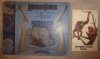
Day 15: Howletts Wild Animal Park (1976) - Asian hoofstock in parkland
Page count: 40
Photographs: 48 (including one double-page image and 11 full-page images)
Illustrations/diagrams: 37 (including two double-page diagrams)
Layout: General overview of the Aspinall family, the manor and parkland, and species holdings.
Map: N/A
This time, a guidebook giving a rather interesting insight into the early years of a collection - and zoological organisation - which has been discussed with quite some regularity on Zoochat in the last decade or so! This is one of my more recent acquisitions, having come to me a year or two through an eBay user who was (and still is) one of the most reliable sources for rare and unusual zoo paraphernalia, having worked in the zoo and conservation world for several decades - a fairly significant portion of my collection of annual reports, maps and zoo inventories has been purchased from him over the years, but I've also been quite a regular customer of his when zoo guidebooks are concerned too; as it happens, my most recent purchase was from him!
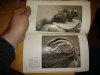
This particular item can best be termed as "short but choice" I reckon - in terms of actual textual content, there is rather less than one would expect from a guidebook covering a total of 40 pages, but this is more than balanced out by a large number of photographs in full colour, as well as numerous small drawings and diagrams in the section discussing animal species held at Howletts at the time of publication. Overall, the guidebook can be broken down into five distinct segments, which I shall discuss in turn. The first of these, a segment of which is visible below, is a general overview of the collection, its history and the overall aims and "mission statement" of John Aspinall and his two zoological collections, and is appropriately enough titled
"Welcome to Howletts". Two aspects of this section particularly leap out to my eye; the emphasis being placed on the importance of breeding species in captivity to form a back-up population for eventual reintroduction once the wild environment is once again suitable (quite different from the current Aspinall policy of phasing out as many species as possible by halting all breeding, or sending entire populations of species back into the wild whether they are ready to do so or not), and the rather blase way in which John Aspinall betrays his well-known extreme right-wing political sentiments with a brief digression about the evils of "Christianity, Islam and Communism"

Beyond here we reach a pair of linked segments;
"Know the animals" and "
Where they are found"; these comprise first a summary of the various species held at Howletts at the time of publication, with each taxon represented by a small monochrome drawing/symbol and a short paragraph relating a handful of facts about the species in question, followed by a segment where these drawings, alongside short sentences relating the natural habitat of the species in question, are numbered and used as the key for a pair of diagrams (one showing Africa and the Indian subcontinent, and the other the entire world) showing the rough location where these species occur in the wild. These diagrams, although informative at a very broad level, are fairly inaccurate and awkward to reference - several numbers are used multiple times to reflect the wider range of some species, occasionally in areas which are not correctly placed; as such, the first segment, where the species are initially discussed, is superior in my opinion.
The next portion of the guidebook, "
Friends of the family", comprises a fairly lengthy segment - eight pages in total - devoted to the Aspinall family and their close bond with the animals in their care.... or to put it another way, after a few paragraphs discussing various animals with which John and his children were in regular close contact, and a section on the animals handreared by keepers at Howletts - featuring the rather revealing line "our keepers and their women-folk" - we are presented with a dozen photographs showing various members of the extended Aspinall family (including all three of his children, his mother, and his Osborne half-siblings) kissing and cuddling chimpanzees, gorillas, leopards, wolves and tigers. Given the fact that several keeper deaths occurred due to incidents involving tigers at Howletts in the decades following the publication of this guidebook, the lattermost category of photographs is particularly startling to look at with hindsight!

Beyond here, there is a segment devoted to discussing the history of the manor and surrounding parkland within which the collection is situated, also going into some detail on the various trees planted throughout over the centuries, and the deliberate choice to focus on Asian hoofstock in the central "deer park" rather than African species, as was - and still is - the case at many safari parks in the UK. Unsurprisingly, then, this portion of the guide has the title "
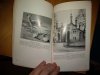
Howletts beautiful parkland" and is fittingly illustrated by numerous images of the various species of hoofstock displayed at the collection, along with a double-page image showing Howletts Manor and the surrounding woodland - as can be seen below.
The final section - and, where written text is concerned, the briefest - is simply called "
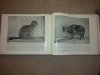
The Howletts Collection", and comprises nothing more nor less than three short paragraphs once again introducing the collection, followed by 14 pages of full-colour (and often full-page) photographs showing various species held at Howletts at the time of publication, from the various big cats and gorillas to oddities such as Ratel, Fisher and Bengal Tiger - the latter of which, at the time in question, may have even been genuine. In many ways this section, along with the earlier brief overview of species held at Howletts and the discussion of the parkland within which it is located, can be seen as the de-facto "heart" of the guidebook and the main focus as far as the zoo-guide enthusiast is concerned, with the remaining sections being more applicable to those wishing to understand the individuals involved with the collection... both past and present!


This, then, is a rather interesting and revealing guidebook - it is well-designed and attractively-formatted, even if the sections detailing the animal collection have their flaws as already discussed, and the choice of photographic material throughout is excellent. The only real fault with the guidebook is that, fairly unusually for items published at this time in the UK, it entirely omits any map or other such material giving an impression of the layout of the collection itself, and similarly no photographic material giving an insight into enclosure design or appearance is present. Overall, though, definitely an item which is worth picking up by anyone with an interest in the collection, or in UK collections in general!


 I know you intended this to be random, but for engagement it might be better to do place by place. That way you're not repeating background stuff in the future, and people aren't waiting to see if something is covered in a previous or newer edition.


 and by all means upload an image of the map - it will be very interesting to post within this thread as comparison to the later map uploaded by Vogelcommando, and the earlier map in my possession (which I reckon I will upload ASAP rather than waiting to see if the guidebook it came with comes up randomly.