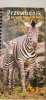
Day 26: Western Plains Zoo (c.1977) - Animals of the Western Plains Zoo
Page count: 14 (including inner covers)
Photographs: N/A
Illustrations/diagrams: 45 silhouette illustrations
Layout: Brief introduction to zoo and visitor information, followed by summary of species held across collection
Map: Located on back cover of guidebook
Another short but choice item this time round, representing the first time we have taken a look at an item from Australia - and indeed the Southern Hemisphere. To the best of my knowledge this guidebook was issued in the first year or so that Western Plains Zoo was open, and acted as a supplement to a larger and more comprehensive guidebook which could be purchased at the giftshop; although I cannot prove this, and have been unable to track down anyone else who owns a copy of this guidebook to verify my suspicions, I would not be surprised if this guidebook was given out for free alongside admission given the fact it promotes the larger guidebook within, includes a collection map and (barring the introductory pages) more or less comprises a detailed summary of the species held at the collection, with each entry illustrated by a simple drawing which corresponds with one on the map.

After the above brief introduction to the zoo, which as one can see is accompanied by various items of useful information aimed at the visitor, such as entry times, parking facilities and so forth, along with the various rules and regulations relating to entry to the zoo, the guidebook enters into the main body of the text. This comprises a walkthrough account of the species held at Western Plains Zoo at the time of publication, separated into rough geographic areas corresponding to those comprising the various zones of the collection, followed by discussion of the assorted native water birds displayed within the various lakes and wetland exhibits present within the Australian zone of the zoo. Given the fact that this item represents a fairly significant record of the species held at Western Plains Zoo at the time it first opened, something which may be of particular interest to those Australian and Kiwi members of the forum who may be reading this thread, I feel it will be worthwhile to make a note within this post of the full species list as presented within this guidebook. As such, as well as posting images taken from this section of the guidebook - and discussing the species accounts in more general terms - I shall provide a full species list as noted.

Where the geographic species accounts are concerned - split into "Africa", "Eurasia", "North America", "Australia" and "South America" sections respectively - the first key aspect that should be noted is the fact that the vast majority of the accounts were accompanied by simplified silhouettes of the species under discussion, which correspond to similar silhouettes presented within the collection map itself; as such, these accounts almost serve as the key to the map, allowing the location of various species held at the collection to be presented along with notable information about the taxa in question, whilst not overly clogging the map up with extraneous information. By and large, the information presented within is succinct but informative, giving key information on the wild range of the species, aspects of their diet, reproductive cycle and other such points of interest, and often providing specific information about the individuals held at Western Plains, or the long-term plans held by the collection regarding the taxa in question. For instance, in a section discussing the albino Red-necked Wallabies held at the collection, it is stated that "
the group at Western Plains Zoo is descended from albino specimens which were collected and bred by Sir Edward Hallstrom, the former Honorary Director of Taronga Zoo".
Beyond here, the section discussing the various water birds held in the collection at the time of publication omits the silhouette illustrations, but otherwise follows much the same general format in terms of the level of detail provided - if not perhaps slightly more detailed than those sections immediately preceding them, perhaps a deliberate choice to compensate for the lack of illustration. The text divides the taxa in question into six very rough categories; "very large swimming birds", "large swimming birds", "grazing waterfowl", "medium sized swimming birds "small swimming birds" and "large wading birds"; by no means the most scientifically sound way to divide the water birds held at Western Plains, but certainly one well-suited to the overall purpose.
Species stated to be present within the collection at the time of publication are as follows, with common and scientific names replicated precisely:
Cheetah (Acinonyx jubatus)
Barbary Sheep (Ammotragus lervia)
Arabian Camel (Camelus dromedarius)
Southern Ostrich (Struthio camelus australis)
Sitatunga (Tragelaphus spekei)
Giraffe (Giraffa camelopardalis)
Eland (Taurotragus oryx)
Grants Zebra (Equus burchelli boehmi)
Southern White Rhinoceros (Ceratotherium simum simum)
Hippopotamus (Hippopotamus amphibius)
African Elephant (Loxodonta africana)
African Hunting Dog (Lycaon pictus)
Helmeted Guineafowl (Numidia mitrata)
---
Persian Onager (Equus hemionus onager)
Asiatic Water Buffalo (Bubalus bubalis)
Indian Antelope (Antilipe cervicapra)
Sambar Deer (Cervus unicolor)
Chital Deer (Axis axis)
Javan Rusa (Cervus timorensis russa)
Przewalski Horse (Equus przewalski)
Banteng (Bos javanicus)
Tiger (Pathera tigris)
Entellus Langur (Presbytis entellus)
Lar Gibbon (Hylobates lar)
Blue Peafowl (Pavo cristatus)
Red Deer (Cervus elaphus)
Fallow Deer (Dama dama)
---
Wapiti (Cervus elephus canadensis)
White-tailed Deer (Odocoileus virginianus)
American Bison (Bison bison)
North American Turkey (Meleagris galloparvo)
---
Dingo (Canis familiaris dingo)
Koala (Phascolarctos cinereus)
Red Kangaroo (Macropus rufus)
Western Grey Kangaroo (Macropus fuliginosus)
Eastern Grey Kangaroo (Macropus giganteus)
Red-necked Wallaby (Macropus rufogriseus)
Albino Bennet's Wallaby (Macropus rufogriseus fruticus)
Eastern Wallaroo (Macropus robustus)
Emu (Dromaius novaehollandia)
---
Llama (Lama glama)
Common Rhea (Rhea americana)
Central American Spider Monkey (Ateles geoffroyi)
Mara (Dolichotis patagonum)
Galapagos Tortoise (Geochelone elephantopus)
Maned Wolf (Chrysocyon brachyurus)
---
Australian Pelican (Pelecanus conspicillatus)
Black Swan (Cygnus atratus)
Large Black Cormorant (Phalacrocorax carbo)
Large Pied Cormorant (Phalacrocorax varius)
Little Black Cormorant (Phalacrocorax sulcirostris)
Little Pied Cormorant (Phalacrocorax melanoleucos)
Mountain Shelduck (Tadorna tadornoides)
Cape Barren Goose (Cereopsis novaehollandiae)
Black Duck (Anas superciliosa)
Chestnut-breasted Teal (Anas castanea)
Grey Teal (Anas gibberifrons)
Pink-eared Duck (Malacorhynchus membranaceus)
Musk Duck (Biziura lobata)
Little Grebe (Tachybaptus novaehollandiae)
Hoary-headed Grebe (Poliocephalus poliocephalus)
Dusky Moorhen (Galinula tenebrosa)
Australian Wood Duck (Chenonetta jubata)
White-necked Heron (Ardea pacifica)
White-faced Heron (Ardea novaehollandiae)
White Ibis (Threskiornis molucca)
Straw-necked Ibis (Threskiornis spinicollis)
The guidebook concludes by providing a short list of relevant books on native Australian wildlife and wider zoological matters which may be of interest to anyone visiting Western Plains Zoo and desiring further information, along with a map of the collection located on the back cover. As can be seen above, this is fairly well-labelled both with the animal silhouettes of which I spoke earlier, and various symbols denoting the location of first aid, toilet facilities, information kiosks, picnic areas and so forth; all things considered I think this is a very good map, and indeed a very good guidebook given the fact that (as noted) it originates from the very earliest days of the collection, when it can be reasonably assumed that it was still developing and establishing itself. I would be very interested to hear whether any Antipodean Zoochatters visited the collection during the timespan in question -
@Hix perhaps? - and if so whether they would be able to share their thoughts and recollections... although of course, feedback from *anyone* would be more than welcome, whether they have visited the collection during this timespan, at a later point or indeed not at all!
It is also worth once again noting here that if anyone has comments or remarks about a previously-discussed guidebook, don't be deterred by the fact the thread has progressed in the intervening time; I would be more than happy to resume discussion of any given guidebook or collection whenever required! In other words, you don't have to get your thoughts or feedback written up immediately - this is a project to prompt leisurely discussion and debate, not discussion with a deadline!

 it's long enough ago since I last visited London Zoo (and my total visits few enough in number) that my memories of that aviary were too vague for me to put two-and-two together!
 as I've noted a few times now, there are several guidebooks for several collections which contain directions on how to reach them!

 )
)