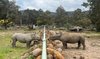
Australasian Rhino Population

Whipsnade have similarly experienced success with two breeding females; though few can compare to the success experienced by the herd at Basel Zoo (from which Dubbo’s bull descends).
Whipsnade is an interesting case. They first bred the species(Indian rhino) the year after Basel in the 1950's, so becoming the second zoo in the world to do so. In fact their first calf(female Mohiniji)) and Basel's first calf(male Rudra) were sent together to Milwaukee in USA to form a new pair but never bred there. The story goes that with the next breeding, where the sexes of the calves was reversed (Whipsnade; the male, Basel;the female), ZSL later approached Basel again with a view to forming another pair to send away. But Dr Lang, the then Basel director wouldn't pay ball this time- they were going to keep their female calf as a second breeding female! This was Moola.

Whipsnade then later bred several from another(single) pair Kumar & Roopa( both unrelated to their original breeding) during the 1970-80's period but only about half those calves produced survived.

The two females they currently have, Behan and Beluki, arrived in the 1990's(?) as part-grown animals from Nepal (all their others, and most other founder Indian rhinos in zoos, came from Assam) They were some sort of political gift I think, from the King of Nepal and they were first housed at London Zoo and only moved to Whipsnade sometime later. Why they sent two females rather than a male/female pair I don't know, as it was then several years after they were already fully adult,and already aged about 10-11, before they acquired a bull- the first one 'Jaffna', was actually Basel's stud bull at the time but they didn't need him for a while as they had calves at Basel. He bred successfully with both Whipsnade females, then later was returned to Basel Zoo. Their current bull 'Hugo' came from Rotterdam I believe. A couple of years ago, a female calf was born which I saw when it was very young. It could well be the last Indian rhino born at Whipsnade for some time- both the adult females must be approaching post-reproductive status, the other one already has I believe.
 
Last edited:
Whipsnade is an interesting case. They first bred the species(Indian rhino) the year after Basel in the 1950's, so becoming the second zoo in the world to do so. In fact their first calf(female Mohiniji)) and Basel's first calf(male Rudra) were sent together to Milwaukee in USA to form a new pair but never bred there. The story goes that with the next breeding, where the sexes of the calves was reversed (Whipsnade; the male, Basel;the female, ZSL later approached Basel again with a view to forming another pair to send away. But Dr Lang, the then Basel director wouldn't pay ball this time- they were going to keep their female calf as a second breeding female! This was Moola.

Whipsnade then later bred several from another(single) pair Kumar & Roopa( both unrelated to their original breeding) during the 1970-80's period but only about half those calves produced survived.

The two females they currently have, Behan and Beluki, arrived in the 1990's(?) as part-grown animals from Nepal (all their others, and most other founder Indian rhinos in zoos, came from Assam) They were some sort of political gift I think, from the King of Nepal and they were first housed at London Zoo and only moved to Whipsnade sometime later. Why they sent two females rather than a male/female pair I don't know, as it was then several years after they were already fully adult, before they acquired a bull- the first one 'Jaffna', was actually Basel's stud bull at the time but they didn't need him for a while as they had calves at Basel. He bred successfully with both Whipsnade females, then later was returned to Basel Zoo. Their current bull 'Hugo' came from Rotterdam I believe. A couple of years ago, a female calf was born which I saw when it was very young. It could well be the last Indian rhino born at Whipsnade for some time- both the adult females must be approaching post-reproductive status, the other one already has I believe.

Beluki and Behan were estimated to have been born 1996 in the wild. They arrived at London Zoo 29/04/1997; and were transferred to Whipsnade Zoo 29/09/1998 and 03/11/1998 respectively.

These were their births:

Beluki:

1.0 Rap (2007)
0.1 Karamat (2010)

Behan:

0.1 Asha (2006)
1.0 Ajang (2010)
1.0 Jamil (2012)
1.0 Bali (2015)
0.1 Zhiwa (2019)

Both females are now retired from breeding. Beluki was unable to breed due to uterine cysts. It was decided not to operate, though that was potentially an option.
 
Thanks for the fill-in information.

I think Rap is now the breeding male at West Midlands Safari Park.
Asha is the breeding female at Chester.

As a child I saw the first calf born at Whipsnade- female Mohinija- back in either 1957-8. And then Zhiwa just a couple of years ago- as I said, she is possibly the last calf born there for some time to come until new breeding animals replace the current (now) non-breeding females who may go on to live for some long while yet.
 
Last edited:
Thanks for the fill-in information.

I think Rap is now the breeding male at West Midlands Safari Park.
Asha is the breeding female at Chester.

No problem.

Yes, that’s correct. Rap sired a male calf in 2020; while Asha gave birth to a female calf in 2013 and a male calf in 2018. These were the first two of their species to be born at Chester Zoo.
 
So what is the parentage of the Indian rhino bull at Dubbo?
Dora (Parentage)

Dora was born to Sanver and Nilgiri 14/08/1999 at the Nagoya Higashiyama Zoo.

Sire:

Saver was born 12/09/1971 at Assam State Zoo.

Saver was born to Shivaji (wild born 00/00/1955) and Padmini (wild born 00/00/1956).

Dam:

Nilgiri was born 23/10/1990 at Basel Zoo.

Niligiri was born to Chitawan (born at Basel Zoo 11/01/1990) and Tanaya (born at Basel Zoo 24/08/1971).

Chitawan was born to Arjun (wild born 00/00/1957) and Tanaya (born at Basel Zoo 24/08/1971).

Tanaya was born to Arjun (wild born 00/00/1957) and Joymothi (wild born 00/00/1957)
 
From Taronga Western Plains Zoo

"We are devastated to announce the sudden recent passing of two-year-old White Rhino Meeka.
Meeka experienced an acute illness and while the entire team acted swiftly to provide support and care, she tragically passed away.
The whole Taronga family is in shock at Meeka’s death, and her loss is deeply upsetting to our team of dedicated keepers, vets, volunteers and other zoo staff who cared for her.
Meeka was a charismatic and captivating Rhino and had a special place in our hearts having been born here at the Zoo in 2019. Meeka is remembered as a friendly rhino who loved getting a scratch from her Keepers.
A thorough investigation into the cause of Meeka’s illness is currently underway.
Please leave a message of condolence and support below. Thank you."

very tragic indeed :(
 
From Taronga Western Plains Zoo

"We are devastated to announce the sudden recent passing of two-year-old White Rhino Meeka.
Meeka experienced an acute illness and while the entire team acted swiftly to provide support and care, she tragically passed away.
The whole Taronga family is in shock at Meeka’s death, and her loss is deeply upsetting to our team of dedicated keepers, vets, volunteers and other zoo staff who cared for her.
Meeka was a charismatic and captivating Rhino and had a special place in our hearts having been born here at the Zoo in 2019. Meeka is remembered as a friendly rhino who loved getting a scratch from her Keepers.
A thorough investigation into the cause of Meeka’s illness is currently underway.
Please leave a message of condolence and support below. Thank you."

very tragic indeed :(

Very sad. This is the fourth juvenile we’ve lost in as many years:

2018 - Tundu died at 18 months
2019 - Imani died at 11 months
2021 - Eshe died at 15 months
2022 - Meeka died at 33 months

Curiously, the thing these deaths have in common is that the calves were all housed in a herd with Satara. He was at Monarto Zoo, where the first three calves died; and was then transferred to Dubbo, where Meeka has now died.

I’m mentioning this purely as coincidence, as it appears Meeka died of an illness; but there were links between the previous three deaths (see Post #48 of this thread) - the calves sustained injuries consistent with trauma around the age of weaning or when the bull would be trying to mate with the cow again (Satara was transferred to Dubbo for breeding).
 
Very sad. This is the fourth juvenile we’ve lost in as many years:

2018 - Tundu died at 18 months
2019 - Imani died at 11 months
2021 - Eshe died at 15 months
2022 - Meeka died at 33 months

Curiously, the thing these deaths have in common is the calves were all housed in a herd with Satara. He was at Monarto Zoo, where the first three calves died; and was then transferred to Dubbo, where Meeka has now died.

I’m mentioning this purely as coincidence, as it appears Meeka died of an illness; but there were links between the previous three deaths (see Post #48 of this thread) - the calves sustained injuries consistent with trauma around the age of weaning or when the bull would be trying to mate the cow again.

Is there any connection with them all being female calves? Also, have any other zoos suffered the same issues with calves dying around weaning in either N.America or Europe?
 
Is there any connection with them all being female calves? Also, have any other zoos suffered the same issues with calves dying around weaning in either N.America or Europe?

No, I believe the fact they’re all female is of no significance. There were no male calves at Monarto around that time frame and Meeka was similarly Dubbo’s only juvenile.

There’s undoubtably been cases in zoos overseas (though I’m not aware of any specific cases). Bulls can lose patience pretty rapidly if a calf is getting in the way of their attempts to mate with its mother. There’s footage of this occurring in the wild too: WATCH: Rhino attacks calf in mating fight

Other juveniles have died at a similar age in the region, but the cause was attributed to bacterial infections, tetanus etc.
 
I’m mentioning this purely as coincidence, as it appears Meeka died of an illness; but there were links between the previous three deaths (see Post #48 of this thread) - the calves sustained injuries consistent with trauma around the age of weaning or when the bull would be trying to mate with the cow again (Satara was transferred to Dubbo for breeding).

Maybe injuries already sustained could've resulted in a quick onset of infection? I've seen many cases where this has occurred with animals.

Since Mopani is their only viable female now, it's possible Satara was introduced to Mopani and Meeka recently. It'll be interesting to get an exact confirmation of what caused her death, but it's very sad news. Female calves haven't had the best luck within our region in recent years.
 
Dam:

Nilgiri was born 23/10/1990 at Basel Zoo.

Niligiri was born to Chitawan (born at Basel Zoo 11/01/1990) and Tanaya (born at Basel Zoo 24/08/1971).

Chitawan was born to Arjun (wild born 00/00/1957) and Tanaya (born at Basel Zoo 24/08/1971).

Tanaya was born to Arjun (wild born 00/00/1957) and Joymothi (wild born 00/00/1957)

This was during the period Basel were producing inbred calves...her parents were mother/son, while her father was also her half-brother!
 
Maybe injuries already sustained could've resulted in a quick onset of infection? I've seen many cases where this has occurred with animals.

It’s possible, though rhinos have such thick skin, any injury severe enough to lead to infection would result in significant trauma. The calves at Monarto died of causes related to internal bleeding for example, which would have killed them long before any infection had chance to set in.

If Meeks’s illness wasn’t a result of trauma, my money would be on a food or soil contaminant. This seems to be a common cause of death within the region.
 
0.1 Kamari the Southern White Rhino at Taronga Western Plains Zoo has died due to pneumonia. Rather distressing news as it leaves the zoo without any young Dubbo-born females following the death of Meeka. There are only two female white rhino left at Dubbo now - reported on social media.
 
1.0 Kingston the Southern White Rhino has been transferred to Halls Gap Zoo, Victoria from his birthplace of Australia Zoo. There are now two male rhinos at Halls Gap - reported on social media.

This transfer has additional significance in confirming Hamilton Zoo’s plans to transfer Samburu (2016) to Halls Gap Zoo have been canned - as was suspected given Trans-Tasman transfers resumed some time ago.

With Hamilton Zoo advised to stop breeding, we’ll likely see them retain Samburu and maintain a herd of 2.4 Southern white rhinoceros.

It’s also interesting to note that despite being the region’s most successful breeding cow to date (eight calves), only one of Caballe’s five surviving calves is now in a breeding situation.
 
I am surprised considering a number of regional zoos are/have had problems keeping bulls together that this is still being recommend I can't see the benefit of it. This may work with elephants but these are not like elephants!
 
I am surprised considering a number of regional zoos are/have had problems keeping bulls together that this is still being recommend I can't see the benefit of it. This may work with elephants but these are not like elephants!

Don’t worry, Halls Gap Zoo are keeping them in seperate exhibits.

Like you say, bachelor herds of bulls introduced young or from the same herd rarely work out; introducing strangers (one of which is an adult bull) would hold an even greater potential for conflict, so there was never any question of integrating them.

upload_2022-9-22_20-46-13.jpeg
Photo source: Halls Gap Zoo
 

Attachments

  • upload_2022-9-22_20-46-13.jpeg
    upload_2022-9-22_20-46-13.jpeg
    113.9 KB · Views: 37
Back
Top