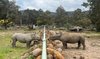
Whipsnade is an interesting case. They first bred the species(Indian rhino) the year after Basel in the 1950's, so becoming the second zoo in the world to do so. In fact their first calf(female Mohiniji)) and Basel's first calf(male Rudra) were sent together to Milwaukee in USA to form a new pair but never bred there. The story goes that with the next breeding, where the sexes of the calves was reversed (Whipsnade; the male, Basel;the female), ZSL later approached Basel again with a view to forming another pair to send away. But Dr Lang, the then Basel director wouldn't pay ball this time- they were going to keep their female calf as a second breeding female! This was Moola.Whipsnade have similarly experienced success with two breeding females; though few can compare to the success experienced by the herd at Basel Zoo (from which Dubbo’s bull descends).
Whipsnade then later bred several from another(single) pair Kumar & Roopa( both unrelated to their original breeding) during the 1970-80's period but only about half those calves produced survived.
The two females they currently have, Behan and Beluki, arrived in the 1990's(?) as part-grown animals from Nepal (all their others, and most other founder Indian rhinos in zoos, came from Assam) They were some sort of political gift I think, from the King of Nepal and they were first housed at London Zoo and only moved to Whipsnade sometime later. Why they sent two females rather than a male/female pair I don't know, as it was then several years after they were already fully adult,and already aged about 10-11, before they acquired a bull- the first one 'Jaffna', was actually Basel's stud bull at the time but they didn't need him for a while as they had calves at Basel. He bred successfully with both Whipsnade females, then later was returned to Basel Zoo. Their current bull 'Hugo' came from Rotterdam I believe. A couple of years ago, a female calf was born which I saw when it was very young. It could well be the last Indian rhino born at Whipsnade for some time- both the adult females must be approaching post-reproductive status, the other one already has I believe.
Last edited: