America's 100 Must See Exhibits

What are the current primate species exhibited?
The most recent species list done by @Coelacanth18 shows the following: Angolan colobus, mandrill, Schmidt’s red-tailed monkey, tufted capuchin, lion-tailed macaque, DeBrazza's monkey, Wolf's Monkey, and lesser spot-nosed monkey.

I also concur that the the area is extremely challenging to get through. Even after to several visits I've yet to find the pygmy hippo and crocodile exhibits. However, I think that's part of the areas charm. There's a real feeling of exploration and not knowing what you'll come across next which is much more exciting than being on a set path.
 
also concur that the the area is extremely challenging to get through. Even after to several visits I've yet to find the pygmy hippo and crocodile exhibits. However, I think that's part of the areas charm.
Really? This isn't a reflection on whether it is "must see" or not, but surely a visitor not being able to find the exhibits isn't so much a charm as a failing?
 
Really? This isn't a reflection on whether it is "must see" or not, but surely a visitor not being able to find the exhibits isn't so much a charm as a failing?
Agreed. I would be very frustrated by a zoo if I was unable to find all of the exhibits. A strong logical layout, proper directional signage, and an easy-to-read map should all be a must for any zoo.
 
I also concur that the the area is extremely challenging to get through. Even after to several visits I've yet to find the pygmy hippo and crocodile exhibits. However, I think that's part of the areas charm. There's a real feeling of exploration and not knowing what you'll come across next which is much more exciting than being on a set path.

While I do like exploration feeling in the Lost Forest, for a zoo with so much to see, having to spend lots of time back tracking and planning where to go can result in not seeing many of the other exhibits.
 
Really? This isn't a reflection on whether it is "must see" or not, but surely a visitor not being able to find the exhibits isn't so much a charm as a failing?

I've still never seen Pygmy Hippo because I never did find the right path to them. Most of that area is two story paths that intermix and are surrounded by bamboo and trees far taller still. Which makes it nigh impossible to see what's around the corner and sometimes even down below. The area itself is super impressive in appearance, but the sheer complexity is a bit of a drawback.
 
San Diego is a difficult zoo to navigate in general, and that area is probably the worst it gets. It would be less of an issue if the zoo were smaller, I think; it's definitely frustrating to get turned around a lot when getting the zoo fully completed is already a tall order. I planned my trip and routes around the zoo the week before, and I still probably lost a bit of time because of it.

That being said, I think I get what @pachyderm pro means by it being "part of the charm". Yes, the area is laid out chaotically and it's easy to miss things; however, it would be a very different area if they had just made a simple loop with the same enclosures - I'd argue maybe worse, certainly more generic. The zoo gets crowded enough as is, so having infinite options for moving around helps prevent crowd blockages. This also provides opportunity to meander down a side path and find yourself alone at a small aviary with birds you've never seen or heard of before, or a monkey you saw from above earlier suddenly staring down at you from the canopy. It's not efficient, but it is a valuable and rewarding experience nonetheless.
 
It’s really not that hard to find if you pin point it on the map the problem is it’s put in a very inconvenient spot. That path isn’t a part of treetops trails complex and is instead the bridge between the African great apes and the Australasian birds/Parker aviary. The problem is right before you hit the right turn to see the hippos and crocodiles (at the end of treetops trail) is the scrips aviary and even if you get past that the gorillas are right in front of you. So to walk through that area and see everything you have to back track a lot. I’ve always considered the inconvenience of the lost forests chaos as a way to add to the idea that you see something new everytime you go to the zoo or aquarium. It’s meant for people who go to zoos to explore and learn. It wouldn’t be much of a lost forest if you didn’t get lost every now and then. It adds to the experience of the are and enhances it for normal guests.
 
I also concur that the the area is extremely challenging to get through. Even after to several visits I've yet to find the pygmy hippo and crocodile exhibits. However, I think that's part of the areas charm. There's a real feeling of exploration and not knowing what you'll come across next which is much more exciting than being on a set path.

I've been a member of the San Diego Zoo for 25 years and after all that time, the middle of the zoo is still a nightmare to navigate. I wouldn't call it charm; it is very bad design. To the zoo's credit they have an army of docents around there to help people find their way around, but it is still not fun to get lost and have to double back.
 
I enjoy the exhibit not despite the fact that you can get lost in it but because you can. I've seen it 4 times, and it seems different every visit. San Diego has an unfair advantage with the vegetation it can sustain. They do a great job with it IMO.
 
11. Promedica Museum of Natural History
Toledo Zoo, OH
Opened: 1938 (Completely Renovated in 2019)
Size: 66,000 Square Feet (6,130 Square Meters)
Inhabitants: >110 ectotherms, plus a few birds.


When this colossal WPA era building was first erected, it primarily served as an education center where animals were an afterthought. Now it’s a museum, herpetarium, insectarium, and aquarium fusion unrivaled anywhere else in the country. A two-story atrium was added in the renovation and features different free-ranging species that will make themselves visible depending on the humidity levels, including white-throated ground doves, hummingbirds, butterflies, day geckos and dart frogs. What follows is an elaborate series of halls featuring dozens and dozens of fascinating species and several rarities found in few zoos worldwide. The diversity here is unparalleled and everything from Komodo dragons to rhinoceros beetles is displayed extremely professionally. There are taxonomically sorted displays such as two different halls for venomous ectotherms and an incredibly diverse arthropod room with an enormous coconut crab habitat as the main attraction. The Oak Forest room gives visitors the perspective of an ant by including super-sized statues of amphibians and invertebrates above their live counterparts. There is also a gallery for hellbenders and minnows with streams that flow through interconnected habitats. The actual museum aspect of the building isn’t lost among all of the animal habitats either. The centerpiece of the facility is an exhibition on Ohio during the Pleistocene era, complete with life-size models of extinct species in contrast to their living relatives. With enough ecological and interpretive displays to make your head spin, there is so much to see in this one building that one could spend their entire day discovering it all.

full

@Milwaukee Man
full

@Moebelle
full

@Moebelle
full

@Moebelle
full

@Moebelle
full

@Moebelle
full

@Moebelle
full

@Moebelle

Similar Exhibits: None. At least certainly nothing at this scale.
 
One of the few exhibits in a US Zoo that seem as though they could be entire zoos in their own right. While I've never visited Toledo Zoo, it's high on my list- chiefly because of some of their incredible indoor exhibits, such as this one and the aviary.
 
The museum was closed for renovations when I last went. I hadn’t considered the museum worth returning for, but I suppose you’ve changed my mind.
 
10. Monkey Trails and Forest Tales
San Diego Zoo, CA
Opened: 2005
Size: 3 Acres (1.2 Hectares)
Inhabitants: A wide array of primates, Pygmy Hippo, Babirusa, Slender-snouted Crocodile, and a variety of birds and herps.


This maze of upper and lower walkways through dense tropical rainforest perfectly encapsulates what makes San Diego so special. The zoo is widely regarded as one of greatest facilities for primates in America and the series of multi-leveled monkey habitats is to thank for that reputation. There is often debate about if islands or cages are the best way to exhibit primates and this exhibit makes a very good case for the latter. Every exhibit is essentially a large netted cage, generous in both floor space and height. The cages give the primates great verticality by allowing access to several live trees within the exhibits themselves, enabling them to get eye-to-eye with visitors from both levels. Viewing for the lower level of the primate habitats is on the forest floor alongside a few aviaries and a wall of vivaria, plus several interconnected babirusa paddocks located under the visitor pathways. The pygmy hippo and wolf’s guenon exhibit is a clear highlight even if the space for the hippos isn’t huge and the adjacent crocodile pool is just as attractive. An exhibit like this is impossible to accomplish at many places and creates an atmosphere the average rainforest house cannot.

full

@Moebelle
full

@Moebelle
full

@Moebelle
full

@Moebelle
full

@Moebelle
full

@Moebelle

Similar Exhibits: If you were wondering what this exhibit would look like if it was done in the midwest instead of the west coast, look no further than Primate Canopy Trails at Saint Louis Zoo. It’s a similar concept being a series of multi-tiered mesh primate enclosures viewed from multiple vantage points. The complex is connected to the zoo's historic primate house and every enclosure is rotational. There is an even greater diversity in primates here, but there aren’t any complimenting species beside them and of course everything is much more exposed without the lush vegetation of Southern California.

full

@Moebelle
full

@pachyderm pro
full

@pachyderm pro
full

@pachyderm pro
I can vouch for St. Louis's primate canopy trails being a good honorable mention. Watching a Geoffroy's marmoset 'hunt' earthwormsworms by diving from a climbing structure was one of the most interesting zoo experiences I've had.

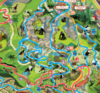
Regarding SDZ's monkey trails, I planned out this route a while back:
upload_2023-1-3_18-11-39.png
If I remember everything correctly, it technically should go past all of the exhibits, but this route planning obsession of mine all started after visiting SDZ, really. I attempted a similar route back when I was there nearly 10 years ago, and it was like a corn maze- quite difficult to navigate through/orient yourself. I think it did add to the charm, though. A sort of meta-theming literally placing you in the LOST forest
 

Attachments

  • upload_2023-1-3_18-11-39.png
    upload_2023-1-3_18-11-39.png
    743.5 KB · Views: 191
Last edited:
I can vouch for St. Louis's primate canopy trails being a good honorable mention. Watching a Geoffroy's marmoset 'hunt' earthwormsworms by diving from a climbing structure was one of the most interesting zoo experiences I've had.

Regarding SDZ's monkey trails, I planned out this route a while back:
View attachment 599222
If I remember everything correctly, it technically should go past all of the exhibits, but this route planning obsession of mine all started after visiting SDZ, really. I attempted a similar route back when I was there nearly 10 years ago, and it was like a corn maze- quite difficult to navigate through/orient yourself. I think it did add to the charm, though. A sort of meta-theming literally placing you in the LOST forest
What a coincidence! After getting lost on my 2012 visit, I used this exact route on my 2019 San Diego trip.
 
  • Like
Reactions: CMP
11. Promedica Museum of Natural History
Toledo Zoo, OH
Opened: 1938 (Completely Renovated in 2019)
Size: 66,000 Square Feet (6,130 Square Meters)
Inhabitants: >110 ectotherms, plus a few birds.


When this colossal WPA era building was first erected, it primarily served as an education center where animals were an afterthought. Now it’s a museum, herpetarium, insectarium, and aquarium fusion unrivaled anywhere else in the country. A two-story atrium was added in the renovation and features different free-ranging species that will make themselves visible depending on the humidity levels, including white-throated ground doves, hummingbirds, butterflies, day geckos and dart frogs. What follows is an elaborate series of halls featuring dozens and dozens of fascinating species and several rarities found in few zoos worldwide. The diversity here is unparalleled and everything from Komodo dragons to rhinoceros beetles is displayed extremely professionally. There are taxonomically sorted displays such as two different halls for venomous ectotherms and an incredibly diverse arthropod room with an enormous coconut crab habitat as the main attraction. The Oak Forest room gives visitors the perspective of an ant by including super-sized statues of amphibians and invertebrates above their live counterparts. There is also a gallery for hellbenders and minnows with streams that flow through interconnected habitats. The actual museum aspect of the building isn’t lost among all of the animal habitats either. The centerpiece of the facility is an exhibition on Ohio during the Pleistocene era, complete with life-size models of extinct species in contrast to their living relatives. With enough ecological and interpretive displays to make your head spin, there is so much to see in this one building that one could spend their entire day discovering it all.

full

@Milwaukee Man
full

@Moebelle
full

@Moebelle
full

@Moebelle
full

@Moebelle
full

@Moebelle
full

@Moebelle
full

@Moebelle

Similar Exhibits: None. At least certainly nothing at this scale.
An exhibit that has been on my radar for a while now. If I ever find myself in or around the Toledo area, I will certainly try to make a visit to this excellent complex.
 
12. Kilimanjaro Safari
Disney’s Animal Kingdom, FL
Opened: 1998
Size: 110 Acres (44.5 Hectares)
Inhabitants: Various hoofstock, African Elephant, Black Rhino, Nile Hippo, African Lion, Spotted Hyena, Mandrill, Nile Crocodile and more.


When you have an unlimited budget, year-round sunshine, and a little Disney magic on your side, you have the tools to create the ultimate drive-through savanna experience. No expense was spared when crafting one of the most detailed and genuinely beautiful recreations of the Serengeti anywhere in the world. The realism here is second to none, with everything from the vegetation to the riverbanks designed to resemble the native landscape. Dozens of hoofstock freely roam across the environment with separate enclosures for elephants, rhinos, hippos, mandrills and several large predators blending in seamlessly. The large herds of hoofstock are impressive in their own right of course, but the huge groups of elephants, hippos and crocodiles are a truly rare sight in the zoo world. Its biggest flaw is something that all drive-through exhibits can’t help but suffer from; seeing animals for a very limited amount of time. Several species are only seen for less than a minute, assuming the animals even choose to present themselves in the first place. Regardless, this is easily one of the all time greatest immersion exhibits, even if it finishes with a rather anticlimactic species; Nigerian dwarf goats.

full

@geomorph
full

@geomorph
full

@Ituri
full

@geomorph
full

@Mr.Weasel
full

@geomorph

Similar Exhibits: Drive-through savannas are hardly a novel concept and none come close to the thematic aspect of what Disney has put together, but there are a few exceptional ones that come to mind. The beautiful pastures at Busch Gardens Tampa and Fossil Rim Wildlife Center are among some of the more realistic and there are others that may appear on this list at a later time.

Busch Gardens Tampa

full

@JaxElephant
full

@snowleopard
full

@Mr.Weasel

Fossil Rim Wildlife Center

full

@Ituri
full

@jbnbsn99
full

@jbnbsn99
 
Back
Top