Baby certainly had a lot to teach to people, about its species, its evolution and ecology. Or just looking at him was amazing.
All of these being forms of value, belying your words immediately above that "
the
value of those single individuals ....is zero, I am sorry, but it is true" and that there is "
very little" educational value possible from such singletons.
The value of those single individuals, for zoo collections or breeding programmes, or even for conservation is zero, I am sorry, but it is true. Because the purpose of a modern zoo is not to have a list of species but actually what you can do with the species you hold. Fortunately, the 19th and early 20th-century mentality that a zoo is greater the more species it houses is disappearing. Because this thread sounds a bit like that old mentality.
Putting aside the possible implication that you hold the
existence of this thread in mild contempt - presumably due to the fact you've entirely misinterpreted the founding intention of the thread, which I will clarify anon- I will point out that it need not be an either/or situation.
Although I would hope that
no one on this forum wants to return to the days of overly-crowded stampbook collections held in tiny, grossly insufficient enclosures, I think that the responsibility of modern zoological collections to be centres for conservation and education is not mutually-exclusive with attempts to depict something of the wide variety of form/function in nature beyond that represented by so-called ABC species, but can be enhanced by such attempts.
For instance, one of the very best zoo exhibits I have seen within the last 12 months was the "Snakes of Croatia" complex at Zagreb, which contains a near-complete set of the snake species native to the country (missing only the European Blind Snake); of the 13 species displayed within, all but two are classified as Least Concern and (to the best of my knowledge) not all of them represent actively-breeding populations. As such, if the value of a species or exhibit is restricted to whether it is contributing to conservation or an ongoing breeding programme, the exhibit would be worthless. But this is very much not the case; as far as I am concerned there is a massive amount of value in having a well-presented, attractive and near-comprehensive display of the variety found within a single country, and I would also argue that displays such as this *do* contribute to conservation in their own way through providing a greater appreciation and knowledge of the natural world in its entirety. When the presence of a species within captive collections is ephemeral, it is no bad thing to lament the imminent loss - even when, as is the case with the Bearded Pig, they were phased out for a good reason - but nonetheless appreciate the diversity they represent whilst we have them, and be thankful we *had* them once we no longer do

To return to my point about the intended purpose of this thread and the "original" incarnation which is linked within the first post, the following two items of information have a strong bearing on the matter:
1) I am autistic, and one of my "things" is a massive interest in the preservation, collection and distribution of historical information. See also my thread devoted to zoological guidebooks, for instance.
2) In the early years of this forum, it contained rather more members falling into two categories than is the case now: individuals from continental Europe familiar with the zoological collections there, and individuals worldwide who had been visiting (or working in) zoological collections for several decades and therefore had collected a wide amount of information both anecdotal and documentary about exhibits and species present from the mid-20th century onwards. As a result, the Zoochat gallery contained a significant number of historical photographs at the time.
Unfortunately, in late 2010 the forum owner discovered that the gallery was taking up a lot more server space than realised, and that the hosting provider needed to free up space with some urgency - as such, he deleted over 50,000 photographs from the gallery using an automatic process which selected the least-viewed images. These, unfortunately, tended to be those taken historically or at more obscure zoological collections. Worse, the backups made with the hope of restoring the photographs once a better hosting solution for the gallery was found were corrupted, and the photographs were therefore lost entirely.
In the intervening time, many of the members who had originally uploaded the most noteworthy photographs had left the forum - however, I ultimately started the "original" incarnation of this thread as a means of encouraging those who remained to re-upload any relevant photographs, and therefore preserving some fraction of zoological history, with the secondary goal of allowing those born too late, or in the wrong location, to appreciate some of the species held in years past. Eventually, the thread fell into disrepair and ceased to be updated, but over the last year members of the forum started asking me to resume the thread - given the amount of updates that would be needed, I chose to start afresh
Perhaps the most satisfying upload to the gallery as a result of the original thread, incidentally, was a photograph of a Shelley's Eagle Owl held at Antwerp until the early 1990s:
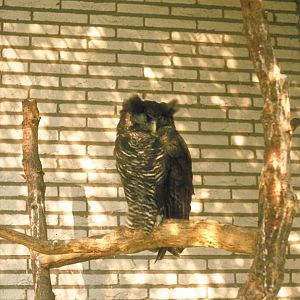
This species is so little-known that it was first photographed in the wild in 2021, and until the upload of the above photograph I believe only
ONE photograph of a living individual (again, taken at Antwerp) was known to be extant.
TL;DR of all of the above: this is primarily an exercise in providing a historical record, rather than an attempt to (incorrectly) claim that we should return to the bad old days

If you have a list of species and you tick the boxes of bearded pig and mountain anoa because "they are still in display in Europe" with those single lonely individuals. What does that mean to you?
If one was to provide a list of the species on-display in Europe, deliberately omitting any species which were on-display but represented only by singletons or unsustainable populations on the basis that they will cease to be on-display
eventually would be nothing more than the conscious creation of an incorrect list. I may be misunderstanding your point here (see my above point about autism
) but are you seriously suggesting that - for instance - anyone writing a list of the bovid species present within European collections should pre-emptively omit any mention of mountain anoa, slender-horned gazelle and red hartebeest, and *only* mention those species present in numbers?
But I wonder if in 10 or 20 years people will even remember that Duisburg held river dolphins let alone what they have learned about them. And I am talking about the average member of the public of course.
I reckon more people remember unique and unusual species than you might think.... and of course, even quite prosaic species may latch into the memories of the "
average member of the public" - I didn't actively start visiting zoological collections until 2010, but one of my earliest and strongest memories is seeing my first ever lynx at Highland Wildlife Park as a toddler in the late 1980s, with only scattered aquariums visited (very rarely) in the twenty years that followed.
But we probably shouldn't limit species on the basis of whether any given visitor will be certain to remember seeing them in 20 years time, or we might end up reduced to meerkats, meerkats and more meerkats


