Species lost from European collections during the 21st Century

I very much hope for the opposite thread: species gained in zoos in 20. century (or the last 30 years).

It would be especially interesting to show whether European zoos switch more for conservation of endangered species, or to ABC popular species.

They could be species which were present sometime in the past, but occassional or struggling, but became regular and much commoner recently. For example, Tasmanian devil, giant otter or chacoan peccary. Naturally, there would be an element of personal choice how rare should be a species earlier and what counts as gained currently.

Recently, Tasmanian Devils, Sea Otters, Yellow-backed duiker, Iberian Lynx, Coroquel's Sifakas and Chinese Pangolins are the ones that come to my mind as new additions/reinforcements to European collections. For sure some species of birds, reptiles or amphibians are there too due to constant animal trafficking and zoos ending up rehoming these animals. I believe Vienna Zoo got a lot of Chameleons this way recently. A lot of species of them btw.
 
Recently, Tasmanian Devils, Sea Otters, Yellow-backed duiker, Iberian Lynx, Coroquel's Sifakas and Chinese Pangolins are the ones that come to my mind as new additions/reinforcements to European collections. For sure some species of birds, reptiles or amphibians are there too due to constant animal trafficking and zoos ending up rehoming these animals. I believe Vienna Zoo got a lot of Chameleons this way recently. A lot of species of them btw.
I can also think to species like Chaco Peccaries and Mhorr Gazelles ; although they aren't properly "new" species, these endangered species are increasingly kept in European zoos that breed them.
One wouldn't forget the amphibians like the Titicaca Toad, whose case has been recently discussed on this forum.
 
There have been around nine or ten holders within Europe in the past decade or two!


I suspect so - it is probably going to be a race of sorts between whether we lose Mountain Anoa first or the Bornean Bearded Pig! :(
They are already lost (a while ago). What is the value of having a single individual on display? It does not matter how many holders display a species or if it still exists on "paper" just to make a species list larger. Without a sustainable population, the value of having those species or individuals is equal to zero. Even if those last lonely individuals would live forever! It would be more interesting to look at this thread through the lens of populations. Many of those cetaceans and ungulates were never held in significant numbers to have a sustainable population in the first place. Or were even held with that intention
e.g. the pilot whale at Lisbon zoo was not even supposed to be part of their permanent collection, it was a rescued animal that grew too large to live in the marine animal rescuing centre facilities, and hence it was transferred to the zoo. The plans were to transfer him to San Diego, but unfortunately, it died.
 
Recently, Tasmanian Devils, Sea Otters, Yellow-backed duiker, Iberian Lynx, Coroquel's Sifakas and Chinese Pangolins are the ones that come to my mind as new additions/reinforcements to European collections.

Without a sustainable population, the value of having those species or individuals is equal to zero. Even if those last lonely individuals would live forever!

In which case, you presumably believe that there is no value in most of the species you cited previously; the Coquerel's Sifaka, Yellow-backed Duiker and Chinese Pangolin are all in very small numbers and have not yet established themselves (and in the case of the duiker represent the last fragments of a longstanding population, much like the anoa and bearded pig) and the European populations of Sea Otter and Tasmanian Devil - barring special dispensation given to Copenhagen for the latter - are explicitly banned from being bred at all.

As such, by your own definition only the Iberian Lynx has any value.... but of course, you are disregarding the educational value of more unusual species, along with several other aspects of value.

If a taxon holds zero value solely because their numbers are not sustainable, or no longer so, you might as well argue we "cut to the point" and actively PTS wild species such as Vaquita or Sumatran Rhinoceros which fit the description. But I think no one would argue this, because species do have other kinds of "value'.
 
In which case, you presumably believe that there is no value in most of the species you cited previously; the Coquerel's Sifaka, Yellow-backed Duiker and Chinese Pangolin are all in very small numbers and have not yet established themselves (and in the case of the duiker represent the last fragments of a longstanding population, much like the anoa and bearded pig) and the European populations of Sea Otter and Tasmanian Devil - barring special dispensation given to Copenhagen for the latter - are explicitly banned from being bred at all.

As such, by your own definition, only the Iberian Lynx has any value.... but of course, you are disregarding the educational value of more unusual species, along with several other aspects of value.

If a taxon holds zero value solely because their numbers are not sustainable, or no longer so, you might as well argue we "cut to the point" and actively PTS wild species such as Vaquita or Sumatran Rhinoceros which fit the description. But I think no one would argue this, because species do have other kinds of "value'.
The examples I cited previously are, some of them, active efforts to build up sustainable captive populations. And of course, they must start from somewhere, which in this case means a small group of founders (no one imports dozens or hundreds of animals). Remember, every zoo population started small. The Yellow-backed duiker not only received new imports from the USA but was elevated to a full EEP as well (far from compared to the bearded pig or the mountain anoa situation), which demonstrates a willingness to make it into a sustainable population.
And just because I cited those examples it does not mean I consider them to be sustainable populations, most aren't, yet.
I strongly debate if a single individual can, in any significant way, contribute to a consistent educational programme. In my honest opinion even for an educational goal, you should have a sustainable population of animals to ensure that those animals last for a significant number of generations so your education goals also last.
You can possibly make a whole educational programme about the bearded pig at Berlin zoo, but once that last individual dies, the education programme about that species dies with it.
Do you really believe any visitor leaves Berlin Zoo or Krefeld Zoo keeping in mind that they have seen a bearded Pig or a Mountain Anoa? Maybe a few will think it is animal abuse to keep those individuals alone without any companions of their own species. How educational it is to display to the public social animals living lonely in a zoo enclosure? Very little since they are not displaying most of the behaviours they would display in the wild. And yes, if we go to the animal welfare sphere your all argument that keeping a lonely individual has any value, falls immediately. The same can apply to a small inbred population since inbreeding depression impacts individual welfare.
About the sea otters, they will never be bred because the USA only exports castrated animals, and with so many pups being rescued, there will be always plenty of sea otters to supply European aquaria (actually that is the goal because US facilities are running out of space to accommodate most rescued pups). Do they serve an educational role? Yes, but mostly because they are a charismatic species (which people will pay attention to anyways) and they make your ticket revenue grow. But not every place will want to have sea otters, because, believe me, they are not cheap animals to keep (I have worked with the species before). Is it a breeding population? No. But do you have a constant supply of individuals to source? Yes, you do. So yes you can call it a "population" that you can use for research or education. And since they are recorded in the American studbook, all individuals in Europe are like a branch of the American population.
The same can be said with the devils. The European population is an ambassador branch of the Australian population, but it will only achieve its educational goal if you have several representatives in many different zoos spread around Europe. But that branch is sustainable because it has all the support from the Australian population. It is not isolated.
The mountain anoa or the bearded pig? They are isolated, there are no other breeding programmes in zoos out there, nor with any breeding programme in range.
Summarising the otters and the devils are part of 2 sustainable populations that happen to not be based in Europe.

And let's not mix In-situ conservation with Zoo collections regarding this topic please, because you do not know what I think about that neither you can extrapolate what I do think based on my post. And because those are very two different topics. Conservation of small near-to-extinction wild populations has little to do with my all point in this post.
 
What is the point here exactly? Are you suggesting that the lone examples of animals such as the Berlin bearded pig or the Krefeld mountain anoa should be taken off show or even PTS as they have no worth being exhibited as lone "dead-end" species?
 
What is the point here exactly? Are you suggesting that the lone examples of animals such as the Berlin bearded pig or the Krefeld mountain anoa should be taken off show or even PTS as they have no worth being exhibited as lone "dead-end" species?
I never advocated that neither my posts suggest that. Those two individuals still have intrinsic value as living beings and everything must be done to give them a good quality of life. What I am saying is that functionally those 2 species were long gone before these 2 last individuals die. So you can tick the box of lost species for them in European zoos. Counting the days to their death is just a painful exercise in my opinion. Simple.
 
neither my posts suggest that.

"the value of having those species or individuals is equal to zero"

That was certainly the impression you gave me with the above absolute statement - hence my deliberate (and acknowledged in-post) hyperbole about the endpoint of such thinking in the hope it would (and did) prompt a more nuanced explanation.... even if we still largely disagree on the definition of "value" :)

Of course, there is also the fact that neither species in question were always singletons - both are the last remnants of previously larger breeding populations which were actively phased out in favour of related taxa. In theory this would imply that the population became completely valueless in your eyes at the moment of that decision, no matter how large it was at the time - in the case of the Bearded Pig I think we're talking about 13-15 individuals. Which raises an interesting point for further discussion actually; at what precise point should we cease to care about the continued presence of a captive species, and view it as already being lost to us?

To use the example of Baby the Amazon River Dolphin at Duisburg, there was no prospect of the species remaining in European collections beyond his death the moment the adult females in his family group died shortly after import - does that mean his presence held zero value for the near-entirety of his life and represented nothing but a painful exercise? Or alternatively, that after the breeding of Sea Otter in Europe ceased, those animals which remained were effectively valueless until the import of non-breeding rescue stock started a few years ago.... at which point the elderly animals at Lisbon presumably regained their value?
 
"the value of having those species or individuals is equal to zero"

That was certainly the impression you gave me with the above absolute statement - hence my deliberate (and acknowledged in-post) hyperbole about the endpoint of such thinking in the hope it would (and did) prompt a more nuanced explanation.... even if we still largely disagree on the definition of "value" :)

Of course, there is also the fact that neither species in question were always singletons - both are the last remnants of previously larger breeding populations which were actively phased out in favour of related taxa. In theory this would imply that the population became completely valueless in your eyes at the moment of that decision, no matter how large it was at the time - in the case of the Bearded Pig I think we're talking about 13-15 individuals. Which raises an interesting point for further discussion actually; at what precise point should we cease to care about the continued presence of a captive species, and view it as already being lost to us?

To use the example of Baby the Amazon River Dolphin at Duisburg, there was no prospect of the species remaining in European collections beyond his death the moment the adult females in his family group died shortly after import - does that mean his presence held zero value for the near-entirety of his life and represented nothing but a painful exercise? Or alternatively, that after the breeding of Sea Otter in Europe ceased, those animals which remained were effectively valueless until the import of non-breeding rescue stock started a few years ago.... at which point the elderly animals at Lisbon presumably regained their value?
Sorry if this was not understood correctly. When I say painful exercise, it is for us, the community to be here crying out waiting for their disappearance from European zoos. It is already a fact even if the last individual is still alive. I never intended to say that it was painful for Duisburg or for Baby's keepers to keep it alive all those years.

When should we stop caring? To be honest I do not have an answer to that question, because several factors are at play. Did the population ever have enough founders? Are there enough institutions interested into allocate space for the species? Does the population reproduce efficiently enough to grow? Aren´t there plans to import more animals? Each case is an individual situation.
The value of those single individuals, for zoo collections or breeding programmes, or even for conservation is zero, I am sorry, but it is true. Because the purpose of a modern zoo is not to have a list of species but actually what you can do with the species you hold. Fortunately, the 19th and early 20th-century mentality that a zoo is greater the more species it houses is disappearing. Because this thread sounds a bit like that old mentality. Just because the zoo world lost one species, does it mean the zoo world is doing less for wildlife worldwide?
Now, paying back with a question to you. If you have a list of species and you tick the boxes of bearded pig and mountain anoa because "they are still in display in Europe" with those single lonely individuals. What does that mean to you?

As I explained as well, education is also very debatable, because it will vary from species to species and how much attention it catches from the public. Each case would be worth a thread in this forum just about that topic. Baby certainly had a lot to teach to people, about its species, its evolution and ecology. Or just looking at him was amazing. But I wonder if in 10 or 20 years people will even remember that Duisburg held river dolphins let alone what they have learned about them. And I am talking about the average member of the public of course.
Additionally, you cannot compare 2 charismatic species (the dolphin and the otters) with two relatively neutral species (the bearded pig and the mountain anoa) in the eyes of the general public. The dolphin and the otters will always create a larger impact on the public even if you have only a single individual. Of course that facilitates education. Another thing influencing education is how you display the animals. Both Baby and the Otters in Lisbon were displayed in highly immersive and thematic exhibits that aim to teach about their ecosystems. This is strongly favourable to increase the education of the public. The bearded pig and the anoa are just housed in uninteresting and standard paddocks.

Lisbon Oceanarium will always house otters because that exhibit can hardly be repurposed for other species and the otters are the biggest attraction of that facility. They were always valuable to that institution. For the overall European zoo world? Not really. But as I said, its animals will always come from the American population, they are not singletons. It is beyond my knowledge of why a sudden growing interest in the species by aquaria in Europe.
 
Baby certainly had a lot to teach to people, about its species, its evolution and ecology. Or just looking at him was amazing.

All of these being forms of value, belying your words immediately above that "the
value of those single individuals ....is zero, I am sorry, but it is true
" and that there is "very little" educational value possible from such singletons.

The value of those single individuals, for zoo collections or breeding programmes, or even for conservation is zero, I am sorry, but it is true. Because the purpose of a modern zoo is not to have a list of species but actually what you can do with the species you hold. Fortunately, the 19th and early 20th-century mentality that a zoo is greater the more species it houses is disappearing. Because this thread sounds a bit like that old mentality.

Putting aside the possible implication that you hold the existence of this thread in mild contempt - presumably due to the fact you've entirely misinterpreted the founding intention of the thread, which I will clarify anon- I will point out that it need not be an either/or situation.

Although I would hope that no one on this forum wants to return to the days of overly-crowded stampbook collections held in tiny, grossly insufficient enclosures, I think that the responsibility of modern zoological collections to be centres for conservation and education is not mutually-exclusive with attempts to depict something of the wide variety of form/function in nature beyond that represented by so-called ABC species, but can be enhanced by such attempts.

For instance, one of the very best zoo exhibits I have seen within the last 12 months was the "Snakes of Croatia" complex at Zagreb, which contains a near-complete set of the snake species native to the country (missing only the European Blind Snake); of the 13 species displayed within, all but two are classified as Least Concern and (to the best of my knowledge) not all of them represent actively-breeding populations. As such, if the value of a species or exhibit is restricted to whether it is contributing to conservation or an ongoing breeding programme, the exhibit would be worthless. But this is very much not the case; as far as I am concerned there is a massive amount of value in having a well-presented, attractive and near-comprehensive display of the variety found within a single country, and I would also argue that displays such as this *do* contribute to conservation in their own way through providing a greater appreciation and knowledge of the natural world in its entirety. When the presence of a species within captive collections is ephemeral, it is no bad thing to lament the imminent loss - even when, as is the case with the Bearded Pig, they were phased out for a good reason - but nonetheless appreciate the diversity they represent whilst we have them, and be thankful we *had* them once we no longer do :)

To return to my point about the intended purpose of this thread and the "original" incarnation which is linked within the first post, the following two items of information have a strong bearing on the matter:

1) I am autistic, and one of my "things" is a massive interest in the preservation, collection and distribution of historical information. See also my thread devoted to zoological guidebooks, for instance.
2) In the early years of this forum, it contained rather more members falling into two categories than is the case now: individuals from continental Europe familiar with the zoological collections there, and individuals worldwide who had been visiting (or working in) zoological collections for several decades and therefore had collected a wide amount of information both anecdotal and documentary about exhibits and species present from the mid-20th century onwards. As a result, the Zoochat gallery contained a significant number of historical photographs at the time.

Unfortunately, in late 2010 the forum owner discovered that the gallery was taking up a lot more server space than realised, and that the hosting provider needed to free up space with some urgency - as such, he deleted over 50,000 photographs from the gallery using an automatic process which selected the least-viewed images. These, unfortunately, tended to be those taken historically or at more obscure zoological collections. Worse, the backups made with the hope of restoring the photographs once a better hosting solution for the gallery was found were corrupted, and the photographs were therefore lost entirely.

In the intervening time, many of the members who had originally uploaded the most noteworthy photographs had left the forum - however, I ultimately started the "original" incarnation of this thread as a means of encouraging those who remained to re-upload any relevant photographs, and therefore preserving some fraction of zoological history, with the secondary goal of allowing those born too late, or in the wrong location, to appreciate some of the species held in years past. Eventually, the thread fell into disrepair and ceased to be updated, but over the last year members of the forum started asking me to resume the thread - given the amount of updates that would be needed, I chose to start afresh :)

Perhaps the most satisfying upload to the gallery as a result of the original thread, incidentally, was a photograph of a Shelley's Eagle Owl held at Antwerp until the early 1990s:
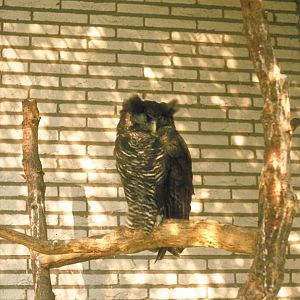


This species is so little-known that it was first photographed in the wild in 2021, and until the upload of the above photograph I believe only ONE photograph of a living individual (again, taken at Antwerp) was known to be extant.

TL;DR of all of the above: this is primarily an exercise in providing a historical record, rather than an attempt to (incorrectly) claim that we should return to the bad old days :P

If you have a list of species and you tick the boxes of bearded pig and mountain anoa because "they are still in display in Europe" with those single lonely individuals. What does that mean to you?

If one was to provide a list of the species on-display in Europe, deliberately omitting any species which were on-display but represented only by singletons or unsustainable populations on the basis that they will cease to be on-display eventually would be nothing more than the conscious creation of an incorrect list. I may be misunderstanding your point here (see my above point about autism :p ) but are you seriously suggesting that - for instance - anyone writing a list of the bovid species present within European collections should pre-emptively omit any mention of mountain anoa, slender-horned gazelle and red hartebeest, and *only* mention those species present in numbers?

But I wonder if in 10 or 20 years people will even remember that Duisburg held river dolphins let alone what they have learned about them. And I am talking about the average member of the public of course.

I reckon more people remember unique and unusual species than you might think.... and of course, even quite prosaic species may latch into the memories of the "average member of the public" - I didn't actively start visiting zoological collections until 2010, but one of my earliest and strongest memories is seeing my first ever lynx at Highland Wildlife Park as a toddler in the late 1980s, with only scattered aquariums visited (very rarely) in the twenty years that followed.

But we probably shouldn't limit species on the basis of whether any given visitor will be certain to remember seeing them in 20 years time, or we might end up reduced to meerkats, meerkats and more meerkats ;) :p
 
They are already lost (a while ago). What is the value of having a single individual on display?

And yes, if we go to the animal welfare sphere your all argument that keeping a lonely individual has any value, falls immediately.

Those two individuals still have intrinsic value as living beings and everything must be done to give them a good quality of life.

The value of those single individuals, for zoo collections or breeding programmes, or even for conservation is zero, I am sorry, but it is true.

So many interpretations going on here it's almost baffling. For most singletons kept they are the last remnant of a prior population, as has already been pointed out. Most of these species were never imported as a singleton and have simply dwindled down. There is value in the husbandry knowledge of the species they have brought, potential lifespan information, and an introduction to the species for what members of the public who did see them. Historical value is also part of the equation - species have come and gone from zoos as long as zoos have existed, and having record of when species leave is worthwhile information in my opinion. A fair number of species are only truly known from the odd specimen or two that made it into zoos somewhere along the line, and while some of them may have had little to do with visitor interest, scientifically they had massive value. Equally such specimens hold great conservation value as we get a better understanding of the species itself and its habits. Not quite the same as monitoring them in their natural habitat, but valuable nonetheless. Many singleton species are endangered in the wild and any understanding we can get on the species is beneficial, as is any attention we can bring to their plight.

Also, I think there is overall more interest in rare species than you give credit for. Throughout the history of zoos and circuses they were constantly using posters and articles of unusual specimens from far away countries. The first sub-Antarctic penguins were quite a draw back in the day, and likewise people flocked to see their first elephant or rhinoceros at the traveling circus. Even now look at the huge draw that is the Giant Panda; I've seen lines an hour long to see the bamboo-guzzling bears. Orcas and Whale Sharks have brought similar fame. The members of this site keep close tabs on many of the notable rarities, and many species have been the subject of specific trips to certain zoos.

Re the argument of looking at the thread's subject through the lens of populations, many rarer species never really had one to begin with. Nor will they necessarily even if tried several times, such as Gerenuk in Europe. It is a very different situation from looking at just the species's presence. Species can be relatively common but the population status can be virtually dead-end. In some cases its as much they're imported as much as individuals pass. Sometimes they become absent from zoos but private keepers still maintain them. Additionally, a couple of the species quoted as returns/boosts cannot be bred - so where is their point then if not for education purposes?

In my opinion, this sort of thread is very interesting from both a historical and comparison perspective. Some species have sporadically popped in and out of zoos over the years, and it is interesting to see the patterns. It is equally interesting to compare how Europe has lost species that are still holding on or are doing relatively well here in North America. The zoo world is constantly changing and having an easily visible record of some of these species changes is quite a benefit I feel.
 
Thank you for both your insights. I am happy that the spirit here is not of a stamp collection, because you can still see that a lot around here and among many animal enthusiasts, especially private breeders. And that is just how I do not want the zoo world to be. Zoos can do a lot to help animal species that they do not have in their collections. I have already seen unfair blaming of EAZA, TAGs or the EEPs because their favourite stamp is not anymore in the collection. And doing so with absolute ignorance about the reason why certain species are gone or not or knowing very little about what that means managing a population. That toxic blaming attitude is not fruitfully for wildlife conservation in anyway.

If one was to provide a list of the species on-display in Europe, deliberately omitting any species which were on-display but represented only by singletons or unsustainable populations on the basis that they will cease to be on-display eventually would be nothing more than the conscious creation of an incorrect list. I may be misunderstanding your point here (see my above point about autism :p ) but are you seriously suggesting that - for instance - anyone writing a list of the bovid species present within European collections should pre-emptively omit any mention of mountain anoa, slender-horned gazelle and red hartebeest, and *only* mention those species present in numbers?

Rephrasing my question, let's say there are 2 groups of species, the ones that still exist and the ones that have disappeared right? My question about what that means to you is why put the mountain anoa and the bearded pig in the same group of species as let's say, orangutan, banteng, elephants or Visayan warty pig and not in the same category as the river dolphin, the klipspringer or the Masai giraffe? Because for me the situation is radically different between the orangutan, the elephants, the banteng or the warty pig and the mountain anoa and the bearded pig. For me, the orangutan, the banteng, the elephants or the warty pig mean future, continuity, etc. While the mountain anoa or the bearded pig are just dead ends. It is hard for me to see them as the same within the zoo world. But that is because I value function above presence. That is because the future of zoological gardens is to preserve functional populations above just keeping species.
 
let's say there are 2 groups of species, the ones that still exist and the ones that have disappeared right? My question about what that means to you is why put the mountain anoa and the bearded pig in the same group of species as let's say, orangutan, banteng, elephants or Visayan warty pig and not in the same category as the river dolphin, the klipspringer or the Masai giraffe?

Because they haven't disappeared yet - if the categories you want me to choose between are "the ones which still exist" and "the ones that have disappeared" then the two species in question can only belong within the former category at present, regardless of the fact that they *are* going to join the latter category sooner rather than later.

It would be entirely incorrect to claim they already belong within the latter category - and if you are confident that your logic is sound and they *have* already disappeared from European zoos, I invite you to catch a train from Utrecht to Krefeld this morning, walk up to the Mountain Anoa exhibit and begin telling anyone who passes by that the animal standing in front of you doesn't actually exist anymore :p

For me, the orangutan, the banteng, the elephants or the warty pig mean future, continuity, etc. While the mountain anoa or the bearded pig are just dead ends. It is hard for me to see them as the same within the zoo world.

They aren't the same thing - we are fully agreed on this matter. As I said previously, their loss is inevitable at this stage and (in the case of the Bearded Pig, where a viable population was deliberately phased out due to the suspicion that one of the original founders was a scrofa barbatus hybrid, and moreover the decision by EAZA to focus on the more threatened Visayan Warty Pig) the correct course of action in the long-term, even if the loss of overall diversity is something that can and should be recognised and mourned.

Our point of difference lies in the fact that you are falling into the fallacy of begging the question (your conclusion is that if a species is no longer viable in captivity, it has already ceased to exist in captivity, and that therefore the question of whether mountain anoa and bearded pig still exist in captivity can only be answered in the negative - a true example of the fallacy) and moreover suggesting that anyone who believes that species such as these *do* still exist in captivity view them as being indistinguishable from those species with higher populations and a chance of long-term viability.

In other words, rather than assuming everyone thinks as you seem to - purely in black-and-white terms where only two rigidly-defined groupings are possible and species in captivity can exist in a quantum state of physically existing yet already having ceased to physically exist, consider that for the majority, the first category represents a spectrum which extends to an event horizon beyond which it becomes inevitable the species within will enter the second category at some point.

I'd say that this discussion proves that the commonly-held belief that people on the autistic spectrum such as myself are incapable of nuance or flexibility in opinion, but I recognise that (given how many members of this forum are on the spectrum) there is a greater-than-zero chance that it is actually a discussion between two of us, not merely one :p
 
Because they haven't disappeared yet - if the categories you want me to choose between are "the ones which still exist" and "the ones that have disappeared" then the two species in question can only belong within the former category at present, regardless of the fact that they *are* going to join the latter category sooner rather than later.

It would be entirely incorrect to claim they already belong within the latter category - and if you are confident that your logic is sound and they *have* already disappeared from European zoos, I invite you to catch a train from Utrecht to Krefeld this morning, walk up to the Mountain Anoa exhibit and begin telling anyone who passes by that the animal standing in front of you doesn't actually exist anymore :p


They aren't the same thing - we are fully agreed on this matter. As I said previously, their loss is inevitable at this stage and (in the case of the Bearded Pig, where a viable population was deliberately phased out due to the suspicion that one of the original founders was a scrofa barbatus hybrid, and moreover the decision by EAZA to focus on the more threatened Visayan Warty Pig) the correct course of action in the long-term, even if the loss of overall diversity is something that can and should be recognised and mourned.

Our point of difference lies in the fact that you are falling into the fallacy of begging the question (your conclusion is that if a species is no longer viable in captivity, it has already ceased to exist in captivity, and that therefore the question of whether mountain anoa and bearded pig still exist in captivity can only be answered in the negative - a true example of the fallacy) and moreover suggesting that anyone who believes that species such as these *do* still exist in captivity view them as being indistinguishable from those species with higher populations and a chance of long-term viability.

In other words, rather than assuming everyone thinks as you seem to - purely in black-and-white terms where only two rigidly-defined groupings are possible and species in captivity can exist in a quantum state of physically existing yet already having ceased to physically exist, consider that for the majority, the first category represents a spectrum which extends to an event horizon beyond which it becomes inevitable the species within will enter the second category at some point.

I'd say that this discussion proves that the commonly-held belief that people on the autistic spectrum such as myself are incapable of nuance or flexibility in opinion, but I recognise that (given how many members of this forum are on the spectrum) there is a greater-than-zero chance that it is actually a discussion between two of us, not merely one :p
I do not see it as black or white. Actually, I feel that a 3rd category like, species still on display but functionally extinct should be a thing. A grey area if you might.
 
I do not see it as black or white. Actually, I feel that a 3rd category like, species still on display but functionally extinct should be a thing. A grey area if you might.

In which case we are in full agreement, and the question you posed (twice) insisting on a two-group dichotomy - and saying that species such as the anoa and bearded pig belonged in the second category alongside those which have already been lost, despite factually belonging within the first category - was based on false premises which you did not hold yourself :p

Of course, then we get into the sticky matter of where a population reliant on regular imports of entirely new blood and which hasn't bred sustainably for decades - such as the Yellow-Backed Duiker - belongs.... or indeed whether it is possible for species to return to the first category having moved into the mid-point category. In the latter case, I am thinking about taxa such as babirusa, which *were* pretty much functionally extinct in European collections but bounced back due to improvements in husbandry, some hard work at one or two collections, and subsequent imports of new blood. This, of course, is why it is perhaps better to view things as a spectrum!
 
One aspect for the bearded Pig and the mountain anoa wasn't mentioned here yet. The are at least useful for the EAZA Biobank. Even though they don't have an breeding program, if they would have disappeared 10 years ago there DNA would probably be missing forever in the Biobank.
 
Last edited:
Back
Top