American Herping: A Guide to Reptiles and Amphibians in US Zoos

To backtrack a little, I did find two herps not mentioned in this thread on some recent visits.

Madagascan Ground Gecko (Pareodura picta) - new at Bronx Zoo and seen.

Spotted Paddle-tailed Newt (Pachytriton brevipes) - at the Tackapausha Museum in New York. Although I didn't actually see individuals visible, it is signed.
 
As promised, a blurb on America's most common cobra before we move on to other elapids:


Genus Dendroaspis – Mambas

A famous group of venomous African snakes. There are four species in the genus, all of which are held in US collections: three green arboreal species and one darker terrestrial type.

Western Green Mamba (D. viridis) – Common
Eastern Green Mamba (D. angusticeps) – Prevalent
Jameson’s Mamba (D. jamesoni) – Rare

These arboreal species are collectively the most common type of elapid in American zoos behind the king cobra. Hailing from different jungles of the African continent, Eastern and Western are fairly common in major zoos; the Jameson’s is much rarer and more restricted to snake specialist zoos and venom labs, although the Abilene Zoo in Texas holds the species as well. Eastern and Western appear to be different in coloration, with Eastern being a more uniform bright green while Westerns have more noticeable black scale margins and dark shading.

full

Eastern Green Mamba (D. angusticeps) / Taken at the San Antonio Zoo by @Ding Lingwei

full

Western Green Mamba (D. viridis) / Taken at the Dallas Zoo by @jayjds2

Black Mamba (D. polylepis)
Status in US Zoos: Uncommon in AZA; Prevalent when including reptile zoos

One of the most feared and renowned snakes in the world, with a venom that kills most people who don’t receive treatment. Their color is actually more of a brown-gray, but I guess “Browngray Mamba” takes longer to shout if someone is about to step on one (in actuality, the common name comes from their ink-toned mouth). It is also one of the fastest snakes in the world, capable of slithering at up to 12 mph. Despite its famous reputation, it is notably less common in zoos than green mambas.

full

Taken at Reptile Lagoon (South Carolina) by @TinoPup

Unless it recently left the collection, Waco/Cameron Park Zoo should have Jameson's Mamba exhibited together with their West African Green Mamba aswell.
 
Australian Elapids

Australia doesn’t have any vipers, so the super deadly snakes they’re famous for are elapids. The survey found about a dozen species, but most of them are rare and many only found in venom labs and reptile specialist zoos. Indisputably the best traditional US zoo for these snakes is the Omaha Zoo in Nebraska, with its Desert Dome holding at least 4 species of Australian hots.

Genus Acanthophis – Death Adders
Status in US Zoos: Uncommon

Not related to the adders of Africa and Eurasia, which are vipers – so we’ll get to those later. These do look more like vipers than other elapids, with short thick bodies and triangular heads – so until now, you’d be excused for thinking that’s what they are! The death adders have a messy history taxonomically, but the 5 species I found in the survey appear to be:

Common Death Adder (A. antarcticus)
Plains Death Adder (A. hawkei)
Northern Death Adder (A. praelongus)
Desert Death Adder (A. pyrrhus)
Rough-scaled Death Adder (A. rugosus)

full

Rough-scaled Death Adder (A. rugosus)
Taken at Reptile Lagoon (South Carolina) by @jayjds2

full

Northern Death Adder (A. praelongus)
Taken at the National Aquarium in Baltimore by @TinoPup

Genus Oxyuranus – Taipans

The longest venomous snakes in Australia, and also fairly well-known among the list of Australian “could-kill-you” animals – which is not a short list. One of the three species was just described in 2007 and unsurprisingly it doesn’t seem to be here, but American collections have both of the original species:

Coastal Taipan (O. scutulatus) – Rare
Inland Taipan (O. microlepidotus) – Uncommon

Inland Taipans in particular are famous for being the single most toxic snake in the world – one bite has enough venom to kill an adult human 100 times over. Fortunately (as is often the case) they are generally placid snakes who live in unpopulated areas, so bites are rare. Meanwhile, Coastal Taipans (also lethal) are much more nervous snakes that will become aggressive if cornered.

A beautifully iridescent animal, for the moment taipans are almost entirely relegated to reptile specialist collections here; the only major American zoos that currently have them are Toledo and Omaha (which recently bred Inland Taipans). A couple of obscure and privately operated zoos in the Southeast have acquired them as well, somehow.

full

Inland Taipan (O. microlepidotus)
Taken at TerraZoo Rheinburg (Germany) by @snowleopard

full

Inland Taipan / Taken at the Australia Zoo by @WhistlingKite24

Other Australian elapids found in the past 5 years are included in the list below. Three additional species (Tiger Snake, Red-bellied Black Snake, and Northern Brown Snake) haven’t been recorded in nearly a decade; Reptile Gardens in South Dakota had a large collection of Australian elapids in the mid-2010's, but I don't know how many they still hold today.

Collett’s Snake (Pseudechis colletti) – Rare
King Brown Snake (Pseudechis australis) – Rare, only confirmed at Omaha

full

Collett's Snake (Pseudechis colletti) / Taken at the Omaha Zoo by @ThylacineAlive
 
Last edited:
A couple of obscure and privately operated zoos in the Southeast have acquired them as well, somehow.
Prices for Inland taipans have gone down considerably over the years, making them more affordable, unlike many other Australian elapids. However, males are still more expensive due to their relative scarcity, and breeding is not always a given. One way or another: I love working with them; wonderfully curious animals.
 
A beautifully iridescent animal, for the moment taipans are almost entirely relegated to reptile specialist collections here; the only major American zoo that has them currently is Omaha (which recently bred their Inland Taipans). A couple of obscure and privately operated zoos in the Southeast have acquired them as well, somehow.
I saw a snake signed simply as "Taipan" at Toledo in 2018.
 
Still sad that Dallas has gone out of both Inland Taipan and Northern Death Adder, still hoping they were just moved BTS like their Caiman Lizards and not passed away
 
I saw a snake signed simply as "Taipan" at Toledo in 2018.

They held Coastal Taipan for several years through at least 2019, but at some point afterward it was gone - so that would have been the snake you saw. Upon double-checking that, however, I discovered that as of earlier this year Toledo is back to having taipan on display! This time it is the Inland species.

The Central Florida Zoo also had Coastal Taipan as late as 2017, but it hasn't been mentioned in more recent years and is not on their website.
 
Other Elapids

Kraits

A mix of several different kinds of elapid snake. Many kraits are sea snakes, hunting fish in coral reefs; that being said, not all kraits are marine or even aquatic. The thing most seem to have in common are colorful banded patterns.

Kraits are almost nonexistent in US collections. The Toledo Zoo and Aquarium of the Pacific both had Laticauda sea kraits on display for a long time, but they no longer are at either facility. I haven’t been able to confirm any other sea krait holdings, although there is always a possibility that they get picked up as a bycatch rescue or a trafficking confiscation. The Kentucky Reptile Zoo – a venom lab and snake specialist zoo – has two species of Bungarus, a genus of Asian land kraits; they seem to be the only kraits on public display anywhere in the country at the moment.

Banded Krait (Bungarus fasciatus)
Many-banded Krait (Bungarus multicinctus)

full

Sea Krait (Laticauda sp.); taken at the Toledo Zoo by @Moebelle

full

Many-banded Krait; taken at the Kentucky Reptile Zoo by @jayjds2

Genus Micrurus – Coral Snakes
Status in US Zoos: Uncommon

Did you know that we have native elapids, right here in the United States? Now you do! These are the snakes that milksnakes fashion themselves after to scare off potential predators – a prime example of Batesian mimicry. Don’t worry, though; only two people have died from Micrurus bites in the last century.

The survey found two of the three native species, Eastern Coral Snake (M. fulvius) and Texas Coral Snake (M. tener); both are rarely seen in captive collections, all or nearly all in the South. I didn’t find any holdings for the Arizona species.

full

Eastern Coral Snake (Micrurus fulvius); taken by @Maguari at the Jacksonville Zoo

Rare Elapids that Didn’t Fit Anywhere Else:

Angolan Garter Snake (Elapsoidea semiannulata) – displayed at Sedgwick County Zoo, which has bred them twice since 2021
 
Family Viperidae – Vipers

The biggest group yet; roughly 115 species were found by the survey, the most of any reptile or amphibian family. Lots of zoos are great places to see a variety of viper species: rattlesnakes are abundant across the country (though especially in the Southwest), while Dallas, Fort Worth, Toledo, Los Angeles, and San Antonio are just five examples of major zoos with many other types of vipers. This is in contrast to Europe, where (similar to the elapids) most vipers are found primarily or even exclusively in reptile specialist zoos rather than traditional zoos.

Vipers are fairly easy to distinguish as a group; mostly thick-bodied snakes with triangular heads. Telling all of the species apart can be a challenge, though, especially given how many there are. Remember that signage and Latin names are your friends ;)

As with colubrids there are too many species to cover them all individually, so a lot of this will be done largely by genus. We'll kick off with the less numerous subfamily, Viperinae - the "true" or pitless vipers.

Bitis – African Adders

Found mostly across Sub-Saharan Africa, these are very stout snakes. They're also called puff adders, thanks to their ability to inflate their bodies and loudly hiss to ward off predators. I wouldn’t recommend being one of those predators, as all of these species have dangerous venom – and can strike very fast, belying their sluggish appearance! We have 4 or 5 species in US collections, all of which are found in several places.

Gaboon Vipers (B. rhinoceros and gabonica)
Status in US Zoos: Abundant

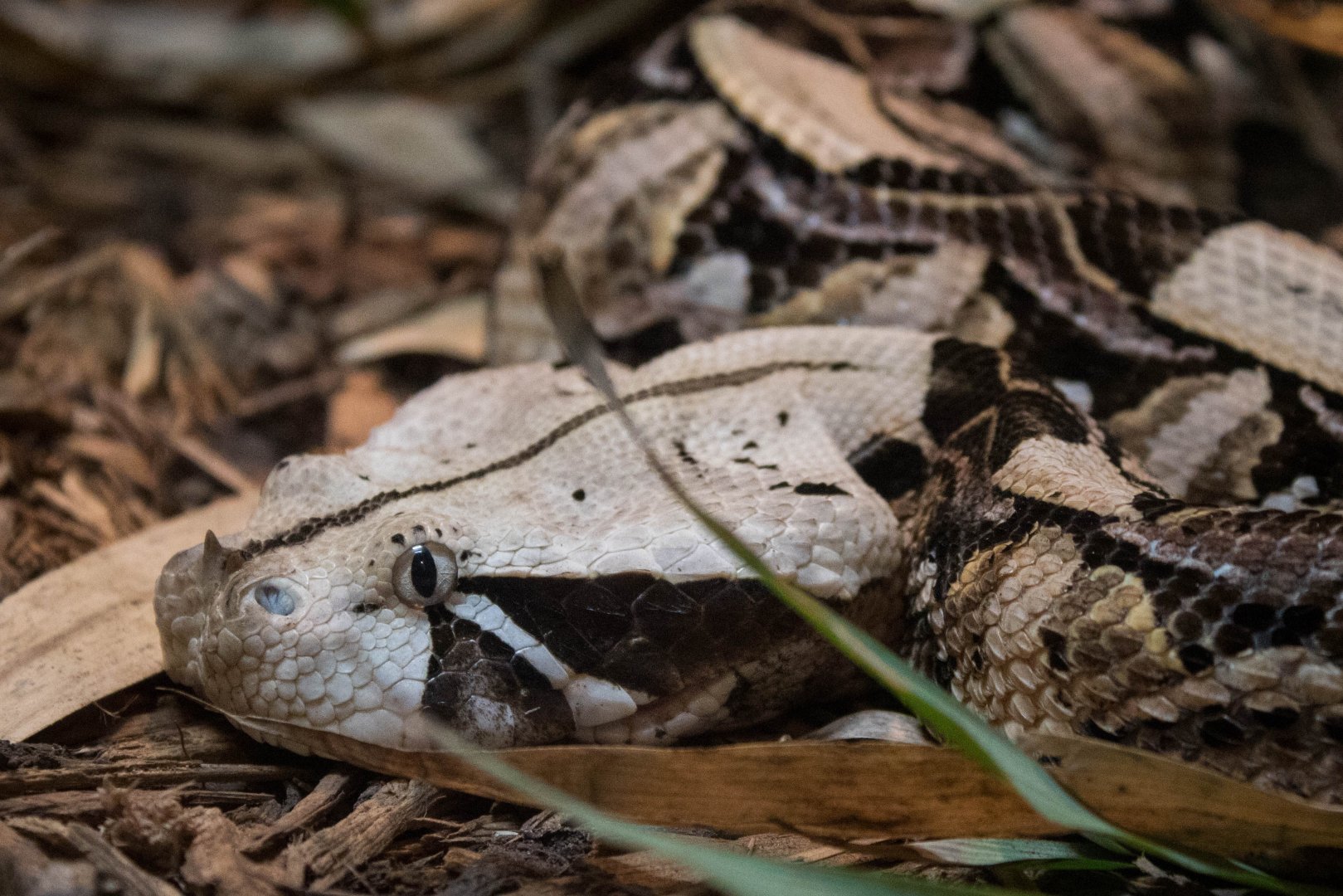
Collectively, Gaboon Vipers are the most common exotic viper in US zoos with ~45 holders minimum. Comically large snakes with leaf camouflage coloration, they are far more common than the other Bitis species – making them a good frame of reference in case you see another member of the genus. They are quite large and most superlative snakes: one of the heaviest hots in the world, possessing the largest fangs (2 in) of any snake, the highest quantity of venom, and one of the fastest striking snakes on the planet.

The two Gaboon Vipers were split into a West African (rhinoceros) and a Central African (gabonica) about 20 years ago; identifying features between the two include the snout horns (generally 2 on rhinoceros, 1 on gabonica) and stripes below the eyes (opposite - 1 on rhinoceros, 2 on gabonica). Going off photos, it seems that most zoos who sign their vipers as gabonica actually have rhinoceros, though gabonica has been kept in recent years and possibly still is.

full

full

Gaboon Viper (signed B. gabonica, visually B. rhinoceros)
Taken at the Smithsonian National Zoo by @Andrew_NZP

Rhinoceros Viper (B. nasicornis) – Prevalent

Not to be confused with B. rhinoceros, which confusingly refers not to Rhinoceros Viper but to West African Gaboon Viper. The coloration on these snakes is more vibrant, and the nose horn more elaborate; think of it as a Gucci-style jungle adder.

full

Taken at the Cincinnati Zoo by @Ding Lingwei

Puff Adder (B. arietans)
– Prevalent

This species is found throughout the savannas and grasslands of Africa and into the Middle East. Their coloration also matches what you’d expect for camouflage in that environment. They are the leading cause of snakebite deaths on humanity’s home continent, for a variety of reasons ranging from their abundance, long fangs, potent venom, and habit of quietly basking right next to footpaths. See, this is why North Americans attached baby toys to the tails of their venomous snakes :p

full

Taken at the Central Florida Zoo by @ThylacineAlive

Ethiopian Mountain Adder (B. parviocula)
– Uncommon

An endangered, mint-green adder only found in a few localities of the Ethiopian highlands. Little else is known about it, and there is only one well-documented case of a person being envenomated (who survived, fortunately). On a darker note, this species appears to only be in captivity today as a result of illegal (or at least legally dubious) exportation from its home country by reptile dealers in the 2000's; these snakes were then captive-bred and some of their descendants are now in zoos.*

full

Taken at Zoo Knoxville by @Coelacanth18

*For anyone interested in knowing more about this story and other instances of US reptile smuggling, I recommend Stolen World: A Tale of Reptiles, Smugglers and Skulduggery by Jennie Erin Smith which was the primary source for that information.
 
Last edited:
Family Viperidae – Vipers

The biggest group yet; roughly 115 species were found by the survey, the most of any reptile or amphibian family. Lots of zoos are great places to see a variety of viper species: rattlesnakes are abundant across the country (though especially in the Southwest), while Dallas, Fort Worth, Toledo, Los Angeles, and San Antonio are just five examples of major zoos with many other types of vipers. This is in contrast to Europe, where (similar to the elapids) most vipers are found primarily or even exclusively in reptile specialist zoos rather than traditional zoos.

Vipers are fairly easy to distinguish as a group; mostly thick-bodied snakes with triangular heads. Telling all of the species apart can be a challenge, though, especially given how many there are. Remember that signage and Latin names are your friends ;)

As with colubrids there are too many species to cover them all individually, so a lot of this will be done largely by genus. We'll kick off with the less numerous subfamily, Viperinae - the "true" or pitless vipers.

Bitis – African Adders

Found mostly across Sub-Saharan Africa, these are very stout snakes. They're also called puff adders, thanks to their ability to inflate their bodies and loudly hiss to ward off predators. I wouldn’t recommend being one of those predators, as all of these species have dangerous venom – and can strike very fast, belying their sluggish appearance! We have 4 or 5 species in US collections, all of which are found in several places.

Gaboon Vipers (B. rhinoceros and gabonica)
Status in US Zoos: Abundant

Collectively, Gaboon Vipers are the most common exotic viper in US zoos with ~45 holders minimum. Comically large snakes with leaf camouflage coloration, they are far more common than the other Bitis species – making them a good frame of reference in case you see another member of the genus. They are quite large and most superlative snakes: one of the heaviest hots in the world, possessing the largest fangs (2 in) of any snake, the highest quantity of venom, and one of the fastest striking snakes on the planet.

The two Gaboon Vipers were split into a West African (rhinoceros) and a Central African (gabonica) about 20 years ago; they can be told apart by their snout, as the West African species has two small nose horns that gabonica lacks. Going off photos, it seems that most zoos who sign their vipers as gabonica actually have rhinoceros; this is true to such an extent that I’m not even certain whether we have true gabonica, although it’s certainly possible. Any information on this would be welcome.

full

full

Gaboon Viper (signed B. gabonica, visually B. rhinoceros)
Taken at the Smithsonian National Zoo by @Andrew_NZP

Rhinoceros Viper (B. nasicornis) – Prevalent

Not to be confused with B. rhinoceros, which confusingly refers not to Rhinoceros Viper but to West African Gaboon Viper. The coloration on these snakes is more vibrant, and the nose horn more elaborate; think of it as a Gucci-style jungle adder.

full

Taken at the Cincinnati Zoo by @Ding Lingwei

Puff Adder (B. arietans)
– Prevalent

This species is found throughout the savannas and grasslands of Africa and into the Middle East. Their coloration also matches what you’d expect for camouflage in that environment. They are the leading cause of snakebite deaths on humanity’s home continent, for a variety of reasons ranging from their abundance, long fangs, potent venom, and habit of quietly basking right next to footpaths. See, this is why North Americans attached baby toys to the tails of their venomous snakes :p

full

Taken at the Central Florida Zoo by @ThylacineAlive

Ethiopian Mountain Adder (B. parviocula)
– Uncommon

An endangered, mint-green adder only found in a few localities of the Ethiopian highlands. Little else is known about it, and there is only one well-documented case of a person being envenomated (who survived, fortunately). On a darker note, this species appears to only be in captivity today as a result of illegal (or at least legally dubious) exportation from its home country by reptile dealers in the 2000's; these snakes were then captive-bred and some of their descendants are now in zoos.*

full

Taken at Zoo Knoxville by @Coelacanth18

*For anyone interested in knowing more about this story and other instances of US reptile smuggling, I recommend Stolen World: A Tale of Reptiles, Smugglers and Skulduggery by Jennie Erin Smith which was the primary source for that information.

I've found the snout horns in Bitis rhinoceros can be variable, I've seen some with barely any noticable. The easier way to tell them apart is the black stripes by the eyes; rhinoceros has just one past each eye, gabonica has an additional one under the eye.
 
I've found the snout horns in Bitis rhinoceros can be variable, I've seen some with barely any noticable. The easier way to tell them apart is the black stripes by the eyes; rhinoceros has just one past each eye, gabonica has an additional one under the eye.

Good information to note, thanks. Seems like my visual ID on the Smithsonian viper was still valid then, fortunately.

Based on that ID knowledge have you seen any true gabonica, and if so remember where they might have been?
 
Good information to note, thanks. Seems like my visual ID on the Smithsonian viper was still valid then, fortunately.

Based on that ID knowledge have you seen any true gabonica, and if so remember where they might have been?
Looking through my own personal photos of various zoos with Gaboon Vipers, all had the one stripe characteristic of rhinoceros, even though many were signed as Bitis gabonica. Only in Wild Florida Safari was I unable to make an identification because the head was obscured but I'd be willing to bet they have rhinoceros too.

I don't know of any other zoo that currently has true gabonica. I do remember Bronx Zoo had signs for both gabonica and rhinoceros pretty recently, maybe about a couple of years ago. But I've only seen rhinoceros and its very likely the gabonica sign is just a result of the zoo using older taxonomy. @ThylacineAlive would probably be able to confirm if the zoo had both snakes in recent times.
 
Good information to note, thanks. Seems like my visual ID on the Smithsonian viper was still valid then, fortunately.

Based on that ID knowledge have you seen any true gabonica, and if so remember where they might have been?

Philadelphia had both until 2018 or 2019. A great photo of the head by @jayjds2
 
Going off photos, it seems that most zoos who sign their vipers as gabonica actually have rhinoceros; this is true to such an extent that I’m not even certain whether we have true gabonica, although it’s certainly possible. Any information on this would be welcome.
Back in the days (and still in some people's minds), the two gaboon viper species were considered as two subspecies of one species, i.e. Bitis gabonica gabonica and B. gabonica rhinoceros. Both can crossbreed, with the offspring showcasing features of both, which makes the differentiation in some individuals more tricky.
B. gabonica seems to be a bit more delicate and more easily stressed in captivity, which might explain why B. rhinoceros is more common.

Both WdG and HdN keep B. gabonica [although mine could be a hybrid], so if you want to see one, feel free to come to Salzburg. :D
Zoo/Terraristik/Museum on Instagram: "#gabunviper #budspencer gönnt sich noch einen Abebdsnack und wünscht ein schönes #wochenende #fyp #foryoupage #tgif #thanksgoditsfriday #snacktime #gaboonviper #viper #snake #venomoussnakes #weltdergifte #weekend #schlangen #animalphotography #budspencerterencehill #dunebuggy #food #salzburg"
 
Last edited:
Today we’ll zip through the rest of the pitless vipers, going by genus.

Atheris – Bush Vipers
Status in US Zoos: Uncommon to Prevalent

Another African genus, these have evolved a very similar body type and niche to the pitvipers of tropical Asia and the Americas – an example of convergent evolution. Inhabitants of dense jungles, these snakes are beautifully colored and have dagger-like scales like dragons.

The survey found 5 species in US collections, but only the Variable Bush Viper (A. squamigera) was in more than a couple of facilities, enough to qualify as Uncommon. The four rarer species were:

Broadley’s Bush Viper (A. broadleyi)
Usambara Bush Viper (A. ceratophora)
Western Bush Viper (A. chlorechis)
Great Lakes Bush Viper (A. nitschei)

full

Broadley's Bush Viper (A. broadleyi) / Taken at Reptile Lagoon by @jayjds2

Saharan Horned Viper (Cerastes cerastes) – Uncommon

Found in the sandy dunes of North Africa and Arabia, these vipers have horns located above each eye. They travel by sidewinding across the sand dunes of their arid land, earning them the nickname “sidewinder” – which is also applied to a rattlesnake found in the southwestern United States. If you have trouble telling them apart, just remember: one has a rattle, and one doesn’t.

full

Taken at the Dallas Zoo by @geomorph

Daboia
Status in US Zoos: Rare

Two species of viper from West and South Asia, both found in maybe a couple facilities each.

Species:
Palestine Viper (D. palaestinae)
Russell’s Viper (D. russelii)

Echis – Saw-scaled Vipers
Status in US Zoos: Uncommon

These small vipers from dry regions of Africa and Asia are named for their ability to create a sizzling noise by rubbing their scales together, sort of like how Madagascar hissing cockroaches make noise. They have a reputation for possessing a fierce temper; this combined with their tendency to be found close to human settlements makes them responsible for more deaths than any other venomous snake worldwide – in fact, some scientists reckon that Echis envenomations account for more snakebite deaths than all other venomous snakes combined. They’re fairly rare in US collections, for some reason.

Species:
Indian Saw-scaled Viper (E. carinatus)
Painted Saw-scaled Viper (E. coloratus)
Egyptian Saw-scaled Viper (E. pyramidum – do you get it?)

full

Transcaspian Saw-scaled Viper (E. multisquamatus)
Taken at the Moscow Zoo by @Fishapod

Vipera, Montivipera, and Macrovipera – Eurasian Vipers

I combined these genera because they are comprised of broadly similar species. 10 species were found between the three genera in the survey; we’ll touch on two of those species.

Long-nosed Viper (Vipera ammodytes) – Prevalent

Found on rocky hillsides across the southern European states like Italy and Greece into West Asia, the Long-nosed Viper’s name is self-explanatory (see picture below). Considered one of the most dangerous snakes in Western Europe, this is the most common European viper in US collections.

full

Taken at the Toledo Zoo by @Lucas Lang

Armenian Viper (Montivipera raddei) – Rare

Hailing from said country and surrounding nations, this threatened mountain viper is the subject of a breeding program – but the species is only on display at a small handful of major players. In the photo below it is on the left; conveniently to its right is a rare Levant Viper (Macrovipera lebetinus), also found in the survey.

full

Armenian Viper on left (gray), Levantine Viper on right (beige)
Taken at the Sedgwick County Zoo by @Ituri

Other species (all Rare):
Milos Viper (Macrovipera schweizeri)
Mount Bulgar Viper (Montivipera bulgardaghica)
Ocellate Mountain Viper (Montivipera wagneri)
Ottoman Viper (Montivipera xanthina)
Dinnik’s Viper (Vipera dinniki)
Caucasus Viper (Vipera kaznakovi)
Nikolsky's Viper (Vipera nikolskii)

The Asp Viper (Vipera aspis) was only recorded at Reptile Gardens nearly a decade ago; it is found in several European zoos, as it is one of the most common wild vipers in that region. The Adder (Vipera berus) - the most common viper or only viper in much of Western Europe - was conspicuously absent from the survey as well.
 
Last edited:
Today we’ll zip through the rest of the pitless vipers, going by genus.

Atheris – Bush Vipers
Status in US Zoos: Uncommon to Prevalent

Another African genus, these have evolved a very similar body type and niche to the pitvipers of tropical Asia and the Americas – an example of convergent evolution. Inhabitants of dense jungles, these snakes are beautifully colored and have dagger-like scales like dragons. They also have terrible tempers – again, like dragons.

The survey found 5 species in US collections, but only the Variable Bush Viper (A. squamigera) was in more than a couple of facilities, enough to qualify as Uncommon. The four rarer species were:

Broadley’s Bush Viper (A. broadleyi)
Usambara Bush Viper (A. ceratophora)
Western Bush Viper (A. chlorechis)
Great Lakes Bush Viper (A. nitschei)

full

Broadley's Bush Viper (A. broadleyi) / Taken at Reptile Lagoon by @jayjds2

Saharan Horned Viper (Cerastes cerastes) – Uncommon

Found in the sandy dunes of North Africa and Arabia, these vipers have horns located above each eye. They travel by sidewinding across the sand dunes of their arid land, earning them the nickname “sidewinder” – which is also applied to a rattlesnake found in the southwestern United States. If you have trouble telling them apart, just remember: one has a rattle, and one doesn’t.

full

Taken at the Dallas Zoo by @geomorph

Daboia
Status in US Zoos: Rare

Two species of viper from West and South Asia, both found in maybe a couple facilities each.

Species:
Palestine Viper (D. palaestinae)
Russell’s Viper (D. russelii)

Echis – Saw-scaled Vipers
Status in US Zoos: Uncommon

These small vipers from dry regions of Africa and Asia are named for their ability to create a sizzling noise by rubbing their scales together, sort of like how Madagascar hissing cockroaches make noise. Like the bush vipers, they have a fierce temper; this combined with their tendency to be found close to human settlements makes them responsible for more deaths than any other venomous snake worldwide – in fact, some scientists reckon that Echis envenomations account for more snakebite deaths than all other venomous snakes combined. They’re fairly rare in US collections, for some reason.

Species:
Indian Saw-scaled Viper (E. carinatus)
Painted Saw-scaled Viper (E. coloratus)
Egyptian Saw-scaled Viper (E. pyramidum – do you get it?)

full

Transcaspian Saw-scaled Viper (E. multisquamatus)
Taken at the Moscow Zoo by @Fishapod

Vipera, Montivipera, and Macrovipera – Eurasian Vipers

I combined these genera because they are comprised of broadly similar species. 7 species were found between the two genera in the survey; we’ll touch on two of those species.

Long-nosed Viper (Vipera ammodytes) – Prevalent

Found in Italy and the Balkan states, the Long-nosed Viper’s name is self-explanatory. Found on rocky hillsides, it is generally considered the most dangerous European snake.

full

Taken at the Toledo Zoo by @Lucas Lang

Armenian Viper (Montivipera raddei) – Rare

Hailing from said country and surrounding nations, this threatened mountain viper is the subject of a breeding program – but the species is only on display at a small handful of major players. In the photo below it is on the left; conveniently to its right is a rare Levant Viper (Macrovipera lebetinus), only recorded at two zoos (Los Angeles and Sedgwick County).

full

Armenian Viper on left (gray), Levantine Viper on right (beige)
Taken at the Sedgwick County Zoo by @Ituri

Other species:
Ottoman Viper (Montivipera xanthina)
Ocellate Mountain Viper (Montivipera wagneri)
Dinnik’s Viper (Vipera dinniki)
Caucasus Viper (Vipera kaznakovi)

The Asp Viper (Vipera aspis) was only recorded at Reptile Gardens nearly a decade ago; it is found in several European zoos, as it is one of the most common wild vipers in that region.
San Antonio used to have a few other species of Vipera, the Nikolsky's Viper(Vipera nikolskii) and Snub-Nosed Viper(Vipera latastei gaditana), shame they lost both species in recent years.
 
Back
Top