Day 10 #24 Wildnispark Zurich Langenberg
So after the Mythenquai aviary, I took the train to visit the Wildnispark Zürich. Wikipedia taught me that this park aims to provide nature experience and recreation for the population from the urban conurbation of Zurich, Zug and Lucerne. It offers courses, tours and workshops for groups, schools and individual visitors.
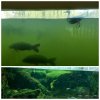
The park consists of 2 spaced-out sections: Wildpark Langenberg (80 ha) and the Sihlwald (1100 ha), both in the Sihl valley south of Zurich. I only visited the former, the Sihlwald is actually more of a nature park where you can take long walks through mountain forests and across moors. Otters, European crayfish and fish are the only animals on display there; there is also a restaurant and a nature museum.
Wildpark Langenberg is about 15 minutes from Zurich by train. The park is located on and around the Langenberg in the municipality of Langnau am Albis. The park itself (Langeberg Ost) is free and accessible 24 hours a day (the - few - buildings do close), the extended part (Langenberg West) is also free but does close in the evening.
The Langenberg Widnispark is a member of the Swiss Association of scientific zoos and claims to be the oldest zoo in the country (it opened as early as 1869). It exhibits only native animals, including species that have since become extinct in Switzerland (e.g. moose and wisents), as well as introduced species such as sikadeer. The odd ones out were the Prezwalskii horses, but they of course refer to the tarpan, a wild European horse that became extinct (in 1887).
From the train station, it's a solid 3km uphill walk before you get to the actual animal enclosures. I had completely misjudged it (I had undergone knee surgery 2 months before this trip).
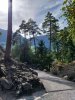
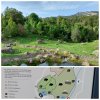
Langenberg-Ost consists of a forested hill with large natural enclosures for wolves, lynx and brown bears. It has steep climbs in dense forest with viewing platforms here and there. At the bottom of the valley is a large restaurant and shop. Here is also the visitor bridge to Landenberg-West.

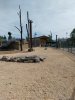
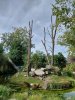
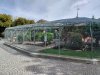
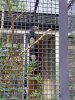
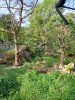
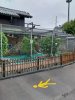
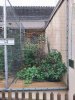
Eurasian wolf enclosure and viewing point
In the valley we find a lookout point for brown bears, wild boars, hares and 2 visitable buildings.

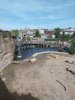
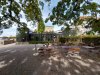
Eurasian brown bear enclosure seen from the restaurant
Here I saw the first wild boar walk through (mandatory with a park ranger), I wonder what our American friends will think of that.
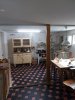
The Müsli-Hüzli Haus is a building dedicated to rodents. Seven sleepers, house mice and brown rats can be seen. The enclosures are decorated like a real (human) house.

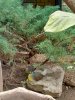
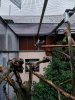
Müsli-Hüzli - Brown rat enclosure
The Wildkatzenhaus visitor gallery gives a good insight into a spacious enclosure for European wild cats.

Wildkatzenhaus
Neighbouring enclosures include red deer, Alpine ibex, Alpine marmot, European fallow deer and Sika deer.
Langenberg-West consists of more open terrain on another hill. This was the only moment of the trip where I had to decide not to visit this part of the zoo. Knowing that I still had to cross the first hill back to get to the station, I didn't see the Urzeitrundweg as a good idea. I therefore only saw the enclosures for moose, wisents and foxes. Higher up live roe deer and Prezwalski horses, so no great loss as both species are very abundant in European zoos.

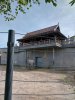
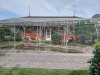
Moose house
After a long day, I decided to walk around downtown Zurich before heading to my hotel. It was an almost perfect day, unaware that the next morning would start with some calamity.
So after the Mythenquai aviary, I took the train to visit the Wildnispark Zürich. Wikipedia taught me that this park aims to provide nature experience and recreation for the population from the urban conurbation of Zurich, Zug and Lucerne. It offers courses, tours and workshops for groups, schools and individual visitors.
The park consists of 2 spaced-out sections: Wildpark Langenberg (80 ha) and the Sihlwald (1100 ha), both in the Sihl valley south of Zurich. I only visited the former, the Sihlwald is actually more of a nature park where you can take long walks through mountain forests and across moors. Otters, European crayfish and fish are the only animals on display there; there is also a restaurant and a nature museum.
Wildpark Langenberg is about 15 minutes from Zurich by train. The park is located on and around the Langenberg in the municipality of Langnau am Albis. The park itself (Langeberg Ost) is free and accessible 24 hours a day (the - few - buildings do close), the extended part (Langenberg West) is also free but does close in the evening.
The Langenberg Widnispark is a member of the Swiss Association of scientific zoos and claims to be the oldest zoo in the country (it opened as early as 1869). It exhibits only native animals, including species that have since become extinct in Switzerland (e.g. moose and wisents), as well as introduced species such as sikadeer. The odd ones out were the Prezwalskii horses, but they of course refer to the tarpan, a wild European horse that became extinct (in 1887).
From the train station, it's a solid 3km uphill walk before you get to the actual animal enclosures. I had completely misjudged it (I had undergone knee surgery 2 months before this trip).
Langenberg-Ost consists of a forested hill with large natural enclosures for wolves, lynx and brown bears. It has steep climbs in dense forest with viewing platforms here and there. At the bottom of the valley is a large restaurant and shop. Here is also the visitor bridge to Landenberg-West.
Eurasian wolf enclosure and viewing point
In the valley we find a lookout point for brown bears, wild boars, hares and 2 visitable buildings.
Eurasian brown bear enclosure seen from the restaurant
Here I saw the first wild boar walk through (mandatory with a park ranger), I wonder what our American friends will think of that.
The Müsli-Hüzli Haus is a building dedicated to rodents. Seven sleepers, house mice and brown rats can be seen. The enclosures are decorated like a real (human) house.
Müsli-Hüzli - Brown rat enclosure
The Wildkatzenhaus visitor gallery gives a good insight into a spacious enclosure for European wild cats.
Wildkatzenhaus
Neighbouring enclosures include red deer, Alpine ibex, Alpine marmot, European fallow deer and Sika deer.
Langenberg-West consists of more open terrain on another hill. This was the only moment of the trip where I had to decide not to visit this part of the zoo. Knowing that I still had to cross the first hill back to get to the station, I didn't see the Urzeitrundweg as a good idea. I therefore only saw the enclosures for moose, wisents and foxes. Higher up live roe deer and Prezwalski horses, so no great loss as both species are very abundant in European zoos.
Moose house
After a long day, I decided to walk around downtown Zurich before heading to my hotel. It was an almost perfect day, unaware that the next morning would start with some calamity.
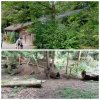
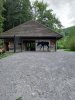
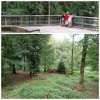

 One was Zurich, a few months after the Masoala Rainforest complex opened, and the other was Langenberg. Zurich didn't have as many exhibits back then and I saw both zoos on the same day and didn't get back to my place of residence until very late in the night with aching legs due to so much walking. I do recall Langenberg being like a typical German 'wildpark', or similar to Northwest Trek Wildlife Park near Seattle, and I enjoyed it immensely. They didn't have a walk-through Wild Boar exhibit back then!