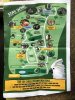
Visited 4/11
Lots changed since my last visit at the beginning of this year.
Animals on show in the area between the reception and the rainforest corner are:
Caiman lizard
False water cobra
Spectacled caiman
In the rainforest corner were exhibits for:
Cuvier's dwarf caiman
Chinese crocodile lizard (a pair)
Biak tree monitor
Philippine sailfin lizard
Blue tongued skink
Reticulated python
Straight ahead in the tropical house (where Digby used to be) was the Burmese python.
On the left as you enter was a netted viewing area for the False gharial and seemingly the only area with butterflies, although only 2 were seen.
Just past this, in the main tropical house was an open top mixed exhibit for Red-footed tortoise and Green Iguana.
The aviary previously home to Java sparrow was empty with the sparrows freeroaming in the tropical house alongside:
Victoria crowned pigeon
Diamond dove
Gouldian finch
Roul-roul
Red crested turaco
Black-cheeked lovebird
Goldies lorikeet
A single unidentified conure who seemed to be bonded to the Goldies lorikeet
Rainbow lorikeet (alot!)
The ponds in the centre of the tropical house each held Goldfish and Koi, the goldfish pond seemed to have basking areas for turtles but none were seen.
In the end aviary was the Nile monitor.
The exit to the tropical house was still through the rainforest corner.
Upon exiting the viewing windows are separate exhibits, the left holding Digby, the Six-banded armadillo, and more Conures. The right held Common marmoset, although only one was seen. Opposite this was the enclosure for a very active Common genet. In the discovery kingdom I only saw Giant day gecko, mixed with Madagascar hissing cockroach and two small exhibits for both Sun beetle and a Stick insect sp.
In the area beyond the tropical house, the aviary formerly housing umbrella cockatoo now housed a single Red-tailed black cockatoo, a single Australian king parrot and a single Ringneck parakeet. Of the two aviaries behind, the right was empty and the left housed a single Green-winged macaw and a single Blue-and-gold macaw together.
In this same area was exhibits for Domestic rabbits, Guineapigs, Kune kune pigs and Striped skunk. As well as aviaries for American red squirrel and Umbrella cockatoo. Behind them a walkthrough for first Pygmy goats and then Bennetts wallaby. The exit to this opposite to aviaries for Hyacinth macaw and Blue-throated macaw. Aviaries further along this path housed Ring-tailed coati, Bolivian squirrel monkey and Striated caracara. The new bird of prey aviaries housed Laughing kookaburra, Turkey vulture, Bengal eagle owl and Harris' hawk. The old bird-of-prey corner housed 2 Barn owl subspecies (guttata and alba), the second Laughing kookaburra, Tawny owl and Chaco owl.
The zoo beyond this had not much changed, apart from ongoing developments to the former Crested porcupine and Yellow mongoose exhibit and the new arrivals of the Greater flamingo.
The new flamingo enclosure is a large netted aviary with great viewing, including a 'walk-in' area. This area housed Meerkat, Ring-tailed lemur, Brown lemur, Black-and-white colobus monkey, Serval, African grey parrot, Black-and-white ruffed lemur, African civet and the Greater flamingo.
The large walkthrough at the far end of the zoo was likewise very much unchanged with the right-side housing Domestic chickens, a single Kune kune pig, a single Domestic goat and a small group of Patagonian mara. On the left was a single Llama and a single Greater rhea.
In the 'Asia' area by the exit, both the Binturong and Asco were very active. The two small aviaries by the playpark housed Red fox (signed but not seen) and Great horned owl.
Species listed on ZTL but not seen:
Crested porcupine
Red fox (signed)
Yellow mongoose
Black-headed parrot
Brown wood owl
Guineafowl
Sulcata tortoise (signed)
Central american wood turtle
Central bearded dragon
Corn snake
Green tree python
Horsfield's tortoise
Red-tailed ratsnake
Ball python
Veiled chameleon
Golden poison frog
Green-and-black poison frog
Ornate horned frog
Splashback poison frog
Re, the Yellow Mongooses. I have not seen them for over a year. The porcupines took over the enclosure that the Yellow Mongooses were in, and yesterday that was empty too. It looked very muddy and with all the burrows, possible waterlogged, so perhaps the porcupine's have been moved to a drier, off show, enclosure.