Trends in European zoo collections in the 21st century

Does weight matter?

Weight, as a proxy for size, is one of the main factors that is often thought to influence whether a mammal gains or loses popularity. In an era enclosures are becoming larger it would make sense that with a finite amount of space, there is less appetite for keeping the species with the biggest space requirements. The animals that need a lot of space tend to be the heaviest ones. I have yet to see a 2 hectare meerkat enclosure, whereas that figure isn’t out of the ballpark when it comes to elephants. Fortunately it is quite easy to test this. If you don’t want to know the methodological details and just want an answer, I advise you to continue reading after the boxplot figure.

full

@Lynne For those not interested in statistics, look at this cute red panda

For this exercise I used the exact same dataset as in the post above on geography. So 739 mammal species were included which were present either in 2000, in 2023 or both and whose status was not unclear at either point. To have a large enough sample size to meaningfully test for significant differences I again used the groupings of winners, losers and stable species. I did however break these up between the 5 main groups of mammals used in the thread: ungulates (including cetaceans), carnivores, primates, rodents+ (rodents, bats & insectivores) and the ‘other’ category (marsupials, monotremes, afrotherians, xenarthrans, pangolins & tree shrews). The reason for this is simple. Even if we would find an overall weight effect that could just be because we lost many primates and ungulates, and these losses aren’t caused by their weight. Splitting into these groups is also informative as it would make it clear whether there has been a shift from e.g. large to small primates or from small to large rodents.

full

@Therabu Even when females are already heavy, male Steller's sea lions can be 4 times heavier

The weight data were taken from the book “All mammals of the world” and for each species both the lower and upper weight limit were noted and then averaged (for species with sexual dimorphism, like Steller’s sea lion, this meant the smallest female weight and the highest male weight). For the small minority of species that only had an average or upper limit indicated, those were used. When there was no weight given, often the case for newly-split species, the weight of a closely related similar species was taken as a proxy. As you can imagine there is a lot of variation in weight in mammals, ranging from Etruscan shrews to African elephants, and there are many more small species compared to heavy species. That means you do not exactly have a hump-shaped (gaussian) distribution. To make sure the few heavyweights did not hijack the analysis, I transformed the averaged weights to a common logarithmic scale (log10()). This is a common type of data transformation in science too to account for such long right-tailed distributions. I then used a GLM to statistically test for differences between losers, winners and stable species. I did that for all species combined and separate for the 5 main groups.

Weight_boxplot2.png
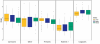
Figure 1: Boxplot showing the mean weight, log10(grams), averaged for winners, losers and stable species per category. For those of you new to boxplots:the line in each boxplot shows the median (average), with the coloured square being the range between 25th percentile and 75th percentile (IQR; so 50% of all values are within the box), the lines on either side are the IQR *1.5 with dots outside it the outliers.

The short answer is that even for all species combined there is no significant difference in weight between winners and losers or between stable species and winners or losers. If you split this out between the different groups (Figure 1) it is unsurprising to see that ungulates are the heaviest group and the rodents+ the least heavy group. Within the 5 groups there is a lot of variation within each category. So while that means that the average “winning” primates and carnivores are slightly smaller than the losers, these results are nowhere near significant. For the rodents+ and ‘other’ categories the average winner is slightly larger than the average loser. But all these differences are so small and there is so much variation within each group that there is no significant difference at all between any of the categories within each grouping. So while there might be some small species that made gains and large species that are losing popularity, that is counteracted by other large species making gains and smaller ones losing popularity. There does not appear to be any overall effect of weight on mammal trends in European zoos.

full

@Azubaa Black rhino are one of the heavyweights that are gaining popularity

But if you dive somewhat deeper into the data there is a bit of evidence that in some cases weight does matter. For primates, carnivores, ungulates and the ‘other’ category species that were actually newly gained this century, as opposed to merely increasing in popularity, tend to be smaller than the average species already present in each grouping. I did not test this statistically (yet), but that could be the reason why some have the idea that the average mammal kept in Europe is becoming smaller. On the other hand the species lost since 2000 aren’t larger than the average in each group. An easy explanation is that mammal collections are biassed towards larger species anyway, so the chance of a new large species being added is much smaller compared to one of the myriad smaller options around.

full

@Jana Slender mongoose are one of the small carnivores gained this century

The reason why there is no relation between trend and weight might actually be the same one as why there is no difference in the number of mammal species kept now compared to 2000. While the old (city) zoos have lost species and many size-limited zoos have stopped keeping some larger species, this is compensated by the rise of many zoos that are less limited by space. So European zoos have compensated for increasing enclosure sizes by just having more space on a European scale devoted to zoo enclosures.

Only 3 mammal posts left before a long break, so enjoy it while it lasts ;)
 

Attachments

  • Weight_boxplot2.png
    Weight_boxplot2.png
    88.6 KB · Views: 304
But this has always been the case and while I cannot back it up with data, my feeling is that the single most important reason whether a species is around or not, is interest of 1-5 curators/directors for individual species.

In that perspective, it would be interesting to know whether the educational background of curators/directors has changed, e.g. from a more biological-scientific to a more economic education.

From my own experience, nothing to do with zoos, I know that this can make a big difference in both day-to-day operations and longer-term decisions.
 
educational background of curators/directors has changed, e.g. from a more biological-scientific to a more economic education.
It has, at least in major urban zoos. Back in the old days, a zoo director in general had a zoology degree or was somehow related to zoology, in particular mammology. Quite a bunch worked up their way from zoo keeper to curator and then director. Some had a background as commercial animal traders or catchers (like Carl Hagenbeck or Gerald Durrell). Veterinarians were smiled at as second-best options at first, but slowly (Grzimek, Klös etc.) established themselves as equally suitable directors. Nowadays you have more and more zoo directors with at least some knowledge and experience in business managament or even a separate economic next to a zoological director (like Duisburg). Zoo management in general has become more and more of a business, and walking zoological encyclopedias with leadership qualities and a passion for zoological oddities (like Dathe) who work as directors or curators are harder to find these days.
 
It has, at least in major urban zoos. Back in the old days, a zoo director in general had a zoology degree or was somehow related to zoology, in particular mammology. Quite a bunch worked up their way from zoo keeper to curator and then director. Some had a background as commercial animal traders or catchers (like Carl Hagenbeck or Gerald Durrell). Veterinarians were smiled at as second-best options at first, but slowly (Grzimek, Klös etc.) established themselves as equally suitable directors. Nowadays you have more and more zoo directors with at least some knowledge and experience in business managament or even a separate economic next to a zoological director (like Duisburg). Zoo management in general has become more and more of a business, and walking zoological encyclopedias with leadership qualities and a passion for zoological oddities (like Dathe) who work as directors or curators are harder to find these days.

You hit the nail on the head here and there are even examples from long ago. Chuck Bieler, who was hired by San Diego Zoo back in the early 1970s, knew nothing about animals, at one point mistook a tiger for a lion (!!), and he spent years at General Motors selling cars. However, the #1 job of a zoo director these days is to raise money. There is endless fundraising, schmoozing with philanthropic donors, dealing with hundreds of staff members, budgeting and scheduling and everything else that comes with management positions. The animals are practically an afterthought. There are a few dozen zoo directors in the U.S. right at this moment who never once worked at a zoo before they were hired, let alone have a zoology or biology degree. Many used to work in the corporate world and are skilled at handling finances and delegating jobs to people around them. These directors might have only visited a handful of zoos before they were hired, less than some zoo nerds will visit in a single weekend while on a trip, yet they are excellent at their jobs because that particular leadership role has changed over the last few decades.
 
I think the educational background of the director has a big impact on the zoo. I'm sure there is a major shift though. I think there are differences when looking from country to country and yes non-biology directors have become more common, although I know some relatively recent appointments where people came from the ranks. Also there might be some nuance here as there are non-biologist zoo directors that could be considered zoo nerds and there are biologist zoo directors who could be considered outsiders (as in they know their biology, but would know near to nothing on husbandry and or veterinary requirements). And of course there is a third category of political appointed zoo directors who can be either of the two or neither.
 
It has, at least in major urban zoos. Back in the old days, a zoo director in general had a zoology degree or was somehow related to zoology, in particular mammology. Quite a bunch worked up their way from zoo keeper to curator and then director. Some had a background as commercial animal traders or catchers (like Carl Hagenbeck or Gerald Durrell). Veterinarians were smiled at as second-best options at first, but slowly (Grzimek, Klös etc.) established themselves as equally suitable directors. Nowadays you have more and more zoo directors with at least some knowledge and experience in business managament or even a separate economic next to a zoological director (like Duisburg). Zoo management in general has become more and more of a business, and walking zoological encyclopedias with leadership qualities and a passion for zoological oddities (like Dathe) who work as directors or curators are harder to find these days.

The German speaking countries are, at least in Western Europe, quite an outlier, in that many zoos still love to have someone with a doctorate in zoology/veterinary sciences. Even in the younger generation the there are still a lot of them which value the "Dr." in front of their name. But given these are often government-owned there is less reason to worry about funding. Otherwise the majority of zoo directors these days seems to have no zoo background.

The curators generally do all have either a zoo background or have studied biology/animal management/veterinary sciences at university level. I don't think background tells much about whether they love animal diversity, but that it is more of a personal thing. I think a big point is that the job of curator has also changed in the past decade, with a much bigger emphasis on health, enrichment, training and with collection management being a smaller component than before.
 
If we are to be honest: except from the business people mentioned by @snowleopard brought in by the zoo stakeholders as zoo directors (or rather, zoo managers - although usually not as blatantly business-orientated as in "Fierce Creatures"), the recruitment practice of major zoos in regard to certain posts has become quite self-limiting, at least in what @lintworm calls the "The German speaking countries [...], at least in Western Europe". Back in the days, career changers without a professional zoo educational background had the (albeit limited) chance to somehow get in and climb up the career ladder within zoos if they had what it took. Nowadays, the more regimented professional education requirements for zoo husbandry positions make it a lot harder for an "outsider" to get into the zoo profession (at least in major, EAZA/AAZA etc. accredited zoos) and the zoos limit their recruitment to people that are already more or less established within the zoo community, up to the point of "poaching" good employees from other zoos.
What I've also witnessed is what the German Tiergarten.com forum rather fittingly describes as "Stellenkarussel" (Job roundabout): unlike their precusors who stayed as long as possible in their position in one zoo to fulfill their "life's work", modern zoo directors in Germany, Austria, Switzerland etc. have less qualms to leave "their" zoo behind for a director post in a more prestigious zoo.
 
Last edited:
The advantage of being endangered?

In an age where zoos are telling anybody who listens that they are an ark for endangered species, one would expect that such endangered species fill more and more available slots. Like always the real story is more complicated. For starters there have been just as many least concern (LC) species in European zoos this century (56.7%) as in the wild (56.4%). There have however been relatively more critically endangered (CR; 6% vs 5%), endangered (EN; 13% vs 9%), vulnerable (VU; 15% vs 9%) and near threatened (NT; 9% vs 6%) mammals in European zoos this century compared to all mammals. The big difference is that only very few species kept in zoos are listed as data deficient (DD) or not evaluated (NE; 1% vs 14%). That makes sense as the mammal species kept in zoos tend to be larger, with bats, shrews and murid rodents far less common than might be expected based solely on sheer species numbers. It is those groups and next to unknown mammals that end up in the DD or NE category and these are simply far less likely to make it into zoos.

full

@HOMIN96 The Crete spiny mouse is one of the very few data deficient species in European zoos

Not only are there relatively more threatened mammal species around in Europe, the ones gaining popularity are also on average in somewhat higher IUCN categories. Among the winners there are more CR (8% vs 5%), EN (16% vs 11%), VU (16% vs 12%) and NT species (8% vs 7%) compared to the stable species. It is however not that easy, among the losing species there are also clearly more NT (12%) and VU (19%) species compared to both the winners and stable species. 13% of the losing species are in the EN category, more than for stable species but less than for the winners. Only 3% of the losing species is CR, so that is a slightly lower total compared to stable species and winners. When looking at stable + winning species together, some 40% are in a threatened category, whereas among the losers that is 47%, similar for winners only. The difference is that the winners are in slightly higher IUCN categories compared to the losers.

full

@Julio C Castro Mountain bongo are among the critically endangered mammals that have gained popularity

So when looking at those numbers IUCN status is not an asset per se. It is always dangerous to draw big conclusions from such numbers, without looking at what is the cause or analyse the data differently. For starters: primates make up about ⅓ of all losing species, but at the same time are more likely to be threatened (73%). So many of the losing species are in that category basically because primate diversity in zoos has declined, due to space limits, the disappearance of (extremely) unsustainable populations or single survivors from 1970s and 1980s imports. Additionally there is a difference between species newly gained this century and species that were present already in 2000, but have gained popularity. Of all the newly gained species some 69% is listed as LC and only 4 are CR. But of the species gaining popularity “only” 40% is listed as LC and 16 are CR. So that basically means it is likely much easier to import LC species compared to more threatened ones and zoos are working on promoting threatened species they already have. When looking at the data from another angle, some 33% of all mammal species in European zoos belong to the winner category. But EN (40%) and CR species (49%) are more likely to be in that category. There thus seems to be a trend that zoos are increasingly interested in the most endangered mammals, but mostly ones that were already around in 2000.

full

@Therabu Despite being critically endangered southern white-cheeked gibbons are on their way out from Europe

That would be a satisfying conclusion, but again things are not what they seem. 72% of the species already present in 2000 and gaining popularity, is part of an EEP*. Whereas among stable species (35%) and “loser” species (10%) that figure is much lower. So for species already present, having an EEP seems to be an enormous asset if you want to gain popularity, regardless of whether you are threatened or not. This is however something of a chicken/egg story. There is certainly a case to be made where EEPs are only continued for species that do fine and are popular, whereas ones for species with declining populations are discontinued. Having EEP status is however increasingly important in collection management and the growing popularity of animals like mohr gazelle can certainly also be attributed to the fact they are a EEP-managed species. So there are 2 reasons why EEP species are more likely than others to be gaining popularity. Which of the 2 is the driving factor in the majority of cases, I do not know. It would be possible to test this, but for that I would need the list of EEP/ESB managed species in 2000, which is something I do not have.

full

@WhistlingKite24 Eastern grey kangaroo are a least concern, but EEP managed, species that has been steadily gaining popularity

It is also interesting to see that of all dead end species and lost species, none has an EEP, though some have had one in the past. Additionally some 30% of the species that are losing popularity are currently part of an EEP and there are plenty of species losing popularity whose breeding program was discontinued recently. The programs that still exist have their work cut out for them, including goitered gazelle, golden cat, musk ox and lesser chevrotain. Another fun fact is that only 12% of all newly gained species is part of an EEP. So very few new species are brought in with the idea of establishing an EEP, which means that the zoo ark for mammals basically caters for the species already present. It is likely that new EEPs will be established once some of the gained species are doing really well, but that is very reactionary and it seems that there is little coordination of who imports which species with the goal of establishing a captive breeding program.

full

@Kaelio Balabac chevrotain are one of the very few newly kept species this century for which an EEP has been established

After all the twists and turns of this post it still seems preferable to be a threatened species if you want to stay. But being EEP managed is likely your ticket to achieve that, merely being threatened might not be enough. But overall the best answer would be “it depends”. IUCN status surely seems to be a driver, but it is one driver among multiple. There are clear signs as to what taxonomic groups of species are gaining or losing, as well as clear geographical differences that also play a role. It is next to impossible to combine these different drivers and test their relative importance. However, if you are an endangered Malagasy carnivore with an EEP, you are more likely to flourish compared to a least concern North American ungulate without an EEP.

full

@Arizona Docent Narrow-striped boky fit all the categories to flourish and have indeed become significantly more common in European zoos this century

The next post will focus more on which zoos are driving these changes and also provide a timeline as to how many species were gained/lost in any given year this century. After that I will try to make some predictions for the future based on what has happened the past 25 years.


*Whereas EEP stands for European Endangered species Programme, the programme is not exclusive for endangered species, but is increasingly a management tool for species that zoos want to maintain a long-term well-managed population of. Being threatened is a reason for inclusion as are educational value and other criteria.
 
In an age where zoos are telling anybody who listens that they are an ark for endangered species, one would expect that such endangered species fill more and more available slots. Like always the real story is more complicated. For starters there have been just as many least concern (LC) species in European zoos this century (56.7%) as in the wild (56.4%). There have however been relatively more critically endangered (CR; 6% vs 5%), endangered (EN; 13% vs 9%), vulnerable (VU; 15% vs 9%) and near threatened (NT; 9% vs 6%) mammals in European zoos this century compared to all mammals.

To be fair, zoos rarely can import any new threatened mammals, because trade of almost all endangered species is prohibited by local and international laws. One could easily count CITES how many threatened mammals could be imported. It would be like 95% of threatened mammals are banned from trade internationally.

And add biodiverse countries which locally ban export of any wild animals, including China, Madagascar and Australia, veterinary laws which ban import of ungulates to Europe, and activists who run crazy campaigns. So it is actually an achievement that zoos keep so many endangered species, mostly by breeding mammals which ancestors were imported to zoos decades ago, before such laws were passed.

One zoo director told the story how sometime around 2000 a number of European zoos wanted to import Ader's duikers from Africa, because a local kept several as pets. The bureaucracy took two years, and in the meantime a civil unrest happened in the local country, and the duikers were killed.
 
Last edited:
It is probably a lot of work but I think the very interesting variable one should analyze is not threat status of the given specie but its relative threatening status compared to other members of the category as it translates better how zoos work : Collection planning is not done at mammals level but rather inside TAGs. If you're a vulnerable gibbon, you might be the less threatened of your family while a vulnerable armadillo would rapidly get priority over all other family members.

That's super interesting anyhow, I appreciate very much all the work you put in the figures and in the writing.
 
I do wonder of the animals that have “survived” regardless of gaining or losing popularity how many of them had their IUCN status changed (for example the golden-bellied mangabey) ? And to what extent does the IUCN status change the interest towards the species (for example southern pig-tail macaques gaining an EEP after they got listed as endangered)
 
So for species already present, having an EEP seems to be an enormous asset if you want to gain popularity, regardless of whether you are threatened or not. This is however something of a chicken/egg story.

I think the chicken-egg story is actually more one sided. Animals are first imported and start to thrive. EEP coordinator can formalize and organize breeding, but essentially reacts to what zoos can and want to keep.

Another fun fact is that only 12% of all newly gained species is part of an EEP. So very few new species are brought in with the idea of establishing an EEP

This would be a dream, but it is usually impossible to import a large number of larger rare mammals. Gone are the days when Gerald Durrell brought 20 Rodriguez Flying Foxes from the Rodriguez island, or Dvur Kralove Zoo imported dozens of giraffes, antelope and zebras from Africa. Unfortunately, the only remaining way is to import a pair or some animals, and hope that unrelated founders can somehow be imported in future.
 
I think the chicken-egg story is actually more one sided. Animals are first imported and start to thrive. EEP coordinator can formalize and organize breeding, but essentially reacts to what zoos can and want to keep.


This would be a dream, but it is usually impossible to import a large number of larger rare mammals. Gone are the days when Gerald Durrell brought 20 Rodriguez Flying Foxes from the Rodriguez island, or Dvur Kralove Zoo imported dozens of giraffes, antelope and zebras from Africa. Unfortunately, the only remaining way is to import a pair or some animals, and hope that unrelated founders can somehow be imported in future.
If captive populations exist out of Europe (not only in zoos but also in other facilities), imports may be doable without too many difficulties.
I think to Tasmanian Devils from Australia, Sea Otters from the US or (even it isn't a mammal species) Harpy Eagles from the Itaipu breeding centre in Brazil.
 
I don’t know how otters forced to be castrated by the US government can be useful to establish a captive population without any dead ends.
I don't talk only about breeding animals or facilities. Until now the imports of Sea Otters in Europe haven't the purpose to establish a breeding population. But they may virtually persist as long as US (and Canadian ?) facilities continue to rescue these animals.
The situation is similar with the Tasmanian Devils, whose European population includes a lot of surplus males from the Australian breeding centers. Obviously they are unfit for breeding but their presence itself is a powerful tool to raise the awareness of the public to the conservation of this species.

I may evoke many other examples of imports from non-European facilities : there's another prominent case with some breeding centres in South Africa where Brown Hyaenas were acquired a few months ago ; I hope that these animals would be founders of new breeding populations in our continent.

There are finally transfers in the opposite direction, the numerous zoos in Europe being able to send animals to zoos in other countries. I think to a recent transfer (late 2023) of 2 Indian Rhinos from French zoos to Guadalajara in Mexico.
 
there's another prominent case with some breeding centres in South Africa where Brown Hyaenas were acquired a few months ago ; I hope that these animals would be founders of new breeding populations in our continent.

You're a little behind the times on this one - Hamerton Zoo here in the UK recently announced the fact that their recently-imported pair have had a litter of cubs :P
 
To be fair, zoos rarely can import any new threatened mammals, because trade of almost all endangered species is prohibited by local and international laws. One could easily count CITES how many threatened mammals could be imported. It would be like 95% of threatened mammals are banned from trade internationally.

And add biodiverse countries which locally ban export of any wild animals, including China, Madagascar and Australia, veterinary laws which ban import of ungulates to Europe, and activists who run crazy campaigns. So it is actually an achievement that zoos keep so many endangered species, mostly by breeding mammals which ancestors were imported to zoos decades ago, before such laws were passed.

One zoo director told the story how sometime around 2000 a number of European zoos wanted to import Ader's duikers from Africa, because a local kept several as pets. The bureaucracy took two years, and in the meantime a civil unrest happened in the local country, and the duikers were killed.

Yes and no. Legislation and paperwork has made imports more difficult. Especially for those species that are part of groups with big economic interests like livestock. Although I understand the frustration of zoos trying to safe a species and work with them, this also means you need to invest time and money ensuring that the import has to be planned and thought out well. So the chance that when you import an endangered species it has a better chance because it needs to be back-up with resources. It also prevents importing single individuals or pairs which make that the species is a dead-end at arrival.

@lintworm brilliant like always although Europe has a challenge with endangered species that is especially relevant for native ones. Many species present in Europe are endangered in Europe, but are considered least concern due to their large range going into Asia. Think about the work done by zoos with Eurasian lynx, European wildcat, white-backed woodpecker or black grouse. All very valid projects on an European scale (and species regionally threatened), but species that on a global scale aren't threatened.
 
It is probably a lot of work but I think the very interesting variable one should analyze is not threat status of the given specie but its relative threatening status compared to other members of the category as it translates better how zoos work : Collection planning is not done at mammals level but rather inside TAGs. If you're a vulnerable gibbon, you might be the less threatened of your family while a vulnerable armadillo would rapidly get priority over all other family members.

That's super interesting anyhow, I appreciate very much all the work you put in the figures and in the writing.

That would indeed be a better indicator, but extremely hard to get it right if you want to do statistical tests. The problem is that many groupings that you need to answer the questions like gibbons or armadillos are so small that it is hard to test for from a statistical point of view. An option would be to randomly select losing - stable - winner trios for each category and then do a paired ANOVA or something similar to test all these trios together. That would be a lot of work. If I have some free time later this weekend, I will see if I can get some quick-and-dirty statistical tests done to see what is feasible and whether such a work will likely yield results.

I do wonder of the animals that have “survived” regardless of gaining or losing popularity how many of them had their IUCN status changed (for example the golden-bellied mangabey) ? And to what extent does the IUCN status change the interest towards the species (for example southern pig-tail macaques gaining an EEP after they got listed as endangered)

That likely has some impact, but a small one I would guess. There are some examples like the pig-tailed macaque, but also Vicuna retaining their edge despite being downlisted a long time ago. You now see it with African vultures which as a group have been listed as EN or CR and there are more zoos interested in African vultures these days.

I think the chicken-egg story is actually more one sided. Animals are first imported and start to thrive. EEP coordinator can formalize and organize breeding, but essentially reacts to what zoos can and want to keep.

It is not exactly that easy. Especially with the new round of EEPs, new style EEPs were created for the winners whereas for losing species their EEPs were discontinued. So the EEPs do show a bias already towards winners. And the gaur case shows that a phase-out of a previously managed stable species can create a losing species with a pen stroke.

This would be a dream, but it is usually impossible to import a large number of larger rare mammals. Gone are the days when Gerald Durrell brought 20 Rodriguez Flying Foxes from the Rodriguez island, or Dvur Kralove Zoo imported dozens of giraffes, antelope and zebras from Africa. Unfortunately, the only remaining way is to import a pair or some animals, and hope that unrelated founders can somehow be imported in future.

As @Haliaeetus mentioned when working together with foreign zoos, large numbers can be imported. Yellow-footed rock wallaby are a good example with multiple zoos importing at least 16 of them from the US this century. Additionally the imports of echidna and bear cuscus also involved quite some potential founders, though there the mortality rates were high.

@lintworm brilliant like always although Europe has a challenge with endangered species that is especially relevant for native ones. Many species present in Europe are endangered in Europe, but are considered least concern due to their large range going into Asia. Think about the work done by zoos with Eurasian lynx, European wildcat, white-backed woodpecker or black grouse. All very valid projects on an European scale (and species regionally threatened), but species that on a global scale aren't threatened.

That is indeed always the case and can't really be avoided for such big scale analyses. There are also endangered species without an EEP, but where the zoos involved are part of breeding programs for reintroduction, such as European hamster and Bavarian pine vole.
 
@lintworm the massive work done to get these trends has been very helpful as most of us base it on our own experiences, which by necessity are an incomplete picture. Also zooming means that some of the nuances/details get lost. Which is not bad as sometimes by being invested in a group of species or even single species we get lost in details that are not that relevant for the overall trends.

What for me is interesting is that while we don't see an overall loss of species diversity in European zoos, we see a loss of diversity in individual institutions. Which makes sense as husbandry and welfare standards have evolved. Also that individual commitment (by an institution or person) is making a significant difference for individual species. EEPs and the vocational ethic of feeling responsible for the public role of zoos to safe endangered species have quite a big impact as well, although my experience is that again the commitment and drive of a person or institution shapes the outcomes of TAG discussions very often.

What would be interesting to see what is the percentage of ABC animals vs the "niche" species that help zoos distinguish themselves. And then see if there is a trend of homogenization as often claimed here on the forum. Of course selecting what are the ABC species will be extremely subjective (although could be done by animals kept by at least x amount of institutions) and is there a need to make a distinction between EAZA and non-EAZA zoos (as there has been a view EAZA has been driving this). So many interesting questions, so little time. It does name me appreciate the work you did @lintworm
 
Back
Top