Does weight matter?
Weight, as a proxy for size, is one of the main factors that is often thought to influence whether a mammal gains or loses popularity. In an era enclosures are becoming larger it would make sense that with a finite amount of space, there is less appetite for keeping the species with the biggest space requirements. The animals that need a lot of space tend to be the heaviest ones. I have yet to see a 2 hectare meerkat enclosure, whereas that figure isn’t out of the ballpark when it comes to elephants. Fortunately it is quite easy to test this. If you don’t want to know the methodological details and just want an answer, I advise you to continue reading after the boxplot figure.

@Lynne For those not interested in statistics, look at this cute red panda
For this exercise I used the exact same dataset as in the post above on geography. So 739 mammal species were included which were present either in 2000, in 2023 or both and whose status was not unclear at either point. To have a large enough sample size to meaningfully test for significant differences I again used the groupings of winners, losers and stable species. I did however break these up between the 5 main groups of mammals used in the thread: ungulates (including cetaceans), carnivores, primates, rodents+ (rodents, bats & insectivores) and the ‘other’ category (marsupials, monotremes, afrotherians, xenarthrans, pangolins & tree shrews). The reason for this is simple. Even if we would find an overall weight effect that could just be because we lost many primates and ungulates, and these losses aren’t caused by their weight. Splitting into these groups is also informative as it would make it clear whether there has been a shift from e.g. large to small primates or from small to large rodents.

@Therabu Even when females are already heavy, male Steller's sea lions can be 4 times heavier
The weight data were taken from the book “All mammals of the world” and for each species both the lower and upper weight limit were noted and then averaged (for species with sexual dimorphism, like Steller’s sea lion, this meant the smallest female weight and the highest male weight). For the small minority of species that only had an average or upper limit indicated, those were used. When there was no weight given, often the case for newly-split species, the weight of a closely related similar species was taken as a proxy. As you can imagine there is a lot of variation in weight in mammals, ranging from Etruscan shrews to African elephants, and there are many more small species compared to heavy species. That means you do not exactly have a hump-shaped (gaussian) distribution. To make sure the few heavyweights did not hijack the analysis, I transformed the averaged weights to a common logarithmic scale (log10()). This is a common type of data transformation in science too to account for such long right-tailed distributions. I then used a GLM to statistically test for differences between losers, winners and stable species. I did that for all species combined and separate for the 5 main groups.

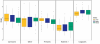
Figure 1: Boxplot showing the mean weight, log10(grams), averaged for winners, losers and stable species per category. For those of you new to boxplots:the line in each boxplot shows the median (average), with the coloured square being the range between 25th percentile and 75th percentile (IQR; so 50% of all values are within the box), the lines on either side are the IQR *1.5 with dots outside it the outliers.
The short answer is that even for all species combined there is no significant difference in weight between winners and losers or between stable species and winners or losers. If you split this out between the different groups (Figure 1) it is unsurprising to see that ungulates are the heaviest group and the rodents+ the least heavy group. Within the 5 groups there is a lot of variation within each category. So while that means that the average “winning” primates and carnivores are slightly smaller than the losers, these results are nowhere near significant. For the rodents+ and ‘other’ categories the average winner is slightly larger than the average loser. But all these differences are so small and there is so much variation within each group that there is no significant difference at all between any of the categories within each grouping. So while there might be some small species that made gains and large species that are losing popularity, that is counteracted by other large species making gains and smaller ones losing popularity. There does not appear to be any overall effect of weight on mammal trends in European zoos.

@Azubaa Black rhino are one of the heavyweights that are gaining popularity
But if you dive somewhat deeper into the data there is a bit of evidence that in some cases weight does matter. For primates, carnivores, ungulates and the ‘other’ category species that were actually newly gained this century, as opposed to merely increasing in popularity, tend to be smaller than the average species already present in each grouping. I did not test this statistically (yet), but that could be the reason why some have the idea that the average mammal kept in Europe is becoming smaller. On the other hand the species lost since 2000 aren’t larger than the average in each group. An easy explanation is that mammal collections are biassed towards larger species anyway, so the chance of a new large species being added is much smaller compared to one of the myriad smaller options around.

@Jana Slender mongoose are one of the small carnivores gained this century
The reason why there is no relation between trend and weight might actually be the same one as why there is no difference in the number of mammal species kept now compared to 2000. While the old (city) zoos have lost species and many size-limited zoos have stopped keeping some larger species, this is compensated by the rise of many zoos that are less limited by space. So European zoos have compensated for increasing enclosure sizes by just having more space on a European scale devoted to zoo enclosures.
Only 3 mammal posts left before a long break, so enjoy it while it lasts
Weight, as a proxy for size, is one of the main factors that is often thought to influence whether a mammal gains or loses popularity. In an era enclosures are becoming larger it would make sense that with a finite amount of space, there is less appetite for keeping the species with the biggest space requirements. The animals that need a lot of space tend to be the heaviest ones. I have yet to see a 2 hectare meerkat enclosure, whereas that figure isn’t out of the ballpark when it comes to elephants. Fortunately it is quite easy to test this. If you don’t want to know the methodological details and just want an answer, I advise you to continue reading after the boxplot figure.
@Lynne For those not interested in statistics, look at this cute red panda
For this exercise I used the exact same dataset as in the post above on geography. So 739 mammal species were included which were present either in 2000, in 2023 or both and whose status was not unclear at either point. To have a large enough sample size to meaningfully test for significant differences I again used the groupings of winners, losers and stable species. I did however break these up between the 5 main groups of mammals used in the thread: ungulates (including cetaceans), carnivores, primates, rodents+ (rodents, bats & insectivores) and the ‘other’ category (marsupials, monotremes, afrotherians, xenarthrans, pangolins & tree shrews). The reason for this is simple. Even if we would find an overall weight effect that could just be because we lost many primates and ungulates, and these losses aren’t caused by their weight. Splitting into these groups is also informative as it would make it clear whether there has been a shift from e.g. large to small primates or from small to large rodents.
@Therabu Even when females are already heavy, male Steller's sea lions can be 4 times heavier
The weight data were taken from the book “All mammals of the world” and for each species both the lower and upper weight limit were noted and then averaged (for species with sexual dimorphism, like Steller’s sea lion, this meant the smallest female weight and the highest male weight). For the small minority of species that only had an average or upper limit indicated, those were used. When there was no weight given, often the case for newly-split species, the weight of a closely related similar species was taken as a proxy. As you can imagine there is a lot of variation in weight in mammals, ranging from Etruscan shrews to African elephants, and there are many more small species compared to heavy species. That means you do not exactly have a hump-shaped (gaussian) distribution. To make sure the few heavyweights did not hijack the analysis, I transformed the averaged weights to a common logarithmic scale (log10()). This is a common type of data transformation in science too to account for such long right-tailed distributions. I then used a GLM to statistically test for differences between losers, winners and stable species. I did that for all species combined and separate for the 5 main groups.
Figure 1: Boxplot showing the mean weight, log10(grams), averaged for winners, losers and stable species per category. For those of you new to boxplots:the line in each boxplot shows the median (average), with the coloured square being the range between 25th percentile and 75th percentile (IQR; so 50% of all values are within the box), the lines on either side are the IQR *1.5 with dots outside it the outliers.
The short answer is that even for all species combined there is no significant difference in weight between winners and losers or between stable species and winners or losers. If you split this out between the different groups (Figure 1) it is unsurprising to see that ungulates are the heaviest group and the rodents+ the least heavy group. Within the 5 groups there is a lot of variation within each category. So while that means that the average “winning” primates and carnivores are slightly smaller than the losers, these results are nowhere near significant. For the rodents+ and ‘other’ categories the average winner is slightly larger than the average loser. But all these differences are so small and there is so much variation within each group that there is no significant difference at all between any of the categories within each grouping. So while there might be some small species that made gains and large species that are losing popularity, that is counteracted by other large species making gains and smaller ones losing popularity. There does not appear to be any overall effect of weight on mammal trends in European zoos.
@Azubaa Black rhino are one of the heavyweights that are gaining popularity
But if you dive somewhat deeper into the data there is a bit of evidence that in some cases weight does matter. For primates, carnivores, ungulates and the ‘other’ category species that were actually newly gained this century, as opposed to merely increasing in popularity, tend to be smaller than the average species already present in each grouping. I did not test this statistically (yet), but that could be the reason why some have the idea that the average mammal kept in Europe is becoming smaller. On the other hand the species lost since 2000 aren’t larger than the average in each group. An easy explanation is that mammal collections are biassed towards larger species anyway, so the chance of a new large species being added is much smaller compared to one of the myriad smaller options around.
@Jana Slender mongoose are one of the small carnivores gained this century
The reason why there is no relation between trend and weight might actually be the same one as why there is no difference in the number of mammal species kept now compared to 2000. While the old (city) zoos have lost species and many size-limited zoos have stopped keeping some larger species, this is compensated by the rise of many zoos that are less limited by space. So European zoos have compensated for increasing enclosure sizes by just having more space on a European scale devoted to zoo enclosures.
Only 3 mammal posts left before a long break, so enjoy it while it lasts