Berlin Tierpark Tierpark Berlin News 2024

They indeed plan sending the offspring over to Africa where they are supposed to meet the two last living Northern White Rhinos and learn the specific social behaviour (e.g. they have different calls). So for Tierpark visitors it will mainly be an exhibit with Southern White Rhinos. If there should be any successful breeding, the visitors won't ever see the offspring fully grow up in the Tierpark (but I'm sure, there would be some form of medial connection to virtually follow them along).
Will the offspring be hand reared if they are moved over to Africa as calves, or will they be joined by their mothers, or will they be a few years old anyway before they meet the two older Northern White Rhinos?
 
Will the offspring be hand reared if they are moved over to Africa as calves, or will they be joined by their mothers, or will they be a few years old anyway before they meet the two older Northern White Rhinos?

Unfortunately, I don't know any details. All I remember from some (out of many) news article was this information. Apparently, Northerners and Souterners have different social behaviour (reminds me of my time in England, please excuse this little pun). So it wouldn't be good, if they only get into contact with their "birth mothers" or whatever you want to call them. How exactly this is thought to work out: I honestly couldn't tell. All I understood was that they can't and won't wait for generations. My guess would be that they only wait for the little rhinos to reach a certain necessary (but still very young) age to be separated and then send them over to Africa where they can both get into their natural habitat and meet their actual genetic relatives.

But this definitely will be a relevant issue apart from the reproduction process itself.
 
A note of critique: Whereas I applaud the rationale of the project, I do consider to use part of the traditional zoo site of the Tierpark plan for the project a little challenging.

White rhino are certainly not the rhino species particularly in need of more extra spaces within the European EAZA/EEP setting (where both the Greater One-Horned and the Black Rhino EEP's have long clamoured for extra spaces within zoos in the European region). I really had hoped that the black rhino would feature prominently at Tierpark Berlin (certainly since the last black rhino were transferred from Berlin Zoo this year and its refocus fully on the Indian Rhino).

I would have rather favored a BTS larger facililty at Tierpark Berlin. Really the Tierpark does have sufficient area for an off site dedicated breeding and research compound and that the zoo would have an on-view and dedicated African (both black and white) rhino exhibit compound in the traditional zoo grounds Incorporated into the African Savannah complex.

Well, just my personal perspective and preferences (admittedly coming from the formidable rhino conservationist ... that is me).
 
Last edited:
Sorry, I keep flooding this thread with lengthy posts. I certainly don't blame anyone, if you don't feel like reading up on all this new information... :D

Well, there have also been some press reports, a few of which particularly stand out for me! If you feel like reading all of it, you can easily use a device like deepl.com (which is just great in my opinion). But I will also paraphrase the bits which appear new and relevant to me. Again, I will break it up into three posts to make editing a bit easier for me.

So let's start with the obligatory dpa report, which appeared on many platforms, including the German main news Tagesschau, and at least provides a good overview of the most important facts and background information.
Berlin: Nur noch zwei Weibchen: Forscher möchten bedrohte Nashorn-Unterart im Berliner Tierpark retten | tagesschau.de

However, the FPA report, which I have only been able to find on Stern so far, contains some new information: It confirms that start of construction scheduled for this fall/autumn, but also mentions the building process is due to be completed in spring 2026, which means that the first rhino cows could indeed move in by 2026. In terms of the timetable, the rhinos would even overtake the elephants for which the park now targets mid-2026 according to the latest annual report.
Forschungsstation für bedrohtes Nördliches Breitmaulnashorn entsteht in Berlin | STERN.de
 
But my personal highlight is a really well-written and informative article in the Berliner Kurier. It puts things into a completely different context and also adds a lot of exciting and interesting background information:
- For example, when Mr Hildebrandt first collected sperm of the subspecies 30(!) years ago, and initially just wanted to demonstrate the feasibility of this process. At that time, neither he nor anyone else had any idea that the animals would be in such a bad state relatively soon afterwards. - The fact that the breeding attempts with the two cows from the Czech Republic failed completely was another surprising setback, which in retrospect made this work even more important. This meant their collection of tiny cells grew to become the the very last hope for these massive animals.
- Hildebrandt then began harvesting egg cells around 5 years ago in 2019. According to other sources, the fact that there is another "bio bank" in Italy in addition to the one in Berlin is probably for safety reasons in case something should happen at one location.
- The breakthrough was the successful breeding and implantation of an embryo in the closely related Southern subspecies. By the way, the death of the respective rhino cow and thus the embryo had nothing whatsoever to do with the medical "manipulation". It was due to a natural disaster with floods, which in turn spread bacteria and thus also caused a bacterial infection in the rhinoceros cow. In the actual main objective of the project, however, this was not a setback after all, as they still had evidence the process worked out (other sources attest to a 90 per cent chance of survival for an embryo at this stage of development).
- Mr Hildebrandt is therefore very confident that there will also be success with embryos of the northern subspecies. By the way, the article also states a planned completion date of the Berlin breeding station "early 2026".
- Interestingly, in contrast to one of my much earlier sources, there is no longer any mention of the urgent need for contact with the last living animals in Kenya. Instead, it now states that the animals are to be prepared for their future home using "artificial intelligence" such as sound simulations. I don't know, if this means they dropped this aspect altogether or if they just use modern technology to complement it.
- It was also interesting to me personally, to find out why the Berlin senate and then in particular the often "stingy" Ministry of Finance, is covering the majority (i.e. 60%) of the construction costs despite strict austerity measures: The Minister of Finance stated it as follows: despite pressure to save money, "important projects" must continue to be supported. Berlin wants to stand for "research, science, innovation". Apparently, they feel this project can achieve this goal and also attract international attention.
- And indeed, there already have been enquires at Berlin: According to Hildebrandt, the Indonesians contacted him and the IZW with regard to Sumatran rhinoceros and Java rhinoceros...
Tierpark Berlin rettet Nashorn vor dem sicheren Arten-Tod (berliner-kurier.de)
 
Last but not least, there is another well-founded article in Die Zeit, which fortunately provides exciting details about the second pillar of genetic diversity - the work of the Berlin colleagues at the MDC, but also about the other breeding stations (in plural!):
- According to the article, this project is indeed very reminiscent of Jurassic Park, as a species that has become extinct in the wild is to be resurrected through genetic reconstruction.
- In addition to Tierpark Berlin, there are TWO other locations: The Ol Pejeta sanctuary in Kenya and the Dvůr Králové Zoo in the Czech Republic.
- In fact, Kenya even seems to be the biggest station and will also first be starting with embryos of the northern subspecies this SUMMER, followed by the Czech Republic possibly starting in 2025 and finally the Berlin Tierpark possibly joining in 2026. In my opinion, it seems like all three locations seem plausible in some way and I hope they will form a strong and effective alliance.
- The above-mentioned proof of feasibility with an embryo of the southern subspecies, which survived and matured for 62 days, has already been provided at the very same centre in Kenya. So again, it makes a whole lot of sense to have them lead in this. Let's just hope there won't be any more natural calamities.
- But calves are also expected in Berlin "in just a few years".
- Now this actually isn't a point in the paper but just me thinking out loud (so a bit OT): I'm curious to see whether other locations are going to be added (for instance, I am thinking of San Diego but possibly also locations in Asia, where there would be strong research and corresponding sponsors).
- This is where the Berlin MDC would also come into play, as there are currently only 30 embryos with a limited genetic diversity. But by now the MDC can even produce sperm and eggs from skin cells of old taxidermy mounts. Hildebrandt emphasises that this actually is the only way to create the genetic diversity required for a sustainable population.
- The Czech Republic and Berlin are supplementing the work in Kenya in order to produce as many calves as quickly as possible for the largest and most diverse population possible and then release them into the wild "on a large scale" in Africa in a few years' time.
- Here, too, there is talk of training the offspring with artificial intelligence. In the Czech Republic and Berlin, plants from the animals' native countries are also to be cultivated.
- And once again, it is emphasised that, in addition to the rhinos themselves, many other animals (my remark: particularly in their immediate habitat) will also benefit from the work.
Nördliches Breitmaulnashorn: Deutscher Zoo plant Wiedergeburt ausgerotteter Nashörner | ZEIT ONLINE
 
Well you should shut up, I can't like every reply :p

Very interesting news, though I'm conflicted by some personal philosophy, this is undeniably a huge event
 
The above-mentioned proof of feasibility with an embryo of the southern subspecies, which survived and matured for 62 days,
By the way, the death of the respective rhino cow and thus the embryo had nothing whatsoever to do with the medical "manipulation". It was due to a natural disaster with floods, which in turn spread bacteria and thus also caused a bacterial infection in the rhinoceros cow. In the actual main objective of the project, however, this was not a setback after all, as they still had evidence the process worked out (other sources attest to a 90 per cent chance of survival for an embryo at this stage of development).
Even if the embryo died as a result of the death of its mother I am a bit skeptical about the success of the feasibility of this method. What if the embryo died halfway through the pregnancy, had the pregnant cow hadn’t died? And this is just one rhinoceros. I argue that this experiment should have been repeated before everyone gets excited about it.
 
I particularly find it fascinating that they can create egg and sperm cells from taxidermy mounts!

I never heard of this before either. But it reminds me of discussion (or back then may be rather premature "rumours") about the potential of mammoth cells. Proper institutions probably wouldn't cross that line. But perhaps some not so shiny ones would. But this is always the case with scientific progress, I guess.
 
- And indeed, there already have been enquires at Berlin: According to Hildebrandt, the Indonesians contacted him and the IZW with regard to Sumatran rhinoceros and Java rhinoceros...
Tierpark Berlin rettet Nashorn vor dem sicheren Arten-Tod (berliner-kurier.de)
I assume it will be - for now - most relevant for Sumateran rhinos in Sumatera (and perhaps in future with the last remnants of Malaysian Sabah Sumateran rhinos))!

I would personally favor both an in situ and ex situ offshoot and potentially 2 ex situ breeding centers for the species on the island of Sumatera (so, not just Way Kambas BC).

The current main population in situ is (Gunung) Leuser NP in Aceh, North Sumatera .... however greatly scattered here...., and Way Kambas, South Sumatera (south of Lampung) being the second largest population. Bukit Barisan NP is emtpied off rhinos thanks to the then Govt. not evicting local people overrunning the park. We know what happened since ...., the Taman Nasional system must be more rigorously protected through BKDSA. The total wild population for Sumateran rhino is not estimated to be beyond 50-80 max, and probably no more than 30-45 .....
 
I assume it will be - for now - most relevant for Sumateran rhinos in Sumatera (and perhaps in future with the last remnants of Malaysian Sabah Sumateran rhinos))!

I would personally favor both an in situ and ex situ offshoot and potentially 2 ex situ breeding centers for the species on the island of Sumatera (so, not just Way Kambas BC).

The current main population in situ is (Gunung) Leuser NP in Aceh, North Sumatera .... however greatly scattered here...., and Way Kambas, South Sumatera (south of Lampung) being the second largest population. Bukit Barisan NP is emtpied off rhinos thanks to the then Govt. not evicting local people overrunning the park. We know what happened since ...., the Taman Nasional system must be more rigorously protected through BKDSA. The total wild population for Sumateran rhino is not estimated to be beyond 50-80 max, and probably no more than 30-45 .....

If it was up to me and this all came to fruition, I would advocate for an entirely ex situ population, purely as risk management for the active volcanoes in the region. Singapore leaps to mind as an appropriate place.
 
Not much to note from visiting today, aside from the secretary birds having been moved elsewhere to allow for renovations on their exhibit. Unsure of where they have moved, be it another zoo or just offshow at the Tierpark. There was also quite a lot of work being done on the spectacled bear habitat as well as the currently empty outdoor exhibit next to the sun bears at ABH. Nothing visibly happening with the elephant house unfortunately :(

Few questions. Is it known what will be added to the aforementioned ABH exhibit, and also to the one next to the vultures? The latter looks ready for new residents, but it's been empty for 2 years.

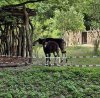
The new okapis are lovely and came out later in the afternoon to feed and nosey at visitors. Italo is overall more confident but once he's out Sabu is incredibly inquisitive - to the point of sticking his snout through the branches at the viewing area. I suspect they may have to rethink that bit now.
 

Attachments

  • 20240617_155800.jpg
    20240617_155800.jpg
    281.1 KB · Views: 36
Some kind of wonderful news! One of the rarest Asian vulture species around. Parco Natura Viva has had considerable success from - what I believe (correct me if I am wrong) - is the only breeding pair within Europe!

Unless our Estimado Italian Zoochat poster from PNV informs us otherwise that they have in fact 2 breeding pairs. The zoo started with 2 hand-raised chicks and 1.1 was added from Paris Menagerie / Jardin des Plantes in 2020.

It is excellent news that the program which was started by just the one Italian zoo as ambassador for this very endangered vulture species has found a new holder and possibly may in time find a wider zoo community to invest in eipanding this vulture species prominente in Europe and its conservation breeding ex situ.
 
Some kind of wonderful news! One of the rarest Asian vulture species around. Parco Natura Viva has had considerable success from - what I believe (correct me if I am wrong) - is the only breeding pair within Europe!

Unless our Estimado Italian Zoochat poster from PNV informs us otherwise that they have in fact 2 breeding pairs. The zoo started with 2 hand-raised chicks and 1.1 was added from Paris Menagerie / Jardin des Plantes in 2020.

It is excellent news that the program which was started by just the one Italian zoo as ambassador for this very endangered vulture species has found a new holder and possibly may in time find a wider zoo community to invest in eipanding this vulture species prominente in Europe and its conservation breeding ex situ.
They have several breeding pairs afaik, the transport could be to let the couples reproduce again in the absence of the offsprings

Also these vultures are reminiscent of the 70s when you could still buy animals off of any dealer, so they have a broader gene pool I guess
 
Last edited:
Back
Top