Part Three - Safari Bus Tour
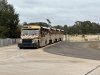
After viewing the lions, wild dogs and hippopotami, I made my way to the Safari Bus. It’s a 40 minute experience that’s completely free, though you can pay $60 do the delux version (smaller group sizes and better photo opportunities). The tour began with the guide pointing out the Asian elephant complex, which was in the early stages of construction. The 21ha habitat will feature six paddocks as of the most recent update will and have a capacity of up to 40 elephants. I can’t wait to see the finished result one day.
Safari Bus:
 Asian elephant complex construction:

To the right was a bachelor herd of zebra in a side paddock. They had recently arrived from Melbourne Zoo, who had recently decided to phase the species out.
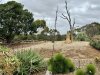
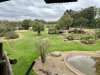
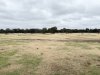
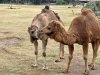
The first drive through paddock was the Arid Zone, inhabited by Dromedary camel and Scimitar-horned oryx. New Zealand’s last camel died in 2005, so it was exciting to see this species again, especially in a small herd; and since my memory of seeing Orana’s Scimitar-horned oryx is so vague, it was like seeing these antelopes for the first time. The exhibit was simple, reminiscent of an arid landscape; and spacious.
Arid Zone:
 Dromedary camel:

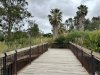
The tour bus passed over the final Conmon hippopotamus exhibit via a bridge; which until two days prior, had housed mother and daughter, Brindabella and Pansy. As mentioned in the previous post, they were transferred to Monarto Safari Park.
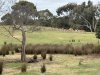
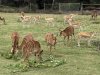
The next drive through paddock followed, which was the Grasslands Zone. It housed large herds of Indian antelope, Lowland nyala and female ostrich, which we saw from a distance; getting much better close up views upon the return. Though none of these three species were a novelty to me, it was great to see such large herds of the two antelopes.
Grasslands Zone:
 Indian antelope and Lowland nyala:

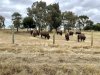
Two more side paddocks followed, one housing North American bison; the other housing Przewalski’s horse. It was the first time I’d seen the latter, which was exciting. I’ve been intrigued by the species ever since I read a story as a child about Basil, Marwell Zoo’s first Przewalski’s stallion. Though the bus slowed down, it didn’t stop, so my view of both these exhibits was somewhat fleeting.
North American bison exhibit:

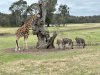
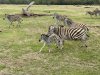
The final drive through is the largest paddock, the Savannah Zone. This exhibit is huge and highly immersive, conjuring up images of the plains of Africa. The species in this habitat were Giraffe, Southern white rhinoceros, Plains zebra, Common eland, Waterbuck and male ostrich. Seeing the zebra herd was especially exciting as one of the mares, Zola (2020), had given birth to her first foal the previous night; and the guide stopped the bus as the herd cantered around us in a circle.
Savannah Zone:
 Newborn Plains zebra:

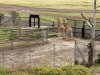
Werribee has held 19 giraffe since 1984. The first five were bulls that arrived as juveniles from Melbourne Zoo between 1984 and 1991. A pair from New Zealand followed with the bull, Oskar (1994) born at Auckland Zoo; and the cow Zawadi (1995) born at Wellington Zoo. Both were imported the year they were born and it appears Werribee planned to hold a breeding pair; alongside their established bachelor herd as Zawadi was their sole female. Sadly Zawadi died in 1996 and Werribee have since continued to hold bachelor bulls. The herd on exhibit considered of four bulls: Amani (2007, Harold (2008), Ajali (2010) and Jelani (2010). All are castrated. Three juvenule bulls had recently arrived and were visible in the holding yards - Jesse (2021) and Dave (2021) came from Australia Zoo; Wayo (2022) from Taronga Western Plains Zoo. They’ve since been integrated with the rest of the herd.
New male giraffes:

Werribee’s first Southern white rhinoceros were a pair named Lee and Alexandra, who were imported as juveniles from Whipsnade in 1981. Like Auckland Zoo, who also imported a pair of juveniles in 1980, Werribee’s pair failed to breed; and the cow was transferred to Dubbo in 1989, where she conceived seven months after arrival. In 1999, Werribee joined several zoos in the region in a mass import of Southern white rhinoceros from Kruger National Park. Werribee received 1.3 white rhinos from this import; and although six calves were born to two cows, only three survived to adulthood and only one of these was female. That female was Kipenzi (2013) and although she had lost her first calf eight months prior to my visit; I later discovered she had been around half-way through a new pregnancy of my visit, delivering a healthy male calf in August 2024. The sire is Kifaru (2009), who I saw as a calf at Hamilton Zoo. Kifaru’s parents were also Kruger imports from the 1999 group import.
All in all, I thought the tour was fantastic. The guide was informative, telling us useful information along the way; as well as being happy to answer my questions afterwards. It would have been nice if the bus could have stopped a few more times to get a better look at the species; but I note this experience is provided via the paid tour and considering the one I took was free, I thought it was excellent.





 Your reviews are so detailed that you can have a long post talking about only two exhibits! I have been to 20 Australian zoos but never Werribee and so I'm excited to read the rest of your review.









 ).
).