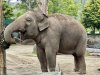
Burma - Auckland Zoo’s Last Elephant
In just four days time, Burma will board a plane for Monarto Safari Park in South Australia. Not only will Burma be Auckland Zoo’s last elephant; she will likely be the last elephant ever to live in a New Zealand zoo. While it’s a seismic change for Auckland Zoo, who have held elephants for 101 years since 1923, this has been a long time in the planning. The decision to phase out elephants was announced in 2020; and Burma was initially scheduled to leave a month after Anjalee in April 2022. But here we are in November 2024.
Burma was born in a logging camp in Myanmar in 1982; and imported into New Zealand as an eight year old in 1990. She lived for two years in the zoo’s Elephant House (built 1923); before moving to the current exhibit in 1992, which at the time was considered state of the art and one of the best exhibits in the region. Auckland Zoo’s history book,
A Tiger by the Tail, described her as a long awaited companion for Kashin; and that was no exaggeration. Following the unexpected passing of their then 18 year old elephant Ma Schwe in 1982, Auckland Zoo imported an African elephant calf named Koru in 1983. Kashin doted on the calf and grieved heavily following her death just three months after her arrival. A seven year wait would follow until Burma’s arrival, during which there were multiple unsuccessful attempts to import a new elephant.
When Burma finally arrived, Kashin initially snubbed her, taking close to two years to warm to her. Their initial relationship was similar to that of Jamuna and Malini, with the former disinterested in the younger female, who like Burma, arrived as an adolescent. While it would be easy to attribute the lack of camaraderie to demographics, matching personalities was no less crucial; at least in the absence of building up a matriarchal herd of related females, as is now recognised as the optimum social structure for captive herds. An example would be when Kashin arrived as a four year old in 1972. She was initially overwhelmed by the friendly overtures of the then eight year old Ma Schwe, who had a confident, assertive personality. Following Ma Schwe’s death, Kashin became matriarch by default and like her predecessor, would dominate Burma by guarding access to her favourite toys. They otherwise formed a strong bond and on my childhood visits, were rarely seen apart.
Some of my earliest memories of Auckland Zoo involve seeing the pair being walked around the zoo during visitor hours, as well as being taken to explore other exhibits such as Baboon Hill. I often wondered as child why Burma led the procession around the zoo, when Kashin was the matriarch. I later learned the reason was Burma being younger and more energetic, grew impatient of waiting for Kashin, who was content to amble at a slower pace. During her youth and prime years, Burma grew into a confident and playful young elephant, a stark contrast from the more reserved Kashin, who lacked Burma’s enthusiasm for energetic pursuits.
Given the disparities in personalities detailed above, it’s to the credit of Auckland Zoo’s staff that they went to great lengths to source a new female following Kashin’s death that would match Burma’s personality. Their success in doing so was evident by Burma’s pure excitement at Anjalee’s arrival, with both females building an instant rapport. Burma’s age and seniority meant she assumed the matriarch role, though she always gave the impression of a reluctant leader. It would come as no surprise to see Burma take a back seat upon her introduction to the other cows at Monarto next year; especially in the presence of the naturally dominant Pak Boon.
Despite the effort that went in to matching Burma and Anjalee, their age difference of 24 years inevitably led to a chasm in activity levels, with the older Burma preferring to observe. I’ve always thought of Anjalee as the companion Burma needed a decade or two prior. Combined with the fact that they lacked the family ties you’d expect to see within a matrilineal herd; and Auckland Zoo’s decision to send them to separate Australian zoos was certainly understandable.
On a personal level, Burma has been one of my favourite animals to visit since my first visit to Auckland Zoo as a child in the early 2000’s. Along with Charlie and Melur the orangutans; the founders of the Greater flamingo flock; and the four adult Galapagos giant tortoise, she’s one of the few remaining animals I saw on my first visit. Since then I’ve become a father and have in turn have taken my sons to the zoo to see Burma. I can only imagine how many millions have people have visited her over the years; and how many more will to come in her new habitat at Monarto.
On 31/10/2024, I made my final trip to see Burma at Auckland Zoo. It was great to see her one last time. Though the zoo won’t be the same without her, it’s undeniably in her best interests to join Monarto’s herd and I’m excited for what the future holds for her. I wish her and keepers safe travels and look forward to to hearing of her progress over the coming months as she settles into her new home; and meets the elephants that will be joining her to form the foundations of a multigenerational herd.
Photo of Burma from my October 31 visit: