Day 1 Fahr Fahr Fahr - YouTube
A few hours after work I get in my car for an overnight drive to Poland, dreaming of Javan banded pittas, Sykes monkeys and black-tailed thallomys. Leftfields ‘Release the pressure’ was the first of many hundreds songs I played in my car, and that is exactly how I feel when travelling.
While I couldn't wait to enter my first Polish zoo, I saw no reason to pass by all those excellent German collections without visiting a few. It seems impossible not to; as a little child, I could never stay out of the biscuit jar either.
So it was barely 7am when I saw the sun rise over Dresden's beautiful baroque city centre. It was urgent time for a stop to try a local Dresdner Eierschecke and, of course, a visit to the local zoo.
#1 Zoo Dresden
It was almost 15 years since I was in Dresden and a lot has changed: new buildings and exhibits, remodelled enclosures. This was always an interesting place, standing a bit too much in de shadow of Leipzig.
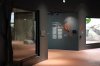
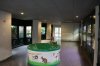
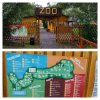
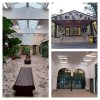
The sleek but colourful modernist entrance building opened along with the Africa building in 1999. To me, it is still one of the most stylish entrances in our zoos.
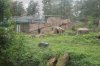
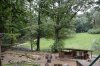
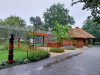
Set in a beautiful park with old trees, the zoo is dotted with large enclosures for ungulates and aviaries. There are quite a few accessible buildings in all kinds of geometric shapes, and often with an interesting mix of species.
Looking at the zoo's map, you could say that the bottom half is reserved for African species, while everything above is dominated by animals from Asia. In the middle there is a sidetrack here and there to other areas. And like a wedge across the zoo, an area dedicated to birds runs from the entrance to the back.
The area dedicated to Africa left of the entrance is dominated by no more than 3-4 different exhibits.
The
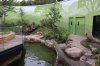
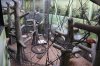
Africa Building (1999) was extensively renovated in 2018. In addition to elephants, it shows mandrills, naked mole rats and Karoo round-eared elephant shrews. The monkeys live on a 250m² outdoors enclosure that is well laid out and while a moat guarantees open views. Nets have been used inside, though, which provides plenty of climbing opportunities that this ground dweller may not always need much of. In any case, this is a better space-saving solution than using a moat, as it was originally. I have little recollection of how it was before 2018 but fortunately, there is the fantastic Zoolex, where this building is extensively documented
ZooLex Exhibit - Africa Hall and we see that in the first version, birds flew around freely and reptiles and fish were present. That has all disappeared anno 2024.

In the south-west corner of the zoo, next to the elephant enclosure are the historic
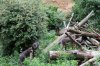
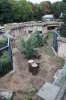
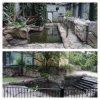
Raubtierfelsen, where a lion enclosure was integrated in 2007. I am not a fan of the latter: at 1300 m², it is large enough, but because it is bordered on all sides by high rocks, it gives a particularly oppressive feeling. The zoo itself talks about a savannah landscape, but you have to take that with a grain of salt. Of course, the rocks themselves, which date back to 1911, are great fun as historical eye-catchers: you can climb them and at the top you have great views of the African elephants, lions and the ring-tailed lemur island. Visitors can walk through certain parts of the former Carnivore house (horrible tiny). Through glass panels, you come face-to-face with the lionesses and that's where the too-small size of this enclosure is even more striking. Enclosures for caracal, banded mongoose and ring-tailed lemur are nearby.


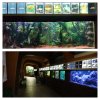
The Aquarium Reptile House closed permanently in 2022 but adjacent t o it is the enclosure for
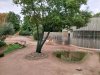
Kordofan giraffes and Chapman's zebra (2008). It sits against the edge of the zoo and slopes upwards a bit, and even that little bit of relief makes it a lot more attractive. Both species have separate stables, of which the one for the giraffes is accessible. The austere timber-framed building stands out for its oval shape. Inside, both stable and outdoor enclosure can be viewed on a platform, with a terrarium for Gundi as eye-catcher. On the ground floor, three aquariums are dedicated to the Congo River, Lake Malawi and Lake Tanganyika. The first has a nice school of Congo salmon, a particularly attractive fish that I have kept myself, but the stars here are six-band distichodus (Distichodus sexfaciatus) and the African backswimmer (Synodontis nigriventris, unfortunately not seen). The Tanganyika aquarium includes snailfish (Neolamprologus multifasicatus) and white-spotted cichlids (Tropheus duboisi). The Malawi tank has dolphin cichlid, Demason's mbuna, the CR endangered Chipoka cichlid and Nimbochromis venustus. These are 3 large and beautiful aquariums but a bit difficult to enjoy when there is a large crowd.

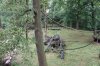
Beyond the Giraffe House, the zoo remains unchanged. Animals from northern regions can be seen: dholes, golden takins, Chinese goral, Caucasian ibex and Himalayan thar. Their enclosures are nothing special but the mature planting provides enough atmosphere. What struck me here (and elsewhere afterwards): the group of dholes had shrunk considerably.
Central to the zoo is a traditional pampa and a large enclosure for nyala, but the eye-catcher here is still the large
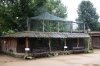
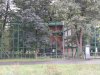
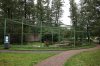
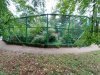
Aviary complex (1999). Besides separate aviaries for snow and northern hawk-owls, northern nutcracker and southern bald ibis, there are large mixed species aviaries. The one for storks is the least attractive, but the adjoining 700 m²
Tundra aviary is well known among zoochatters. And rightly so, even though the collection has diminished: little grebe, corncrake, common redshank, common ringed plover and 2 very rarely shown species: common sandpiper and great yellow wagtail. It is an original exhibit that has hardly been copied elsewhere. It is still a wetland aviary but I think the vegetation has grown too much to be reminiscent of a tundra. I think back with some wistfulness to the common whimbrel, curlew sandpipers and golden plovers of the past. At the back, a large domed aviary is currently inhabited by Verreaux’s eagle owl, griffon and Egyptian vultures. In 2007, I saw another combo of vultures with geladas here.

Opposite the vultures are the famous
European songbird aviaries. Dresden has a wonderful collection of native songbirds, including: ortolan, Bohemian waxwing, black redstart, yellowhammer, goldfinch, song thrush, etc. These are small aviaries but well laid out and densely planted. I do notice a shift, European stone curlew, bee-eater and Hermann’s tortoises are nice species but somehow I also regret their appearance here. The highlight was definitely the white-crowned wheatear, in an aviary with bee-eater, hoopoe, ortolan and stone curlew.
Next to the Orang building is the
Professor Brandeshaus (2010), a mix of a monkey and tropical house and named after Gustav Brandes, director of the zoo in the 20s and 30s and the founder of the modern Dresden zoo. It’s brilliant and of high quality.

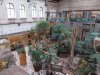
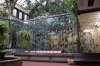
It has an ingenious floor plan, with lots of nooks and crannies, exits and exhibits, and there is something worth seeing everywhere. It is surrounded by large islands. Inside, because the visitors' area deflects and rises in the middle section, you can't see the whole space anywhere in at a glance. Daylight enters through round cutouts in the roof. There are large plant compartments and terrariums built into the wall while two-toed sloths hang above the visitors.

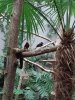
Everything but fish is on display. Although the stars of the building are the koalas, for me it’s all about primates. The red howler monkeys, Kikuyu colobus and lion-tailed macaques each have large curving, densely planted and well structured islands with tall trees, open and hidden areas. There are small enclosures for white-faced saki, emperor tamarin and crowned lemurs that also have outdoor cages. A crocodile enclosure runs under the visitor area in the centre of the building although there are currently only false gavials in the largest section. There is a communal enclosure with Javan chevrotain, Prevost's squirrel and Visaya tarictic hornbill.

The saki and tamarin have southern tamandua and southern three-banded armadillo, respectively as co-inhabitants. The saki enclosure is the only one that seemed too small. The koalas are in two large green indoor enclosures and did what they do everywhere – absolutely nothing. A series of wall-mounted terrariums show Mexican redknee tarantula, agate snail, giant Malaysian leaf insect, Cuban tree frog, etc. It was a pleasure to wander around in and around this building.
At the back of the zoo, a part of the old Ape house is still standing, and you can also find Swinhoe's squirrel, Chinese bamboo partridges, blue-crowned laughingthrushes and Northern yellow-throated marten, but the crowd puller here are two beautifull but not too large
enclosures for snow leopards (2011).

From the penguin enclosure and against the edge of the zoo is a row of enclosures that are gradually being upgraded. These are primarily cheetahs and a number of cattle: domesticated Ankole-watutsi but also breeding groups of Javan banteng and red forest buffalo. The bantengs live along with Ajam Tjemani, a pitch-black breed of chicken from Indonesia. I have not been able to ascertain it myself but even the intestines of these birds appear to be black. In between are small enclosures for bat-eared fox and meerkats.
The highly original 1997
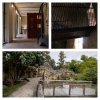
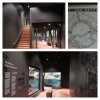
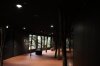
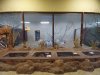
Zoo under der Erde is literally an entrenched 70m² building consisting of 1 single dark corridor with small animal enclosures on either side: Central Spanish fire salamander, brown rat (in a sewerage enclosure), kingsnake, Iberian ribbed newt, Brongersma Atlas frog and Etruscan shrew, as well as invertebrates : Montenegro roller woodlouse, Congo rose beetle, death's head cockroach, tropical land snails, etc. This is a very fun and original concept that for some reason is rarely copied. Around it are large enclosures for Bactrian camels, Indian hog deer and Nilgai.

Near the entrance is another
aviary complex. A new large aviary has Cuban flamingos, roseate spoonbill and scarlet ibis (2020) as residents, while the macaw aviary is home to araruna and red-fronted macaw. More interesting are 3 other aviaries, each with a nice combo: a large one with grey-crowned cranes and Kirk dikdik's, another for long-tailed fiscal and yellow-necked francolin, and a last one for Cape rock hyrax and eastern yellow-billed hornbill. Both the shrike and the hornbill are only seen in a handful of zoos.