Ruili, part three
Last day in Ruili I was aiming for the Ruili Botanic Gardens which are out of town a bit to the west. I had been going to stay longer because I did have more sites in mind – the Wanding Botanic Gardens to the east and the Jiele Reservoir in particular – but the cost of getting around was frustrating me. The taxi for Moli Rainforest was around NZ$20 each way, and today’s trip was costing me 200 Yuan return (about NZ$50) because it was two return trips from the driver’s point of view (i.e. taking me there in the morning, then he goes back to town, then he comes back in the afternoon to pick me up again). I don’t mind wandering around not seeing many birds if I’m not paying anything but doing the same thing when it costs a fair bit of money (in backpacking terms) is a bit irksome. As context, NZ$20 is what all of my hotels are costing, so each one of those taxi rides is the equivalent of a night’s accommodation.
The Ruili Botanic Gardens were about twenty minutes drive. We got there at 8.30am and the gates were still closed and chained. There were no opening hours posted, so I used the camera on my phone to translate some of the signs around the gate (really, a phone is such a useful tool to have! Who woulda thunk it). Turned out that the gardens were closed until 31 December due to it being too dangerous with fallen trees and slips.
Luckily I had another site further up the same road, the Nanjingli Ridge. I had favoured the gardens over the ridge for the day because it seemed like an easier destination to explain to a driver - “Nanjingli Ridge” is just the eBird name so it’s not going to mean anything to any local person other than that Nanjingli itself is a place name in the area. However I knew where it was in relation to the gardens, with the initial access point being a hairpin side-road directly before a small road tunnel. We headed up that way for about ten minutes until we saw the tunnel and the driver dropped me off, with the agreement he would return at 2pm to pick me up.
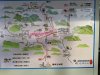
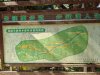
The initial hairpin road is only about a kilometre long, although quite steep, then it meets a three-way intersection. Outside an official-looking building there was a big fancy map-board which I couldn’t get to grips with, and a bit further on a more simple map-board showing a forest trail and other points of interest which I still couldn’t figure out the directions for.
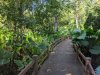
I tried the right hand road for a little ways first, then returned to the intersection and took the main route figuring that was more likely to be the one visiting birders would be driving along. Just past a large white “church” (apparently built for a film according to an old trip report I had read) I happened across what I assume is the forest trail of the map-board. It was old and disused but the paving stones were mostly still visible. The trail followed the road, eventually coming back out onto it.
After an hour I still hadn’t seen any identifiable birds other than Silver-eared Mesias. If you haven’t seen one of these before you should google some photos. A Silver-eared Mesia is like a bird which has won the lottery and decided that now it is rich it is going to wear
all the colours. They are beautiful but so common that you start ignoring them.
I was feeling like this was a waste of time and money being up here, but then I hit a magic spot where I spent an hour on a stretch of about 50 metres of road, seeing over twenty species of birds and two squirrels.
I had first heard birds calling from inside a tangle of bamboo right beside the road. A Mountain Bulbul came out and while I was focusing my binoculars on that a Rufous-headed Parrotbill suddenly popped up right next to the bulbul and posed in full view on one of the stems. There are two almost-identical species of parrotbill here - the Rufous-headed and the Pale-billed, the latter of which has a pale bill and a black eyebrow-stripe. Both species regularly forage together in mixed flocks along with White-hooded Babblers (which I also saw) but frustratingly this individual was the only one I saw close up because the flock moved quickly to the trees much further from the road where I could still see them but not with enough detail to tell if both species were present.
Mixing in with the parrotbills were the White-hooded Babblers, Rusty-fronted Barwings, Blue-winged Minlas and Bronzed Drongos. The longer I spent looking at the trees the more birds appeared, with first a Maroon Oriole, then a Lesser Yellownape (woodpecker), then a Lesser Racquet-tailed Drongo. There was even a Black Giant Squirrel.
Black Giant Squirrel
After a while the mixed flock moved behind the trees where I couldn’t see them any more, and I became distracted by an Orange-bellied Leafbird and a pair of Long-tailed Sibias feeding in a tree of pink blossoms. While I was trying to photograph the sibias (not entirely successfully!) I heard a noise behind me and saw for the briefest moment a squirrel on the base of a tree.
Long-tailed Sibia
One of the mammals I most want to see in Yunnan is Anderson’s Squirrel
Callosciurus quinquestriatus, also called the Stripe-bellied Squirrel. It has an extremely restricted distribution, being found only along the Yunnan/Burma border. Its most distinctive feature is its white belly with three black stripes (one along either side and one along the centre of the belly). I didn’t know for sure if the species was found around Ruili but I knew it has been recorded at Nabang and the Tengchong section of the Gaoligongshan, so it probably is.
The squirrel I had just seen vanished immediately - in fact I didn’t even see it vanish because I glanced down while I lifted my camera and it had just disappeared. I hung around for another half an hour but the squirrel was gone. It had clearly been a
Callosciurus species, but other than that I couldn’t be sure which species because I never saw its belly. That’s one of the most vexing things about animal-watching, when you see something and you know what it is in general terms - a scimitar-babbler, say, or a
Callosciurus squirrel, but you didn’t see it well enough to specifically identify it.
The mixed flock of birds from before reappeared while I was waiting on the squirrel, and now they had been joined by some Red-billed Scimitar-Babblers, Velvet-fronted Nuthatches and Yellow-cheeked Tits. Closer to the road a large fruiting tree was also attracting birds, including White-throated and Striated Bulbuls, Blue-throated Barbets and Black-breasted Thrushes.
Striated Bulbul
I felt like the squirrel had long gone, so I moved on. Further up the road I found a Mrs Gould’s Sunbird, a Brown Shrike, some Bar-winged Flycatcher-Shrikes, and a Grey Bushchat amongst other birds seen elsewhere.
It seemed like the road ahead was turning more towards cultivation, and I had to be back at the main road to meet the taxi driver at 2pm, so I headed back the way I had come. When I got to the squirrel spot I paused for a bit, just in case – and there it was! Very briefly, as it fled again. Except this time I managed to get a glimpse of its belly as it dashed through the branches. It was just a Red-bellied Squirrel, which I have seen dozens of. I also saw the Black Giant Squirrel again.
The last bird seen for the day was Green-billed Malkoha on the way back to meet the taxi.