Island Odyssey: - (8 exhibits)
At long last, without further delay, our well-awaited
island odyssey has officially begun!
Beginning with walking past the building foreshadowed in the original teaser, this rather imposing structure is actually one of two nocturnal buildings present on zoo grounds, (with the following containing only one species).
If we choose to turn around and head indoors, remember to spare some time to allow your eyes to adjust to the immediate darkness. For the interior area accessible to visitors is as a dimly-lit as the exhibit of focus. You see, following their importation from a certain island nation, the Wilder Zoo’s original pair of
North Island Brown Kiwi were temporarily housed in a behind-the-scenes area within
Creatures of the Crypt. It wasn’t until the construction of the so-called “kiwi building” that the birds were relocated and could finally be seen by the general public. Years later, this original kiwi pair would leave behind two surviving offspring, with the parents passing away unexpectedly shortly thereafter. Today, one of these two descendants remains with us, and is considered the one and only star attraction of the kiwi building.
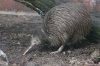
 North Island Brown Kiwi (Apteryx mantelli)
Photo Credit: @HOMIN96
After adjusting your eyes to the daylight once again, and after walking a few good steps towards your right. Up ahead within a small, open enclosure with synthetic metal bars disguised as bamboo for fencing, is where you will soon find our
Red-Crowned Cranes. There’s not too much to add about the animals and their surroundings, but no matter the weather or times of year; these relatively hardy birds are proven to have handled said conditions throughout their lives here. During the warmer summer months, other exotic waterfowl endemic to various islands cohabitate with these cranes. But for now, during the winter, only the cranes can be seen as they serenade one another with their signature calls.
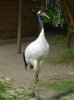
 Red-Crowned Crane (Grus japonensis)
Photo Credit: @ralph
From here, visitors can walk left, then straight ahead towards the sheltered dining areas that are attached to one of the zoo’s two signature restaurants. This is
Komodo Kitchen, which itself is a seasonal restaurant that is only open during the spring-summer season, with a seasonal closure that usually begins in September and ends between March and April, depending on the amount of snowfall the zoo receives that season.
You see, the Komodo Kitchen was initially named in correspondence to their nearby neighbors, for which, we face towards our right with the possibility of approaching one of the largest lizards on Earth! As seen with most zoos that display the species, the zoo’s single
Komodo Dragon has a toasty indoor room viewable to the public, and a separate outdoor yard that is only accessible during the warmer times of year. Compared to other zoos, the outdoor dragon habitat is most notable for having a rather spacious body of water designed to show off their swimming capabilities; and is thus touted as one of the largest exhibits for this species anywhere in the nation.
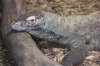
 Komodo Dragon (Varanus komodoensis)
Photo Credit: myself, Austin the Sengi
Sharing the same building as the dragon, while having separate holding quarters for rather obvious reasons. Directly next door is a seasonal outdoor aviary humorously referred to as
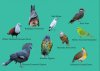
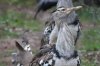
Pigeon’s Paradise. To be clear, this is not a walkthrough aviary, even though you can see the residents more clearly via, a bird-friendly viewing area that is currently roped off.
To counterbalance the relatively basic design of this “paradise”, the assembly of birds and bats help to showcase these island endemics more effectively; as evidenced with the image below:
 Provided by yours truly, Austin the Sengi
A little ways nearby, we will soon come across the indoor quarters for a personal favorite of mine; for directly ahead after turning left from the mixed aviary is a visually impressive barn and paddock for an unproven breeding pair of
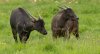
Lowland Anoa. These two are some of the largest animals we will encounter on this odyssey, which is rather ironic for a species often regarded as a “dwarf buffalo”. Nonetheless, the attention driven by the anoa barn is enough to entice us further ahead, with the exterior architecture taking culturally-respective inspiration from traditional architecture associated with the anoa’s natural range.
Around this time of year, the main paddock is only accessible to the anoa as long as the animals have direct access to their temperate-controlled holding stalls; otherwise, especially on extremely cold spells, the anoa are then confined exclusively to their barn. If you are worried of not seeing our pair, worry not, for visitors can still view the animals from their barn via, an indoor viewing area akin to what is often used for far bigger setups associated with larger mammals like giraffes and elephants.
Admittedly, while the following is not exactly related to our usual format. I must confess that anoa are one of my favorite even-toed ungulates, and to give them a setup that truly highlights the best of the species and the island they represent is a dream come true; even if you have to imagine the majority of this dream. What’s not a dream, however, is what I consider to be one of the best photos of the species I’ve seen anywhere on this website, which is why I am glad to showcase it here to give this species the attention they deserve.
 Lowland Anoa (Bubalus depressicornis)
Photo Credit: @ro6ca66
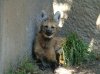
If we carry on our odyssey from the outdoor paddock, then not far from our right is the first of two enclosures dedicated to the island fauna of Madagascar. While the Wilder’s Zoo collection of Malagasy fauna is a far cry from Rembrandt Park’s, I’d say the exhibitry for the respective animals is more or less the same for either facility. Anyways… general visitors may have a tricky time in finding them at first, but once you know where to look, then perhaps, you might spot a
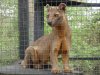
Fossa that might’ve been secretly observing you the entire time!
Here at the Wilder Zoo, we have a male-female pair that periodically rotate between the main exhibit and a separate enclosure inaccessible to visitors. Depending on your plans, you might see the male on one or two occasions, and on another occasion, the female may be present. Either way, this systematic rotation is nothing new among captive carnivorans; but nonetheless, it provides the individuals with the occasional change of direction and scenery. Much like our anoa, the pair have not had any offspring thus far, even though, in this case, the chances are slightly better.
 Fossa (Cryptoprocta ferox)
Photo Credit: @MagpieGoose
Not far from the fringes of the fossa enclosure, is a spacious, tree-covered island entirely surrounded by a shallow moat. This island, unsurprisingly, contains two species of the ever-iconic, endemic icons that are lemurs. Currently, you will encounter a larger, breeding conspiracy of the ubiquitous
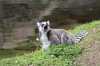
Ring-Tailed Lemur and an older, smaller conspiracy of the not so common
Red-Fronted Lemur. This combination is not the first time the island has seen multiple species of lemur mixed together, for the practice has been mostly maintained with various other species since the attraction first opened. The only notable point in history where only one species of lemur was present was when it the island was inhabited by a trio of
Red-Ruffed Lemurs, which have since left the collection.
 Ring-Tailed Lemur (Lemur catta)
Photo Credit: myself, Austin the Sengi
As we begin to reach our final destination, it won’t take us long
(both figuratively and literally) to arrive at the last major exhibit the odyssey has to offer. What lies ahead is relatively basic paddock with shade trees aplenty, and some slight levels of varying elevation; with the inhabitants of this enclosure hailing from what is technically an atoll, rather than an island. Regardless, the inhabitants that hail from this atoll may slowly wander into your hearts in the form of our
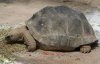
Aldabra Giant Tortoises.
Historically, when the odyssey first opened, the exhibit you see before you contained a group of
Galapagos Giant Tortoises with a disputed genetic history; which were even accompanied by a small, sheltered kiosk that highlighted the significance of Galapagos fauna through the centuries of research initially pioneered by Charles Darwin and his contemporaries. In the years since, the tortoises never produced offspring during their time here, and have since moved on to other facilities across the country; with the kiosk being removed around the same time. It wasn’t until a few years ago when we received our current tortoises, and our hopes of successfully breeding these threatened giants were soon resurged upon their arrival.
 Aldabra Giant Tortoise (Aldabrachelys gigantea)
Photo Credit: @vogelcommando
By reaching the end of our time with our newfound friends, it is at this point of the pathway where you could either head back towards the kiwi building to restart your journey, or perhaps, choose to return back towards the
Formal Pond and the rest of the zoo. For it is the latter option that we ultimately decide upon as to mark the conclusion of this odyssey.
(
5 mammal taxa)
(
10 bird taxa)
(
2 reptile taxa)
With the completion of our island odyssey, another anticipated stop awaits at the Wilder Zoo; for by heading over to the complete opposite end of the zoo, it won’t take us long to run into some familiar faces by visiting
Faces of the Forest!
Until then…
 Image Credit: KevinB





 Seems too easy to self-award something to be completely honest.