Hong Kong Day 3 (Trip day 8)
Considering that Mai Po wasn’t supposed to open until 9am, my wakeup time wasn’t too bad for once. Unfortunately, I spent quite a while on the entry road to Mai Po, so it would’ve still have been better to get out there quicker. Taking the Tuen Ma Line to Yuen Long was easy enough, but in typical HK fashion it took a little while for me to find the right bus to Mai Po; the bus stop ended up being beneath the mall containing the MTR stop. I took the 76k bus and got off at the Mai Po village stop, before walking the 1.6 km down Tam Kon Chau road. This road was lined with gei wai (traditional shrimp farming) ponds, and actually proved to be rather nice for birding.
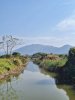
 Tam Kon Chau road
I was quite excited by the soaring
Great Cormorants,
Amur stonechats, and a
Long-tailed Shrike early on. At one of the earlier ponds, I had a very brief view of a very small, light-colored Y-shaped twig of a bird in flight- in Hong Kong, that meant a
Yellow Bittern. It disappeared into some foliage along the bank of one of the agricultural ponds. After scanning the numerous mynas, doves, and herons, I spotted a
Red-billed Starling perched atop a tree.
The whole area had a wonderful view of the Shenzhen skyline, a very impressive city with perhaps my favorite building I’ve ever seen. The Ping An Finance center is truly an architectural and engineering marvel, and seeing it in the background of the wetlands throughout the day was quite evocative. It also spoke to the rapid development and importance of conserving the area. I saw a great egret far out over the river, clearly in mainland China, and got to fill in the mainland on my ebird map.
 View of Shenzhen (mainland China) behind gei wai ponds
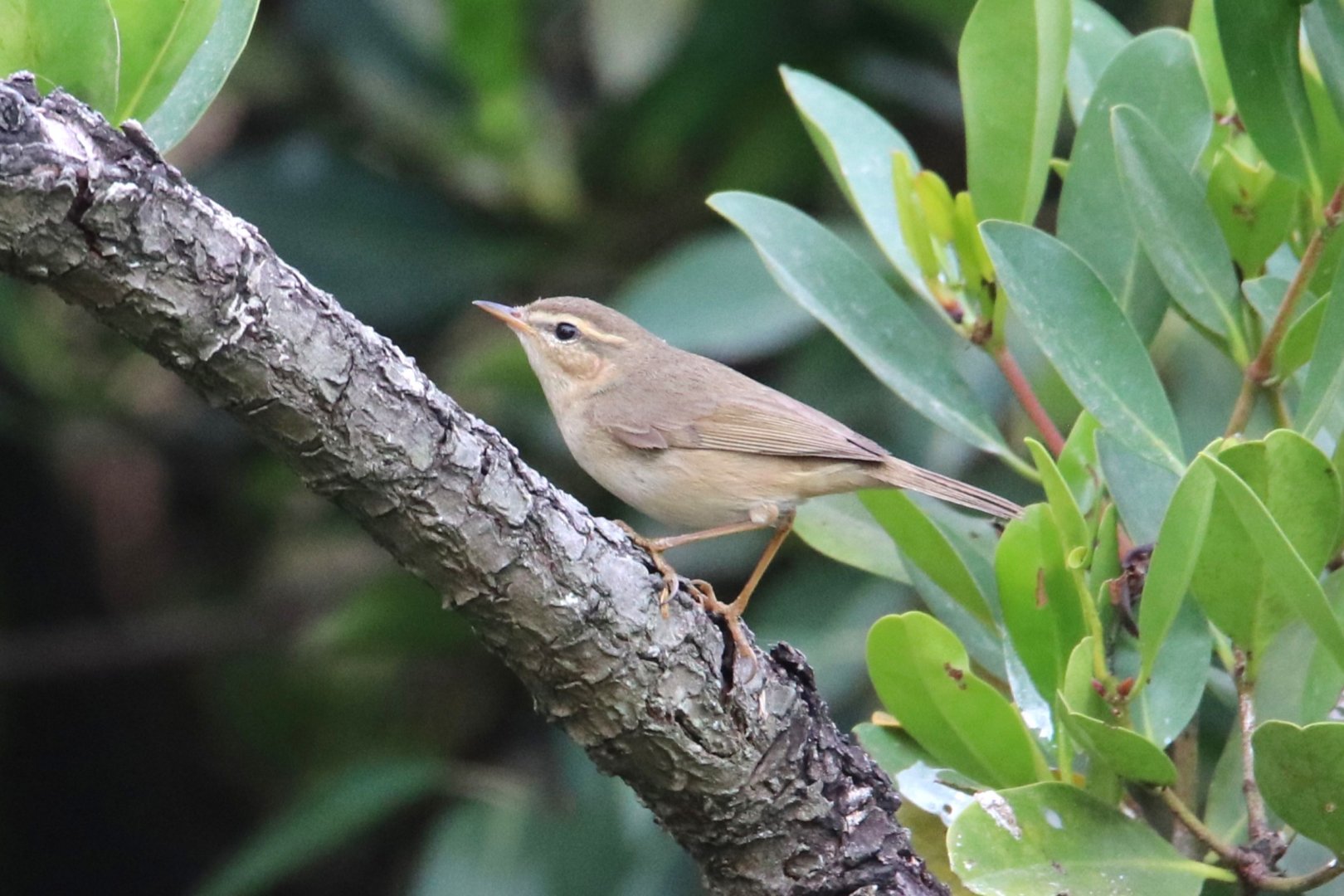
Carefully inspecting all the little brown jobs along the way, the vast majority of which were prinias, I did hear and see a
Dusky Warbler, which turned out to be rather common in the open wetland habitats. A little further on I saw a spoonbill fly across but it dipped past the treeline before I could make out the species. It was probably the endangered Black-faced Spoonbill, a major reason I came out to Mai Po, which boasts some of the largest wintering populations of the species in the world.
Because of the importance of the wetland, and its proximity to the border with the mainland, Mai Po is a restricted entry reserve. However, they do provide a special one day permit for visiting naturalists from overseas. To fill out the form, you need to provide evidence of membership of a conservation organization or the like, pay the 300 HKD fee, and a deposit of 200 HKD. That’s pretty steep! I had applied for this a few months back and thus was able to freely roam the massive preserve, after signing in at the visitors center, which I’d need to be back at by 5pm to get back my deposit. When I pulled out the 250 HKD that was the fee listed from when I had applied, the attendant at the desk sheepishly informed me of the price increase, effective the new year.
At the pond in the back of the visitors center I saw a
Greater Coucal fly across and into the bushes, a very impressively large cuckoo. Also in the back, I was delighted to see the
Azure-winged Magpies, known to hang around the area. In the visitor center was a large display with the tide charts for the day at the different mudflat hides out on the deep bay. This was very helpful for targeting the best time to be out there, which looked to be at the end of the day near the 5pm closing time, if I wanted to get my deposit back.
The path between the permit gate and the visitor center was quite birdy, with some
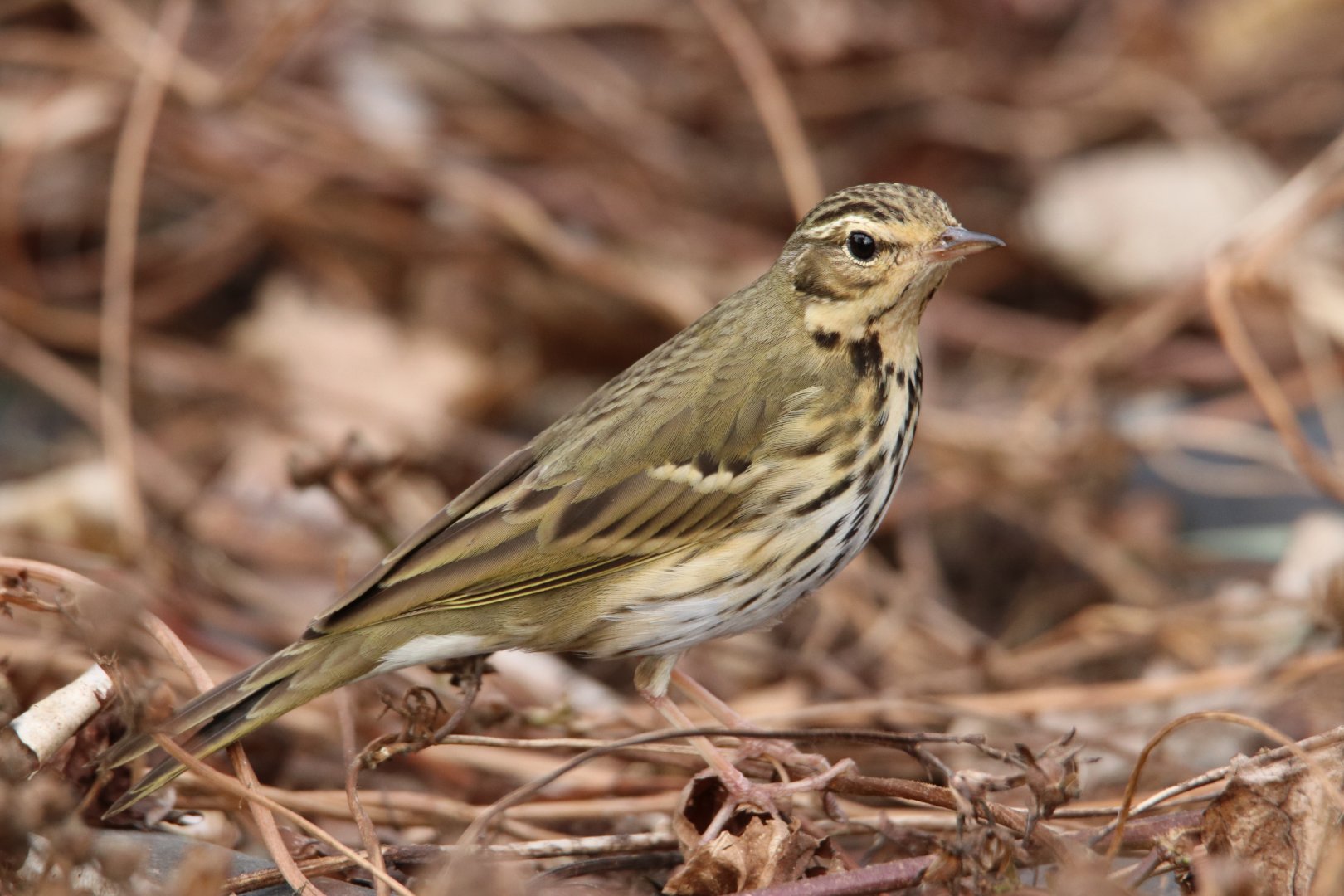
Masked Laughingthrushes rummaging around the leaves by the toilet block. There is a palm tree here that is supposed to be a reliable Greater Short-nosed Fruit Bat roost, but try as I might I didn’t see any underneath the leaves. I later asked a regular on iNaturalist about this roost, and they said the bats sometimes come and go but almost always will be at that roost in the day. I had excellent views of an
Olive-backed Pipit, and definitive ones of
Black-faced Spoonbills walking past more of the cultivated gei wai pools on the path to the second entry gate. I handed a sheet in exchange for a permit to a pair of disembodied hands that popped out of a gap in the wall at a small booth where the attendant was. Without ever seeing his face, he told me to hold onto the laminated sheet of paper in case any officials asked, given the proximity to the border and the sensitive nature of the species at the reserve. I don’t think there’s anything like this in the states, such a forward-facing job without seeing face-to-face.
The main portion of Mai Po is a series of ponds, at varying water levels, most very low on my visit. The first area I went to was a tall and very serious looking bird blind, sponsored by the ‘Hong Kong Jockey Club’, the same ones kind enough to sponsor the Snub-nosed Monkey exhibit at HK Ocean Park. I went to the top to see what I could, and was surprised by a pair of
Oriental White Storks off on the exposed mud flat, another large white endangered Asian bird. Another one flew in and gave spectacular views from my elevated position at the top of the hide.
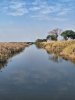
 Canals in Mai Po
Continuing down the path I saw
Black-faced Bunting,
Daurian Redstarts, and
Amur Stonechat. A
Collared Crow soared past, a really neat corvid of eastern China. I foolheartedly scanned the
Tufted Ducks for other Aythya species (perhaps of the baeri persuasion, there have actually been records here before). I saw some more storks soaring overhead as I walked the trails, passing over boardwalks and past more ponds, and even a paddock for Domestic Water Buffalo as I headed along the south east end of the reserve. I walked past a shaded reedy area, investigating every prinia, when out erupted a
Eurasian Bittern, which flew before I could get a photo! I was sitting at 0/2 for Asian bittern species, but it was still really neat to see one. Up above, a huge kettle of
Black Kites were soaring, and among them a
Greater Spotted Eagle! It was noticeably larger and was bickering with some of the unruly kites. I stopped briefly at the south bird hide, another impressive, enclosed tower, where I saw many more shovelers, cormorants, wigeons, and spoonbills.
 Boardwalk over flooded field
In some mangrove trees growing along the side of a canal, I saw my first
White-throated Kingfisher, a spectacular bird. At ‘The Scrape’ hide, there was not much other than greenshanks and grey herons and the like, which I’d been seeing throughout the reserve. Some other birders were around, and I walked with one towards the deep bay. Given the timing, the tides should be coming in and viewing conditions should be improving.
 View from the hide of 'the scrape'
Just as we started walking along the paved sidewalk, I noticed some movement right off the path and the other birder let out a yelp- we had flushed a
Chinese Water Cobra! It hurried from the small patch of cut grass just to the right of the sidewalk and slithered deep into a clump of bamboo. I was so shocked that I didn’t even manage to get a photo, mostly out of self-preservation! In that split second, I got a clear look: a huge, mostly black snake with white markings near its head and a slightly flared hood. Shockingly, this would be the only snake I would see my entire trip. Considering the number of venomous snake species I was within the range of, I’m not too upset about that- although I shudder to think of how many were in striking distance that I didn't see. I still have no clue what to make of it, the only snake I saw was one of the deadliest in the world, in terms of kill count- and I only saw it by flushing it!
At the end of this path, there is an extensive fenced off portion along the Northwest portion of the reserve where the mangrove area is. Walking along the fence, I passed additional pools and mudflats, which held some shorebirds including my first
Pied Avocets. Past here, there was an unlocked gate, quite a serious looking thing. Because of the permits I had acquired I was allowed to proceed through the gates. What followed was maybe the sketchiest ‘trail’ I've ever taken, but it was pretty fun. Most of the path was essentially a pair of planks placed on floating barrels. It went straight through the heart of the mangroves, mostly over water, but sometimes right over higher mounds of mud, which were handy if you passed someone going the other direction. There were plenty of crabs around, but I found the mangroves were pretty devoid of obvious bird life. I rushed out to the flats to make the most of the time out there, I knew I’d need a long time scanning, especially without a scope and just my camera.
 Floating mangrove boardwalk- it bounced around a ton when walking down it
My excitement rose as I neared a hide. On the side of a boardwalk, I saw a mudskipper, my second since Taiwan but the same species,
Shuttle’s Hoppfish. So cool! The tide at the first mudflat hide was, as expected from the tables, way too low. This meant many more mudskippers were visible, however, the species out on the more exposed flats being the impressive
Great Spotted Mudskippers! I saw an
Osprey perched on a stick far out on the flats, and could somewhat make out whimbrels and curlews, but decided to head to the north hide where the water level should be right for much better views of the birds.
 Boardwalk between hides
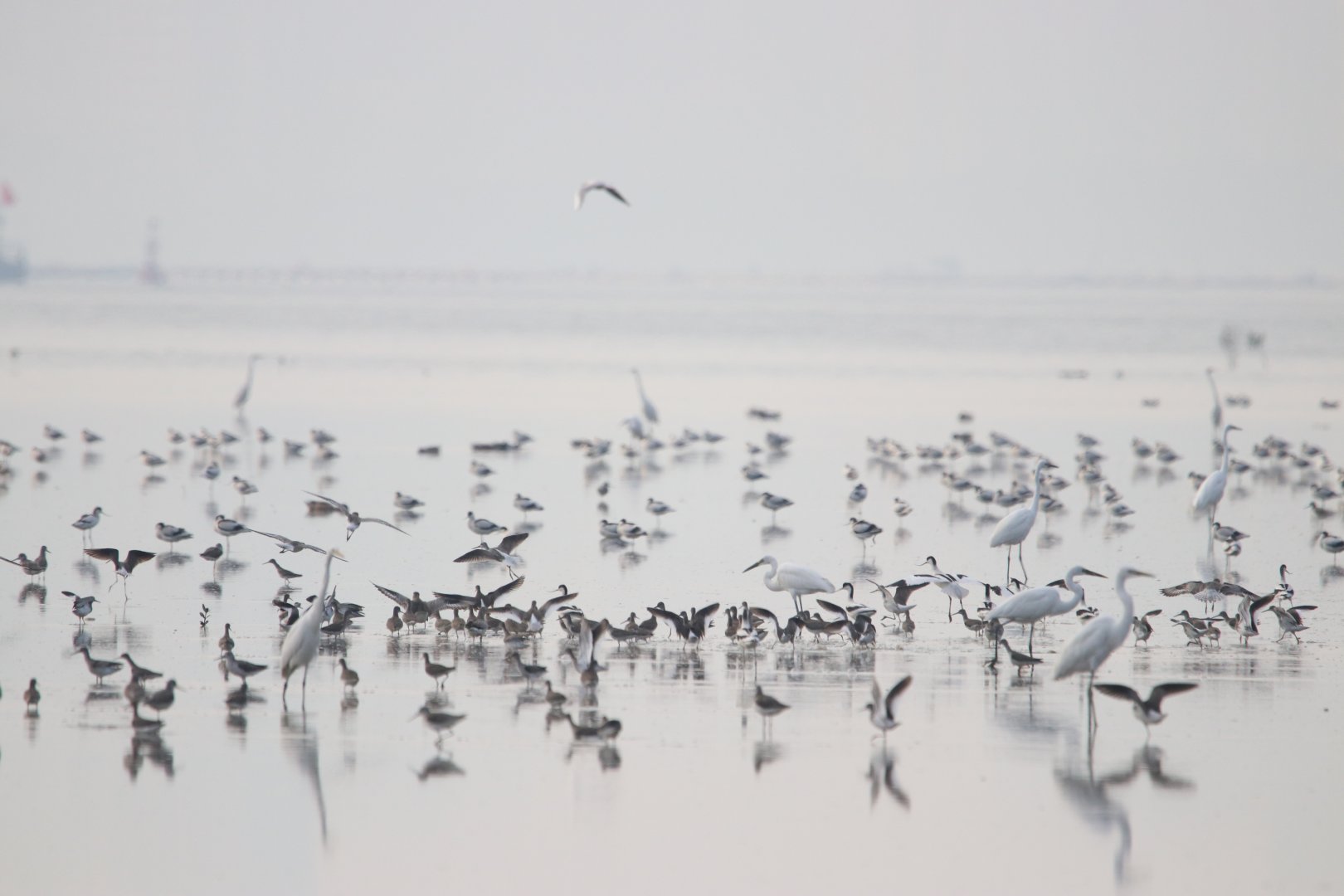
There were huge numbers of birds over at the north hide, as predicted, they were much closer. Most individuals out here were
Great Cormorants, but I was most excited by the large flock of large gulls. There were also many of the smaller
Black-headed Gulls, which are like our North American Bonaparte’s gulls. Much to my delight, among the larger gulls were some of the rarer
Pallas’s Gulls, imposing birds with black heads. The large flock of Larus looked rather daunting, considering the number of very similar species possible. I took as many photos as I could, hoping I could separate
Lesser Black-backed,
Mongolian, and possibly
Vega Gull, and any others, if they were present. It did seem like more than one larus was here. I was quite happy, when, after corresponding with one of the top gull experts in North America, I received confirmation on all three of the mentioned Larus species being present. Once I learned some of the key ID features the differences became fairly clear from my photos.
 North Hide- flocks on deep bay and Shenzhen out in the distance
Slightly less esoteric was a close feeding
Black-faced Spoonbill, and a ‘Common’ trio of Greenshanks, Redshanks, and Sandpipers. Also present were
Pied Avocet,
Black-Bellied Plovers,
Eurasian Curlews and
Eurasian Whimbrels (an armchair tick for me),
Northern Pintail,
Green-winged Teal,
Eurasian Wigeon, and a lifer
Common Pochard.
It was nearing 5pm, and I did prefer to get my 200 HKD ($25.5 USD) deposit back. I rushed through the mangroves, back down to the second south hide. The tide had come in a bit more, so some birds were closer, yet there were still massive flocks far out, with many
Great Egrets,
Grey Heron, and more
Pied Avocets and
Black-bellied Plovers. Even further back, there were many
Black-headed gulls, whimbrels and curlews, and I even picked out a few
Saunders Gulls among them.
I love gulls and was very happy with the species here, even if not all of the shorebirds I was hoping to see were present. Watching the mudskippers and mass of birdlife out on the Deep Bay was pretty special as well. As I made my way out of the mangroves, and back towards the visitor center, I saw more of the many wonderful birds I had been seeing throughout that day. I’m glad I stopped for some very pretty wigeon/teal like ducks that seemed a bit different- they were a pair of lifer
Falcated Duck, though no male in breeding plumage, still very nice.
 Boardwalk on way out
I walked quickly on my way out to make sure I got back in time to return my permit and collect my deposit, watching the ground carefully for any more cobras this time. I was down to the wire, and really rushed back, arriving with less than a minute to spare, although it was obvious nobody was watching the seconds. I just didn’t want any issues. It was clear the attendants were getting ready to leave for the day soon anyway.
I walked all the way back along Tom Chow road in the evening light, and took the bus back to Yoho Mall in Yuen Long and took the Tuen Ma line back to Tsim Sha Tsui.