Mutations

Pertinax said:
Interesting, it may be the same bear. It seems the extra infusion of white marking has extended to the feet/toes.
yes, you can see that the skin of the nose and underside of the hind left foot seem to be affected by albinism or something akin to it. The bear in Arizona Docent's photo appears to have a larger black area on the left side of its face, but I wasn't sure if this was due to shadow or not. Otherwise it is very similar.
 
this link Germany's bald bears: Fur disease afflicts Dolores and baffles vets | Mail Online shows spectacled bears at Leipzig that have lost their fur - and they look wierd! - and at the bottom is a picture of a bear that looks very similar to the one in Arizona Docent's photo from Houston (on the first page of this thread)

This is interesting because the female spectacled bear at the San Diego zoo is also suffers from baldness just like the Leipzig zoo bears. The SD Zoo says that she suffers from allergies which cause her baldness.
 
My first contribution for today (and hopefully my only one-I need to get some work done)! After Vulpes mentioned it I thought I'd have a look at some python morphs- this collection seems pretty comprehensive-though I'm sure there are many more. Have to admit- I think I still find the wildtype most attractive (same probably goes for those zebrafinches too.)
TSK - The Snake Keeper

Most striking are those individuals showing a switch from mottling to vertical stripes - it seems quite a distinct change. It reminded me of a photo (I think it was in a library book but may be on the internet somewhere) of a wild adder with lengthways stripes instead of the usual 'zip' pattern. I know nothing of snake breeding and genetics- maybe the switch to longitudinal stripes is a fairly common mutation?

EDIT: I also remember seeing a vertical striped puff adder in a field guide.
 
My first contribution for today (and hopefully my only one-I need to get some work done)! After Vulpes mentioned it I thought I'd have a look at some python morphs- this collection seems pretty comprehensive-though I'm sure there are many more. Have to admit- I think I still find the wildtype most attractive (same probably goes for those zebrafinches too.)
TSK - The Snake Keeper

Most striking are those individuals showing a switch from mottling to vertical stripes - it seems quite a distinct change. It reminded me of a photo (I think it was in a library book but may be on the internet somewhere) of a wild adder with lengthways stripes instead of the usual 'zip' pattern. I know nothing of snake breeding and genetics- maybe the switch to longitudinal stripes is a fairly common mutation?

EDIT: I also remember seeing a vertical striped puff adder in a field guide.

I dont think that is even half of the ball python morphs! You get all the regular morphs then you get supers which are the same only high colour, then you have snakes that are made up of multiple morphs, so two mutations in one! Its mind boggling!

This will probably distract you a little longer but they have just produced a leucistic reticulated python, It seems to be a real big deal with snake keepers!

Message

nerdlucy1.jpg
 
some very interesting examples here.

There are several photos here of White Fallow deer which are claimed to be albinos. A 'milk' white phase is actually fairly common in some herds eg. the New Forest, though these aren't albinos to my knowledge. The fawns are gingerish colour and only turn white as they grow up. That's not to say there can't be true Albino fallow deer as well.
 
I dont think that is even half of the ball python morphs! You get all the regular morphs then you get supers which are the same only high colour, then you have snakes that are made up of multiple morphs, so two mutations in one! Its mind boggling!

This will probably distract you a little longer but they have just produced a leucistic reticulated python, It seems to be a real big deal with snake keepers!

Continuing with snakes- I've found a few examples of 'scaleless' morphs. Apparently they're big money in herp pet circles but to be frank I think they look plain wrong.
http://www.reedysreptiles.com/fullsize/Scale-less 800.jpg
http://www.bluechameleon.org/2008 April - Fieldherping/Python regius, scaleless, collage, 1000cc.jpg
 
Well, this is turning into quite a fascinating thread!

Thanks for the clarification on the sahara cheetah - I have noticed all the other photos I have seen look like typical southern cheetahs and I was wondering why that was the only one ever photographed.

As for the two owls where one appears darker, it is just a characteristic of the camera flash (I am fairly sure). I think the camera was held vertically, which put the flash on the left side, so the left (closer) bird appears brighter. This can be confirmed by looking at the sleeves of the shirt on the person holding the birds - the arm in front is brighter than the arm in back.

The white whale is really cool, but as for Japan continuing to hunt whales (as per article attached), I think the UN should send fighter jets to sink all their whaling ships :mad:
 
Continuing with snakes- I've found a few examples of 'scaleless' morphs. Apparently they're big money in herp pet circles but to be frank I think they look plain wrong.
http://www.reedysreptiles.com/fullsize/Scale-less 800.jpg
http://www.bluechameleon.org/2008 April - Fieldherping/Python regius, scaleless, collage, 1000cc.jpg

Looks like their skin would so easily tear! I admit I don't know much about reptiles, but I'd think the scales would act as a sort of armor.
 
Looks like their skin would so easily tear! I admit I don't know much about reptiles, but I'd think the scales would act as a sort of armor.

I was reading up on them the other day and they apparently have a lot of trouble moving around as the scales on the belly of a snake are one of the main things that help them move around
 
That death adder is weird! I really dont like this mutation and I know they are propagating them in the US for the pet trade. I would imagine they would feel very uncomfortable! Imagine having lost the top layer of your skin, be like a burn victim I think. Also how do they shed? or do they? are they missing the eye cap also?
 
Also how do they shed? or do they? are they missing the eye cap also?

I read that they do shed but often with difficulty.

@Sun, the completely scaleless beardie looks, if anything, weirder than the snakes!

I guess it's kind of hypocritical of me complaining about scaleless reptiles when I've already admitted that I kept Polish bantams as a kid- really they're both somewhat awkward as far as the animal is concerned. I never really noticed any problems with the Polish's crest though- I just can't see scaleless reptiles being equally as unfazed.
 
An albinotic tapir was born at zoo Zlin - Lesna sometime around 1980?
Albino Tapir

WOW! I think this is def one of the most surprising albinos yet! is it still alive?

w1.jpg


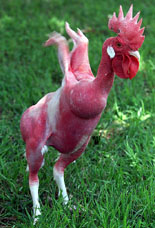
these guys were produced to save money plucking chickens on big farms! They remind me a little of the scaleless reptiles! Scientists are trying to prove that dinosaurs scales evolved into feathers so I presume its a similar type of mutation.

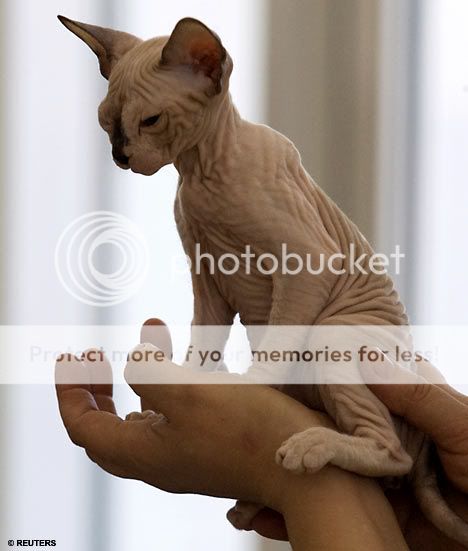
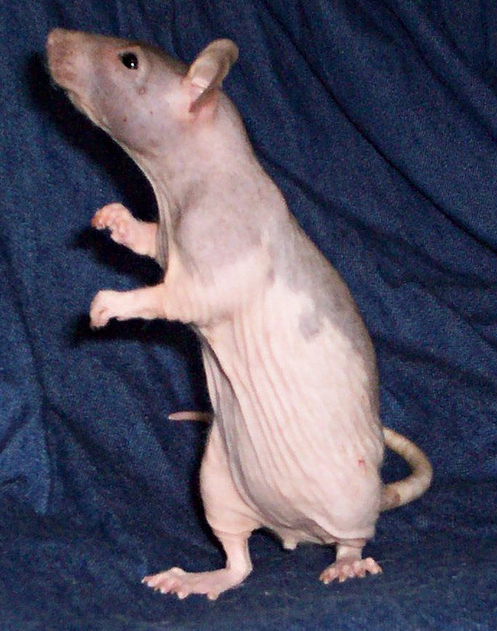
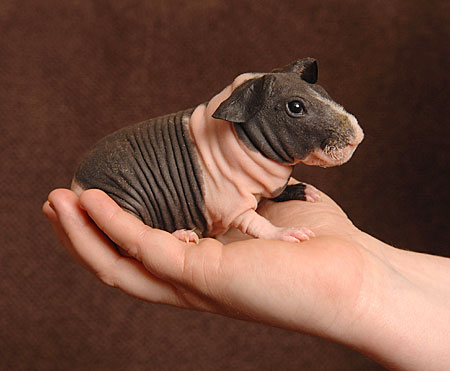
Of course there are many other examples of genetically "Bald" animals!


XoloitzcuintliCaminosFridaKahlo1.jpg

2PussInHoodR_468x551.jpg

Hairless_rat_Lhassa.jpg

skinnypig_450x371.jpg


Note that these are all healthy animals the genes that produce hair have been "switched off" through selective breeding
 
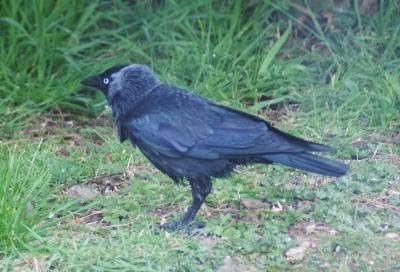
'Blue' Jackdaw?

Yesterday I saw a very strange bird- a Blue(?) Jackdaw. I first noticed it because it appeared 'shiny'- when I looked more closely I saw its shoulders, back and tail were a sort of dark irridescent blue colour (similar to a Roller). When it flew I could see the secondaries of the wings also were similar coloured. The rest of its plumage was black and it had the normal grey nape feathers and eye colour.

The bird behaved quite normally and the colouring appeared natural, not artificial. Has anyone else seen a similar specimen in this or another species?
 
could it have been the light? "black birds" are believed to show up different colours in UV light which other birds can see but we cannot. Here is an artists impression of how it would look

Before

mynah-1-copy.jpg


and after

mynah-2-copy.jpg


Sometimes when the sun is shinning we can pic up faint colours such as blue. This picture captures some of the blue you describe
Jackdaw.jpg


There are other species of jackdaws but they are unlikely to turn up in england like the Daurian Jackdaw from China
ai_1248588754094.jpg
 
This may be the key as it was definately something like the Mynah in the 2nd photo. But there were other jackdaws with it(same light, same background) which were quite normal in colour, so perhaps this one had some sort of feather malfunction. It was one of the strangest 'common' birds I've seen.
 
maybe you can see in ultraviolet, and if you can learn to control it you could be a superhero of some sort.....
 
Back
Top