Part III: Pangolins, Prairie Dogs And Path To Gondwanaland
We decided that in the time we had prior to the pangolin feed, it would be worth our while to head back towards the Kiwara Savannah, both in the hope that the inhabitants of the enclosure would be more visible and in order that we could view the rest of the exhibit beyond the point at which we had turned back.
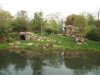
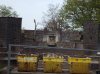
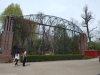
En-route to the savannah, we once again passed the old "Bear Castle", which over the years had held a number of taxa; most recently Spectacled Bear. Now it stood crumbling and empty, with barriers surrounding it on all sides and the distinct impression that the renovation/demolition process had stagnated. Variously, this area of the zoo has been suggested to be earmarked for a cafe, a nocturnal house or a landscaped area; I am unsure as to which, if any, of these options is the current plan. At one point, the rear of the castle had held Tammar Wallaby and domestic goat - these too were gone, something of a blow in the former case as these would have comprised a lifetick. Frustratingly, we were informed by a keeper, having enquired in faltering German, that the wallabies *were* still in the collection - but our attempts to work out where the keeper had indicated they were now kept were in vain.
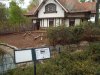
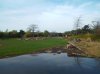
When we reached the Savannah exhibit, we were pleased to find that all the inhabitants barring the Thomson's Gazelle were easily visible and making full use of the space provided; something which, despite the excess theming and other such fripperies evident throughout the public portion of this area of the zoo, rather improved the Savannah exhibit's standing in our eyes. We were particularly pleased with the variety of ages and number of individuals forming the herd of Rothschild's Giraffe which was present within the enclosure; a number of young individuals were present, and the adult bull was a fine specimen of this rather attractive taxon. We were also pleased to see that the various inhabitants of the enclosure were mixing with little apparent conflict. As we progressed along the perimeter of the exhibit, we reached a small island next to the interior housing for the giraffes, which was signposted as holding
Lesser Flamingo (
Phoeniconaias minor); however for whatever reason, the inhabitants were locked within their internal housing when we visited, a small annexe built on the side of the giraffe house. To our considerable displeasure, when we looked through the window into the interior housing for the Lesser Flamingo we were met with a dirty, bare and muddy little room, much too small for the sizable flock of flamingo which were stood within. This rather contrasted with the bright and garish signage and overall "feel" of the Africa zone of the zoo, and rather exemplified the growing sense I was getting about the collection; many of the older portions of the zoo were crumbling and neglected, certainly no longer fit for purpose yet still retained a certain "soul"...... whilst most of the new and cutting-edge enclosures and exhibits we had seen thus far, although at first glance better than the old in every possible way, seemed soulless and false. As such, this grim and sub-standard corner of the Kiwara Savannah exhibit seemed to confirm this impression, that the theming and carefully polished design choices were only surface deep, and beneath them corners had been cut.
We then entered the giraffe house itself, finding a bright and airy space which was very obviously designed along functional lines, lacking much of the unnecessary theming found elsewhere in this area of the zoo but retaining enough of the design style that it fit with the rest. The one most notable failing of the internal housing for the giraffes was that to my judgement, although not so small as to compromise the welfare of the inhabitants it *did* seem smaller than would be suitable for the number of individuals held. Within the public area of the house, there were three medium-sized glass tanks containing a selection of small mammals; the first of these held
Round-eared Elephant Shrew (
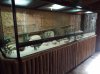
Macroscelides proboscideus, being quite long and thin and containing a mixture of sandy and rocky substrate, rocks and boulders, and sparse vegetation with two individuals visible. It struck me as quite a good enclosure for the species, giving the inhabitants plenty of space and more importantly places to hide from public gaze. The second enclosure, for
Ansell's Mole-rat (
Fukomys anselli), comprised a glass tank with a soft exposed-soil substrate, which was positioned over a much larger enclosed tank which presumably contained the tunnels and burrows in which the inhabitants lived; however it came as little surprise to us that despite observing the enclosure for some time we failed to see the inhabitants. The third and final tank contained
Fat Sand Rat (
Psammomys obesus), a lifetick taxon for all four of us, and comprised a long narrow tank much like that for the Elephant Shrew, but with significantly more rockwork, branches of wood connecting various points of the enclosure, and several nestboxes built into the rockwork. We observed a significant number of individuals making full use of the enclosure, which gave them both climbing and concealment opportunities as the need took them. Overall, then, these three small mammal exhibits were rather better in quality and presentation than the giraffe house in which they were found.
Prior to returning to the Elephant Temple, we briefly made our way back towards the Maned Wolf enclosure, in the hope that the inhabitants would now be active and visible; a hope which turned out to be well founded. We were pleased to note that the inhabitants included a number of juveniles and that the family group as a whole were making full use of the enclosure, displaying no stereotypical behaviour as far as we could tell. As this is a taxon which I have noticed in the past is particularly susceptible to the latter issue, this along with the evidence of successful breeding rather spoke to the quality of the enclosure, basic though it appeared.
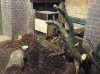
We then returned to the basement of the Elephant Temple with a few minutes to spare; this gave us time to examine the two enclosures properly. For all intents and purposes, they comprised a single enclosure which was divided into two by a glass barrier running through the centre, each enclosure including several hollow logs and branches for the inhabitants to climb on and inside, as well as a mock-rock structure which seemed intended to resemble the base of a tree trunk; this structure included a tunnel which connected the two enclosures, presumably allowing the two pangolins to mingle if they so wished, but also allowing the keepers to separate them if need be. Nest boxes were present in each enclosure.
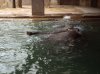
Before long, the lights were raised and keepers started to move around within the enclosure; the activity, increased light levels and the regular occurrence of this event quite obviously acted as an "alarm clock" for the inhabitants, as very soon both pangolins emerged from their nestboxes. Initially, whilst the keepers were preparing the food for the pangolins, they merely started patrolling and exploring their enclosures, but eventually they began to take a closer interest in the activity of the keepers. It was at this point in time that one of the pangolins was picked up, closely examined by the keeper and then placed in a plastic bag hanging from a spring-scale in order to weigh it. This, I believe, is an additional activity which takes place every Monday on top of the daily feeding. After this had occurred, one keeper per enclosure placed the food bowls in front of the pangolins; these contained thick "porridge" of sorts comprising pulverised bee larvae originating from complexes of hives kept onsite, along with apples, chitin powder and various other ingredients, boiled into a smooth paste. Water bowls were also provided; between these and the food bowls, we were able to observe the long protuberant tongues of the pangolins at length - pun unintended - and with great ease. Moreover, the pangolins were both extremely active and unconcerned with the large number of people observing them; in fact, at one point, when one of the keepers left the door leading from the public corridor into the enclosure ajar one of the pangolins made a bid for freedom, prevented only at the very last second by a keeper's foot!
A video of one of the pangolins feeding, recorded by myself, can be found at the following link:
https://www.youtube.com/watch?v=cblExOZjtx4&feature=youtu.be
When the pangolins finally retreated back into their nestboxes, we felt a curious mix of elation at having seen such a unique and special taxon, and sadness at the thought that we were unlikely to see such a sight ever again...... and that considering the precarious position of pangolins in the wild, especially the Chinese taxon, we had just observed an animal which stands a high chance of soon joining such taxa as the Thylacine, Schomburgk's Deer and Bubal Hartebeest in the infamous ranks of extinct animals which have been displayed in European collections.
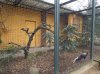
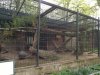
Intending to make our way towards the Gondwanaland house next, we left the Elephant Temple and passed between two large and spacious aviaries which straddled the main avenue leading away from the Temple; one was a partially walk-through free-flight aviary themed around Asian taxa, whilst the other was a larger aviary with no particular thematic focus. Both aviaries were very thickly planted with vegetation and mature trees, the Asian Walkthrough aviary especially so - this aviary also included a number of gently-stepping waterfalls constructed from natural stone, which improved the "feel" of the enclosure further. Although a distinct Asian theme was apparent - made all the clearer by the bamboo frames in which the signage for the enclosure was enclosed - unlike the theming found within the Africa portion of the zoo it did not feel forced, and as such I felt myself much more kindly disposed to this example of geographic theming.
The Asian Walkthrough aviary held the following taxa:
Asian Woolly-necked Stork (
Ciconia episcopus episcopus)
Black-headed Ibis (
Threskiornis melanocephalus)
Glossy Ibis (
Plegadis falcinellus)
White-winged Duck (
Asarcornis scutulata)
Black-crowned Night Heron (
Nycticorax nycticorax nycticorax)
Indian Pond-heron (
Ardeola grayii)
The opposite aviary - although slightly larger -was also somewhat less vegetated, and was surrounded on three sides by high artificial rockwork designed to emulate cliff-faces; this aviary lacked the Asian theming of the walkthrough aviary, and contained the following taxa:
Western Eurasian Griffon Vulture (
Gyps fulvus fulvus)
Yellow-billed Stork (
Mycteria ibis)
Waldrapp Ibis (
Geronticus eremita)
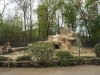
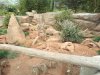
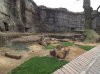
We were now drawing close to the entrance to Gondwanaland; however first we passed a pair of enclosures which, although very obviously old and crumbling, nonetheless still looked rather imposing and retained some shadow of their original glory. Each comprised a tall semi-circular mock-rock wall emulating a sheer cliff - much like that within the aviary which we had just passed - with open and relatively spacious enclosures in front of them which were variously sandy and grass-covered in patches, and strewn with various logs, branches and ropes. The left enclosure, which contained much more of this form of decoration, was signposted for
Ring-tailed Coati (
Nasua nasua) whilst the right-hand enclosure was signposted for
Black-tailed Prairie Dog (
Cynomys ludovicianus). Although both enclosures were perfectly okay for the species they held, the large area given to them seemed something of a waste; particularly in the case of the latter taxon, the individuals of which were present only in a small portion of the enclosure and - judging by how pristine much of the substrate was in the rest of the enclosure, contrary to what one would expect in an enclosure for this taxon - seldom if ever ventured around the rest of the enclosure. Although as noted above the enclosures were obviously some of the older ones we had seen thus far, unlike the rather detestable big cat cages these were still fit for purpose and looked quite pleasant, having an old-fashioned character of their own. As such I think these enclosures would be put to much better use displaying more appealing and interesting taxa than those present within; Alpine Marmot or - if the two enclosures were merged - even a caprine taxon perchance?
We next turned the corner onto the path leading up to the entrance to Gondwanaland.
(
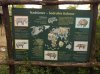
Attached are images of the old Bear Castle, a view over the Kiwara Savannah, the Elephant Shrew enclosure, a portion of the Chinese Pangolin enclosure, the exterior of the Asian Walkthrough aviary and the Black-tailed Prairie Dog enclosure)

 - for anyone else). This may have been covered elsewhere, but why is the kiwi not in the nocturnal house?