The German Adventures Of A Tea-Loving Dave - April 2014

TeaLovingDave said:
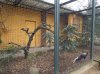
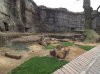
Where the nocturnal house at London has become a hollow shell of what it once was, the nocturnal basement at Zoo Berlin still displays many zoological treasures and - just as importantly - displays them well, and in enclosures which are well-suited to their inhabitants needs.
it has been so long that I had to go back and find the post to read about the Nocturnal House all over again (post #167 - April last year :p - for anyone else). This may have been covered elsewhere, but why is the kiwi not in the nocturnal house?
 
it has been so long that I had to go back and find the post to read about the Nocturnal House all over again (post #167 - April last year :p - for anyone else). This may have been covered elsewhere, but why is the kiwi not in the nocturnal house?

I wouldn't know for sure but due to zoo Berlins mainly taxonomic arrangement, could it be convenience? I'm assuming they fall under a 'bird team' and all of there stock is kept in just the two buildings?
 
They certainly have enough Kiwi that in theory they could display one or two in the nocturnal house and still have plenty off-display in the Fasanerie!
 
Kiwis on display

I was fortunate enough to have a detailed discussion with a kiwi keeper on my visit last year.

Berlin has had a great deal of success in breeding kiwis in recent years, and they put a lot of this down to the kiwis' exposure to natural/seasonal temperature fluctuations. Almost all of their birds are kept in outdoor on-show aviaries, but they're very rarely seen by the public and so no signs are displayed either. Even after hours they aren't particularly showy.

I was told that if a nocturnal exhibit was set up they would ideally arrange some kind of climate control, and even then the birds would likely be visible only infrequently. It seems feasible but not something they found particularly desirable.
 
I was fortunate enough to have a detailed discussion with a kiwi keeper on my visit last year.

Berlin has had a great deal of success in breeding kiwis in recent years, and they put a lot of this down to the kiwis' exposure to natural/seasonal temperature fluctuations. Almost all of their birds are kept in outdoor on-show aviaries, but they're very rarely seen by the public and so no signs are displayed either. Even after hours they aren't particularly showy.

I was told that if a nocturnal exhibit was set up they would ideally arrange some kind of climate control, and even then the birds would likely be visible only infrequently. It seems feasible but not something they found particularly desirable.
kiwi generally don't breed in nocturnal houses because there is far too much disturbance from the visitors. In NZ display kiwi are usually young birds which are taken off-display (to outdoor pens) for breeding when older, or are released if that is their role. The rare adult birds on display are usually birds no longer required for breeding.
 
April 7th 2014: Zoo Leipzig

Part I: Travel To Leipzig And First Impressions

On the Monday morning, Hel and myself rose at approximately 5.30am, and having decided to purchase food for our breakfast at Leipzig-Hauptbahnhof, did not have much reason to linger longer than neccesary at the hostel. As such we made our way from the hostel to Senefelderplatz, where we caught the U2 line to Alexanderplatz, changing there onto the S75 service to Berlin-Hauptbahnhof. Having explored the train station on the Friday evening in order to work out in advance where we would need to go, we were able to promptly reach the platform from where our train to Leipzig was to depart with about 20 minutes spare. As such, once joined by Chris and Ang we had a little time to talk with one another, and discuss our plan for when we arrived into Leipzig.

The train we caught, an InterCity Express service, eventually set off from Berlin at 06:52, and as an express service took little more than an hour to reach Leipzig-Hauptbahnhof at 08:04. Having already travelled on the regional train system to reach Magdeburg, as well as the U-Bahn, S-Bahn, tram and bus systems within Berlin itself, it was quite satisfying to be able to travel on yet another mode of transport during our trip, allowing us to experience the differences between each of these first hand.

When we arrived into Leipzig, as we had almost an hour before the zoo would open and knew that it would take little more than 10 minutes to walk there, we decided to explore the train station and find something to eat for breakfast; ultimately myself and Hel went to a bakery and purchased a few different items, including a slice of a very pleasant coconut quark-cheesecake. As it was raining quite heavily outside, the four of us sat in the station in order to eat; however fortune was on our side, as by the time we had finished our breakfast the rain had subsided and we were able to make our way to the zoo.

The route we walked from Leipzig HBF to the zoo is detailed in the link below:

https://goo.gl/maps/KpHjY

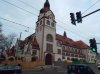
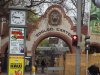
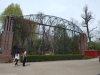
As we approached the zoo, we were met with a very pleasant-looking entrance plaza, with a large and rather attractive building - housing the offices of the zoo - to one side of an ornate archway. Having arrived slightly early, we had time to loosely plan our initial route through the collection; as we had been advised to ensure we saw both the elephant bathing and the feeding of the pangolins, both of which would take place in the "Elephant Temple" at some point in the morning, we decided to head towards this house in order to discover when these were scheduled for, albeit in a slightly roundabout fashion in order to get a first impression of as much of the zoo as possible.

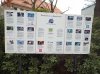
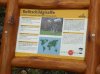
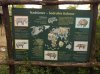
The first enclosure we reached was a smallish pond, containing two species of flamingo; the Chilean (Phoenicopterus chilensis) and Carribean (Phoenicopterus ruber); it was pleasant enough but not particularly memorable nor representing much of note. Much more interesting was the information board opposite, which discussed the various animal species which Zoo Leipzig is involved with the in-situ conservation and protection of, including Philippine Eagle Owl and Simien Wolf. Just down from the flamingo enclosure, we came to a reasonably large paddock for Maned Wolf (Chrysocyon brachyurus) - a species which I am particularly fond of due to how unusual they are taxonomically, and their attractive appearance. The enclosure itself was, as noted, reasonably large and contained a number of wooden shelters, boulders and mature trees; however the condition of the substrate was poor, with scrubby grass interspersed with areas of bare and eroded soil. At this point in time the inhabitants were not visible, presumably still being within the house at the rear of the paddock, but we were able to smell them with ease.

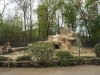
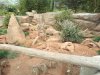
We then reached a sandy enclosure marked by a large degree of artificial rockwork forming a cliff-like structure in the centre of the paddock, holding a large group of Dall's Sheep (Ovis dalli dalli); a very welcome lifetick, considering my fondness for caprine taxa, but an unexpected one as we had heard false rumour that this taxon had left the collection. The sheep were making full use of their enclosure, including the rockwork, which rather served to show off their climbing abilities - as such I rather liked this enclosure, even if it did not meet the standard set by similar enclosures for other caprine taxa which I have observed at Highland Wildlife Park and the two Berlin collections. Next to this enclosure was a smaller one for Reeves' Muntjac (Muntiacus reevesi), a pleasant-enough sandy paddock containing a number of large mature trees, a handful of wooden shelters partially obscured by heaps of evergreen branches and a large felled log.

Opposite here we could see a very large paddock with what looked like a sand and woodchip substrate, and dotted with large boulders and logs, which was intended to house Przewalski's Horse (Equus ferus przewalskii) - however much like the Maned Wolves, at this point in time we were unable to see the inhabitants of the enclosure as they had yet to be let out of their internal housing, which was visibly closed in the far corner of the paddock far from the path. A little further along from here, we came across another mid-size paddock, marked yet again by the deep red sand which we were rapidly realising was something of a trademark of the zoo, and much like the Muntjac enclosure containing a number of partially hidden wooden shelters and mature trees; however in this case there was also a number of scrubby bushes within the enclosure. A signpost stated that this enclosure held European Roe Deer (Capreolus capreolus), and careful examination of the enclosure revealed a single individual huddled under one of the camouflaged shelters. As I am quite familiar with this taxon, seeing it quite regularly in the countryside around Helly's house, it struck me that although the enclosure was superficially quite a good one, the sandy substrate and lack of thicker vegetation was somewhat unsuited to the very shy nature of the species - quite possibly one of the reasons the individual within the enclosure was apparently trying to remain hidden.

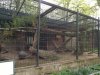
We next came to a complex of various small aviaries in a row, facing a set of further enclosures which had obviously once comprised further aviaries, but which appeared to have been knocked-together and merged to form a number of larger enclosures. However, these enclosures were still rather small for the taxa they held, quite uninspiring and obviously worn with age, and overall only presenting a stop-gap solution to the issue of where to house the taxa in question. Two of these were signposted for Snow Leopard (Panthera uncia), with an explanatory signpost stating that these two enclosures were interconnected, allowing the inhabitants to intermingle if they so wished. Although various climbing opportunities were provided for the inhabitants, and free access was granted to the off-display indoor enclosures, the overwhelming impression I got was one of decay and ugliness - although many have criticized the interior and external carnivore housing within the Alfred-Brehm at Tierpark Berlin, having seen both collections within a short space of time I was struck by the fact that despite the failings of the Berlin enclosures, they were nowhere near as decrepit and ill-maintained as these. Another such enclosure stood empty and unlabelled; this, I later discovered through reading an old guidebook, had at one point held the Amur Leopards now housed elsewhere in the collection. A final such enclosure, smaller and much more thickly planted, but just as ugly and ill-maintained, held Ring-tailed Coati (Nasua nasua).

The aviaries opposite, on the other hand, were significantly more appealing; housing as they did rather smaller species, being rather more thickly vegetated and overall looking significantly better-kept and cleaned - although still not representing anything special design-wise. These held the following taxa:

Red-billed Blue Magpie (Urocissa erythroryncha)
Little Owl (Athene noctua)
European Boreal Owl (Aegolius funereus funereus) and Swinhoe's Pheasant (Lophura swinhoii)
Eurasian Northern Hawk-owl (Surnia ulula ulula)
Monk Parakeet (Myiopsitta monachus) and Temminck's Tragopan

With the exception of the Monk Parakeet - a rather out-of-place taxon presumably included due to its nature as an invasive taxon - this collection represented a rather pleasant range of Eurasian birds native to cool climates, and as such rather pleased me.

We then reached a fairly-standard, but reasonably large, circular enclosure for Nepalese Red Panda (Ailurus fulgens fulgens) - as with many enclosures for this taxon, it contained a number of large mature trees, connected together by logs and ropes, with further vegetation and climbing opportunities dotted around the enclosure. As such, it was a pleasant enclosure and one suited to the taxon on display, but nothing which we had not seen many times in the past.

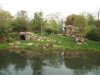
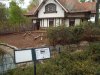
(Attached are two images of the entrance area of the zoo, a signpost discussing in-situ conservation programmes Leipzig is involved with, the Dall's Sheep enclosure, the aviary for Boreal Owl and Swinhoe's Pheasant, and one of the decrepit big cat enclosures)
 

Attachments

  • DSCF1429.jpg
    DSCF1429.jpg
    1.3 MB · Views: 14
  • DSCF1430.jpg
    DSCF1430.jpg
    2 MB · Views: 16
  • DSCF1435.jpg
    DSCF1435.jpg
    1.5 MB · Views: 19
  • DSCF1438.jpg
    DSCF1438.jpg
    2.1 MB · Views: 23
  • DSCF1464.jpg
    DSCF1464.jpg
    2 MB · Views: 21
  • DSCF1637.jpg
    DSCF1637.jpg
    2.1 MB · Views: 31
Yay, Leipzig at last! But you are touring it backwards t how I toured it, so its a bit confusing so far!

Aren't there plans to remove all the aviaries and leopard exhibits very soon? Which would explain why they have not been maintained particularly well.
 
Aren't there plans to remove all the aviaries and leopard exhibits very soon? Which would explain why they have not been maintained particularly well.

Reading back on the forums, I rather get the impression they have been saying that since at least 2008 :p
 
Reading back on the forums, I rather get the impression they have been saying that since at least 2008 :p

Well they have moved the Amur leopards out, so that's some progress. Was that open on your visit? Guess I will find out...

Anyway, great review of the "South American" area of the zoo!
 
Reading back on the forums, I rather get the impression they have been saying that since at least 2008 :p

Snow Leopards and red pandas move to new exhibits later this year (or early next year). New South America exhibits will then begin to take the place of the dated enclosures in that corner of the park. Your route through the Zoo couldn't have been the best first impression, but at least you saved the good stuff for later!
 
Part II: Kiwara Savannah And Enclosures Towards Elephant Temple

We next reached the Kiwara Savannah enclosure, a 25,000 square metre mixed enclosure for a number of African taxa and the centrepiece of the "African" section of Zoo Leipzig. As we were headed towards the "Elephant Temple", and it was still early enough that the inhabitants of the savannah enclosure were not - as yet - actually visible we decided to only view a portion of the enclosure at this point in time, resolving to visit it properly later in the day. We could see wide expanses of grassland, dotted with wooden shelters and trees, with a handful of pools here and there and a wide moat stretching along the entire far perimeter of the enclosure, a necessary precaution given the fact this also represented a sizable proportion of the outer perimeter of the zoo itself.

The enclosure held the following taxa, the latter three of which were unlabelled:

Grevy's Zebra (Equus grevyi)
Scimitar-horned Oryx (Oryx dammah)
Rothschild's Giraffe (Giraffa camelopardalis rothschildi)
Nile Lechwe (Kobus megaceros)
Thomson's Gazelle (Eudorcas thomsonii)
South African Ostrich (Struthio camelus australis)
Marabou Stork (Leptoptilos crumeniferus)
South African Crowned Crane (Balearica regulorum regulorum)
Southern Ground Hornbill (Bucorvus leadbeateri)

From our first impressions, we thought the enclosure was quite pleasant, although naturally we reserved full judgement until we were able to actually view the inhabitants of the enclosure and thus assess how the enclosure looked and felt when in use. One affectation - or if one prefers, theming touch - which we did make note of, however, was the fact that the signage for the enclosure was held within multiple roughly-hewn but highly-polished wooden frames, obviously intended to "feel" African - to rub the point in further, the frames were more or less the exact same shade of orange-red as the sand and mock-rock which we had already noticed was dotted throughout the collection! In any case, even had we not desired to view the enclosure in use for the reasons given above, the Thomson's Gazelle represented a lifetick for all four of us and as such gave us added motivation to return to the enclosure later in the day.

The next exhibit was a large and reasonably attractive enclosure for Spotted Hyena (Crocuta crocuta), which protruded somewhat into the footplan of the savannah exhibit and created a bottleneck behind the hyena enclosure. Although quite generously vegetated at the far end, where the enclosure bordered the savannah exhibit, much of the enclosure comprised bare sandy-scrubby substrate, with copious use of mock rock, tree trunks and logs throughout, and a number of entrances to underground dens. In many ways, it was reminiscent of the enclosure for Spotted Hyena at Colchester Zoo, except on a rather larger scale. As such it shared the strengths of this enclosure, such as plentiful access to places where the inhabitants could hide from the gaze of the public, but also the weaknesses, such as a certain clinical feel, and a slightly unpleasant aesthetic due to the level of mock-rock used. That said, it was still probably the best of the three enclosures for this species which I have seen thus far.

We next came to an enclosure for the nigh-ubiquitous Meerkat (Suricata suricatta) - as with so many exhibits housing this taxon, it comprised a mid-size enclosure featuring artificial termite mounds, scrubby vegetation and a deep sandy substrate, surrounded by tall mock-rock walls. Although it is hardly surprising that this taxon was displayed, and the enclosure was decent enough, albeit displaying the same slightly-affected theming as the nearby enclosures, it did strike me as something of a shame that something so commonplace and dull was taking up an enclosure which could so easily have housed a more unusual mongoose taxon. Just around the corner, we found a fairly large enclosure for Angolan Lion (Panthera leo bleyenberghi) - a somewhat unusual taxon in European collections, representing a lifetick for all four of us, and one which as a result we were careful not to overlook. The enclosure comprised a well-vegetated area with a number of rock dens and boulders scattered throughout, with a wide moat dividing it from the footpath and sheer mock-rock walls at the back and sides. As lion enclosures go, it was quite pleasant but nothing special - however it was nice to be able to get a good view of the inhabitants without glass or fencing posing an obstruction, something which is seldom possible in lion enclosures.

We next briefly viewed the rear portion of a walkthrough "Australia" enclosure, which we planned to view at more length later, noting that it held Red Kangaroo (Macropus rufus), Magpie Goose (Anseranas semipalmata) and Red-necked Wallaby (Macropus rufogriseus) as we did so. From our brief examination of the enclosure, it seemed a bit shabby and overgrown with vegetation, with numerous mature trees growing within interspersed with rockwork and felled logs. Passing the crumbling - and fenced off - remains of the "Bear Castle" - another area we intended to look at more fully later - we then approached the "Small Deer House", a very attractive little building which did indeed look for all the world like a small and somewhat old-fashioned house in which one could imagine someone living. Associated with this house were three enclosures; two for Lowland Anoa (Bubalus depressicornis) and one for Visayan Warty Pig (Sus cebifrons negrinus). The enclosures were reasonably pleasant and seemed suited to the species held within, albeit nothing particularly unusual. In many ways they were akin to some of the paddocks which I had seen a few days prior at Magdeburg, along with some of the old deer paddocks at Zoo Berlin, and in a strange way felt they had more "soul" than the over-themed enclosures of the "Africa" area we had just left.

Before continuing on our way towards the "Elephant Temple" we briefly walked along the path from the anoa enclosures, in order to view the enclosure for Eastern Black Rhinoceros (Diceros bicornis michaeli); doubtless intended to eventually be housed within the "Africa" portion of the collection, this taxon is currently located in a large and spacious - if somewhat bare - sandy paddock not far from the Bird House and Furseal enclosure which roughly speaking form the central point of Zoo Leipzig. The enclosure was nowhere near as pleasant to look at, nor as suitable for the inhabitants, as the complex of enclosures and paddocks for this taxon which we had viewed a few days prior at Magdeburg, but it was still a solid enclosure which seemed to meet the needs of the occupants. One feature which rather appealed to me was an informational signpost about rhinoceros taxa as a whole, discussing the various extant species as well as the extinct Woolly Rhinoceros which was present in central Europe at the last glacial maximum; the only failing of this signage was that, due to the presumed age of the sign, it drastically overstated the population of Sumatran, Javan and Northern White Rhinoceros.

At the far side of the rhinoceros paddock, it bordered a large lake which extended much of the way towards the Elephant Temple. Having doubled back and once again walked past the "Small Deer House", we were able to get close to this lake and view the inhabitants; a large group of perhaps a dozen or so Dalmatian Pelican (Pelecanus crispus). This enclosure too rather appealed to my tastes; an island in the centre of the lake gave the pelicans somewhere to nest away from any risk of predation, and the lake itself was surrounded by lush vegetation and mature trees, giving an overall feel which was much more natural and relaxed than the artificially-contrived environment I had noticed elsewhere in the collection as already noted.

Having reached the "Elephant Temple" complex, we found it comprised a central house for Indian Elephant (Elephas maximus indicus) with several large paddocks surrounding it, and a number of bridges, canals, archways and paths following the perimeter - these being themed to resemble a South-east Asian temple setting as closely as possible. The overall effect, although still somewhat "false" and over-the-top in feel, worked rather better than the equivalent theming attempts in the Africa area of the zoo from my point of view. The external paddocks for the elephants were large and spacious, and some of the better examples of their kind which I had seen to date; something which did somewhat ameliorate the overly-themed feel of the fripperies.

Inside the elephant house itself, we found a pleasantly-designed - if slightly small - interior with vegetation tracing its way around the perimeter in places, and a single rather bland and small aviary for Bali Mynah (Leucopsar rothschildi) close to the entrance. The internal enclosure itself comprised a sandy area with mock-rock columns and buttresses which were intricately decorated to resemble tree trunks, brickwork archways overhanging the main living area for the elephants, and a deep pool with a descending floor covering almost a third of the entire area. Stairs from the upper viewing area led to a basement level, almost one entire wall of which comprised a pair of thick glass viewing windows from floor to ceiling - the water of the aforementioned pool extending to the very top. This was the viewing area for the "elephant bathing" which we had heard so much about prior to our visit. Behind us as we looked towards the viewing window was a pair of small enclosures holding the other major attraction of the "Elephant Temple"; the Chinese Pangolin (Manis pentadactyla). A sign on the pangolin enclosure informed us that the feeding time for the inhabitants - the only time to be certain of seeing this reclusive treasure - would be at 10.50 am, a shade under an hour later. As such, we knew we would have a little time to further explore the zoo before returning - but first we would view the elephant bathing, which a sign in the upper portion of the house informed us would be within the next few minutes. Therefore we chose to stand and wait.

Rather than waste words trying to describe what followed, I feel it is appropriate for me to link to the following video which I recorded; I apologise for the occasional moment where the video loses focus as a result of my camera trying to focus on the scratched window:

https://youtu.be/9TI6V8-rFeE

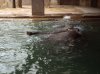
Having watched the elephant underwater for a time as shown in the above video, and with the water growing steadily murkier, we soon chose to once again ascend the stairs in order to watch the pool from above ground level; this allowed us to continue watching the elephant for some time longer before we elected to have a wander elsewhere in the zoo prior to returning for the pangolin feed. At this point in time, the unique opportunity to watch an elephant in this situation was certainly the highlight of the day, and the sight of a fully grown elephant doing somersaults in the water will stay with me to the grave; however we rather suspected the best was yet to come.

(Attached are images of a signage example from the Kiwara Savannah, the Meerkat enclosure, the Angolan Lion enclosure, one of the Lowland Anoa enclosures, the Rhinoceros taxonomy signage and a view of the Indian Elephant bathing)
 

Attachments

  • DSCF1466.jpg
    DSCF1466.jpg
    1.1 MB · Views: 20
  • DSCF1476.jpg
    DSCF1476.jpg
    1.9 MB · Views: 22
  • DSCF1481.jpg
    DSCF1481.jpg
    1.9 MB · Views: 20
  • DSCF1522.jpg
    DSCF1522.jpg
    2 MB · Views: 19
  • DSCF1514.jpg
    DSCF1514.jpg
    1.5 MB · Views: 23
  • DSCF1560.jpg
    DSCF1560.jpg
    1.4 MB · Views: 23
Part III: Pangolins, Prairie Dogs And Path To Gondwanaland

We decided that in the time we had prior to the pangolin feed, it would be worth our while to head back towards the Kiwara Savannah, both in the hope that the inhabitants of the enclosure would be more visible and in order that we could view the rest of the exhibit beyond the point at which we had turned back.

En-route to the savannah, we once again passed the old "Bear Castle", which over the years had held a number of taxa; most recently Spectacled Bear. Now it stood crumbling and empty, with barriers surrounding it on all sides and the distinct impression that the renovation/demolition process had stagnated. Variously, this area of the zoo has been suggested to be earmarked for a cafe, a nocturnal house or a landscaped area; I am unsure as to which, if any, of these options is the current plan. At one point, the rear of the castle had held Tammar Wallaby and domestic goat - these too were gone, something of a blow in the former case as these would have comprised a lifetick. Frustratingly, we were informed by a keeper, having enquired in faltering German, that the wallabies *were* still in the collection - but our attempts to work out where the keeper had indicated they were now kept were in vain.

When we reached the Savannah exhibit, we were pleased to find that all the inhabitants barring the Thomson's Gazelle were easily visible and making full use of the space provided; something which, despite the excess theming and other such fripperies evident throughout the public portion of this area of the zoo, rather improved the Savannah exhibit's standing in our eyes. We were particularly pleased with the variety of ages and number of individuals forming the herd of Rothschild's Giraffe which was present within the enclosure; a number of young individuals were present, and the adult bull was a fine specimen of this rather attractive taxon. We were also pleased to see that the various inhabitants of the enclosure were mixing with little apparent conflict. As we progressed along the perimeter of the exhibit, we reached a small island next to the interior housing for the giraffes, which was signposted as holding Lesser Flamingo (Phoeniconaias minor); however for whatever reason, the inhabitants were locked within their internal housing when we visited, a small annexe built on the side of the giraffe house. To our considerable displeasure, when we looked through the window into the interior housing for the Lesser Flamingo we were met with a dirty, bare and muddy little room, much too small for the sizable flock of flamingo which were stood within. This rather contrasted with the bright and garish signage and overall "feel" of the Africa zone of the zoo, and rather exemplified the growing sense I was getting about the collection; many of the older portions of the zoo were crumbling and neglected, certainly no longer fit for purpose yet still retained a certain "soul"...... whilst most of the new and cutting-edge enclosures and exhibits we had seen thus far, although at first glance better than the old in every possible way, seemed soulless and false. As such, this grim and sub-standard corner of the Kiwara Savannah exhibit seemed to confirm this impression, that the theming and carefully polished design choices were only surface deep, and beneath them corners had been cut.

We then entered the giraffe house itself, finding a bright and airy space which was very obviously designed along functional lines, lacking much of the unnecessary theming found elsewhere in this area of the zoo but retaining enough of the design style that it fit with the rest. The one most notable failing of the internal housing for the giraffes was that to my judgement, although not so small as to compromise the welfare of the inhabitants it *did* seem smaller than would be suitable for the number of individuals held. Within the public area of the house, there were three medium-sized glass tanks containing a selection of small mammals; the first of these held Round-eared Elephant Shrew (Macroscelides proboscideus, being quite long and thin and containing a mixture of sandy and rocky substrate, rocks and boulders, and sparse vegetation with two individuals visible. It struck me as quite a good enclosure for the species, giving the inhabitants plenty of space and more importantly places to hide from public gaze. The second enclosure, for Ansell's Mole-rat (Fukomys anselli), comprised a glass tank with a soft exposed-soil substrate, which was positioned over a much larger enclosed tank which presumably contained the tunnels and burrows in which the inhabitants lived; however it came as little surprise to us that despite observing the enclosure for some time we failed to see the inhabitants. The third and final tank contained Fat Sand Rat (Psammomys obesus), a lifetick taxon for all four of us, and comprised a long narrow tank much like that for the Elephant Shrew, but with significantly more rockwork, branches of wood connecting various points of the enclosure, and several nestboxes built into the rockwork. We observed a significant number of individuals making full use of the enclosure, which gave them both climbing and concealment opportunities as the need took them. Overall, then, these three small mammal exhibits were rather better in quality and presentation than the giraffe house in which they were found.

Prior to returning to the Elephant Temple, we briefly made our way back towards the Maned Wolf enclosure, in the hope that the inhabitants would now be active and visible; a hope which turned out to be well founded. We were pleased to note that the inhabitants included a number of juveniles and that the family group as a whole were making full use of the enclosure, displaying no stereotypical behaviour as far as we could tell. As this is a taxon which I have noticed in the past is particularly susceptible to the latter issue, this along with the evidence of successful breeding rather spoke to the quality of the enclosure, basic though it appeared.

We then returned to the basement of the Elephant Temple with a few minutes to spare; this gave us time to examine the two enclosures properly. For all intents and purposes, they comprised a single enclosure which was divided into two by a glass barrier running through the centre, each enclosure including several hollow logs and branches for the inhabitants to climb on and inside, as well as a mock-rock structure which seemed intended to resemble the base of a tree trunk; this structure included a tunnel which connected the two enclosures, presumably allowing the two pangolins to mingle if they so wished, but also allowing the keepers to separate them if need be. Nest boxes were present in each enclosure.

Before long, the lights were raised and keepers started to move around within the enclosure; the activity, increased light levels and the regular occurrence of this event quite obviously acted as an "alarm clock" for the inhabitants, as very soon both pangolins emerged from their nestboxes. Initially, whilst the keepers were preparing the food for the pangolins, they merely started patrolling and exploring their enclosures, but eventually they began to take a closer interest in the activity of the keepers. It was at this point in time that one of the pangolins was picked up, closely examined by the keeper and then placed in a plastic bag hanging from a spring-scale in order to weigh it. This, I believe, is an additional activity which takes place every Monday on top of the daily feeding. After this had occurred, one keeper per enclosure placed the food bowls in front of the pangolins; these contained thick "porridge" of sorts comprising pulverised bee larvae originating from complexes of hives kept onsite, along with apples, chitin powder and various other ingredients, boiled into a smooth paste. Water bowls were also provided; between these and the food bowls, we were able to observe the long protuberant tongues of the pangolins at length - pun unintended - and with great ease. Moreover, the pangolins were both extremely active and unconcerned with the large number of people observing them; in fact, at one point, when one of the keepers left the door leading from the public corridor into the enclosure ajar one of the pangolins made a bid for freedom, prevented only at the very last second by a keeper's foot!

A video of one of the pangolins feeding, recorded by myself, can be found at the following link:

https://www.youtube.com/watch?v=cblExOZjtx4&feature=youtu.be

When the pangolins finally retreated back into their nestboxes, we felt a curious mix of elation at having seen such a unique and special taxon, and sadness at the thought that we were unlikely to see such a sight ever again...... and that considering the precarious position of pangolins in the wild, especially the Chinese taxon, we had just observed an animal which stands a high chance of soon joining such taxa as the Thylacine, Schomburgk's Deer and Bubal Hartebeest in the infamous ranks of extinct animals which have been displayed in European collections.

Intending to make our way towards the Gondwanaland house next, we left the Elephant Temple and passed between two large and spacious aviaries which straddled the main avenue leading away from the Temple; one was a partially walk-through free-flight aviary themed around Asian taxa, whilst the other was a larger aviary with no particular thematic focus. Both aviaries were very thickly planted with vegetation and mature trees, the Asian Walkthrough aviary especially so - this aviary also included a number of gently-stepping waterfalls constructed from natural stone, which improved the "feel" of the enclosure further. Although a distinct Asian theme was apparent - made all the clearer by the bamboo frames in which the signage for the enclosure was enclosed - unlike the theming found within the Africa portion of the zoo it did not feel forced, and as such I felt myself much more kindly disposed to this example of geographic theming.

The Asian Walkthrough aviary held the following taxa:

Asian Woolly-necked Stork (Ciconia episcopus episcopus)
Black-headed Ibis (Threskiornis melanocephalus)
Glossy Ibis (Plegadis falcinellus)
White-winged Duck (Asarcornis scutulata)
Black-crowned Night Heron (Nycticorax nycticorax nycticorax)
Indian Pond-heron (Ardeola grayii)

The opposite aviary - although slightly larger -was also somewhat less vegetated, and was surrounded on three sides by high artificial rockwork designed to emulate cliff-faces; this aviary lacked the Asian theming of the walkthrough aviary, and contained the following taxa:

Western Eurasian Griffon Vulture (Gyps fulvus fulvus)
Yellow-billed Stork (Mycteria ibis)
Waldrapp Ibis (Geronticus eremita)

We were now drawing close to the entrance to Gondwanaland; however first we passed a pair of enclosures which, although very obviously old and crumbling, nonetheless still looked rather imposing and retained some shadow of their original glory. Each comprised a tall semi-circular mock-rock wall emulating a sheer cliff - much like that within the aviary which we had just passed - with open and relatively spacious enclosures in front of them which were variously sandy and grass-covered in patches, and strewn with various logs, branches and ropes. The left enclosure, which contained much more of this form of decoration, was signposted for Ring-tailed Coati (Nasua nasua) whilst the right-hand enclosure was signposted for Black-tailed Prairie Dog (Cynomys ludovicianus). Although both enclosures were perfectly okay for the species they held, the large area given to them seemed something of a waste; particularly in the case of the latter taxon, the individuals of which were present only in a small portion of the enclosure and - judging by how pristine much of the substrate was in the rest of the enclosure, contrary to what one would expect in an enclosure for this taxon - seldom if ever ventured around the rest of the enclosure. Although as noted above the enclosures were obviously some of the older ones we had seen thus far, unlike the rather detestable big cat cages these were still fit for purpose and looked quite pleasant, having an old-fashioned character of their own. As such I think these enclosures would be put to much better use displaying more appealing and interesting taxa than those present within; Alpine Marmot or - if the two enclosures were merged - even a caprine taxon perchance?

We next turned the corner onto the path leading up to the entrance to Gondwanaland.

(Attached are images of the old Bear Castle, a view over the Kiwara Savannah, the Elephant Shrew enclosure, a portion of the Chinese Pangolin enclosure, the exterior of the Asian Walkthrough aviary and the Black-tailed Prairie Dog enclosure)
 

Attachments

  • DSCF1568.jpg
    DSCF1568.jpg
    1.8 MB · Views: 25
  • DSCF1577.jpg
    DSCF1577.jpg
    1.3 MB · Views: 21
  • DSCF1598.jpg
    DSCF1598.jpg
    1.3 MB · Views: 27
  • DSCF1661.jpg
    DSCF1661.jpg
    1.6 MB · Views: 32
  • DSCF1773.jpg
    DSCF1773.jpg
    2 MB · Views: 24
  • DSCF1783.jpg
    DSCF1783.jpg
    1.8 MB · Views: 29
This small and dirty indoor enclosure is at the moment the most successful breeding facility of lesser flamingo and breeding purposes are the only reason why they were kept inside at your visit.

The Bear castle will be redeveloped as a playground and that should be ready within a few months.
 
This small and dirty indoor enclosure is at the moment the most successful breeding facility of lesser flamingo and breeding purposes are the only reason why they were kept inside at your visit.

Interesting; I've been informed by other zoochatters that this taxon actually *requires* over-cramped conditions in order to successfully breed - of course, the fact the windows were dirty on the visitor side too has rather less bearing on the matter :p

That said, it is quite interesting that whilst breeding well in an overly-small enclosure is not deemed an excuse when it comes to mammalian taxa, as a rule people do seem more accepting when it comes to avian taxa.

The Bear castle will be redeveloped as a playground and that should be ready within a few months.

I hope so; as noted before the redevelopments have seemingly been postponed multiple times, and the purpose of the redevelopments shifted just as many times - so we can but hope this time is the charm.

I'd be interested to know what you think about my opinion of the coati/prairiedog enclosures, incidentally :)
 
Interesting; I've been informed by other zoochatters that this taxon actually *requires* over-cramped conditions in order to successfully breed - of course, the fact the windows were dirty on the visitor side too has rather less bearing on the matter :p

That said, it is quite interesting that whilst breeding well in an overly-small enclosure is not deemed an excuse when it comes to mammalian taxa, as a rule people do seem more accepting when it comes to avian taxa.


I hope so; as noted before the redevelopments have seemingly been postponed multiple times, and the purpose of the redevelopments shifted just as many times - so we can but hope this time is the charm.

I'd be interested to know what you think about my opinion of the coati/prairiedog enclosures, incidentally :)

I'm not sure which redevelopments have been "postponed or shifted." Zoo Leipzig has followed a long-range master plan with greater intensity and diligence than just about any zoo I can think of.

The prairie dog and coati exhibits were developed as a way to temporarily occupy two massive old grottoes (formerly home to big cats, I believe), while awaiting their eventual--and planned--total redevelopment into a Himalayan zone with snow leopards and red pandas. The adjacent aviary will also be renovated for vultures as part of the same thematic complex. While certainly the coatis and prairie dogs seemed a little out of scale surrounded by the huge Hagenbeckian slabs, they were nice choices of a visitor-friendly active species to hold down the fort until now. I believe the conversion of the grottoes has begun, or will very soon.

I'm greatly enjoying and appreciating these thorough (understatement!) reviews of your travels and zoo experiences. However, I must say that among my fondest memories of Leipzig was sitting on the deck of the Savanna restaurant, surrounded by the beautiful African decor you dismiss as "fripperies," enjoying a cold beer and delicious lunch while watching the various denizens of what in my mind is one of the most compelling and satisfying African plains exhibits anywhere. To each their own!
 
I'm not sure which redevelopments have been "postponed or shifted." Zoo Leipzig has followed a long-range master plan with greater intensity and diligence than just about any zoo I can think of.

Re: my use of the word "postponed", this would be due to the fact I have been hearing people say that the old big cat cages and the Bear Castle were to be redeveloped imminently for about 5 years now :p

As for shifting focus, as noted earlier I have variously heard that the Bear Castle was to become a nocturnal house, a cafe and now a children's playground; I have a feeling it might even have been you that mentioned the first of these, years ago.

The prairie dog and coati exhibits were developed as a way to temporarily occupy two massive old grottoes (formerly home to big cats, I believe), while awaiting their eventual--and planned--total redevelopment into a Himalayan zone with snow leopards and red pandas. The adjacent aviary will also be renovated for vultures as part of the same thematic complex.

Snow Leopard would be a pretty nice inhabitant for these grottoes as it is; although I think that for this to happen the two grottoes would have to be joined as suggested in my review. Red Panda I can give or take :p but overall this redevelopment sounds like a pretty sound one; it would be nice if something of the original character of these enclosures was retained in the final product however.

However, I must say that among my fondest memories of Leipzig was sitting on the deck of the Savanna restaurant, surrounded by the beautiful African decor you dismiss as "fripperies," enjoying a cold beer and delicious lunch while watching the various denizens of what in my mind is one of the most compelling and satisfying African plains exhibits anywhere. To each their own!

Indeed; be a pretty boring place if we all agreed with one another :)

I definitely agree with you that the Savannah exhibit itself is great; I've not seen nearly as many plains exhibits as you have, naturally, but it certainly impressed me. I just thought the decor around the public areas was a bit tacky and unnecessary :p but that is not to say I think all such decor in zoo exhibits is tacky and unneccessary. For instance, to cite an example which is a useful direct comparison being another "African" exhibit which I saw during my trip, I very much liked the theming and design choices being put into play at Magdeburg in their Africambo complex - it struck me as giving the desired impression and feel without being overblown, whereas at Leipzig it fell short.

I think we will profitably be able to debate the matter further once I have finished relaying my impressions of Leipzig as a whole :) but for now I think it can be summarised thus; my preference is skewed towards a good and functional exhibit with understated theming and decor as a nice extra, whilst you feel the theming and decor is integral for an enclosure or exhibit to be truly good.
 
I am enjoying your (very overdue!) commentary, Dave - not least because I rather share your feelings about Leipzig (or at least, the ones you have expressed thus far).

All the new developments are well done, and it is undoubtedly a Great Zoo - something that is all the more remarkable when one thinks that 20 years ago it was in a desperate state, with only the aquarium able to command respect, and the rest of the zoo looking out-dated, shoddy and wholly out-of-place in the late C20th.

But.... like you, I find it in some ways to lack the character of many other zoos. 'Character' is not a synonym for 'preserved antiquity' (and to be fair to Leipzig, they have done a good job of maintaining the older buildings that were worth maintaining). I think I'd have to say that I prefer Dresden or Magdeburg, even if I would be hard pressed to claim that either zoo was 'better' than Leipzig.

The prairie dog and coati exhibits were developed as a way to temporarily occupy two massive old grottoes (formerly home to big cats, I believe),

I may be wrong, but I'm pretty certain that these enclosures most recently held wolves.

However, I must say that among my fondest memories of Leipzig was sitting on the deck of the Savanna restaurant, surrounded by the beautiful African decor you dismiss as "fripperies," enjoying a cold beer and delicious lunch while watching the various denizens of what in my mind is one of the most compelling and satisfying African plains exhibits anywhere. To each their own!

Although I am pretty sceptical about the ersatz "African" theming, I have to agree about the food in this restaurant: it is good, by zoo standards very good, and looking out on the animals in the 'savannah' exhibit while eating is a magical experience.
 
I may be wrong, but I'm pretty certain that these enclosures most recently held wolves.

They certainly did at my first visit (2005) but the current species were in place when I was there in 2011.

I should be at Leipzig again this week, all being well, so it's very tempting to write up my own review of the rest of the zoo to post when I get back and steal TLD's thunder - he'd only have himself to blame! :D
 
Back
Top