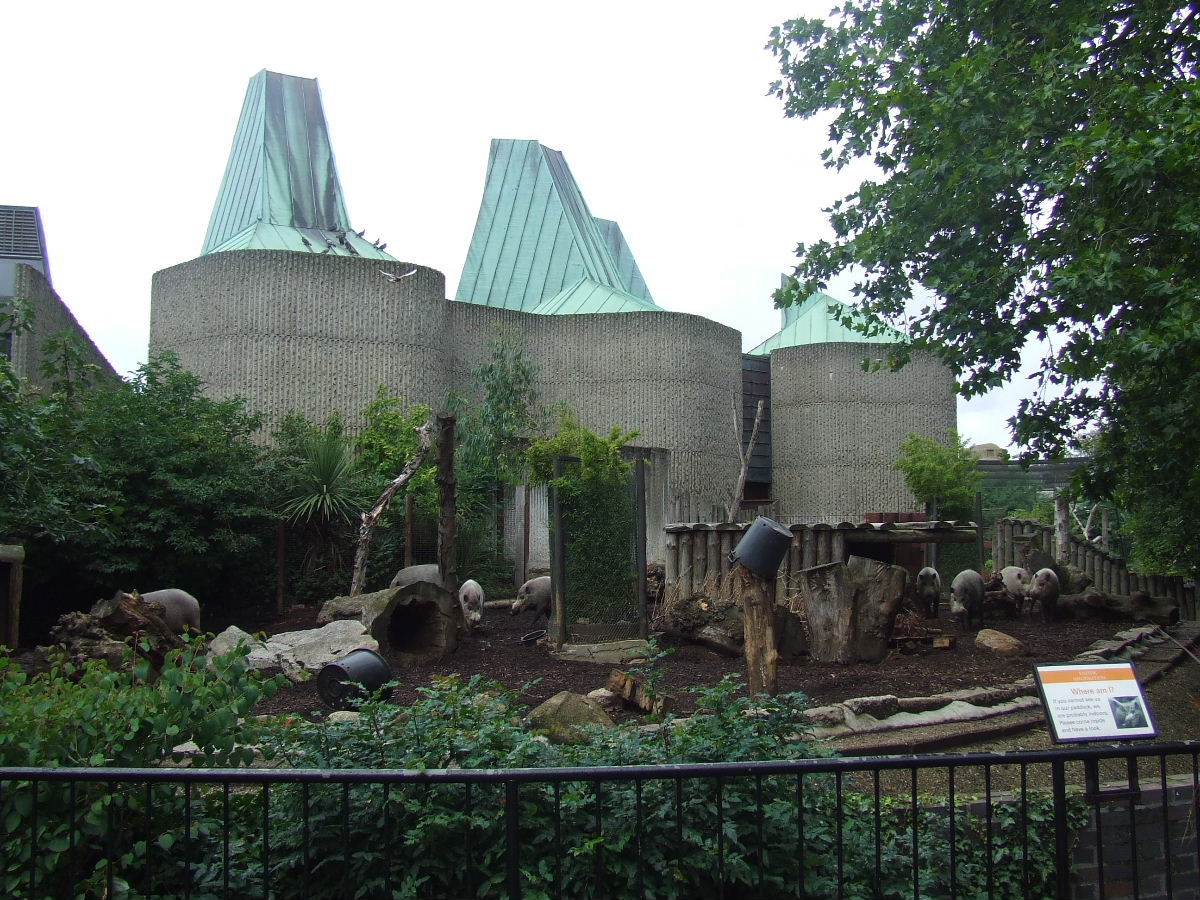
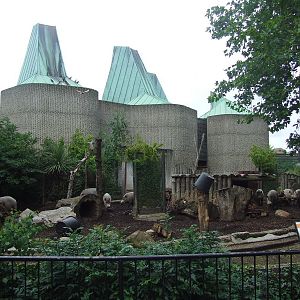
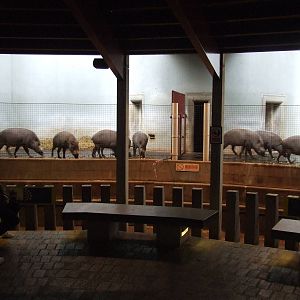
The concrete surfaces led to a lot of foot problems - bumblefoot and the like. As you say, it's the hardest to fill with animals of the four, but it's also the smallest, so if it has to stay empty it's at least not taking up too much of a footprint.
The Casson is a huge space inside, and I'm sure could be put to very good use with a little imagination. The Roundhouse is perfectly serviceable in its current form.
And while I can understand not liking the Tecton/concrete buildings, I have never been able to understand why people don't like the Mappin Terraces mountains. They're stylised, yes, but they make for such a great 'skyline'. And they're a great landmark, both from the zoo and Regent's Park itself.
With the recent demolition of the Parrot House at London Zoo, I wonder if some zoo fans were secretly glad that it was not heritage listed. Maybe we should start a poll. Which construction project is uglier?
1- Casson Pavilion
2- Lubetkin Penguin Pool
3- Mappin Terraces
4- Tecton Round House
While zoos can only benefit from open and informed discussion, childish, emotional and value-added words like 'ugly' are not appropriate; especially if you have only seen the building or exhibit from photos, not in person.
London Zoo has a longer and more complex history than say Akron Zoo or the Greater Vancouver Zoo across the pond. When you judge it, you need to have been there (as I have, albeit a decade ago) and consider a whole lot of factors; such as its history and how it has been run and by whom to name but two things.
We have discussed the 'American Zoo Model versus the British Zoo Model' privately and you will know where I stand. I do think it is essential to visit London Zoo and other British zoos before you allow yourself to comment like this.
Not sure about the paint (though I'm not sure if that would be possible as it's listed?).
They certainly did fill it in with substrate and use it for porcupines for a short time - don't know why they took them out but I never found it a particularly satisfying exhibit. I think a fountain may be the best use for now.
They certainly did fill it in with substrate and use it for porcupines for a short time - don't know why they took them out but I never found it a particularly satisfying exhibit. I think a fountain may be the best use for now.
Didn't they have problems with drainage? I would agree that it didn't really work with other animals in - and I think it should be left as it is, a beautiful monument to a fascinating architectural style. It's not as if every inch of London Zoo is taken up with developments...
And I couldn't agree more with those who defend the architectural legacy of the zoo. It is such a legacy which gives a zoo - or any other institution - its soul. Where London's soul does remain, it is through its landmark buildings, even if the 'right' use has not yet been found for all of them.
While zoos can only benefit from open and informed discussion, childish, emotional and value-added words like 'ugly' are not appropriate; especially if you have only seen the building or exhibit from photos, not in person.
London Zoo has a longer and more complex history than say Akron Zoo or the Greater Vancouver Zoo across the pond. When you judge it, you need to have been there (as I have, albeit a decade ago) and consider a whole lot of factors; such as its history and how it has been run and by whom to name but two things.
We have discussed the 'American Zoo Model versus the British Zoo Model' privately and you will know where I stand. I do think it is essential to visit London Zoo and other British zoos before you allow yourself to comment like this.
I don't find any of the buildings ugly. I think London could often benefit from some more creative and aspirational thinking, especially regarding some of its less flexible installations - and I hope the tiger enclosure will go somewhere to address this - but these buildings are a vital and iconic part of London's long and highly significant history and I would actually hate it if they were to be flattened and replaced with bland any-zoo designs.
Often British zoos are criticised for their lack of architecture, for the farmer's field and wire fence aesthetic school of zoo design and this is something you certainly can't accuse of London Zoo's historical buildings.
sooty mangabey puts it very well - it is here where London's soul resides.
I don't find any of the buildings ugly. I think London could often benefit from some more creative and aspirational thinking, especially regarding some of its less flexible installations - and I hope the tiger enclosure will go somewhere to address this - but these buildings are a vital and iconic part of London's long and highly significant history and I would actually hate it if they were to be flattened and replaced with bland any-zoo designs.
Often British zoos are criticised for their lack of architecture, for the farmer's field and wire fence aesthetic school of zoo design and this is something you certainly can't accuse of London Zoo's historical buildings.
sooty mangabey puts it very well - it is here where London's soul resides.
I agree the modernist heritage buildings of London are interesting and historically significant. But the slavish required adherence to keeping every aspect of the original "creations" intact has frustrated and eventually led to the loss of some very strong and potentially impactful leadership (including one now making a real mark down under). The most egregious example I have heard about was the rejection of the proposal to replace the rotting original mesh on the largely-useless Snowdon aviary with lightweight, stronger and less visible stainless steel netting, because the original architect felt it would sully his design!
Re the 'soul' of London Zoo, I always feel rather 'cheated' that the old Elephant House [near where the Tecton Roundhouse is now, I believe] was demolished before I was born. Old photographs show [for their time] reasonable sized outside yards with bathing facilities. What I've never seen is photos or even a plan of the inside; do these exist anywhere?
Certain sounds that always seemed part of the Zoo to me, and part of the visiting experience. Approaching on foot from Camden Town tube station the bull Sealion's barking could be heard in the distance with, if you were lucky, the cry of the Fish Eagle as you got closer. Towards the end of the day, Sonneratt's Junglefowl could be heard answering each other's crowing from the pheasant aviaries by the Bird House to the ones on the canal bank. All gone now, with all the geese and cranes, how lucky that the Bird House is still with us and appearing to work well.
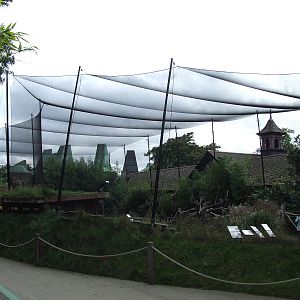
The Northern/Snowdon Aviary ['The Folly' to a past generation of keepers, and for all I know to the present lot] always had its issues. Very hard to catch a bird up, even harder to provide winter shelter with all that high perching. BUT, it's still not a bad walkthrough experience, with nesting Ibis & Egrets [if they're still in there] at walkway height.
Re the 'soul' of London Zoo, I always feel rather 'cheated' that the old Elephant House [near where the Tecton Roundhouse is now, I believe] was demolished before I was born. Old photographs show [for their time] reasonable sized outside yards with bathing facilities. What I've never seen is photos or even a plan of the inside; do these exist anywhere?
I understand your feelings about the old Elephant House; I wish I had seen it too.
Photographs of the interior are extremely scarce, but I believe that John Edwards will include one in the next edition of his book London Zoo from Old Photographs.
The first edition of Edwards' book suggests that the inside quarters may have been a bit cramped, and the animals had to take turns using the paddocks. However, at least two of the Sumatran rhinos housed there lived longer than any others since, and Indian Rhino longevities were also creditable. It may not have been up to 21st century standards, but was perhaps a better Elephant & Rhino house than the more pretentious casson.