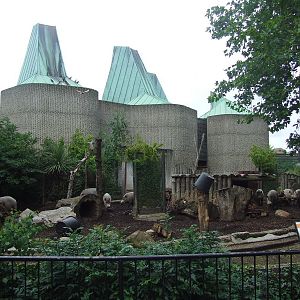
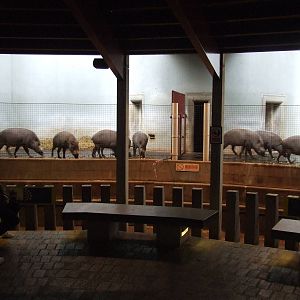
The architect of the building under discussion was Sir Hugh Casson, whose Wikipedia biography is as follows...
Sir Hugh Maxwell Casson, KCVO, RA, RDI, (23 May 1910 – 15 August 1999) was a British architect, interior designer, artist, and influential writer and broadcaster on 20th century design. He is particularly noted for his role as director of architecture at the 1951 Festival of Britain on London's South Bank.
Casson's family originated from Wales. He was the nephew of actor, Sir Lewis Casson. Hugh Casson studied at Eastbourne College in East Sussex, then St John's College, Cambridge (1929–1931), after which he spent time at the Bartlett School of Architecture in London. Up to the start of the Second World War in 1939, he divided his time between teaching at the Cambridge School of Architecture and working in the London office of his Cambridge tutor, architect Christopher (Kit) Nicholson. During the war, he worked in the Camouflage Service of the Air Ministry.
Hugh Casson was appointed to his role as director of the Festival in 1948 at the age of 38 and set out to celebrate peace and modernity through the appointment of other young architects. For example, the Modernist design of the Royal Festival Hall was led by a 39-year-old, Leslie Martin. Casson's Festival achievements led to him being knighted (KCVO) in 1952.
After the war, and alongside his Festival work, Casson went into partnership with young architect Neville Conder. Their projects included various corporate headquarters buildings, university campuses, the Elephant House at London Zoo, a building for the Royal College of Art (where Casson was Professor of Interior Design from 1955 to 1975), and the masterplanning and design of the Sidgwick Avenue arts faculty buildings for the University of Cambridge. This latter project lasted some 30 years.
As a leading light in the fine arts, Casson also served as Provost of the Royal College of Art and, after being elected in 1970, was President of the Royal Academy (1976–1984). A close friend of the British royal family, he designed the interior of the royal yacht Britannia and was also credited with teaching Charles, Prince of Wales to paint in watercolours.
In the 1980s, Sir Hugh became a television presenter, with his own show 'Personal Pleasures with Sir Hugh Casson', which, despite its title, was in fact about stately homes and places he enjoyed.
Casson is commemorated by Private Eye's Sir Hugh Casson Award, recognising the "Worst New Building of the Year" in the Nooks and Corners column.
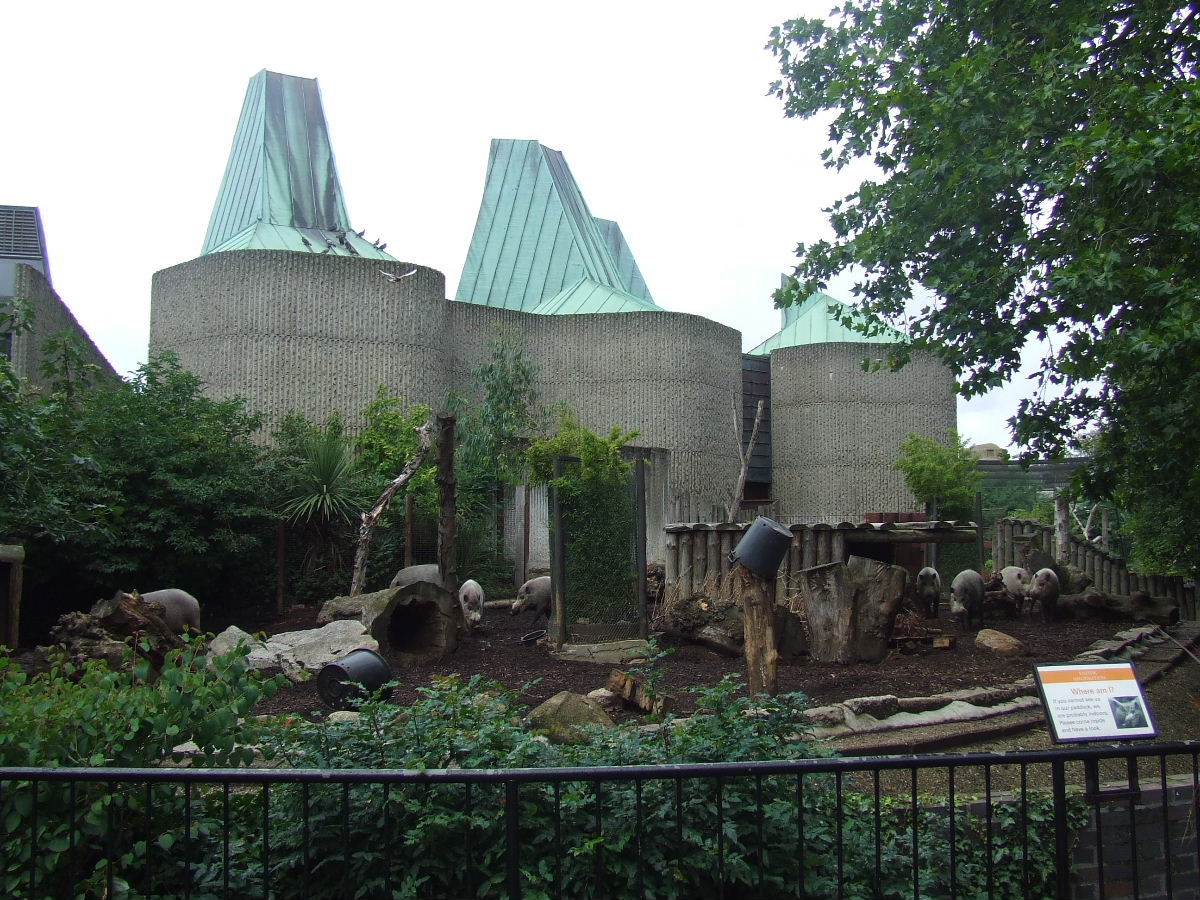
The above tells you why this building's listed. There is also the mundane consideration that so much reinforced concrete went into its construction that it would probably take a cruise missile attack to demolish it.
There is a thinly disguised (but unremitting) assault on this appalling building in Gerald Durrell's book "The Stationary Ark" in which he describes to a foreign director how the structure, described by Durrell very accurately as being rather like a deformed cathedral, is supposed to represent a group of elephants at a water hole. His horrified companion is supposed to have enquired whether it was thought that the elephants would fly up into the rafters at night to sleep.
For the record, the green snorkels are skylights into the animals' dens....
There is a thinly disguised (but unremitting) assault on this appalling building in Gerald Durrell's book "The Stationary Ark" in which he describes to a foreign director how the structure, described by Durrell very accurately as being rather like a deformed cathedral, is supposed to represent a group of elephants at a water hole. His horrified companion is supposed to have enquired whether it was thought that the elephants would fly up into the rafters at night to sleep.
Maybe Casson was designing the building for this elephant? Might explain some things...
Well, it was the 1960s. Although I feel that Casson was far too much of an Establishment figure to have partaken in, ahem, "alternative" stimulants.
Having said that, there has long been a story that the building was well under way before it was noticed that there were no doorways leading from the dens into the paddocks.....
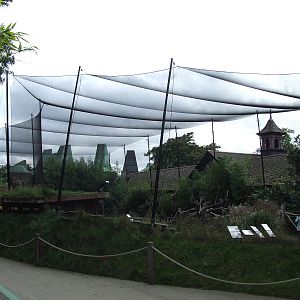
I should like to make a suggestion for the Snowdon Aviary. This is, in my opinion, quite a disappointing exhibit that always has a rather tired look about it. I know that when it was built, it had a much greater variety of birds in it, but it proved very difficult to manage those birds and the difficulty of providing good winter housing meant it was really suitable only for the most hardy of species. Well, John Ironmonger, in his book "The Good Zoo Guide", proposed that, instead of birds, the exhibit could be used for endangered primates (he suggested douc langurs, or lion-tailed macaques, or drills). I think his idea has merit - but I wouldn't want to lose the walk-through aspect (otherwise most of the primates would be barely visible for much of the time in such a vast space), so how about a walk-through exhibit for Barbary macaques. We know from that Monkey Forest place at Trentham in Staffordshire that it is possible to allow members of the public to mingle with Barbary macaques.
That's an interesting proposal. perhaps for a non-walk throughable species you could have a cover over the walkway (but maybe not possible from an architectural preservation point of view).
There is a trend for close encounters and walkthroughs and I think close up encounters are something city zoos like London could excel in. it would certainly get lots of publicity and I can picture the advertising campaign too.
The Casson Pavilion opened in 1965; it originally housed African and Asiatic elephants, white rhinos and black rhinos.
It is worth mentioning the male white rhinoceros ‘Ben’, who arrived at the zoo in 1955 and was previously housed in the old Deer & Cattle Sheds, was a Northern white rhinoceros; he was sent to Dvur Kralove in 1986.
For a time in the mid nineteen seventies, this building housed three species of rhinoceros as the female Indian rhino ‘Mohini’, who had previously been at Whipsnade for many years, spent some time in London Zoo before being sent to Amsterdam (Artis) Zoo.
For a while in 1966 / 1967, the indoor elephant bathing pool held a young walrus ‘Alice’; this pool was subsequently used for pigmy hippos.
So when it opened the Casson simultaneously held four pachyderm species? I didn't even realise it had more than two yards! (based on my visits in recent years)
And a Walrus as well! I find it fascinating how so many species at London seem to have been held in impromtu enclosures that served many purposes over their lifetime. I know exhibits still get new inhabitants today, but we live in an era where more and more are tailored to a specific species. Although this is mostly theming of course. Tiger Territory, for example could hold any number of animals.
As a footnote I remember reading Gerald Durrell's attack on the Casson in The Overloaded Ark as a child. It obviously left quite an impression because I later saw a picture of the building for the first time in a book I think was called 'Zoos of the World', and instantly knew this must be the one he was criticising!
Gerald Durrell's verbal attack on the Casson Pavilion was actually in his 1976 book, "The Stationary Ark" (it's on pages 28/29 of the hardback edition), not "The Overloaded Ark" (which was his first book). He doesn't mention the Casson (or, indeed, London Zoo) by name, but it's not difficult to work out which edifice in which of the world's zoos he was referring to. Durrell was always (rightly) contemptuous of vastly expensive zoo exhibits where the visiting public seemed to have priority over the needs of the animals. The Casson was not designed at all well for pachyderms. I think I'm right in saying that Desmond Morris, who was Curator of Mammals at the time the building was conceived, was very dissatisfied with the architect's blueprint when he saw it, and argued for the rhinos and the elephants to be given more space, but he was overruled.
So when it opened the Casson simultaneously held four pachyderm species? I didn't even realise it had more than two yards! (based on my visits in recent years)
It never had more than two outside areas. The rhinos would normally alternate in using the one outside area. It may have been possible to divide it at the narrowest point with movable metal poles- I can't quite remember, but I never saw two Rhino species outside at once.