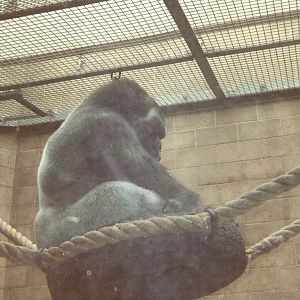
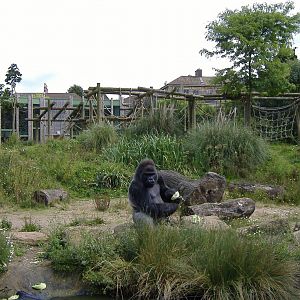
Even though Gorilla Island is a much nicer enclosure for the gorillas, I still enjoyed seeing them in the old ape house. The indoor area seemed very peaceful. I visited a lot in the 90s and on one of my visits, I saw Diana with Nadia just a few weeks before Nadia died, and I was really shocked to read the news in a national newspaper. I also never saw Daniel or Jason again.
I felt that Daniel had certain characteristics that were very much like his mother Delilah. I found him fascinating to watch.
Some old zoo houses , although unsatisfactory in many respects , had an intangible "peaceful" quality, which should never be underestimated as an essential factor in animal & human welfare.You could write a book on the subject of what generates this peaceful quality.Strangely enough , I think it is very difficult to achieve a truly peaceful environment in an absolutely new building , even if the design is really excellent.Could it be that a certain "lived-in" quality is necessary?On a purely practical level , it is obvious how old zoo buildings inspire visitor behaviour.A visitor pushing open a door with 100 years of history enters a zoo building in a different way than a visitor crossing a light beam and having a sliding glass door open in front of him as if it were an airport terminal or shopping centre.Old-style signs with small letters, etc all contribute to slow visitors down and relax them, as opposed to interactive displays etc , which may invite hyperactivity as children rush to press every button.Multiply this by the thousands of visitors who traipse through a building on a daily basis and you can appreciate how these energies gradually suffuse a building and undoubtedly are transmitted to those living there 24 hours a day ,i.e. the animals.Personally , I only need to be in a building for 5 minutes before I have a good idea on whether it is potentially stressing or relaxing for animals.
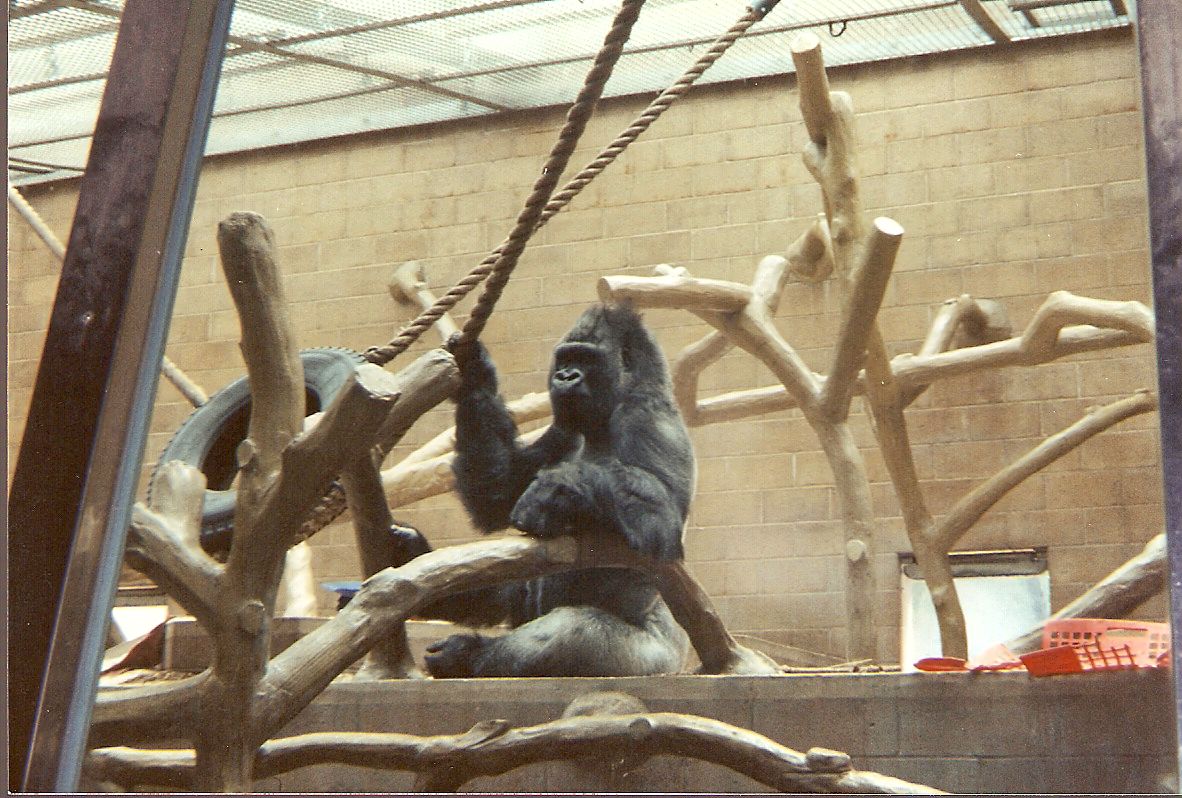
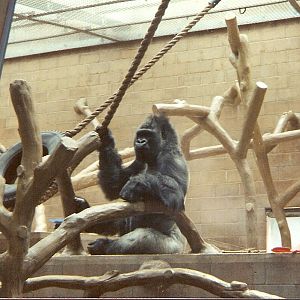
I never liked the 'new' Ape House at Bristol, as it was then: the external cages were all concrete and rocks, with sloping floors and very little opportunity for climbing, except on a few big branches, and they were small even by 1970s standards. The big internal cage for gorillas, shown in this photo, was pretty good - but the other internal cages were too small. The record for breeding success with their gorillas was terrible.
The 'atmosphere' in the old gorilla house and the old ape house (which was a real eyesore) seemed better to me and the apes were more active if I remember rightly.
I never liked the 'new' Ape House at Bristol, as it was then: the external cages were all concrete and rocks, with sloping floors and very little opportunity for climbing, except on a few big branches, and they were small even by 1970s standards. The big internal cage for gorillas, shown in this photo, was pretty good - but the other internal cages were too small. The record for breeding success with their gorillas was terrible.
The 'atmosphere' in the old gorilla house and the old ape house (which was a real eyesore) seemed better to me and the apes were more active if I remember rightly.
1. The outdoor enclosures of this house were badly designed. Asante when visiting from Twycross broke her toes on those rocks while the Orangutans had less climbing opportunities available to them than in the old barred house.
2. The big internal cage(shown here) was good but was never put to its full potential as there was no proper social group and very little enrichmennt-consequently the Apes just sat and did nothing all day(or in some cases plucked themselves) which is why it seemed so 'quiet' in there. I think as display cage it was a better design (modelled on Frankfurt/Basel's of the time) than the existing indoor Gorilla enclosure as this one is somewhow rather cramped and narrrow.
3. The 4 other indoor cages were too small- particularly for Gorillas which ended up occupying 2/3rds of the House.
4. Breeding in here was a disaster- I won't even mention the 'lost' babies- too many to count... though that was not directly due to the House.
Just seen this thread. I first saw "Daniel" in April 1973, so he would have been the first young gorilla I saw (having only seen "Guy" and "Lomie" previously).
I don't know what happened in the 1976 Ape House (and the outdoor enclosures wouldn't have flattered mangabeys or macaques), but it represented a terrible waste of gorillas.
Just seen this thread. I first saw "Daniel" in April 1973, so he would have been the first young gorilla I saw (having only seen "Guy" and "Lomie" previously).
I don't know what happened in the 1976 Ape House (and the outdoor enclosures wouldn't have flattered mangabeys or macaques), but it represented a terrible waste of gorillas.
Don't start me on the 1976 house- it was a catalogue of disasters. Only Gorilla studbooks or a full analysis of Bristol's births for both Orangutans and Gorillas reveal the true extent of their failures at that time (e.g. a total of over 20 births/stillbirths between four female Gorillas of which nearly all DNS) I don't think the house had much to do with it though.
It seems Bristol (and I mean no disrespect here, they were working with what was traditionally a very difficult species) rather lost their way after two ground-breaking successes, firstly, rearing Alfred to near maturity (first Gorilla to survive past early adolescence (if London's Mok & Moina even got that far in their few years of life), and second, breeding and rearing Daniel.
Gorilla 'technology' has advanced out of all recognition over a few decades. Aspinall deserves a lot of the credit for keeping them in less than sterile conditions and having the major breeding breakthrough from Kisoro onwards. I always feel that more could be made of the fact that two of the three current females at Durrell ( Kahili and Kishka) I are daughters of the two pre-eminent breeding males of the 70s and 80s, Jambo and Kisoro. Today's captive gorilla populations owe a lot to those two silverbacks.