
Some better news for the giraffes today. A healthy reticulated giraffe calf was born on Friday. Mother and calf will stay in the stable together for now to build a strong bond.
Source: Facebook ARTIS
Source: Facebook ARTIS

Some better news for the giraffes today. A healthy reticulated giraffe calf was born on Friday. Mother and calf will stay in the stable together for now to build a strong bond.
Source: Facebook ARTIS
During my recent visit to Artis I noticed quite a few changes in both the Reptile, Small Mammal and Forest Houses.
The Grey-handed Night Monkeys (Aotus griseimembra) have been removed from the Forest House / Apenhuis and can now be seen in ther former Cotton-top tamarin (Saguinus oedipus) enclosure in the Small Mammal House / Kleine Zoogdierenhuis. The cotton-top tamarins have been moved to the former binturong enclosure, giving them access to direct sunlight for the first time. This does mean that this species is only visible on the outside of the Small Mammal House. The Pygmy marmosets (Cebuella pygmaea) and Bearded emperor tamarin (Saguinus imperator subgrisescens) have been moved to the Forest House.
The Reptile House / Reptielenhuis has also undergone some changes, I have updated my schematic overviews for the Reptile House.
The most changes have happend in the Small Hall, the "colder" part next to the Forest House, where animals either left the collection of were moved to different terrariums.
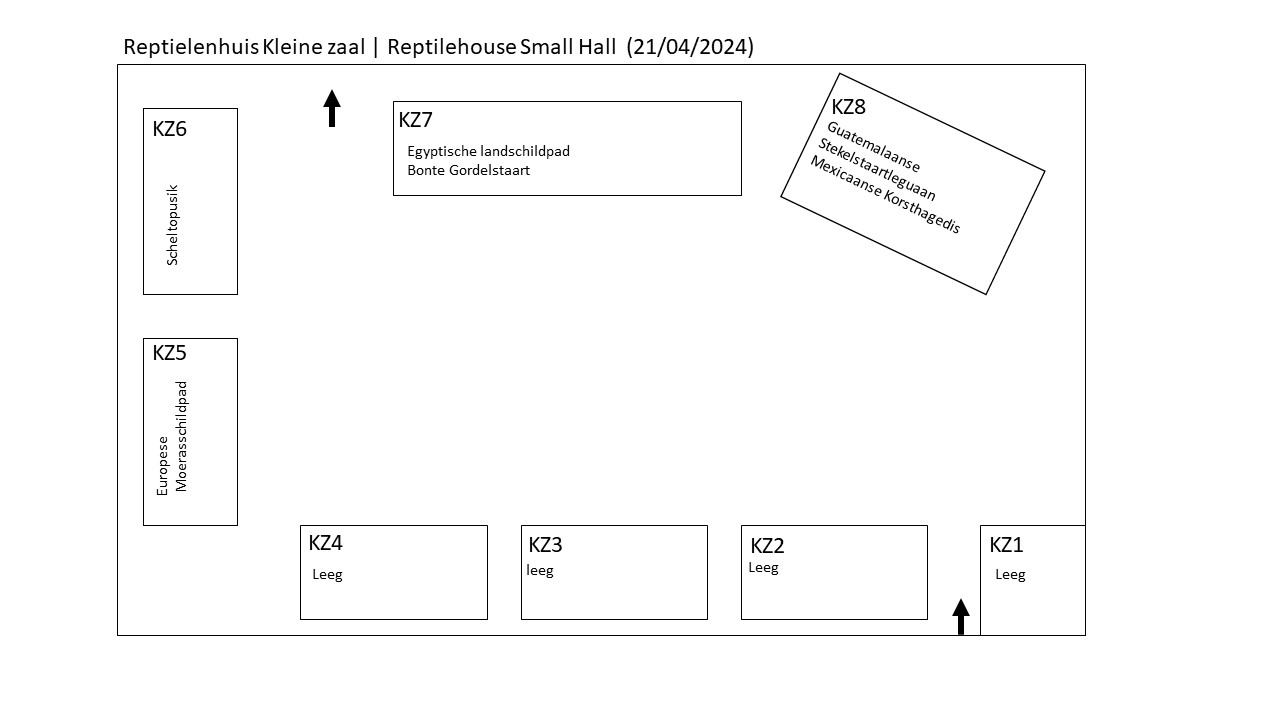
Reptielenhuis Kleine Zaal | Reptile House Small Hall (21/04/2024)
Schematic overview of the content of each terrarium in the small hall (April 2024). This is the...
KZ1: Empty
KZ2: Empty (used to house Crocodile lizards (Shinisaurus crocodilurus)).
KZ3: Empty (animals moved to KZ7)
KZ4: Empty (animals moved to KZ6)
KZ5: European pond turtles (Emys orbicularis).
KZ6: European legless lizards (Pseudopus apodus), previously housed San Francisco gartersnakes (Thamnophis sirtalis tetrataenia).
KZ7: Egyptian tortoises (Testudo kleinmanni) and Zoutpansberg girdled lizard (Smaug depressus). Previously housed Algerian orange-tailed skink (Eumeces algeriensis) and Common chuckwallas (Sauromalus ater), they moved to terrariums in the warmer part of the reptile house.
KZ8: Guatemalan spiny-tailed iguana (Ctenosaura palearis) and Rio Fuerte beaded lizards (Heloderma horridum exasperatum).
As you can see, quite a lot of terrariums are sitting empty at the moment.
They have been redecorated so I persume new animals will arrive soon.
The European pond turtles (Emys orbicularis) and European legless lizards (Pseudopus apodus) will also soon leave the reptile house, they will live in the former Asian small clawed otter enclosure in the small mammal house.
The Big Hall, the "warmer" part next to the former lion enclosure, has mostly stayed the same.
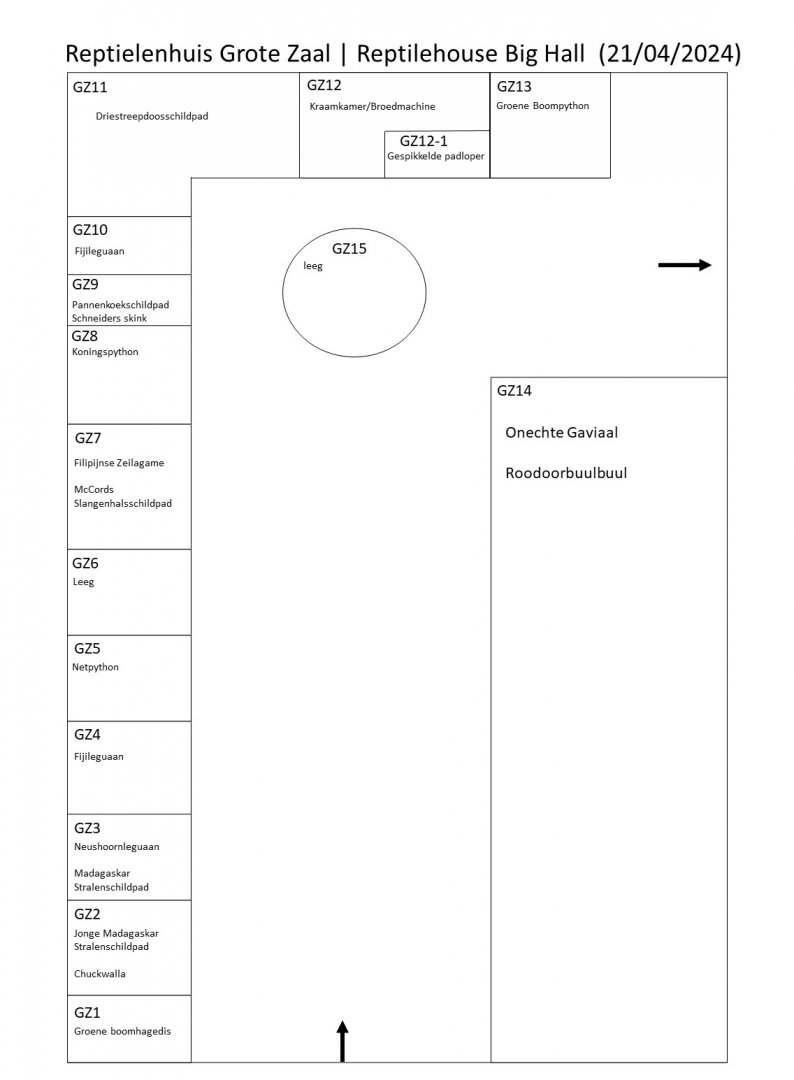
Reptielenhuis Grote Zaal | Reptile House Big Hall (21/04/2024)
Schematic overview of the content of each terrarium in the Big Hall (April 2024). This is the...
GZ1: Green keel-bellied lizards (Gastropholis prasina).
GZ2: Juvenile Radiated tortoises (Astrochelys radiata) and Common chuckwallas (Sauromalus ater), previously housed Central bearded dragons (Pogona vitticeps).
GZ3: Hispaniolan rhinoceros iguanas (Cyclura cornuta cornuta) and adult Radiated tortoises (Astrochelys radiata).
GZ4: Fiji banded iguanas (Brachylophus fasciatus).
GZ5: Reticulated python (Malayopython reticulatus).
GZ6: Empty, used to house Frill-necked lizards (Chlamydosaurus kingii).
GZ7: Philippine sailfin lizard (Hydrosaurus pustulatus) and McCord's snake-necked turtles (Chelodina mccordi). The McCord's snake-necked turtles swapped enclosures with the Chinese three-striped box turtles (Cuora trifasciata).
GZ8: Royal pythons (Python regius).
GZ9: Pancake tortoises (Malacochersus tornieri) and one Algerian orange-tailed skink (Eumeces algeriensis).
GZ10: Fiji banded iguanas (Brachylophus fasciatus).
GZ11: Chinese three-striped box turtles (Cuora trifasciata). Previously housed McCord's snake-necked turtles (Chelodina mccordi) and one Chinese water dragon (Physignathus cocincinus).
GZ12: Two separate terrariums with Speckled cape tortoises (Chersobius signatus), this used to be the reptile nursery. The speckled cape tortoises used to be kept in the Gorilla house next to the Aldabra giant tortoises (Aldabrachelys gigantea gigantea).
GZ13: Green tree python (Morelia viridis).
GZ14: False gharial (Tomistoma schlegelii) and free flying Red-whiskered bulbuls (Pycnonotus jocosus).
GZ15: Empty, this used to have multiple separate terrariums with juvenile Tokay geckos (Gekko gecko), one Common leopard gecko (Eublepharis macularius) and one Greater Madagascar day gecko (Phelsuma grandis).
Not that much has changed.
GZ1 now houses a new species, a few species have left mainly because the small terrariums in GZ15 have been removed. The reptile nursery has also been replaced for two terrariums for Speckled cape tortoises (Chersobius signatus) which used to be kept in the Gorilla House.

Had a quick visit to the Zoo today, not much had changed.
Sadly the newborn male giraffe was inside, probably resting since he was visible a few hours prior to my visit.
The European Garden dormice (Eliomys quercinus) were quite active, I counted 7 mice!
Small change in the Small Hall of the Reptile House.
KZ5 now houses Egyptian tortoises (Testudo kleinmann), they can also still be seen in KZ7.

Here are some details that caught my eye.Artis has published an updated version of the Masterplan 2030. A few highlights:
- The construction of a multi-storey car park. A new reptile building will then be built on part of the old car park as well as a fourth pond with a water purification garden. There is also room for a new elephant bull pen and outdoor enclosure.
- The penguin enclosure will become a water garden. The penguins will get a new enclosure.
- A ‘primate hill’ will be built at the back of the zoo.
The full master plan can be found here ( map with future plans on pages 126 -127) : https://www.artis.nl/media/filer_pu...f/ruimtelijk_masterplan_-_update_aug_2024.pdf
Here are some details that caught my eye.
So it seems like the snow monkeys and sea lions will be gone with the former getting replaced with meerkats and the latter having its changed into a penguin habitat.
There’s a symbol that looks like a nutria on the river by the reptile house. On the other end of the parking lot there’s a symbol.
The small mammal house is a spiral? I wonder what that means.

Artis has published an updated version of the Masterplan 2030. A few highlights:
- The construction of a multi-storey car park. A new reptile building will then be built on part of the old car park as well as a fourth pond with a water purification garden. There is also room for a new elephant bull pen and outdoor enclosure.
- The penguin enclosure will become a water garden. The penguins will get a new enclosure.
- A ‘primate hill’ will be built at the back of the zoo.
The full master plan can be found here ( map with future plans on pages 126 -127) : https://www.artis.nl/media/filer_pu...f/ruimtelijk_masterplan_-_update_aug_2024.pdf

Artis has published an updated version of the Masterplan 2030. A few highlights:
- The construction of a multi-storey car park. A new reptile building will then be built on part of the old car park as well as a fourth pond with a water purification garden. There is also room for a new elephant bull pen and outdoor enclosure.
- The penguin enclosure will become a water garden. The penguins will get a new enclosure.
- A ‘primate hill’ will be built at the back of the zoo.
The full master plan can be found here ( map with future plans on pages 126 -127) : https://www.artis.nl/media/filer_pu...f/ruimtelijk_masterplan_-_update_aug_2024.pdf
I couldn’t find the chimpanzees on this map, was I missing something or does that mean the zoo are phasing them out?


The former Japanese macaque habitat will be home for red panda's and asian small clawed otters. They will start renovating in November and will be done early next year.

After the renovation it will be a lot greener, though. And the red pandas will also have access to some of the surrounding trees through aerial bridges.
No I don't believe so. But it is an iconic enclosure for Artis. The current abstract ‘Apenrots’ (Monkey Rock) replaced the old Monkey Rock in 1966.Is the structure itself protected?

Ok. Good, it would be horrible on that smal Island alloneAfter the renovation it will be a lot greener, though. And the red pandas will also have access to some of the surrounding trees through aerial bridges.

That exhibit was a lot larger than I thought when I visited in March of last year, but it was still a weak exhibit for the macaques. Hopefully, the red pandas and Asian small-clawed otters make good use of it! (and hopefully, they throw in some underwater viewingIt's incredible to think that the Japanese Macaque 'crashed spaceship' exhibit will be home to Red Pandas and Small-clawed Otters next year. Wow! Here are two of my photos from 2019:


 )
)