Australian Asian Elephant Population 2025

I've seen a lot of Werribee's cows enjoy the pool thus far - Kulab, Num Oi and Mali especially. Makes sense with them being the youngest of the adults. Luk Chai's also quite a big water baby, and even going back to his time at Melbourne, he was often in the pool. It's no surprise considering he grew up in a rather youthful Taronga herd, often playing in the pool there.

It's interesting that you also mention the TOTE pools - the one in the main cow exhibit was specifically designed for calves, standing at a depth of 1.5 meters. Obviously when the calves were super young, it was drained, but was a perfect little pool to enable the calves to be able to develop their skills and confidence around the water from virtually day one.

It seems having young elephants in the herd definitely gives the older ones a new lease on life. Anjalee used to badger Burma to come in the pool with her, which Burma loved doing as a young elephant; while Tang Mo spent a lot of time in Taronga’s pool when the first trio of calves were young. If Pak Boon breeds, I imagine she’ll be the one in the pool the most with the calf out of the adults in the herd. Burma will surely be glad of a break, similar to how Mek Kepah isn’t as involved with the calves (especially the latest trio) as much as the younger cows.

The benefit of having peers is clear from observations of Taronga and Melbourne’s cohorts. Although it’s not an option to breed from another female alongside Pak Boon, birth intervals can be as short as just under three years (if the mother conceives when the calf is around 12 months of age and she returns to cycle). I hope if Pak Boon is successful in producing one calf, she’ll be allowed to conceive another ASAP. It’s not like Monarto will be short on space.
 
I would favour Thai origins elephants with a look at a potential in situ conservation and rehabilitation project. Feel good factor at maximum level.
Another Thai import would be welcomed for the sole purpose of genetics, but other than that, it has little pros compared to importing individuals from Europe/USA. It's just a huge investment, huge amount of paperwork, effort with quarantining, and with the activists these days; an import from a reputable zoological facility would be far easier and more realistic.

Bulls are also what we need - and it makes little sense to go those lengths just to acquire a bull or two. Perhaps if it was to be cows, there would be more inclination to do so due to the little amount of cows available in Europe/USA, but our region isn't currently in need of additional cows, and likely won't - unless additional facilities come on board down the line.
 
Another Thai import would be welcomed for the sole purpose of genetics, but other than that, it has little pros compared to importing individuals from Europe/USA. It's just a huge investment, huge amount of paperwork, effort with quarantining, and with the activists these days; an import from a reputable zoological facility would be far easier and more realistic.

Bulls are also what we need - and it makes little sense to go those lengths just to acquire a bull or two. Perhaps if it was to be cows, there would be more inclination to do so due to the little amount of cows available in Europe/USA, but our region isn't currently in need of additional cows, and likely won't - unless additional facilities come on board down the line.

It’ll be interesting to see when the region next undertakes an import, but I’m inclined to believe it won’t be for at least 15-20 years:

Taronga Western Plains Zoo have one breeding cow (Anjalee) and on future breeding cow (Kanlaya). Anjalee is unrelated to both Gung and Pathi Harn. If her unborn calf is a female, it can breed with Pathi Harn upon reaching maturity. Kanlaya is unrelated to Gung, but related to Pathi Harn. Therefore Dubbo will require a new bull once future daughters of Kanlaya are of reproductive age. Dubbo intend for Kanlaya to produce her first calf at 14 years of age (2032), so a new bull won’t be needed for at least 20 years.

All going well, Monarto Safari Park will succeed in breeding Putra Mas and Pak Boon. A new bull would be needed to sire calves to any daughters produced once they reach the desired breeding age (at least 10-15 years away).

Werribee Open Range Zoo intend to breed their cows with a new bull to produce the cohort that comes after the next one (Luk Chai’s second cohort of calves). This will be around 8-10 years from now.

There’s countless possibilities, but transferring the Dublin/Sydney bulls to Monarto and Werribee appears the obvious next step.
 
Another Thai import would be welcomed for the sole purpose of genetics, but other than that, it has little pros compared to importing individuals from Europe/USA. It's just a huge investment, huge amount of paperwork, effort with quarantining, and with the activists these days; an import from a reputable zoological facility would be far easier and more realistic.

Bulls are also what we need - and it makes little sense to go those lengths just to acquire a bull or two. Perhaps if it was to be cows, there would be more inclination to do so due to the little amount of cows available in Europe/USA, but our region isn't currently in need of additional cows, and likely won't - unless additional facilities come on board down the line.
I am talking exchanging elephants from the same ESU ... as opposed to getting a Sri Lanka/Indian Subcontinent ESU's bull. Aside, the paperwork from Europe would be equally extensive as when coming from Thailand/S.E. Asia ..., so that argument goes a bit out of the window.
 
I am talking exchanging elephants from the same ESU ... as opposed to getting a Sri Lanka/Indian Subcontinent ESU's bull.

Though I note the Thai elephants have slight differences to other elephants from the Indian subspecies, the Australasian population has never distinguished beyond the recognised subspecies of Indian, Sri Lankan and Sumatran; with Indian and Sri Lankan allowed to inter-breed (as seen recently with Gung/Anjalee).

Whatever Europe is willing to send us from their population will be first and foremost elephants that are genetically well represented within their population (i.e. considered surplus). As long as they’re Indian and/or Sri Lankan elephants, their heritage would be considered incidental.
Aside, the paperwork from Europe would be equally extensive as when coming from Thailand/S.E. Asia ..., so that argument goes a bit out of the window.

Singapore is the only South East Asian country on the approved countries list, so while it’s possible to import from other South East Asian countries, it requires quarantine in a third party country.

Canada, Austria, Belgium, Denmark, Finland, France, Germany, Greece, Ireland, Italy, Luxembourg, the Netherlands, Portugal, Spain, Sweden and the United Kingdom, New Zealand, Singapore and the United States.
 
Further: the EEP/EAZA is presently conducting a research project that has already gone past the half-way mark to determine the level of diversity and clustering in elephant popuations from different parts of Asia.

Whereas the conventional wisdom has been that India's Asiatic elephants and Sri Lankan plus the 2 island subspecies on Sumatera and Kalimantan (Sabah-Malaysia) exist ..., the goal is to separate out the different ssp. within the captive populations in Europe too.

This gives further impetus to the fact that it is important to forego any exchanges that might polste natural ESU's and various unique gene pools. I would therefore advocate taking only elephants from the Thai/Myanmar ESU only for the Australasian population.
 
Singapore is the only South East Asian country on the approved countries list, so while it’s possible to import from other South East Asian countries, it requires quarantine in a third party country.

Canada, Austria, Belgium, Denmark, Finland, France, Germany, Greece, Ireland, Italy, Luxembourg, the Netherlands, Portugal, Spain, Sweden and the United Kingdom, New Zealand, Singapore and the United States.
I do note Singapore Night Safari are sitting on a now, mature bull, Sang Wira (2001), who's a son of Chawang. He's related to all of the Night Safari's viable cows, so he really has no breeding application at the park, and is only there as a display animal.

He could be considered as an option for an import in a decade or so time, especially considering his great genetic value. We could even send them a bull back - as Neha is reaching reproductive age now and obviously can't breed with her brother or father.
 
I do note Singapore Night Safari are sitting on a now, mature bull, Sang Wira (2001), who's a son of Chawang. He's related to all of the Night Safari's viable cows, so he really has no breeding application at the park, and is only there as a display animal.

He could be considered as an option for an import in a decade or so time, especially considering his great genetic value. We could even send them a bull back - as Neha is reaching reproductive age now and obviously can't breed with her brother or father.
Why wait until he is bigger and heavier to transport bringing him in sooner would make more sense and also would be on hand, many things can happen in a decade even another zoo could take him if he is that valuable?
I assume the elephant management team at Werribee are aware of him?
 
Why wait until he is bigger and heavier to transport bringing him in sooner would make more sense and also would be on hand, many things can happen in a decade even another zoo could take him if he is that valuable?
I assume the elephant management team at Werribee are aware of him?

Sang Wira (2001) is in his prime, so he’s not going to get much bigger.

You make an interesting point as while we don’t necessarily need a bull here and now, Werribee’s complex does have the capacity to hold two adult bulls in adjacent exhibits.

My assumption however is that the region will utilise what we have first. Two founders (albeit half-brothers) are unrepresented; and a third has a single surviving offspring.
 
Why wait until he is bigger and heavier to transport bringing him in sooner would make more sense and also would be on hand, many things can happen in a decade even another zoo could take him if he is that valuable?
I assume the elephant management team at Werribee are aware of him?

Sang Wira (2001) is in his prime, so he’s not going to get much bigger.

You make an interesting point as while we don’t necessarily need a bull here and now, Werribee’s complex does have the capacity to hold two adult bulls in adjacent exhibits.

My assumption however is that the region will utilise what we have first. Two founders (albeit half-brothers) are unrepresented; and a third has a single surviving offspring.
There's really little reason to import him right now, even though Werribee does have the space. They're instead electing to give the matriarchal herd run of the majority of the complex.

In the future though, there's the possibility they could look at acquiring him. They do have the space as you say to hold multiple bulls on site - so they could do this, or even transfer Luk Chai elsewhere like Sydney to serve as a mentor bull.
 
There's really little reason to import him right now, even though Werribee does have the space. They're instead electing to give the matriarchal herd run of the majority of the complex.

In the future though, there's the possibility they could look at acquiring him. They do have the space as you say to hold multiple bulls on site - so they could do this, or even transfer Luk Chai elsewhere like Sydney to serve as a mentor bull.

Sydney Zoo lends itself well to managing bachelor bulls as the two paddock system and adjoining yards allow fission-fusion of the bachelor herd. The duo that inhabit it turn 11 years old this year and still spend the majority of their time together without issue. As they enter musth in the coming years, they will need time apart, which could tie in perfectly with Werribee requiring a new breeding bull.

Luk Chai, Roi-Yim and a bull calf from the next cohort could transfer to Sydney Zoo together, with the Sydney bulls dispersing to Werribee and Monarto. With this in mind, a repeat gender ratio of 1.2 calves from the next cohort would be ideal, but of course isn’t something that could be guaranteed. Two bull calves joining Luk Chai and Roi-Yim would probably be doable at a stretch; but sending three rather than four would be more manageable long term.
 
Sydney Zoo lends itself well to managing bachelor bulls as the two paddock system and adjoining yards allow fission-fusion of the bachelor herd. The duo that inhabit it turn 11 years old this year and still spend the majority of their time together without issue. As they enter musth in the coming years, they will need time apart, which could tie in perfectly with Werribee requiring a new breeding bull.

Luk Chai, Roi-Yim and a bull calf from the next cohort could transfer to Sydney Zoo together, with the Sydney bulls dispersing to Werribee and Monarto. With this in mind, a repeat gender ratio of 1.2 calves from the next cohort would be ideal, but of course isn’t something that could be guaranteed. Two bull calves joining Luk Chai and Roi-Yim would probably be doable at a stretch; but sending three rather than four would be more manageable long term.
If the Sydney zoo do consider holding other bulls in the future they may have to start planning an expansion on the current footprint of just holding two adult males
 
If the Sydney zoo do consider holding other bulls in the future they may have to start planning an expansion on the current footprint of just holding two adult males

My expectation would be they’d transfer out the two adolescent bulls (by then approaching their prime) ahead of the new bulls coming in. Assuming the next cohort at Werribee yields at least one male calf, they could supply Sydney Zoo with three compatible bulls, headed by a proven mentor. In the absence of cows, they may be able to live cohesively year round, with the exception of Luk Chai’s musth period.

By the time Luk Chai’s sons are beginning to musth cycle, there could be a desire for one of them to move onto a breeding situation; or even export one of them. A bull calf from Num-Oi would be the most genetically valuable out of the three cows breeding at Werribee; and a bull calf from Mali the least genetically valuable. With that in mind, Roi-Yim is the strongest candidate for export in the future; along with Sabai, who has little to no application to the breeding programme due to his brother’s success/representation. Sabai will gain an additional half-sibling later this year, with more likely to follow in years to come.
 
My expectation would be they’d transfer out the two adolescent bulls (by then approaching their prime) ahead of the new bulls coming in. Assuming the next cohort at Werribee yields at least one male calf, they could supply Sydney Zoo with three compatible bulls, headed by a proven mentor. In the absence of cows, they may be able to live cohesively year round, with the exception of Luk Chai’s musth period.

By the time Luk Chai’s sons are beginning to musth cycle, there could be a desire for one of them to move onto a breeding situation; or even export one of them. A bull calf from Num-Oi would be the most genetically valuable out of the three cows breeding at Werribee; and a bull calf from Mali the least genetically valuable. With that in mind, Roi-Yim is the strongest candidate for export in the future; along with Sabai, who has little to no application to the breeding programme due to his brother’s success/representation. Sabai will gain an additional half-sibling later this year, with more likely to follow in years to come.
Another interesting thing to consider is Monarto's complex - which could be incredibly valuable to the regional breeding program in the long term.

If the cows are all integrated together, Monarto will only be holding two groups of elephants across five exhibits. That would leave three exhibits empty - assuming the other groups aren't held across multiple exhibits. In that case Monarto will have the space to operate as a surplus bachelor facility regionally.

Considering the space they have, it would be nice if they could allocate two to three paddocks to this. Having Monarto (alongside Sydney) as secondary bachelor facilities would do dividends in the long term for the region, allowing both Werribee and Dubbo to continue breeding and growing their herds.
 

A recent video showcasing Luk Chai in the fidget-spinner paddock! First time I've seen anything about him being in a paddock other than the dedicated bull yard - only underscores the brilliance of this complex! I genuinely want to see this place in person when I get the chance.
 

A recent video showcasing Luk Chai in the fidget-spinner paddock! First time I've seen anything about him being in a paddock other than the dedicated bull yard - only underscores the brilliance of this complex! I genuinely want to see this place in person when I get the chance.

Indian antelope coming soon!

It was great to see the sign during the video noting that Indian antelope are coming soon. I didn’t expect to see this species introduced to the complex so quickly, but I’m glad they will be. No doubt they’ll have their own paddock initially to undertake a protected contact introduction.

Kulab, Num-Oi and Kati looked like a close trio - as they were at Melbourne Zoo. I’ll be interested to see how the relationships within the herd evolve over the coming years. It was to be expected that the uncertainty of a new complex would draw them all together; but as they familiarise themselves with their new surroundings, I anticipate we’ll see more fission-fusion. Mek Kepah dictating which paddocks the herd will explore and then Dokkoon/Mali and Kulab/Num-Oi dispersing with their respective offspring.
 
Last edited:
Indian antelope coming soon!

It was great to see the sign during the video noting that Indian antelope are coming soon. I didn’t expect to see this species introduced to the complex so quickly, but I’m glad they will be. No doubt they’ll have their own paddock initially to undertake a protected contact introduction.

Kulab, Num-Oi and Kati looked like a close trio - as they were at Melbourne Zoo. I’ll be interested to see how the relationships within the herd evolve over the coming years. It was to be expected that the uncertainty of a new complex would draw them all together; but as they familiarise themselves with their new surroundings, I anticipate we’ll see more fission-fusion. Mek Kepah dictating which paddocks the herd will explore and then Dokkoon/Mali and Kulab/Num-Oi dispersing with their respective offspring.
I would hope they have their passports ready traveling from Africa to Asia, lol :D, But seriously I wonder if they might have to put up extra fencing around what is mainly thick steel cabling on the exhibit fence line?. The exhibit because of its sheer size is already showing signs of paying dividends in the years to come the amount of flexibly will certainly widen the behaviour for the whole herd. I believe the biggest bonus in my view is their ability to actually plan their day to which area they wish to spend whatever time in they please something never available to them before hand. As the herd grows and yet another cohort of calfs are born the whole herd will become even more complex in structure which is going to be even more stimulating and beneficial over time.
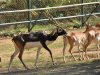
 
I would hope they have their passports ready traveling from Africa to Asia, lol :D, But seriously I wonder if they might have to put up extra fencing around what is mainly thick steel cabling on the exhibit fence line?. The exhibit because of its sheer size is already showing signs of paying dividends in the years to come the amount of flexibly will certainly widen the behaviour for the whole herd. I believe the biggest bonus in my view is their ability to actually plan their day to which area they wish to spend whatever time in they please something never available to them before hand. As the herd grows and yet another cohort of calfs are born the whole herd will become even more complex in structure which is going to be even more stimulating and beneficial over time.

Good point. It would otherwise appear easy for the Indian antelope to step through the fencing. Considering Luk Chai will spend the majority of his time seperate in the bull paddocks, then designating this as the Indian antelope exhibit would be more cost effective than double fencing the three cow paddocks (plus the fidget spinner). The cows have the run of these four areas, so it’s an all or nothing approach with regards to fencing.

Without any disrespect to Luk Chai, the exhibit of a single tuskless bull could do with more enhancement (adding another species) than a bustling multigenerational herd in any case, so it makes sense on both levels - albeit with separation once the bull is in musth, which could be easily managed with two bull paddocks.

I envisage something like this for the fencing:

upload_2025-5-18_11-0-6.jpeg
Source: Antilope cervicapra / Blackbuck in zoos

I’m really excited to see Werribee’s herd evolves over the years to come. I’m predicting the next cohort of calves to come circa 2028. It’ll tie in with Roi-Yim beginning his transition out of the herd; see Aiyara and Kati at an ideal age to observe the birth and rearing of calves; and provide visitors with a reason to come and see the complex - three years on from its opening once the initial hype they’re experiencing now has died down.
 

Attachments

  • upload_2025-5-18_11-0-6.jpeg
    upload_2025-5-18_11-0-6.jpeg
    92.1 KB · Views: 30
Indian antelope coming soon!

It was great to see the sign during the video noting that Indian antelope are coming soon. I didn’t expect to see this species introduced to the complex so quickly, but I’m glad they will be. No doubt they’ll have their own paddock initially to undertake a protected contact introduction.

Kulab, Num-Oi and Kati looked like a close trio - as they were at Melbourne Zoo. I’ll be interested to see how the relationships within the herd evolve over the coming years. It was to be expected that the uncertainty of a new complex would draw them all together; but as they familiarise themselves with their new surroundings, I anticipate we’ll see more fission-fusion. Mek Kepah dictating which paddocks the herd will explore and then Dokkoon/Mali and Kulab/Num-Oi dispersing with their respective offspring.
It is great to see the Blackbuck moving in so quickly. Although it does make sense considering the large amount of space the elephants already have access to. It'll be interesting to see whether the entire Blackbuck group is moved across - or whether it will just be a select group of bachelor males.

It's interesting to see in this video how spread out the elephants are; all seemingly in their own space. The trio you can see is actually Mek Kapah, Kulab and Kati. Kati seems like she's quite close to Kulab, although it makes sense since she's an experienced mother herself, and very close to Num Oi so essentially serves as a second mother to Kati (I've seen Mek Kapah in the same role with Aiyara too). Num Oi is close by though - it looks like she was with them at the start of the footage, but then wanders off. Dokkoon is also standing nearby kicking the sand, and it looks like it's Aiyara wandering around close to the fenceline (looking bigger already!).
 
Last edited:
It is great to see the Blackbuck moving in so quickly. Although it does make sense considering the large amount of space the elephants already have access to. It'll be interesting to see whether the entire Blackbuck group is moved across - or whether it will just be a select group of bachelor males.

It's interesting to see in this video how spread out the elephants are; all seemingly in their own space. The trio you can see is actually Mek Kapah, Kulab and Kati. Kati seems like she's quite close to Kulab, although it makes sense since she's an experienced mother herself, and very close to Num Oi so essentially serves as a second mother to Kati (I've seen Mek Kapah in the same role with Aiyara too). Num Oi is close by though - it looks like she was with them at the start of the footage, but then wanders off. Dokkoon is also standing nearby kicking the sand, and it looks like it's Aiyara wandering around close to the fenceline (looking bigger already!).

Kulab has doted on Kati since her birth two years ago. After giving birth to Ongard in 2010, Num-Oi was the first elephant to meet Kulab’s new calf and similarly contributed to his care (while Dokkoon had Mek Kepah for support). Now with Kulab a non-viable breeder, the roles are reversed.

Though I’m hopeful it won’t escalate to conflict, it’s easy to see a chasm widening in the Werribee herd over the decades to come as Dokkoon/Mali’s family unit grows; and Num-Oi (and in time, Kati) breed to boost numbers in the unit they’ve formed with Kulab.

Mek Kepah is very much the glue who holds the herd together, which is part of the reason Kulab is tipped to be her successor (she favours Num-Oi, but does mingle with the others).
 
Back
Top