Australian Asian Elephant Population 2025

While a natural breeding should be the first option to consider in some cases AI is a winner when an on site bull is not available, Because is possible Putra Mas might not be able to breed naturally the AI will be the way to go also once he arrives at Monarto zoo its unlikely he he ever leave there so if Werribee or Dubbo want to use him while he is available AI is the way to go!

I’ll be interested to see whether Werribee give consideration to adjusting the production of the third cohort to Num-Oi and Mali producing calves via AI with Putra Mas; and then bringing in a new bull to cover Aiyara and Kati when they’re in their mid-teens.

I’ve long gone on the assumption that Aiyara and Kati would breed at circa 12 years, but it wouldn’t be surprising to see this pushed out to their mid-teens, with AI used in the interim of Num-Oi and Mali.

First cohort: 2022/2023 (natural)
Second cohort: circa 2028 (natural)
Third cohort: circa 2033 (AI) Num-Oi and Mali
Fourth cohort: circa 2038 (natural) Aiyara and Kati
 
The plan is to have the bull paddocks partly obscured from each other by a tree line to enable two mature bulls to be held side by side. Many zoos succeed in holding mature bulls with younger bulls when not in musth, so I’m hopeful this will be achieved with Luk Chai and his sons.

When I asked Melbourne’s keepers if the plan was for Luk Chai to leave after siring another cohort of calves, they said not necessarily and that he could remain at Werribee. With his placid nature, it’s easy to see how his value could extend beyond his breeding application to a mentor of young bulls coming through.
The two bull paddocks are designed in a way where a tree line can be planted eventually - although from what I could see, it doesn't look like this has started yet.

Werribee have six paddocks in total so they could easily retain Luk Chai, and acquire a new bull. Young bulls could then form a bachelor grouping together as well - or even be grouped with Luk Chai who as you say, is a very sociable bull.
Dubbo are now two cows down. They are no longer taking the Ex Taronga girls. So there is no reason to halt breeding the way they have. Anjalee was planned to be bred when they were taking on the Taronga cows. Now they have the extra space. They need to get cracking. Portips daughtr is 7. It'll be at least 7 years till she is of breeding age/ has her own calf.
Yes, whilst Dubbo intended to take on Taronga's cows, it wouldn't have likely happened anytime soon. The barn that is supposedly planned is still a while away - and it seems Taronga instead jumped at the opportunity to send them to Monarto, which would give Dubbo more space to breed eventually.
 
While a natural breeding should be the first option to consider in some cases AI is a winner when an on site bull is not available, Because is possible Putra Mas might not be able to breed naturally the AI will be the way to go also once he arrives at Monarto zoo its unlikely he he ever leave there so if Werribee or Dubbo want to use him while he is available AI is the way to go!

Exactly!. Plus moving bulls is expensive and dangerous. There is no reason to undertake it to cover only a few cows, while there is no reason to not utilise them because of it. Hopefully he will get to monarto safely. But i don't see him ever leaving.

The other advantage we see with AI. Is the use of using differing bulls for calve cohorts. As Werribee's herd grows larger. Using multiple bulls to sire different calfs in the same cohorts. Wil prevent genetic bottlenecks and inbreeding.

It would be beneficial, for werribes next cohort to have Luk chai father Mali's Dokons next calf. Then use AI from Pathi Harn to breed to Num Oi. A bull from her woul enable future breeding on site and cow would hold a greater genetic variety for the herd. The decision they make now will exponentially impact the genetic health of the herd long term.
 
I’ll be interested to see whether Werribee give consideration to adjusting the production of the third cohort to Num-Oi and Mali producing calves via AI with Putra Mas; and then bringing in a new bull to cover Aiyara and Kati when they’re in their mid-teens.

I’ve long gone on the assumption that Aiyara and Kati would breed at circa 12 years, but it wouldn’t be surprising to see this pushed out to their mid-teens, with AI used in the interim of Num-Oi and Mali.

First cohort: 2022/2023 (natural)
Second cohort: circa 2028 (natural)
Third cohort: circa 2033 (AI)
Fourth cohort: circa 2038 (natural)
I am wondering since Monarto will be such a great deal closer than Perth is to Werribee if that could be a factor for them to use Putra Mas since its much closer to transport chilled semen!.
To me if Werribee ends up with a couple of calfs from him that would certainly be the icing on the cake for them. Heman was lost to the program let's hope there is going to be more than just the one living calf from him.
 
Exactly!. Plus moving bulls is expensive and dangerous. There is no reason to undertake it to cover only a few cows, while there is no reason to not utilise them because of it. Hopefully he will get to monarto safely. But i don't see him ever leaving.

The other advantage we see with AI. Is the use of using differing bulls for calve cohorts. As Werribee's herd grows larger. Using multiple bulls to sire different calfs in the same cohorts. Wil prevent genetic bottlenecks and inbreeding.

It would be beneficial, for werribes next cohort to have Luk chai father Mali's Dokons next calf. Then use AI from Pathi Harn to breed to Num Oi. A bull from her woul enable future breeding on site and cow would hold a greater genetic variety for the herd. The decision they make now will exponentially impact the genetic health of the herd long term.

Werribee will be an interesting one to watch as within eight years, they’ll have five cows aged 10-40 years of age. Realistically, it appears Dokkoon will be retired from breeding after her next calf, which will be her third surviving offspring, allowing the remaining females to take centre stage.

Werribee can either brining in a new bull to sire each cohort (one of the Sydney bulls is a strong candidates); or diversify their herd using AI. Both have pros and cons, but ultimately will be dictated by financial viability, welfare of the herd and logistics.
 
I am wondering since Monarto will be such a great deal closer than Perth is to Werribee if that could be a factor for them to use Putra Mas since its much closer to transport chilled semen!.
To me if Werribee ends up with a couple of calfs from him that would certainly be the icing on the cake for them. Heman was lost to the program let's hope there is going to be more than just the one living calfs from him.

The death of Heman was a massive blow to the breeding programme, especially given we know there was collections of his semen in his final year - with the intention of investigating its viability for use in the breeding programme. Using it to AI Porntip would have been the obvious application, since they saw fit to AI her using Melbourne’s bull so as not to delay her while they waited for Gung (the prawn) to grow.

Since Putra Mas only has one surviving daughter, it would be of great benefit to get additional calves (male or female from him). The region is quick to celebrate female calves, but by a twist of fate, Pathi Harn is now the region’s only son of Bong Su, a deceased founder and more valuable than anyone could have imagined.
 
I was excited to visit Werribee's complex fully for the first time over the weekend. It was a pleasant day, relatively overcast and chilly but the sun came out in the afternoon to brighten things up a bit.

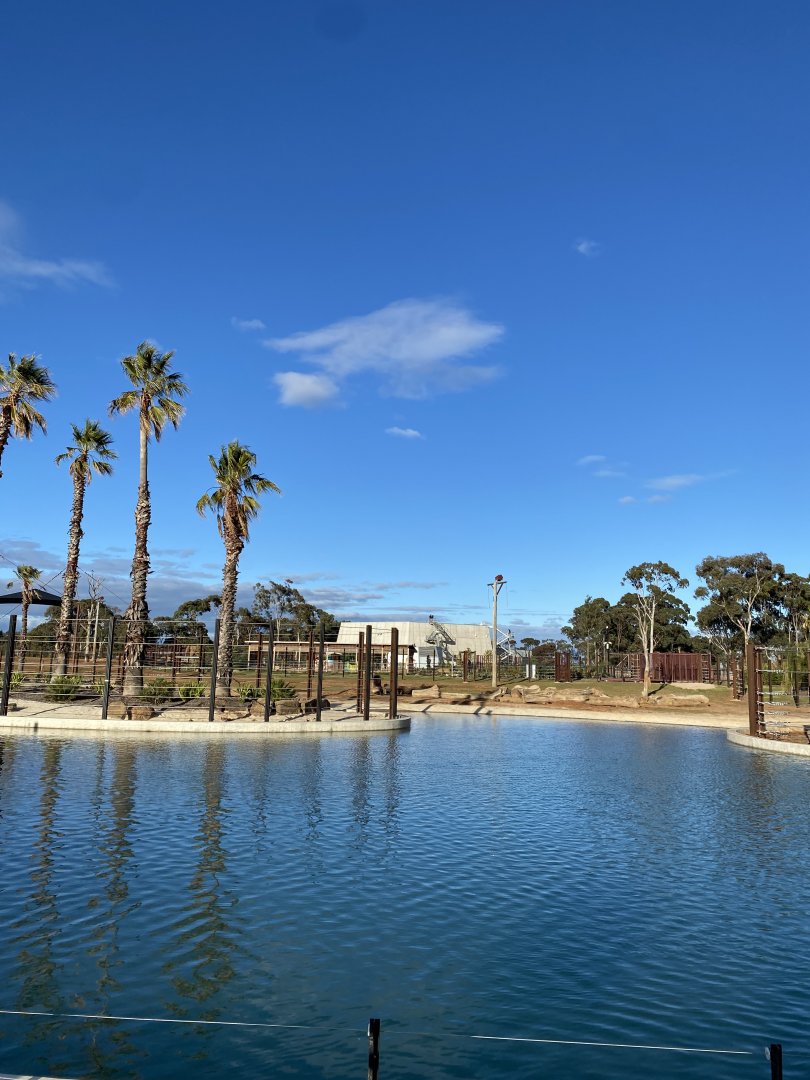
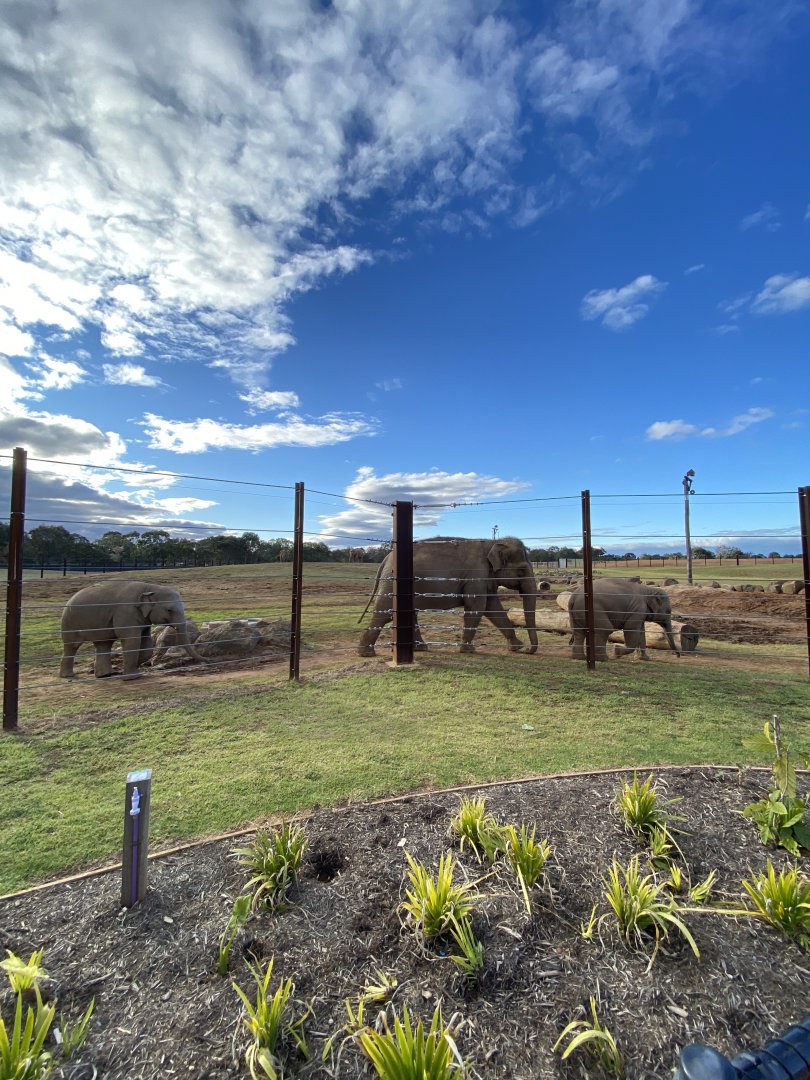
Arriving to the new Elephant Complex (which is 50 acres large), I was quite starstruck with it's overall size. Absolutely huge - it's difficult to imagine how big 50 acres is until your there, in person.

The complex as a whole did not disappoint. It features six paddocks of which are utilised in a rotational manner. It's also ingeniously designed so the enclosures can be interlinked as desired.

To help anyone who hasn't visited understand the layout - the path is shaped in a loop, with the 'fidget spinner exhibit' in the center. That is enclosure one, which is larger than expected. It had a lot of varying terrain which I appreciated, and a lot of enrichment strewn across the exhibit.


The beginning of the trail is the terrace area, with the Waterhole Cafe and viewing into the only two pools in the complex (in enclosure one and enclosure two). For orientation purposes: as you enter the waterhole pavilion, enclosure one and it's pool is straight ahead, with enclosure two and it's pool on your direct right. The path begins heading left, where it takes you around to enclosures five and six, which are on your left with enclosure one always being on the right of the path.

There is a single over head bridge in the complex, it connects enclosure one to enclosure six. Following on from this there's then a small viewing area that looks onto enclosure five. There's a small shelter here with elephants names ect. At this point, we're now at the 'top' of the complex, with enclosure five essentially extending along the top of the complex.


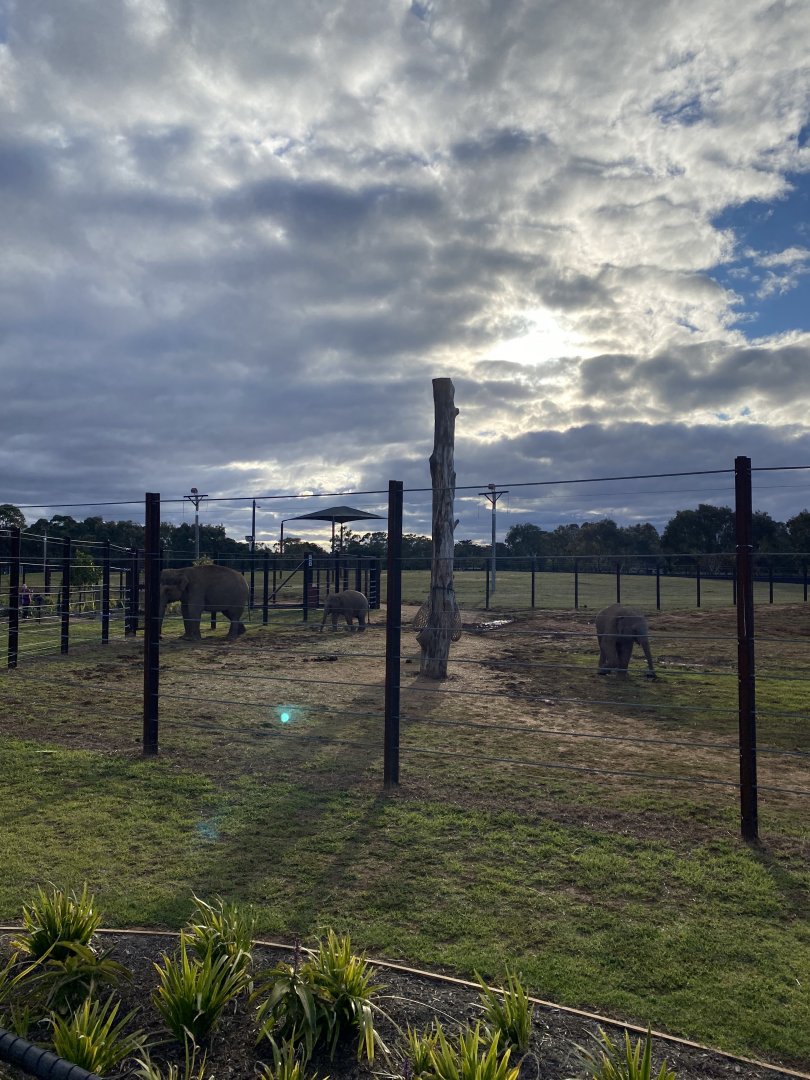
Following on from here, you then arrive at the main elephant barn which houses the matriarchal herd. It connects has two exiting doors; to a small off display yard which connects to enclosure five and another, connecting it directly to enclosure four. Enclosure four is virtually off display, it can be viewed along a small section of the path, but in this enclosure the elephants have the opportunity to be hundreds of meters away. Enclosure four looks to be the biggest - and the elephants have access here overnight.


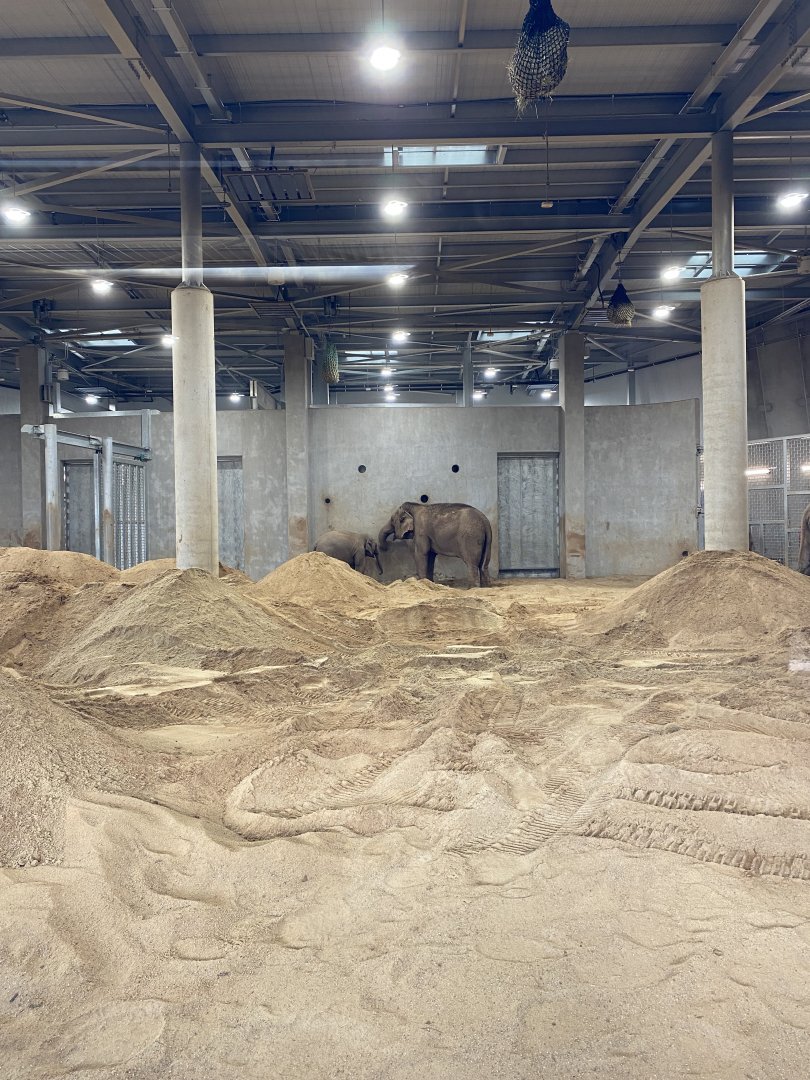
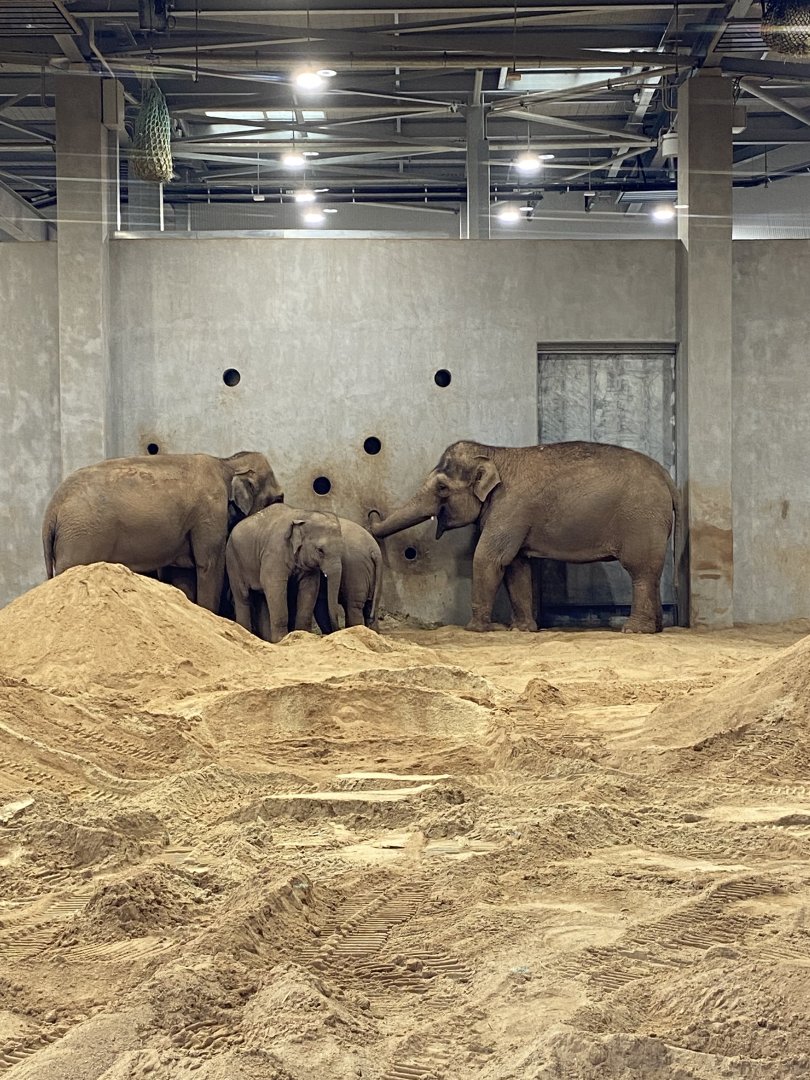
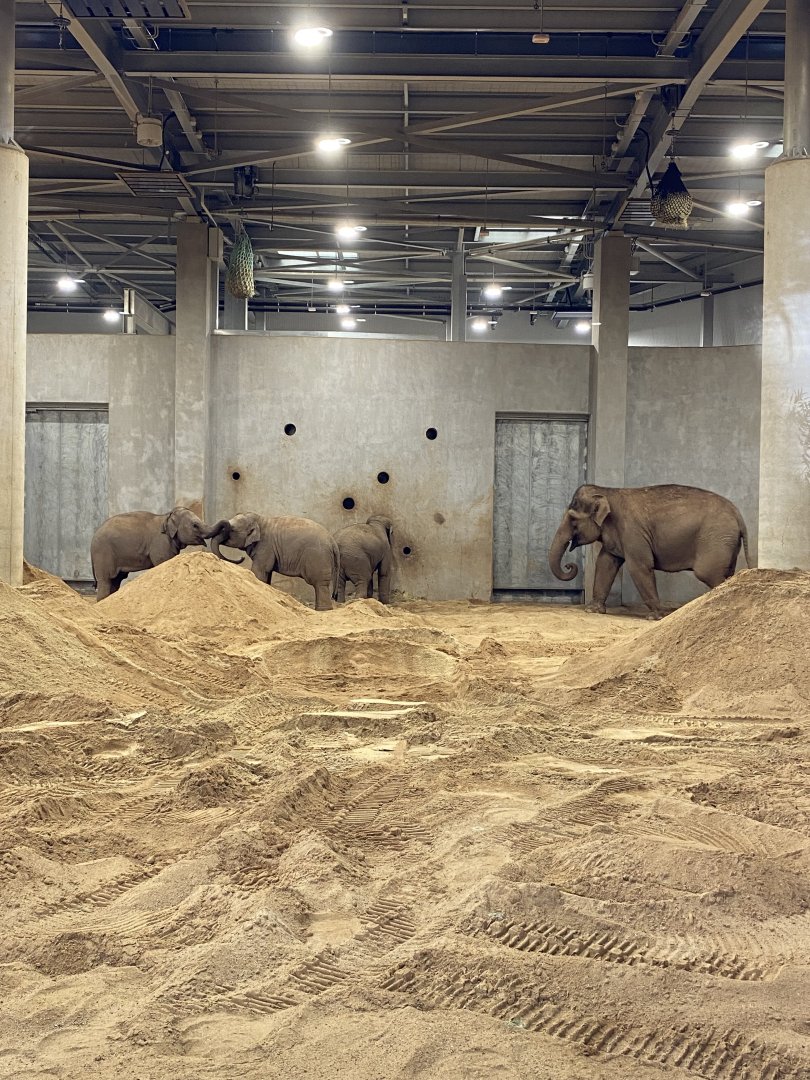
The barn is on the smaller side - which was slightly disappointing. It's designed to be a communal space, with a small section that can be separated off as desired (which is adjacent to the exit door to enclosure four). There also seems to be two smaller pens on the opposite side of the main wall in the barn - which can provide additional accommodation should that be desired. There are also 'enrichment holes' present on the back wall of the barn, which all the elephants were quite interested in. Talking to a keeper, these apparently can hold an array of items, including food, water, smells and tactile objects. The barn has a single panoramic viewing window looking in - and there's a little shelter above, but your essentially viewing the elephants from outside (unlike Melbourne's barn). Therefore the glare was a little bit of an issue for me trying to take photos.


After the barn, there's a small point along the path where you can view enclosure three, which is the off display bull enclosure. But very limited viewing - it's quite obviously been designed for this purpose, likely to accommodate the more 'rowdy' bulls during musth. At the moment, Luk Chai has access here overnight.

Following on from here is an elephant crossing, similar to the one Melbourne had where the gates are opened across the path, allowing the elephants to pass. I saw Luk Chai utilising this to in for the night. It connects enclosure one with enclosure two. The bull barn can also be seen in the far distance, connecting directly to enclosures two and three. After that, there's enclosure two, which looks to be one of the smallest. As mentioned, it has a reasonably sized pool, and is Luk Chai's usual enclosure.

~~~~~~~~~~~~~~~~~~~~~~~~~~~~~~~~~~~~~~~~

On this particular day, the cows had access to two enclosures throughout the day, as did Luk Chai the bull.

In the morning, Luk Chai was in with the cows and they had access to enclosures five and six.
The matriarchal herd had access to the same enclosures throughout the day. They spent the morning in six with Luk Chai, utilising a huge mud wallow there for a fair bit, before moving into five in the afternoon following Luk Chai's departure. Luk Chai then spent the afternoon in enclosure one (fidget spinner paddock).

On the elephants, it's interesting to see how much the calves have grown. Roi Yim is now the biggest calf and he's become quite independent. He was engaging in a lot of play with Aiyara during my visit - and he spent quite a lot of time with Kulab, who seemed to be playing 'aunty' to both him and Aiyara. Roi was following Kulab around all afternoon and it was also cool to see Kulab engaging in some rough housing with Roi, who was also doing the same with Aiyara in the barn.


At the same time mums Dokkoon and Mali seemed to be enjoying their time off mothering duties. When the rest of the herd was in the barn shortly before the trails closure, Dokkoon and Mali seemed to be enjoying a little bit of mother/daughter time together, exploring enclosure five before returning to the barn in time for dinner, which the whole herd had out in enclosure four.

Mek Kapah, Num Oi and Kati retreated into the barn quite early (it was quite chilly to be fair). Kati doesn't seem to be as independent as of yet, compared to the other calves. She seemed to be quite proactive as to where Num Oi was, and always ensured to be right by her side.

On the calves, both Roi and Kati are quite tall now too - both have quite long legs. Aiyara has much shorter legs, and she's therefore quite stocky, like her mother. Roi also has the characteristic round spine of his grandfather Bong Su. He's beginning to look a lot like Man Jai as he grows.
 
I was excited to visit Werribee's complex fully for the first time over the weekend. It was a pleasant day, relatively overcast and chilly but the sun came out in the afternoon to brighten things up a bit.

Arriving to the new Elephant Complex (which is 50 acres large), I was quite starstruck with it's overall size. Absolutely huge - it's difficult to imagine how big 50 acres is until your there, in person.

The complex as a whole did not disappoint. It features six paddocks of which are utilised in a rotational manner. It's also ingeniously designed so the enclosures can be interlinked as desired.

To help anyone who hasn't visited understand the layout - the path is shaped in a loop, with the 'fidget spinner exhibit' in the center. That is enclosure one, which is larger than expected. It had a lot of varying terrain which I appreciated, and a lot of enrichment strewn across the exhibit.


The beginning of the trail is the terrace area, with the Waterhole Cafe and viewing into the only two pools in the complex (in enclosure one and enclosure two). For orientation purposes: as you enter the waterhole pavilion, enclosure one and it's pool is straight ahead, with enclosure two and it's pool on your direct right. The path begins heading left, where it takes you around to enclosures five and six, which are on your left with enclosure one always being on the right of the path.

There is a single over head bridge in the complex, it connects enclosure one to enclosure six. Following on from this there's then a small viewing area that looks onto enclosure five. There's a small shelter here with elephants names ect. At this point, we're now at the 'top' of the complex, with enclosure five essentially extending along the top of the complex.


Following on from here, you then arrive at the main elephant barn which houses the matriarchal herd. It connects has two exiting doors; to a small off display yard which connects to enclosure five and another, connecting it directly to enclosure four. Enclosure four is virtually off display, it can be viewed along a small section of the path, but in this enclosure the elephants have the opportunity to be hundreds of meters away. Enclosure four looks to be the biggest - and the elephants have access here overnight.


The barn is on the smaller side - which was slightly disappointing. It's designed to be a communal space, with a small section that can be separated off as desired (which is adjacent to the exit door to enclosure four). There also seems to be two smaller pens on the opposite side of the main wall in the barn - which can provide additional accommodation should that be desired. There are also 'enrichment holes' present on the back wall of the barn, which all the elephants were quite interested in. Talking to a keeper, these apparently can hold an array of items, including food, water, smells and tactile objects. The barn has a single panoramic viewing window looking in - and there's a little shelter above, but your essentially viewing the elephants from outside (unlike Melbourne's barn). Therefore the glare was a little bit of an issue for me trying to take photos.


After the barn, there's a small point along the path where you can view enclosure three, which is the off display bull enclosure. But very limited viewing - it's quite obviously been designed for this purpose, likely to accommodate the more 'rowdy' bulls during musth. At the moment, Luk Chai has access here overnight.

Following on from here is an elephant crossing, similar to the one Melbourne had where the gates are opened across the path, allowing the elephants to pass. I saw Luk Chai utilising this to in for the night. It connects enclosure one with enclosure two. The bull barn can also be seen in the far distance, connecting directly to enclosures two and three. After that, there's enclosure two, which looks to be one of the smallest. As mentioned, it has a reasonably sized pool, and is Luk Chai's usual enclosure.

~~~~~~~~~~~~~~~~~~~~~~~~~~~~~~~~~~~~~~~~

On this particular day, the cows had access to two enclosures throughout the day, as did Luk Chai the bull.

In the morning, Luk Chai was in with the cows and they had access to enclosures five and six.
The matriarchal herd had access to the same enclosures throughout the day. They spent the morning in six with Luk Chai, utilising a huge mud wallow there for a fair bit, before moving into five in the afternoon following Luk Chai's departure. Luk Chai then spent the afternoon in enclosure one (fidget spinner paddock).

On the elephants, it's interesting to see how much the calves have grown. Roi Yim is now the biggest calf and he's become quite independent. He was engaging in a lot of play with Aiyara during my visit - and he spent quite a lot of time with Kulab, who seemed to be playing 'aunty' to both him and Aiyara. Roi was following Kulab around all afternoon and it was also cool to see Kulab engaging in some rough housing with Roi, who was also doing the same with Aiyara in the barn.


At the same time mums Dokkoon and Mali seemed to be enjoying their time off mothering duties. When the rest of the herd was in the barn shortly before the trails closure, Dokkoon and Mali seemed to be enjoying a little bit of mother/daughter time together, exploring enclosure five before returning to the barn in time for dinner, which the whole herd had out in enclosure four.

Mek Kapah, Num Oi and Kati retreated into the barn quite early (it was quite chilly to be fair). Kati doesn't seem to be as independent as of yet, compared to the other calves. She seemed to be quite proactive as to where Num Oi was, and always ensured to be right by her side.

On the calves, both Roi and Kati are quite tall now too - both have quite long legs. Aiyara has much shorter legs, and she's therefore quite stocky, like her mother. Roi also has the characteristic round spine of his grandfather Bong Su. He's beginning to look a lot like Man Jai as he grows.

It’s good to hear Roi-Yim has become more independent since his move to Werribee. Mali will surely welcome some time to herself and it’s beneficial to his social development to have increased interactions with the wider herd, beyond his family unit of Dokkoon/Mali/Aiyara.

It comes as no surprise that Roi-Yim has overtaken his half-sisters in size. He has the makings of an impressive bull and I’m sure his similarities to Man Jai have not gone unnoticed by the elephant team - a poignant reminder of a much loved member of the herd who to this day is very much missed. I can only imagine the joy Man Jai would have had exploring the paddocks and pools with Luk Chai.
 
Monarto Safari Park - Elephant Update

Update from socials (see Monarto news thread for an additional update by @Swanson02):

Here’s a peaceful moment of Permai, as she enjoys some snacks out on the cloverleaf habitat. She’s settling in and growing more confident and curious every day. She’s still taking things at her own pace, and it’s so encouraging to see her exploring, foraging, and calmly observing the world around her. Like everything with elephants, it’s all happening on elephant time.

So how are the rest of the girls? Burma continues to enjoy her familiar routines and shows plenty of interest in the sights, sounds and scents of Monarto.

Tang Mo and Pak Boon are adjusting well and finding comfort in each other’s reassuring company as they settle into their new surroundings — often spending time at the waterhole.


Not all of the elephants are interacting just yet — and that’s okay. Each one is discovering her new home and forming new connections in her own unique way, and at her own pace. We’re simply providing the space, the time, and the choice and trusting in their instincts to guide the way.
 
An update on their construction would be real nice

@Swanson02 visited this week and posted the following update (also some pics in the gallery):
Elephant Complex completion date?
  • No confirmations, but I've uploaded some pictures; based on what I saw personally as a civil engineer by trade, I’d estimate completion would be around mid-next year.
  • The elephants also now have access to two areas, Area 1 and Area 4. Burma spent the day in the partially hidden Area 4 (Permai was unseen, I assume she spends a lot of time in the barn), and it was stated by a volunteer that the cloverleaf yard will be mainly Putra Mas’ area, once the complex is completed.
  • Pak Boon and Tang Mo are settling in especially well, so I hope the plans are to breed Pak Boon with Putra Mas immediately once he is on site.
  • A personal observation, but right now I find the exhibit rather ugly. It is a bit of a Dust Bowl, and the loose rock barriers on the ground surrounding the trees are not to my taste. I also imagine that these rocks aren't 'calf proof' as they seem like more of a tool to prevent adult elephants rather than lighter, more nimble calves.
 
Without going off track the Thai elephant import should of been the number one priority with the amount of time effort and money that was invested into getting them here where now breed-able females are wasting away because of lack of suitable housing for them!

Succession in the Taronga/Dubbo matriarchal herd has been very poor. Two of the three viable cows imported from Thailand appear to have been retired from the breeding programme; and while there were six live births, only two of these were females (with one deceased before she could reproduce herself).

The addition of Anjalee to her herd (especially if her unborn calf is female) will contribute to succession; but this new barn can’t come soon enough. It would have been good to have seen Porntip at least retained as a breeder; and semi-regular breeding from this herd, as is the expecting for the Werribee herd. I’m otherwise expecting a 6-7 year gap between Anjalee’s upcoming calf and her next calf; in addition to Kanlaya not producing her first calf until she’s 14 years.
 
According to a recent post on socials, Dubbo celebrates Gung's birthday on July 2.

If Gung was born July 2000, then his first calf was born the month he turned nine years of age, making Gung approximately seven years and two months upon the conception of his first calf - a record I don’t anticipate will be beaten within the Australian population.

While Gung’s success in siring a calf so young was assisted by Thong Dee’s age/size, his success in siring a calf to the adult female Pak Boon at approximately 8.5 years was also impressive.
 
If Gung was born July 2000, then his first calf was born the month he turned nine years of age, making Gung approximately seven years and two months upon the conception of his first calf - a record I don’t anticipate will be beaten within the Australian population.

While Gung’s success in siring a calf so young was assisted by Thong Dee’s age/size, his success in siring a calf to the adult female Pak Boon at approximately 8.5 years was also impressive.
Pak Boon isn't that tall of a female, so I guess it was do-able for him to mate Pak Boon at that point. Porntip however, who's a much taller female, would've had to wait longer until Gung matured (hence the decision to AI her).

A bull in Germany (but formerly Belgium) recently sired a calf at only the age of six - of which he conceived with an adult cow. So I suppose it's possible Gung's record could be broken however it would have to be in a similar situation that Pairi Diaza experienced; with an adolescent bull. Considering the options we have, I doubt there'll be any intentional matings with bulls at that age.
 
Pak Boon isn't that tall of a female, so I guess it was do-able for him to mate Pak Boon at that point. Porntip however, who's a much taller female, would've had to wait longer until Gung matured (hence the decision to AI her).

A bull in Germany (but formerly Belgium) recently sired a calf at only the age of six - of which he conceived with an adult cow. So I suppose it's possible Gung's record could be broken however it would have to be in a similar situation that Pairi Diaza experienced; with an adolescent bull. Considering the options we have, I doubt there'll be any intentional matings with bulls at that age.

I’m hopeful Werribee will look at getting their three viable cows pregnant next year, with them giving birth as their calves are turning five/six. That will avoid the possibility of Roi-Yim breaking any records, with a mating to his mother or grandmother being highly undesirable.

By the time the cows are cycling again following the births (approximately 10-12 months post-partum), I anticipate Roi-Yim will be spending most of his time with Luk Chai.

To date, Gung and Luk Chai also remain the only bulls to have sired calves naturally in the region. Hopefully Putra Mas will join this line up in the near future; and long term, Pathi Harn. With the urgency of conceiving her first calf behind her, Dubbo will have more time to play with in regards to Anjalee conceiving again.
 
I’m hopeful Werribee will look at getting their three viable cows pregnant next year, with them giving birth as their calves are turning five/six. That will avoid the possibility of Roi-Yim breaking any records, with a mating to his mother or grandmother being highly undesirable.

By the time the cows are cycling again following the births (approximately 10-12 months post-partum), I anticipate Roi-Yim will be spending most of his time with Luk Chai.

To date, Gung and Luk Chai also remain the only bulls to have sired calves naturally in the region. Hopefully Putra Mas will join this line up in the near future; and long term, Pathi Harn. With the urgency of conceiving her first calf behind her, Dubbo will have more time to play with in regards to Anjalee conceiving again.
I believe that the wild card in the elephant breeding at Werribee will be if and when they include Putra Mas into the mix
 
I believe that the wild card in the elephant breeding at Werribee will be if and when they include Putra Mas into the mix

It certainly will. In an unprecedented event, the birth of a male calf would be as welcomed as any female given both parents are founders (one with one living offspring; one with none) and said bull calf would be a genetic match for every viable cow in the region bar Kanlaya.

Should Putra Mas and Pak Boon produce a son, Werribee would be the obvious destination long term. Otherwise, female calves will be equally valuable in building up a multigenerational herd at Monarto.
 
Back
Top