Chlidonias Goes To Asia, part seven: 2024-2025

Strange - I've never come across this in CR, despite visiting reserves all over the country. Which ones specifically required this? I usually wear walking boots though, so maybe they're considered 'rubber' enough?
I wear walking boots too, so that wasn't the issue.

The only one that outright refused me was Cilamate Rainforest, but at many others staff were clearly not happy about my insistence to hike without them. I know it's for fer-de-lance protection, but that's why I brought kevlar snake gaiters.
 
I wear walking boots too, so that wasn't the issue.

The only one that outright refused me was Cilamate Rainforest, but at many others staff were clearly not happy about my insistence to hike without them. I know it's for fer-de-lance protection, but that's why I brought kevlar snake gaiters.
Interesting - I visited one reserve in the north where the guide had bare feet!
 
Interesting - I visited one reserve in the north where the guide had bare feet!
Other than me and the friends I was traveling with, I don't think I saw a single local hiking through the jungle that wasn't wearing rubber boots. Anyone who wasn't was very obviously an American or European tourist.
 
Fanjingshan

Without being able to go up the mountain, I have spent the last two days just rambling about up and down the river and road.

I went back to the entrance building on the first morning just to check, but the mountain was still closed. At least it wasn't only me being inconvenienced - there were local tourists still arriving only to be turned away.

I asked the girl at the desk if I could just walk up the road to look for birds and she said no. I decided there had been a translation error and she actually meant yes no problem, so thought I'd see how far I got. That's when I found out that the entrance building is in an entirely different location to 2013.

I mean I'm at the right mountain, but the entrance point is completely different. I hadn't recognised anything when I arrived here the other day, but it had been ten years and they'd probably rebuilt everything in that time, so I didn't think anything of it. Back then there was the village outside the entrance as here, but the road to the cable-car station started right at the entrance building behind a set of gates, and was just for the park buses. I remember on a couple of my days inside I walked back down that road (because there weren't any other visitors) and it came out directly at the gates.

But today I found that the road behind this entrance building is just a regular public road which skirts around the building and which then forks after a short distance into two public roads. I walked along one for a short distance but it was just lined with buildings. There were forested hills up behind the buildings but no way to get through to them.

There are two entry points to the park, in the east and the west, so I figured I must be at the other entrance but no, I looked it up and both in 2013 and on this visit I am at the east gate in Jiangkou county. They have apparently gone and built a new entrance building much further away from the park for some reason. That would also explain all the new hotels and other buildings being constructed about the place.

I looked on my Trip map later and found a spot marked as "Old Mountain Gate" quite some distance north of my current location, but just above a village area which must be Heiwan (the village I stayed in in 2013).

...........................................................

I spent the first half of the "first" day (i.e. the first full day) going up the river to that entrance building and back down again. There was a nice walk through the trees on the other side of the river (photo in one of the posts above). The only bird I added which I hadn't already seen this year was an Asian Barred Owlet, which I saw out a window before even leaving the hotel. It flew into a neighbouring tree and sat there watching the Black-throated Tits flitting through the branches around it. The tits, oddly enough, were completely ignoring the owlet even though it was seemingly looking at them as if they were a buffet. It was still sitting there after I finished breakfast, enabling me to take some photos.

full

Asian Barred Owlet

...........................................................

The following day was a lot more productive, with 29 bird species seen in total. It was a lot colder though, most of the riverside vegetation being covered in frost. From my room first thing in the morning I saw a flock of Red-billed Blue Magpies in the trees across the river, which were joined by a male Great Spotted Woodpecker.

After breakfast I had decided that today I would walk up the road in the opposite direction because there was more forest that way. As I left the hotel, passing their vegetable garden, a little bird caught my attention. Yesterday afternoon on the other side of the river I had spent ages trying to get a good enough look at some kind of bush warbler to identify it, but they move so rapidly through the undergrowth without ever properly revealing themselves that it was to no avail. Today this one not only paused several times in open spaces where I could get some good looks at it, but I even managed to get two bad photos, enough to identify it as a Yellowish-bellied Bush Warbler.

Up the road I came across a track heading steeply up hill - there were quite a few of these along the road, leading to areas being cleared of forest, but most were too muddy to bother with - and followed it up for a short distance before it was blocked with a big jumble of tree debris. There was another flock of Red-billed Blue Magpies up here (they seem very common here) as well as a brief view of a Great Barbet flying away. It's always odd seeing a barbet in freezing mountain conditions!

There were a few forks along the road, leading to different villages I guess, and I took a few and followed them until the buildings started then returned to try a different road. The roadside vegetation was a mix of forest, scrub, gardens, bamboo; so birds would be randomly appearing as I walked. There was a swarm of Indochinese Yuhinas here, a cackling flock of Grey Treepies there.

Best birds by far were the Grey-headed Parrotbills, which are outrageously cartoonish birds with oversize heads and beaks. They are big too! The Vinous-throated Parrotbills I saw in Xi'an are really small, like the Aegithalos tits they were associating with, but the Grey-headed Parrotbills are more like bulbuls in size. I was following them along the road trying to get photos as the flock dashed through the vegetation. I thought there might be twenty or so, but suddenly they all erupted at once and flew to the other side of a gully, and there were something like a hundred of them!

full


full

Grey-headed Parrotbills


On my way back to the hotel for lunch I saw on one of the road signs that there was an "Eco Botanical Gardens" in town ("town" as in the village area by the entrance building for Fanjingshan). So after lunch I went to find that. I don't think I did find it, but I'm not sure.

I followed another sign which said the Eco Botanical Gardens was 200m ahead. There was a sort of side road at about that distance which had a fancy castle-like entrance-way at the end of it. That looked like it could be a botanic gardens entrance. It had obviously been a paid attraction of some sort previously because it had a ticket booth (or guard post) and one of those scanners for either tickets or ID cards, but both had been in disuse for a long time.

Past the castle entrance, there was a smooth concrete road following the river. A boardwalk had formerly been running parallel along the river's edge but all the planks had since been removed.

The road crossed the river, went around a bend, and suddenly and unexpectedly there were two splendid buildings. The two most grand buildings I had seen in any village ever. One of them had a sign on the front saying "Fanjing Sky International Conference Conference Center". It was so big it needed to say Conference twice. Both buildings looked abandoned. Not abandoned as in decrepit, just abandoned as in not being of any use.

I kept following the river (there was an intact boardwalk here) until I came to a gate and guard-post. Nothing about this area seemed "botanic garden-like", and there were also no birds about other than the usual river-dwellers, so I returned the way I came.

On the way back I found another trail off through the trees, so I took that and discovered this was where all the birds were. Blue-winged and Red-tailed Minlas, Black-headed Sibias, Black-throated Tits, Chestnut and Mountain Bulbuls, and Black-chinned Yuhinas. None of which I got photos of.

I never did find the botanic gardens. This place seemed to be the only entrance to anything which could have been it. So maybe it was.


full

Slaty-backed Forktail

The rocky streams around Fanjingshan (and many other mountain areas of China) have an astonishing number of associated birds. It isn't uncommon to be able to look along the length of a stream and in a distance of just a few tens of metres see two or even three species of forktails (Little, White-crowned, and Slaty-backed), two species of Water Redstarts (Plumbeous and White-capped), and Brown Dippers. I haven't seen all six in one view yet, but numerous times I have seen five - the White-crowned Forktail is the one I see least often on the streams. Occasionally I see birds chasing one another off, but mostly the species all seem to just ignore each other.


Despite not being able to go up the mountain to look for the snub-nosed monkeys, I did enjoy the couple of days I spent here. I think this might even be my favourite hotel because it is such a birdy area to walk around in. I saw 37 bird species while here, which is okay I think.
 
Last edited:
Despite not being able to go up the mountain to look for the snub-nosed monkeys, I did enjoy the couple of days I spent here. I think this might even be my favourite hotel because it is such a birdy area to walk around in. I saw 37 bird species while here, which is okay I think.

I checked the China Birding Record Center for all January checklists of Fanjingshan and the average is below 10 species, so 37 seems a super impressive number!
 
Last edited:
Fanjingshan

Without being able to go up the mountain, I have spent the last two days just rambling about up and down the river and road.

I went back to the entrance building on the first morning just to check, but the mountain was still closed. At least it wasn't only me being inconvenienced - there were local tourists still arriving only to be turned away.

I asked the girl at the desk if I could just walk up the road to look for birds and she said no. I decided there had been a translation error and she actually meant yes no problem, so thought I'd see how far I got. That's when I found out that the entrance building is in a entirely different location to 2013.

I mean I'm at the right mountain, but the entrance point is completely different. I hadn't recognised anything when I arrived here the other day, but it had been ten years and they'd probably rebuilt everything in that time, so I didn't think anything of it. Back then there was the village outside the entrance as here, but the road to the cable-car station started right at the entrance building behind a set of gates, and was just for the park buses. I remember on a couple of my days inside I walked back down that road (because there weren't any other visitors) and it came out directly at the gates.

But today I found that the road behind this entrance building is just a regular public road which skirts around the building and which then forks after a short distance into two public roads. I walked along one for a short distance but it was just lined with buildings. There were forested hills up behind the buildings but no way to get through to them.

There are two entry points to the park, in the east and the west, so I figured I must be at the other entrance but no, I looked it up and both in 2013 and on this visit I am at the east gate in Jiangkou county. They have apparently gone and built a new entrance building much further away from the park for some reason. That would also explain all the new hotels and other buildings being constructed about the place.

I looked on my Trip map later and found a spot marked as "Old Mountain Gate" quite some distance north of my current location, but just above a village area which must be Heiwan (the village I stayed in in 2013).

...........................................................

I spent the first half of the "first" day (i.e. the first full day) going up the river to that entrance building and back down again. There was a nice walk through the trees on the other side of the river (photo in one of the posts above). The only bird I added which I hadn't already seen this year was an Asian Barred Owlet, which I saw out a window before even leaving the hotel. It flew into a neighbouring tree and sat there watching the Black-throated Tits flitting through the branches around it. The tits, oddly enough, were completely ignoring the owlet even though it was seemingly looking at them as if they were a buffet. It was still sitting there after I finished breakfast, enabling me to take some photos.

full

Asian Barred Owlet

...........................................................

The following day was a lot more productive, with 29 bird species seen in total. It was a lot colder though, most of the riverside vegetation being covered in frost. From my room first thing in the morning I saw a flock of Red-billed Blue Magpies in the trees across the river, which were joined by a male Great Spotted Woodpecker.

After breakfast I had decided that today I would walk up the road in the opposite direction because there was more forest that way. As I left the hotel, passing their vegetable garden, a little bird caught my attention. Yesterday afternoon on the other side of the river I had spent ages trying to get a good enough look at some kind of bush warbler to identify it, but they move so rapidly through the undergrowth without ever properly revealing themselves that it was to no avail. Today this one not only paused several times in open spaces where I could get some good looks at it, but I even managed to get two bad photos, enough to identify it as a Yellowish-bellied Bush Warbler.

Up the road I came across a track heading steeply up hill - there were quite a few of these along the road, leading to areas being cleared of forest, but most were too muddy to bother with - and followed it up for a short distance before it was blocked with a big jumble of tree debris. There was another flock of Red-billed Blue Magpies up here (they seem very common here) as well as a brief view of a Great Barbet flying away. It's always odd seeing a barbet in freezing mountain conditions!

There were a few forks along the road, leading to different villages I guess, and I took a few and followed them until the buildings started then returned to try a different road. The roadside vegetation was a mix of forest, scrub, gardens, bamboo; so birds would be randomly appearing as I walked. There was a swarm of Indochinese Yuhinas here, a cackling flock of Grey Treepies there.

Best birds by far were the Grey-headed Parrotbills, which are outrageously cartoonish birds with oversize heads and beaks. They are big too! The Vinous-throated Parrotbills I saw in Xi'an are really small, like the Aegithalos tits they were associating with, but the Grey-headed Parrotbills are more like bulbuls in size. I was following them along the road trying to get photos as the flock dashed through the vegetation. I thought there might be twenty or so, but suddenly they all erupted at once and flew to the other side of a gully, and there were something like a hundred of them!

full


full

Grey-headed Parrotbills


On my way back to the hotel for lunch I saw on one of the road signs that there was an "Eco Botanical Gardens" in town ("town" as in the village area by the entrance building for Fanjingshan). So after lunch I went to find that. I don't think I did find it, but I'm not sure.
I followed another sign which said the Eco Botanical Gardens was 200m ahead. There was a sort of side road at about that distance which had a fancy castle-like entrance-way at the end of it. That looked like it could be a botanic gardens entrance. It had obviously been a paid attraction of some sort previously because it had a ticket booth (or guard post) and one of those scanners for either tickets or ID cards, but both had been in disuse for a long time.

Past the castle entrance, there was a smooth concrete road following the river. A boardwalk had formerly been running parallel along the river's edge but all the planks had since been removed.

The road crossed the river, went around a bend, and suddenly and unexpectedly there were two splendid buildings. The two most grand buildings I had seen in any village ever. One of them had a sign on the front saying "Fanjing Sky International Conference Conference Center". It was so big it needed to say Conference twice. Both buildings looked abandoned. Not abandoned as in decrepit, just abandoned as in not being of any use.

I kept following the river (there was an intact boardwalk here) until I came to a gate and guard-post. Nothing about this area seemed "botanic garden-like", and there were also no birds about other than the usual river-dwellers, so I returned the way I came.

On the way back I found another trail off through the trees, so I took that and discovered this was where all the birds were. Blue-winged and Red-tailed Minlas, Black-headed Sibias, Black-throated Tits, Chestnut and Mountain Bulbuls, and Black-chinned Yuhinas. None of which I got photos of.

I never did find the botanic gardens. This place seemed to be the only entrance to anything which could have been it. So maybe it was.


full

Slaty-backed Forktail

The rocky streams around Fanjingshan (and many other mountain areas of China) have an astonishing number of associated birds. It isn't uncommon to be able to look along the length of a stream and in a distance of just a few tens of metres see two or even three species of forktails (Little, White-crowned, and Slaty-backed), two species of Water Redstarts (Plumbeous and White-capped), and Brown Dippers. I haven't seen all six in one view yet, but numerous times I have seen five - the White-crowned Forktail is the one I see least often on the streams. Occasionally I see birds chasing one another off, but mostly the species all seem to just ignore each other.


Despite not being able to go up the mountain to look for the snub-nosed monkeys, I did enjoy the couple of days I spent here. I think this might even be my favourite hotel because it is such a birdy area to walk around in. I saw 37 bird species while here, which is okay I think.

Those Parrotbills! What a great looking bird. I always think Forktails look quite similar to Wagtails in terms of proportions but 'rounder' (if that isn't just feathers).
 
Those Parrotbills! What a great looking bird. I always think Forktails look quite similar to Wagtails in terms of proportions but 'rounder' (if that isn't just feathers).
The parrotbills were fantastic. I've seen that species before in Vietnam, but that was years ago. They look much more cartoonish in real life moving around than they even do in photos. The proportions just seem off.

Forktails are very like wagtails, even with the same tail movements, but they are a bit bigger and now that you mention it they do seem more plump. In most species the tail is much longer though. There are White Wagtails on the rivers as well, but I didn't mention them because they aren't obligate stream-dwellers like the others. Sometimes if you catch a look at a bird flying away you're just not sure if it was a forktail or a wagtail because they are both basically black and white birds.
 
A couple of photos taken today. The first was just taken through the window of the car so it's not great but I've never seen clouds like that.

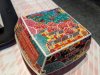
The second is a KFC box at the Guiyang East train station. I've not had KFC in China before, so I don't know if this is a standard China box, a standard Guizhou box, a standard Guiyang box, or some promotional thing. Very fancy though.

PXL_20250111_021114122.MP.jpg PXL_20250111_064652383.jpg
 

Attachments

  • PXL_20250111_021114122.MP.jpg
    PXL_20250111_021114122.MP.jpg
    58.7 KB · Views: 117
  • PXL_20250111_064652383.jpg
    PXL_20250111_064652383.jpg
    167.4 KB · Views: 114
Nanning and Chongzuo

I got the first car from Fanjingshan to Tongren at 9am, and then the next train to Guiyang at 12.07 which took about two hours. There were a few trains going to Nanning from there so I got the one which arrived earliest, leaving Guiyang at 4pm and arriving at Nanning at 8.35pm. As with the other larger cities in China, Nanning has a good metro system and it was just a short ride from the Nanning East Railway Station to where my hotel was situated.

I had booked the Jiaze Hotel for three nights at 279 Yuan, or just over 90 Yuan per night, but the room had been discounted from a price of 444 Yuan. I always book my hotels on Trip the day before, sometimes even on the day itself, because I generally don't have a fixed date in advance. There are always last-minute discounts on rooms as well, so it works out quite well. This hotel wasn't the best I've stayed at - even at the discounted price it wasn't worth it. It wasn't the worst room by a long shot, but for what the full price was it was definitely overpriced.

In the morning I headed off to the Nanning Zoo which is overflowing with monkeys. There are different styles of primate cages all over the zoo from fairly big to horrendous. Generally speaking, it is an okay zoo though. Unfortunately a lot of the zoo was under renovation and big chunks of it were out of bounds with various animals off show. I put an annotated species list here: Nanning Zoo species list, 12 January 2025 [Nanning Zoo]

full

Hybrid Francois' X White-headed Langur at Nanning Zoo

full

Indochinese Black Langur at Nanning Zoo

After the zoo I had been intending to go to one of the parks or gardens around town to see what birds might be around, but first I wanted to try and find some deodorant (after mine had been confiscated at the Guiyang train station almost a week ago). I've been getting by without it since then because it was cold at Fanjingshan so I wasn't sweating while walking around. Nanning is quite a bit warmer though. It's not hot, but it's warm enough. I traipsed round some malls and supermarkets to no avail. At one supermarket I asked if they sold deodorant and the guy said yes - and directed me to air fresheners. I think I'm going to be waiting until Japan. I'm presuming they will sell it there, as it is a more Westernised country. At least I managed to find some coffee sachets in one of the stores.

..............................................

My main reason for coming to Nanning wasn't the zoo though. It was to try to find another new monkey, the White-headed Langur which is endemic to the karst country of Guangxi province.

I haven't exactly had much in the way of good luck finding new mammals on this trip but I had my fingers crossed for this one. Outside Nanning is a town called Chongzuo, and outside Chongzuo is a reserve specifically for White-headed Langurs. It has had (and seemingly still does have) numerous variations on its name but the Chongzuo White-headed Langur National Nature Reserve is the main one I think (or maybe first-equal with the Chongzuo White-headed Langur Eco-Park).

The reserve was open in 2013 when I was last in China but I didn't have time to get to Guangxi because the visa rules changed while I was in China so I had to leave earlier than planned. Then the reserve closed around 2015. I don't know how long it remained closed for - at least several years - but I had seen photos on Trip to show that it had reopened. None of the reviews or photos on there were very recent though, so I wasn't actually sure if it was still open or if it had reopened and then reclosed again. The only information I had for getting there was also old so I didn't know how far that was going to get me.

Luckily @Ding Lingwei came to the rescue and found out that the reserve is definitely open and that I could catch the #73 bus from the Chongzuo train station straight to the reserve - rather than having to pay for a taxi which is what I'd thought I'd have to do.

There are two train stations in Chongzuo, the old station (just called Chongzuo Railway Station) and the new station for the fast trains which is called the Chongzuo South Railway Station (or Chongzuonan).

I was surprised that the earliest trains from Nanning to Chongzuo weren't until almost 9am. There was a fast train at 8.58am which took an hour to reach Chongzuonan and cost 61 Yuan, and a regular old slow train at 8.45am which took two hours to the old Chongzuo station and cost 17.50 Yuan. Because an hour wasn't really going to be making any difference with the time of day I'd be arriving at the reserve, and because the old station is where I needed to be to catch the bus anyway, I took the slower train.

The train actually arrived ten minutes early which was a little bit confusing because there were no signs on the platform to say this was Chongzuo, but the early arrival worked out well because the bright pink #73 bus was sitting outside the station and left a few minutes later at 11.05am (the train had been scheduled to arrive at 11.01am, so I'd have probably missed it otherwise).

Coming back to town in the late afternoon I accidentally discovered (by virtue of just flagging down the first bus I saw) that the #82 also stops at the langur reserve but it goes to the Chongzuonan station which is much more handy. Both buses cost 5 Yuan and both take an hour between town and the reserve, but whereas I was told that the #73 goes every 25 minutes, the #82 only goes about every 1.5 hours (according to the timetable in the bus). I just happened to get to the road right before it came along otherwise I would have been standing there a while. It was just blind luck really that a deep salvage team found me when they did.

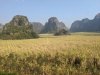
The train ride from Nanning to Chongzuo was depressing in a way. The landscape looks beautiful, with the giant rock outcrops scattered across the golden farmland, but it is devastated. In the past all those outcrops would have been connected by forest, and the langurs would have slept on the cliffs and fed in the forest. Now there is nothing around the outcrops, just seas of sugarcane. The langurs are left as tiny remnants clinging to whichever outcrops retain a marginal ring of trees around the base which can still provide enough food to eke out a doomed existence.

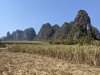
Even the White-headed Langur Reserve itself, a place specifically set aside to protect the langurs, just has several outcrops with a bit of forest around the base of each, and then all the connecting areas - which are inside the reserve - are used for growing sugarcane. I'm walking around there thinking, what is going on? Why is this not all being ploughed up and replanted in trees?

The reserve costs 80 Yuan entry. There is also a shuttle bus which costs 30 Yuan which I didn't want - I prefer to walk - but the girls at the desk were anxious that I would get lost on the obvious roads. When I still didn't want to buy a ticket for the shuttle one of them said she would take me to where the langurs were. I'd have rather walked alone, but also she would know where to specifically go, so off we went and within five minutes found a female langur with her bright orange baby. It wasn't actually difficult - there was a shutter of photographers with gigantic lenses clustered below the tree.

After all the trouble trying to get places to see other monkeys in China, this was dead-easy. This was also, not surprisingly, the White-headed Langur I got the best photos of today. I stayed there a while, but the photographers were really getting on my wick, constantly whistling and trilling and clucking and doing everything they could to annoy the poor monkey to make her and the baby look at them for photos.

full


full

White-headed Langur with baby

I said to the girl from the reception that I would just go off walking now to look for birds, and she quickly asked if she could take some photos with me first because I was the first foreigner she had ever met.

It was pretty hot out there in the cane-fields - this is down near the Vietnam border - and most of the birds around were Red-whiskered Bulbuls which don't care how hot it is. There was a small bird flock near that first langur, consisting of Pin-striped Tit-Babblers and Blue-winged Minlas, as well as a Mountain Tailorbird even though this isn't the mountains I don't think. Later there was what may have been the same flock of Tit-Babblers but they were joined by some Streak-breasted Scimitar-Babblers and a sneaky Pale-footed Bush-Warbler.

full

Blue-winged Minla

full

Pin-striped Tit-Babbler - the pin stripes are on the yellow breast but they are not very obvious, even when looking at the real bird through binoculars.

Around 3pm or so I found my own White-headed Langurs, two of them feeding in thick trees to the side of one of the sugar cane fields. They weren't easy to see, and the photographs were nowhere near as good as the ones of the female in the open tree, but I actually like them better. I felt like I had found these langurs "in the wild" as it were. I wasn't standing on the road beside half a dozen photographers, I was just on a little path by myself peering through the undergrowth, moving to a new spot when a langur moved. It's no different of course, they are the same langurs everyone else sees, but the perception still matters.

full

One of "my" White-headed Langurs
 
Last edited:
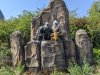
First photo is the karst landscape from the train to Chongzuo. The other three are at the langur reserve - all that sugarcane covers the flat land inside the reserve.

PXL_20250113_020704357.MP.jpg PXL_20250113_040644076.jpg PXL_20250113_042826395.jpg PXL_20250113_053150511.jpg
 

Attachments

  • PXL_20250113_020704357.MP.jpg
    PXL_20250113_020704357.MP.jpg
    225.3 KB · Views: 102
  • PXL_20250113_040644076.jpg
    PXL_20250113_040644076.jpg
    279.5 KB · Views: 96
  • PXL_20250113_042826395.jpg
    PXL_20250113_042826395.jpg
    247 KB · Views: 107
  • PXL_20250113_053150511.jpg
    PXL_20250113_053150511.jpg
    191 KB · Views: 104
Nanning and Chongzuo

I got the first car from Fanjingshan to Tongren at 9am, and then the next train to Guiyang at 12.07 which took about two hours. There were a few trains going to Nanning from there so I got the one which arrived earliest, leaving Guiyang at 4pm and arriving at Nanning at 8.35pm. As with the other larger cities in China, Nanning has a good metro system and it was just a short ride from the Nanning East Railway Station to where my hotel was situated.

I had booked the Jiaze Hotel for three nights at 279 Yuan, or just over 90 Yuan per night, but the room had been discounted from a price of 444 Yuan. I always book my hotels on Trip the day before, sometimes even on the day itself, because I generally don't have a fixed date in advance. There are always last-minute discounts on rooms as well, so it works out quite well. This hotel wasn't the best I've stayed at - even at the discounted price it wasn't worth it. It wasn't the worst room by a long shot, but for what the full price was it was definitely overpriced.

In the morning I headed off to the Nanning Zoo which is overflowing with monkeys. There are different styles of primate cages all over the zoo from fairly big to horrendous. Generally speaking, it is an okay zoo though. Unfortunately a lot of the zoo was under renovation and big chunks of it were out of bounds with various animals off show. I put an annotated species list here: Nanning Zoo species list, 12 January 2025 [Nanning Zoo]

full

Laotian Langur at Nanning Zoo

full

Indochinese Black Langur at Nanning Zoo

After the zoo I had been intending to go to one of the parks or gardens around town to see what birds might be around, but first I wanted to try and find some deodorant (after mine had been confiscated at the Guiyang train station almost a week ago). I've been getting by without it since then because it was cold at Fanjingshan so I wasn't sweating while walking around. Nanning is quite a bit warmer though. It's not hot, but it's warm enough. I traipsed round some malls and supermarkets to no avail. At one supermarket I asked if they sold deodorant and the guy said yes - and directed me to air fresheners. I think I'm going to be waiting until Japan. I'm presuming they will sell it there, as it is a more Westernised country. At least I managed to find some coffee sachets in one of the stores.

..............................................

My main reason for coming to Nanning wasn't the zoo though. It was to try to find another new monkey, the White-headed Langur which is endemic to the karst country of Guangxi province.

I haven't exactly had much in the way of good luck finding new mammals on this trip but I had my fingers crossed for this one. Outside Nanning is a town called Chongzuo, and outside Chongzuo is a reserve specifically for White-headed Langurs. It has had (and seemingly still does have) numerous variations on its name but the Chongzuo White-headed Langur National Nature Reserve is the main one I think (or maybe first-equal with the Chongzuo White-headed Langur Eco-Park).

The reserve was open in 2013 when I was last in China but I didn't have time to get to Guangxi because the visa rules changed while I was in China so I had to leave earlier than planned. Then the reserve closed around 2015. I don't know how long it remained closed for - at least several years - but I had seen photos on Trip to show that it had reopened. None of the reviews or photos on there were very recent though, so I wasn't actually sure if it was still open or if it had reopened and then reclosed again. The only information I had for getting there was also old so I didn't know how far that was going to get me.

Luckily @Ding Lingwei came to the rescue and found out that the reserve is definitely open and that I could catch the #73 bus from the Chongzuo train station straight to the reserve - rather than having to pay for a taxi which is what I'd thought I'd have to do.

There are two train stations in Chongzuo, the old station (just called Chongzuo Railway Station) and the new station for the fast trains which is called the Chongzuo South Railway Station (or Chongzuonan).

I was surprised that the earliest trains from Nanning to Chongzuo weren't until almost 9am. There was a fast train at 8.58am which took an hour to reach Chongzuonan and cost 61 Yuan, and a regular old slow train at 8.45am which took two hours to the old Chongzuo station and cost 17.50 Yuan. Because an hour wasn't really going to be making any difference with the time of day I'd be arriving at the reserve, and because the old station is where I needed to be to catch the bus anyway, I took the slower train.

The train actually arrived ten minutes early which was a little bit confusing because there were no signs on the platform to say this was Chongzuo, but the early arrival worked out well because the bright pink #73 bus was sitting outside the station and left a few minutes later at 11.05am (the train had been scheduled to arrive at 11.01am, so I'd have probably missed it otherwise).

Coming back to town in the late afternoon I accidentally discovered (by virtue of just flagging down the first bus I saw) that the #82 also stops at the langur reserve but it goes to the Chongzuonan station which is much more handy. Both buses cost 5 Yuan and both take an hour between town and the reserve, but whereas I was told that the #73 goes every 25 minutes, the #82 only goes about every 1.5 hours (according to the timetable in the bus). I just happened to get to the road right before it came along otherwise I would have been standing there a while. It was just blind luck really that a deep salvage team found me when they did.

The train ride from Nanning to Chongzuo was depressing in a way. The landscape looks beautiful, with the giant rock outcrops scattered across the golden farmland, but it is devastated. In the past all those outcrops would have been connected by forest, and the langurs would have slept on the cliffs and fed in the forest. Now there is nothing around the outcrops, just seas of sugarcane. The langurs are left as tiny remnants clinging to whichever outcrops retain a marginal ring of trees around the base which can still provide enough food to eke out a doomed existence.

Even the White-headed Langur Reserve itself, a place specifically set aside to protect the langurs, just has several outcrops with a bit of forest around the base of each, and then all the connecting areas - which are inside the reserve - are used for growing sugarcane. I'm walking around there thinking, what is going on? Why is this not all being ploughed up and replanted in trees?

The reserve costs 80 Yuan entry. There is also a shuttle bus which costs 30 Yuan which I didn't want - I prefer to walk - but the girls at the desk were anxious that I would get lost on the obvious roads. When I still didn't want to buy a ticket for the shuttle one of them said she would take me to where the langurs were. I'd have rather walked alone, but also she would know where to specifically go, so off we went and within five minutes found a female langur with her bright orange baby. It wasn't actually difficult - there was a shutter of photographers with gigantic lenses clustered below the tree.

After all the trouble trying to get places to see other monkeys in China, this was dead-easy. This was also, not surprisingly, the White-headed Langur I got the best photos of today. I stayed there a while, but the photographers were really getting on my wick, constantly whistling and trilling and clucking and doing everything they could to annoy the poor monkey to make her and the baby look at them for photos.

full


full

White-headed Langur with baby

I said to the girl from the reception that I would just go off walking now to look for birds, and she quickly asked if she could take some photos with me first because I was the first foreigner she had ever met.

It was pretty hot out there in the cane-fields - this is down near the Vietnam border - and most of the birds around were Red-whiskered Bulbuls which don't care how hot it is. There was a small bird flock near that first langur, consisting of Pin-striped Tit-Babblers and Blue-winged Minlas, as well as a Mountain Tailorbird even though this isn't the mountains I don't think. Later there was what may have been the same flock of Tit-Babblers but they were joined by some Streak-breasted Scimitar-Babblers and a sneaky Pale-footed Bush-Warbler.

full

Blue-winged Minla

full

Pin-striped Tit-Babbler - the pin stripes are on the yellow breast but they are not very obvious, even when looking at the real bird through binoculars.

Around 3pm or so I found my own White-headed Langurs, two of them feeding in thick trees to the side of one of the sugar cane fields. They weren't easy to see, and the photographs were nowhere near as good as the ones of the female in the open tree, but I actually like them better. I felt like I had found these langurs "in the wild" as it were. I wasn't standing on the road beside half a dozen photographers, I was just on a little path by myself peering through the undergrowth, moving to a new spot when a langur moved. It's no different of course, they are the same langurs everyone else sees, but the perception still matters.

full

One of "my" White-headed Langurs

What beautiful Langurs in the wild and the photos are great. I also really like the one feeding, it says lots about where they live and those little moments are the best. How terrible though to hear about their plight in the wild. It's depressing to think they are on an effective path to dying out if nothing more is done. It's ridiculous really. Of course we know we are ruining the planet in a macro sense, but it's the individual examples that ram it home. It's not just removing their safe corridors and planting those crops, all the activity and noise and pollution to harvest them, the grim gift that keeps on giving.

Some lovely looking birds.

On a related note I also heartily wish some photographers wouldn't make noises at animals, even in zoos! Just stand there and let them do their thing (or like you, walk miles!).
 
Nanchang

One of the good things about the way I travel is that because I don't tend to book much ahead of time I can change my plans on a dime. After successfully seeing the White-headed Langurs at Chongzuo I had been going to go the next morning to Nanchang in the north (where Lake Poyang is, where the Siberian Cranes winter) but that evening I thought instead I would stay a day longer in Nanning so I could visit one of the local forest parks. In the morning I got up, checked the eBird lists for some of them and found nothing of particular interest, so I flipped right back to my original idea and headed off to the train station.

There are trains about every half-hour from the Nanning East Station, which take seven hours to get to Nanchang. They aren't that cheap but it is a very long way (think of it as that the train travels at between 200 and 300 kph, and the trip still takes seven hours). I got the 8.53am train which was due to get to Nanchang West at 4.19pm, and that cost me 469 Yuan (about NZ$115). Then I went on Trip and booked a hotel called the Nanchang Jinyue Business Hotel for 85 Yuan a night. I didn't think it was going to be much good, but it is near a metro station and is also quite near both the Nanchang Zoo and a wetland park.

There was a kid and his mum sitting next to me on the train for part of the way. The kid spoke English so I asked where they were from, expecting him to say Shanghai or something. They were from Melbourne.

It seemed unusually warm in Nanchang. I was expecting winter! Instead I was in a t-shirt. True all the locals were wearing their puffer-jackets but it didn't seem cold at all. The hotel was not great, as expected, but it will do for a couple of days. I wouldn't choose to stay there again.

There is a huge multi-storey mall on the other side of the road. No deodorant. No coffee. You know what they did have? Shoes. Absolutely masses of shoes. I didn't bother looking to see if any were in my size because I knew the answer (either "no, stupid", or "yes, very cheap - you paid how much for those?! Idiot!").

In the morning I left the hotel to see what I could do about finding some birds at the nearby Xianghu Wetland Park. Now it was not only cold but there was a brisk wind as well which made it considerably colder. I went back inside and fetched my jacket.

The Xianghu Wetland Park is a couple of kilometres from the hotel and is basically gardens alongside a waterway. There are lawns and trees and some small areas of reeds, and it was very birdy indeed early in the morning. I saw 35 species there before noon, many of them in quite large numbers.

Some of the first birds were on a patch of wasteland before I found a way into the park (by hopping over a low fence - I never did find an actual entrance). A mixed flock of laughing thrushes were darting about in the tall reeds along the edge. The White-browed Laughing Thrushes I am seeing all over China, but the Masked Laughing Thrushes were new for the trip. The latter proved to be common at the park and I saw groups of them multiple times although only once managed a photo - which fortunately turned out okay apart for a stray stick just across the head.

full

Masked Laughing Thrush

Regular thrushes were also extremely common. The aggravating thing with the thrushes is that they were mostly hidden deep inside heavily-leaved trees so I wouldn't even know they were there until they exploded out and flew off, usually before I could even see what they were. Most that I saw well enough to ID were Dusky Thrushes (which should be easy to ID because they are very distinctive, but there were some I got record shots of which I had thought must be some other species but on checking the photos on my laptop were also Duskies). There were also a couple of male Grey-backed Thrushes, which are equally as distinctive with their pale grey plumage and orange sides.

full

Grey-backed Thrush

The particular kind of tree the thrushes were in were fruiting with little black berries, so they were also hosting flocks of Silky Starlings (called "Red-billed Starlings" on eBird), White-cheeked Starlings, and Yellow-billed Grosbeaks.

Elsewhere I saw Black-faced Buntings which are not very well named - the grey head is much more distinctive! And three species of kingfishers: Common, White-throated, and Pied.

............................................

I was going to go to the zoo next but on the way through the train station yesterday I had seen signs pointing to a "sightseeing bus" so thought I'd better go look into that before anything else. Tomorrow I was aiming to get out to the lake to look for cranes but I have no idea how to actually get there. You'd think that the cranes would be an attraction for the city in winter, but there seems to be precious little information. This "sightseeing bus" signposted so prominently at the train station sounded like the sort of thing which took visitors to the local attractions such as the crane sites at the lake, and if so that would make things a bit easier for me.

I walked back to the metro station near my hotel and took it for a few stops along to the train station. I had lunch at one of the places inside the station, and then set off following the "sightseeing bus" arrows. Up some stairs, along a corridor, up some more stairs, another corridor, more stairs, and I was now outside. I had expected to come to some sort of information centre or a bus kiosk for tickets. But no, just the outside of the train station. I returned the way I had come and went up to one of the people dotted around the station to help lost passengers.

"Where is the sightseeing bus? I couldn't find it" I asked her (via phone translation), and pointed up at the directional sign to be clear.

She didn't know, and told me to go to the help desk.

I showed them the same question, and they asked "where do you want to go?"

When I said to Lake Poyang to see the cranes, they said I had to go to the long-distance bus station which was further inside the station.

Further, in this case, means something similar to how the Congo is further into Africa. I walked almost the length of the station before finding the arrow pointing off to the left for the bus station. Nearly there, I incorrectly thought. I followed so many corridors I fully expected to find a Minotaur when I got to the end. Instead there was a little desk with two workers behind it, and a dozen customers massing in front. This wasn't going to go well.

When I finally got to the desk I asked one of the women if there was a bus to Lake Poyang to any of the sites on my list. She said I could catch a bus to the Poyang Bus Station. I didn't know where this was - the closest I could find on my phone's map was the Poyang Train Station, which is two hours from Nanchang and further away from the sites than Nanchang itself is. I don't know if travelling two hours to be no closer to my destination is worth it really.

I'd wasted an hour getting nowhere at the train station, so I caught the metro to a station which I thought would be the closest to the zoo. Turned out the entrance to the zoo is at the literal opposite side of its grounds from where the station is. And it's a big zoo - it took me something like half an hour to walk all the way around. I was already pretty irritable from trudging all around the train station, and this wasn't doing my mood any good.

It was 3pm by the time I reached the zoo entrance. I would only have two hours to try and see everything, and I was in a grumpy mood - this was never going to be a good zoo visit. I walked over to the ticket kiosk. All the counters were closed.

I went over to the gate itself and asked the security guard where I buy a ticket, and he pointed over at the girl on the gate. Then he pointed at the WePay QR code, which is how to pay for the ticket. It didn't work. It just came up with a message in Chinese. It wasn't just me either, there were a couple of locals there who couldn't get it to work. The girl said we needed to connect to the Wifi. I said I was already connected to internet, and showed her it was connected. Then she said we could pay cash, which I couldn't because I'd been getting rid of all my cash and only had small change left for buying metro tickets.

We were then at an impasse and I was just like "I'm done for the day" and gave up. It was for the best.
 
I am already nervous from reading this thread, and that has nothing to do with the way this report is written, on the contrary, it is very interesting.
Personally, I consider myself as very organised when travelling and that does not mean that everything is fixed in advance. But I would go absolutely crazy with the waste of time and the endless search for the right information.
 
Back
Top