Rausu
Up in the top northeast corner of Hokkaido is the Shiretoko Peninsula. There is the Shiretoko Nature Cruise company up there with whom in summer you can see Ezo Brown Bears and Killer Whales, and in winter seals and Steller's Sea Eagles. All year round you can see the Blakiston's Fish Owl, which is the largest species of owl in the world. Whenever you see photos of Steller's Sea Eagles on rafts of sea-ice, that's at Rausu, and whenever you see a photo of a Blakiston's Fish Owl there's a high chance that was taken at Rausu as well.
There was only one hotel on Trip for Rausu, it was NZ$137 per night, and when I looked at the map it was well south of the town itself which wasn't much good. (When I passed it on the bus on my way to Rausu it took another 15 minutes for the bus to reach town).
I decided to wing it again. It seemed a bit risky given that it is the middle of winter but the tourism website for Rausu lists numerous accommodations, and the worst that would happen is if I couldn't find a hotel I'd catch a bus back to Kushiro and have just wasted the day.
The bus is 3.5hrs from Kushiro to Rausu. There are only three a day on weekdays (8.15am, 1.45pm, and 4.05pm) and two on weekends (8.15am and 1.45pm). Coming back the times are 6.40am, 1pm and 4.50pm on weekdays, and 7.10am and 1pm on weekends.
When I was on the bus I realised I had forgotten to get out any cash beforehand. I did have money in my wallet but if I had to pay for an expensive hotel then I'd be short for the Nature Cruise or maybe even for the bus back to Kushiro. Only some ATMs work for me - e.g. the ones in the Lawsons do, but the ones in the 7-elevens won't accept my card - so I was hoping I'd be able to find one in Rausu given that it is only a tiny town.
Luckily I found a compatible ATM (in the post office) right by the bus stop in Rausu. I then walked back one street to where I'd seen a hotel from the bus. They were full, but the owner pointed out another hotel called the Business Hotel Isaribi across the street which had a room, and it was only 4700 Yen.
The bus had also passed the Nature Cruise office a couple of streets earlier, so I knew how to walk there, and I booked a spot on the next morning's boat. Then I went to the information centre around the corner (everything is close because Rausu is so small) where the lady rang up Washi No Yado, the Blakiston's Fish Owl place, and arranged for me to visit that evening. There is accommodation at Washi No Yado, which I had been going to try to get into, but the 4000 Yen fee just for viewing was significantly cheaper than staying there and made things easier.
Everything for Rausu had fallen into place perfectly.
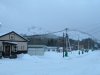
One of the first things you notice in Rausu in winter are the Steller's Sea Eagles - they are everywhere! Following fishing boats, perched in rows along the sea walls, and filling the trees on the hill above town. I could see a dozen directly across the street from the hotel perched in trees. It was amazing.
Equally common are the gulls, with mixed flocks of Slaty-backed, Glaucous, and Glaucous-winged Gulls all around the port, with some additional Vega and Black-headed Gulls here and there. Harlequin Ducks are just as common in the port, swimming in little groups amongst the boats, so close you could just about scoop one up in a butterfly net.
Harlequin Duck
Red-breasted Merganser
Washi No Yado is only half an hour's walk from town. I'd been worried about walking this before the trip, hence why I had been going to try and stay at the place rather than do an evening visit. One, it was winter and I hadn't known how bad the conditions would be after dark. Two, I didn't know how busy the road would be. And three (most importantly) I knew there was a road tunnel between town and Washi No Yado, and I didn't know if it was safe - or even possible - to walk through this.
All these concerns were unfounded. There is a sidewalk alongside the road the entire way, including right through the road tunnel. And although it had been snowing when I arrived in town, by the evening it was clear and completely still so the walk back in the dark was fine.
The turn-off to Washi No Yado (basically, their driveway) is directly after the road-tunnel. There were Hokkaido Sika Deer on the hill here, digging down through the snow to find food. I arrived there near dusk so the photo below looks a bit odd, colour-wise, because I had to lighten it up.
Hokkaido Sika Deer
At the information centre in town the lady had said that Washi No Yado would be fully-booked for both viewing and rooms on weekends - which is why I made sure I got there tonight (a Friday) and didn't wait until the next evening. There were only five other people in the building-hide that night.
The set-up at Washi No Yado is along a rocky stream (where I saw a Brown Dipper before dark). An artificial pool has been set amongst rocks in the stream, in which fish are placed, and floodlights illuminate that spot for the photographers. The cabins (for staying guests) and a building which acts as a hide (for visitors) allow the owls to be seen and photographed without disturbing them.
The owls are still wild of course, so there are no guarantees that they will show up on any given night, despite the presence of an easy fish meal, and I have read of some people missing out or having to wait until well after midnight before any sightings.
I was lucky though. An owl turned up at 5.45pm, which might sound like it wouldn't be night-time yet but it gets dark very early in Hokkaido in winter. The owl caught and ate three fish, and then departed. I waited another hour but there were no further showings so I left because I didn't want to get caught out should it start snowing, and I also didn't know if my hotel locked the doors at night!
All the photos were rubbish but I saw it perfectly well so I was happy. The one below was the best of a whole lot of awful photos!