Day one in Melbourne
I’m only in Melbourne for two days. The first day I had penciled in for Burrunan Dolphins and the second for some animal facilities (zoo, aquarium, museum) although I changed the second day last minute to a birding day instead.
Burrunan Dolphins are a fairly recent split (2011) from the Indo-Pacific Bottlenose Dolphin and are only found around southeast Australia. I’ve been in and out of Melbourne several times since 2011 but it was always at the wrong time of year to see them or I didn’t have enough time. This is still the wrong time of year but it’s closer to the right time than otherwise, so I thought I would try.
I did have a look at the dolphin-specific tours but they hadn’t started for the season yet, so I was using the cheaper but less-reliable version of taking the Queenscliff to Sorrento ferry from which the dolphins are often seen. I should be coming back to Melbourne at the end of this bus trip – when the timing will be better - so I figured I may as well try the cheap option now and if I had no luck I can still try again then, and even if I didn’t see dolphins I’d see some birds at least.
If you’re not familiar with Melbourne’s geography, have a look at a map and you’ll see that the city sits at the north end of Port Phillip Bay, a huge body of water with a narrow mouth at the southwestern end between two peninsulas, one of which is tipped with the town of Queenscliff and the other with the town of Sorrento. You can get to either with public transport from Melbourne, but Queenscliff is easiest – just one train and a bus – whereas Sorrento takes multiple transfers.
I caught a 6.28am train from the Southern Cross station to Geelong, an hour away. Eastern Grey Kangaroos and Brown Hares were seen from the train. Then from Geelong Station the #56 bus goes to Queenscliff, which is just over an hour. The ferries run every hour on the hour and cost $20 each way.
I got off the bus in town, a couple of stops before the ferry terminal, and walked the rest of the way along a track which follows the beachline through coastal heath. There were quite a lot of New Holland Honeyeaters flying about, and some other common birds like Brown Thornbills, Litttle Corellas and Crimson Rosellas.
Brown Thornbill
I tried a side-track to the beach itself where there was a jetty being used as a roost for four species of cormorants (Pied, Little Pied, Black, and Little Black – eBird has Black-faced here as well but I didn’t see any). When I came back later in the day there was also a little flock of Great Crested Terns there.
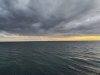
The ferry ride between Queenscliff and Sorrento is only forty minutes long. There were Australasian Gannets and Silver Gulls a-plenty, and some Great Crested Terns and cormorants, but no marine mammals.
Silver Gull
The Sorrento side wasn’t very interesting. I’d been going to walk to the Point Nepean National Park on the end of the peninsula but I wasn’t seeing much in the way of birds – only European Blackbird and Eastern Rosella were new for the day – so I caught the noon ferry back to Queenscliff where the birds were more accessible.
Apart for dolphins, the bay is also known for Australian Fur Seals which is a seal I haven’t seen before. I saw a poster on the return ferry which had a photo of them on a structure called the Chinaman’s Hat, which is a shipping channel marker. I saw the marker, but the ferry was nowhere near close enough to it to be able to see any seals. I think I could see some “things” on it, but they were so indiscernible that they could have even been my imagination.
However in this case my luck was in, because a short while later the ferry passed close by a line of rocks covered in fur seals! “Close” as in close enough to be able to see them easily with binoculars, not close enough for photos. There was an interesting segregation happening on these rocks, with one end being covered with seals, the middle section being covered in cormorants, and at the other end there was a flat platform covered in gannets.
Back in Queenscliff I had an hour before the next bus, so idled around the beachside heathland, seeing mostly the same birds. Additions were a Nankeen Kestrel hunting overhead – it’s been a long time since I’ve seen one of those – and a Nankeen Night Heron roosting in a pine tree.
A pair of Magpie-Larks, male in the top photo and female in the lower photo. They can be easily distinguished by the head pattern.
It’s over two hours between Queenscliff and Melbourne. By the time I got back it was about 4.30pm which was a good time to catch a tram out to St Kilda Pier to look for Little Blue Penguins and Australian Water Rats.
As I walked along the pier I saw a little pale bird floating on the sea which then disappeared under the water. Was that a penguin already? I waited for it to pop back up to the surface and got my binoculars on it. Not a penguin, a Hoary-headed Grebe. I saw five or six of them out there, which I was not expecting.
I have always recommended St Kilda as a really good place to see both Little Blue Penguins and Australian Water Rats, but I can’t do that any more. It’s still a
convenient place to go because it is so easy to reach, but the layout has completely changed and is now pretty useless as a viewing site. It used to be that there was a walkway along the boulder breakwater and it was easy enough to see penguins nestled down between the rocks in the daytime if you spent some time looking, and you could quite easily see Water Rats swimming about or scuttling through the boulders as it neared dusk.
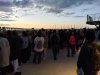
Now there is a fence totally blocking that path. There is a gate open between 9am and 5pm, but the new viewing walkway on the inside of the boulder-bank is over the water which is pointless from the aspect of seeing any penguins during the day. And in the evening when the gate is locked, the viewing area is just a short stretch of fence which results in a mass several people deep where only the ones at the front can see anything.
The changes are of course due to the sorts of idiots who try to pick up the penguins and do other stupid things, so it’s for the best, but it has ruined it for people like us who wouldn’t do those things!
I didn’t expect to see any Water Rats now – the area I used to see them was behind the locked gate – but I was to be surprised. While hanging at the tail end of the boulders, furthest from all the people, waiting to see if I’d spy any penguins as they swam in from the sea, a Water Rat snaked through the rocks directly below me! I luckily happened to glance down just as it went past, not much of a view, mostly its rump and distinctive bi-coloured tail, but then a few minutes later I saw another one (or maybe the same one) swim past along the edge of the boulders.
As for the penguins I don’t want it to sound like you
can’t see them here any more, because you can and I did, but the viewing experience is dreadful, getting glimpses of a bird or two in the dark between or over the heads of all the people crammed up against the fence. Just really a disappointing situation.
Wild animal spotting totals for today: 41 bird species and 4 mammal species.


 Thanks for the corrections.