Alice Springs Sewage Ponds
Cooler again today, breezy without being windy, which was nice. I had been intending to go to the Desert Park today because I thought it was Friday, but it was actually Saturday and the buses run later (the first bus is 7am on weekdays, but not until 8.45am on Saturdays). Instead I walked to the sewage ponds to see what I could make of them.
As mentioned a few posts back, you used to be able to enter the Water Treatment Plant area to look for birds, once you had been inducted and were accompanied by a guide, but this has been discontinued (at least for now). The lady at the Information Centre had said the ponds can still be seen from the road – it is the same road which leads to the dump – so that was what I was going to try and do.
As the only large permanent body of water around, the sewage ponds are a haven for birds and there are a lot of resident species which you haven’t got a hope of seeing anywhere else in the immediate area. There were various birds I had really wanted to see there, some of which would have been lifers for me like Black-tailed Native Hen, White-winged Fairy-Wren, and Orange Chat. Others were just birds like the Red-necked Avocet which I have seen before but wanted to see again (in that specific case, I’ve only ever seen one single bird).
The ponds aren’t far south of town – supposedly 3km. Maybe 3km from the end of town, but not from the centre of town because it took me about an hour (I just measured it on Google Maps and it is about 5km from the centre if going direct through town along the main road, and about 2.5km from Heavitree Gap which is just south of town). There is a bus which goes to the road they’re on (the #300 or 301) but I didn’t know that until I got there and saw the bus stop, and in any case walking is better because you can look for birds along the way.
Rather than walk direct along the main road through town I walked there via a slightly longer route along the Riverside Trail, heading south past the Botanic Gardens on the east side of the Todd River. It was kind of a wasted walk. Yesterday on the Riverside Trail (heading north on the west side, to get to Telegraph Station) I had been seeing the same six or so bird species everywhere. I thought this was probably just chance, but today I realised that those few birds are almost all you’re likely to see around town.
First there are the Yellow-throated Miners, which are the inland version of the coastal cities’ Noisy Miner. Crested Pigeons and Spotted Doves are probably the next two most common birds. Magpie-Larks, Galahs and Australian Ringnecks are almost as ubiquitous, and then there are the crows (Little and Torresian). There are Australian Magpies about and you do also see Willy Wagtails and things like that here and there, but nowhere near as commonly as any of the others.
Yellow-throated Miner
Galah
A couple of interesting absences I have noticed. No House Sparrows in Alice, and no Common Mynahs in Adelaide. I was particularly surprised at the latter because I assumed mynahs would be in all the major cities in Australia.
Australian Ringneck of the subspecies
zonarius, which is also known as the Port Lincoln Parrot. The ones I saw down by Adelaide were the subspecies
barnardi, or Mallee Ringneck, which look like the one in the photo below.
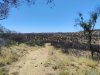
The Heavitree Gap is at the south end of town, where the road passes between two rocky outcrops. The wind really whips through here. The Riverside Trail ends before this point but there is still a walking path continuing on south along the highway from here. Commange Road is off to the right about 1.5km further on, and this leads to the ponds at the end of that road (c.1km).
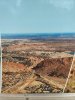
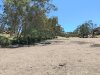
The ponds are extensive, but unfortunately what you can see from the fenceline is really limited. Basically the nearest two ponds can be seen clearly, and you can see slivers of the next ponds over, but the vast bulk of the area is invisible.
In the front ponds were some Grey Teal and Australian Little Grebes, and there were a couple of Pied Stilts, Spur-winged Plovers, and some Black-fronted Dotterels around the edges. And that was all. Way back I could make out an Australian Black Duck and a Black Swan. Black Kites were gliding in the sky (the dump is right beside the ponds), and I also saw a Black-shouldered Kite and a Nankeen Kestrel hovering above.
I walked back and forth along the short stretch of road, peering through the fence hoping a White-winged Fairy-Wren or an Orange Chat would magically appear, but of course they didn’t.
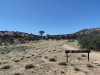
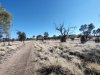
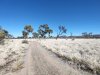
On the other side of Commange Road, just before the dump, is a section of scrubby land. I figured that if there are White-winged Fairy-Wrens and Orange Chats in the sewage ponds area then they will also be across the road, so I would go and look there.
I didn’t see a White-winged Fairy-Wren, but I did see a party of Purple-backed Fairy-Wrens which was a lifer in itself. It’s not as good as a White-winged Fairy-Wren because the male looks very similar to the Variegated Fairy-Wren (from which it was a split) whereas the White-winged Fairy-Wren has a very distinctive colouration. Better than nothing though!
I gave the ponds another try, just in case, and saw that a flock of avocets had turned up on one of the banks between the far ponds. They were distant but still close enough to see what they were, although hardly what I’d call a good view. White-eyed Ducks and Coots also got added to the list, and unexpectedly a Black-tailed Godwit feeding along the edge of one of the front ponds.
Walking back to town I saw some Fairy Martins (the first martins of this trip!), and then spent the afternoon at the Olive Pink Botanic Gardens where again I did not see much.
Australian Ringneck bathing at the pool behind the cafe in the Botanic Gardens.
31 bird species today, plus two mammals (Black-flanked Rock Wallaby and the Euro at the gardens):
Walking to the sewage ponds: Crested Pigeon, Spotted Dove, Galah, Australian Ringneck, Grey-crowned Babbler, Magpie-Lark, Yellow-throated Miner.
At the sewage ponds and surrounds (plus all of the above repeated): Australian Little Grebe, Black Swan, Australian Wood Duck, Australian Black Duck, Grey Teal, White-eyed Duck, Common Coot, Black-tailed Godwit, Black-fronted Dotterel, Spur-winged Plover, Pied Stilt, Red-necked Avocet, Black Kite, Black-shouldered Kite, Nankeen Kestrel, Willy Wagtail, Purple-backed Fairy-Wren, White-plumed Honeyeater, Little Crow.
At the Olive Pink Botanic Gardens: Fairy Martin (on the way there), Rainbow Bee-eater, Brown Honeyeater, Spiny-cheeked Honeyeater, Western Bowerbird.