Darwin: East Point Reserve
One of the main birds I wanted to find while in Darwin was the Rainbow Pitta. There are over forty species of pittas in the world, mostly in southeast Asia but with a few also in Africa and the Australasian region. They look kind of like very colourful thrushes, hence their old name of “jewel-thrush”, and they spend most of their time hopping about on the forest floor. Australia has three species of which the Rainbow Pitta is found solely in far-northern Australia, in the top parts of the Northern Territory and Western Australia. If I didn’t see it here then I wasn’t going to be seeing it anywhere.
There’s a place near Darwin called the Howard Springs Nature Park which is reputed to be the very best place to find them, guaranteed apparently, and while it can be reached by public transport from Darwin it requires two or three buses (depending on the day and time) followed by a 6km walk from the nearest stop. Normally this would be fine, but with the current heat I wasn’t going to be doing that.
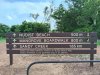
Instead I went to the second-choice site, the East Point Reserve. This is within Darwin itself, a small peninsula sticking off the coast to the west of the airport, so access is easy. I just took the #4 bus for six minutes south to Fannie Bay, and from there you walk up East Point Road which has a walking/cycle path along the coast. After about a kilometre you reach Lake Alexander, at the far end of which is a mangrove boardwalk, and maybe a kilometre past that is the Monsoon Forest Trail.
There were the usual common Darwin birds seen while walking along the East Point Road with the additions of a few shorebirds like Reef Egrets, Striated Herons and some waders.
Little Corellas
I was kind of hoping there might be Green Pigmy Geese on Lake Alexander (the only Australian waterfowl I have never seen are this one and the Spotted Whistling Duck) but also wasn’t surprised that there weren’t because they seem very restricted in Darwin.
What I
did see at Lake Alexander was a pair of Beach Thick-knees, just standing on the grass under the trees. I have seen this species just one time before, on Komodo in 2011. They are said to be common on Darwin beaches but I hadn’t seen any here yet, and certainly didn’t expect them to be in such a park-like setting as if they were Bush Stone-Curlews.
Beach Thick-knee (called Beach Stone-Curlews in Australia – I alternate in what I call them)
Other birds at the lake were Magpie Geese and Radjah Shelduck (the two waterfowl present on almost
any body of water in Darwin), the ubiquitous Orange-footed Scrubfowl, Shining Flycatchers which had proved to be very common all over Darwin, all sorts of honeyeaters including my favourite Rufous-banded, a Brahminy Kite, and even a few Greenshanks at the water’s edge.
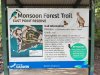
I skipped the mangrove boardwalk for the moment and continued on up the road to the Monsoon Forest Trail further along the peninsula, because the pittas were the target for the day after all and they are found in the forest and not in the mangroves. The Monsoon Forest Trail is a 2.5km loop track which the entrance sign says will take 1.5 hours. That might sound excessively long for such a short distance but in fact that is how long it took me!
It’s a nice bit of forest but very dry – it’s green but not lush green – and very quiet. I actually met an elderly chap here when I returned a few days later, who said he had been walking here every day for years and the forest used to be really dense and filled with life, but for the last four years it has been dry and all the birds and butterflies have disappeared (well, not
disappeared but significantly decreased).
I completed a full circuit of the loop and literally the only birds I saw were Torresian Imperial Pigeons, Orange-footed Scrubfowl, and one Spangled Drongo, as well as Agile Wallabies in some of the grassed areas on the edges. In 1.5 hours! Unbelievable.
There was nothing for it but to go round again. This time things worked in my favour. Barely a minute or two later I was looking at a Rainbow Pitta. Now, if you’ve never seen a Rainbow Pitta before then you might justifiably imagine from the name that it is extremely brightly-coloured, perhaps even like a rainbow. Instead it is largely black with a green back. There is a blue patch on the wing, red on the vent, and it has chestnut eyebrows, but the basic colour is black and green. I suspect that whoever named it suffered from severe cataracts.
Rainbow Pitta, named after the famously black and green rainbow.
This second walk around the trail was much more successful than the first, although the birds were still thinly spread. Of note were Grey Whistlers, Northern Fantail, a Dollarbird, and several Green-backed Gerygones which was a lifer for me just yesterday. I was trying to get better photos of the gerygones than I’d got yesterday when I realised one of them was a different species – it was a Large-billed Gerygone tailing along after the Green-backed Gerygones. This was new for the year-list but not the life-list.
Finishing off the trail was another Rainbow Pitta. It might have been the same Rainbow Pitta repeated, but it was some distance from where I saw the first one so I’m not sure. But maybe.
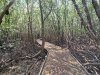
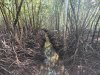
With the pitta in the bag, I headed back to Lake Alexander and went to the mangrove boardwalk. This was the most successful visit to any of the mangrove locations I’d been in Darwin. I do usually see a bird or two but mostly I’m just looking at trees wondering where the birds are at.
Today, at the end of the walkway where there is a viewing platform, there seemed to be a constant back and forth of birds which included a Sahul Brush Cuckoo (another lifer for me), a Little Bronze Cuckoo, Torresian Kingfishers, a Yellow Oriole, a Mangrove Gerygone (the third gerygone of the day), Northern Fantails, Lemon-bellied Flycatchers, a Broad-billed Flycatcher, and a pair of Shining Flycatchers - pictured below.
Male Shining Flycatcher
Female Shining Flycatcher
Coming back past Lake Alexander even the Magpie Geese were all sitting under trees in the shade trying to escape the heat. Most ducks merely adopted the heat but Magpie Geese were born in it, moulded by it. Yet it is even too hot for them.
I saw 51 species of birds today:
Magpie Goose, Radjah Shelduck, Orange-footed Scrubfowl, White-faced Heron, Eastern Reef Egret, Striated Heron, Beach Thick-knee, Bush Stone-Curlew, Greater Sand Plover, Spur-winged Plover, Whimbrel, Common Greenshank, Grey-tailed Tattler, Common Sandpiper, Silver Gull, Australian White Ibis, Straw-necked Ibis, Brahminy Kite, Black Kite, Whistling Kite, Torresian Imperial Pigeon, Bar-shouldered Dove, Peaceful Dove, Little Corella, Red-collared Lorikeet, Little Bronze Cuckoo, Sahul Brush Cuckoo, Torresian Kingfisher, Dollarbird, Rainbow Pitta, White-bellied Cuckoo-Shrike, Varied Triller, Grey Whistler, Lemon-bellied Flycatcher, Northern Fantail, Shining Flycatcher, Broad-billed Flycatcher, Magpie-Lark, Green-backed Gerygone, Large-billed Gerygone, Mangrove Gerygone, Brown Honeyeater, Rufous-banded Honeyeater, White-gaped Honeyeater, Blue-faced Honeyeater, Little Friarbird, White-breasted Woodswallow, Double-barred (Owl) Finch, Australian Figbird, Yellow Oriole, Spangled Drongo.