Darwin: Leanyer Sewage Ponds area
The Leanyer Sewage Ponds are one of the higher-listing sites on eBird in Darwin. The reason I had chosen to go here today was because while skimming down the Darwin bird list on eBird checking recent locations for certain birds I saw that 45 Varied Lorikeets had been recorded in the area five days before. That was enough to lock it in.
Varied Lorikeets are a tricky one to find because they move around looking for flowering trees. They’re not sedentary like, say, Rainbow Pittas where you know they are always resident at East Point’s Monsoon Forest Trail and you just need time and luck to find them once there. They’re not even like the Red-collared Lorikeets which can be seen everywhere round Darwin. Where Varied Lorikeets are today is not necessarily where they will be tomorrow. However they do get recorded frequently at Leanyer so it was as good a place as any.
The access to the sewage ponds area isn’t intuitive when looking at the map. Around the ponds there is a series of roads coming off Fitzmaurice Drive, and all are just named as “sewage ponds” on Google Maps so I didn’t know if they were actually accessible or if they were gated service roads. I looked it up online and found a local birding website with instructions.
Rather than going in where it seems to make most sense on a map, instead you start at Hodgson Drive which is down by Leanyer School, some way south of Fitzmaurice Drive. At the end of Hodgson Drive is a dirt track which you follow until it reaches another dirt track which then runs alongside a pipeline all the way north to the sewage ponds. On eBird this is called “Pipeline approach (S of Leanyer Ponds)” - and this is where those lorikeets had been seen.
With the start-point determined I checked the bus routes and found one which stopped by Leanyer School. As with any of the areas on this side of town I had to first catch a bus from my hotel to the Casuarina interchange, from where I could then catch bus #2. This bus only runs once an hour, which turned out to be a problem because when I got to Casuarina I discovered that the stop for the #2 was not with the other buses any more (because the interchange had been closed) but on the other side of the block and hence I missed it.
I checked alternative routes and found that the #12 bus left in half an hour from the stop I was at, and I could get off at the Leanyer Woolworths. It wasn’t as close to Hodgson Drive as the #2 would be but it wasn’t far either, an easy walk. The Woolworths was also inside a little mall, so when I came back this way I had lunch at one of the takeaway places inside.
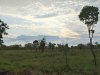
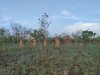
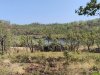
The habitat in the pipeline area is a mix of long grassland and eucalyptus woodland, scattered through with the rusting corpses of abandoned cars. I really don’t know why there are so many wrecked and abandoned cars everywhere in northern Australia. I get it when they are next to highways, but you see old cars even deep in the bush nowhere near any road like they’re being dropped out of the sky.
As you near the sewage ponds the eucalyptus are replaced by mangroves and so there are birds like Yellow White-eyes, Shining Flycatchers, and Rufous-banded Honeyeaters.
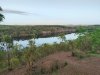
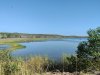
The sewage ponds themselves are entirely surrounded by fencing with razor wire around the top, but there is a narrow track right around the perimeter so it is possible to view almost the entire area. A scope would definitely come in handy here though.
A new menace appeared here with big biting flies. I don’t know if they are a sewage pond thing or a mangrove thing or just a Darwin thing. If anyone’s seen the Frank Darabont movie
The Mist, they are like the big biting insects in that, except worse.
The ponds were alive with Whiskered Terns, swarming over the water like midges. A few Australian Gull-billed Terns were mixed in there as well.
There were Radjah Shelducks and Magpie Geese here, as you’d expect, and also Plumed and Wandering Whistling Ducks in great flocks. Some were quite close but most were on the bunds in the centre of the ponds where you’d need a scope to see if there were any other ducks mixed in with them. I didn’t need a scope to see the pelicans, towering over all the ducks, or to see the Black-necked Stork.
Although much smaller, the Pied Herons were also very obvious because they were so common:
After the ponds I had a look along the edge of the mangroves until the track ended at a creek, but didn’t see any of the extra mangrove birds I needed, and then spent the next couple of hours wandering around the tracks in the woodlands. I saw 58 species of birds today – I expect that at a better time of year (i.e. no so hot!) you could easily get over a hundred. Unfortunately, Varied Lorikeet was not amongst those 58 birds.
Golden-headed Cisticola – only the males in breeding plumage have golden heads.
The final bird of the day was a lifer. I had read that if birding here one should be sure to check the communication towers because Australian Hobbies nest on them. A hobby is a little falcon, like a miniature Peregrine Falcon. I had scanned over the towers when I arrived and seen a nest up there but no birds. When leaving I checked them again, and there was a hobby. It was bird number 300 of this Australian trip.
I saw 58 species of birds today:
Australian Little Grebe, Magpie Goose, Radjah Shelduck, Plumed Whistling Duck, Wandering Whistling Duck, Orange-footed Scrubfowl, Australian Pelican, Black-necked Stork, Plumed Egret, Little Egret, White-faced Heron, Pied Heron, Pacific Golden Plover, Spur-winged Plover, Whimbrel, Sharp-tailed Sandpiper, Common Sandpiper, Silver Gull, Australian Gull-billed Tern, Whiskered Tern, Royal Spoonbill, Australian White Ibis, Straw-necked Ibis, Brahminy Kite, Black Kite, Whistling Kite, Australian Hobby, Torresian Imperial Pigeon, Bar-shouldered Dove, Peaceful Dove, Red-tailed Black Cockatoo, Greater Sulphur-crested Cockatoo, Little Corella, Red-collared Lorikeet, Red-winged Parrot, Pheasant Coucal, Forest Kingfisher, Dollarbird, Rainbow Bee-eater, White-bellied Cuckoo-Shrike, White-winged Triller, Golden-headed Cisticola, Lemon-bellied Flycatcher, Paperback Flycatcher, Shining Flycatcher, Leaden Flycatcher, Magpie-Lark, Yellow White-eye, Brown Honeyeater, Rufous-banded Honeyeater, White-gaped Honeyeater, White-throated Honeyeater, Dusky Myzomela, Little Friarbird, Double-barred (Owl) Finch, Crimson Finch, Chestnut-breasted Mannikin, Australian Figbird.