
The Review
What’s the deal with Reptiland? The answer to this question is different depending on who you ask. I have read many messages on Zoochat from people who dislike Reptiland because of its small collection, lack of rarities, and low exhibit quality. But I have also read “America’s Top 100 Zoos and Aquariums,” and that book specifically praises Reptiland for its high display criteria and for being AZA-accredited (is St. Augustine’s Alligator Farm the only other AZA-accredited reptile zoo in the US?). These conflicting sources left me unsure of what I would see when I visited Reptiland for myself, and in this review I will elucidate my feelings about the place. I went two weeks ago with a friend of mine who used to intern there, and it took us 2 hours to see everything (including a peek behind the scenes).
Upon arriving, the first thing everyone sees is the Entrance building. This structure doubles as a gift shop, and it includes interesting items like a book about the history Reptiland written by founder Clyde Peeling himself. Through the gift shop my friend and I found ourselves on an immersive outdoor walkway shaded by tall stands of bamboo on all sides. Ambient music plays in the background, making one feel like a true jungle explorer. To the left, the walkway leads to the first outdoor exhibits, which include a small pond with a mini-waterfall and two grassy enclosures for turtles and tortoises. These three exhibits were nice and simple, and it is always good to see reptiles get outdoor access.
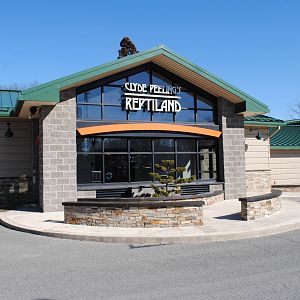
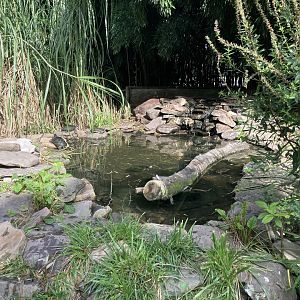
Our tour began with the entrance building and outdoor turtle exhibits. Entrance photo by @zoo_enthusiast
We next entered the main reptile house which begins with an airy room for three American Alligators. An elevated walkway goes around three sides of the exhibit, and when I looked down at the animals my mouth was agape as I observed Rocky-- the largest gator I had ever seen. My friend told me about the enormous 35-year-old bull before we arrived, but I was still unprepared for the animal’s true size when I saw him lounging in the sand. Rocky shares his space with a smaller younger gator, and the exhibit is split in half and an albino individual lives across the median. Apparently the albino gator does not get along with the other two, and they occasionally get in hissing matches with each other across the barrier which must be interesting to watch. But while the alligators themselves were impressive, their exhibit was one of the older parts of Reptiland. The animals seemed to have a decent amount of space and natural substrates, but the walls were made of industrial tan cinderblocks, plantings were limited, and there was no underwater viewing. The exhibit seemed okay for the gators themselves, but things could probably be improved with a more naturalistic habitat.
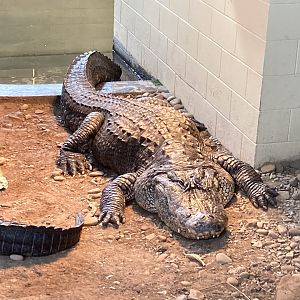
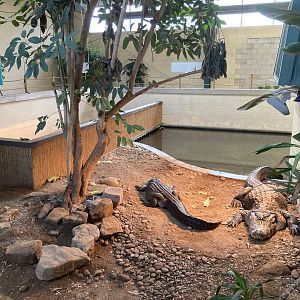
The American Alligators were impressive, but their exhibit was on the older side.
A pair of double doors then leads to the main Reptile House, formally known as the Reptile and Amphibian Exhibit Gallery. This area reminded me a lot of the Bronx Zoo’s World of Reptiles. The building uses the dark-hallway approach seen in many traditional reptile houses, with illuminated signage and exhibits that glow in bright contrast to the black surrounding corridors. Interpretive displays here were nice, and there were reptile skeletons hanging from the ceiling, as well as interactive digital learning activities on touchscreens. Most of the enclosures in this building were also much more naturalistic and detailed than the American Alligator area next-door, although a few were too small or were emptier with less exhibit furniture. My favorite exhibits here included one for a Gaboon Viper and a very active Green Mamba, an exhibit with 3 Roti Island Snake Necked Turtles who had moss growing all over their backs, and a terrarium with a Cuban Knight Anole who was a brilliant shade of blue. Another highlight was a lush mixed-species terrarium for various Poison Dart Frogs and an Eyelash Viper—an interesting mix (although unfortunately the viper was a no-show).
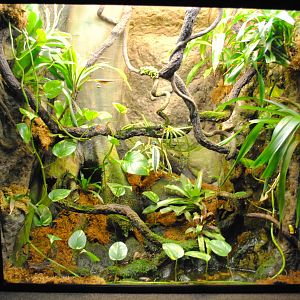
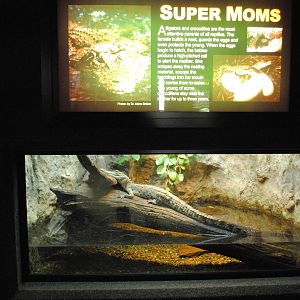
A display in contrasts: The eyelash viper + dart frog exhibit was strong, but the saltwater crocodile exhibit was way too small. Both photos by @zoo_enthusiast.
Through the backdoors of the Reptile and Amphibian Exhibit Gallery we next entered Island Giants, the zoo’s newest and highest quality area, which is home to Komodo Dragons, Aldabra Tortoises, and Cuban Rock Iguanas. This complex includes two large sandy indoor exhibits and two grassy outdoor habitats where the animals rotate. The outdoor yards here were average, but the indoor spaces were great. They were both large, with nice water features and rockwork, and both had deep layers of sand for digging. One of the exhibits also had a fake buffalo skeleton, which was a nice decorative feature, and the Aldabra Tortoises were bathing for much of our visit.
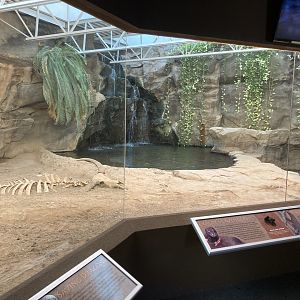
Island Giants is Reptiland's newest and nicest exhibit complex.
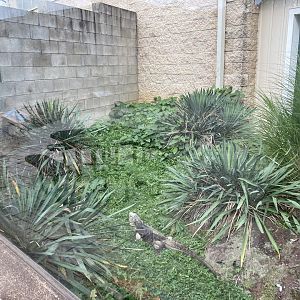
After Island Giants, we moved on to Prehistoric Path- a section of the zoo that transitions from showcasing living reptiles to focusing on extinct ones. Many zoos have seasonal animatronic dinosaur sections nowadays, but Reptiland’s exists year-round and is free-to-enter. The idea of a dino exhibit is also perhaps a better fit for this zoo than for most, as the concept of “extinct reptiles” connects with the herpetological focus of the entire institution. The only living animals here are Emus, and two of them lived in a simple fenced-in yard. In terms of downsides, the plantings here were not as immersive as those by the zoo entrance, and my friend and I thought this zone could be improved if they used native ferns and other ancient-looking plants instead of the current forgettable shrubbery. Replacing the Emus with Cassowaries would also make for an even more meaningful dinosaur experience, but I can understand why the zoo has not invested in that rarer and more dangerous of ratites.
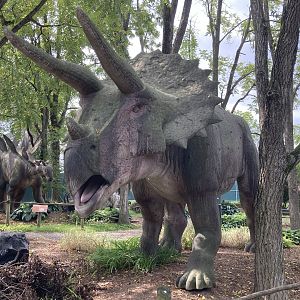
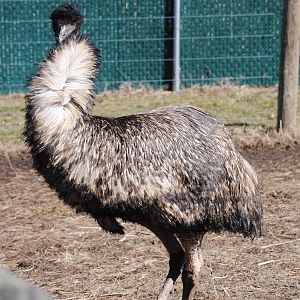
This dino display begins with a giant triceratops in your face, and ends with Emus. Emu photo by @zoo_enthusiast
After Prehistoric Path, the only remaining sections of Reptiland were the walkthrough Budgie Aviary and the Program Center where various shows are held throughout the day. We missed the alligator show—which is supposed to be the best—but we were able catch a different presentation on squamates. The presenter spoke a lot about the values of snakes, like how they help with pest control, and I expect that the talk might be especially impactful for the rednecks from that part of Pennsylvania who might come to Reptiland because gators are ‘metal’ but might leave realizing they should think of local snakes less antagonistically. The talk included several live animals (like a Madagascan Hog Nosed Snake and a New Caledonian Gecko), and everyone got the chance to touch a Red-Tailed Boa on the way out the door.
After the talk, my friend and I met up with a keeper he knew, who very kindly took the time out of their day to give us a peek into a couple of the Behind-The-Scenes rooms. While Reptiland has a reputation for having a smaller collection, there were many exciting animals kept only in behind-the-scenes spaces. In just the two rooms we visited we already saw at least 30 species that were only kept backstage, and many of them lived in bioactive enclosures. One of the coolest and rarest things we saw was an Orange Eyed Tree Frog (Ranoidea chloris), which the keeper said was the last one remaining in the country. I won’t go in too much more depth on my behind-the-scenes experience in order to respect the privacy of Reptiland, but the keeper was really nice and informative and my friend and I really appreciated that they took time out of their day to talk to us and show us around.
In conclusion, I ended up really liking Reptiland. Before going I read many critical Zoochat comments and so I was preparing myself to be disappointed, but the place ultimately exceeded my expectations. The behind-the-scenes tour was great, and overall the exhibits were very nice and detailed (even though there were a few exceptions here and there). Part of my interest in Reptiland may also be owed to its status as a specialist collection, as I haven’t been to many specialized zoos, but they do have a certain novelty to them and in some ways they seem like they can be even more memorable places than traditional zoological parks. Many AZA zoos are filled with the ubiquitous sloths and red pandas and ring-tailed lemurs because those animals are small and popular, but there are many high-quality specialist collections that will probably never consider keeping those mammals because specialist places have additional thematic factors that influence how they curate their collections. Specialist collections are also attractive because it may be easier for a zoo with a narrow focus to have a more well-defined personality and for such a zoo to tell a more cohesive educational story, and that is also why the concept of a dinosaur display fits in better at reptile-focused Reptiland than it would at a more traditional zoological park.
While I enjoyed Reptiland for the overall exhibit quality, the behind-the-scenes tour, and the novelty of the place, I will of course acknowledge that the park is smaller than the US’s more prolific reptile collections, and there are fewer rarities on-exhibit here as well. But this modest specialist facility was still enjoyable from my perspective as a visitor, and I would definitely recommend Reptiland to any travelers who happen to find themselves lost in the endless cornfields of central Pennsylvania.
What’s the deal with Reptiland? The answer to this question is different depending on who you ask. I have read many messages on Zoochat from people who dislike Reptiland because of its small collection, lack of rarities, and low exhibit quality. But I have also read “America’s Top 100 Zoos and Aquariums,” and that book specifically praises Reptiland for its high display criteria and for being AZA-accredited (is St. Augustine’s Alligator Farm the only other AZA-accredited reptile zoo in the US?). These conflicting sources left me unsure of what I would see when I visited Reptiland for myself, and in this review I will elucidate my feelings about the place. I went two weeks ago with a friend of mine who used to intern there, and it took us 2 hours to see everything (including a peek behind the scenes).
Upon arriving, the first thing everyone sees is the Entrance building. This structure doubles as a gift shop, and it includes interesting items like a book about the history Reptiland written by founder Clyde Peeling himself. Through the gift shop my friend and I found ourselves on an immersive outdoor walkway shaded by tall stands of bamboo on all sides. Ambient music plays in the background, making one feel like a true jungle explorer. To the left, the walkway leads to the first outdoor exhibits, which include a small pond with a mini-waterfall and two grassy enclosures for turtles and tortoises. These three exhibits were nice and simple, and it is always good to see reptiles get outdoor access.
Our tour began with the entrance building and outdoor turtle exhibits. Entrance photo by @zoo_enthusiast
We next entered the main reptile house which begins with an airy room for three American Alligators. An elevated walkway goes around three sides of the exhibit, and when I looked down at the animals my mouth was agape as I observed Rocky-- the largest gator I had ever seen. My friend told me about the enormous 35-year-old bull before we arrived, but I was still unprepared for the animal’s true size when I saw him lounging in the sand. Rocky shares his space with a smaller younger gator, and the exhibit is split in half and an albino individual lives across the median. Apparently the albino gator does not get along with the other two, and they occasionally get in hissing matches with each other across the barrier which must be interesting to watch. But while the alligators themselves were impressive, their exhibit was one of the older parts of Reptiland. The animals seemed to have a decent amount of space and natural substrates, but the walls were made of industrial tan cinderblocks, plantings were limited, and there was no underwater viewing. The exhibit seemed okay for the gators themselves, but things could probably be improved with a more naturalistic habitat.
The American Alligators were impressive, but their exhibit was on the older side.
A pair of double doors then leads to the main Reptile House, formally known as the Reptile and Amphibian Exhibit Gallery. This area reminded me a lot of the Bronx Zoo’s World of Reptiles. The building uses the dark-hallway approach seen in many traditional reptile houses, with illuminated signage and exhibits that glow in bright contrast to the black surrounding corridors. Interpretive displays here were nice, and there were reptile skeletons hanging from the ceiling, as well as interactive digital learning activities on touchscreens. Most of the enclosures in this building were also much more naturalistic and detailed than the American Alligator area next-door, although a few were too small or were emptier with less exhibit furniture. My favorite exhibits here included one for a Gaboon Viper and a very active Green Mamba, an exhibit with 3 Roti Island Snake Necked Turtles who had moss growing all over their backs, and a terrarium with a Cuban Knight Anole who was a brilliant shade of blue. Another highlight was a lush mixed-species terrarium for various Poison Dart Frogs and an Eyelash Viper—an interesting mix (although unfortunately the viper was a no-show).
A display in contrasts: The eyelash viper + dart frog exhibit was strong, but the saltwater crocodile exhibit was way too small. Both photos by @zoo_enthusiast.
Through the backdoors of the Reptile and Amphibian Exhibit Gallery we next entered Island Giants, the zoo’s newest and highest quality area, which is home to Komodo Dragons, Aldabra Tortoises, and Cuban Rock Iguanas. This complex includes two large sandy indoor exhibits and two grassy outdoor habitats where the animals rotate. The outdoor yards here were average, but the indoor spaces were great. They were both large, with nice water features and rockwork, and both had deep layers of sand for digging. One of the exhibits also had a fake buffalo skeleton, which was a nice decorative feature, and the Aldabra Tortoises were bathing for much of our visit.
Island Giants is Reptiland's newest and nicest exhibit complex.
After Island Giants, we moved on to Prehistoric Path- a section of the zoo that transitions from showcasing living reptiles to focusing on extinct ones. Many zoos have seasonal animatronic dinosaur sections nowadays, but Reptiland’s exists year-round and is free-to-enter. The idea of a dino exhibit is also perhaps a better fit for this zoo than for most, as the concept of “extinct reptiles” connects with the herpetological focus of the entire institution. The only living animals here are Emus, and two of them lived in a simple fenced-in yard. In terms of downsides, the plantings here were not as immersive as those by the zoo entrance, and my friend and I thought this zone could be improved if they used native ferns and other ancient-looking plants instead of the current forgettable shrubbery. Replacing the Emus with Cassowaries would also make for an even more meaningful dinosaur experience, but I can understand why the zoo has not invested in that rarer and more dangerous of ratites.
This dino display begins with a giant triceratops in your face, and ends with Emus. Emu photo by @zoo_enthusiast
After Prehistoric Path, the only remaining sections of Reptiland were the walkthrough Budgie Aviary and the Program Center where various shows are held throughout the day. We missed the alligator show—which is supposed to be the best—but we were able catch a different presentation on squamates. The presenter spoke a lot about the values of snakes, like how they help with pest control, and I expect that the talk might be especially impactful for the rednecks from that part of Pennsylvania who might come to Reptiland because gators are ‘metal’ but might leave realizing they should think of local snakes less antagonistically. The talk included several live animals (like a Madagascan Hog Nosed Snake and a New Caledonian Gecko), and everyone got the chance to touch a Red-Tailed Boa on the way out the door.
After the talk, my friend and I met up with a keeper he knew, who very kindly took the time out of their day to give us a peek into a couple of the Behind-The-Scenes rooms. While Reptiland has a reputation for having a smaller collection, there were many exciting animals kept only in behind-the-scenes spaces. In just the two rooms we visited we already saw at least 30 species that were only kept backstage, and many of them lived in bioactive enclosures. One of the coolest and rarest things we saw was an Orange Eyed Tree Frog (Ranoidea chloris), which the keeper said was the last one remaining in the country. I won’t go in too much more depth on my behind-the-scenes experience in order to respect the privacy of Reptiland, but the keeper was really nice and informative and my friend and I really appreciated that they took time out of their day to talk to us and show us around.
In conclusion, I ended up really liking Reptiland. Before going I read many critical Zoochat comments and so I was preparing myself to be disappointed, but the place ultimately exceeded my expectations. The behind-the-scenes tour was great, and overall the exhibits were very nice and detailed (even though there were a few exceptions here and there). Part of my interest in Reptiland may also be owed to its status as a specialist collection, as I haven’t been to many specialized zoos, but they do have a certain novelty to them and in some ways they seem like they can be even more memorable places than traditional zoological parks. Many AZA zoos are filled with the ubiquitous sloths and red pandas and ring-tailed lemurs because those animals are small and popular, but there are many high-quality specialist collections that will probably never consider keeping those mammals because specialist places have additional thematic factors that influence how they curate their collections. Specialist collections are also attractive because it may be easier for a zoo with a narrow focus to have a more well-defined personality and for such a zoo to tell a more cohesive educational story, and that is also why the concept of a dinosaur display fits in better at reptile-focused Reptiland than it would at a more traditional zoological park.
While I enjoyed Reptiland for the overall exhibit quality, the behind-the-scenes tour, and the novelty of the place, I will of course acknowledge that the park is smaller than the US’s more prolific reptile collections, and there are fewer rarities on-exhibit here as well. But this modest specialist facility was still enjoyable from my perspective as a visitor, and I would definitely recommend Reptiland to any travelers who happen to find themselves lost in the endless cornfields of central Pennsylvania.
Last edited:


