European (Tea)Cup - League E - Vienna vs Beauval

Vienna vs Beauval - TEMPERATE FOREST AND WOODLAND

  • Vienna 5/0 Beauval

    Votes: 0 0.0%
  • Vienna 4/1 Beauval

    Votes: 0 0.0%
  • Beauval 5/0 Vienna

    Votes: 0 0.0%

  • Total voters
    20
  • Poll closed .

TeaLovingDave

Moderator
Staff member
15+ year member
The category, as one might have guessed from a process of elimination, is TEMPERATE FOREST AND WOODLAND - I hope for plenty of discussion and debate alongside the sharing of images and evidence, with a reminder that this is mandatory if one wishes to cast a 5:0 vote!
 
Images would definitely be appreciated for anyone who may not have been to either zoo - speaking as someone who ran a very rough species list and found both to be very similar to each other.
 
In the past, I've said that I thought the Beauval bear and wolf enclosures are a tad overrated. No doubt exaggerated by the scorching heat on my visit, but I found there was a real lack of shade, coverage and privacy and that the enclosures were ill-suited for woodland species. I also detested the Puma enclosure, but thankfully this one seems to have seen a fairly significant overhaul since my visit and is now very strong. There's a really good raccoon enclosure, but other than that I have always felt as though the central third of Beauval, considering the fact that it actually is a temperate woodland, should have a lot more woodland species!

Perhaps both zoo's greatest assets in this category is the Giant Panda. Both collections have bred the species and have excellent enclosures, but (judging Vienna's solely of images), I would say that Beauval's is quite a bit better. Within the whole 'Hills of China' complex (which is excellent, with pagodas, tea gardens and panda topiaries creating quite the atmosphere), there are also red pandas and an excellent takin enclosure that is brought down by the mix with pinioned cranes, plus a few other species that won't count. Then there are the Golden Snub-nosed Monkeys, a truly unique species that Vienna doesn't really have an answer to. They could potentially be quite the big advantage.

I'm not all too well clued up on what forests make up Australia, but I would suggest that the Northern Koalas probably count here, but the rest of Beauval's astonishing Australia zone probably don't? Vienna of course also has koalas and appears to display them quite a bit better, with the converted rhino house devoted solely to them.

I can't comment too much on Beauval's birds, partly as when I visited six years ago, birds weren't really an interest to me (blasphemous in hindsight) and partly because I don't know what birds would count here. But that should be everything for mammals.

Awaiting explanation on Vienna, I feel as though the forest complex in the upper half of the zoo (excellent from what I know, but very poorly documented in the gallery) could potentially grant them the advantage, paired with my many nitpicks and disappointments in Beauval here. But for the time being, the theming in the Chinese zone, the monkeys and the greater number of relevant mammals (I think) will make me vote 3-2 to Beauval.

A very close one so looking forward to seeing how debate progresses.

full

@lintworm - bear and wolf enclosure.

full

@twilighter - around half of one of the two (equally sized, so a quarter of the whole complex I'd guess) panda enclosures.

full

@Maxime - takin and crane enclosure.

full
]
@Corby93 - one of the two aviary-like enclosures that comprise the Golden Snub-nosed Monkey complex.

full

@Maguari - indoor Northern Koala enclosure within the Australia Greenhouse.

20230429_160017-jpg.765624

@twilighter (from another thread, not the gallery) - new Puma enclosure.
 
Perhaps both zoo's greatest assets in this category is the Giant Panda. Both collections have bred the species and have excellent enclosures, but (judging Vienna's solely of images), I would say that Beauval's is quite a bit better. Within the whole 'Hills of China' complex (which is excellent, with pagodas, tea gardens and panda topiaries creating quite the atmosphere), there are also red pandas and an excellent takin enclosure that is brought down by the mix with pinioned cranes, plus a few other species that won't count. Then there are the Golden Snub-nosed Monkeys, a truly unique species that Vienna doesn't really have an answer to. They could potentially be quite the big advantage.

I'm not at all sure that either species, being endemic to montane regions in the subtropics, falls within this category - for comparison, thus far within the Cup we have regarded Spectacled Bear exhibits (again, a species endemic to subtropical montane forests) as falling within the "Mountains and Poles" and "Tropical Forest" categories.

One for further discussion perhaps?

but other than that I have always felt as though the central third of Beauval, considering the fact that it actually is a temperate woodland, should have a lot more woodland species!

Awaiting explanation on Vienna, I feel as though the forest complex in the upper half of the zoo (excellent from what I know, but very poorly documented in the gallery) could potentially grant them the advantage, paired with my many nitpicks and disappointments in Beauval here.

As you note, the forest complex at Vienna is a major bonus for the collection in question - and indeed is one of the main reasons I have voted as I have - and does a *lot* more with the "raw material" provided by being located in a dense temperate woodland than I gather Beauval does.

For previously-discussed reasons I am presently holding back from posting any detailed arguments or photographic evidence for Vienna myself, but strongly urge others familiar with the collection to do so. However, if no one steps up to the bar by tomorrow night, I shall try to provide a full and impartial photographic summary :)

I would also be interested to hear the thoughts of @AmazonianHippo as the sole 4:1 voter.
 
I'm not at all sure that either species, being endemic to montane regions in the subtropics, falls within this category - for comparison, thus far within the Cup we have regarded Spectacled Bear exhibits (again, a species endemic to subtropical montane forests) as falling within the "Mountains and Poles" and "Tropical Forest" categories.

One for further discussion perhaps?
I take no issue with that stance, and will happily accept your say as tournament host to be final. Personally, I find the cup more enjoyable when we are debating the quality of the zoos rather than the demarcation of categories. ;)

Here are some photos I found on the gallery for Vienna in this category. Please bare in mind that I have never been to Vienna and have no first-hand experience with these enclosures whatsoever.

full

@Chapman'szebra

full

@Maguari

Neither of those photos appear to show the full extent of the enclosure, so I cannot compare it size-wise to Beauval but would guess it's probably a little smaller. Certainly far better planted though, conveying a woodland setting better and offering more shade. Personally, given the issues I had with the paucity of vegetation and open feel of Beauval's wolf enclosure, this enclosure appeals more to me. I also love the sloping nature of it compared to the flatter one at Beauval. Not sure whether either of those sentiments actually convey the needs of the wolves though!

As well as no complete photos of the wolf enclosure, there aren't any photos of the lynx enclosure whatsoever on the gallery, so I have no idea what this looks like.

full

@Maguari - a Honey bee display in a zoo is hardly reinventing the wheel, but I've always liked the design of Vienna's in photos.

full

@Maguari

I'm not quite what the present-day lineup in these native-species vivaria are, nor if said species count for the category. But yet again they have always really appealed to me and I have long wanted to see them in person. Sadly, there is nothing really comparable at Beauval.

full

@remar - there are some temperate forest-based native birds in this aviary in the bird house. That said, I'm sure that Beauval has a lot throughout its grounds for a variety of native birds, just that I can't recall them.

I'm not sure what the stance is on counting domestics for such categories, but Vienna also has the very interesting Tirolerhof situated atop their forest section: an authentic Tirol-based barn that was moved brick-by-brick to Vienna for the zoo and houses a variety of domestics. In fact, I'm not even sure whether there are still live animals in the Tirolerhof and what they are.

Without the monkeys and the pandas (both major assets to Beauval), I personally feel slightly swayed in Vienna's favour by their having an extensive woodland zone with some native wildlife displays, although I still get the feeling that Beauval has a more extensive offering, and of course the lack of the pandas is also a detriment to Vienna.

Most certainly open to being persuaded back in Beauval's favour, especially if someone knows more about what relevant birds they have as I will be stunned if it is nothing.
 
I take no issue with that stance, and will happily accept your say as tournament host to be final. Personally, I find the cup more enjoyable when we are debating the quality of the zoos rather than the demarcation of categories. ;)

Well, it's not a fixed stance per se - that's why I was opening it up for feedback on what other people think :)

As well as no complete photos of the wolf enclosure, there aren't any photos of the lynx enclosure whatsoever on the gallery, so I have no idea what this looks like.

I've definitely got photographs of both exhibits, so if no one else uploads anything I reckon I can fill that gap. I have several thoughts on the woodland exhibits overall, but again I'll hold off awhile to give other people a chance to provide their own observations and feedback.

I'm not sure what the stance is on counting domestics for such categories, but Vienna also has the very interesting Tirolerhof situated atop their forest section: an authentic Tirol-based barn that was moved brick-by-brick to Vienna for the zoo and houses a variety of domestics. In fact, I'm not even sure whether there are still live animals in the Tirolerhof and what they are.

Domestics from a given ecological category count, I reckon - again, the general precedent I'm thinking of is the fact we've accepted species such as camels, llamas and yaks in previous matches for other geographic and ecological categories - but I'm not sure how well any of the domestic taxa in question fit into *this* category per se.

From memory the Tirolerhof house and its environs currently contain three or four cattle breeds, three or four sheep and goat breeds, plus breeds of doves, horses and chickens - almost all native to Austria.
 
I'm not at all sure that either species, being endemic to montane regions in the subtropics, falls within this category - for comparison, thus far within the Cup we have regarded Spectacled Bear exhibits (again, a species endemic to subtropical montane forests) as falling within the "Mountains and Poles" and "Tropical Forest" categories.

One for further discussion perhaps?

TBPH, I'd have considered all the aforementioned species as temperate forest. You COULD potentially blame Zoo Tycoon 2 for that mentality, but the giant panda in particular doesn't really scream "tropical forest" to me.

EDIT: Even Planet Zoo lists the giant panda as a temperate animal. Not the spectacled bear, so there is that, but I guess I'm not the only one with the panda mentality.
 
At another match within this category the spectacled bears also counted and imo therefore the giant pandas and Snubnosed monkeys should count as well.

The terrariums at Vienna showed by @Kalaw keep species, that aren't really forest animals. But at another part of the zoo there are a few similar terrariums with a few forest species like common adder and fire salamanders. The Tiroler Hof does not count, as they keep mountain breeds. Actually they are responsible that alpine meadows stay tree free ;)

The ural owl aviary at the forested part of the zoo at Vienna is also very stunning

 
I'm not at all sure that either species, being endemic to montane regions in the subtropics, falls within this category - for comparison, thus far within the Cup we have regarded Spectacled Bear exhibits (again, a species endemic to subtropical montane forests) as falling within the "Mountains and Poles" and "Tropical Forest" categories.

One for further discussion perhaps?

I would say Giant panda, like Takin, fits into this category, as they live in the temporate broadleaf and conifer forests of f.e. respectively Wolong Reserve and the Dihang Dibang Biosphere Reserve. Due to altitude temperate woodland does occur in the (sub)tropics.
 
I'm not at all sure that either species, being endemic to montane regions in the subtropics, falls within this category - for comparison, thus far within the Cup we have regarded Spectacled Bear exhibits (again, a species endemic to subtropical montane forests) as falling within the "Mountains and Poles" and "Tropical Forest" categories.

One for further discussion perhaps?


As you note, the forest complex at Vienna is a major bonus for the collection in question - and indeed is one of the main reasons I have voted as I have - and does a *lot* more with the "raw material" provided by being located in a dense temperate woodland than I gather Beauval does.

For previously-discussed reasons I am presently holding back from posting any detailed arguments or photographic evidence for Vienna myself, but strongly urge others familiar with the collection to do so. However, if no one steps up to the bar by tomorrow night, I shall try to provide a full and impartial photographic summary :)

I would also be interested to hear the thoughts of @AmazonianHippo as the sole 4:1 voter.

Despite having never visited either of the institutions, I felt that what I know about them already would be sufficient for a 3-2 vote. But upon looking at some of the images provided I think I'm going to give Beuaval the bigger edge. Most of the enclosures look well designed and good for the animals, specifically impressed by the panda habitat and the unique way of mixing brown bears and wolves. And of course the Snub-Nosed Monkeys add even more to quite a good temperate collection. And whilst Vienna has some good-quality temperate enclosures and exhibits, take the honeybees or arctic wolves for example, Beauval outdoes it with quantity, quality or both the collection and the habitats themselves.
 
Probably just the mix itself :p I mean it's not often you see two large predators (with one of them living in large groups) in one enclosure!

Beauval isn't even the only zoological collection in this Cup which has a mixed exhibit of this sort :D:rolleyes: and I can think of at least a dozen others throughout Europe.
 
I enjoy seeing all the showcases provided, I do feel some big species should count in this category for Vienna that have not been mentioned yet.
full

@twilighter
full

@twilighter - Two endangered big cat species that roam the forests of Siberia. They live in netted enclosures in lush surroundings. The Tiger enclosure is not very large (not small either), but has nice climbing frames and a good pool.
Species: Amur Leopard, Siberian Tiger
full

@honeybadger - A very nice new enclosure for (Himalayan Tahr?) and Golden Takin (Recently arrived)
full

@Philipine eagle - I feel like this fantastic enclosure also counts, but only for one species, the Barbary Macaque
full

@LaughingDove - A nice Red Panda enclosure
 
the unique way of mixing brown bears and wolves.

What is so unique about the wolf and bear mix at Beauval @AmazonianHippo ?

Probably just the mix itself :p I mean it's not often you see two large predators (with one of them living in large groups) in one enclosure!

Well, just at small Austria are four zoos with the same mix.

Beauval isn't even the only zoological collection in this Cup which has a mixed exhibit of this sort :D:rolleyes: and I can think of at least a dozen others throughout Europe.

All of the above may actually be moot - the current map for Beauval clearly shows the exhibit as now being split in two, dividing the bears and wolves entirely:

upload_2025-6-30_3-52-29.png

I'd be interested to hear from anyone who has visited recently and may know whether this is the case or not.

Either way, as @Kalaw notes the exhibit seems to be pretty open and bare - not the best representation of a temperate woodland!
 

Attachments

  • upload_2025-6-30_3-52-29.png
    upload_2025-6-30_3-52-29.png
    152.8 KB · Views: 27
I don't have my photographs from more recent visits to Vienna in 2023 and 2024 on this laptop right now, and will root out the relevant external hard drive tomorrow in case I can find better shots, but for now these images from my September 2022 visit should suffice in illustrating just how good the woodland area of Tiergarten Schönbrunn is, and why the collection deserves the win for this category:

Eurasian Wolf

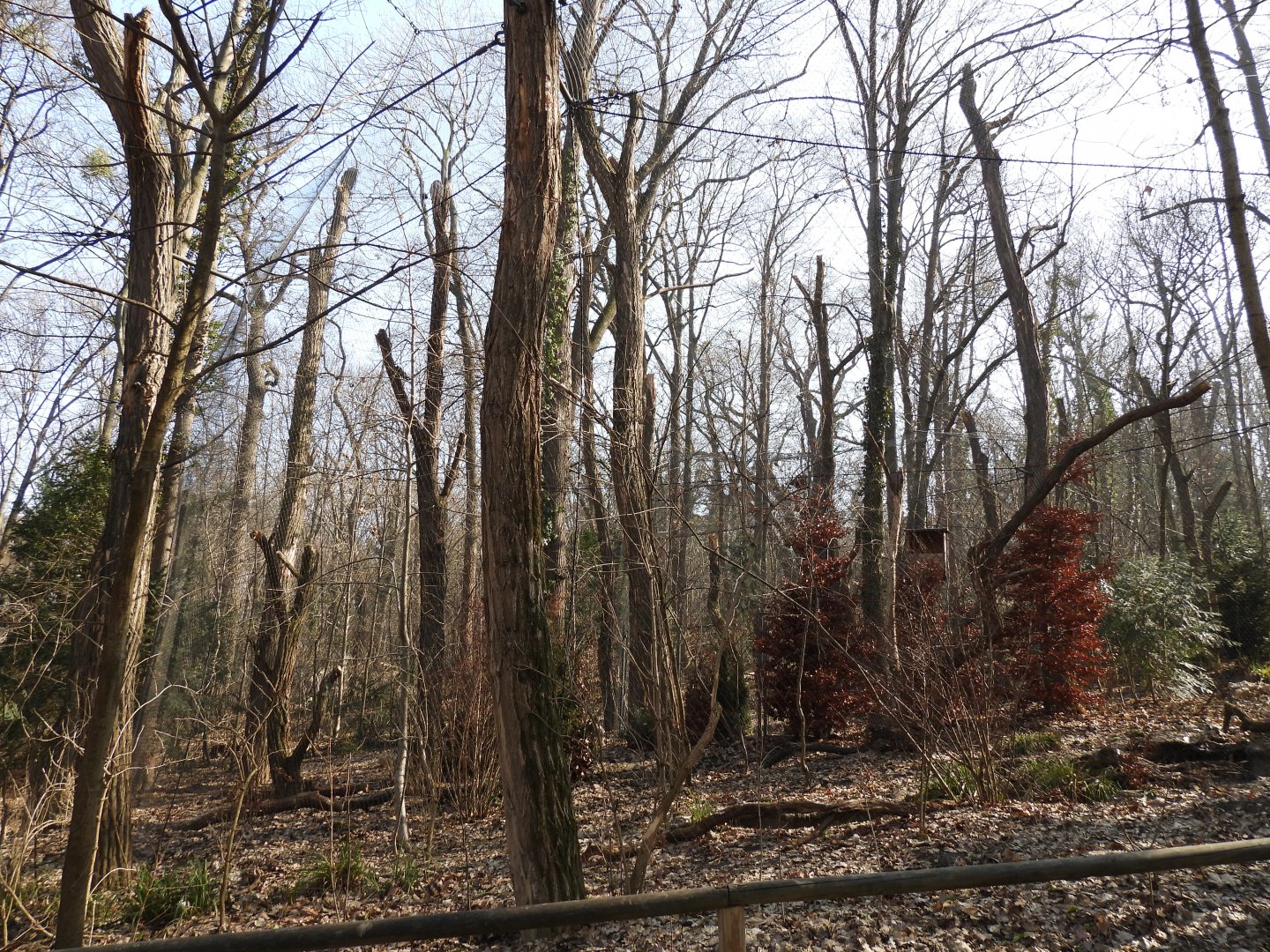
This exhibit is large, located within dense mature woodland, and is very well-suited for the breeding group of wolves held within.

As suggested by @Kalaw , it isn't quite as large as the Beauval exhibit at 2,800m² (as opposed to 7,500m² if the bear and wolf mix at the French collection is indeed still extant, and 3,000m² if the wolf exhibit is restricted to the area indicated by the Beauval map) but I think it is better for the inhabitants overall.

P1160072.JPG

P1160073.JPG

Ural Owl

I would argue that few exhibits for a native owl species get better than this one - rather than overcomplicating matters, the aviary merely comprises a large area of the existing woodland fenced off, meshed-over and supplemented by nestboxes. One of the more interesting aspects of this exhibit is that it is actually a mixed-exhibit for Ural Owl and Fire Salamander, as indicated by the educational signage - it contains a colony of the latter species, which can be seen with a lot of luck and patience (and which I suspect may have been present prior to the exhibit being built!)

The other important aspect of this particular exhibit which I feel requires particular attention is the fact that it is integral to the ongoing conservation and reintroduction programme for Ural Owl in the extensive forests located to the west of Vienna - all of the Ural Owls bred at the zoo are released into the wild within the Wienerwald and Lainzer Tiergarten.

P1160085.JPG

P1160083.JPG


Common Raven

I don't have any decent photographs of this aviary, which is located on the opposite side of the visitor path from the Ural Owl aviary and follows more-or-less the same general design ethic, being an area of fenced/meshed-over woodland.

Honey Bee

Depicted pretty well in the photograph already cited by @Kalaw - image attachment limits preclude me from posting any of the (copious) informational signage which is present within this exhibit.

Eurasian Lynx

Again, where my 2022 photographs are concerned I don't have many decent shots of the Lynx exhibit and will check my 2023 and 2024 photographs anon - for now, this shot should suffice in demonstrating the full use of the vegetation and mature woodland available in creating a fairly simple but extremely good exhibit for the species at hand. At a rough guess I would estimate this exhibit is about the same size as the previously-depicted wolf exhibit.

P1160096.JPG


Educational displays

Beyond the Tirolerhof and surrounding domestic exhibits, the public footpath extends through a pleasant expanse of forest which is dotted with a wide variety of signs discussing the native species which occur wild within the forest, the species of trees which comprise the forest itself, the conservation work undertaken to maintain the native forest and woodland habitats in the area, along with several other related subjects. Although not directly related to captive animal husbandry, I would nonetheless aver that these educational exhibits are an intrinsic part of why this segment of Tiergarten Schönbrunn is so good. The following are a small selection of the signs visible within this area.

P1160118.JPG

P1160123.JPG


P1160115.JPG


Terraria

The final segment of the woodland exhibit complex, at the end of the "forest walk" area, comprises a series of large terraria for a range of reptiles and amphibians native to the area, including fire salamander, alpine newt, Italian crested newt, yellow-bellied toad, adder, green toad and western green lizard, along with a variety of informational signage (similar in design to those located within the "forest walk") discussing these species along with other reptiles and amphibians native to Austria, including several occurring wild within the grounds of the zoo.

P1160138.JPG

P1160139.JPG

----

As noted, tomorrow I will attempt to find better photographs to fill the gaps I have left - and also cover the category-specific exhibits elsewhere in the zoo - but for now I hope I have provided a decent starting point for people to consider the strengths of Vienna within this category, using the woodland exhibit complex as a starting-point :)
 

Attachments

  • P1160072.JPG
    P1160072.JPG
    276.2 KB · Views: 28
  • P1160073.JPG
    P1160073.JPG
    270.9 KB · Views: 28
  • P1160083.JPG
    P1160083.JPG
    208.4 KB · Views: 27
  • P1160085.JPG
    P1160085.JPG
    306.1 KB · Views: 27
  • P1160096.JPG
    P1160096.JPG
    289.2 KB · Views: 29
  • P1160118.JPG
    P1160118.JPG
    184.2 KB · Views: 29
  • P1160123.JPG
    P1160123.JPG
    172.7 KB · Views: 27
  • P1160115.JPG
    P1160115.JPG
    199 KB · Views: 28
  • P1160138.JPG
    P1160138.JPG
    161.8 KB · Views: 29
  • P1160139.JPG
    P1160139.JPG
    268.1 KB · Views: 28
I certainly agree with @TeaLovingDave about the quality of the woodland area at Vienna.

One small side note: I thought Vienna's wolves were labeled as the arctic subspecies that occur in the Arctic tundra ecosystem instead of temperate woodland.
 
One small side note: I thought Vienna's wolves were labeled as the arctic subspecies that occur in the Arctic tundra ecosystem instead of temperate woodland.

The same actually applies for the wolves at Beauval too - in both cases they are just generic "zoomix" wolves, as there are no Arctic wolves in captivity within European collections.
 
All of the above may actually be moot - the current map for Beauval clearly shows the exhibit as now being split in two, dividing the bears and wolves entirely:

View attachment 804610

I'd be interested to hear from anyone who has visited recently and may know whether this is the case or not.
I don't know whether this is currently the case, but I don't think it is remotely fair to Beauval to assume that it is. On my visit way back in 2019, the two species were separate. Since then, they have been introduced and separated again on various occasions by opening up the two enclosures, but are mixed more often than not. Whether or not they are mixed likely changes far more frequently than the design of the zoo's map does, so the map has to show one outcome or another even in the knowledge that it may not be true.

In the time being, I think it is fairer that we assume they are mixed. Unless, of course, someone has visited over the last month or so and can disprove this.
 
Back
Top