Grand Zoo Parc de Dion

MClaeys

Well-Known Member
Hello my dear speculative zoo fans. I hereby want to show you my big project I’ve been working on for a while now. The name of this project is going to be Grand Zoo Parc de Dion. It is actually a rework of an original project named Zoo Park Dyonyssus I did at the Dutch and Belgian community Laafsekikkers.

Grand Zoo Parc de Dion, situated for the biggest part at Dion, a sub-municipality of the Belgian city Beauraing at the province Namur. The domain is also for some part situated in Winenne and Fromelennes. This zoo is a member of the EAZA, WAZA and EEP. It isn’t just a normal zoo. It is around 400 acres in size. That’s going to be a real big zoo for Belgian standards.

What you can expect… lots of animals and a lot of big enclosures and good theming with fitting habitats. We have a mix of both animals that are known with the big audience and also less known animals. Mammals, birds, reptiles, amphibians, fish, invertebrates, … we have it all at Dion.

Here are the 18 theme worlds for Grand Zoo Parc de Dion that we will talk about.

1. The Wonders of Europe
2. Kids’s Farm
3. The Beach
4. The Sahara
5. The Dense Jungle Trail
6. The East African Savannah
7. Cape Kingdom
8. Lemur Island
9. The Rimbu of Southeast Asia
10. The China Complex
11. The World of Japan
12. Canyons of North America
13. The Middle Americas
14. The Amazon Territory
15. The Andean Ledge
16. The Cold Realm
17. The Australian Wilderness
18. Faraway Islands

As a bonus there is also a dogs and birds of prey demonstration for extra animation in a specially designed colosseum.

This weekend, normally I’ll show you the first part, The Wonders of Europe. Like you can read, the first continent we’re going to talk about is Europe.

Tips and tricks are always welcome! I’ll enjoy posting these updates for sure. I hope you will like the concept.
 
I’d like to add two new worlds to my project.

The Central Asian Habitat
Grand Zoo Park of Dragons

This will be the updated list.

1. The Wonders of Europe
2. Kids’s Farm
3. The Beach
4. The Sahara
5. The Dense Jungle Trail
6. The East African Savannah
7. Cape Kingdom
8. Lemur Island
9. The Central Asian Habitat
10. The Rimbu of Southeast Asia
11. The China Complex
12. The World of Japan
13. Grand Zoo Park of Dragons
14. Canyons of North America
15. The Middle Americas
16. The Amazon Territory
17. The Andean Ledge
18. The Cold Realm
19. The Australian Wilderness
20. Faraway Islands
 
Before we kick of with the first part, let’s talk about the entrance.

As our park is situated at the wild Ardennes with municupalities Dion, Winnene and Fromelennes, it is a wooded area with hills and so to get at the entrance and parking zone we need to go through the woods.

It is easy to reach by car, bus and train, since shuttle busses to the park coming from Beauraing and Namur and there’s also a train that stops at Beauraing. At the train station you can take a shuttle bus every 20 minutes to Grand Zoo Parc de Dion.

The park has four parking zones. We have parking A, parking B, parking C and also a special parking zone for resort guests. We ask 10 euro for parking your car.

After showing your online parking ticket or after buying one at the kiosk before entering, the barrier opens and you can drive in.

There is also a bicycle shed for people who come by bike. There is also a bus parking zone at parking B for people who come with groups.

The shuttle bus stop is situated just near parking C. The parking zone is covered to prevent nuts like acorns or horse chestnut falling on your car. You can compare it with the parking zone of Pairi Daiza.

Then it’s time we go to the entrance. We also looked after the safety for our guest so we placed red lights to make sure we won’t have accidents. We enter a big plaza with a fountain, statues of animals (bears, wolves, elephants, lions, gorillas and deer).

After we pass this plaza, we go through a semicircular arc flanked by two tiger statues and we arrive at the entrance. We have two ticket kiosks that are almost always both opened, depending on how crowded it is, toilets, a souvenir shop, a check-in and check-out for resort guests and also some horeca points like a burger stand, a French fries hut and a waffle and pancake stand.

The ticket price for one day is 48 euro. It’s not cheap, but you get value for your money. A park subscription is 73 euro. So if you compare it to a day ticket, the price is pretty okay I guess. Other ticket prices will be revealed soon.

After we have our ticket it’s time to enter. We have ten gates. Scan your ticket at the entrance and there we go, we’re in and we can prepare ourselves to meet the first animals in ‘Wonders of Europe’. We already see a big castle towering above us. What will we see there…

This is an interesting one to know by the way. Most of our personel speaks three languages: French, Dutch and English.
 
Last edited:
I also want to include a first enclosure now that I think about it. After going through the semicircular arc there is an aviary for rooks (Corvus frugilegus) (4.4) on the right side of the path. The aviary is spacious, has some (dead) trees, bushes and has a grassy subsoil.

Here are some photos to give you an idea how it looks like.

Credits to Dr. Wolverine
Eastern Rook (Corvus frugilegus) - ZooChat
 
Last edited:
I know it takes a while to see my park, but I promise you it will be worth it. This week I’ll start posting the first parts.

While waiting here is some more information you need to know for visiting Grand Zoo Parc de Dion.

Normally you can visit Grand Zoo Parc de Dion from 9:30 AM until 6:30 PM. At the nocturnal periods, the zoo is opened until 10:00 PM.

As we were saying, we had a ticket price of 48 euro for an ‘adult’ (12-64) for one day at Grand Zoo Parc de Dion. Children up to 3 years old can enter the zoo for free. Children between 3 and 12 years old can enter the zoo for 39 euro. 65+ years old can take a visit at Grand Zoo Parc de Dion for 44 euro. I also took a look at the subscription price, but I’m afraid, for all the animals you can see, we need to ask a little bit more.

Ticket prices for 2025:
Our little ones (-3 years old) - Free
Child (3-12 years old) - 39 euro
Adult (12-64) —> 48 euro -
Senior (65+) - 44 euro

Subscription prices
Child (3-12 years old) - 88 euro
Adult (12-64) - 97 euro
Senior (65+) - 94 euro

If we compare this to Pairi Daiza for example it still isn’t too much for a subscription. The ticket prices for a day are a little bit in the same trend, but the park is almost double the area surface too, so it compensates.

As we said, there is also going to be a resort for guests who want to visit the zoo for more than one day. There are some options, to see which animals will be your ‘roommates’, take a look. (if you don’t want to get spoiled, don’t open the spoiler!)
The Hyena Cave - Spotted hyenas
The Big Safari Lodge - Animals of the African savannah
The Meerkat Hut - Meerkats
The Lion Lodge - Lions
The Cheetah Hut - Cheetahs
The Sloth Bear Lodge - Sloth bears
The Elephant Hotel - Asian elephants and other Indian animals
Sumatran orangutans and other monkeys

The resort prices are between 355 and 930 euro. We have rooms from one to six people.

I’ll also make a logo for my zoo. Normally this will also drop at the end of the week.
 
Last edited:
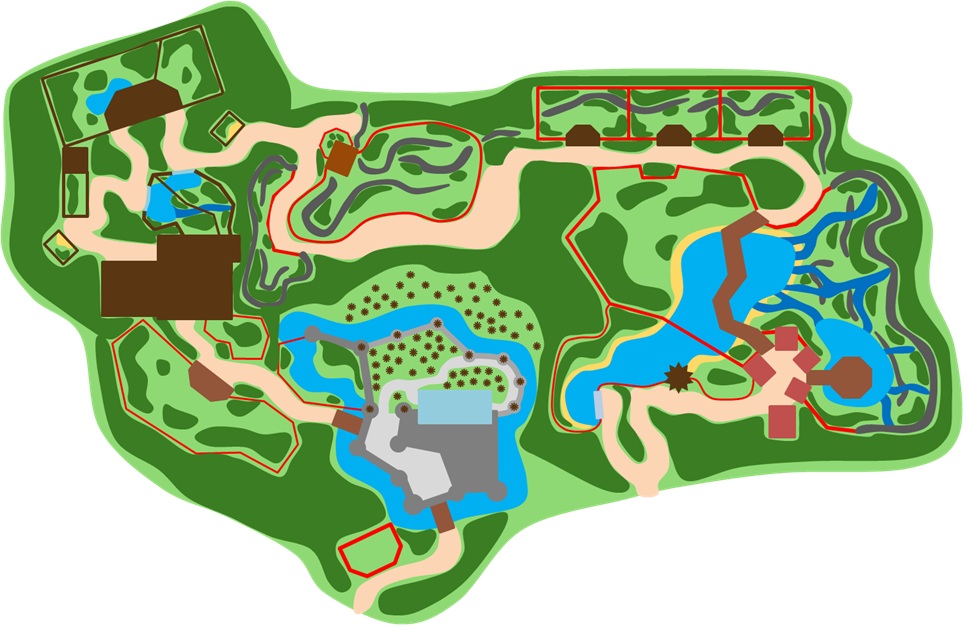
Alright, hereby I want to present you to our first theme world of Grand Zoo Parc de Dion. Welcome to the 'Wonders of Europe'.

Credits to @Mr.Gharial for making the maps and for helping with the project.


We have 4 sections in this theme world.

Section 1: Stork Castle

Section 2: Hunter's Forest

Section 3: Alpine

Section 4: Scandinavia

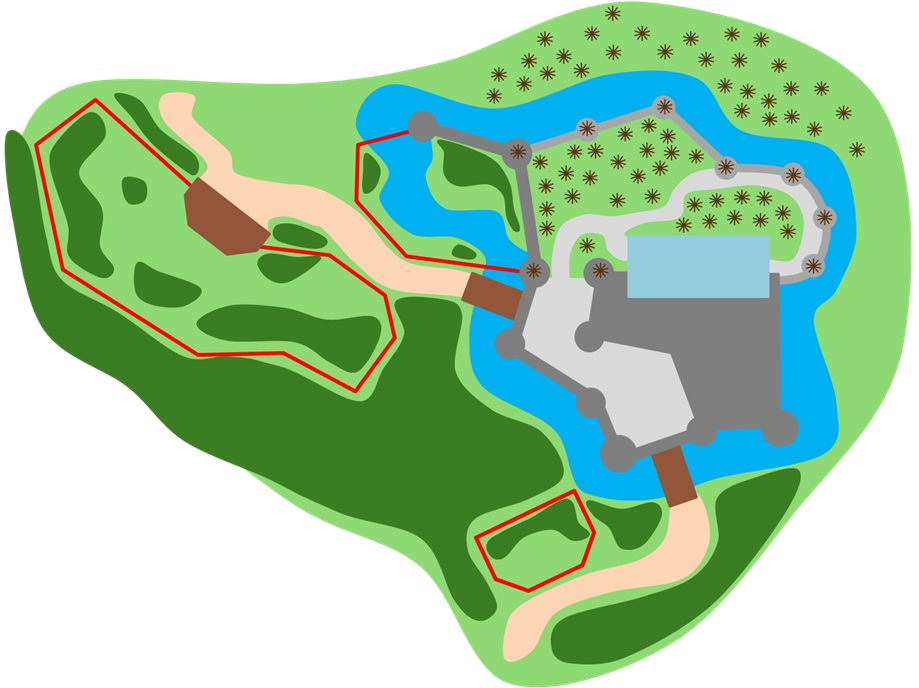
Let's begin with the first part. Welcome to the first section, Stork Castle.


After we passed the rook aviary and got through the entering gates, there's our eyecatcher at the entrance plaza at the right side. A big castle, surrounded by several nesting grounds for a big migratory bird. That's right we're talking about the European white stork. We have 70 known pairs of white stork living at Grand Zoo Parc de Dion.

There's also a restaurant named 'La Cigogne Affamée', in English 'The Hungry Stork'. The seating area is in a greenhouse, where you can also see the nesting and flying storks. We have a pretty extensive cuisine. Our guests can order some typical Belgian dishes like Vol-au-vent, Flemish stew, Meatballs in tomato sauce and Scampi diabolique, but also Italian food like Spaghetti or Lasagna bolognese and Pizza margherita or pepperoni. All the Belgian dishes will be served with French fries. When you go outside you can also view the castle from another side and take a look over the water, where there are some more nesting grounds for the storks.

Castle on zoo grounds - ZooChat

View in 'Castle Creatures' - ZooChat

European White Stork in Parc de l'Orangerie - ZooChat

When you exit the castle and pass the decking, you encounter the cormorant aviary at the right side of the parth. The main animal here is the Eurasian great cormorant. These are combined with the follow bird species: European hoopoe, barnacle geese, northern shovelers, black-necked grebes. In the water there are also European carps. The biome of this aviary is the swamp.

Black Stork aviary - ZooChat

Up next there is the enclosure for the Central European wild boars. Go on with the path and turn to the left an you will see a group of six animals. The wild boars exhibit gives an impression of the Ardens, where the zoo is also located by the way.

Here's what it looks like.

Central European Wild Boar (Sus scrofa scrofa) - ZooChat

When you go on with the path, we enter the next section, what will we find there...

An overview of the animals we have seen at the first section of 'Wonders of Europe'.

Mammals:
Central European wild boar (Sus scrofa scrofa)

Birds:
European white stork (Ciconia ciconia ciconia)
Eurasian cormorant (Phalacrocorax carbo sinensis
European hoopoe (Upupa epops epops)
Black-eared grebe (Podiceps cristatus)
Barnacle goose (Branta leucopsis)
Northern shoveler (Spatula clypeata)

Fish:
European carp (Cyprinus carpio)

Next will be the second section, the Hunter's Forest.

Credits to everyone for the photos.
 
Last edited:
Hello there everyone, Mr Gharial here with some clarifications about this "collaborative" zoo.

I wouldn't call it a full collab zoo, as I'm more of a consultant here. As mentioned, Mclaeys had already been posting his spec zoo on the Dutch/Belgian zoo website Laafsekikkers. He mentioned there he also wanted to work with making maps so when I saw he started this thread I thought I might as well send him a message.

We go back and forth with the species list for a bit and then he sends me the map he made. In the case of this first area, I had to do a lot of "course-correcting", so it's mostly me. But the next few areas (Kid's farm and onwards) I barely changed a thing. After the kid’s farm has been uploaded (and if Mclaeys doesn’t mind) I might show the comparisons between his “first draft” and my “touched up” version.

With that said I’m gonna share a few of my own inspiration pics to further show the “style” of this area.

The first enclosure we come across is the medium-sized aviary for rooks, this is a relatively simple structure made with wooden poles and filled with some relatively dense foliage, similar to this:
European eagle-owl aviary - ZooChat

Then, our castle. This is actually styled after two different Belgian castles. On the bridge side, it looks quite similar to Castle Gravensteen in Gent. With multiple flanking towers and a heavily fortified wall. The walkway through the castle also replicates Gravensteen's inner courtyard.

Outer wall of the castle:
Castle inspo 2.png

The grass courtyard section, and the stork nesting grounds, are inspired by Castle Wijnendale, from the same side of Belgium. A large, grassy courtyard lined by a wall that is short from the visitor's perspective, but is still quite tall over the moat.

Castle courtyard:
Castle inspo 1.png

Now, when I was presented with a Cormorant aviary, set in a Belgian zoo, set near/next to a castle, I immediately got flashbacks to my trip to Brugge/Bruges. Cormorants, canals and medieval architecture all come together there so that's what the Cormorant aviary is heavily inspired by. The back of the aviary is formed by an extended castle wall and the castle moat runs right through it. There's also a grassy field with some trees in the back of the aviary, all taken right from Brugge (but not literally).

Bridge and canal style past the cormorant aviary:
Swamp inspo.png 20221018_122710.jpg

The riverbank (moatbank?) is also based around the famous swan area in Brugge:
20221018_094036.jpg 20221018_095550.jpg

There's quite a few weeping willows as well as some trees with tall, bare branches to allow the Cormorants to perch up high, just like they do in Brugge:
20221018_133650.jpg
(The Brugge photos are mostly my own! :D)

Finally, I personally imagined the Boar enclosure to be much more forested, like here:
Black Sable Antelope (Hippotragus niger niger) - ZooChat

Although, realistically, it wouldn't be as planted on the ground because of the boars, well, doing their thing.

And, of course, I'm finishing it off with a species list picture. I was originally planning on sending this to Mclaeys before he posted, but it seems he got here ahead of me ;)

Stork castle.png
 

Attachments

  • Castle inspo 1.png
    Castle inspo 1.png
    1 MB · Views: 12
  • Castle inspo 2.png
    Castle inspo 2.png
    1.2 MB · Views: 12
  • Stork castle.png
    Stork castle.png
    807.8 KB · Views: 232
  • Swamp inspo.png
    Swamp inspo.png
    1.5 MB · Views: 12
  • 20221018_094036.jpg
    20221018_094036.jpg
    306.1 KB · Views: 12
  • 20221018_122710.jpg
    20221018_122710.jpg
    255.8 KB · Views: 12
  • 20221018_095550.jpg
    20221018_095550.jpg
    280.2 KB · Views: 12
  • 20221018_133650.jpg
    20221018_133650.jpg
    398.5 KB · Views: 237
Last edited:
Here’s a little update for our project.

As the design took forward, I must say this animal theme park will be really huge! Grand, as the name of the zoo says. So actually, even 400 acres will not be enough. In volume it will be like 3 times as big as Pairi Daiza for example.

We’ve designed a lot of maps per theme already. Soon I want to go through the exhibits with all of you again.

Looking back on my first project I did at the Dutch platform Laafsekikkers, Zoo Parc Dyonyssus, it will be splendid, a lot of changes have happened and I will show everything a lot more visual, so you can imagine just right how everything will look like.

Credits also to @Mr Gharial for all the help and support he’s given to my project already. Helping me with the list of animals, making some combination exhibits, helping me with the maps. And I must say, going through the process, my designs get better and better. It takes lots of work, but it will be worth it.
 
Credits also to @Mr Gharial for all the help and support he’s given to my project already. Helping me with the list of animals, making some combination exhibits, helping me with the maps. And I must say, going through the process, my designs get better and better. It takes lots of work, but it will be worth it.

Yup, nearly 30 pages of PM in, and I have to agree that your designing skills are improving!
 
It’s getting hot in Belgium this week, so that means we will give the animals of Grand Zoo Parc de Dion some resfreshments. There isn’t a heat wave yet, but this weekend it will be around 31 degrees Celcius, or 87,8 degrees Fahrenheit.

Most of the animals look out for the shadow on these warm days. Trees, long grass, shrubs, hollow trees, and when it gets too hot to stay outside, some of them like to stay in their inner sheds. So, in short, they like to chill and avoid the hot sun.

At the other hand, some of them just like the sun. We humans are not the only ones who like some good weather, you know.

For our carnivores and primates we will be doing some frozen treats. The lions enjoy a juicy, bloody ice snack for example, while the gorillas like to have a taste on some frozen fruit treats.

Some other animals like ungulates and birds enjoy a shower. In some aviaries for our parrots, the zoo has installed a ‘rain’ system that can be activated when it’s real hot. Otherwise we also have the garden hose to make the animals wet when they want to.

Other animals at Dion like our wild boars, enjoy a mud bath. The perfect defense against bug bites and being dirty is just what pigs like, right?

And last but not least, the real die hards can take a swim, like our elephants. In some enclosures there is the possibility to take a jump into the water, and with these temperatures, there is THE opportunity to make use of water sources.

Well, this is how our zookeepers and the animals handle the heat at Grand Zoo Parc de Dion.

Not a real update, I know, but some entertainment isn’t too bad I guess here? For the ones who read through, some animals got spoiled on purpose.

I’m also designing the zoo logo by the way. Soon I will show you how the Grand Zoo Parc de Dion’s zoo shield will look.
 
Last edited:
Hello, dear followers of Grand Zoo Parc de Dion…

Finally! Here it is… the moment you’ve been all been waiting for! The summer is over, and we (Mr. Gharial and I) already got a several worlds ready to present.

Here’s part 2 of ‘Wonders of Europe’, the Hunter’s Forest. The next European section of animals can’t wait to meet all of you! Enjoy!

First I'll show you the standard version.
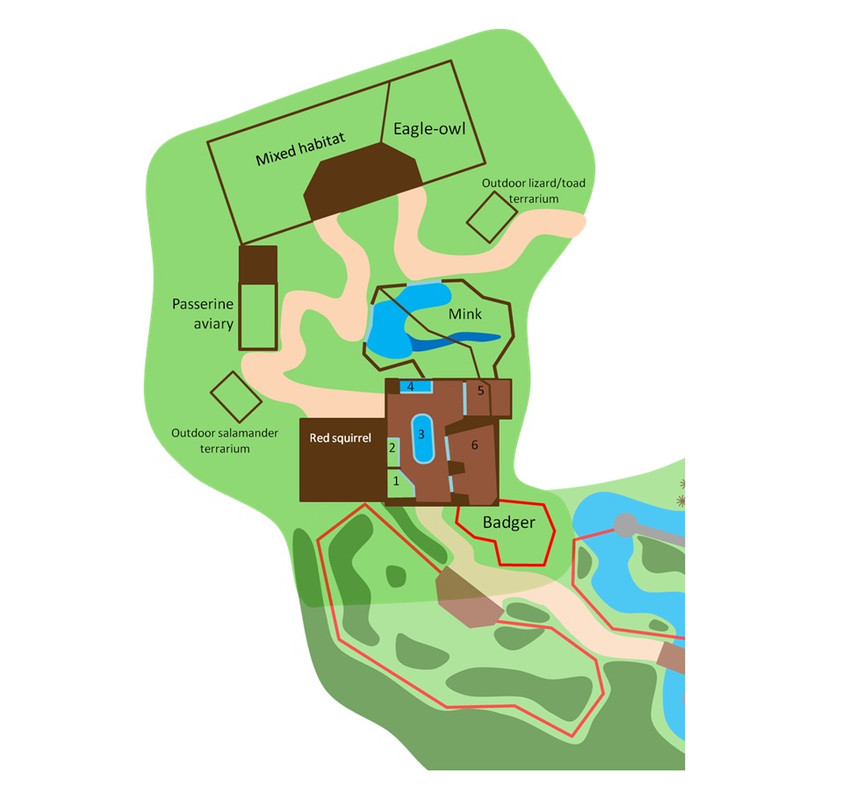


Here is the decorated version.
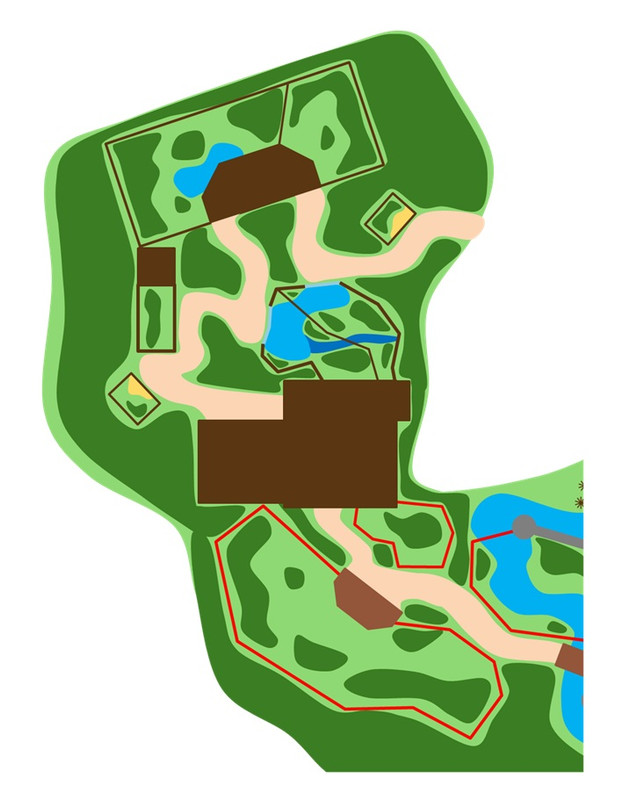


Last time we ended on our trip through ‘Wonders of Europe’, we had the enclosure of the wild boars. If we follow the path a little bit further we encounter a hut. A ‘chalet’ like we call it at the Ardennes Forest (a region of forests, rough terrain and hills in Belgium, Luxemburg, France). And this house is home to Roger the hunter, or in French: Roger le chasseur. The house is decorated with antlers, pelt, animal skulls, ... There are also hanging some guns (a shotgun and a nightvision scope for example, ...) and other hunting tools at the wall, like bear traps and rabbit cages for education.

The house of the hunter is home to several species of animals. Some of them also have an outdoor space. To start, if you look go from the wild boars to the other side of the path, here is the European badger. Grand Zoo Parc de Dion has two female badgers living in an outdoor exhibit, with the option to go in their inner shed inside the house.

Next is another special carnivoran mammal, that is also found a lot at the water’s edge. It’s the European mink. European mink are critically endangered now and in Dion we are also supporting the breeding program of EAZA, so we have a couple. In the mink’s moat there are also some fish, which also provides some extra life in the water. We got a group of European bitterlings.

If we enter the house, the atsmophere of the Ardennes is taking over. If we look to the right we can ser the indoor enclosure of the badgers after a glass barrier. There are two viewing points to see this carnivoran mammal inside.

Left to the badgers’s indoor box, there’s a middle sized aquarium. It’s time to meet the European crayfish and ninespine sticklebacks. For the crayfish we have a couple. In case of the sticklebacks we have 0.0.10 fish.

Go more to the left and to the beginning of the house to follow the row of the left indoor habitats and you’ll see the first terrarium in the hunter’s house. It’s the one that houses sand lizards (1.1) and natterjack toads (1.1). A good thing to know is during the spring and summer season these animals have an outside living space in a terrarium.

Just next to the sand lizards and natterjack toads, there’s a terrarium for a group of 4.4 banded fire salamanders. Just like the lizards and toads, we can bring our salamanders to an outside terrarium.

Next on our list, we have the indoor living space of the European red squirrel. We have 1.1 of these cute, arboreal animals. The squirrels got both a outdoor cage and a inner shed. So when you leave the house, it is possible to see them in a well planted aviary.

After seeing the red squirrels, if we go to the right again, we got a little tank for great diving beetles (1.1). These predatory, aquatic beetles are certainly a nice addition for the chalet.

Last but not least in the hunter’s house, we have on of the inner sheds of the critically endangered European mink (1.1). Later on, we will see their outdoor enclosure, which is a really nice one. When they are inside, you can see the mink after a glass barrier. The animal that can be seen inside by the visitors, is the male mink.

Now it’s time we leave the house and go looking for the next animals in this European forest. If you follow the route there is the aviary of the European red squirrels as mentioned before.

Next up, following the route, you see the outdoor terrarium of the banded fire salamanders. Like mentionned the animals are only present outside during the warmer periods of the year. Otherwise, you can just see them in their original exhibit in the hunter’s house.

If we go on with the path, we have a medium sized aviary for the northern bullfinch (1.1) and the European quail (1.3). The aviary of these two bird species is well plantedso, so they can hide and nest if they want to.

After encountering the second birds aviary at Dion we have seen, we encounter the exhibit of the male European mink. Later on it is also possible to see the female mink. The two enclosures can be made into one for breeding purposes. In the water you can see European bitterlings for some extra life in the water, where they love to take a swim (and maybe like to snatch a little fish snack?)..

Next, we see two bigger aviaries. The first one, the biggest one of the two, is a mixed woods aviary with two species of birds of prey and two species of owls. We got the long-eared owl, the western barn owl, the common black kite and the European kestrel - all 1.1. On the ground lives a couple of western capercaillie. The second aviary, which also is pretty spacious, is inhabited with a couple of the Eurasian eagle owl, one of the biggest owl species in the world. The aviary is provided with a lot of green (trees, shrubs, grass, …) and also with a shelter hut for the owls.

Two exhibits to go... After seeing the raptors and birds, we take a look into the female European mink exhibit, which doesn't look to different from the male's exhibit. Both living areas give a swamp impression. Just like in the first mink exhibit, you can see the European bitterlings too.

And last but not least, the outdoor terrarium for the sand lizards and natterjack toads. Is it the right season? Then you can see the animals. Is it not? Make sure you have seen them at the hunter's house. And with that, we made a nice trip through the forest.

Looks like we’re through section 2 of the ‘Wonders of Europe’ theme. I hope you enjoyed this part of Grand Zoo Parc de Dion. Here’s an overview of the animals we saw again.

Mammals:
European red squirrel (Sciurus vulgaris)
European badger (Meles meles meles)
European mink (Mustela lutreola)

Birds:
Northern bullfinch (Pyrrhula pyrrhula pyrrhula)
European quail (Coturnix coturnix)
Long-eared owl (Asio otus)
Western barn owl (Tyto alba)
Common black kite (Milvus migrans migrans)
European kestrel (Falco tinnunculus)
Western capercaillie caillie (Tetrao urugallus)
Eurasian eagle-owl (Bubo bubo)

Reptiles:
Sand lizard (Lacerta agilis)

Amphibians:
Natterjack toad (Epidalea calamita)
Banded fire salamander (Salamandra salamandra terrestris)

Fish:
Ninespine stickleback (Pungitius pungitius)
European bitterling (Rhodeus amarus)

Invertebrates:
European crayfish (Astacus astacus)
Great diving beetle (Dysticus marginalis)

Next up will be section 3 of ‘Wonders of Europe’, the Alpine.

P.S. I'll also post some inspiration images later this weekend. And so will Mr. Gharial, also with the species list picture, like he has done with section 1.
 
Last edited:
Some inspo pics:

The outdoor reptile habitats are in the typical, netted style. filled with a mix of heath plants, tall grass and dune bushes:
Western sand lizard enclosure 020825 - ZooChat
Sand lizard enclosure - ZooChat

The Mink enclosures are surrounded by rather tall, wooden walls. The glass viewing windows are partially underwater, so you can see the Minks playing on the water's edge:
Itampalo - Fossa viewing point - ZooChat
(^ Doesn't show the underwater section but it gives a good feel of how it would look anyway)

The grand, wooden aviary isn't very well-viewed from anything but the viewing hut, if uncovered it would look something like this:
Snowy owl aviary - ZooChat

Species of the hunter's forest:
Hunter's Forest.png
 

Attachments

  • Hunter's Forest.png
    Hunter's Forest.png
    890.8 KB · Views: 87
Hello! As promised - sorry for the delay, I was on a trip to Europapark, with also a little stop at Zoo Basel - here are some inspiration pictures of my point of view.

European badger habitat 030924 - ZooChat

-
To start, I like to show you what the European badger exhibit looks like. Credits to @gulogulogulo

Wildpark Langenberg - Müsli-Hüsli Haus - ZooChat

Next, this is what the outside of the house of the hunter would look like. A nice, wooden hunting hut, a bit like a chalet. Credits to @Philipine eagle

Nortica - Siberian red squirrel enclosure - ZooChat

- Here’s a reference for the Euopean red squirrel exhibit. This is the old exhibit of the Siberian red squirrels in Wildlands. Recently we went to Wildlands together, but seems like I can’t find the picture of the renovated exhibit anymore. Credits to @Mr Gharial

Red squirrel - ZooChat

- And here is what it looks like inside the enclosure. Like you can see, a nice, green rodent aviary. This is one of the photos I took at Zoo Basel, I was quite lucky to see a wild red squirrel strolling around in the grass.

British red squirrel habitat 100924 - ZooChat

- This would be a reference for the Eurasian eagle-owl aviary. Ironic thing: this is also a red squirrel exhibit. Credits to @gulogulogulo

So, I hope this helps to make it a little bit more visible.
 
Last edited:
Goodevening, here I am again. :)

Well, well, guess what? Is it time for another part of Grand Zoo Parc de Dion? Yes, it is... The next world will be... Wow, not so fast... we're not through 'Wonders of Europe' yet... But I hope you are ready for section 3, because I am. Talk about picking up the pace... I've let you wait long enough after the first section. Grand Zoo Parc de Dion has been too quiet for quite too long.

Take out your walking shoes and winter jacket, and maybe even your ski suit. Are we going to the North Pole? No, but normally it isn't very warm there either. When you enjoy going on a winter holiday at countries like France, Germany, Austria, Switzerland, etc. ... then you are on the right track. Welcome to the Alpine, in French: les Alpes!


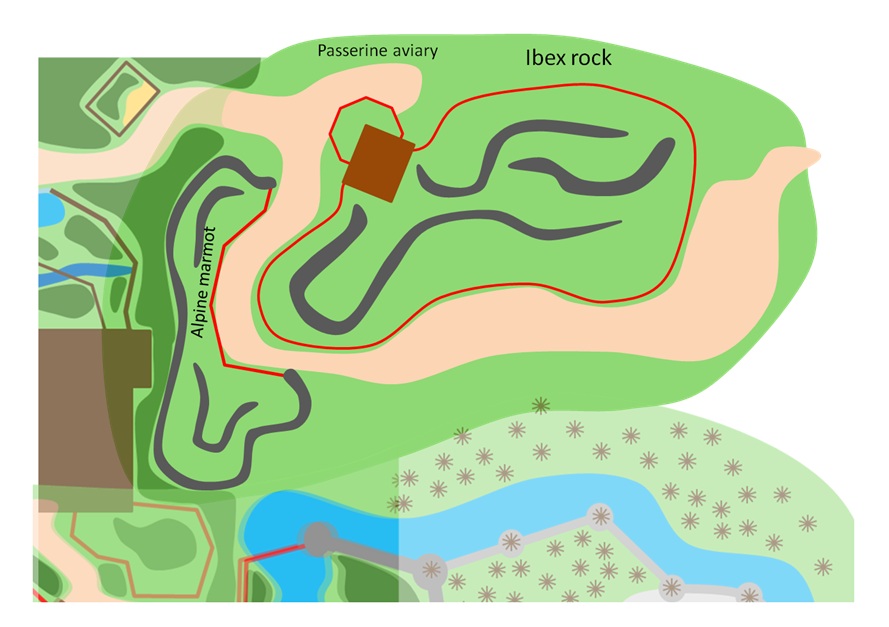
Here is the standard version.


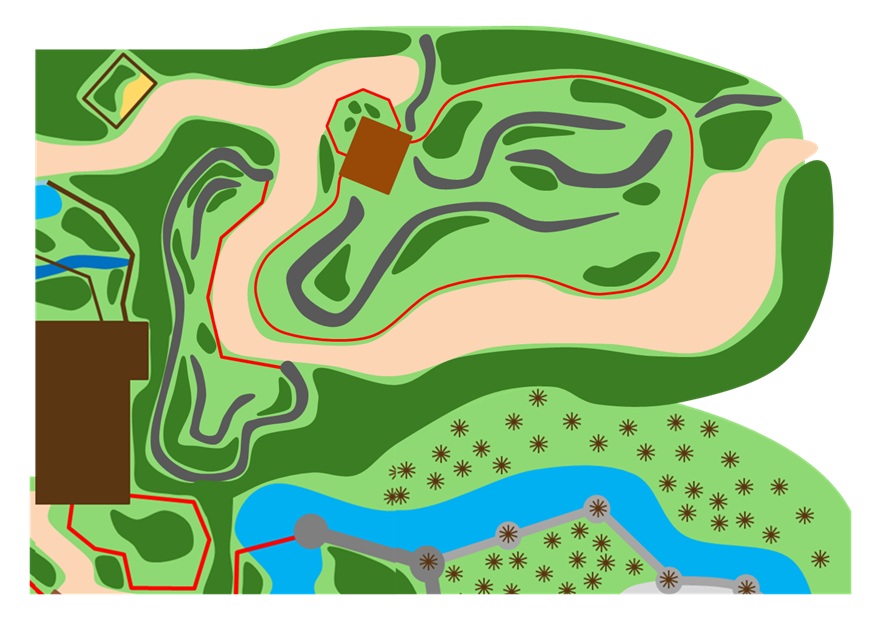
And here is the decorated version.

Like you can see, it's still a pretty forested area, but of course a lot rockier than the Hunter's Forest. This section of 'Wonders of Europe' gives the feeling that we're in the Black Forest, also named the 'Schwarzwald' in German. Don't get confused, because the Black Forest isn't part of the Alpine, but actually a 'Mittelgebirge' before entering the mountains we're talking about.

First on our route, after leaving the forest of the Ardennes, there's a small aviary with a couple of red crossbills and a pair of alpine rock partridges. This passerine aviary is green enough for the crossbills to hide and nest when they want to. Their inner shed is built against the stable of another animal in this section, that we will encounter later on the trail.

When we follow the path we have the choice to look at two enclosures. When you look to the left, you can see the mountain of the alpine marmots (6.10); which is a pretty large one. This mountain animal has a pretty rough exhibit with holes, trees, shrubs, some heath plants, grass, ... The alpine marmots are the second rodent we encounter on our path through 'Wonders of Europe'. Time to take a look at the other enclosure.

Yup, we're talking about the one that is connected with the aviary for the red crossbills and the alpine rock partridges. We see five big goat-like animals on the rocks. It's at this point that you meet our alpine ibexes (5.0). Grand Zoo Parc de Dion chooses for five males in this pretty large exhibit. Two of them are brothers, the other three are animals that are not related. Just like the exhibit of the alpine marmots, the alpine ibex has a very rocky exhibit, also with some slopes in their paddock. Their stable gives a typical ski resort hut vibe. This is without a question the biggest animal exhibit of the Alpine section: we can call it the ‘Mont Blanc’ of our Alpine region.

Before leaving, I want to say this. 'Wonders of Europe' has a food truck too. We choose for some typical West European snacks in this world. In Belgium there are French fries of course (Belgian fries actually, oh well...), and we also have the choice for hot dogs, 'bratwurst' and hamburgers. If a normal hamburger is too ‘normal’, you can also choose for a Bicky burger or a cheese burger. For the fried snacks we go with 'curryworst', meat balls, chicken nuggets, cheese croquettes and bami goreng disks. This food truck drives through the entire zoo park. So sometimes it's just where it belongs (at the small plaza at the ibex rock), at other times it's can be at another world of Grand Zoo Parc de Dion.

Every world has its own food truck, by the way. Which other food trucks are coming up next? Find out! But for now, you will have to wait until we're done with 'Wonders of Europe'.

Okay, folks, there we are again. This must be the smallest species list of the sections we have in 'Wonders of Europe'.

Mammals:
Alpine marmot (Marmota marmota)
Alpine ibex (Capra ibex)

Birds:
Red crossbill (Loxia curvirostra)
Alpine rock partridge (Alectoris graeca saxatilis)

After this, we're going to Scandinavia, the fourth and final section of 'Wonders of Europe'.

The species list picture will be decorated as usual by my companion Mr Gharial once again. I wonder what his inspo pics will be. :)
 
Last edited:
Whoops, seems like I forgot to send McLaeys the version with the food truck actually on the map!

Alpinen.png

The partridge/crossbill aviary is heavily inspired by the rocky aviaries of Alpine zoo Innsbruck:
full


full

(Photos by @felis silvestris)

Although it lacks Pairi Daiza's more obstructive fencing, the Alpine ibex enclosure does look similar to their Markhor habitat, with multiple rocky ledges and plenty of grass. The Marmot exhibit isn't too dissimilar either...
full

(Photo by @KevinB)

And now we finally see them! The food trucks!
Call me crazy, but this might be one of my favourite concepts of all the things we've brainstormed on. Every single world in Grand Zooparc de Dion has its own food truck, and its own food truck spot. With every truck serving different foods, these trucks will be stationed to a random spot in the zoo, so in this Alpine region there's a random chance you can encounter Mexican food from The Middle Americas, Dönner from the Central Asian habitat, or Afrikaans mixed grill from the Cape Kingdom!

With every new world we'll also reveal the menu from this world's food truck ;)

Species pictures:
Alpine region.png
 

Attachments

  • Alpine region.png
    Alpine region.png
    741.6 KB · Views: 62
  • Alpinen.png
    Alpinen.png
    501.7 KB · Views: 70
Back
Top