Day 16, Tuesday 16th August 2022
Tibooburra to Fort Grey (Sturt National Park)
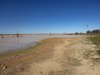
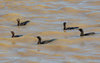
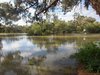
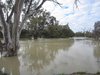
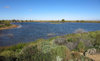
After a good night’s sleep I was up early to another cloudless sky and drove back up to South Myers Tank, a small body of water in the middle of the desert. I was here last year and it proved fairly productive bird-wise. In the middle of the tank is an island which usually has a variety of water birds resting on it, and this time was no different – four Black-tailed Native Hens, a Black-fronted Dotterel, a pair of female Australian Darters, two Little Pied Cormorants, twelve Little Black Cormorants and a Great White Egret. In the water were twenty-six Grey Teal, two Eurasian Coot, an Australian Wood Duck, a male Hardhead and Australian Grebe, while hawking over the water were around eighteen Fairy Martins.


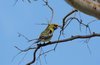
Walking around the tank I saw half-a-dozen Singing Honeyeaters, one which allowed me to approach reasonably close while it was vocalising, some Zebra Finches, a couple of Pipits, eighteen Crested Pigeons that were very shy, and around twenty Diamond Doves that weren’t quite as shy but were difficult to see as they seemed to be well camouflaged even though their plumage was nothing like the red/orange stony ground. In a neighbouring swamp on the other side of the road there were another dozen or so Black-tailed Native Hens, and elsewhere near the road were ten Orange Chats (which were very well camouflaged). During the two hours I was here I saw flying overhead a Brown Falcon, a Whistling Kite and Wedgetail Eagle, most of which spooked the waterbirds. And as I returned to my car there were eight Emus foraging in the grasses a bit further afield plus a lone Western Grey Kangaroo.


Back in Tibooburra I stopped into the National Parks Ranger Office to ask about camping at Narriearra Caryapundy Swamp National Park. This former station has in very recent times become a National Park and is largely unexplored by birders. However, it is known for having a population (i.e. a distinct subspecies) of Grey Grasswrens which are rarely seen as it’s difficult to get to them. And the rangers have established a campsite in the park not far from a swamp which has a decent population of waterbirds so I was keen to go in to the park and spend at least one night camping. It might be rough on my back but I figured the opportunity was worth the pain. However, the Ranger told me the Park was closed (and had been for a week) because there was water covering the access roads from all the rain and probably wouldn’t be open for at least another week. I was disappointed but there wasn’t much I could do. So instead I headed in the opposite direction, into Sturt National and up to the Fort Grey campsite and Cameron’s Corner.
The Fort Grey Campsite is 110 kilometres from Tibooburra and takes well over an hour if you stop along the way to look at birds. After arriving at the campsite and driving around to have look at it, I went back to the main road and continued on another 30 kms to Cameron Corner, the point were NSW, Queensland and South Australia meet. There’s a roadhouse/pub there where you can buy lunch, drinks and souvenirs. And, of course, you can look at the little monument that marks the exact position where the three states meet. But I wasn’t staying here long.
I continued westward into South Australia on Rieck’s Rd (which apparently is also known as Merty Merty Rd), my destination being a point 36 kilometres from the NSW border. Several bird reports have described this a good location for Eyrean Grasswren, another one of Australia’s small desert birds that are not frequently seen. They occur only in North-eastern South Australia, and the Cameron’s Corner area is the easternmost limit of their distribution.
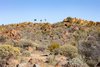
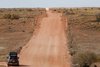
Rieck’s Rd is a great road for people who like rollercoasters. The road went up and over one sand dune after another, just like a BMX track except for cars. The dunes varied in height up to around 50 metres, you drive up to the top and down the other side and there would be another dune in front of you with 50-100 metres of flat road between them. Sometimes the gap between dunes was greater, in some cases almost a kilometre, but it was essentially an east-west road crossing dozens of parallel north-south sand dunes. (See the photo below, with my 4WD to give some scale – there’s also a 4WD on the crown of the last dune in the distance).

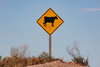
At first I was shooting up the hills at around 100kph and descending at around 80 (the speed limit is 100 kilometres per hour), but after a dozen or so I realised that at that speed, if I crested a dune and there were kangaroos on the downward slope, there was a good chance I’d hit them. I was then thinking they would probably be red Kangaroos which tend to be either singles or pairs out here in the desert, unlike Grey Kangaroos which live in large mobs, and a couple of Reds would be able to get out of the way quickly if I happened upon them. And then I saw this sign:

So I slowed down and made sure I crested the dunes at 60 kph, which was a good thing because a few kilometres further along there was a herd of 30 odd cattle between the dunes, some of which were on the road but moved off at my approach.
At exactly 36 kilometres from the gate I was at the base of dune #79, so I parked my car and climbed the road to the top of the dune and then headed across the top of it. There were low shrubs and a number of various grasses growing in the red sands. Despite the heat and the fact it was around 3:30 in the afternoon there were a few birds active. At least eight Pied Honeyeaters were flying around and vocalising, a small group of half-a-dozen White-winged Fairy-wrens were popping in and out of the grass tussocks, there were three Singing Honeyeaters and four Crimson Chats too. And a flock of about a hundred Budgerigars went flying past.

I had wandered about 50 metres from the road and was not visible to passing traffic, so when a car with a caravan came along and slowed down and then stopped at my car, I had to hurry back to the road and yell that I was fine. A vehicle stopped in the middle of the desert, on a road with very infrequent traffic, may indicate someone in distress so I appreciated them stopping, whoever they were.
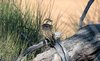
Heading back across the top of the dune to where I had been I considered calling it a day when I saw not one but two Eyrean Grasswrens fly out of the grasses into a low shrub and start vocalising! The shrub had no leaves on it (it may well have been dead) but all the sticks made photography a little challenging. However, I still managed to get a few half-decent images.


Really chuffed with myself for getting another Lifer, I went back to the car and commenced the journey over the 78 giant speedhumps back to NSW and then on to the Fort Grey campground, getting there just before dark. I picked a spot in the campground a short distance from everyone else and erected the tent, looking out into the bush. A flock of 200-300 budgerigars were wheeling about in the skies above, sometimes coming quite low, providing an entertaining sight for the other campers. And with another cloudless night I slept with the tent window open again so I could look up at the myriad of stars.
It was the last night I would spend sleeping in the tent.
Number of birds seen today: 28 species
Additions to my year list: 5
Bird Lifers: 1

Hix
Tibooburra to Fort Grey (Sturt National Park)
After a good night’s sleep I was up early to another cloudless sky and drove back up to South Myers Tank, a small body of water in the middle of the desert. I was here last year and it proved fairly productive bird-wise. In the middle of the tank is an island which usually has a variety of water birds resting on it, and this time was no different – four Black-tailed Native Hens, a Black-fronted Dotterel, a pair of female Australian Darters, two Little Pied Cormorants, twelve Little Black Cormorants and a Great White Egret. In the water were twenty-six Grey Teal, two Eurasian Coot, an Australian Wood Duck, a male Hardhead and Australian Grebe, while hawking over the water were around eighteen Fairy Martins.
South Myers Tank
Walking around the tank I saw half-a-dozen Singing Honeyeaters, one which allowed me to approach reasonably close while it was vocalising, some Zebra Finches, a couple of Pipits, eighteen Crested Pigeons that were very shy, and around twenty Diamond Doves that weren’t quite as shy but were difficult to see as they seemed to be well camouflaged even though their plumage was nothing like the red/orange stony ground. In a neighbouring swamp on the other side of the road there were another dozen or so Black-tailed Native Hens, and elsewhere near the road were ten Orange Chats (which were very well camouflaged). During the two hours I was here I saw flying overhead a Brown Falcon, a Whistling Kite and Wedgetail Eagle, most of which spooked the waterbirds. And as I returned to my car there were eight Emus foraging in the grasses a bit further afield plus a lone Western Grey Kangaroo.
Back in Tibooburra I stopped into the National Parks Ranger Office to ask about camping at Narriearra Caryapundy Swamp National Park. This former station has in very recent times become a National Park and is largely unexplored by birders. However, it is known for having a population (i.e. a distinct subspecies) of Grey Grasswrens which are rarely seen as it’s difficult to get to them. And the rangers have established a campsite in the park not far from a swamp which has a decent population of waterbirds so I was keen to go in to the park and spend at least one night camping. It might be rough on my back but I figured the opportunity was worth the pain. However, the Ranger told me the Park was closed (and had been for a week) because there was water covering the access roads from all the rain and probably wouldn’t be open for at least another week. I was disappointed but there wasn’t much I could do. So instead I headed in the opposite direction, into Sturt National and up to the Fort Grey campsite and Cameron’s Corner.
The Fort Grey Campsite is 110 kilometres from Tibooburra and takes well over an hour if you stop along the way to look at birds. After arriving at the campsite and driving around to have look at it, I went back to the main road and continued on another 30 kms to Cameron Corner, the point were NSW, Queensland and South Australia meet. There’s a roadhouse/pub there where you can buy lunch, drinks and souvenirs. And, of course, you can look at the little monument that marks the exact position where the three states meet. But I wasn’t staying here long.
I continued westward into South Australia on Rieck’s Rd (which apparently is also known as Merty Merty Rd), my destination being a point 36 kilometres from the NSW border. Several bird reports have described this a good location for Eyrean Grasswren, another one of Australia’s small desert birds that are not frequently seen. They occur only in North-eastern South Australia, and the Cameron’s Corner area is the easternmost limit of their distribution.
Rieck’s Rd is a great road for people who like rollercoasters. The road went up and over one sand dune after another, just like a BMX track except for cars. The dunes varied in height up to around 50 metres, you drive up to the top and down the other side and there would be another dune in front of you with 50-100 metres of flat road between them. Sometimes the gap between dunes was greater, in some cases almost a kilometre, but it was essentially an east-west road crossing dozens of parallel north-south sand dunes. (See the photo below, with my 4WD to give some scale – there’s also a 4WD on the crown of the last dune in the distance).
At first I was shooting up the hills at around 100kph and descending at around 80 (the speed limit is 100 kilometres per hour), but after a dozen or so I realised that at that speed, if I crested a dune and there were kangaroos on the downward slope, there was a good chance I’d hit them. I was then thinking they would probably be red Kangaroos which tend to be either singles or pairs out here in the desert, unlike Grey Kangaroos which live in large mobs, and a couple of Reds would be able to get out of the way quickly if I happened upon them. And then I saw this sign:
So I slowed down and made sure I crested the dunes at 60 kph, which was a good thing because a few kilometres further along there was a herd of 30 odd cattle between the dunes, some of which were on the road but moved off at my approach.
At exactly 36 kilometres from the gate I was at the base of dune #79, so I parked my car and climbed the road to the top of the dune and then headed across the top of it. There were low shrubs and a number of various grasses growing in the red sands. Despite the heat and the fact it was around 3:30 in the afternoon there were a few birds active. At least eight Pied Honeyeaters were flying around and vocalising, a small group of half-a-dozen White-winged Fairy-wrens were popping in and out of the grass tussocks, there were three Singing Honeyeaters and four Crimson Chats too. And a flock of about a hundred Budgerigars went flying past.
I had wandered about 50 metres from the road and was not visible to passing traffic, so when a car with a caravan came along and slowed down and then stopped at my car, I had to hurry back to the road and yell that I was fine. A vehicle stopped in the middle of the desert, on a road with very infrequent traffic, may indicate someone in distress so I appreciated them stopping, whoever they were.
Heading back across the top of the dune to where I had been I considered calling it a day when I saw not one but two Eyrean Grasswrens fly out of the grasses into a low shrub and start vocalising! The shrub had no leaves on it (it may well have been dead) but all the sticks made photography a little challenging. However, I still managed to get a few half-decent images.
Really chuffed with myself for getting another Lifer, I went back to the car and commenced the journey over the 78 giant speedhumps back to NSW and then on to the Fort Grey campground, getting there just before dark. I picked a spot in the campground a short distance from everyone else and erected the tent, looking out into the bush. A flock of 200-300 budgerigars were wheeling about in the skies above, sometimes coming quite low, providing an entertaining sight for the other campers. And with another cloudless night I slept with the tent window open again so I could look up at the myriad of stars.
It was the last night I would spend sleeping in the tent.
Number of birds seen today: 28 species
Additions to my year list: 5
Bird Lifers: 1
Hix
Attachments
Last edited: