Hix Goes Round the Edges

  • Thread starter Thread starter Hix
  • Start date Start date
Day 16, Tuesday 16th August 2022
Tibooburra to Fort Grey (Sturt National Park)


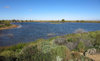
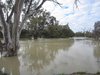
After a good night’s sleep I was up early to another cloudless sky and drove back up to South Myers Tank, a small body of water in the middle of the desert. I was here last year and it proved fairly productive bird-wise. In the middle of the tank is an island which usually has a variety of water birds resting on it, and this time was no different – four Black-tailed Native Hens, a Black-fronted Dotterel, a pair of female Australian Darters, two Little Pied Cormorants, twelve Little Black Cormorants and a Great White Egret. In the water were twenty-six Grey Teal, two Eurasian Coot, an Australian Wood Duck, a male Hardhead and Australian Grebe, while hawking over the water were around eighteen Fairy Martins.

upload_2023-6-21_21-6-48.jpeg
South Myers Tank

full

full


Walking around the tank I saw half-a-dozen Singing Honeyeaters, one which allowed me to approach reasonably close while it was vocalising, some Zebra Finches, a couple of Pipits, eighteen Crested Pigeons that were very shy, and around twenty Diamond Doves that weren’t quite as shy but were difficult to see as they seemed to be well camouflaged even though their plumage was nothing like the red/orange stony ground. In a neighbouring swamp on the other side of the road there were another dozen or so Black-tailed Native Hens, and elsewhere near the road were ten Orange Chats (which were very well camouflaged). During the two hours I was here I saw flying overhead a Brown Falcon, a Whistling Kite and Wedgetail Eagle, most of which spooked the waterbirds. And as I returned to my car there were eight Emus foraging in the grasses a bit further afield plus a lone Western Grey Kangaroo.

full

full

full

full

full

full

full


Back in Tibooburra I stopped into the National Parks Ranger Office to ask about camping at Narriearra Caryapundy Swamp National Park. This former station has in very recent times become a National Park and is largely unexplored by birders. However, it is known for having a population (i.e. a distinct subspecies) of Grey Grasswrens which are rarely seen as it’s difficult to get to them. And the rangers have established a campsite in the park not far from a swamp which has a decent population of waterbirds so I was keen to go in to the park and spend at least one night camping. It might be rough on my back but I figured the opportunity was worth the pain. However, the Ranger told me the Park was closed (and had been for a week) because there was water covering the access roads from all the rain and probably wouldn’t be open for at least another week. I was disappointed but there wasn’t much I could do. So instead I headed in the opposite direction, into Sturt National and up to the Fort Grey campsite and Cameron’s Corner.

The Fort Grey Campsite is 110 kilometres from Tibooburra and takes well over an hour if you stop along the way to look at birds. After arriving at the campsite and driving around to have look at it, I went back to the main road and continued on another 30 kms to Cameron Corner, the point were NSW, Queensland and South Australia meet. There’s a roadhouse/pub there where you can buy lunch, drinks and souvenirs. And, of course, you can look at the little monument that marks the exact position where the three states meet. But I wasn’t staying here long.

I continued westward into South Australia on Rieck’s Rd (which apparently is also known as Merty Merty Rd), my destination being a point 36 kilometres from the NSW border. Several bird reports have described this a good location for Eyrean Grasswren, another one of Australia’s small desert birds that are not frequently seen. They occur only in North-eastern South Australia, and the Cameron’s Corner area is the easternmost limit of their distribution.

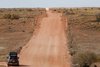
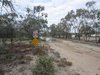
Rieck’s Rd is a great road for people who like rollercoasters. The road went up and over one sand dune after another, just like a BMX track except for cars. The dunes varied in height up to around 50 metres, you drive up to the top and down the other side and there would be another dune in front of you with 50-100 metres of flat road between them. Sometimes the gap between dunes was greater, in some cases almost a kilometre, but it was essentially an east-west road crossing dozens of parallel north-south sand dunes. (See the photo below, with my 4WD to give some scale – there’s also a 4WD on the crown of the last dune in the distance).

upload_2023-6-21_21-8-19.jpeg

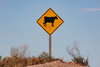
At first I was shooting up the hills at around 100kph and descending at around 80 (the speed limit is 100 kilometres per hour), but after a dozen or so I realised that at that speed, if I crested a dune and there were kangaroos on the downward slope, there was a good chance I’d hit them. I was then thinking they would probably be red Kangaroos which tend to be either singles or pairs out here in the desert, unlike Grey Kangaroos which live in large mobs, and a couple of Reds would be able to get out of the way quickly if I happened upon them. And then I saw this sign:

upload_2023-6-21_21-9-58.jpeg

So I slowed down and made sure I crested the dunes at 60 kph, which was a good thing because a few kilometres further along there was a herd of 30 odd cattle between the dunes, some of which were on the road but moved off at my approach.

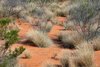
At exactly 36 kilometres from the gate I was at the base of dune #79, so I parked my car and climbed the road to the top of the dune and then headed across the top of it. There were low shrubs and a number of various grasses growing in the red sands. Despite the heat and the fact it was around 3:30 in the afternoon there were a few birds active. At least eight Pied Honeyeaters were flying around and vocalising, a small group of half-a-dozen White-winged Fairy-wrens were popping in and out of the grass tussocks, there were three Singing Honeyeaters and four Crimson Chats too. And a flock of about a hundred Budgerigars went flying past.

full


I had wandered about 50 metres from the road and was not visible to passing traffic, so when a car with a caravan came along and slowed down and then stopped at my car, I had to hurry back to the road and yell that I was fine. A vehicle stopped in the middle of the desert, on a road with very infrequent traffic, may indicate someone in distress so I appreciated them stopping, whoever they were.

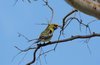
Heading back across the top of the dune to where I had been I considered calling it a day when I saw not one but two Eyrean Grasswrens fly out of the grasses into a low shrub and start vocalising! The shrub had no leaves on it (it may well have been dead) but all the sticks made photography a little challenging. However, I still managed to get a few half-decent images.

full

full


Really chuffed with myself for getting another Lifer, I went back to the car and commenced the journey over the 78 giant speedhumps back to NSW and then on to the Fort Grey campground, getting there just before dark. I picked a spot in the campground a short distance from everyone else and erected the tent, looking out into the bush. A flock of 200-300 budgerigars were wheeling about in the skies above, sometimes coming quite low, providing an entertaining sight for the other campers. And with another cloudless night I slept with the tent window open again so I could look up at the myriad of stars.

It was the last night I would spend sleeping in the tent.


Number of birds seen today: 28 species
Additions to my year list: 5
Bird Lifers: 1

:p

Hix
 

Attachments

  • upload_2023-6-21_21-6-48.jpeg
    upload_2023-6-21_21-6-48.jpeg
    197 KB · Views: 19
  • upload_2023-6-21_21-8-19.jpeg
    upload_2023-6-21_21-8-19.jpeg
    163.1 KB · Views: 24
  • upload_2023-6-21_21-9-58.jpeg
    upload_2023-6-21_21-9-58.jpeg
    113.1 KB · Views: 22
Last edited:
Are Budgies generally difficult to see in the wild?
Not if you're in the right area. They can form very large flocks several hundred strong, but can also be found in much smaller numbers (like less than 10 individuals). For smaller groups it's often the calls that alert you to their presence, whereas the larger flocks are generally pretty obvious. I find that the further inland you go, the more common they are.

:p

Hix
 
Not if you're in the right area. They can form very large flocks several hundred strong, but can also be found in much smaller numbers (like less than 10 individuals). For smaller groups it's often the calls that alert you to their presence, whereas the larger flocks are generally pretty obvious. I find that the further inland you go, the more common they are.

:p

Hix
Also, budgies, like a lot of Australian birds, are nomadic. So you can’t often say “if I go to point X next month, I will see species Y”. It makes watching Australian birds, especially in the outback, a lot less predicable,
 
Day 17, Wednesday 17th August 2022
Fort Grey to Tibooburra


My back was really bad tonight. It woke me around 11:00pm and then all I could do was doze for short periods before it played up again. At about 4 o’clock when I couldn’t get any relief I remember thinking “thank goodness it doesn’t hurt when I’m driving”, which then led me to think that maybe sitting in the car might ease the pain, and maybe I could get some sleep that way. So I crawled out of my sleeping bag, noticing how very cold it was, climbed down the ladder and got into the driver’s seat. Relaxing, I closed my eyes and tried to sleep (which was an effort because by now I was awake), but after about three minutes every muscle in my back suddenly spasmed together. I got out of the car and walked around for a few minutes before climbing back into the tent because at least it was warm in the sleeping bag. I decided then and there I would not be sleeping in the tent again this trip. Maybe if I got a thicker, firmer mattress. Something to think about in the future.

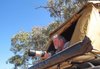
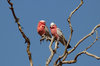
The Dawn Chorus brought me out of my dozing state a little before the sun came up, and once it did I could see it would be another sunny, cloudless day. Looking out the window of my tent I could see a pair of Galahs on top of a dead tree not far away and so I took a quick photo of them while still in the tent. Then I lay there for a while waiting to see if anything else turned up. I could hear a lot of birds, but they were all too distant.

upload_2023-6-23_0-9-15.jpeg
upload_2023-6-23_0-8-47.jpeg

I eventually got up around 7:00am and had something to eat, walking around to loosen up my back. Returning from the ablution block I heard some quiet clicking noises interspersed with some soft chirruping coming from a small dead tree at the side of the campground. I couldn’t see anything at first until I got closer and realised the noises were coming from a juvenile Bourke’s Parrot being fed by an adult. They were hard to see because their plumage kind of blended with the dead branch they were on. I hurried back to the car to grab my camera but the birds were gone by the time I got back.

I like Bourke’s Parrots. I used to keep them in an aviary and occasionally bred them, and I found them to be quiet, confiding and sweet little birds, not aggressive at all, unlike several of their cousins. And the chicks when they are learning to fly are a delight. On my trip here last year I saw my first wild Bourke’s and it was a thrill. And seeing the pair that morning was also a thrill, even if I didn’t get a photo.

Walking back to the car with my camera I suddenly saw a lone Bourke’s foraging around on the ground. Although I couldn’t approach too close I managed to get some good shots of it. Satisfied, I returned to the car unaware this was not the last Bourke’s I would see that day.

full


After packing up the tent I grabbed my binoculars and camera and went for a walk along a path to Lake Pinaroo which is a large water body a couple of kilometres away. The walk to the Lake goes through the bush in two different directions and I walked one of them, came back and then walked the other. Along the way there were plenty of birds in the bush to look at, and each path ended at the Lake which, surprisingly, had virtually no water birds despite being enormous. I did see half-a-dozen Australian Wood Ducks and Pink-eared Ducks, a couple of Grey Teal and a pair of Hardheads, three Red-necked Avocets and a Yellow-billed Spoonbill. There were a lot of dead trees in the lake, presumably the remains of a Eucalypt forest that became flooded when the lake filled up. Although the trees were dead, I counted around forty Little Corellas on the trees or flying around them, and about 30 Fairy Martins collecting mud and building nests on the side of a dead tree-trunk. And even a Bourke’s Parrot sitting on a dead branch.

upload_2023-6-23_0-0-32.jpeg
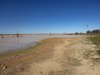
Lake Pinaroo shoreline


full

full

full

full

full


In the bush I saw a number of Black-faced Cuckoo-shrikes, mostly juveniles, a few Galahs, around a hundred Budgies, some Zebra Finches and a single Common Bronzewing Pigeon. I also encountered Bourke’s parrots at a few different spots along the walk, and one place I flushed eighteen of them feeding in grasses beside the path. All up I saw thirty-nine Bourke’s Parrots on the walk. There were also a few Cockatiels, a few Diamond and Peaceful Doves along with a couple of dozen Crested Pigeons, a pair of Hobbys and pair of Nankeen Kestrels, and I heard a Whistling Kite from further along the lakeshore.

full

full

full

full

full

full

full

full


After 4 hours I was back at the campground and, after photographing a Red-backed Kingfisher that was perched in a tree above my car, I was ready to leave Fort Grey.

full


I planned on going straight back to Tibooburra but after a few kilometres I turned around and headed back to South Australia and the seventy-nine dunes. An hour later, standing on top of the same dune I was on the previous day I again saw the Pied Honeyeaters and Crimson Chats, but also Diamond Doves, about thirty Budgies, a family of Black-faced Woodswallows, and this time four Eyrean Grasswrens. However, only one Grasswren was in a good position for photos perching in a shrub, the others were all skipping around on the ground from tussock to tussock.

full

full

full

full

upload_2023-6-22_23-59-4.jpeg
Eyrean Grasswren habitat on the crest of a dune

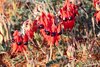
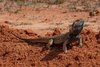
On the long drive back to Tibooburra I was distracted a few times by non-avian wildlife. The first was a trio of Red Kangaroos – a pair and the female’s pouch young. They weren’t far off the road and I could photograph them from the driver’s seat without them getting spooked. Not long after I saw an Inland Bearded Dragon sitting on a pile of soil pushed up on the side of the road. I was going about 100kph at the time so I travelled some distance before the car had stopped, then I turned around and drove back to photograph it, but I couldn’t find it, so I turned the car around again and just as I was gaining speed I saw the lizard again in exactly the same spot. So I slowed down and backed the car up until I was alongside. Turns out I could see it coming from one direction but it was not visible coming from the other direction because of more soil blocking the view of it. Anyway I got some photos of it, but before I got back to Tibooburra I had seen another six! And the only other thing I stopped to photograph was some Sturt’s Desert Peas that were in flower.

full

upload_2023-6-22_23-53-16.jpeg
upload_2023-6-22_23-50-56.jpeg

Arriving back in Tibooburra just before dark I checked into the motel again and, after dinner in the pub, spent the evening uploading images from my camera to my computer and then sorting and labelling them.


Number of birds seen today: 34 species
Additions to my year list: 2

:p

Hix
 

Attachments

  • upload_2023-6-22_23-50-56.jpeg
    upload_2023-6-22_23-50-56.jpeg
    185.2 KB · Views: 21
  • upload_2023-6-22_23-53-16.jpeg
    upload_2023-6-22_23-53-16.jpeg
    201.8 KB · Views: 21
  • upload_2023-6-22_23-59-4.jpeg
    upload_2023-6-22_23-59-4.jpeg
    262.5 KB · Views: 23
  • upload_2023-6-23_0-0-32.jpeg
    upload_2023-6-23_0-0-32.jpeg
    142.1 KB · Views: 23
  • upload_2023-6-23_0-8-47.jpeg
    upload_2023-6-23_0-8-47.jpeg
    238.5 KB · Views: 21
  • upload_2023-6-23_0-9-15.jpeg
    upload_2023-6-23_0-9-15.jpeg
    91.1 KB · Views: 21
Last edited:
I’m still in for the ride, keep it coming. Specially like the pictures of the bearded babbler, very rare indeed :)
I'm glad somebody's enjoying it - it took me long enough to write!

:p

Hix
 
Day 18, Thursday 18th August 2022
Tibooburra and Sturt National Park


Very windy today. Sunny, but windy.

I started out by driving to the Mount Wood campsite, west of Tibooburra. It has a small waterhole but, unfortunately, there weren’t many birds around. A couple of Black-fronted Dotterels, a pair of Crested Pigeons, two Red-backed Kingfishers, ten Budgies, some honeyeaters and woodswallows, and a Magpie on a nest. And I heard a Cockatiel flying past, but didn’t see it.

full


After half an hour I left and continued on the Gorge Loop Rd, which would eventually take me to South Myers Tank again, but after a couple of kilometres the road was covered with water so I turned around and drove back to Tibooburra and then straight up the Silver City Highway to the Tank. Most of the same birds I saw a couple of days ago were still there, just different number of them, but today there was also a Pelican and a White-necked Heron which was rather shy and kept flying off and circling around. I only stayed here for 40 minutes today before following the road onwards to another tank, Mt King Tank, but all it had was two Grey Teal, seven Little Black Cormorants that flew in while I was there, three White-plumed Honeyeaters and a Willie Wagtail.

full


The wind was getting stronger and it was the afternoon so I returned to Tibooburra, but that evening I drove just outside town to a place called Sunset Hill where they have a lookout to watch the sunset over the desert. It was very pretty but there were lots of flies around which were really annoying.

upload_2023-6-23_22-21-29.jpeg

Number of birds seen today: 28 species
Additions to my year list: nil

:p

Hix
 

Attachments

  • upload_2023-6-23_22-21-29.jpeg
    upload_2023-6-23_22-21-29.jpeg
    103.5 KB · Views: 21
Day 19, Friday 19th August 2022
Tibooburra to Broken Hill


Just north of Tibooburra, about 1.5 kilometres from the town, is another campsite within Sturt National Park with the charming name of Dead Horse Gully, and was where I found myself on this particular morning. The campsite is the start of a walking trail, The Granites Nature Trail, that takes you through the valley between some steep hills and amongst some very large boulders. Towards the end of the trail it leads you up and over one of those hills to return you to the campsite.

upload_2023-6-23_22-27-13.jpeg

The path is a little over two kilometres long but there were so many birds to see I spent an hour and a half on the walk. Not a lot of diversity (only 17 species) but lots of individual birds everywhere; I estimate I saw at least 150 Budgerigars and there were plenty of Zebra Finches too. One of the first things I came across was a group of eighteen Chestnut-crowned Babblers foraging in and under many of the small shrubs. The usual Willie Wagtails, Black-faced Woodswallows, Singing Honeyeaters and Crested Pigeons were present, but also a pair of Greater Bluebonnets, two Southern Whitefaces, a trio of Chestnut-rumped Thornbills, a Wedgetail Eagle, and three White-winged Trillers. And goats. Feral goats.

full

full

full

full

full

full


After getting something to eat and drink from the local store, and filling up the car with fuel, I left Tibooburra and drove south for a few hours to Broken Hill, one of the major cities in western New South Wales. After checking into a hotel I drove north of town to a place called the Living Desert.

The Living Desert is a large 2400 hectare reserve which includes a flora and fauna sanctuary, and a sculpture exhibition on one of the hilltops. I was interested in the reserve because a few days before I arrived someone had posted on eBird they had seen Chirruping Wedgebills there, which would be a lifer for me. Unfortunately, all I saw when I visited was Crested Pigeons, Yellow-throated Miners, Spiny-cheeked Honeyeaters, Singing Honeyeaters, Zebra Finches and a dozen White-browed Babblers. There were lots of flowering Sturt’s Desert Peas in the arboretum section of the Flora and Fauna Sanctuary.

Despite a cool breeze it was still quite hot, so after an hour I left and returned to my hotel for the night.


Number of birds seen today: 23 species
Additions to my year list: 4

:p

Hix
 

Attachments

  • upload_2023-6-23_22-27-13.jpeg
    upload_2023-6-23_22-27-13.jpeg
    204 KB · Views: 20
Day 20, Saturday 20th August 2022
Mutawintji National Park


Up early at 05:30 and left at 6:00am – my destination was Mutawintji National Park about 140 kilometres away, along mostly dirt roads. After getting fuel and taking a wrong turn, I eventually arrived about two hours later.

One of my main reasons for visiting this national park, apart from the fact I’ve heard about it for years, is that there is a small remnant colony of Yellow-footed Rock Wallabies in the park which were only discovered in the 1970’s. The main population of the wallabies is in the Grampians in South Australia hundreds of kilometres away so this small colony, which is a different subspecies, was a great find. There’s also another remote, isolated population of this subspecies in Idalia National Park in Queensland.

There are a number of walks you can do in Mutawintji and, although it’s large, most of the walks are in one small part of this massive National Park. I chose the Rockholes Walk as it takes you along the valleys and then leads you up on top of the mountains and I figured this would be the best way to see the rock wallabies. At this point I should mention that while lots of reports state there are rock wallabies in the park, none of those reports actually state where in the park they are to be found.

The Rockholes walk started off as an easy walk along the valley floor and the first thing I came across was a couple of tourists looking up at the top of a nearby eucalypt tree – there was a bird sitting on a nest. They had recognised it as a raptor but didn’t know what sort (they weren’t birders) but now it was sitting all I could see was the tip of the tail poking above the edge of the nest. I thought it might have been a black kite, as they are very common in the outback. And the next few birds I saw were also common outback birds – Mallee Ringneck Parrots, Galahs and Peaceful Doves. A lone Grey Shrike-thrush, found over much of Australia, was foraging on the ground amongst the rocks and occasionally giving forth a burst of its melodious song.

full

full

full


The next bird I encountered came by the dozen. There were several flying about, singing, and rarely stopped long enough for me to get a good look at them. When they did I realised they were White-fronted Honeyeaters, a species I hadn’t seen for many years. I spent a good 40 minutes trying to get photos of them, which was a challenge because, as I said, they were fast moving (like most honeyeaters).

full


Leaving the White-fronteds behind I encountered a few White-plumed Honeyeaters and a female Red-capped Robin. And then a pair of goats.

full


Feral goats are found throughout Australia and are a very unwelcome guest as they eat almost everything including most plants. I’ve seen them throughout my travels and frequently in National Parks, the most recent being on the Granites Walk in Sturt National Park the day before. And they are difficult to manage.

full


Coming to a dry riverbed, which was probably flowing a last week when the rains came through (parts of the campground and parking area were closed due to flood damage), I found a few pools of water that had become trapped within rocks or deeper parts of the riverbed. This area had three Inland Thornbills, a Grey Fantail and a pair of Rufous Whistlers, the male of which was very vocal and very obliging, from a photographic viewpoint. At this point the path I wanted to follow led up the side of a rocky hill to a more level area where my presence scared a few more goats, then past the Rockholes, holes formed in the rock by rain over millions of years, over a saddle then up to the top of another bare, rocky hill that overlooked the path I had just left.

full

full


Not much to see in the way of birds up here, apart from a pair of Nankeen Kestrels on a neighbouring mountain that were roosting on the vertical cliff-face. However, it was a great place to scan the surrounding hills and cliffs for Rock Wallabies. But despite 20 minutes of looking, all I saw was another small group of goats and a couple of pairs of hikers following the easier path further up the dry riverbed.

upload_2023-6-24_23-26-33.jpeg

In case you hadn’t guessed, apart from in the valleys/canyons between the mountains, large expanses of the hills and mountains are bare rock and often devoid of vegetation. In areas where water an detritus collect plants are able to take hold but there are only a few plants able to do so until a more diverse substrate collects. And its where you have a diverse flora that you find more birds.

While on top of this bare mountain/hill I had some lunch and then followed the path back down to the riverbed where I decided to return to the car as it was now mid-afternoon and quite hot. On the way I saw many of the same birds I’d seen on the way up, with the addition of several Yellow-plumed Honeyeaters (as opposed to the White-plumed Honeyeaters I’d seen earlier) a Willie Wagtail and some Zebra Finches. Looking at the raptor nest again I caught sight of a face – a Brown Falcon.

full

full


Although I didn’t see the Rock Wallabies I spent about 5 hours on the walk, which was about 8 kilometres return, and saw 27 species of bird. Before leaving I followed another road further into the park and came to an unmanned visitor centre where I realised that the Rock Wallabies were probably in that section of the park where there are no paths but hikers can visit. Maybe next time I’ll do that.

Number of birds seen today: 27 species
Additions to my year list: 3

:p

Hix
 

Attachments

  • upload_2023-6-24_23-26-33.jpeg
    upload_2023-6-24_23-26-33.jpeg
    154.1 KB · Views: 20
Day 21, Sunday 21st August 2022
Broken Hill to Menindee


Up early to pack, then out to the Living Desert again. Spent about an hour in the flora and fauna reserve, but saw only Chestnut-crowned Babblers, Spiny-cheeked and Singing Honeyeaters, Yellow-throated Miners and Crested Pigeons, then started on a walk that took me up to the top of a hill where I saw some Western Grey Kangaroos.

After an hour I had to get back to the hotel to check out but down in the park I was briefly distracted by a White-browed Babbler foraging for scraps. While there I overheard some people talking about the artworks – stone carvings – on another hilltop within the reserve; they had just walked down to the carpark from there. There is another road that leads directly to the top of the hill so I thought I might as well have a gander at it if I have time.
upload_2023-6-25_19-35-37.jpeg

While driving back to the hotel I was only about a kilometre from the reserve’s entrance when I saw what I thought was a raptor in flight, so I stopped the car and jumped out but the bird banked to the right and vanished before I could get the binoculars on it. As I was gettting back into the car I heard a rustling in the shrubs in front of me and, thinking it was a small marsupial (or more likely a rat) I tried to spot in. When it ran from under one shrub to another one I realised it was a Chirruping Wedgebill, the bird I had been hoping to find! Furthermore, it was joined buy two more Wedgebills, foraging in the leaf litter under these low shrubs. The low shrubs made photography difficult, but I did get one half-decent shot.
upload_2023-6-25_19-35-53.jpeg

Back in Broken Hill I checked out of the Hotel and was on my way back to the Living Desert when I passed a sign that pointed to White Rocks Reserve. Thinking there might be some birds there I made a diversion to this rather small reserve, not much bigger than a children’s playground. But, like the ‘DIG’ tree, there was some history here. White Rocks is an outcrop of quartz, hence the name, and was the site of the only hostilities on Australian soil in World War 1.

Silverton is a town a few hundred kilometres north of Broken Hill, and it was a habit on public holidays for the townsfolk to catch a train to Silverton to have picnics. On New Year’s Day in 1915 two Turks who had been living in Broken Hill for some time, an ice cream vendor and a butcher, under the Turkish flag open fired with rifles on the trainload of picnickers, killing four civilians and wounding seven more. The Turks then took refuge on White Rocks where a three hour gun battle with the police took place, both Turks eventually killed in the encounter.

upload_2023-6-25_19-38-50.jpeg

Birdwise, White Rocks Reserve only had some Spiny-cheeked and Singing Honeyeaters, a single House Sparrow and three Crested Pigeons. And the rock sculptures in the Living Desert – when I went there next – only had Singing Honeyeaters. The sculptures themselves were large and interesting, but not really my cup of tea. Some years ago someone had brought out several rock sculpturers from around the world for an artist’s retreat-style get-together that lasted three months, and many of the resulting sculptures represented their cultures and history.

My next destination was Menindee, next to the famed Menindee Lakes which is part of Kinchega National Park. For years I had been hearing about how the Menindee Lakes were drying up due to a combination of drought and farmer’s diverting water from the Darling River (which supplies the Lakes) into large water storage ponds for agricultural purpose. These diversions happen hundreds of kilometres away, some in Queensland, and news reports are that one of these storage areas is five times the volume of Sydney Harbour. But the recent rains, resulting from three consecutive La Nina events over the past several months, has changed all that – the Darling has been overflowing and flooding low-lying areas all along its course.

The drive to Menindee took only an hour. As I had plenty of time I stopped north of town at a point where the Darling River enters the lake system. A nice area and popular with visitors. There were also a few birds to be seen here, including a pair of nesting Whistling Kites, a single Great Crested Grebe, Willie Wagtails, Pied Cormorants, Little Black Cormorants, Great Cormorants, Silver Gulls, lots of Pelicans (I counted 23) and about 40 Tree Martins. Both Grey and Pied Butchebirds were heard, but not seen.

full

full

upload_2023-6-25_19-39-42.jpeg
upload_2023-6-25_19-39-55.jpeg

Continuing on to Menindee I had to swerve to avoid a Shingleback Skink sunning itself on the road. Stopping the car I ran back to photograph it, and picked it up when another vehicle was coming along.

full


Just outside Menindee is the road to Kinchega National Park so I drove in and found the Darling River campsite was flooded, as was the Emu Lake Campsite (in fact the road to Emu Lake was closed as was most other roads), so I followed the only road left out to the Cawndilla campsite on the shores of Lake Cawndilla. A very nice campsite with (I’m told) excellent sunsets over the lake. Being the only campsite still open it was well-packed with campers and caravans, as you can imagine. So I didn’t stay there long.

On the way back I spotted a pair of Bluebonnet Parrots in a tree and stopped to take some photos. While doing this I was surprised to see another pair of Chirruping Wedgebills foraging amongst the undergrowth a bit further along the road! It was turning into a great day!

full

full


As well as a pair of White-winged Fairy Wrens and a Pied Butcherbird, I also saw 25 Pelicans, four Grey Teal, a Great Egret, six Yellow-throated Miners, another Shingleback, a Bearded Dragon, and several mobs of Western Grey Kangaroos – and one female with a joey was close enough for me to get some good images of her.

full


Menindee itself is a small and quiet little town, and I was staying at the Burke and Wills Motel (apparently this was one of the major stops on their ill-fated journey north). Walking up to the shops a few blocks down the road I saw a man being dive bombed by an Australian Magpie – it probably had a nest somewhere. Magpie-dodging is an enforced past-time in parts of Australia, and wearing black seems to encourage the birds. On my way back I encountered some Western Gerygones in a flowering gum, and a nearby reserve – with picnic tables – was underwater from where the lake had overflowed.
upload_2023-6-25_19-42-20.jpeg


And so ended Day 21.

Number of birds seen today: 31 species
Additions to my year list: 2
Lifers: 1

:p

Hix
 

Attachments

  • upload_2023-6-25_19-35-37.jpeg
    upload_2023-6-25_19-35-37.jpeg
    175.1 KB · Views: 24
  • upload_2023-6-25_19-35-53.jpeg
    upload_2023-6-25_19-35-53.jpeg
    234.2 KB · Views: 21
  • upload_2023-6-25_19-38-26.jpeg
    upload_2023-6-25_19-38-26.jpeg
    185.2 KB · Views: 1
  • upload_2023-6-25_19-38-50.jpeg
    upload_2023-6-25_19-38-50.jpeg
    185.2 KB · Views: 21
  • upload_2023-6-25_19-39-42.jpeg
    upload_2023-6-25_19-39-42.jpeg
    53.5 KB · Views: 27
  • upload_2023-6-25_19-39-55.jpeg
    upload_2023-6-25_19-39-55.jpeg
    135 KB · Views: 22
  • upload_2023-6-25_19-42-20.jpeg
    upload_2023-6-25_19-42-20.jpeg
    239.4 KB · Views: 22
Last edited:
Day 22, Monday 22nd August 2022
Menindee to Ouyen, Victoria


Up early again only to find the day was cloudy and cool with a bit of a wind blowing. After checking out of the motel I drove down the road to a coffee shop and grabbed something to eat. It was near where I saw the Magpie dive-bombing people yesterday so I wasn’t surprised when I noticed the magpie fly onto a telephone pole in front of me as I was heading to my car. I looked directly at it and pivoted to maintain eye contact as I went past, which meant I ended up walking backwards. When I was about ten metres away I turned my back on the bird and kept walking for about two seconds before quickly wheeling around to face it again. The magpie was about a metre from my head and suddenly veered off with a flurry of wings and feathers and landed on a nearby street sign.

“Ha!” I said, “Gotcha!”

If the Magpie was embarrassed at being caught red-winged it didn’t show it. So I backed up some more and did the same thing, turning away and then spinning back after a couple of seconds. And the magpie was in mid-flight towards my head again. This time I was close enough to back up to my car, get my camera out and take a photo of the bird before getting in and driving off to look for the Western Gerygones but they had disappeared. Instead there were three Blue-faced Honeyeaters and six Yellow-throated Miners feeding in the flowering tree. I also saw fifteen cockatiels flying overhead, and in one front yard about two dozen House Sparrows and a Crested Pigeon.

upload_2023-6-26_22-55-17.jpeg
full

full

full


Driving back to Kinchega I stopped at the Darling River campground, which was closed because most of it was flooded. So I birded in the closed campground area for about 90 minutes.
upload_2023-6-26_22-55-40.jpeg
The Darling River Campground - more Darling River than campground

upload_2023-6-26_22-55-50.jpeg

One of the first things I saw was a pair of Eastern Shrike-tits foraging on the tree trunks of some eucalypts. Three Black-tailed Native Hens and a Black-fronted Dotterel were running around the flood-waters edge while Little Black Cormorants fished in the waters itself, and a Great Egret, a White-necked Heron and a White-faced Heron stalked the shallows for fish and frogs. A pair of Whistling Kites spent a lot of time near a tree on the other side of the waters; they may have had a nest nearby. Overhead a Black Kite glided around and I counted nine Pelicans flyover, as did four Gull-billed Terns and seven Great Cormorants. Foraging on the ground at different times were up to seventeen Red-rumped Parrots, one Brown Treecreeper and fourteen Purple-backed Fairywrens while about thirty White-plumed Honeyeaters fed in the flowering eucalypts and a number of Tree Martins hawked for insects above..

full

full

full

full

full

full


On my original itinerary the next destination was to be Mungo Lakes National Park, but I had heard the campground was closed as was much of the park (due to rain and floods) so I decided to forget it this trip and instead I would drive much further south across the border into Victoria and a little town called Ouyen, which is a little ways south of Hattah-Kulkyne National Park.

I had called the day before and reserved a room at the Ouyen Motel. The drive took about four hours from Menindee (with a brief stop in Mildura for lunch), but when I arrived at the Motel at 3:00pm there was nobody there. So, despite the weather deteriorating, I drove back up to Hattah-Kulkyne.

There were three birds I particularly wanted to see, and they were apparently easy to find on the Nowingi Track – Malleefowl, Striated Grasswren and Mallee Emuwren, and all three would be lifers for me. So after finding the Nowingi Track I parked my car and started walking along it. Unfortunately the weather had been getting cloudier all day and now the clouds were getting dark and threatening to rain. I walked a few hundred metres and all I saw was three Yellow-plumed Honeyeaters. I heard a Grey Butcherbird, but it was deep in the bush, way off the track. Reaching the top of a rise I could see rain in the distance heading my way. I also saw a raptor gliding over the trees some distance away. I couldn’t tell what it was because the heavy cloud cover had made everything dark prematurely, but I took a couple of photos of it anyway and then hurried back to the car.

Arriving back at the hotel the owner had arrived back (she’d gone out on an urgent errand) and checked me in. As I was unpacking the rain started, and really thumped down for a while. When it eased up I drove down the road to a Chinese restaurant for dinner.

Back in the hotel I downloaded my photos for the day onto my computer, and was able to inspect the raptor from Hattah-Kulkyne more closely – it was a Little Eagle. Not a lifer but still an addition to my Year list.

upload_2023-6-26_22-57-17.jpeg

Number of birds seen today: 30 species
Additions to my year list: 2

:p

Hix
 

Attachments

  • upload_2023-6-26_22-55-17.jpeg
    upload_2023-6-26_22-55-17.jpeg
    45.4 KB · Views: 21
  • upload_2023-6-26_22-55-40.jpeg
    upload_2023-6-26_22-55-40.jpeg
    165.3 KB · Views: 27
  • upload_2023-6-26_22-55-50.jpeg
    upload_2023-6-26_22-55-50.jpeg
    247 KB · Views: 21
  • upload_2023-6-26_22-57-17.jpeg
    upload_2023-6-26_22-57-17.jpeg
    78.2 KB · Views: 21
It seems like there are so many species of parrots in the Australian deserts. What do they primarily eat out there? Are fruits or nuts plentiful in a lot of the dry areas?
 
Great, not only had I never heard of an “emuwren”, now I’m in suspense over it…

Let me alleviate your suspense - I didn't see any of the three targets :(

It seems like there are so many species of parrots in the Australian deserts. What do they primarily eat out there? Are fruits or nuts plentiful in a lot of the dry areas?

The Australian deserts aren't all sand dunes like the Sahara, but they are very hot in the Summer and quite arid with little rainfall. The photos of the habitats in my previous posts for Innamincka, Tibooburra, Mutawintji, and particularly the Eyrean Grasswren habitat on a sand dune crest on Day 17, show that there is vegetation, and some quite tall trees along river courses (and even dry river beds). Those plants produce seeds and nuts and small fruits, and provide food and shelter for insects, all of which will be food for birds.

:p

Hix
 
I'm really enjoying your travelogue. Thank you for putting it together and taking us along with you.

I have some questions:
1. Were you joking about being in a television series, or were you actually in one?

2. Re: Australia Zoo, in your wildlife travels through Australia did you ever encounter Steve Irwin? What is your opinion of his work? Do you think that he did net good by making people appreciate animals they would otherwise be scared of, or did he do damage by clowning around dangerous animals and disrespecting them?

3. How much of the Australian avifauna have you seen now? Google tells me that there are approximately 850 species of birds in Australia. Have you made a good dent in seeing those species?
 
I'm really enjoying your travelogue. Thank you for putting it together and taking us along with you.

I have some questions:
1. Were you joking about being in a television series, or were you actually in one?

No, I wasn't joking. It was on Border Security, an Australian show that was later copied in USA and released as Homeland Security USA. I made brief appearances in two episodes about ten years ago.

2. Re: Australia Zoo, in your wildlife travels through Australia did you ever encounter Steve Irwin? What is your opinion of his work? Do you think that he did net good by making people appreciate animals they would otherwise be scared of, or did he do damage by clowning around dangerous animals and disrespecting them?

The first time I saw Steve Irwin on TV I thought "What a w anker! He is so over-the-top, he must be playing up for the cameras!" But friends in the reptile world who had met him told me he wasn't play acting, he was actually like that normally - perpetually excited by everything around him.
But I never actually met him, although Terri phoned me at home once, about 25 years ago - I had sent Australia Zoo my resume in the hope they might have some positions available. They didn't but she called to discuss other options at other Queensland Fauna parks. Nothing eventuated but I appreciated the call just the same.

As for his work: he and his team removed problem crocodiles; if that didn't happen the croc would have probably been shot by the local councils. That's a plus in my book. He introduced a lot of people to the wonders of wildlife, and that impact can be seen by the volume of people who visit his zoo - which is in the middle of relatively nowhere. Another plus. And he and Terri started Wildlife Warriors, a conservation organisation that has funded conservation research worldwide.

As for "clowning around" and "disrespecting" the wildlife, I guess that's subjective. I would argue that if Irwin catching a wild venomous snake on camera and then releasing it is disrespectful to the animal, then how is that different to people who catch fish, only to let them go again? In Australia we had television personality who had a fishing show who would even kiss the fish before release. At least Irwin was educational. I think the main argument against Irwin was simply by people who preferred the Attenborough style of presentation and found Steve to be more excitable. But any marketing person will tell you that things that catch your attention will sell - even bad TV advertisements will be remembered which is better than good ads which are quickly forgotten.

So overall I think the pros outweigh the cons by a long shot.

Caveat: I'm not an Irwin expert - I'm basing my opinions on what I've witnessed or heard, primarily online or on TV. People who actually knew him might have different views.

3. How much of the Australian avifauna have you seen now? Google tells me that there are approximately 850 species of birds in Australia. Have you made a good dent in seeing those species?

How many species of birds in Australia is a fluid number, and depends on what is considered "Australia" when calculated, as many sources count only the mainland and Tasmania, and ignore Lord Howe Island, Norfolk Island, Christmas and the Cocos Keeling Islands, and Macquarie Island. Some don't count one-offs, like the Tufted Duck that appeared in Werribee a couple of years ago but a lot of Twitchers added it to their Australia list. eBird currently lists 871 species for the Australian mainland and Tasmania, and 929 for Australia and its territories.

Either way, according to my eBird records I've seen 443 for Australia and 474 for Australia and its territories (mainland, Christmas Island and the Coco Keelings).

:p

Hix
 
Thanks for your thoughts on Steve Irwin. I think I come down where you are. He did come across as a clown until you spent some time seeing what he was about. I did fear that with his aggressively hands-on approach to wildlife handling that it was going to catch up with him. His death was very sad. It sounds like his conservation legacy lives on at his zoo, which is good to know.
 
I think that hands-on approach was all part of the appeal. His death was the first time I've ever heard of someone being killed by a stingray, and I haven't heard of it happening again. According to a website here in Australia, there have only been five recorded deaths since 1945 from a stingray and less than 20 worldwide. So maybe this was just a freak accident.

But when working with wild animals there is always a risk. I'm sure Irwin knew this better than most people but, like me, considered the risk from a ray to be minimal. Lots of people are injured every year, but in this case the spine punctured his chest and heart which caused him to bleed out internally.

:p

Hix
 
Day 23, Tuesday 23rd August 2022
Ouyen, Victoria to Barham, NSW


Got up early and found the clouds had gone and the sun was out, so I checked out of the hotel and headed back to Hattah-Kulkyne National Park and on to the Nowingi Track. I saw some Yellow-plumed Honeyeaters again and a female Red-capped Robin, and I heard a lot more of the robins and the honeyeaters before I came upon a group of Weebills. I have only seen weebills once before, ten years ago in Central Australia, and I wasn’t able to get a photo of them at the time so I was determined to try and get something half-decent when I found these ones. Which wasn’t hard as they were very photogenic and not too shy. Further along the path I heard and then found a pair of Grey Butcherbirds which were also obliging (although I had to walk a fair way off the track through the bush to get to them), and a pair of the black morph of the Grey Currawong which is found in this area. I walked a fair way up the track before turning around again, and on the way back all I saw was a Jacky Winter, some Choughs and a pair of juvenile Horsfield’s Bronze Cuckoos (of which I was able to get a photo that caught the sun on the iridescent feathers of the wing that give them the 'bronze' in their common name). I was on the track for about two and a half hours but never saw the Malleefowl, Emu-wrens or Grasswrens that I was hoping to find.

full

full

full

full

full

upload_2023-6-28_21-19-42.jpeg

In another part of the Park is a campground, and I decided to have a look there before leaving as it was beside one of the lakes and I thought I might see some waterbirds. Along the way I passed a sign pointing to a lookout, so I stopped the car and walked about 200 metre up the path to a tall structure like a fire-lookout station. After climbing up to the top I had an excellent view of the tops of trees in all directions. I thought I’d see the lakes, or some other kind of scenery like hills or mountains, but no – just the tops of the trees. And some powerlines.

Further along the road I saw a pair of Emus in a small grassland. I got out and tried to photograph them but they are much shyer than the desert ones in Sturt National Park, and they panicked and jumped in the idiotic way they do, and then ran off. But there were another four Weebills there and a Spiny-cheeked Honeyeater so I photographed the Weebills as they were also not shy.

full

full


Arriving at the campground I parked in day visitor area and walked along the lake edge into the campground. The lake had obviously recently risen but had since receded a bit because some parts of the campground were still soggy. There were Noisy Miners here, as opposed to the Yellow-throated Miners I’d been seeing everywhere else on my journey. As well as Mallee Ringnecks there was the yellow phase of the Crimson Rosella (usually referred to as Yellow Rosellas) which are found in this part of Australia.

full

full


In the lake all I could see were a few Hoary-headed Grebes, a pair of Great Crested Grebes, four Australian Wood Ducks, a lone Coot and a single Australian Shelduck (aka Mountain Duck). In the trees lining the lake were more Yellow Rosellas, Galahs, Sulphur-crested Cockatoos (the first I’d seen in a couple of weeks), a Striated Thornbill and a Pied Butcherbird. Back at the car I went to use one of the public toilets and found Welcome Swallows resting on the rooftop vent.

full

full

upload_2023-6-28_21-19-15.jpeg
full

full

full


Continuing south through Victoria, my destination was a little town called Barham, on the Murrumbidgee River which forms a border between NSW and Victoria; Barham is on the NSW side. And along the way I stopped at an Ibis Rookery at Reedy Lake, which is one of three lakes in an area with quite a few lakes of varying sizes. I was expecting to see trees full of Australian White Ibis, along with perhaps some Straw-necks and Glossies. But the ibis did not appear to breeding at this point in time, although I did see a large flock of thirty-eight Straw-neck Ibises flying overhead, and from the bird hide that was setup near the lake edge I could see thirty Pelicans resting on fallen logs in the water, six Australian Shelducks and eight Little Black Cormorants. In the trees lining the lake I counted fourteen Red-rumped Parrots.

full

full

full


I eventually arrived at Barham mid-afternoon, and as I still had an hour before the sun went down, I drove through town and eastwards along the Barham-Moama Rd for about 25kms to a place called Thule. I receive eBird notifications for birds I haven’t seen in NSW and I had seen on recent entries that Ostrich had been seen here. That’s right, Ostrich. Apparently, there is a small self-sustaining population around here and it is one of the few places in Australia where you can tick Ostrich off your Australian Bird List. Now, I’ve seen Ostrich in Africa, but this was something different, and this was the only reason Barham was on my itinerary.

All the reports indicate sightings in the area around the intersection with Lashbrook Rd so I started cruising along the main road slowly, about two or three kilometres before Lashbrook, then continued another two or three kms east of Lashbrook, then I came back and went up Lashbrook a short distance, all without luck. This area is all farming, and the fields extended back probably a kilometre or so from the road to eucalypt forest/scrub where the ostrich possibly spend time. I also realised that with the undulating ground, even though the grass/vegetation was short, there were depressions where an ostrich could be sitting on the ground, or on a nest, and not be visible from the road.

As it was getting dark I drove back to Barham and checked into my hotel by the river.

Number of birds seen today: 34 species
Additions to my year list: 3

:p

Hix
 

Attachments

  • upload_2023-6-28_21-19-15.jpeg
    upload_2023-6-28_21-19-15.jpeg
    73.1 KB · Views: 17
  • upload_2023-6-28_21-19-42.jpeg
    upload_2023-6-28_21-19-42.jpeg
    175.6 KB · Views: 23
Last edited:
Back
Top