Part 4 – Can the Woodland Park Zoo Live Up to My Expectations?
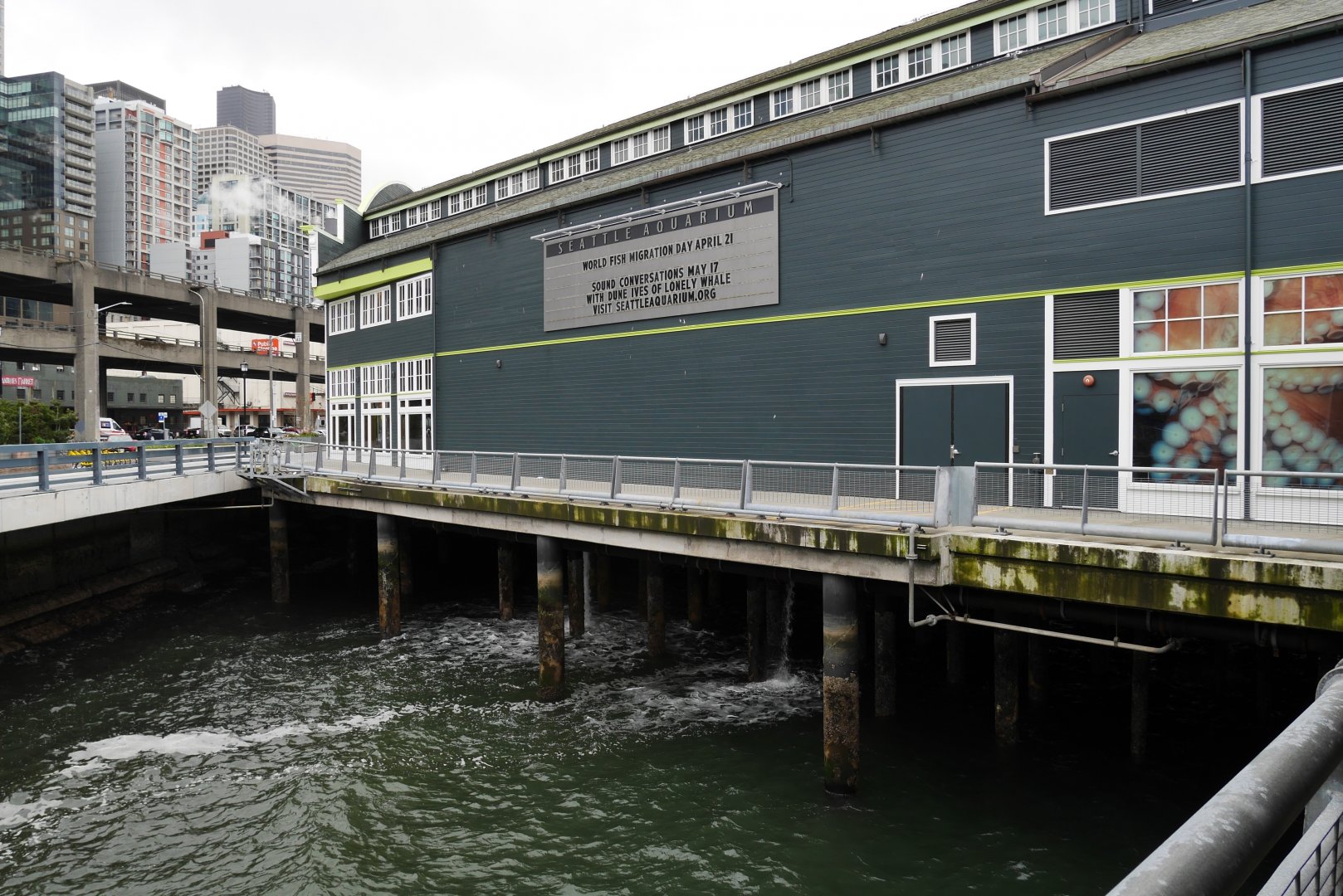
My head was pounding as I walked along Seattle’s waterfront. Between the Chihuly Garden and Glass and the Seattle Aquarium there had been a lot for me to see and analyze and I had not stopped to eat enough on my trip. Admission for the Seattle Aquarium was a considerable $29.95 before taxes, so I was looking for a cheap meal. I wound up grabbing some fish and chips and coleslaw at Ivar’s Fish Bar.
Seating was in a simple pavilion with views of the ocean.
As I ate I watched some diners head outside and throw their scraps to the seagulls. At first, I had mixed reactions to this sight. Where I grew up it was illegal to feed wildlife because it habituated potentially dangerous animals to people. Seagulls aren’t dangerous-in spite of what the movie Birds might suggest. People have probably been throwing their fishing scraps to seagulls for hundreds or thousands of years. There was even a sign outside welcoming you to feed the seagulls. Watching the seagulls was captivating dinner theater and I wanted to participate too! The portion I ordered was generous, so I tossed a bit of my salmon to the seagulls outside. There was a flurry of activity as the seagulls rushed to devour their offering.
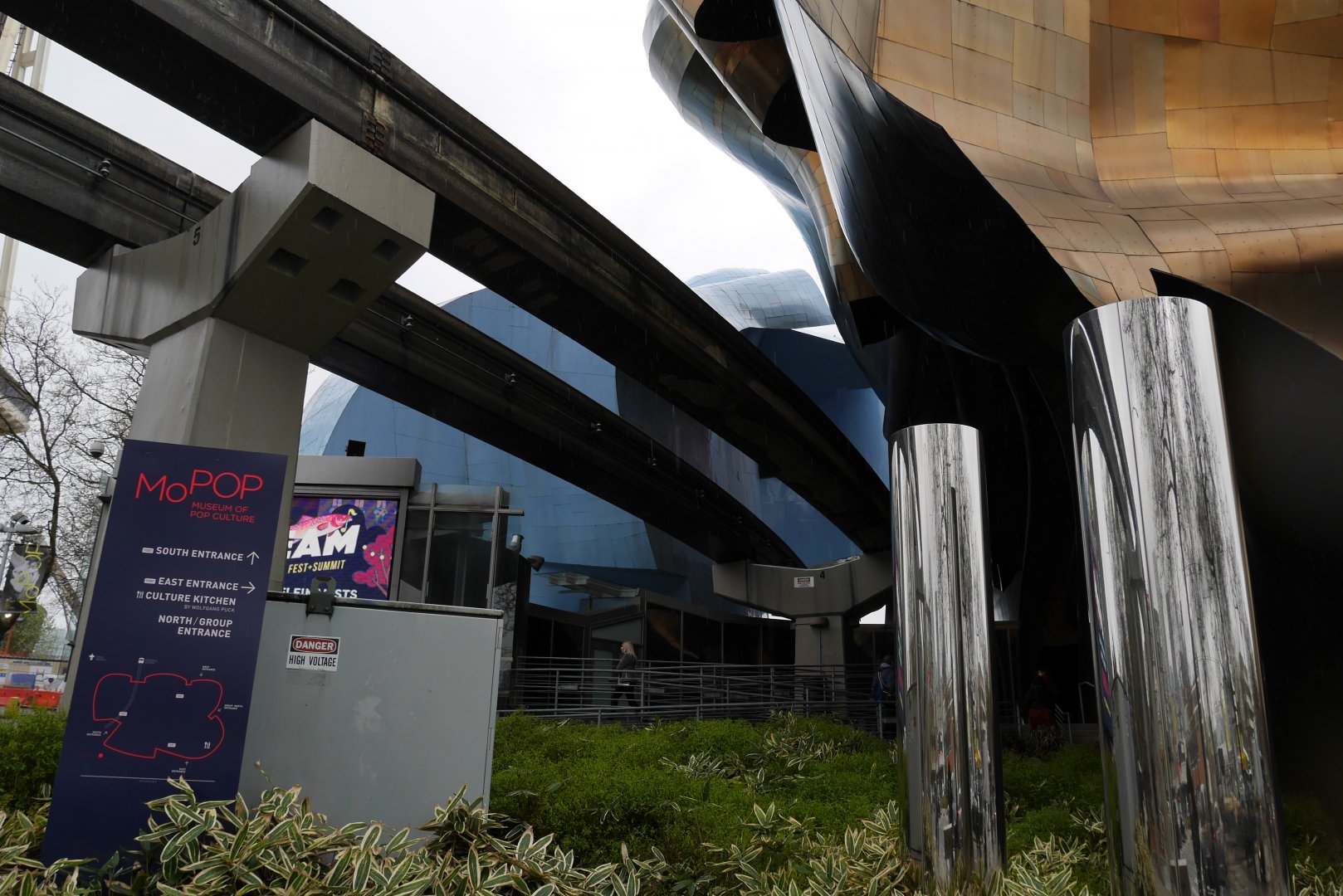
On my way back to my hotel I walked through downtown Seattle and Seattle Center. The Museum of Pop Culture was beautifully lit up, so I came back there later that night with recharged camera batteries.
The next morning, I had breakfast at my hotel and boarded a city bus for the Woodland Park Zoo.
Woodland Park Zoo
My built-up expectations of the Woodland Park Zoo were going to be very hard to live up to. Woodland Park Zoo has always been in my top five list of worldwide zoos that I wanted to visit.
I have wanted to visit the Woodland Park Zoo for about twenty years. It was the closest large American zoo to my childhood homes in Alberta. We traveled often to British Columbia, but no further. Woodland Park Zoo always felt close and out of reach at the same time.
In high-school I read A Different Nature by David Hancocks and came to revere the Woodland Park Zoo for being the birthplace of landscape immersion.
Woodland Park Zoo is significant not just as a pioneer of landscape immersion, but also an organization that has successfully applied those principles for decades over multiple projects. The gorilla exhibit, African Savanna, Northern Trails, Trail of Vines, Tropical Rainforest, and Penguin Cove are all still highly regarded and continue to inspire other zoo exhibits. That’s a lot of high quality exhibits for one Zoo.
Before I even walked through the gates I expected Woodland Park Zoo to be an exceptional zoo. I was anticipating that I would feel inspired and that the Zoo would be a showcase of what a good zoo should be. Could it live up to those expectations?
At the West Entrance I became a member of the Woodland Park Zoo. I calculated that it would basically pay for itself by giving me discounts to a handful of other zoos on my trip. The AZA Conference is in Seattle this year and I was confident that I would be back for that. More importantly, there was the symbolic importance of being a member. The feeling that I was a part of the organization. I bragged that I was probably living the furthest away of all their members (I have you beat Snowleopard)! I walked into the Zoo grounds for the first time as a member.
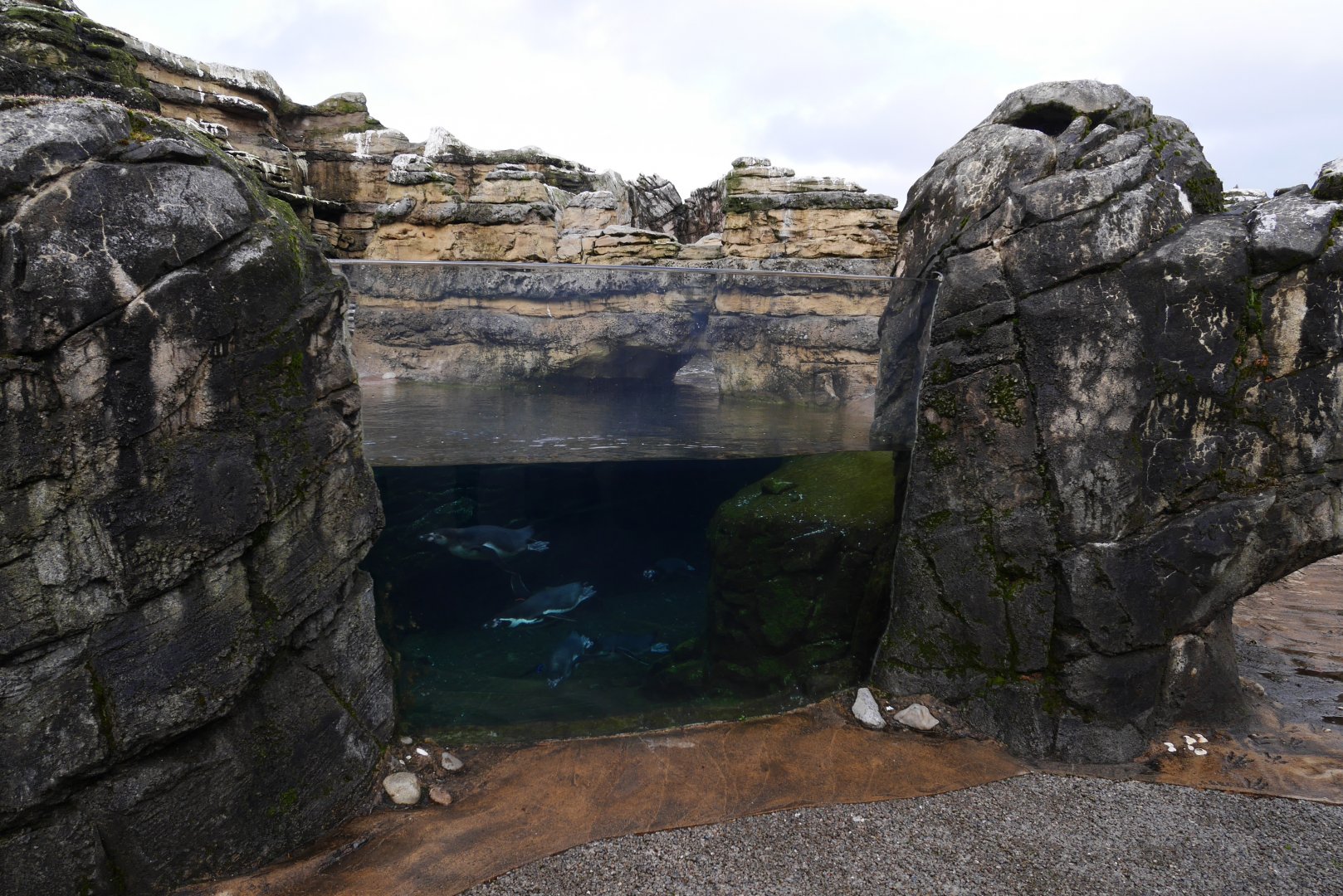
In a few steps I was at a famous exhibit, Penguins of the Humboldt Coast. The unfolding view immerses guests in a simulation of the shoreline of the Punta San Juan Reserve in Peru. In the foreground there are aluminum donor plates shaped like anchovies in the pavement. A fishing boat provides an informal play area for children. To the right there’s a blowhole that periodically sends blasts of water upwards. Further back there’s a low curved acrylic panel for underwater viewing of Humboldt penguins. The pool is flanked by artificial eroding sedimentary rockwork that curves forward on the right to meet the blowhole and back behind the pool to form a backdrop. Periodic cascades of water on the right send surges through the penguin’s pool. A gate on the left leads visitors further into the exhibit. There is a lot of drama, well-crafted rockwork, and embedded storytelling here that helps immerse you into the penguin’s world.
At first, the penguins were on the shoreline in their exhibit, but they soon dove into the water. They swam around and seemed to play in the waves of surging water. Unfortunately, the viewing for visitors here is so low that even kids had trouble watching the penguins swimming by their feet. It’s easier to see the penguins further back, but other visitors can get in the way. I followed the penguins as they swam off to my left.
As I passed through the exhibit the pool deepened. The eroding sedimentary rockwork continues along the back of the exhibit for its entire length. Similar lower foreground rockwork walls have pronounced arch shapes as they connect to the underwater viewing windows to create protected pockets of space. The penguins can build up some decent speed and tend to only be briefly visible as they swim past the viewing windows and bubbles. I walked back and forth through the exhibit a few times following groups of Humboldt penguins. It was a great experience, but I would have been hindered on a busier day and unable to move as well through the exhibit.
I walked back up the exhibit to watch the penguins being fed. They were a few wild birds waiting nearby, including a large heron and seagulls. The exhibit is open-topped, so the zookeeper was hand-feeding the penguins to prevent the wild birds from stealing fish. In some contained exhibits, like Penguin Plunge at the Calgary Zoo, keepers throw fish into the pool. It’s a lot more entertaining to watch the penguins dive for their food and it gives them good stimulation and exercise.
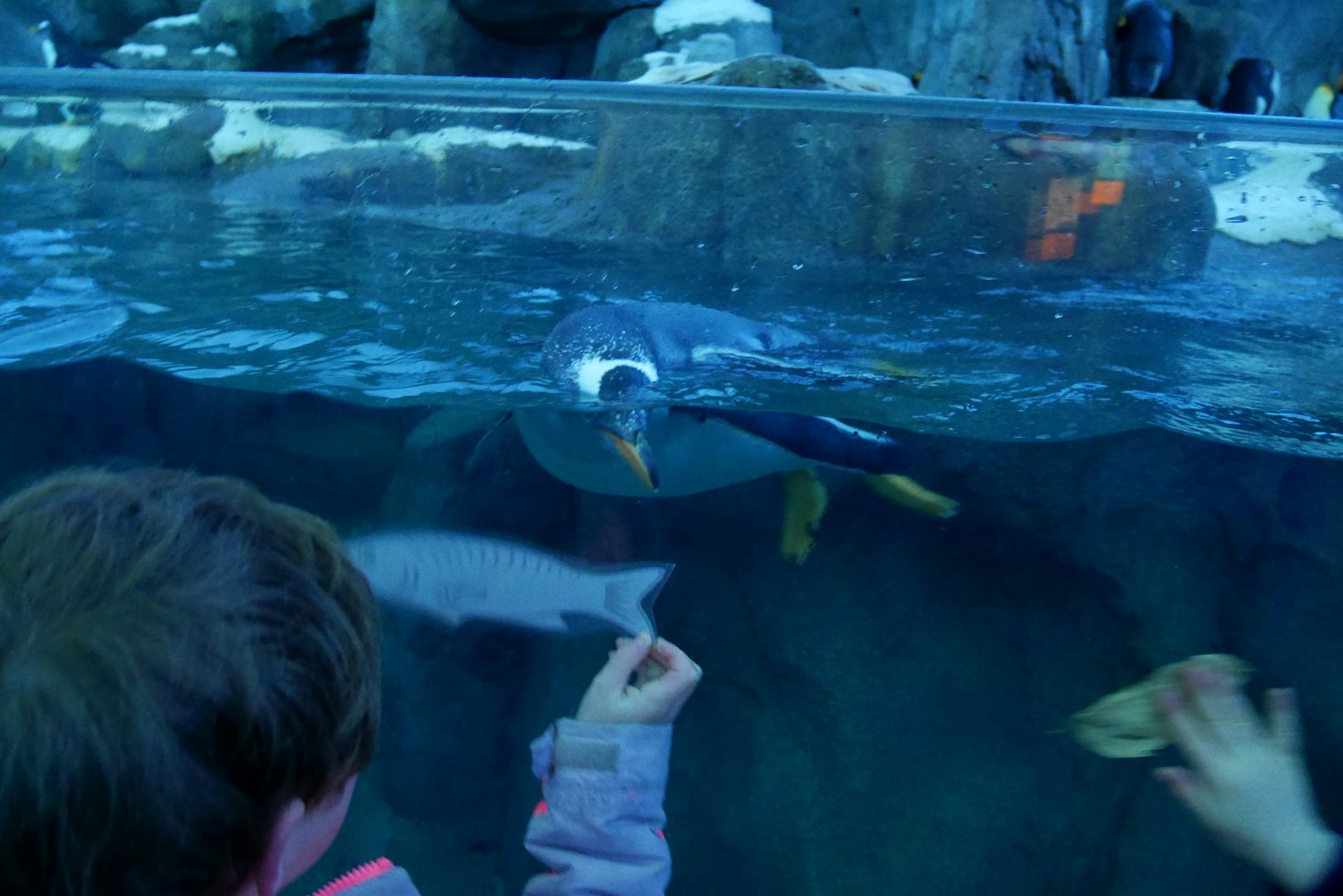
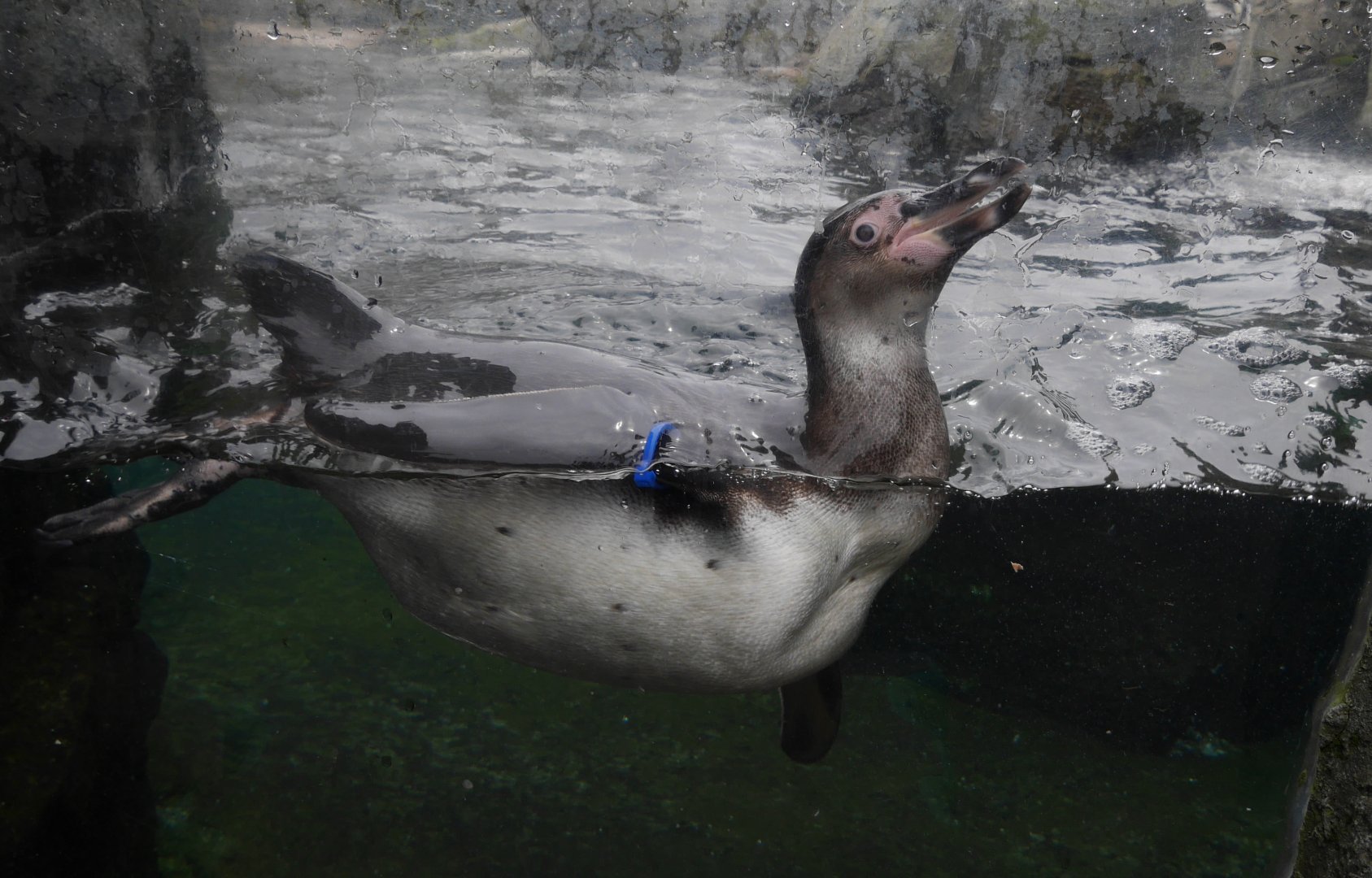
At the Woodland Park Zoo visitors can also feed the penguins. I came back to the exhibit later just for that experience. For $5 you get 5 anchovies to feed to the penguins. I lowered the anchovies one by one over the acrylic panel and the penguins eagerly snatched the fish from my hands! They’re so quick! I made sure I got a picture of one of the penguin I had fed, to help remember the experience.
I walked by the wetlands that treat backflow from the exhibit’s sand filters. Geothermal wells heat and cool the water. Rainwater in the exhibit is collected to compensate for evaporation. All these features are explained in interpretive panels and showcase the Zoo’s commitment to being environmentally responsible.
The sustainable features are just one of the commendable facets of the Humboldt penguin exhibit at the Woodland Park Zoo. Immersive design features and great imbedded interpretation contributes to making the whole exhibit an experience. Feeding the penguins was a great opportunity to interact with them more closely! My only concern is that viewing was a bit difficult in the shallow pool area. Overall, it is still a great exhibit and a great way to start a visit to the Zoo!
From there I headed to Banyan Wilds.
I spent a lot of time watching a family of Asian small clawed otters scamper around their exhibit. They dove into their pool and stream, climbed on branches, dug, played, and ran around. Asian small clawed otters are small, and I had to lean over the visitor barrier to get good views of them below me. The exhibit does rise to partially obscure a smooth curved barrier at the back, but the otters spend more time at the front of their exhibit in the water. It feels like the Zoo missed an opportunity here to better showcase a very entertaining species.
The other exhibits in Banyan Wilds did not hold my attention as well. Netting in the aviary obscured my views of the birds inside, including an impressive great argus. The mother sloth bear and her cubs were off-exhibit, and the other sloth bear was sleeping, and it was hard to see through the frosted viewing windows. I didn’t see the Malayan tigers.
There were some nice built-in enrichment features in the exhibits. An interpreter pointed out distribution feeders and tubes that let the sloth bears vacuum up hidden food. A training wall in the tiger exhibit is a great feature for positive reinforcement between the keepers and tigers. It looked like keepers could also hang food and enrichment from a jostle tree in the tiger exhibit. If I had seen the animals engaged with the enrichment items I would have had a much better experience at Banyan Wilds, but I was probably just unlucky that day.
I was a little disappointed with the size of the tiger exhibit. Snowleopard, whom I respect, described it as adequate. He’s seen much more zoo exhibits than me. According to the AZA Tiger Care Manual the average tiger exhibit at AZA facilities is 5,500 square feet. Based on those averages, Snowleopard's assessment was appropriate. I grew up watching Amur tigers at the Calgary Zoo’s exhibit and that shaped my expectations of tiger exhibits. The largest tiger exhibit at the Calgary Zoo is over 20,000 square feet of usable space based on my Google Map calculations. That’s probably three times the exhibit space for Malayan tigers at the Woodland Park Zoo. Seeing tigers in large spaces helps you intuitively appreciate that tigers are wide ranging and need large areas in the wild too.
The first large cat I saw that day was a snow leopard perched atop a slope in an exhibit past Banyan Wilds. From the visitor viewing shelter the ground rises significantly to the back of the feline exhibit. Natural rocks dot the hillside and form a cave shelter. The view is open, but there are trimmed conifers in the sides of the netted enclosure and behind it.
Nearby are the Australian exhibits. At Willawong Station guests can feed budgerigars, cockatiels, princess parrots, and Eastern rosella with seed sticks. Surprisingly, this area has been quite heavily detailed to look like the Australian Outback. The pathway is red and there are little red banks that have been textured and sculpted well and even include details like a crocodile skull. A bird exhibit in an attached building has been nicely planted and furnished but is too small for the kookaburra to fly much. Adjacent to this exhibit, the indoor space for common wallaroo and red-necked wallaby is very minimal. The exhibit wasn’t very good, but I probably spent several minutes watching the macropods here and having a good conversation about them with an interpreter. Their large, grassy outdoor yard is shared with emus and viewed through a fence from an elevated visitor pathway. On the other side of the path there is a nice collection of Australian plants that feels lost.
The plants in the next section, Northern Trails, are much better integrated into the exhibit experience. Northern Trails is a landscape immersion exhibit representing taiga, tundra, and montane landscapes of the North. It is often difficult to ascertain whether the trees and landscape are part of animal exhibits or outside them. It opened in 1994, so there are now many towering aspen and coniferous trees. The Zoo continues to add new plants too.
On my visit, wolves were lounging under some spruce trees. Standing next to the handrail, there were no noticeable barriers between myself, the wolves, and the empty elk exhibit beyond. The ha-ha fences that contain the wolves are cleverly hidden. Something stirred the wolves into activity and they trotted around.
There was a family watching by me. The boy said, “the wolves don’t have as much space as I remember, their home actually isn’t very big”. I agree. The relatively flat space that the wolves were trotting around in wasn’t very big. A fair proportion of their space has steeper slopes that help disguise the fences. On my return walk past this area, one of the wolves ran down and then back up the slopes, probably to get away from one of the other wolves. The slopes are good for getting out of sight, but there should be more flat areas to escape to where the wolves can rest.
Netted enclosures for birds of prey and porcupines weren’t very big either. Perhaps the birds were rescues and can’t fly well, but if that’s not the case then they could use more space to stretch their wings. The diagonal aviary posts are reminiscent of some of the nearby leaning trunks of aspen.
The Tundra Center is even more cleverly hidden in the landscape. The only part of the building you notice from the outside are the doors. Living willow cover the rest. Inside there’s a 70-foot long curved mural depicting the four seasons of the tundra.
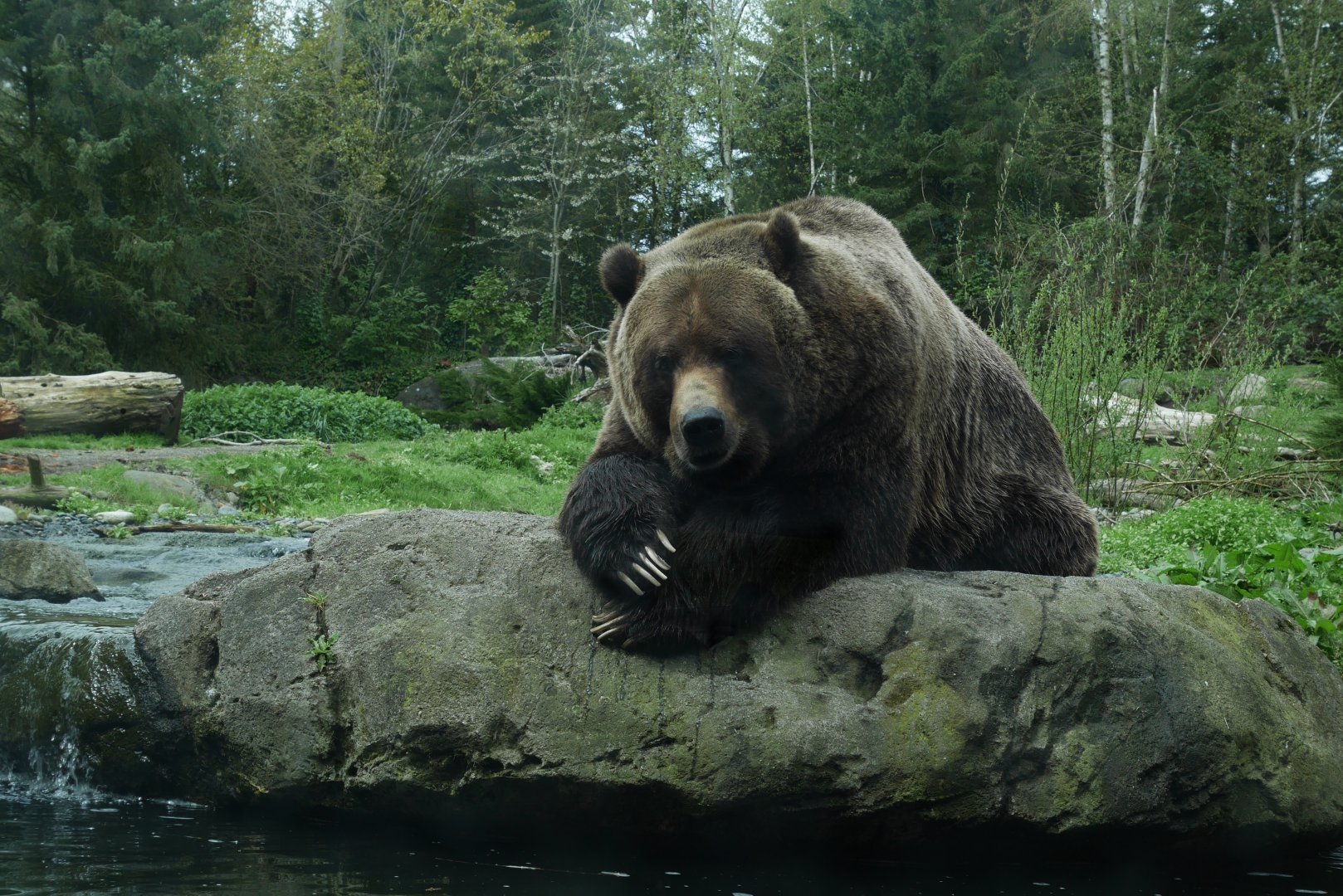
Outside is the first viewing area into the grizzly bear exhibit. There appeared to be nothing between myself and the grizzly bear sitting at eye level across from me. Burrowed views of the landscape beyond make the exhibit seem limitless. Further down the path there’s another view across a similar ha-ha wall. A rock outcropping beside the path is covered in plants and branches. From within there are cracks that provide more views of the grizzlies. At some point my imagination started taking over and I lost sense of where I was. Those moments really can happen at an exceptionally designed zoo exhibit!
The final viewing area is in the Taiga Interpretive Gallery and it’s cleverly disguised by plants growing on the roof. On one side of the gallery there are wide underwater windows looking into the grizzly bear exhibit. The landscape represents a floodplain with a braided stream, fallen trees, and willow plants. One of the two grizzly bears was swimming around while the other rested in the background! There are fish dispensers for enrichment, but I didn’t see any fish.
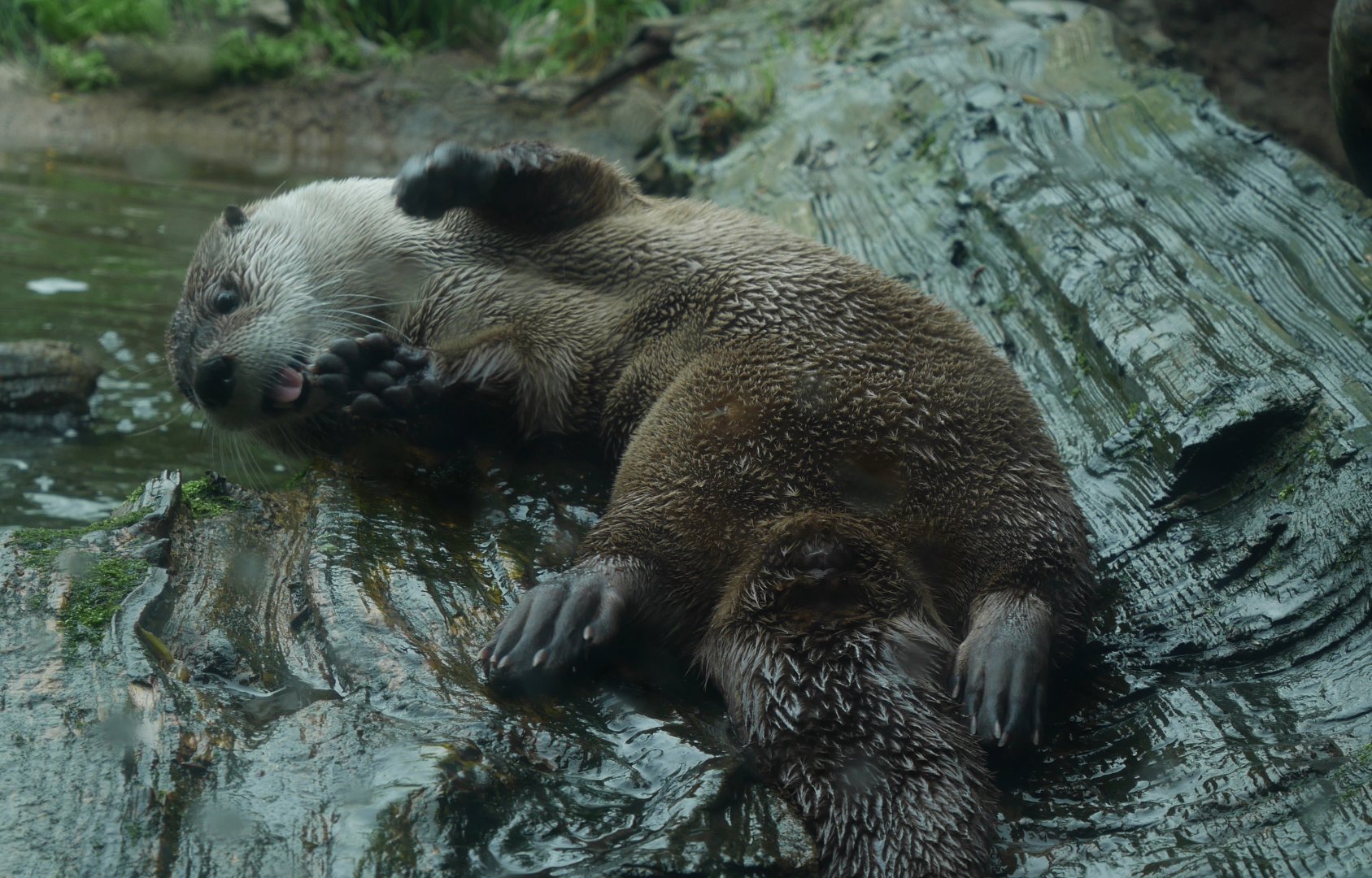
The other side of the Gallery has wide underwater windows looking into the otter exhibit with a mountain goat exhibit in the background and more burrowed landscape behind that. The otters were busy playing with one another. One climbed atop a floating log right up against the viewing windows and rolled around cutely on its back! At the same time there was a lot of action back at the grizzly bear exhibit that I was missing. I watched the grizzlies for a while longer before I reluctantly left the shelter. I had easily been there for twenty minutes.
Unfortunately, the rest of Northern Trails was closed (mountain goats, Stellar sea eagles, and elk).
At times I was awed by the design of Northern Trails. I had some exceptional experiences with river otters and grizzly bears and enjoyed the wolves. However, I felt a bit uncomfortable with the size of the wolf exhibit and the netted enclosures for birds of prey and porcupines. Ideally, the grizzly bears would have more usable space too. Backtracking through the exhibition detracted from the drama and I was disappointed about the closed exhibits. If the animals had more space and other exhibits were added to create a loop, then Northern Trails would almost be flawless.
Adaptations is much less exceptional. It’s a long rectangular building with a line of exhibits along one side. I saw meerkats, Indian fruit bats, two-toed sloth, some smaller reptiles, and Komodo dragons. I believe there was also a well detailed small exhibit for kea, but that may have been in Australia. One of the meerkats was pacing back and forth in a very stereotypical pattern. I have never seen a meerkat do that before and I found it distressing. The exhibit wasn’t well furnished, and I don’t recall much enrichment. Hopefully, the meerkats at the Zoo don’t usually pace like that.
After feeding the penguins I decided that I could also use some sustenance too, so I got some food at the Rainforest Food Pavilion. The Woodland Park Zoo has composting and recycling bins and does a good job reducing consumer waste at their food services. I was ready for the next exhibit complex, the Tropical Rainforest.
The Tropical Rainforest is entered through a large artificial buttressed trunk partially veiled in tropical vegetation. The pathway cuts through dense plantings to a giant simulated fallen ceiba tree. Lush vegetation grows out of the top of the fallen ceiba. A continuous sheet of glass from the bottom of the massive trunk to the pathway below is a window into the stream-side jaguar exhibit.
At first, I couldn’t tell where the jaguar was among the scenic lush vegetation and artificial fallen trees.
Another guest pointed out that the jaguar was in the back of the exhibit pacing back and forth. She knew where to find them almost immediately because they tend to pace in that same area. I felt dispirited. The experience built up by the design and craftsmanship of the landscape was being undermined by my feelings of pity for an animal engaged in repetitive behavior.
It’s possible that jaguar’s temperature tolerances play a role in this concerning behavior. Jaguars cannot tolerate temperatures below -1.1 degrees Celsius and need supplemental heating at temperatures below 10 degrees Celsius (as per the AZA Jaguar care Manual). In Seattle, five months of the year have an average of six or fewer days of at least 16 degrees Celsius (60 Fahrenheit). For a good proportion of the year the jaguars at the Zoo would be unable to fully enjoy their outdoor exhibit and their indoor space probably isn’t nearly as complex. Jaguars that are having difficulty coping with colder climates can display increased pacing (as per the AZA Jaguar Care Manual). This makes sense as they need to stay active to keep warm and that increased activity can lead to more pacing. When this exhibit first opened the jaguars wouldn’t enter the water features. Warming the water led to an increased frequency of swimming behaviors. This anecdote shows that jaguars are sensitive to colder temperatures and that it can modify their behaviors. Stereotypical pacing has complex causes and cannot be traced back to a single deficiency in the animal’s environment. However, it is possible that Seattle’s cooler climate could be contributing to increased pacing by the jaguars.
I watched for awhile and hoped that the jaguar would break out of the routine.
Thankfully it did. The jaguar emerged from the screened back of the exhibit. In clear view, the resplendent feline looked stunning surrounded by the vivid greens of the vegetation. It was no longer pacing in repetitive patterns and seemed to be more actively engaged with the environment. I really wanted to get a picture, but I was being too picky, the jaguar was moving quickly, and seeing the jaguar through the camera lens was less captivating than seeing it unfiltered before me. I missed my chance. The jaguar slipped back behind some dense foliage. I waited for awhile for it to re-emerge, before leaving in favor of seeing more animals.
More Neotropical animals are exhibited in the Tropical Rain Forest building. The path through this building journeys from the shady rainforest floor to the canopy. I couldn’t see the ocelots (other visitors could), but I found colorful birds, reptiles, and amphibians among the giant tropical trunks. Further on, in the understory layer there are golden lion tamarins and bird exhibits with piano wire barriers. Passing into the canopy I saw a couple of white-faced saki monkeys in a tall, vertically orientated exhibit. Icons of South American fauna, the toco toucans also have a home nearby.
A walk-through canopy level aviary is the highlight of the Tropical Rain Forest building. Visitors walk across a bridge surrounded by the upper branches of living tropical trees. A great variety of colorful and exotic birds can be viewed at eye-level as they fly between the tree branches. The dome above is transparent, but further down the architecture is masked by rings of vertical planters with tropical plants. This is the most immersive exhibit in the Tropical Rain Forest Building.
Andean cock-of-the-rocks are one of my favorite Neotropical species and I was thrilled to get close to a couple of vividly colored male birds in the tree-tops! The spangled cotinga and crested oropendola in this aviary were also spectacular sights.
Outside the aviary and building I heard the booming calls of red-ruffed lemurs. The lemurs were bounding along large tree trunks that connected their island exhibit with their holding areas. The holding building is artfully hidden behind a well-detailed artificial mud-bank topped with a dense tangle of vegetation. In between leaps, the lemurs stopped to roar at one another.
Ring-tailed lemurs have a similar island exhibit with several large living trees. A conspiracy (group) of lemurs were cuddled together on a tree branch and didn’t seem to be causing much trouble. They were quite far away though, so it was hard to know for certain.
I got a bit closer to the colobus monkeys from across the windows of a viewing shelter. The dramatically black and white monkeys have an enclosed exhibit set among the wide trunks of several mature trees. A network of branches provides additional climbing. Bamboo plantings green-up the exhibit and screen bad views. The pathway loop continues past the colobus monkeys and through dense plantings. Anticipation was building.
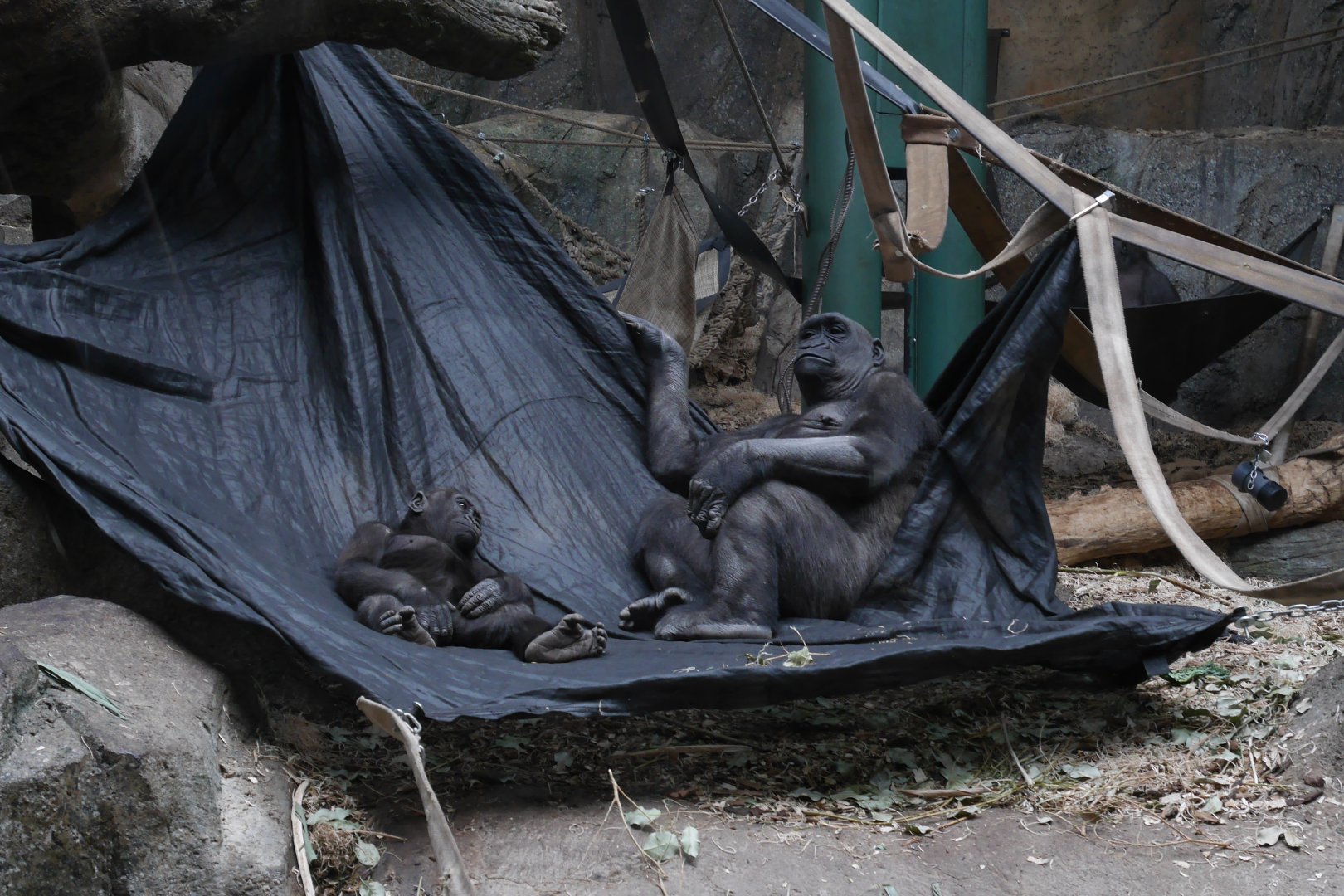
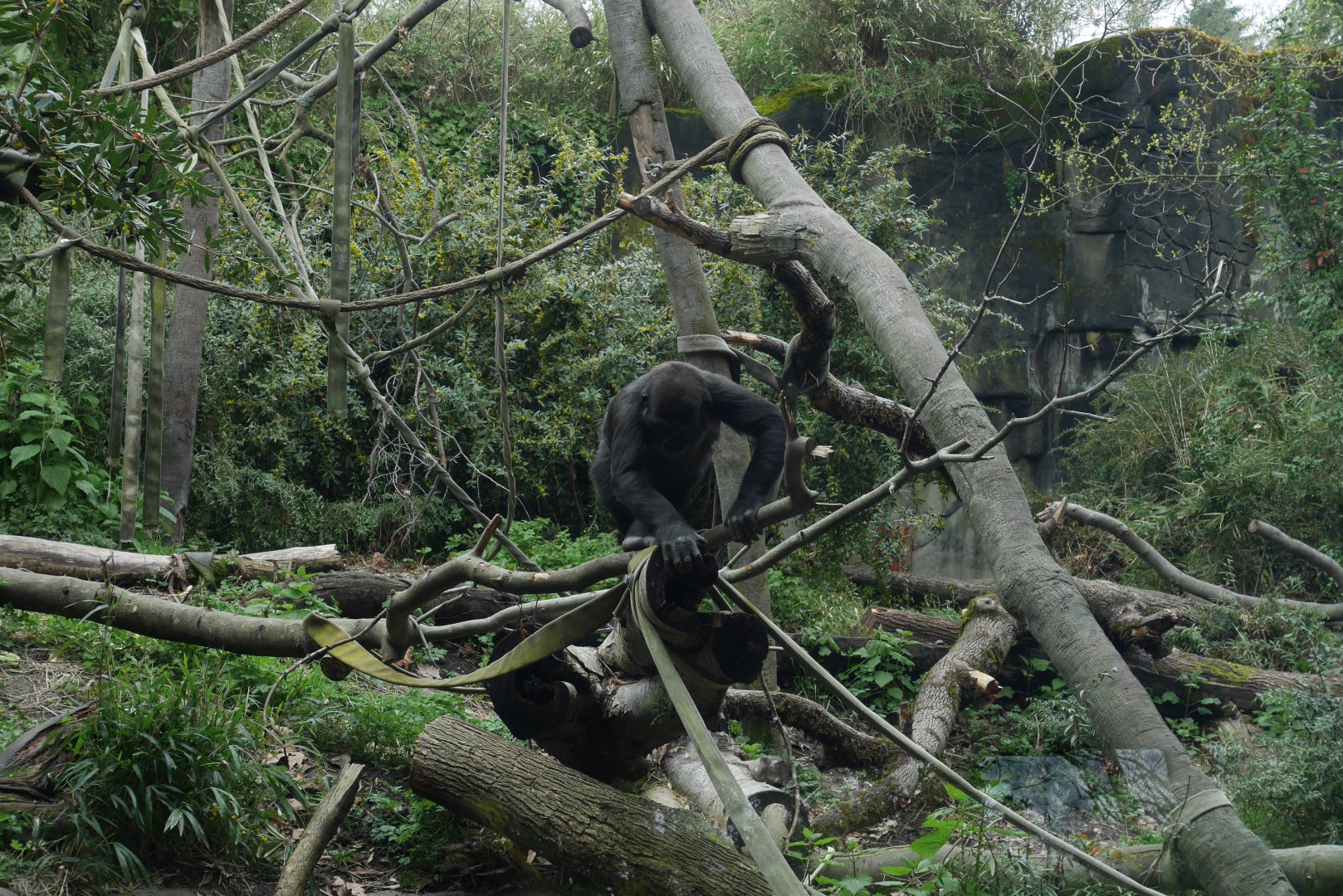
As I passed by more plantings a view of a gorilla family emerged. The adults were foraging on the ground while the younger troop members climbed in the branches and trees above them. Herbaceous plants, shrubs, broken branches, and smaller trees around the gorillas within an area of larger trees gave impressions of a succession area within a tropical forest. The gorilla exhibits have been so cleverly designed and planted that you don’t notice the rockwork or holding buildings. Burrowed views visually extend the exhibit. Here, the landscape has dominance over the visitor areas and the gorillas are contextualized as agents within that landscape.
Past the family group, I watched a couple of males under a covered area and wondered why they were so far away from the females and youngsters. I didn’t realize that there are two separate exhibits! The covered area has an open side that provides the gorillas access to a more open area that can be viewed from across a ha-ha wall, but it is not connected to the space where I saw the gorilla family.
It would be interesting to re-visit this exhibit and see how much time the gorillas spend in the covered area as opposed to the more open areas of their exhibit. Gorillas prefer areas with more structural complexity (walls, ceilings). The covered area has some heating and is protected from the elements. In addition, there was a lot of food scattered around the covered areas, which would encourage the gorillas to spend even more time there. Even if the bachelor gorillas don’t use the more natural, open part of their exhibit often it is possible that it’s still important for their well-being.
The gorillas were a great climax experience at the end of the exceptional Tropical Rain forest loop.
Temperate Forest, the next exhibit zone I saw, was much less compelling than the Tropical Rain Forest. It’s not nearly as immersive. There’s less theming and there doesn’t seem to be much connecting the exhibits together. I would normally be quite interested in some of the animals here, but I passed by most of them quite quickly. There were pudu, red pandas, maned wolves, and some beautiful crane species all in simple exhibits with prominent barriers. Flamingos have an open exhibit viewed from across a boardwalk. I enjoyed the walk-through wetlands aviary more, but the low ceiling felt a bit oppressive in combination with the open views across the exhibit. The row of bird exhibits at the Conservation Aviaries felt repetitive. Bug World has a lot of nice little exhibits, but it felt like I was just crossing things off my list of things to see. I walked quickly through the farm animal areas. I felt a bit anxious to move on because there were still two major exhibit habitats to see.
The African Savanna has a more exciting design. The African Village was under renovation, but the outlook was still open. From there, you can get a view of the Savanna’s waterhole in the mixed-species ungulate exhibit (giraffes, zebras, gazelles, and birds). The topography is nicely varied and there are burrowed views of the trees beyond. On the Savanna Trail there’s a walk-through aviary with a few species of African birds, but it’s dominated by Taveta weavers and the exhibit is dotted with their woven nests. Past the aviary, the path continues through dense vegetation with some openings providing views into the savanna exhibit. The hippo exhibit is seemingly continuous with the savanna beyond. It’s very scenic, but the hippos are viewed from above and the savanna ungulates are hard to see in the distance. A patas monkey exhibit is also visually connected to the savanna, but it’s more elevated relative to visitors than that for hippos. The lion exhibit was large and impressive. The final exhibit is for warthogs but was designed for African wild dogs. It’s well detailed, but the barriers are much better designed for large canines and are excessive for warthogs.
Compared to the other immersive habitats at the Woodland Park Zoo the vegetation in the African Savanna is less immersive. Part of the problem is that public parks tend to have cropped grass and widely spaced trees like a representation of a savanna. Savanna exhibits at zoos must have other features too to look like a wild savanna and not just another city park. The African Savanna exhibit at the Zoo makes extensive use of burrowed views of stands of large trees. Some of those trees are conifers, which doesn’t help the immersion.
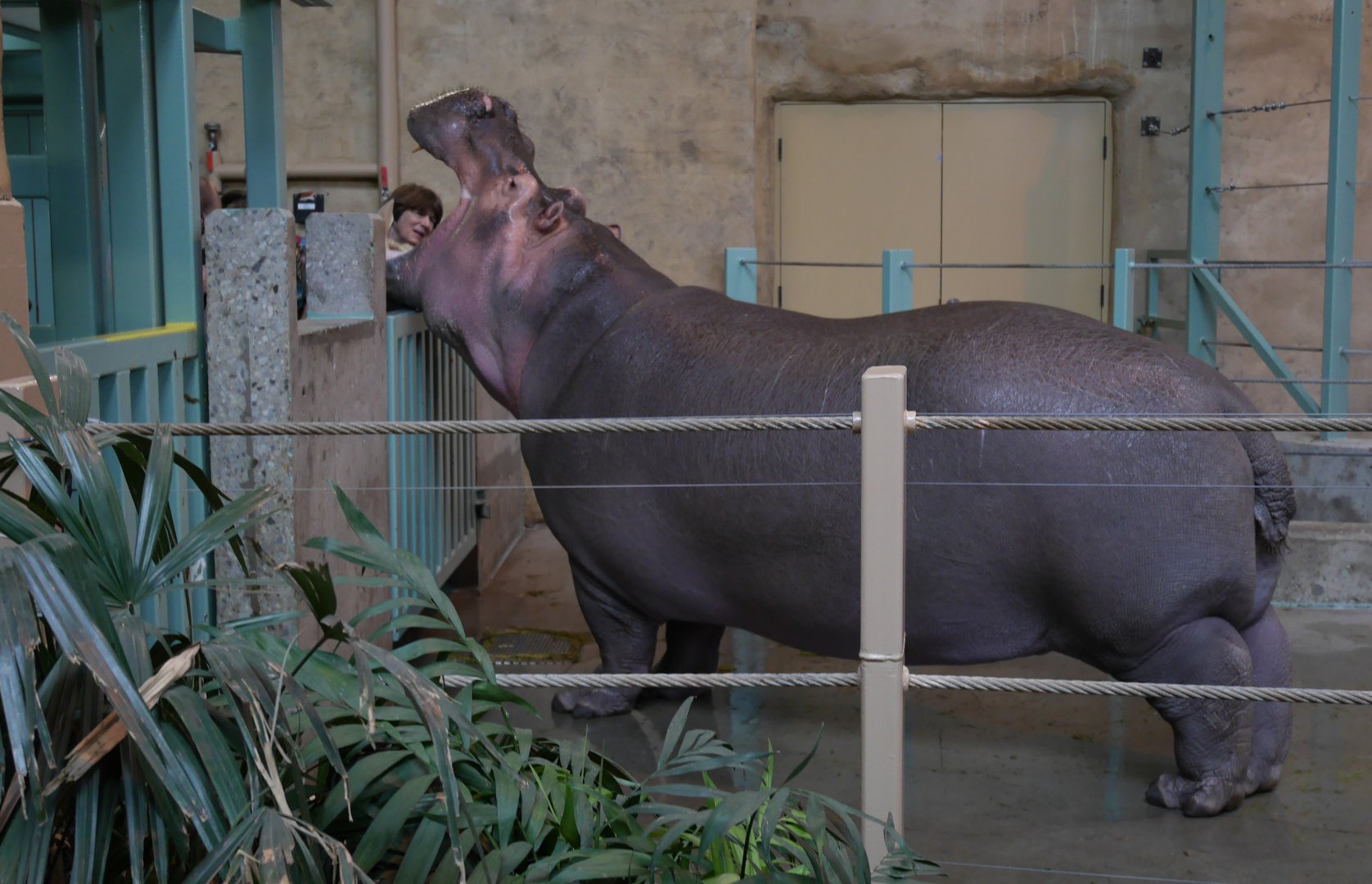
I had anticipated spending more time at the African Savanna, but the animal experiences did not hold my interest. Neither the patas monkeys nor giraffes were out in their exhibits. The expansive ungulate exhibit is viewed from a distance and better suited for viewing giraffes than smaller ungulates like zebra and gazelle. I read somewhere that the giraffes are only out in their exhibit for about four months of the year. The pool for hippos isn’t heated and the hippos are also only visible for part of the year. I did see a hippo, but both the hippos and warthogs are viewed significantly below the eye level of visitors, which isn’t ideal. Finally, the lions were asleep. I probably spent more time watching weaver birds than any other species of animal in the African Savanna.
The Tropical Asia habitats would also be disappointing for animal experiences. Assam Rhino Reserve wasn’t open yet, so I didn’t get to see the Indian rhinoceros, Visayan warty pigs, Demoiselle cranes, and turtles. In Trail of Vines I didn’t see the Francois langurs or siamang. I did see active Malayan tapirs and Indian pythons. I watched the orangutans for a few minutes before they went out of view into their holding spaces. It was past 4 pm, and many of the animals seemed to be headed off exhibit.
I didn’t have enough time to fully appreciate Trail of Vines, but in general it seemed very impressive. The pathways are densely planted with a wide variety of plants to represent the floral biodiversity of tropical forests. Real and artificial vines are wrapped around trees and hang between them to form an arboreal network, like those some rainforest animals, including siamangs, use as trails. The outdoor siamang exhibit is a lush island with trails of vines connecting the trees. Orangutans have two large outdoor exhibits that are viewed primarily from an elevated boardwalk. The second exhibit also has viewing windows at ground level between tall rockwork formations. Each of these outdoor exhibits has tall artificial trees and living trees for climbing and tall rockwork barriers. Both the orangutans and siamangs have vertically orientated indoor exhibits with lots of artificial trees for climbing. The exhibit building has been well integrated into the landscape and the visitor areas are elevated covered paths adjacent to the building with one side facing the indoor exhibits and the other open to the outdoor forest. Windows in the animal exhibits provide burrowed views of the vegetation outside. Trail of Vines is a well-designed exhibit that I would love to explore more thoroughly on a future visit.
I spent a total of over six and a half hours at the Zoo, but I was already planning my next visit before I had left the Zoo. It felt like I had missed quite a lot of animals. There’s a lot to see at the Woodland Park Zoo because they have continued to create award-winning exhibits for decades.
Returning to my expectations, the Zoo met most of them. The design quality at the Zoo was indeed exceptional, particularly Northern Trails. It was inspiring to visit the exhibits and a great opportunity to learn more about zoo design. The craftsmanship evident in the rockwork and other features was phenomenal for a city zoo. The Zoo has a great horticulture department as well. Northern Trails and some of the other exhibits would not work so well if there wasn’t a great team, including many other types of professionals I haven’t mentioned, working together for the Zoo.
The manner that architecture has been integrated into the landscape at the Woodland Park Zoo exceeded my expectations. Many of the buildings are almost completely hidden from view. The transitions from the landscape into exhibit buildings in the immersive exhibits were seamless, especially at the Northern Trails. There is a huge difference between the architecture at the Woodland Park Zoo and the overly self-aware and prominent architecture on the island at the Calgary Zoo. The architecture at the Woodland Park Zoo doesn’t distract from or compete with the experience of moving through natural landscapes and encountering animals.
The Zoo unexpectedly fell a bit short with the proportion of animals that were off-exhibit or not visible. No doubt, that is partially down to luck because animal behavior is variable, and I don’t think they should be forced to be on display. It can also be attributed to the Zoo’s focus on exhibiting animals in naturally landscaped habitats and their exhibition of primarily tropical species. Many species at the Woodland Park Zoo cannot be displayed outside year-round in Seattle. Quite a few of those species, including giraffe and patas monkeys, cannot be viewed in their indoor spaces during these colder periods. If the indoor animal spaces are insufficient then the animal’s welfare will be compromised and that may continue to manifest itself even in the warmer months when the animal can go outside. It’s possible that this contributed to the pacing behavior I saw from the jaguars. Having too many animals off display during colder periods of the year may compromise animal welfare and detract from the visitor experience.
If the Woodland Park Zoo had more indoor exhibits, then the buildings and architecture might detract from the strength of the Zoo- the experience of moving through natural landscapes. There’s a complicated balance here. Part of the solution may be to have more species that are well adapted to the local climate. A lot of tropical species are very popular, many are threatened with extinction, and there’s a bigger variety of them. Compromises need to be made somewhere. The exhibit building in Trail of Vines at the Zoo didn’t significantly detract from the immersion into a tropical forest and shows how some tropical animals may be exhibited in temperate zoos.
I was a little disappointed with the size of some of the animal enclosures at the Woodland Park Zoo, although none of them were bad. The usable space for wolves, and Malayan tigers both felt too limited. Enclosure complexity is much more important than size for captive animal welfare. Size isn’t everything. I think there’s a tendency to compare enclosures based on size because it’s easier to see and more quantifiable than complexity and enrichment. However, a big complex enclosure is better than a small complex enclosure and variety is limited by space. Some animal behaviors, like running or flying, need minimum spaces for performance and this can’t be made up for by more complex exhibits alone. People, including myself, have gut reactions to exhibit sizes too and this influences emotional reactions and experiences of exhibits. That’s why many exhibits use burrowed views and other tricks, including at the Woodland Park Zoo. The designers know that people respond positively to larger animal exhibits. Woodland Park Zoo has pushed zoological standards with the quality of their exhibits but hasn’t been as progressive with the quantity of space for their animals.
There isn’t a perfect zoo. Zoos are evolving institutions and it takes a long time to redevelop facilities. Our understanding of animal’s needs is growing. Funding can be limited. The climate and site pose additional challenges. It’s important to strive for ideals and improve, but zoos are complicated institutions and some compromises need to be made.
I really enjoyed my visit to the Woodland Park Zoo. Most of the Zoo is composed of exceptionally designed immersive habitat loops. I had some great experiences with animals, especially penguins, grizzly bears, otters, Neotropical birds, and gorillas! There are a lot of exhibits that kept me engaged for the whole day and led to a lengthy zoo review!




 .
.


 ! I hoped that you could provide more insight into the activities of the animals because you've been there a few times. That's exactly what you did, so thank you