Part 6 – Things are Going to Get Better
From my recent experiences in Seattle I was wary about both walking through rough areas of the city and fraudulent taxi charges. I decided to take a short taxi ride to the Greyhound station and pay my fare with cash.
Shortly after sitting down at the station, a heated exchange broke out between two men beside me. Greyhound stations tend to have high police presences, and it wasn’t long before an officer came over to mediate and break up tensions. I felt safer than I had in many other downtown Seattle areas.
In an exuberant voice one of the Greyhound workers proclaimed the arrival of my bus. Waiting at transportation hubs is tedious and I appreciated hearing such an outburst of facetiousness. His colleague promptly apologized, thankfully not in a scornful way, and re-announced the arrival with more professional enunciation.
For most of my bus ride to Portland it was too dark to see much outside the windows. South of Seattle the land seemed to become more natural and I finally saw stands of towering coniferous trees. It felt more like the Pacific Northwest I had expected to see.
Before embarking for my trip, my mother had strongly advised me to take a taxi from the Greyhound station in Portland. Apparently, her friend had walked around that area and found it very intimidating. He’s not someone who would spook easily. He’s a night-shift custodian at a strip-mall with a pub. I’ve heard a story about him protecting a woman from attempted rape. It was late, so I heeded their advice and got a taxi ride to my hotel.
Looking back, it would have been very easy for me to walk or use public transportation to my hotel and it is likely much safer than others had led me to fear. The Greyhound station is adjacent to Union Station and very close to green and yellow line local train stations.
In Portland I stayed at Hotel Rose, which cost more than my average lodging for this trip. The front desk agent (I unfortunately forgot his name) was ebullient and a great match for the ambience of the hotel. The lobby and other public areas were funky and vibrant. My room had yellow tones that made it feel warm and inviting. There were little humorous touches, like the do not disturb signs that read, “I’m naked (please go away)”. The last day I had been acting and feeling guarded, but after recuperating at my hotel I had a more sanguine temper. I headed out and wandered through downtown Portland that night.
The next morning, I had a piquant smoked salmon and caper omelette before heading to the Oregon Zoo.
Portland has a great public transportation system and it was very easy to get to the Oregon Zoo. Washington Park station is just an elevator ride and short walk from the Zoo.
Even if you have a personal vehicle I still recommend that you use the light rail trains to get to the Zoo. The trains travel through underground tunnels to reach Washington Park station. It’s one of the deepest transit stations in the world! At the station, the tunnel walls are decorated with images of the city and zoo animals in vivid purples and geometric patterns. There’s a long core sample taken from the site on display with marks along its length to indicate periods of Earth’s history and major geological and biological events. A diagram in the elevator illustrates your passage through geological formations and a display dynamically tracks elevation as the elevator rises. By the time I got to the Zoo I had already had an absorbing experience and learned about natural history.
The Oregon Zoo
Past the entrance gates at the Oregon Zoo, there’s a plaza with visitor services. From the plaza the first exhibit, Cascade Crest can be seen.
Mountain goats inhabit Cascade Crest in a simulated alpine landscape of the Cascade Mountains of Oregon. A cirque water-feature in the foreground forms a natural exhibit barrier. The grassy exhibit slopes are peppered with rocks and formations as they rise to the center of the exhibit. Artificial snowbanks add further character. Tall basaltic formations punctuate the center of the space to become the focus point of the exhibit. A burrowed view of towering coniferous trees forms a backdrop to the scene. As visitors walk around the exhibit different views into the exhibit emerge. Between viewing areas, a simulated glacier ice cave can be entered. Inside there are models of ice insects that have been enlarged several times their natural size. Pieces of exploration equipment and notes add to the embedded narratives. Cascade Crest a very well-realized immersive exhibit that invites exploration.
As I moved through the exhibit, different mountain goats became visible. The shaggy white coats of the mountain goats contrasted strikingly with the dark rock formations, and I enjoyed watching them graze in their exhibit.
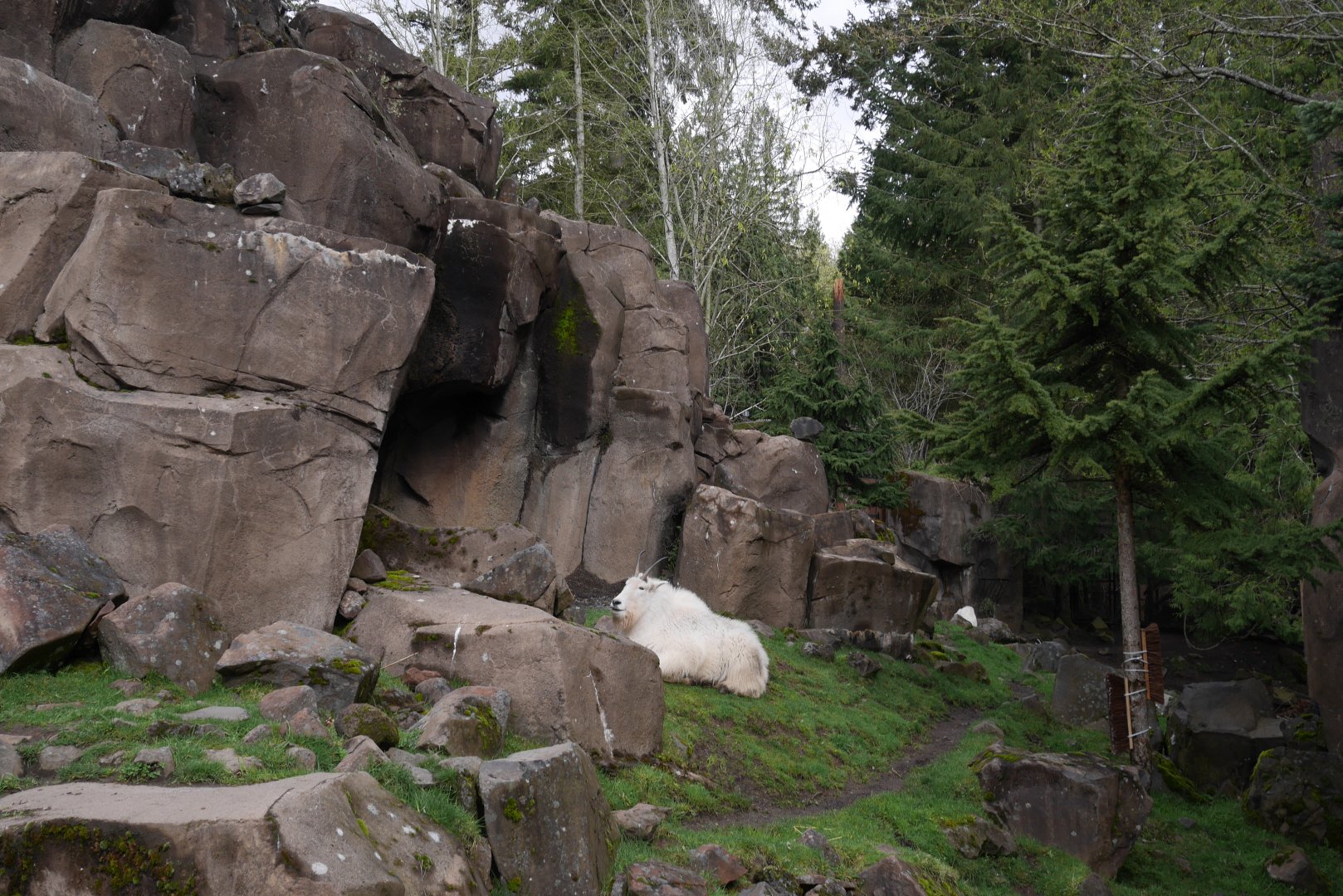
Long-term, there are plans (see the Oregon Zoo Master Plan) to turn this exhibit into a rotational space for native carnivores, including cougars, black bears, and wolves. It will be a significant challenge to install adequate containment barriers for cougars without detracting from the open feeling of this exhibit and the carefully managed sight-lines.
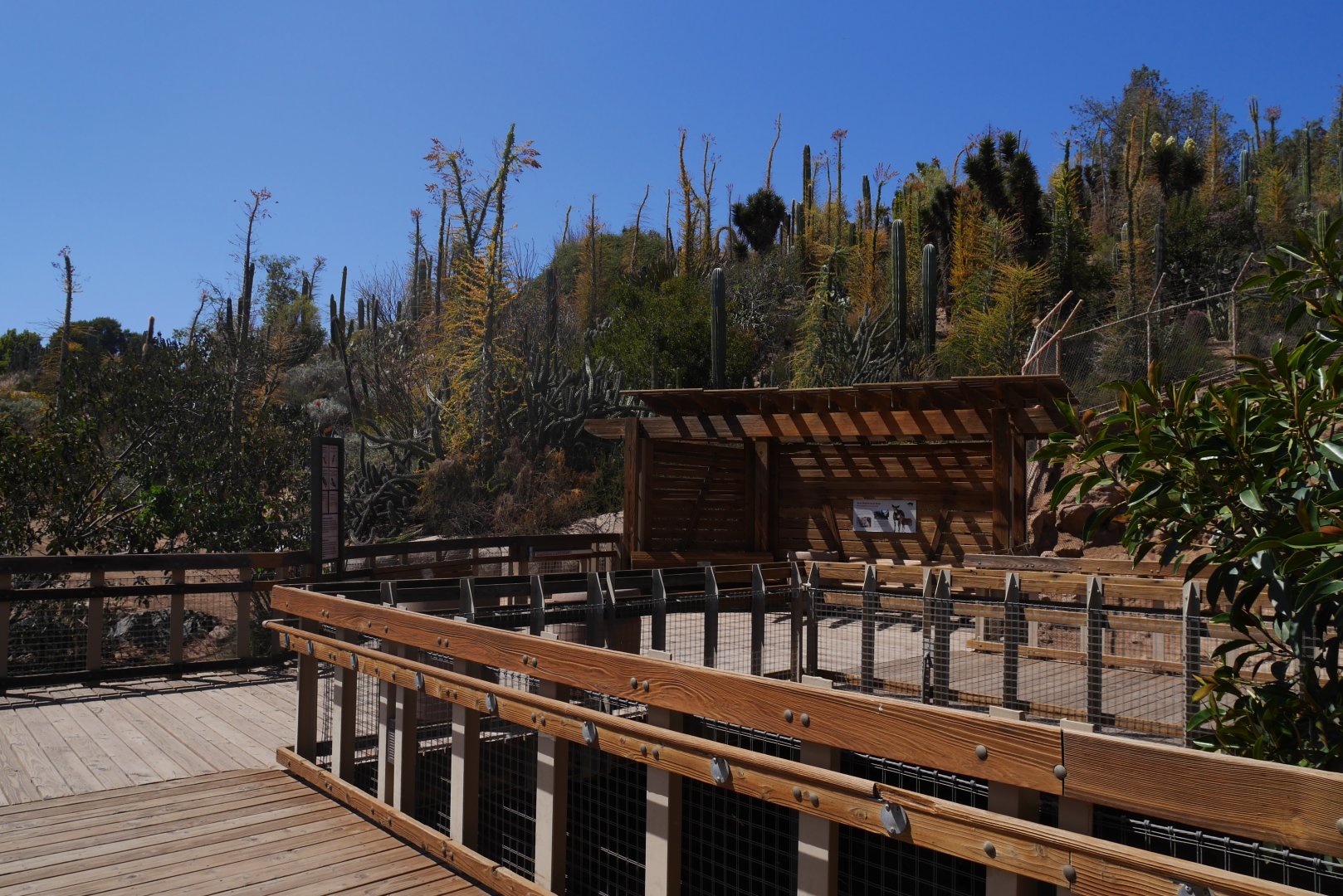
As the pathway travels around Cascade Crest and further into the Zoo visitors view the existing blackbear exhibit on the opposite side. The pathway is significantly elevated here relative to the black bear exhibit. There are a few large trees that the bears can climb to get much closer to visitor’s eye-levels. Further down the path, the bear exhibit crosses under a 100-foot suspension bridge to holding areas somewhat disguised with artificial rock formations. Visitors can look through a large window in a concrete viewing structure for close-up views of bears on top of a rock-work formation. When the bears are lounging under the overhang of the rock-work they would be far less visible. There are also views from the shelter into a netted enclosure for bobcats in the forest. At the other end of the exhibit, visitors can watch the stubby-tailed small felines through a window set in an artificial trunk.
With more theming here, they could have made the whole viewing structure into a simulated rock-outcrop that visitors enter to get selected up-close views of bears and bobcats.
The pathway descends past native plants and lofty Douglas fir trees. It was hard to distinguish what had been planned and planted and what was the result of natural reforestation. It’s very beautiful and made me want to return to Oregon one day to see some of the natural forests there.
Eagle Canyon is beautifully integrated into this scenery. Visitors enter the bald eagle exhibit in an elevated viewing hide. From the open-fronted hide I could see a couple of bald eagles perched high on some branches, a large nest to my right, mature trees, and a stream below. Outside the hide and eagle exhibit, the pathway snakes down the canyon. At one spot an artificial stream complete with salmon sculptures cascades down into grated drains set in the pathway. The water passes under the pathway and to the stream in the eagle exhibit. Visitors re-enter the aviary lower down in a simulated lava-tube. As water falls over the pathway and into the stream it creates a veiled view of the bald eagle exhibit. Salmon, trout, and sturgeon can all be seen underwater sharing the stream within the eagle exhibit. Together the exhibit features create a much more experientially rich exhibit than typical eagle enclosures. Showcasing the bald eagles with fish, water-features, and the native landscape helps convey how they’re all connected and worth preserving.
Eagle Canyon transitions almost seamlessly into Cascade Stream and Pond. Cascade Stream and Pond won the AZA exhibit award when it opened in 1982 and still holds up well. Several species of turtle, including Western pond turtle, can be seen easily in a well-detailed exhibit. I didn’t see any beavers, but I really enjoyed watching waterfowl dive underwater. It provided an exciting new perspective of a commonly seen group of animals. Otters are great display animals and I enjoyed watching one dive in and out of its pool. The ring-tail was active in an exhibit themed like a miner’s cabin, but the exhibit is taller than the small viewing windows and it was tough to get a good angle to watch the small carnivore. I also saw several exhibits for small species of reptiles and amphibians that are native to the Pacific Northwest. The final exhibit is a walk-through aviary for carrel egrets and more waterfowl.
The exhibits of native fauna continue with an exhibit for cougars. There were lots of branches and artificial rock ledges for the cougars to climb. They were resting, so I walked over to another viewing area for the black-bear exhibit. From there I watched through the viewing windows as the bears climbed in their sloped exhibit above me. I watched for awhile, but I felt pulled to the condor exhibit.
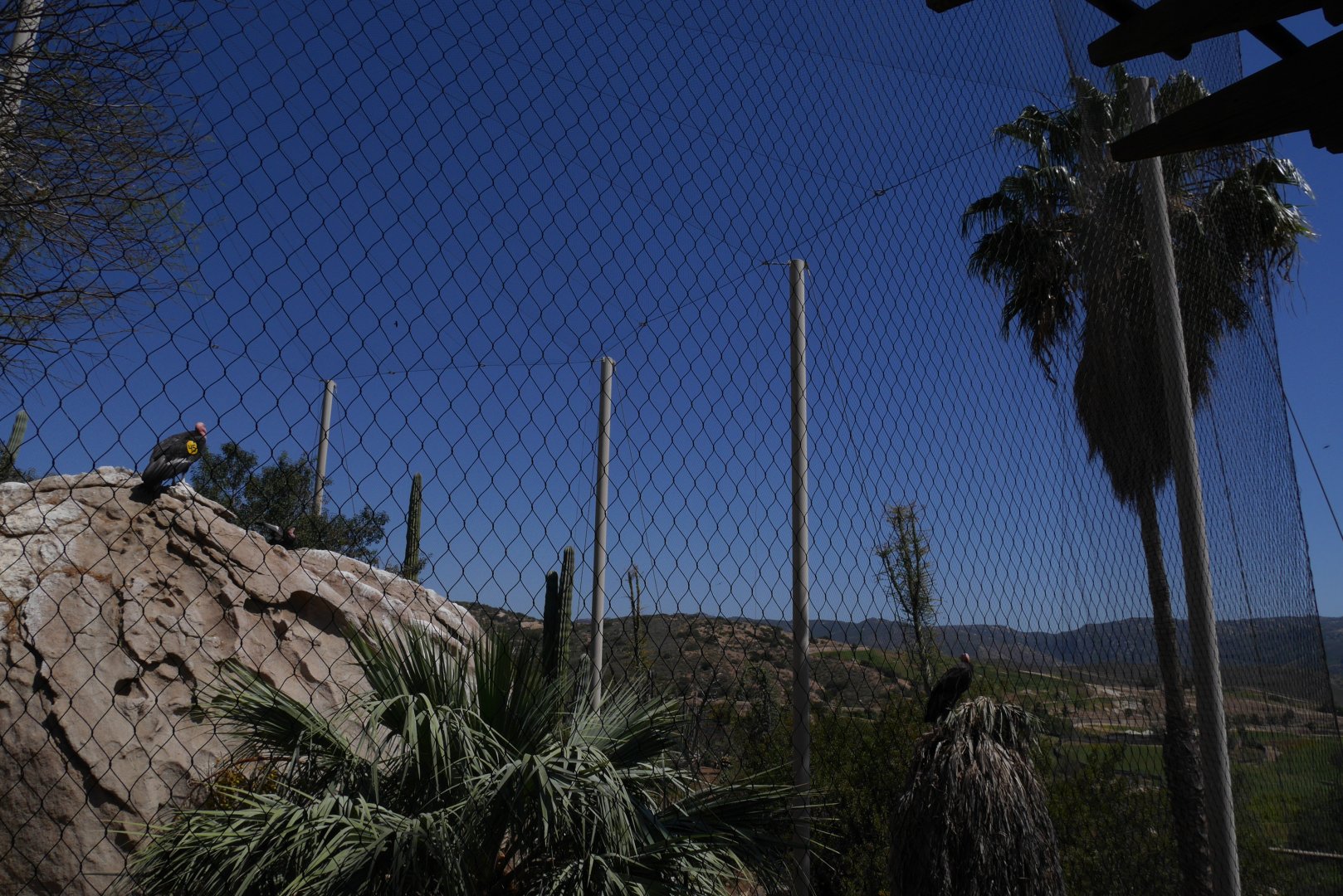
I had first noticed the California condors in the distance all the way back by the mountain goat exhibit. Those were my first glimpses ever of California condors and I was anxious to get a better view of the iconic birds that have been saved from the brink of extinction. They were still active when I finally got close to them. I was surprised just how social and complex they seemed to be. A nearby sign titled Smart and Social confirmed my observations.
California condors are one of the rarest species of birds, but the animals at the nearby Family Farm are some of the most common species of animals. I walked by the farm animals quickly but stopped to take a picture of an outdoor covered enrichment enclosure for housecats. It was a good showcase of how you can get housecats outside, but still protect native wildlife from them. The rest of Family Farm feels too nostalgic. On the map the Great Northwest exhibit complex ends at the Family Farm, but I like to think that it ends with Steller Cove.
Cascade Crest is on the relatively highest point of the Great Northwest exhibits and Steller Cove is located relatively lower than the other exhibits. The change in exhibit elevations represents a journey from the peaks of the Cascade Mountains to Oregon’s coast.
I started to explore Steller Cove from the intended exit, but the sequencing still worked well. My first view was of a simulated rocky coastline with a tidepool nestled under the cliffs. The tidepool had a short viewing panel along its length for underwater viewing of fish and coastal invertebrates. The recreated cliffs above aren’t blocky and monolithic; they are complexly shaped and finely detailed. Large coniferous trees and other native vegetation atop the cliffs adds further drama and realism. The cliffs artfully conceal a repurposed building with underwater viewing and hidden life support equipment. It feels like you are passing into an alcove that the pounding waves have carved into the overhanging cliff face.
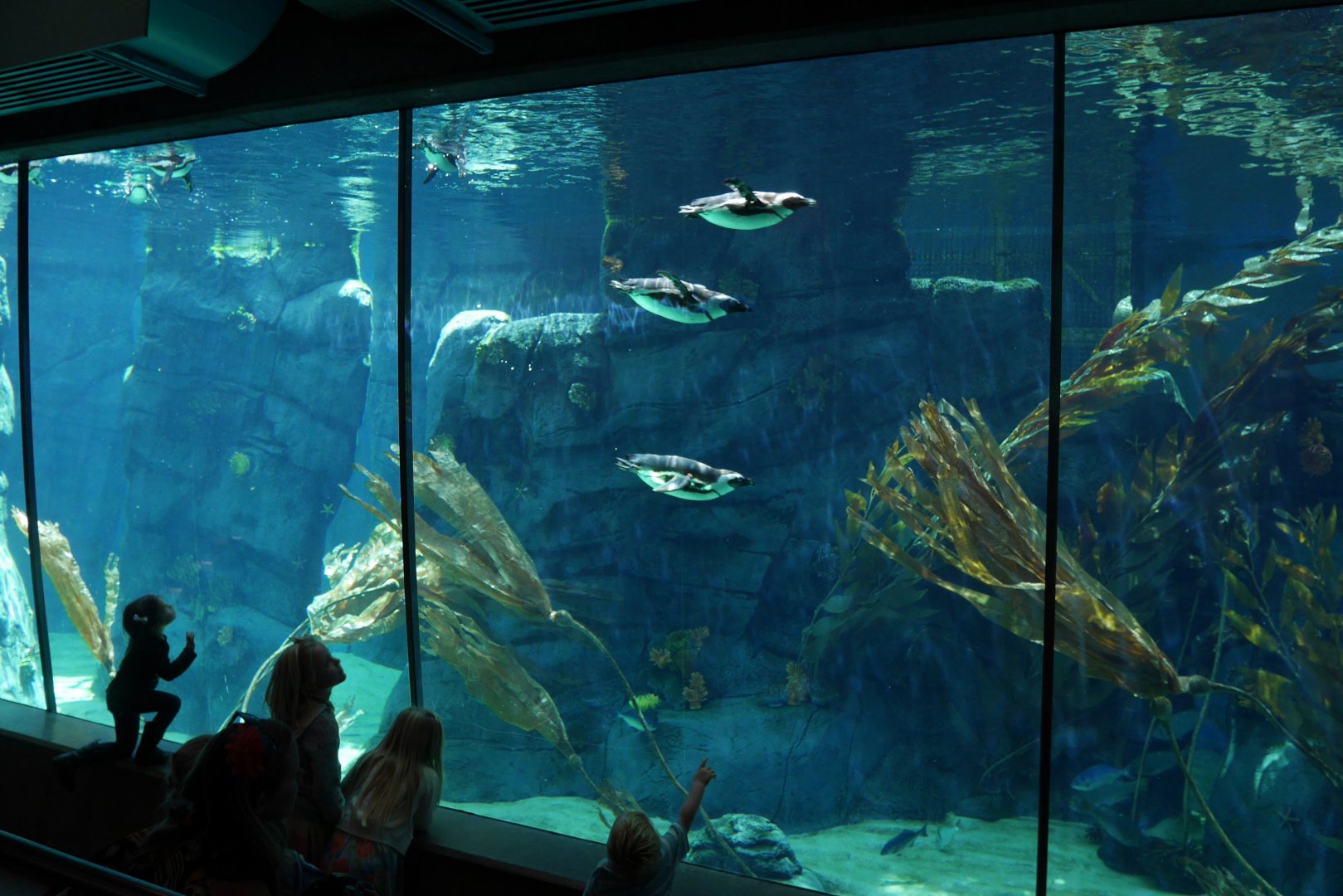
Inside the darkened passageways a dramatic underwater view unfolds of swimming pinnipeds. I’ve seen many photos of this exhibit over the years, but I was still impressed by it. Juxtaposed with the dark enclosed viewing areas the pool feels open and intensely blue. The deep pool curves out of view and burrows views from a fish exhibit. It was originally built for Steller sea lion, but now has harbor seals. I watched the harbor seals glide past underwater formations and rise in a bottling position (nearly vertical with just part of the head emerging above water). It was all quite awe-inspiring and one of the most powerful zoo experiences I’ve had.
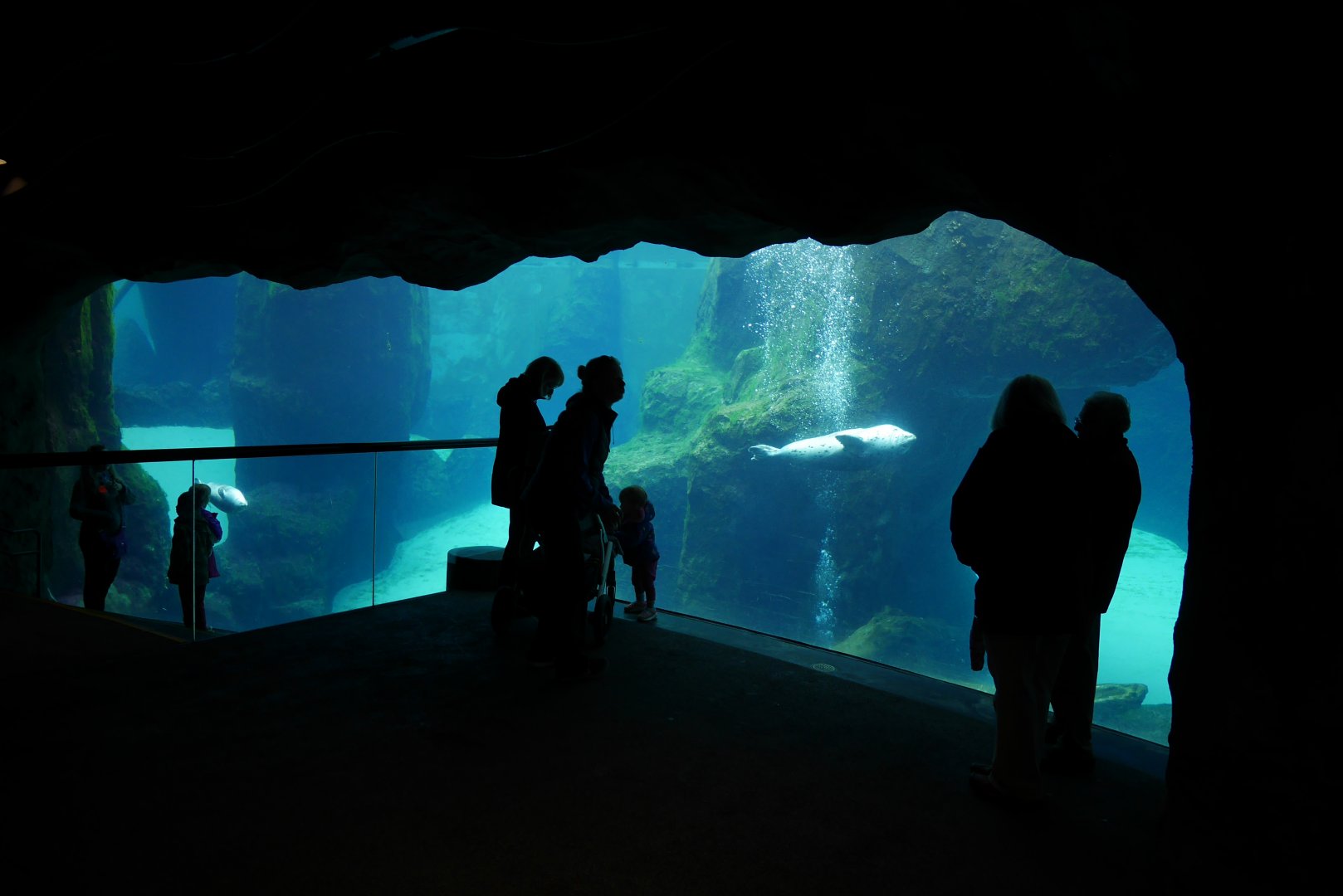
As I ascended gradually through the passageways I passed an aquarium for fish and invertebrates with burrowed views of the pinniped exhibit behind. Further on, there’s a small area where the rock ceiling had appeared to collapse. A large tree was growing in the rubble and up the pocketed opening in the ceiling to the sky.
Emerging out of the building an underwater view unfolds of sea otters backed by rocky cliffs. The sea otter was floating on its back and being fed a bounty of seafood that would threaten the stock of most restaurants!
The other side of the pathway is bordered by a cut through a museum-quality simulation of an archeological midden. It made me think about how the impacts of our activities accumulate over time.
Past the sea otters, the path overlooks the pinniped exhibit from land level. From here visitors can view the pinnipeds when they haul out onto land. Light mesh between the pathway and exhibit were important barriers for Steller sea lions, but probably aren’t as necessary for harbor seals. The exhibit curves out of view and behind the sea otter exhibit where a fallen log forms a barrier, but still provides burrowed views of the pinniped exhibit from the sea otter viewing area.
The final part of Steller Cove I saw was designed to be the entrance. An artificial rock formation planter arches over the pathway to join the cliff faces behind the animal exhibits with those on the opposite side of the pathway.
Steller Cove and Cascade Crest were both designed by the Portico Group and were guided by similar principles. They are both highly detailed immersive recreations of Oregon’s ecosystems. This focus on specific habitats is responsible for much of the embedded narrative features in the exhibits and seems to have inspired the designers to create compelling details. Features like rock ceilings that have partially collapsed.
Humans living in predominantly built environments, especially cities, aren’t exposed much to natural features. Without those experiences, we can’t read natural landscapes as well. When we are unable to interpret natural features, we miss a whole bunch of interesting stories. Without those stories nature is less interesting, and we are less likely to appreciate it. If we don’t appreciate nature it will be lost in favor of satisfying our other needs.
I really like exhibits like Steller Cove and Cascade Crest because all the details and embedded narration convey the complexity of nature and encourage people to look more closely at their surroundings for hidden stories. It made me want to explore Oregon!
Some people might argue that most visitors move much too quickly through attractions to notice and appreciate such things. The Disney themes parks and now the Universal theme parks were designed around a much different assumption; that people do notice and appreciate details and embedded storytelling. I’m sure I’m not the only one who appreciates Steller Cove.
In the Oregon Zoo Comprehensive Capital Master Plan 2011, Steller Cove will be phased out over time in favor of a South American exhibit sequence. The move probably has a lot to do with the Zoo’s push towards becoming a model of environmental sustainability and planning future developments to reduce their environmental footprint. Steller Cove probably takes a lot of energy and water to maintain. It might be difficult to replace the existing infrastructure with more environmentally sustainable features.
I would hate to see Steller Cove demolished. Hopefully, they will be able to incorporate more environmentally responsible features without replacing the whole exhibit complex. Construction takes a lot of resources too.
On maps, Steller Cove is considered part of the Pacific Shores complex at the Zoo. Besides an empty polar bear exhibit and a construction site for Polar Passage (the new polar bear exhibit), there are also Humboldt penguins. The Humboldt penguins were temporally in part of the old polar bear exhibit while the Penguinarium is under renovation. In their temporary home they have a deep pool with underwater viewing, but the water was very cloudy because the filtration wasn’t designed for oily penguin feathers.
Large portions of Primate Forest were also under renovation. After the renovations Primate Forest will be split into areas for Asian and African primates that connect to their appropriate zoogeographic exhibit zones. The Oregon Zoo is trying to save on construction costs by simultaneously building Polar Passage, new primate exhibits, and an expansion for rhinos in the former hippo exhibit.
The renovations to Primate Forest are really needed! I was shocked to see the indoor gibbon exhibit. The walls were white, and it felt like a surgery room. In my other reviews I argued that ideally animal display areas would be natural, but that’s not always practical and it might be better to have some indoor spaces on show than hidden. I still believe that. All animal areas should still have some natural features like substrates, branches, and plants. Those natural furnishings are great for animal welfare, not just aesthetics. Any place in public view cannot completely ignore aesthetics and how those influence visitor’s emotions and experiences. Changing the paint color may not make much of a difference for the animals, and it may make it harder to notice dirt, but it does have a huge impact on visitor perceptions. At one time, visitors may have appreciated how clean and sanitary the space looked, but times change. Part of the problem too is consistency of presentation. It can be jarring to see natural animal habitats and then unnatural indoor spaces.
Most of the other exhibits in Primate Forest were screened or under construction. I watched a black tree monitor climb around its exhibit and cotton-top tamarins in three small connected exhibits but can’t remember much else.
Outside I saw Red Ape Reserve, the outdoor exhibit for orangutans and white-cheeked gibbons. The enclosure is netted and feels horizontally orientated. Part of the viewing is through an artificial tree trunk, no doubt inspired by the much more compelling and appropriate exhibit for gorillas at the Bronx Zoo’s Congo Gorilla Forest. There were lots of furnishings like bamboo sway poles, ropes, logs for climbing, and a large artificial tree trunk with cavities for enrichment. The orangutans were lounging above me in some nets. Portland has a great climate for supporting lush vegetation and tall trees and Red Ape Reserve failed to capitalize on those opportunities. Overall, the exhibit seemed like it was designed more for gorillas than orangutans.
After the disappointing primate exhibits I headed for Elephant Lands unsure what to expect. Elephant Lands is the most ambitious single project in the Oregon Zoo’s history. The $57 million project opened in stages and was complete by 2015. It won Top Honors in the AZA’s Exhibit Award. However, I’ve heard that it’s underwhelming and falls short of elephant exhibits at the North Carolina Zoo, Disney’s Animal Kingdom, and Omaha Henry Doorly Zoo.
Elephant Lands stretches around the east end of the Zoo. There are three long connected outdoor yards, a large open indoor exhibit for socializing (the Forest Hall), and another large attached building for holding.
I believe I saw Sung-surin and Samudra in the North Meadow and Chendra, Rose-Tu, and Lily in the other exhibits. The elephants were separated during my visit, but they came close to the gates between the exhibits a couple of times and exchanged audible and visible communications.
Elephant Lands was designed to encourage walking behavior from the elephants. I watched them for awhile and I found it hard to keep up with them! Over twenty timed feeders are spread throughout the exhibit and the elephants continually moved around checking them.
There’s a variety of types of feeders too that encourage different foraging behaviors. Overhead feeders require the elephants to reach up with their trunks. I watched one of the elephants dig up sand at a partially buried feeder to uncover food.
Sand substrates throughout the exhibit add to the existing topographic variation. I saw the elephants walk up and down sand hills. In the Forest Hall I saw large tire tracks in the sand and suspect that equipment is used to manipulate the sand into new formations. The elephants also seemed to enjoy pushing the sand around and throwing it onto their backs.
Using sand substrates extensively may have some negative consequences. Sand can mix with hay the elephants pick up from the ground and be ingested. Wild elephants purposefully consume some clay and silt and unintentionally ingest substrates with their food, but they may not be able to ingest large quantities of sand. I’ve read reports that Little Diamond, an African elephant at the North Carolina Zoo, died from sand ingestion that impacted the large intestine ('Little Diamond,' NC Zoo's long-time elephant, dies). Hopefully, this doesn’t become a concern at the Oregon Zoo.
I didn’t see the elephants swim, but they have a deep pool outside that can accommodate several elephants at once. They also have access to a shallow pool.
I followed the elephants into the Forest Hall. Inside, they eagerly passed around an artificial tree testing holes with their trunks. Some of the mesh feeders inside had hay and treats that the elephants pulled out with their trunks. Lily, the youngest elephant reached into one of the holes to suck up water and spray into her mouth.
The Zookeepers came down from the artificial tree for a positive reinforcement presentation with the elephants. Using protected contact, the keepers encouraged the elephants to perform a variety of behaviors. For opening their mouths and lifting their feet one by one the elephants got fruit and vegetables. The keepers closely inspect the mouths and feet of the elephants to monitor condition and keep on top of potential health concerns. The elephants got additional treats for climbing on top of logs, lifting logs, and performing other exercises. While this was going on an interpreter explained how the Oregon Zoo takes care of their elephants and pointed out some features that make elephants special. A large crowd watched the proceedings intently from the auditorium overlooking the exhibit. I thought it was a great way for the Zoo to show the public how they care for their animals.
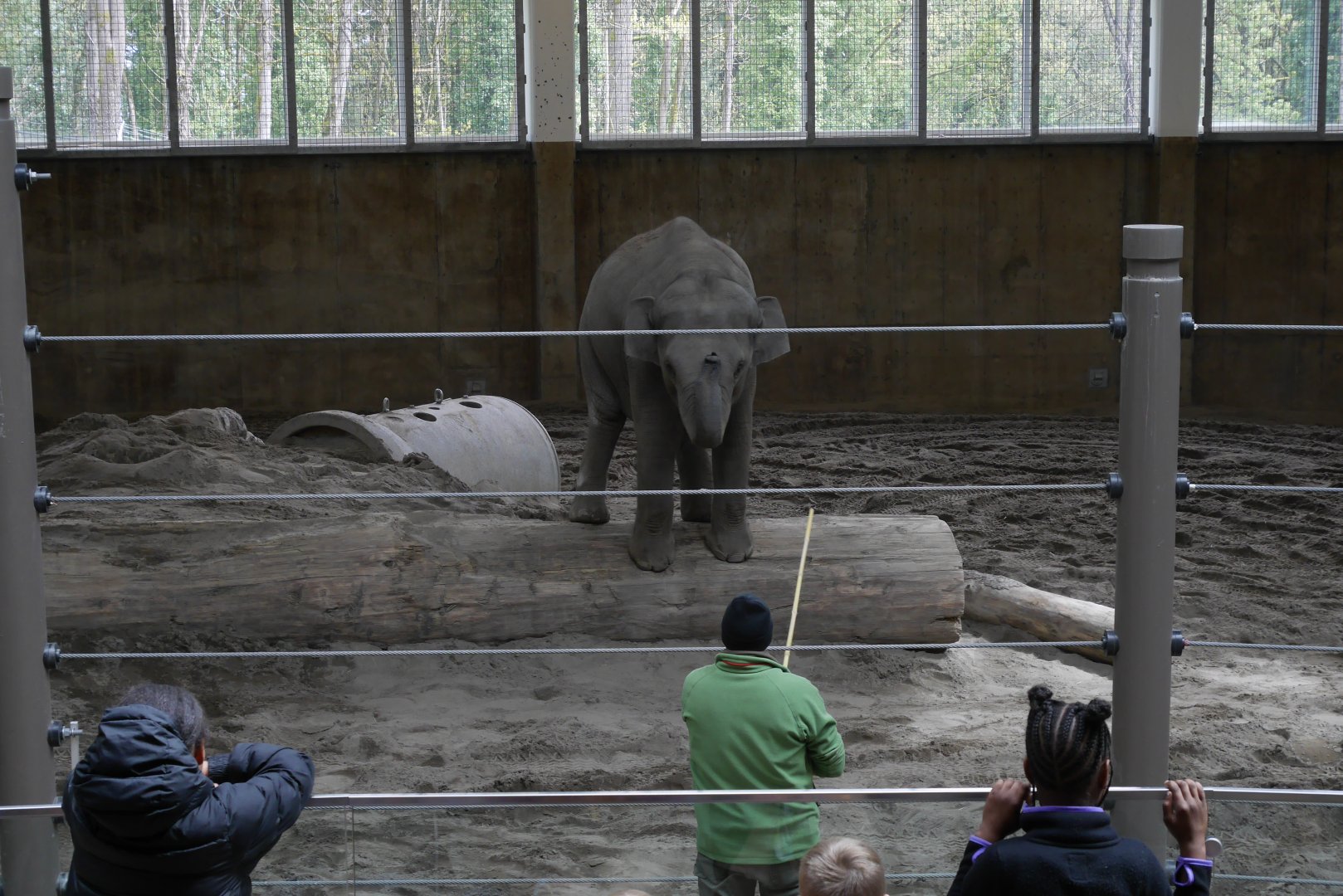
Above the auditorium there are interpretive displays about elephants and cultural artifacts that represent cultural relationships with elephants. I overheard one kid say, “why would people want to kill elephants, they’re awesome”.
Undeniably, the Forest Hall feels architectural and fails to present the elephants in a naturally landscaped context. The name probably refers to the forests outside the building that can be seen through large windows that sweep across the wall behind the elephant’s space. In Portland the elephants probably have access to the outdoors almost year-round (I’ve seen a video of one of their elephants playing in the snow) but need the indoor exhibits to help cope with colder weather.
The building is designed to give the elephants access to the outdoors and remain environmentally sustainable. High efficiency heat recovery and a geothermal plant reduce the building heating load by 95% and a solar thermal system heats water.
I followed the elephants back outside.
The outdoor exhibits don’t have a blade of grass and look a bit barren. Elephants have grey skin and lose a bit of their magnificence in a duller colored landscape like Elephant Lands. That’s the biggest shortcoming of Elephant Lands; it fails to provide a truly compelling natural context for the elephants.
Elephant Lands is much more successful at creating a complex space that encourages the animals to move around considerably and display a variety of behaviors. The multiple spaces can temporarily separate different animals physically, while letting them remain in contact. I spent over an hour enjoying my visit with the elephants at Elephant Lands.
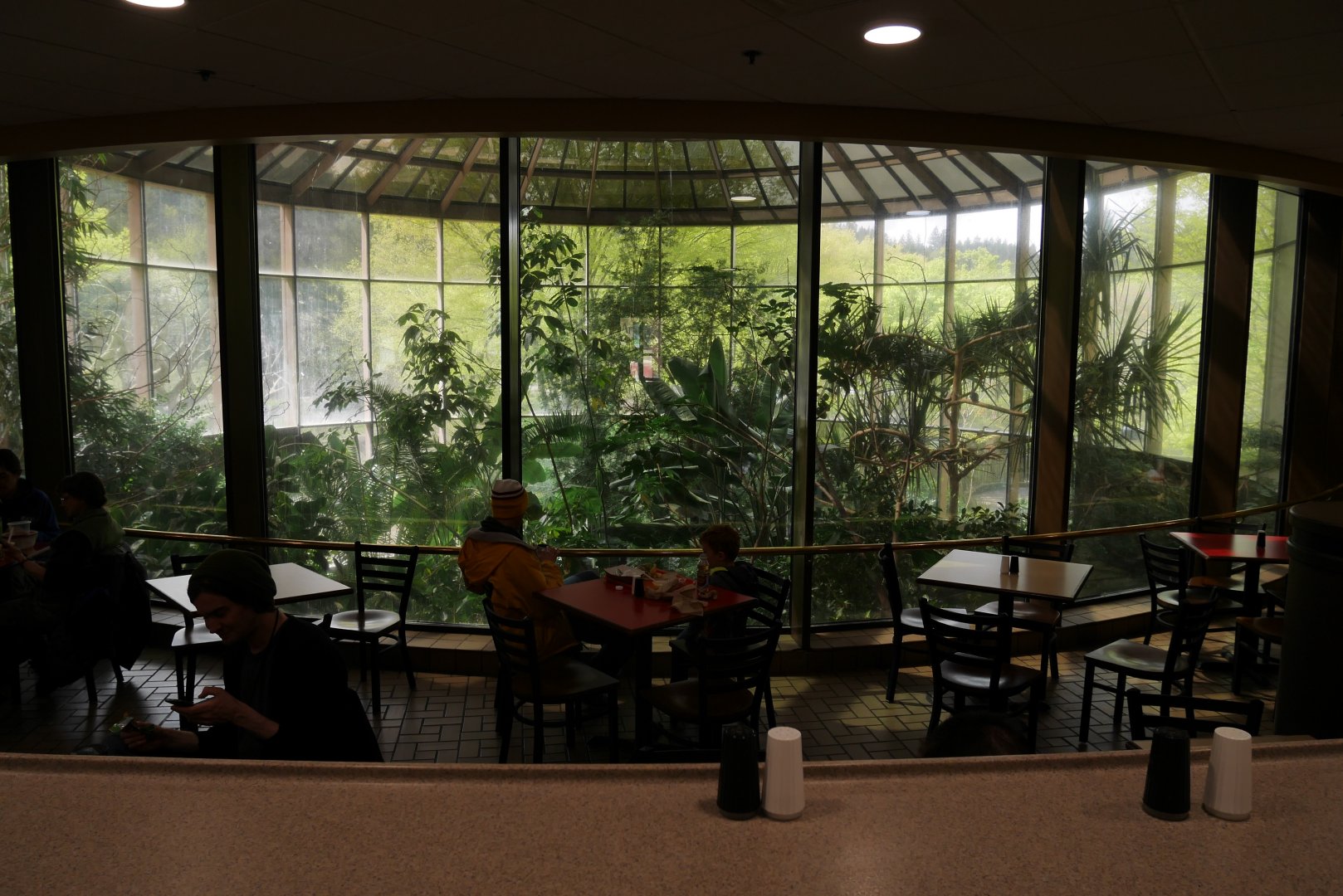
I got lunch at AfriCafe, which has a dining area overlooking the upper levels of the Howard Vollum aviary for African birds. I enjoyed watching the birds but struggled to eat my inedible veggie burger.
After lunch, I visited Predators of the Serengeti. Years earlier this was the Alaskan Tundra. Significant renovations repurposed it to display predator species from Serengeti National Park. A few large evergreen trees are all that remains that hints at the past theming of this area.
A large artificial baobab tree in the plaza serves as an orientation point and establishes the African theming. From the plaza the path descends into Predators of the Serengeti past ornamental grasses, shrubs, and kopje rock formations. Life-size sculptures of a lion family invite touch and photo opportunities. An elevated viewing area with windows overlooks a lion exhibit set on a grassy knoll with a few wide-spaced deciduous trees. Heated artificial rocks on the knoll provide the lions a highpoint where they can scan their surroundings. The knoll is ringed by a barrier made of more artificial rockwork. The pathway descends further from here into a sheltered pathway and exhibit building disguised by more kopje formations and thorny-stemmed shrubs and trees. The sheltered pathway travels around a large netted caracal exhibit. On the opposite side of the pathway there are large windows that overlook outdoor exhibits for lions, African wild dogs, and cheetahs.
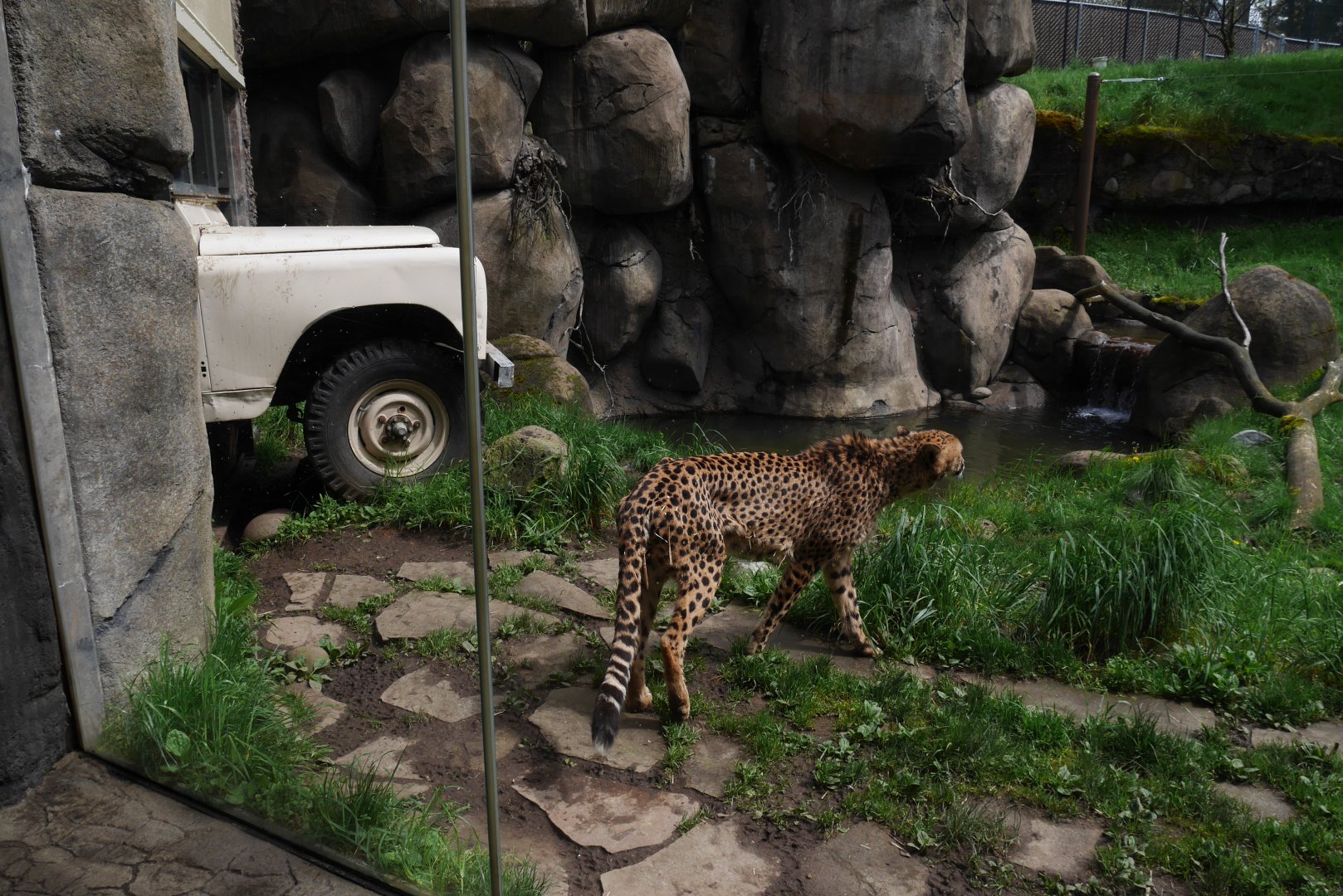
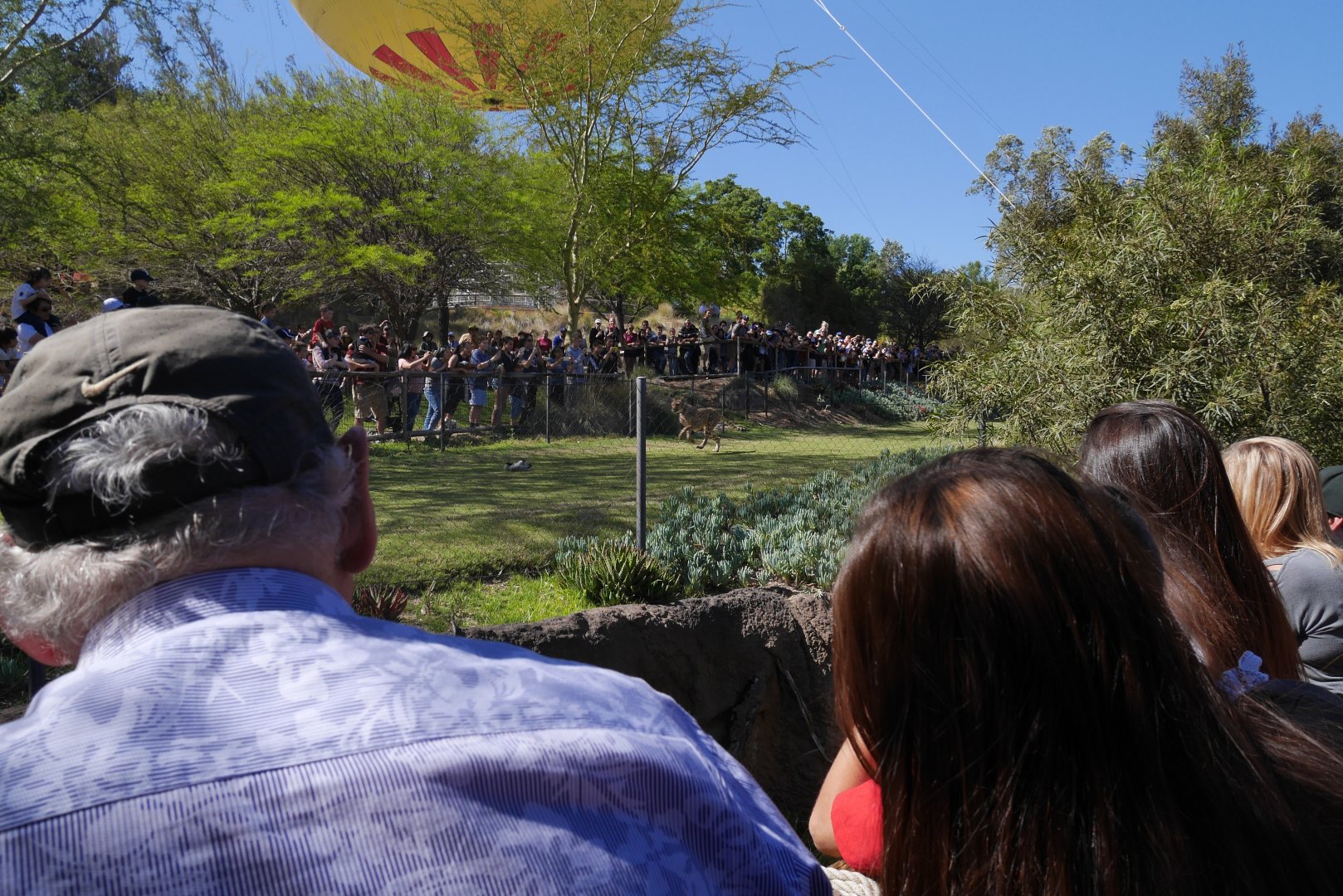
At first all the animals were resting. The two cheetahs were relaxing right up against the windows. The window is set within a kopje, so there is a strong sense of shared space. One cheetah rose up and paused looking directly at me for awhile. Then its lithe frame stretched as it strode away. I followed it to the next viewing area where it paused again to look intently at me. Nearby, the window bisects a safari vehicle that passes into the cheetah exhibit. The cheetah turned by the vehicle and walked up a grassy slope where it met the other cheetah under a rock ledge. From there they climbed on top of rocks and logs to survey their surroundings. I turned around and the caracal was very active as well.
The caracal was walking around its enclosure in an exploratory manner. It would often pause and cock its tufted ears up. Using its long hind legs, the cat effortlessly jumped on and off logs and artificial earthen banks as it traversed the exhibit. The caracal didn’t seem too interested in the acrylic tubes in part of the exhibit, but I read somewhere that one of the caracals loves to watch dwarf mongoose pass through the tubes. Most of the time I watched the caracal I was the only one there. Visitors had gathered nearby to watch the lions.
The lions were roaring and had descended their grassy knoll to the shady areas by the viewing shelter. I watched them for awhile before they climbed back up to their perches on the hill. Nearby the African wild dogs were starting to settle down after an outburst of activity. There was just too much going on at once for me to catch everything!
Even the reptiles were active. The massive African rock python was moving slowly around by caterpillar (rectilinear) progression. In jerky movements the veiled chameleon slowly climbed through its exhibit.
The exhibit building with reptiles also has spiders, tarantulas, scorpions, and dwarf mongoose. You can crawl under the latter exhibit and pop up into in a bubble window surrounded by scurrying mongooses.
Predators of the Serengeti, like the other exhibits at the Oregon Zoo, has exceptional exhibit interpretation. The focus in this exhibit are the challenges predators face, both natural and human induced, and adaptations or responses to those challenges. My favorite interactive feature in Predators of the Serengeti is a thermographic video screen and camera above a replica of a python head. It shows the heat signatures from visitors that pythons would perceive! Pythons use infrared sensing to hunt their prey and possibly for thermoregulation and prey avoidance. In addition to the many interactive interpretive features there are clear signs with interesting information. Informative panels explore how the Zoo’s conservation projects mitigate conflicts that threaten lions, African hunting dogs, and cheetahs. Visitors can donate to these projects through wishing wells. You could spend a lot of time delving deeper into the interpretive features, but they’re also readable at a quicker pace.
If the interpretive features weren’t so engaging, then I probably would have missed them that day. The predators were so interesting to watch! Together, they showed a variety of locomotion behaviors. Predators spend a lot of time searching for their prey. I saw a lot of the carnivores in Predators of the Serengeti make good use of high vantage points in their exhibits to scan the surroundings.
The loop through Predators of the Serengeti toke me back to the plaza where I headed to the Howard Vollum aviary. Within the aviary I walked among the tropical African birds and vegetation I had viewed earlier from the AfriCafe. The cylindrical building has a transparent domed top for natural light. Circular floor plans like this are great for walk-through exhibits. I saw some of the birds fly in loops around the space looking for good spots to perch. The aviary is less than 3,000 square feet, but it seems bigger, especially from inside. In summer, the pathways in the aviary are probably too small to handle high guest volumes. It wasn’t too busy on my visit, so I had more time to stop and watch the birds.
Species in the Howard Vollum aviary included: red-billed hornbill; golden-breasted starling; speckled mouse-bird; speckled pigeon; bearded barbet; white-cheeked turaco; Allen’s gallinule; superb starling; purple glossy starling; hamerkop; oriole warbler; magpie shrike; Hottentot teal; African pygmy goose; and spur-winged lapwing.
Outside, the rest of the Africa Savanna exhibits can be explored. The relatively elevated visitor pathway overlooks four open habitats set in front of artificial riverbanks. Two of the exhibits were empty to prepare for renovations that will expand the rhino exhibit into the former hippo exhibit. The other two exhibits are larger with grassy expanses and scattered trees. The first of these held bonteboks and Speke’s gazelle on my visit and the other had giraffe and southern ground hornbill. A set of exhibits called Treetops separates these two ungulate exhibits. There’s an outdoor netted exhibit for DeBrazza’s monkeys, but most of the exhibits are within a building. The pathway here is elevated and it enters the building on its second floor. This is a great way to reduce the profile of tall buildings and a technique that I also saw at Trail of Vines at the Woodland Park Zoo. The indoor giraffe exhibit is at ground level, but the exhibits for small animals are on the second floor of the building and level with the elevated pathway. I remember an aviary for birds, a naked mole rat exhibit and several exhibits of reptiles. Past the giraffes, the pathway enters the Africa Rainforest.
In the Africa Rainforest the pathways and exhibits are surrounded by lush vegetation. African crested porcupines were in a small exhibit between simulated earth-banks. Low panels in the front and back of the exhibit are topped with artificial fallen branches. The Swamp building was closed for renovations, but the large outdoor aviary attached to the Swamp was still open. Colorful lesser flamingos are the most spectacular birds, but there were also sacred ibis, hadada ibis, red-crested pochard, and white-faced whistling duck. Visitors cross the aviary on a boardwalk that travels over a shallow water feature. A nearby netted outdoor enclosure holds guereza colobus monkeys and Allen’s swamp monkeys. It’s themed with large buttress tree trunks and a waterfall that tumbles down rock-work. The exhibit is lightly planted within. I watched the colobus monkeys bound through the exhibit with their white tails flashing behind them. The final exhibit holds dozens of bats, including straw-colored fruit bats, Egyptian fruit bats, and Rodrigues flying foxes. It was captivating to watch as they climbed around the exhibit feeding on fruit.
The Nature Exploration Station is a far less conventional zoo attraction than Africa. Together with classrooms, a coffee café, and a meeting space for presentations about nature, the Nature Exploration Station is part of the Education Center. The arced form of the buildings looks woven together like a wasp nest. The Education Center was designed to be a regional center of conservation. Inside the Nature Exploration Station there are educational displays, a conservation lab for rearing Western pond turtles, and an insect zoo. Interpretation is centered on exploring nature in Oregon and making environmentally friendly choices in your daily life.
Compared to the other components of the Education Center, the Nature Exploration Station is a bit superfluous. The Great Northwest showcases the beauty of Oregon’s natural areas. Eagle Canyon/Cascade Stream and Pond has a conservation lab and exhibits of Western pond turtles. The former polar bear exhibit has an interpretive that encourages guests to make 10 changes in their everyday lives to reduce their carbon footprint. The educational displays in the Nature Exploration center are interesting, but the Oregon Zoo also has great interpretive displays throughout the animal exhibit complexes.
Amur Cats is across from the Education Center and includes exhibits for Amur tigers and Amur leopards. A steep moat surrounds the front and sides of the Amur tiger exhibit. Three viewing areas with windows are slightly set into the exhibit, but do not provide up-close views. The holding area behind the exhibit is partially themed with rock-work, but it still has an architectural form. The Amur leopard exhibit was a more successful renovation. Leopards can come right up to the viewing shelter and their exhibit is densely planted like Amur mixed forests.
Significant parts of the Oregon Zoo were under renovation during my visit, but I still easily spent six hours at this medium-sized Zoo and really enjoyed it. The bulk of my visit and experiences came from three zones, the Great Northwest (including Steller Cove), Africa, and Elephant Lands. Both the Great Northwest and Africa are large zones with several immersive exhibits built over the years. I had lots of engaging experiences with the animals and landscapes. Elephant lands is less immersive, but I have never watched elephants at one place for so long. I don’t attribute that solely to luck, but rather to an exhibit that was designed to encourage walking and other behaviors from the elephants. In just a couple of years (2020), a new polar bear exhibit, new primate exhibits, and an expanded rhino exhibit will all open and the Oregon Zoo will be even better!
From my recent experiences in Seattle I was wary about both walking through rough areas of the city and fraudulent taxi charges. I decided to take a short taxi ride to the Greyhound station and pay my fare with cash.
Shortly after sitting down at the station, a heated exchange broke out between two men beside me. Greyhound stations tend to have high police presences, and it wasn’t long before an officer came over to mediate and break up tensions. I felt safer than I had in many other downtown Seattle areas.
In an exuberant voice one of the Greyhound workers proclaimed the arrival of my bus. Waiting at transportation hubs is tedious and I appreciated hearing such an outburst of facetiousness. His colleague promptly apologized, thankfully not in a scornful way, and re-announced the arrival with more professional enunciation.
For most of my bus ride to Portland it was too dark to see much outside the windows. South of Seattle the land seemed to become more natural and I finally saw stands of towering coniferous trees. It felt more like the Pacific Northwest I had expected to see.
Before embarking for my trip, my mother had strongly advised me to take a taxi from the Greyhound station in Portland. Apparently, her friend had walked around that area and found it very intimidating. He’s not someone who would spook easily. He’s a night-shift custodian at a strip-mall with a pub. I’ve heard a story about him protecting a woman from attempted rape. It was late, so I heeded their advice and got a taxi ride to my hotel.
Looking back, it would have been very easy for me to walk or use public transportation to my hotel and it is likely much safer than others had led me to fear. The Greyhound station is adjacent to Union Station and very close to green and yellow line local train stations.
In Portland I stayed at Hotel Rose, which cost more than my average lodging for this trip. The front desk agent (I unfortunately forgot his name) was ebullient and a great match for the ambience of the hotel. The lobby and other public areas were funky and vibrant. My room had yellow tones that made it feel warm and inviting. There were little humorous touches, like the do not disturb signs that read, “I’m naked (please go away)”. The last day I had been acting and feeling guarded, but after recuperating at my hotel I had a more sanguine temper. I headed out and wandered through downtown Portland that night.
The next morning, I had a piquant smoked salmon and caper omelette before heading to the Oregon Zoo.
Portland has a great public transportation system and it was very easy to get to the Oregon Zoo. Washington Park station is just an elevator ride and short walk from the Zoo.
Even if you have a personal vehicle I still recommend that you use the light rail trains to get to the Zoo. The trains travel through underground tunnels to reach Washington Park station. It’s one of the deepest transit stations in the world! At the station, the tunnel walls are decorated with images of the city and zoo animals in vivid purples and geometric patterns. There’s a long core sample taken from the site on display with marks along its length to indicate periods of Earth’s history and major geological and biological events. A diagram in the elevator illustrates your passage through geological formations and a display dynamically tracks elevation as the elevator rises. By the time I got to the Zoo I had already had an absorbing experience and learned about natural history.
The Oregon Zoo
Past the entrance gates at the Oregon Zoo, there’s a plaza with visitor services. From the plaza the first exhibit, Cascade Crest can be seen.
Mountain goats inhabit Cascade Crest in a simulated alpine landscape of the Cascade Mountains of Oregon. A cirque water-feature in the foreground forms a natural exhibit barrier. The grassy exhibit slopes are peppered with rocks and formations as they rise to the center of the exhibit. Artificial snowbanks add further character. Tall basaltic formations punctuate the center of the space to become the focus point of the exhibit. A burrowed view of towering coniferous trees forms a backdrop to the scene. As visitors walk around the exhibit different views into the exhibit emerge. Between viewing areas, a simulated glacier ice cave can be entered. Inside there are models of ice insects that have been enlarged several times their natural size. Pieces of exploration equipment and notes add to the embedded narratives. Cascade Crest a very well-realized immersive exhibit that invites exploration.
As I moved through the exhibit, different mountain goats became visible. The shaggy white coats of the mountain goats contrasted strikingly with the dark rock formations, and I enjoyed watching them graze in their exhibit.
Cascade Crest - My First US Zoo Trip
Cascade Crest is a beautiful immersive exhibit by the entrance of the Oregon Zoo that replicates...
Long-term, there are plans (see the Oregon Zoo Master Plan) to turn this exhibit into a rotational space for native carnivores, including cougars, black bears, and wolves. It will be a significant challenge to install adequate containment barriers for cougars without detracting from the open feeling of this exhibit and the carefully managed sight-lines.
As the pathway travels around Cascade Crest and further into the Zoo visitors view the existing blackbear exhibit on the opposite side. The pathway is significantly elevated here relative to the black bear exhibit. There are a few large trees that the bears can climb to get much closer to visitor’s eye-levels. Further down the path, the bear exhibit crosses under a 100-foot suspension bridge to holding areas somewhat disguised with artificial rock formations. Visitors can look through a large window in a concrete viewing structure for close-up views of bears on top of a rock-work formation. When the bears are lounging under the overhang of the rock-work they would be far less visible. There are also views from the shelter into a netted enclosure for bobcats in the forest. At the other end of the exhibit, visitors can watch the stubby-tailed small felines through a window set in an artificial trunk.
With more theming here, they could have made the whole viewing structure into a simulated rock-outcrop that visitors enter to get selected up-close views of bears and bobcats.
The pathway descends past native plants and lofty Douglas fir trees. It was hard to distinguish what had been planned and planted and what was the result of natural reforestation. It’s very beautiful and made me want to return to Oregon one day to see some of the natural forests there.
Eagle Canyon is beautifully integrated into this scenery. Visitors enter the bald eagle exhibit in an elevated viewing hide. From the open-fronted hide I could see a couple of bald eagles perched high on some branches, a large nest to my right, mature trees, and a stream below. Outside the hide and eagle exhibit, the pathway snakes down the canyon. At one spot an artificial stream complete with salmon sculptures cascades down into grated drains set in the pathway. The water passes under the pathway and to the stream in the eagle exhibit. Visitors re-enter the aviary lower down in a simulated lava-tube. As water falls over the pathway and into the stream it creates a veiled view of the bald eagle exhibit. Salmon, trout, and sturgeon can all be seen underwater sharing the stream within the eagle exhibit. Together the exhibit features create a much more experientially rich exhibit than typical eagle enclosures. Showcasing the bald eagles with fish, water-features, and the native landscape helps convey how they’re all connected and worth preserving.
Eagle Canyon transitions almost seamlessly into Cascade Stream and Pond. Cascade Stream and Pond won the AZA exhibit award when it opened in 1982 and still holds up well. Several species of turtle, including Western pond turtle, can be seen easily in a well-detailed exhibit. I didn’t see any beavers, but I really enjoyed watching waterfowl dive underwater. It provided an exciting new perspective of a commonly seen group of animals. Otters are great display animals and I enjoyed watching one dive in and out of its pool. The ring-tail was active in an exhibit themed like a miner’s cabin, but the exhibit is taller than the small viewing windows and it was tough to get a good angle to watch the small carnivore. I also saw several exhibits for small species of reptiles and amphibians that are native to the Pacific Northwest. The final exhibit is a walk-through aviary for carrel egrets and more waterfowl.
The exhibits of native fauna continue with an exhibit for cougars. There were lots of branches and artificial rock ledges for the cougars to climb. They were resting, so I walked over to another viewing area for the black-bear exhibit. From there I watched through the viewing windows as the bears climbed in their sloped exhibit above me. I watched for awhile, but I felt pulled to the condor exhibit.
I had first noticed the California condors in the distance all the way back by the mountain goat exhibit. Those were my first glimpses ever of California condors and I was anxious to get a better view of the iconic birds that have been saved from the brink of extinction. They were still active when I finally got close to them. I was surprised just how social and complex they seemed to be. A nearby sign titled Smart and Social confirmed my observations.
California condors are one of the rarest species of birds, but the animals at the nearby Family Farm are some of the most common species of animals. I walked by the farm animals quickly but stopped to take a picture of an outdoor covered enrichment enclosure for housecats. It was a good showcase of how you can get housecats outside, but still protect native wildlife from them. The rest of Family Farm feels too nostalgic. On the map the Great Northwest exhibit complex ends at the Family Farm, but I like to think that it ends with Steller Cove.
Cascade Crest is on the relatively highest point of the Great Northwest exhibits and Steller Cove is located relatively lower than the other exhibits. The change in exhibit elevations represents a journey from the peaks of the Cascade Mountains to Oregon’s coast.
I started to explore Steller Cove from the intended exit, but the sequencing still worked well. My first view was of a simulated rocky coastline with a tidepool nestled under the cliffs. The tidepool had a short viewing panel along its length for underwater viewing of fish and coastal invertebrates. The recreated cliffs above aren’t blocky and monolithic; they are complexly shaped and finely detailed. Large coniferous trees and other native vegetation atop the cliffs adds further drama and realism. The cliffs artfully conceal a repurposed building with underwater viewing and hidden life support equipment. It feels like you are passing into an alcove that the pounding waves have carved into the overhanging cliff face.
Inside the darkened passageways a dramatic underwater view unfolds of swimming pinnipeds. I’ve seen many photos of this exhibit over the years, but I was still impressed by it. Juxtaposed with the dark enclosed viewing areas the pool feels open and intensely blue. The deep pool curves out of view and burrows views from a fish exhibit. It was originally built for Steller sea lion, but now has harbor seals. I watched the harbor seals glide past underwater formations and rise in a bottling position (nearly vertical with just part of the head emerging above water). It was all quite awe-inspiring and one of the most powerful zoo experiences I’ve had.
Steller Cove - My First US Zoo Trip
Steller Cove originally had Steller's sea lions, but is now exhibits harbor seals. The lighter...
As I ascended gradually through the passageways I passed an aquarium for fish and invertebrates with burrowed views of the pinniped exhibit behind. Further on, there’s a small area where the rock ceiling had appeared to collapse. A large tree was growing in the rubble and up the pocketed opening in the ceiling to the sky.
Emerging out of the building an underwater view unfolds of sea otters backed by rocky cliffs. The sea otter was floating on its back and being fed a bounty of seafood that would threaten the stock of most restaurants!
The other side of the pathway is bordered by a cut through a museum-quality simulation of an archeological midden. It made me think about how the impacts of our activities accumulate over time.
Past the sea otters, the path overlooks the pinniped exhibit from land level. From here visitors can view the pinnipeds when they haul out onto land. Light mesh between the pathway and exhibit were important barriers for Steller sea lions, but probably aren’t as necessary for harbor seals. The exhibit curves out of view and behind the sea otter exhibit where a fallen log forms a barrier, but still provides burrowed views of the pinniped exhibit from the sea otter viewing area.
The final part of Steller Cove I saw was designed to be the entrance. An artificial rock formation planter arches over the pathway to join the cliff faces behind the animal exhibits with those on the opposite side of the pathway.
Steller Cove and Cascade Crest were both designed by the Portico Group and were guided by similar principles. They are both highly detailed immersive recreations of Oregon’s ecosystems. This focus on specific habitats is responsible for much of the embedded narrative features in the exhibits and seems to have inspired the designers to create compelling details. Features like rock ceilings that have partially collapsed.
Humans living in predominantly built environments, especially cities, aren’t exposed much to natural features. Without those experiences, we can’t read natural landscapes as well. When we are unable to interpret natural features, we miss a whole bunch of interesting stories. Without those stories nature is less interesting, and we are less likely to appreciate it. If we don’t appreciate nature it will be lost in favor of satisfying our other needs.
I really like exhibits like Steller Cove and Cascade Crest because all the details and embedded narration convey the complexity of nature and encourage people to look more closely at their surroundings for hidden stories. It made me want to explore Oregon!
Some people might argue that most visitors move much too quickly through attractions to notice and appreciate such things. The Disney themes parks and now the Universal theme parks were designed around a much different assumption; that people do notice and appreciate details and embedded storytelling. I’m sure I’m not the only one who appreciates Steller Cove.
In the Oregon Zoo Comprehensive Capital Master Plan 2011, Steller Cove will be phased out over time in favor of a South American exhibit sequence. The move probably has a lot to do with the Zoo’s push towards becoming a model of environmental sustainability and planning future developments to reduce their environmental footprint. Steller Cove probably takes a lot of energy and water to maintain. It might be difficult to replace the existing infrastructure with more environmentally sustainable features.
I would hate to see Steller Cove demolished. Hopefully, they will be able to incorporate more environmentally responsible features without replacing the whole exhibit complex. Construction takes a lot of resources too.
On maps, Steller Cove is considered part of the Pacific Shores complex at the Zoo. Besides an empty polar bear exhibit and a construction site for Polar Passage (the new polar bear exhibit), there are also Humboldt penguins. The Humboldt penguins were temporally in part of the old polar bear exhibit while the Penguinarium is under renovation. In their temporary home they have a deep pool with underwater viewing, but the water was very cloudy because the filtration wasn’t designed for oily penguin feathers.
Large portions of Primate Forest were also under renovation. After the renovations Primate Forest will be split into areas for Asian and African primates that connect to their appropriate zoogeographic exhibit zones. The Oregon Zoo is trying to save on construction costs by simultaneously building Polar Passage, new primate exhibits, and an expansion for rhinos in the former hippo exhibit.
The renovations to Primate Forest are really needed! I was shocked to see the indoor gibbon exhibit. The walls were white, and it felt like a surgery room. In my other reviews I argued that ideally animal display areas would be natural, but that’s not always practical and it might be better to have some indoor spaces on show than hidden. I still believe that. All animal areas should still have some natural features like substrates, branches, and plants. Those natural furnishings are great for animal welfare, not just aesthetics. Any place in public view cannot completely ignore aesthetics and how those influence visitor’s emotions and experiences. Changing the paint color may not make much of a difference for the animals, and it may make it harder to notice dirt, but it does have a huge impact on visitor perceptions. At one time, visitors may have appreciated how clean and sanitary the space looked, but times change. Part of the problem too is consistency of presentation. It can be jarring to see natural animal habitats and then unnatural indoor spaces.
Most of the other exhibits in Primate Forest were screened or under construction. I watched a black tree monitor climb around its exhibit and cotton-top tamarins in three small connected exhibits but can’t remember much else.
Outside I saw Red Ape Reserve, the outdoor exhibit for orangutans and white-cheeked gibbons. The enclosure is netted and feels horizontally orientated. Part of the viewing is through an artificial tree trunk, no doubt inspired by the much more compelling and appropriate exhibit for gorillas at the Bronx Zoo’s Congo Gorilla Forest. There were lots of furnishings like bamboo sway poles, ropes, logs for climbing, and a large artificial tree trunk with cavities for enrichment. The orangutans were lounging above me in some nets. Portland has a great climate for supporting lush vegetation and tall trees and Red Ape Reserve failed to capitalize on those opportunities. Overall, the exhibit seemed like it was designed more for gorillas than orangutans.
After the disappointing primate exhibits I headed for Elephant Lands unsure what to expect. Elephant Lands is the most ambitious single project in the Oregon Zoo’s history. The $57 million project opened in stages and was complete by 2015. It won Top Honors in the AZA’s Exhibit Award. However, I’ve heard that it’s underwhelming and falls short of elephant exhibits at the North Carolina Zoo, Disney’s Animal Kingdom, and Omaha Henry Doorly Zoo.
Elephant Lands stretches around the east end of the Zoo. There are three long connected outdoor yards, a large open indoor exhibit for socializing (the Forest Hall), and another large attached building for holding.
I believe I saw Sung-surin and Samudra in the North Meadow and Chendra, Rose-Tu, and Lily in the other exhibits. The elephants were separated during my visit, but they came close to the gates between the exhibits a couple of times and exchanged audible and visible communications.
Elephant Lands was designed to encourage walking behavior from the elephants. I watched them for awhile and I found it hard to keep up with them! Over twenty timed feeders are spread throughout the exhibit and the elephants continually moved around checking them.
There’s a variety of types of feeders too that encourage different foraging behaviors. Overhead feeders require the elephants to reach up with their trunks. I watched one of the elephants dig up sand at a partially buried feeder to uncover food.
Sand substrates throughout the exhibit add to the existing topographic variation. I saw the elephants walk up and down sand hills. In the Forest Hall I saw large tire tracks in the sand and suspect that equipment is used to manipulate the sand into new formations. The elephants also seemed to enjoy pushing the sand around and throwing it onto their backs.
Using sand substrates extensively may have some negative consequences. Sand can mix with hay the elephants pick up from the ground and be ingested. Wild elephants purposefully consume some clay and silt and unintentionally ingest substrates with their food, but they may not be able to ingest large quantities of sand. I’ve read reports that Little Diamond, an African elephant at the North Carolina Zoo, died from sand ingestion that impacted the large intestine ('Little Diamond,' NC Zoo's long-time elephant, dies). Hopefully, this doesn’t become a concern at the Oregon Zoo.
I didn’t see the elephants swim, but they have a deep pool outside that can accommodate several elephants at once. They also have access to a shallow pool.
I followed the elephants into the Forest Hall. Inside, they eagerly passed around an artificial tree testing holes with their trunks. Some of the mesh feeders inside had hay and treats that the elephants pulled out with their trunks. Lily, the youngest elephant reached into one of the holes to suck up water and spray into her mouth.
The Zookeepers came down from the artificial tree for a positive reinforcement presentation with the elephants. Using protected contact, the keepers encouraged the elephants to perform a variety of behaviors. For opening their mouths and lifting their feet one by one the elephants got fruit and vegetables. The keepers closely inspect the mouths and feet of the elephants to monitor condition and keep on top of potential health concerns. The elephants got additional treats for climbing on top of logs, lifting logs, and performing other exercises. While this was going on an interpreter explained how the Oregon Zoo takes care of their elephants and pointed out some features that make elephants special. A large crowd watched the proceedings intently from the auditorium overlooking the exhibit. I thought it was a great way for the Zoo to show the public how they care for their animals.
Positive Reinforcement - My First US Zoo Trip
In Elephant Lands the zookeepers demonstrate positive reinforcement with the elephants while...
Above the auditorium there are interpretive displays about elephants and cultural artifacts that represent cultural relationships with elephants. I overheard one kid say, “why would people want to kill elephants, they’re awesome”.
Undeniably, the Forest Hall feels architectural and fails to present the elephants in a naturally landscaped context. The name probably refers to the forests outside the building that can be seen through large windows that sweep across the wall behind the elephant’s space. In Portland the elephants probably have access to the outdoors almost year-round (I’ve seen a video of one of their elephants playing in the snow) but need the indoor exhibits to help cope with colder weather.
The building is designed to give the elephants access to the outdoors and remain environmentally sustainable. High efficiency heat recovery and a geothermal plant reduce the building heating load by 95% and a solar thermal system heats water.
I followed the elephants back outside.
The outdoor exhibits don’t have a blade of grass and look a bit barren. Elephants have grey skin and lose a bit of their magnificence in a duller colored landscape like Elephant Lands. That’s the biggest shortcoming of Elephant Lands; it fails to provide a truly compelling natural context for the elephants.
Elephant Lands is much more successful at creating a complex space that encourages the animals to move around considerably and display a variety of behaviors. The multiple spaces can temporarily separate different animals physically, while letting them remain in contact. I spent over an hour enjoying my visit with the elephants at Elephant Lands.
I got lunch at AfriCafe, which has a dining area overlooking the upper levels of the Howard Vollum aviary for African birds. I enjoyed watching the birds but struggled to eat my inedible veggie burger.
AfriCafe and Howard Vollum Aviary - My First US Zoo Trip
- DevinL
- 1
The AfriCafe overlooks the Howard Vollum Aviary. If only the food could live up to the views!
After lunch, I visited Predators of the Serengeti. Years earlier this was the Alaskan Tundra. Significant renovations repurposed it to display predator species from Serengeti National Park. A few large evergreen trees are all that remains that hints at the past theming of this area.
A large artificial baobab tree in the plaza serves as an orientation point and establishes the African theming. From the plaza the path descends into Predators of the Serengeti past ornamental grasses, shrubs, and kopje rock formations. Life-size sculptures of a lion family invite touch and photo opportunities. An elevated viewing area with windows overlooks a lion exhibit set on a grassy knoll with a few wide-spaced deciduous trees. Heated artificial rocks on the knoll provide the lions a highpoint where they can scan their surroundings. The knoll is ringed by a barrier made of more artificial rockwork. The pathway descends further from here into a sheltered pathway and exhibit building disguised by more kopje formations and thorny-stemmed shrubs and trees. The sheltered pathway travels around a large netted caracal exhibit. On the opposite side of the pathway there are large windows that overlook outdoor exhibits for lions, African wild dogs, and cheetahs.
At first all the animals were resting. The two cheetahs were relaxing right up against the windows. The window is set within a kopje, so there is a strong sense of shared space. One cheetah rose up and paused looking directly at me for awhile. Then its lithe frame stretched as it strode away. I followed it to the next viewing area where it paused again to look intently at me. Nearby, the window bisects a safari vehicle that passes into the cheetah exhibit. The cheetah turned by the vehicle and walked up a grassy slope where it met the other cheetah under a rock ledge. From there they climbed on top of rocks and logs to survey their surroundings. I turned around and the caracal was very active as well.
Cheetah in Predators of the Serengeti - My First US Zoo Trip
In the cheetah exhibit at Predators of the Serengeti the viewing window bisects a safari vehicle...
The caracal was walking around its enclosure in an exploratory manner. It would often pause and cock its tufted ears up. Using its long hind legs, the cat effortlessly jumped on and off logs and artificial earthen banks as it traversed the exhibit. The caracal didn’t seem too interested in the acrylic tubes in part of the exhibit, but I read somewhere that one of the caracals loves to watch dwarf mongoose pass through the tubes. Most of the time I watched the caracal I was the only one there. Visitors had gathered nearby to watch the lions.
The lions were roaring and had descended their grassy knoll to the shady areas by the viewing shelter. I watched them for awhile before they climbed back up to their perches on the hill. Nearby the African wild dogs were starting to settle down after an outburst of activity. There was just too much going on at once for me to catch everything!
Even the reptiles were active. The massive African rock python was moving slowly around by caterpillar (rectilinear) progression. In jerky movements the veiled chameleon slowly climbed through its exhibit.
The exhibit building with reptiles also has spiders, tarantulas, scorpions, and dwarf mongoose. You can crawl under the latter exhibit and pop up into in a bubble window surrounded by scurrying mongooses.
Predators of the Serengeti, like the other exhibits at the Oregon Zoo, has exceptional exhibit interpretation. The focus in this exhibit are the challenges predators face, both natural and human induced, and adaptations or responses to those challenges. My favorite interactive feature in Predators of the Serengeti is a thermographic video screen and camera above a replica of a python head. It shows the heat signatures from visitors that pythons would perceive! Pythons use infrared sensing to hunt their prey and possibly for thermoregulation and prey avoidance. In addition to the many interactive interpretive features there are clear signs with interesting information. Informative panels explore how the Zoo’s conservation projects mitigate conflicts that threaten lions, African hunting dogs, and cheetahs. Visitors can donate to these projects through wishing wells. You could spend a lot of time delving deeper into the interpretive features, but they’re also readable at a quicker pace.
If the interpretive features weren’t so engaging, then I probably would have missed them that day. The predators were so interesting to watch! Together, they showed a variety of locomotion behaviors. Predators spend a lot of time searching for their prey. I saw a lot of the carnivores in Predators of the Serengeti make good use of high vantage points in their exhibits to scan the surroundings.
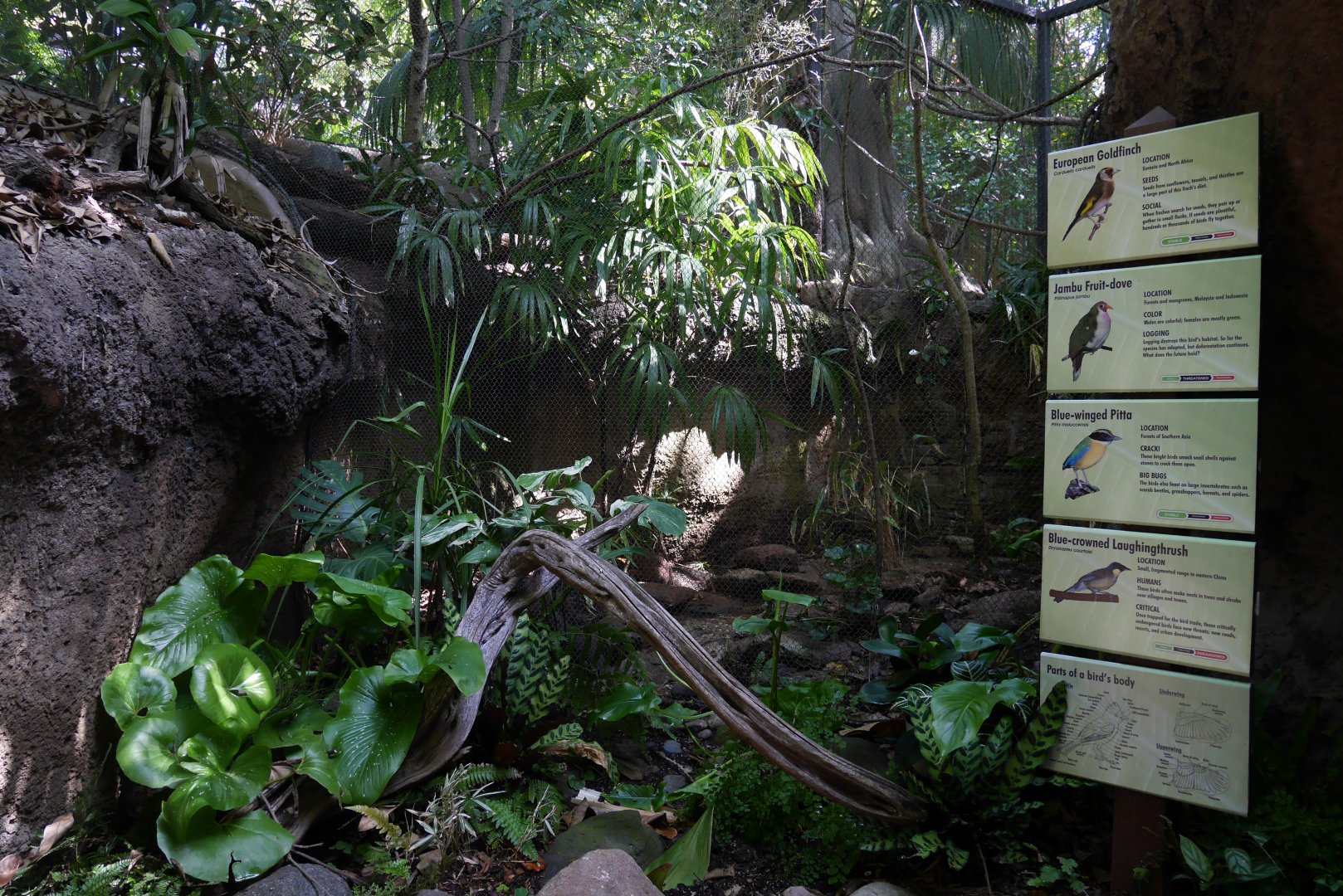
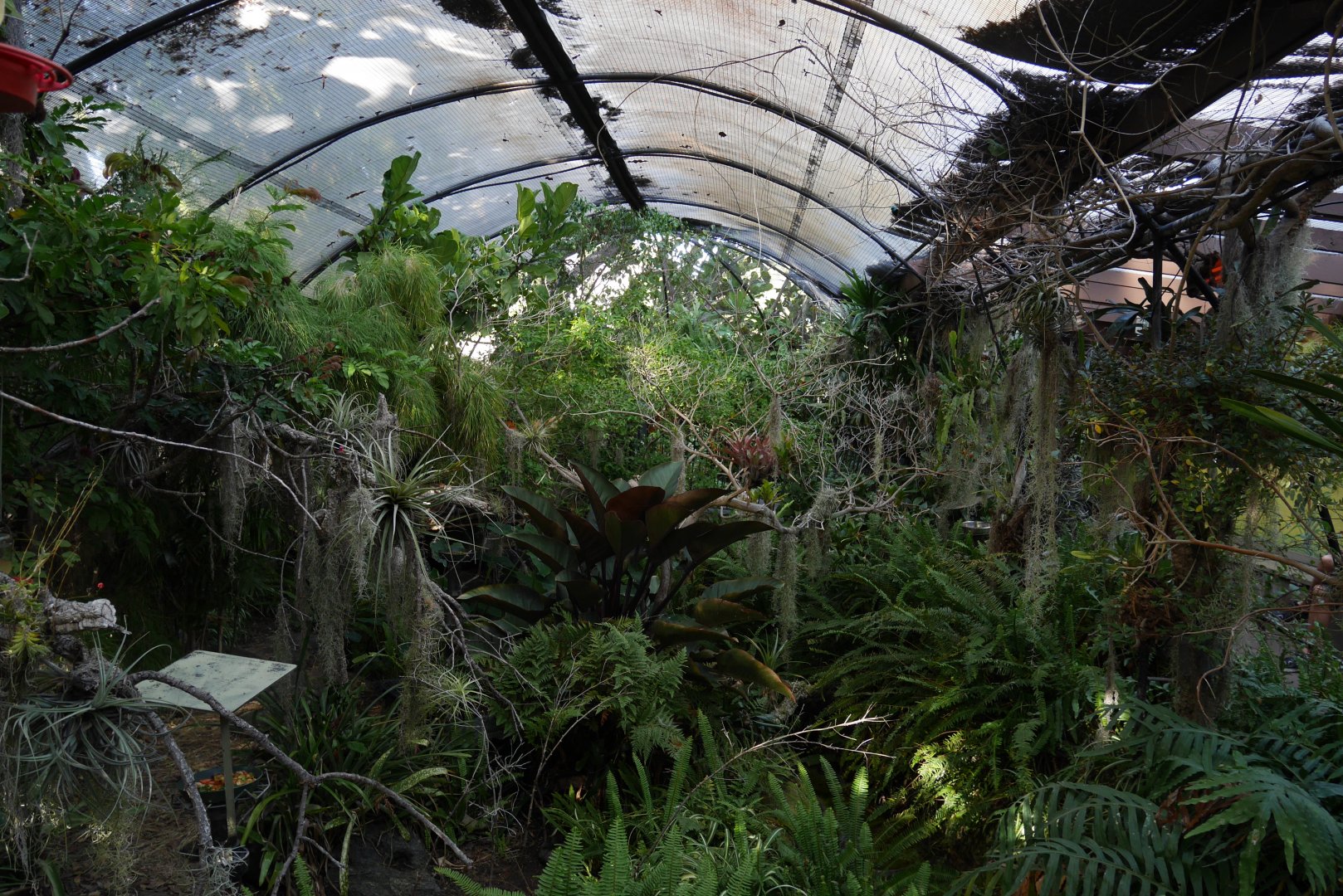
The loop through Predators of the Serengeti toke me back to the plaza where I headed to the Howard Vollum aviary. Within the aviary I walked among the tropical African birds and vegetation I had viewed earlier from the AfriCafe. The cylindrical building has a transparent domed top for natural light. Circular floor plans like this are great for walk-through exhibits. I saw some of the birds fly in loops around the space looking for good spots to perch. The aviary is less than 3,000 square feet, but it seems bigger, especially from inside. In summer, the pathways in the aviary are probably too small to handle high guest volumes. It wasn’t too busy on my visit, so I had more time to stop and watch the birds.
Species in the Howard Vollum aviary included: red-billed hornbill; golden-breasted starling; speckled mouse-bird; speckled pigeon; bearded barbet; white-cheeked turaco; Allen’s gallinule; superb starling; purple glossy starling; hamerkop; oriole warbler; magpie shrike; Hottentot teal; African pygmy goose; and spur-winged lapwing.
Outside, the rest of the Africa Savanna exhibits can be explored. The relatively elevated visitor pathway overlooks four open habitats set in front of artificial riverbanks. Two of the exhibits were empty to prepare for renovations that will expand the rhino exhibit into the former hippo exhibit. The other two exhibits are larger with grassy expanses and scattered trees. The first of these held bonteboks and Speke’s gazelle on my visit and the other had giraffe and southern ground hornbill. A set of exhibits called Treetops separates these two ungulate exhibits. There’s an outdoor netted exhibit for DeBrazza’s monkeys, but most of the exhibits are within a building. The pathway here is elevated and it enters the building on its second floor. This is a great way to reduce the profile of tall buildings and a technique that I also saw at Trail of Vines at the Woodland Park Zoo. The indoor giraffe exhibit is at ground level, but the exhibits for small animals are on the second floor of the building and level with the elevated pathway. I remember an aviary for birds, a naked mole rat exhibit and several exhibits of reptiles. Past the giraffes, the pathway enters the Africa Rainforest.
In the Africa Rainforest the pathways and exhibits are surrounded by lush vegetation. African crested porcupines were in a small exhibit between simulated earth-banks. Low panels in the front and back of the exhibit are topped with artificial fallen branches. The Swamp building was closed for renovations, but the large outdoor aviary attached to the Swamp was still open. Colorful lesser flamingos are the most spectacular birds, but there were also sacred ibis, hadada ibis, red-crested pochard, and white-faced whistling duck. Visitors cross the aviary on a boardwalk that travels over a shallow water feature. A nearby netted outdoor enclosure holds guereza colobus monkeys and Allen’s swamp monkeys. It’s themed with large buttress tree trunks and a waterfall that tumbles down rock-work. The exhibit is lightly planted within. I watched the colobus monkeys bound through the exhibit with their white tails flashing behind them. The final exhibit holds dozens of bats, including straw-colored fruit bats, Egyptian fruit bats, and Rodrigues flying foxes. It was captivating to watch as they climbed around the exhibit feeding on fruit.
The Nature Exploration Station is a far less conventional zoo attraction than Africa. Together with classrooms, a coffee café, and a meeting space for presentations about nature, the Nature Exploration Station is part of the Education Center. The arced form of the buildings looks woven together like a wasp nest. The Education Center was designed to be a regional center of conservation. Inside the Nature Exploration Station there are educational displays, a conservation lab for rearing Western pond turtles, and an insect zoo. Interpretation is centered on exploring nature in Oregon and making environmentally friendly choices in your daily life.
Compared to the other components of the Education Center, the Nature Exploration Station is a bit superfluous. The Great Northwest showcases the beauty of Oregon’s natural areas. Eagle Canyon/Cascade Stream and Pond has a conservation lab and exhibits of Western pond turtles. The former polar bear exhibit has an interpretive that encourages guests to make 10 changes in their everyday lives to reduce their carbon footprint. The educational displays in the Nature Exploration center are interesting, but the Oregon Zoo also has great interpretive displays throughout the animal exhibit complexes.
Amur Cats is across from the Education Center and includes exhibits for Amur tigers and Amur leopards. A steep moat surrounds the front and sides of the Amur tiger exhibit. Three viewing areas with windows are slightly set into the exhibit, but do not provide up-close views. The holding area behind the exhibit is partially themed with rock-work, but it still has an architectural form. The Amur leopard exhibit was a more successful renovation. Leopards can come right up to the viewing shelter and their exhibit is densely planted like Amur mixed forests.
Significant parts of the Oregon Zoo were under renovation during my visit, but I still easily spent six hours at this medium-sized Zoo and really enjoyed it. The bulk of my visit and experiences came from three zones, the Great Northwest (including Steller Cove), Africa, and Elephant Lands. Both the Great Northwest and Africa are large zones with several immersive exhibits built over the years. I had lots of engaging experiences with the animals and landscapes. Elephant lands is less immersive, but I have never watched elephants at one place for so long. I don’t attribute that solely to luck, but rather to an exhibit that was designed to encourage walking and other behaviors from the elephants. In just a couple of years (2020), a new polar bear exhibit, new primate exhibits, and an expanded rhino exhibit will all open and the Oregon Zoo will be even better!


 ! It's almost like a play by play of Avengers: Infinity War. Then Spider-man shot a web at Thanos's face, temporarily blinding him. Meanwhile Iron Man...


 .
.
