You are using an out of date browser. It may not display this or other websites correctly.
You should upgrade or use an alternative browser.
You should upgrade or use an alternative browser.
Old/Obscure Taxonomically Incorrect names for Animals
- Thread starter Cassidy Casuar
- Start date
Unless of course “Fox” means any Canid that isn’t called something else!
And the Ethiopian wolf or Simien jackal that isn't a jackal or wolf

And the Ethiopian wolf or Simien jackal that isn't a jackal or wolf
The Ethiopian Wolf is a member of Canis, so can be considered a wolf.
However, they are also called the "Simien Fox" and are not foxes at all.

But the name "fox" is just a common name for most small canids, it isn't specific to members of the genus Vulpes.The Grey Fox is not actually a fox but in a genus of it's own (along with the Island "Fox")
Many of the South American "Foxes" aren't actually foxes either.
Do you maintain a position that only birds of the genus Anas are ducks, and all the other so-called ducks are "not actually" ducks? And what about all the pheasants which aren't in the genus Phasianus? There are well over 4000 species of anurans which aren't in the genera Rana or Bufo, so what are they if they aren't frogs or toads?

I think they're attributing the label of fox to the orange part of the tree so bat eared, raccoon dog, etc. But then you could say foxes is not a taxonomic grouping at all, and it's a term like fish which is polypheletic, yet still used.But the name "fox" is just a common name for most small canids, it isn't specific to members of the genus Vulpes.
Do you maintain a position that only birds of the genus Anas are ducks, and all the other so-called ducks are "not actually" ducks? And what about all the pheasants which aren't in the genus Phasianus? There are well over 4000 species of anurans which aren't in the genera Rana or Bufo, so what are they if they aren't frogs or toads?
Although isn't canid taxonomy like extremally volatile? Like I tried o find as up to date as I could OneZoom had really weird ones and I think the most recent one I could find had foxes mixed with canids? Although I assume some version of the above tree is correct.
Yes, but he specifically said Grey and Island Foxes "aren't actually foxes" because they are in a different genus. Common names of canids are mostly related to size (fox versus wolf or dog), not to genera - same as (for example) "duck" and "goose" in waterfowl.I think they're attributing the label of fox to the orange part of the tree so bat eared, raccoon dog, etc. But then you could say foxes is not a taxonomic grouping at all, and it's a term like fish which is polypheletic, yet still used.
Although isn't canid taxonomy like extremally volatile? Like I tried o find as up to date as I could OneZoom had really weird ones and I think the most recent one I could find had foxes mixed with canids? Although I assume some version of the above tree is correct.
Canid taxonomy is a mess, but "fox" is not really the same situation as "fish". All canids are in a single family of related species (Canidae) whereas "fish" covers multiple vertebrate classes.

Common names are often based on one physical feature. For instance there are three Families of marsupial that contain both possums and gliders, the defining feature being the presence or absence of a gliding membrane.
With canids I'd suggest it's big = wolf, small = fox with a couple of dogs dropped in there for good measure.
With canids I'd suggest it's big = wolf, small = fox with a couple of dogs dropped in there for good measure.

With canids I'd suggest it's big = wolf, small = fox with a couple of dogs dropped in there for good measure.
With "jackal" more or less filling in the intermediate ground between wolf and fox
 to the point that I am honestly surprised that a term like "American Jackal" for coyotes never caught on.
Birdsage
Well-Known Member
Regarding the use of the term “worm-lizards” for amphisbaenians:
While they are definitely not worms, the “lizard” part is actually more accurate than you’d think. Although they are, for some reason, usually treated separately from lizards, they are lizards cladistically. So are snakes for that matter. Anyway, besides tradition, there is no reason not to consider amphisbaenians lizards, as many unanimous “lizards” are legless, and the Bipes “mole-lizards” do have a front pair of legs.
While they are definitely not worms, the “lizard” part is actually more accurate than you’d think. Although they are, for some reason, usually treated separately from lizards, they are lizards cladistically. So are snakes for that matter. Anyway, besides tradition, there is no reason not to consider amphisbaenians lizards, as many unanimous “lizards” are legless, and the Bipes “mole-lizards” do have a front pair of legs.
Birdsage
Well-Known Member
Marsh Hawk for the Northern Harrier. From what I can tell from relatively recent media, British birders thought and perhaps still think that American birders call Northern Harriers (or Hen Harriers when the two species were lumped) Marsh Hawks even after the name fell out of favor. Not that the name is necessarily especially inaccurate; accipitrids besides “eagles” and “vultures”, including buzzards, kites, and harriers, may be considered to be various forms of hawks (at least in North American parlance); and Northern Harriers do frequent marshes. They are harriers to be specific, though, hence the change to “harrier”, and “Marsh Harrier” was already taken by less similar harrier species.

Coral Banded Shrimp - I only found out recently these are not actually shrimp! They are in a different family, Stenopodidae
Willie Wagtail - Not a wagtail. It's actually a fantail.
Neither of these are old or obscure names though, they are still actively and commonly used.
Willie Wagtail - Not a wagtail. It's actually a fantail.
Neither of these are old or obscure names though, they are still actively and commonly used.

Corangurilla
Well-Known Member
“Brazilian Aardvark” for the Coati. That was a thing that happened, wasn’t it? But I think it goes further back than the Wikipedia stuff. There’s this super obscure cartoon called “Spirello” that was basically about animals in the jungle with spiral legs (it wasn’t a very good show…), and there was an “aardvark” who is very clearly a coati. That show came out in 2003, so maybe it’s responsible for the “Brazilian Aardvark” monicker for the coati?
Birdsage
Well-Known Member
Probably not, and definitely not the “Brazilian” part of the name. I’m sure, however, that plenty of people (including, of course, the known originator of the name on Wikipedia) unfamiliar with coatis would confuse them with anteaters or aardvarks.“Brazilian Aardvark” for the Coati. That was a thing that happened, wasn’t it? But I think it goes further back than the Wikipedia stuff. There’s this super obscure cartoon called “Spirello” that was basically about animals in the jungle with spiral legs (it wasn’t a very good show…), and there was an “aardvark” who is very clearly a coati. That show came out in 2003, so maybe it’s responsible for the “Brazilian Aardvark” monicker for the coati?
Birdsage
Well-Known Member
It appears that the use of the name “Ratel” for Mellivora capensis is falling out of favor, at least starting in the 2010s. Ever since the species gained its internet notoriety, it has, for some reason, only been referred to as the formerly rare name of “Honey Badger” in popular media despite it not being a true badger. Also, the American Badger and the stink-badgers are not badgers either, but no other names seem to be used in English.

Rather off topic, but that's a really nice cladogram. I like it.The Grey Fox is not actually a fox but in a genus of it's own (along with the Island "Fox")
Many of the South American "Foxes" aren't actually foxes either.
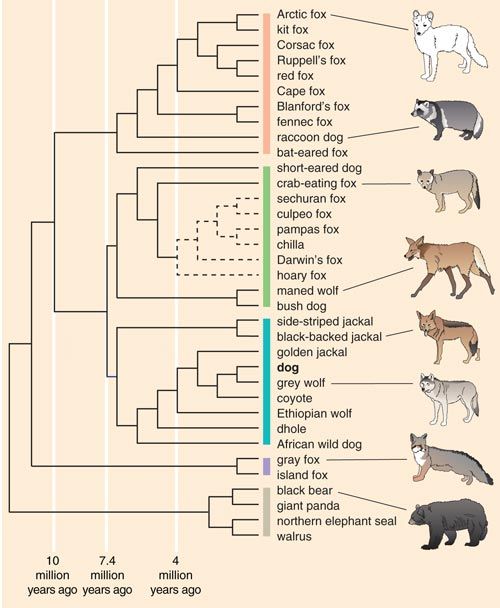
Just needs to be updated with a dire wolf on it too to mess up those lineages a bit.
also I think 'racoon fox' would be a far better name for Nyctereutes anyway.
Birdsage
Well-Known Member
@TeaLovingDave made me aware in this post (Unpopular animals that you like) that there really is such a thing as a “seagull” despite what many birders (including, formerly, myself) claim; the Great Black-backed Gull is Larus marinus.
On the topic of the scientific names of gulls; isn’t it funny that there are two species of gull (Caspian Larus cachinnans and Black-headed Chroicocephalus ridibundus) with a specific epithet that means “laughing” and neither of them is the so-called “Laughing Gull” (Leucophaeus atricilla)? Incidentally, “atricilla” means “black-tailed”, despite the fact that there is an actual Black-tailed Gull (Larus crassirostris, “thick-billed”), and that the Laughing Gull has a white tail as an adult like most gulls (perhaps there was a mistake and it was supposed to be “atricapilla”?)
On the topic of the scientific names of gulls; isn’t it funny that there are two species of gull (Caspian Larus cachinnans and Black-headed Chroicocephalus ridibundus) with a specific epithet that means “laughing” and neither of them is the so-called “Laughing Gull” (Leucophaeus atricilla)? Incidentally, “atricilla” means “black-tailed”, despite the fact that there is an actual Black-tailed Gull (Larus crassirostris, “thick-billed”), and that the Laughing Gull has a white tail as an adult like most gulls (perhaps there was a mistake and it was supposed to be “atricapilla”?)
Last edited:

Audubon's The Quadrupeds of North America includes a lot of interesting old names:
- American Red Squirrel=Hudson's Bay Squirrel
- Bighorn Sheep=Rocky Mountain Sheep
- Black-tailed Jackrabbit=Texan Hare
- Black-tailed Prairie Dog=Prairie Marmot Squirrel
- Bobcat=Texan Lynx, Wild Cat
- Coyote=Prairie Wolf
- Eastern Chipmunk=Chipping Squirrel, Hackee
- Eastern Mole=Common American Shrew Mole
- Fisher=Pennant's Marten
- Fox Squirrel=Weasel-like Squirrel
- Groundhog=Maryland Marmot
- Hooded Skunk=Texan Skunk
- Mountain Beaver=Sewellel
- Muskrat=Musquash
- Northern Pocket Gopher=Mole-shaped Pouched Rat
- Ocelot=Leopard Cat
- Phillip's Kangaroo Rat=Pouched Jerboa Mouse
- Pronghorn=Prong-horned Antelope
- Red Wolf=Red Texan Wolf
- Richardson's Ground Squirrel=Richardson's Spermophile
- Ringtail=Ring-tailed Bassaris
- Snowshoe Hare=Northern Hare
- Striped Skunk=Common American Skunk, Large-tailed Skunk
- Townsend's Ground Squirrel=American Souslik
- White-tailed Deer=Long-tailed Deer, Common American Deer, Virginia Deer