I fully expect a review of Tiergarten Wels in that case
It was an almost unstoppable compulsion to visit it.

I fully expect a review of Tiergarten Wels in that case


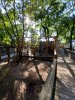
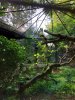
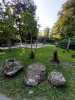
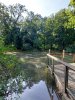
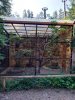

I had a lovely morning there and would return in a moment.
by happenstance I was there for the official opening of the new guereza outdoor exhibit *and* the birth mere hours before my arrival of an additional inhabitant.
I was also very much taken with it when I visited in March 2023
I think your photograph slightly downplays the scale and quality of the guereza exhibit incidentally, so here is one of mine:
View attachment 674597


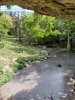
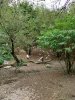
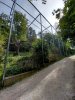
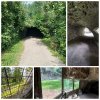

Day 6 # 13 Schmiding Zoo
A 15-minute drive from Wels, in the small village of Krenglbach, is Schmiding Zoo, Austria's second-largest zoo. It is a privately run zoo with some great enclosures and concepts, many of which are a bit outdated, but that certainly didn't spoil my fun.
After the very modern entrance building, the zoo opens with a row of densely planted aviaries for waldrap, black and white ruffed lemur and hornbills (Great Indian and Javan rhinoceros hornbill), and enclosures for secretary birds and red panda.
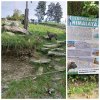
The visitors path continues past a cage for collared mangabey and an aviary for red-crowned amazon, a good enclosure for giraffes, goes right through the Giraffe House (with meerkat and the more interesting savannah monitor), along Japanese cranes to a truly sublime dry riverbed enclosure for western sitatunga, red-crowned cranes, white storks and grey crowned cranes. Beautiful enclosures for ungulates is one of the areas in which this zoo consistently excels.
View attachment 675314
Western sitatunga enclosure
At the Gibbon house there are aviaries for kea, Themminks tragopan and lesser sulphur-crested cockatoo.
Another excellent enclosure is that for South American tapir and capybara which have superb swimming opportunities. Opposite that are the country’s only western gorilla’s and they live in the Gorilla bai, one of the many excellent ideas in this zoo. They have a richly structured outside enclosure which is connected to the interior space by tunnels.
A row of aviaries is home to Bolivian squirrel monkeys, Central American aguti, red-billed blue magpie, silver-cheeked hornbills and wrinkled hornbills. The enclosures with the red river hog and South African cheetah are the prelude to one of the zoo's best enclosures, the South African savannah. This one shines in all its simplicity: it is nothing more than a walled clearing, lined with trees, with just a few trees and some boggy spots. Forget fake baobab trees and so-called authentic African villages. Nothing more is needed to give the black-horse antelopes, Grant zebras and white rhinos a great home. Creating the impression of an African savannah is not that difficult and yet few zoos succeed in this. Enough space and the absence of atypical objects (such as conifers), and the job is almost done. I loved this place, which you could view from an elevated terrace.
View attachment 675315
South African savannah
The Gorilla bai is a great idea that might have its peak in the future in Zurich where the master plan envisages a similar enclosure. Here in Krengelbach, unfortunately, it is too much of a dusty brown rock that does not fit the jungle theme. With the right money, this could become something great. Nevertheless, from a visitor's point of view, this is a particularly attractive part of the zoo, with large information panels and surprising vistas to both the outdoor area and the impressive gorilla bai.
View attachment 675316
The rocky gorilla bai interior
Besides excellent enclosures for ungulates, this zoo also excels in birds of prey: 8 species of vultures and 4 species of eagles, in addition to secretary birds and kites. In 2023, it has become rare to find so many species of birds of prey in a regular zoo.
After the bai, visitors step into a new cave corridor that takes them directly into the 25,000m² aviary. It is divided into three sections: vultures, Steller's sea eagles and wading birds. Each of these aviaries looks good in its own way: the vulture aviary resembles a wooded gorge valley, the Steller's aviary has an excellent depth view and the birds can be easily seen thanks to some strategically placed trees, while the aviary for wading and water birds looks like a dense swamp forest between which small streams provide swampy spots. This aviary could just use some new and clean species signs, but otherwise it is a fantastic place.
View attachment 675317
Wooded gorge for vultures
View attachment 675318
Swamp forest for wading birds
After this impressive aviary, the loop provisionally ends at a large square with a snack bar and a playground. It is surrounded by enclosures and the starting point of a new loop.
No more than 10 European institutions hold martial eagles and Schmiding is, together with the Berlin Tierpark, the only real zoo. They keep it with palm-nut and lappet-faced vultures in a large aviary on the way to the tiger holding.
View attachment 675319
Martial eagle aviary
The latter is especially spectacular due to its underground tunnel with viewpoints on both sides into both tiger enclosures. There are also higher vantage points that give a good view of these spacious enclosures for Siberian tigers.
View attachment 675320
Tiger holding seen from visitor tunnel
The zoo's newest addition is the Himalayan area for blue sheep and Mishmi takins, on a hill that rises steeply and is best seen from an observation tower. It is always a delight to be in such a place where stereotypical theming is kept to a minimum (and especially the earworm music is omitted).
View attachment 675321
Himalaya enclosure
The last stop of this loop is not the least: the Tropenhaus does not look particularly appealing from the outside with its shabby aviaries for white-headed vultures and black and white variants.
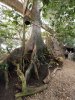
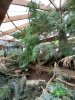
I saw about 20 tropical conservatories during this trip and I loved them all. It is always fun to search among the dense vegetation for the different inhabitants that can (hopefully) be found in that kind of building. This tropical dome in Schmiding is no exception. It has 3 entrances and if you start at the bottom, you walk up through the rainforest on a winding path, passing 3 different sections. The dome is held up by 1 simple but impressive artificial tree, through which the main roof beam runs. A thin net forms the dividing line between the first 2 sections. This tree is so naturalistic and the mesh of the net is so fine that, optically, both sections form a single entity.
View attachment 675322
Beautifull artificial tree
Below are too-small cages for golden-eared and white-eared monkeys and some terrariums. According to the species signs, various amazons, loris, lilac-breasted roller and tyrants live here. I saw only Victoria crowned pigeons, New Guinea eclectus parrot and a mongoz lemur. I cannot rule out the presence of other species, but it seems unlikely given the free-living lemurs. The second section starts with a spacious cage for macaws, mainly blue-and-yellow and green-winged macaws. Free-roaming species here including sunbittern, red-billed hornbill, violet turaco, gould's amadine, and Nicobar pigeons. A pond is home to spectacled caiman and river cooters. Black-capped lory, white-headed bulbul, red-winged starling, Bali mynah and textor weaver are also indicated but I did not see them.
For the third section, you have to go outside for a few steps and when re-entering the dome, it starts with some terrariums for boa constrictor, plumed basilisk and knight anole. The best thing here, however, are the views between the rocks to the lower rainforest.
View attachment 675323
Magnificent view on the 2nd section - macaw aviary on the background
This rainforest house is as fascinating as a rainforest should be. It is a bit dark, visibility is limited and everywhere there is something rustling, some movement noticed or something heard. Too bad the indicated bird collection is not lived up to, but this is definitely a building to cherish.
This was the last stop of this loop and the visit continues past certain habitats, such as the desert (enclosures for Arabian oryx and scimitar-horned oryx), a pampa (ofcourse), an outback (certainly) and a row of aviaries for hawk-headed parrot, yellow-necked francolin, red-tailed amazon, African grey parrot leads you to the zoo restaurant and the entrance area.
Schmiding Zoo is a very pleasant place with some very good ideas, but it lacks just the right amount of money to take them to the top. It certainly excels in well-kept enclosures for ungulates, has an outstanding raptor collection and is equally interesting for hornbills and parrots. With the adjacent aquazoo and evolution museum, it’s a full day’s out.
Interesting that you are so positive about Schmiding, I didn't really like the zoo. Though I would have loved to love it all the bad maintenance, cheap mock rock and the disappointing Aquazoo , didn't make a good impression. I prefer bare concrete to the mock rock monstrosities that are visible there.... Give me nearby Wels anytime
Btw the aviary is 2500 square metres, the zoo loves to add an extra 0, but that would make it Europe's largest, where it is anything but
. it does seem bigger than 2500 sq m, and then they did a good job there, at least I thought it was very spacious.Btw the aviary is 2500 square metres, the zoo loves to add an extra 0, but that would make it Europe's largest, where it is anything but
First of all @Philipine eagle, i'm enjoying this thread more and more. I'm always interested about thoughts and impressions from other people to my well known zoos.
Sorry @lintworm, but that is not true. The zoo is claiming 25000 cubic meter. You can look this up at their homepage here: Highlights im Zoo und Aquazoo Schmiding – Zoo und Aquazoo Schmiding And the 25000 cubic meters seems plausible for me.
The signs at the tropical house are really outdated. There are indeed more free roamers than the mentioned one, but many of them prefer to hide somewhere.
The Gorilla Bai was opened back in 2004.



It was only then that I realised I had missed the woolly monkeys in Schmiding.





so I unfortunately missed the only grey wool monkeys in Europe.
The are was only opened shortly after the last map was printed.


And also the knobbed hornbill
My biggest critic on Salzburg Zoo is the badly executed geo zoo, even in newly opened areas.
Grey woolly monkeys also in Zoo Zlin, the same source as Schmiding
Grey woolly monkeys also in Zoo Zlin, the same source as Schmiding
Ok, I knew it was there, but I simply forgot it. Looking on google maps, it looks like quite a large area, are there more species than the woolly's and the knobbed hornbill?
About Salzburgs geo lay out: it's not that bad, is it? Only the snowleopards and some bird species at the Vogelwiesse are wrong according to that geo-concept, the rest seem more or less ok to me. maned wolves are erroneously placed with Australia on the map, but in the zoo they are with America.