Day 14 #35 Aquatis Aquarium-Vivarium Lausanne
After a beautiful morning in Servion, I drove to Lausanne, Switzerland's fourth largest city.
On the outskirts of the city, at a transport hub with the A9 motorway, a P+R and metroline 2 all around, this 2017 public aquarium is the youngest of the Swiss zoos. A combination of an aquarium and a vivarium, it focuses on our planet's freshwater ecosystems (with a few sidesteps to saltwater). It offers an excellent tour along 20+ themes and 5 continents, and has a total of 46 exhibits, most of which are well to beautifully decorated. They all offer plenty of space for the animals and some have a very high level of naturalistic design.
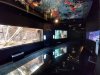
Visitors in the dark, exhibits in bright light, we see it often in other zoo buildings, from the idea that this is how the animals and their enclosure are best shown off. This also has other advantages, in this case to hide the industrial character of the building or bad fake rock work. However, when poorly executed, the disadvantages also immediately emerge. The use of shiny floor tiles causes headaches for those who want to take good photos, and as a result, the windows also often reflect off other visitors. Several exhibits have multiple vantage points, but these are sometimes mispositioned so that you can see other visitors, always a real bummer for me.
The information boards are trilingual, very accurate and easy to navigate. Furthermore, there are not an excessive number of multitech displays present, which might be expected given the young age of the zoo, but which is fine by me (as I often find them too much of a distraction anyway).
The collection is broad and excells in crocodiles, venomous snakes and perchlikes.
Europe
The European section is all about the river
Rhône, from its glacial source to its mouth in the Mediterranean. Surprisingly, hardly any attention is paid to the Camargue, arguably France's most famous natural park.
The visit begins with some exhibits on the
Alpine headwaters of the river. Biodiversity there is poor. Trout, grayling, Asp viper and Italian Alpine newt are the key species here.
View attachment 684982
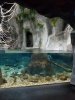
Glacial water of the Rhône
Where the river leaves the mountains, the waters become calmer and we find completely different ecosystems. Themes like
'the lakes',
'the calm waters of the rhône' and
'the rhône at night' show the rich river life with carp, European eels, zander and minnow.
Apart from a small terrarium for fire salamander, this section ends with the
river delta exhibit where fresh and salt water meet (lesser spotted dogfish, mediterranean rainbow wrasse, small red scorpionfish, mediterranean red sea star).
North America
The Nearctic region is represented with only a single exhibit, but the largest in the zoo. The two-storey
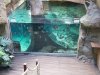
evolution aquarium has an underwater tunnel on the ground floor and several viewing points on the first floor. It is a rather austere mega aquarium for alligator gar, Mississipi paddlefish, longnose gar, perch, barbel, leather carp and common carp. The filtered light makes for an eerie sight, especially when viewing the fish from below.
View attachment 684983
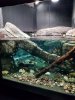
Evolution aquarium
Africa
Venomous snakes are a strong point in the zoo’s reptile collection and this is no different in the African zone, with both Western green mamba & rhinoceros viper in a single ‘
African forests’ exhibit.
Large rivers of Africa is a two-part exhibit with dwarf mongoose, West African Nile crocodile and several fish (tilapia, Congo tetra, yellow-tailed African tetra, Bijou cichlid and moonfish (Citharinus citharus).
View attachment 684984
Dwarf mongoose (rights the passage to the crocodiles)
The latest aquarium is not surprisingly about Lake Malawi with sand castle building lekking fish (Mchenga eucinostomus), Mbuna cichlids (Elongate mbuna and maingano), lemon yellow lab and hump-head.
Asia
Again this section has interesting snakes like the Taiwan beauty snake that lives with the Mangshan pitviper, the rarely shown Taiwan habu or pitviper and the monocled cobra. The latter two are part of the
Rice fields exhibits which include also an open aquarium (three spot gourami, snakeskin gourami, skunk botia, Kapuas river glass catfish (probably ghost catfish), bamboo shrimp, Yamato shrimp)
Both the
Mekong river tank (pangasius, elephant ear gourami, Indonesion tiger perch, fire eel) and the
Mangroves exhibit (green spotted pufferfish, four-eyed fish, corsula, knight goby (stigmatogobius sadanundio), spotted scat, blue-legged hermit crab, orange-spotted spinefoot, clouded archerfish) are among the least impressive exhibits in the zoo, at least in terms of décor.
View attachment 684985
Mangroves exhibit
The
Rare animals from Asia exhibit is a combination of the both CR Indian gharial and Malaysian painted terrapin, EN dwarf botia and Red line torpedo or denison barb, and the beautiful Odessa barb.
View attachment 684986
Indian Gharial (Gavialis gangeticus)
Oceania
The
New Guinea rainbow fish is imo one of the zoo’s most attractive exhibits. This naturalistic aquarium has a fine selection of often-endangered rainbow fish ( Sentani rainbow fish, Kutubu rainbow fish, Sepik rainbowfish, Parkinsons rainbow fish), among others such as Australian red claw crayfish, Cobalt blue stiphodon, and empire gudgeon.
View attachment 684987
New Guinea tank
Sheashores, mangroves and rivers (Australian lungfish, African moony, banded scat, silver moony; fly-specked hardyhead) and the
Great Barrier Reef (Lori’s anthias, madarinfish, scarlet cleaner shrimp, royal dottyback, fairy basslet, banded goby, two-spined anglefish, canary wrasse) are 2 impressive marine aquariums, yet I’ve seen the latter far better in older institutions (the tropical reef aquariums in both Bern’s vivarium and Schmidding’s aquazoo are exceptionally good).
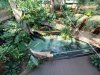
Blue-tongued skink and central bearded lizard, especially the latter, are very well represented in European institutions, while the shingleback skink (no subspecific indication) is much rarer. All these live in the stunningly decorated
Australian lizards exhibit.
View attachment 684991
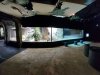
Oceania main hall (fltr Australian lizard - taipan - Great Barrier reef)
Not surprisingly, we also find venomous animals in this section. Australia now has the reputation of being the country with the most poisonous species, wrongly so, as Brazil, for example, has more. But no one will care about the numbers if bitten by an
inland taipan, whose venom is by far the most poisonous of all snakes. Fortunately, there are only a handful of documented attacks by this snake, partly because it lives remotely in semi-arid areas.
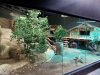
Komodo dragons inhabit the largest exhibit in this section; living together with Gouldian finches, one of only two birds in this zoo. Not bad, but this enclosure looks more like a holiday resort somewhere in the South Pacific, rather than their habitat.
View attachment 684988
Komodo dragon exhibit
South America
The last part of the tour leads through a large South American rainforest with several enclosures. A two-storey tank ‘
Giants of the Amazon’ (arapaima, black pacu, Xingu river stingray, redtail catfish, Teles pires royal pleco) seemed a bit on the small side imo, which cannot be said of the
electric eel aquarium which was huge for the animals.
View attachment 684989
Amazon hall
The visitor trail continu past a pool for the zoo’s third crocodilean, the Cuvier’s dwarf caiman, and an open terrarium for Anthony’s poison arrow frog. Passing again the Giants of the Amazon tank and the enclosure for white-faced saki, it leads to a large
Amazon river aquarium with a selection of stingray, large cichlids and pleco’s (Xingu river stingray, smooth back river stingray, Itaituba river stingray, ocellate river stingray, parrot ciclid, silver hemiodus, red tail hemiodus, tucan fish, flagtail butterfly tetra, black barred characin, Uaru ciclid, Teles pires royal pleco, jaguar catfish, black ghost knifefish, apple snail).
A mixied species terrarium for Yellow-banded poison dart frog, Mission golden-eyed tree frog and eyelash mountain viper heralds the end of the visit as all that follows is a beautiful aquarium for
red piranha.
View attachment 684990
Red piranha tank
Aquatis is expensive, like most such venues, but has no weaknesses in terms of animals and exhibits. Personal preferences in terms of design are of course beyond that.

given the current closure of the reptile exhibits at HdN it'll not take you long to see, if you visit it at all.