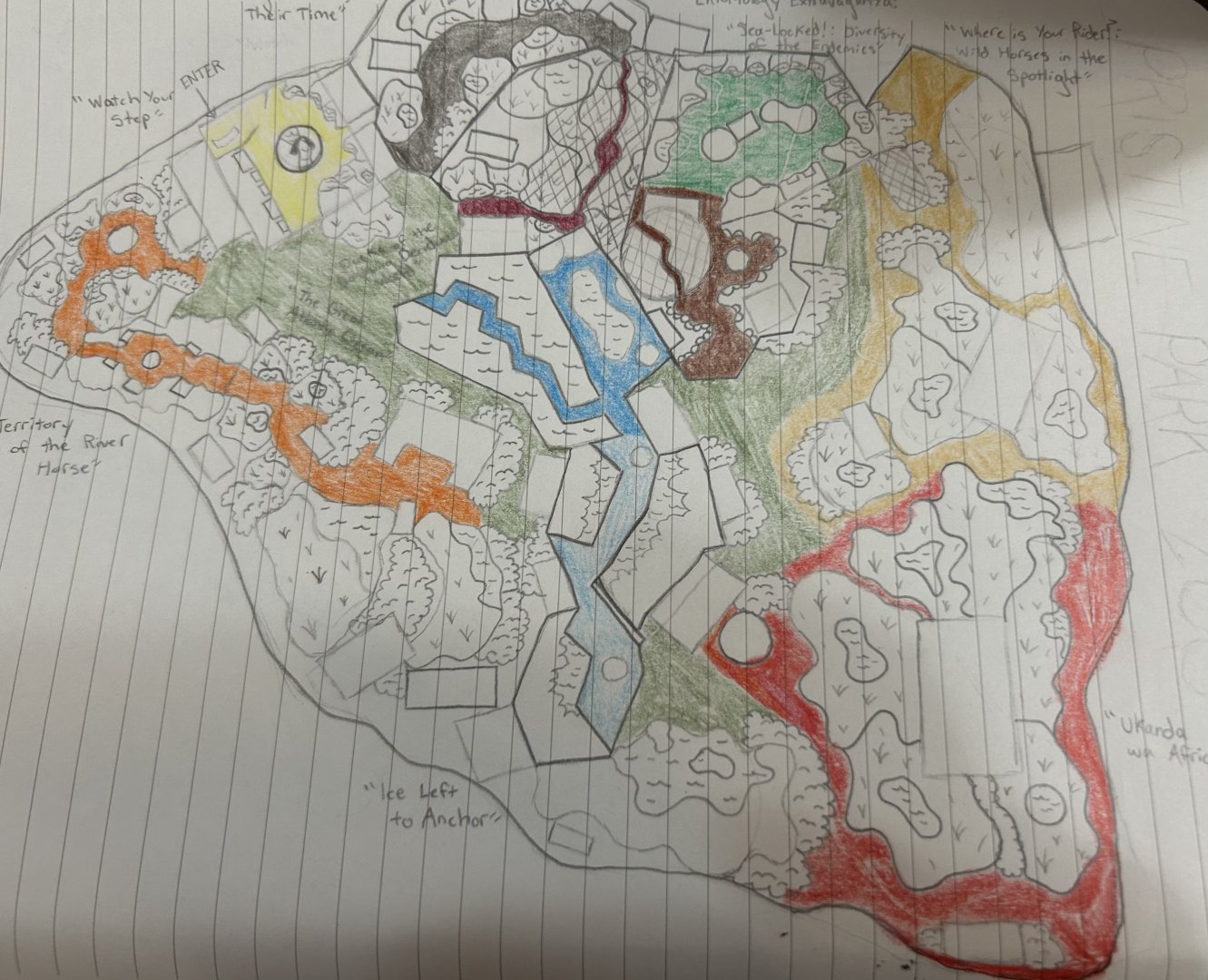
ENTRY ZONE: “Territory of the River Horse”
Mammals: 1
Birds: 12 (+1 since my introduction post)
Reptiles: 5
Amphibians: 1
Fish: 1
Invertebrates: 0
Okay! I'm back again, finally. Sorry It's been months since I posted here last, I had a very busy semester with school. But I am *hoping* to post more regularly, though I will be working at my local zoo this summer so I'll still be busy! Anyway, let's get into the last area of the ENTRY ZONE

.
Once guests exit the entrance building with the “Watch Your Step” exhibit, They are greeted by a pathway surrounded by dense tropical plants supposed to represent that of an African jungle. Guests have now reached the “Territory of the River Horse”, with a large wooden sign placed outside of the pathway on the right to signify so. This exhibit is split into four areas, with two wings of mesh bird aviaries, a sheltered area with terrariums of African reptiles and amphibians, and two habitats for much larger African animals. All species with the exception of one are found in Africa.
African Bird Habitats (1st Wing)
Past the dense botanical greenery is what I call the 1st wing of African bird habitats, with two 350 square foot and four 200 square foot aviaries distributed along the pathway and a gazebo in the middle. This gazebo is what I call the Interpretation Gazebo, and it includes a panorama of African habitats, from savannas and rainforests to rivers and mountains, and where you can find different species of birds. On the left from the gazebo from the pathway is the first mesh-fenced aviary, being home to
Cattle Egrets (Bubulcus ibis) (1.2). Naturally, these exhibits include more natural substrate than that of the indoor exhibits as they utilize the surrounding area in addition. There is significantly more bush and shrubs in these outdoor African bird aviaries, and the egrets in particular have a larger pool surrounded by mock rock with branches and logs across the aviary for them to wade on. Across from the egret aviary to the right of the gazebo is the first of the small aviaries, being 200 square feet, with the same enclosure design as the egrets, home to a pair of
Blacksmith Lapwings (Vanellus armatus) (2.1), however they also rotate with a lone male kept behind-the-scenes on occasions. To the left of the lapwing habitat is another roughly 200 square foot mesh-fenced enclosure, this time home to
Golden-breasted Starlings (Lamprotornis regius) (2.2). Past these two habitats, adjacent to the starling and lapwing habitats are two more 200 square foot mesh-fenced alternating/combinable aviaries for a
Spotted Thick-knee (Burhinus capensis) (1.0) and a pair of
Taveta Weavers (Ploceus castaneiceps) (1.1). The upkeep design in these habitats is the same as the previous bird habitats. The last bird enclosure that is adjacent to the egret aviary is home to a pair of free-flying and intensely active
White-eared Bulbuls (Pycnonotus leucotis) (1.1).
Cattle egret. Photo credit -> DesertTortoise
Blacksmith Lapwing. Photo credit -> vogelcommando
Golden-breasted Starling. Photo credit -> SivatheriumGuy
Spotted Thick-knee. Photo credit -> DesertTortoise
Taveta Weaver. Photo credit -> Austin the Sengi
White-eared Bulbul. Photo credit -> Zooish
African Reptile & Amphibian Terrariums
Next, past the bird aviaries that are surrounded dense wooded plants is the entrance to the sheltered mock-rock area that provides a cool space for guests to look at African reptiles and amphibians on a hot summer’s day. The first terrarium is a small glass tank home to an
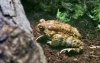
African Bullfrog (Pyxicephalus adspersus) (0.1). Along the wall to the right of the tank is an ecosystem mural that conveys how African bullfrogs are able to exist in harsher environments through dormancy, choice of nesting habitats, and even cannibalism. Across from the bullfrog exhibit, concealed by a wall of mock rock on its left side, having to do a loop around it to view the tank, is a wider and taller terrarium home to the zoos
West African Gaboon Vipers (Bitis gabonica) (2.0) that rotate between which individual is on public display. Beyond that, we enter a more open, circular-type pathway allowing guests to witness several exhibits on each side, and also a species kept in the middle. The middle is a small glass-walled, open-topped exhibit home to a group of
African Spurred Tortoises (Centrochelys sulcata) (2.2), which is just simply a sandy habitat mixed with greens for feeding, a den area for privacy, and a water region along the side. Across from the central habitat on the right side of the pathway is a small terrarium tucked into the mock rock, home to a pair of smaller
Leopard Tortoises (Stigmochelys pardalis) (1.1). And finally, beyond this central tortoise region, the last terrarium guests will see in the shaded herp region is a much larger terrarium home to a
Black Mamba (Dendroaspis polylepis) (0.1). There is another terrarium across from it as well, but that one is currently empty.
African Bullfrog. Photo credit -> JigerofLemuria
West African Gaboon Viper. Photo credit -> RatioTile
African Spurred Tortoise. Photo credit -> Fallax
Leopard Tortoise. Photo Credit -> WhistlingKite24
Black Mamba. Photo credit -> MagpieGoose
African Bird Habitats (2nd Wing)
Beyond the reptile and amphibian terrariums is the 2nd wing of African bird habitats. The size distribution is pretty much the same, with three being approximately 350 sq ft. One of the four habitats has since been split into two evenly, 175 sq ft respectively to both. The first on the right side is one of our 350 sq ft habitats home to a pair of
White-bellied Go-away Birds (Corythaixoides leucogaster) (1.1). Their exhibit is relatively dense in shrubs and greenery around the edges of the exhibit because these birds like their privacy, but it’s relatively open in the interior region to support their active flight behaviors. Right across from the Go-away birds enclosure is another 350 sq ft one, this time home two species: the
Crested Guineafowls (Guttera pucherani) (1.1) and
Superb Starlings (Lamprotornis superbus) (2.2), with their viewing being much more accessible. The viewing area is much clearer, representing that of a woodland, to mimic the natural African environment that the fowls and starlings are found in. Moving on beyond these two first habitats, going back to the left side adjacent to the Go-away bird habitat is an area split in two, each exhibit being 175 sq ft. the first of the two is home to some
Lilac-bresated Rollers (Coracias caudatus) (2.2), and the other side, separated by a mesh fence is home to
White-headed Buffalo Weavers (Dinemellia dinemelli) (2.3). These habitats are meant to create an ecological diversion with the habitats being difficult to differentiate, but each are set up in a unique way. The weavers habitat is supposed to be set up to support their dynamic colonial nesting styles, whilst the roller habitat is more open-flying, designed for individual pairing. The final bird habitat in this long array of habitats, across from the weaver/roller complex and adjacent to the guineafowl/starling enclosure, is home to a singular
Bateleur (Terathopius ecaudatus) (0.1).
White-bellied Go-away Bird. Photo credit -> DaLilFishie
Crested Guineafowl. Photo Credit -> KevinB
Superb Starling. Photo credit -> phraps
Lilac-breasted Roller. Photo Credit -> StreptopeliaNL
White-headed Buffalo Weaver. Photo credit -> evilmonkey239
Bateleur. Photo credit -> olhl.animal.photography
Hippopotamus & Crocodile Habitats
And now, we arrive to the grand attraction. To the right beyond the viewing areas of the bird habitats is a 4,500 sq ft oasis, fixed with underwater viewing and a small lookout tower placed to the side, home to the zoos river horses: this is, of course, the family of
Hippopotamus (Hippopotamus amphibius) (0.4) having the opportunity to either bask in the sun or bathe in the water. The land portion is a mix of flat and sandy regions combined with grass patches to mimic the savanna habitats they are located in naturally. There are several stations for grazing and feeding on hay as well, including areas shaded by various trees scattered throughout the enclosure. The water goes approximately 6 feet deep, giving them space to submerge themselves under water, but also being able to rise to the top with ease. This means that there is a dip in the pathway once the visitors reach the hippo exhibit, just so that they can get a proper glimpse of the enclosure and learn more about how these animals live unique lifestyles both in water and on land in the African savanna. Sharing the habitat with the hippos is a large amount of
Spotted Tilapias (Pelmatolapia mariae) (0.0.67) within the large pool. The last animal habitat of the “Territory of the River Horse” exhibit is slightly smaller, being 3,000 sq ft, home to a breeding pair of
Nile Crocodiles (Crocodylus niloticus) (1.1). However, their exhibit has a lot more grass space in comparison to the hippo exhibit, that is just adjacent to them. The crocodile exhibit, however, does not have underwater viewing, and the path elevates back upward after guests are able to witness the hippos.
Hippopotamus. Photo credit -> Brayden Delashmutt
Spotted Tilapia. Photo credit -> birdsandbats
Nile Crocodile. Photo credit -> SivatheriumGuy
And the entry zone is completely covered! Next, we will start our journey to the CONSERVATORY ZONE, where we will witness a variety of native species to the states that guests can have a bigger impact on, as well as species that live in the dark that can make people oblivious to their importance to their ecosystems. Stay tuned for more!