Rank these UK orangutan outdoor enclosures

I’m thinking Paignton here, but could a series of raised tree houses but without floors for extended ‘lounging’ be erected (without roof access)? This could provide the cover & shelter that most feel is imperative but each one could have a different food source hoisted into it, giving a ‘reason to travel’. The tree houses (I picture large owl type boxes) could be metal or Orang proof but clad in seasonal vegetation. It is clear that most UK zoos are not doing outdoor Orang husbandry/enclosure design very well at the moment.
 
No tree could outgrow what an orangutan can do to it.

Yes, but even if there is a shrubby growth, it offers orangutans a place to hide and play, more than a grass lawn.

It occurred to me that we know very little on how orangutans prefer to sleep. Zoos offer some sort of tall place, but I never heard what apes themselves prefer. It may be important aspect of their welfare. It was a side thought of that maybe better designed sleeping places discourage apes from breaking branches.
 
I’m thinking Paignton here, but could a series of raised tree houses but without floors for extended ‘lounging’ be erected (without roof access)? This could provide the cover & shelter that most feel is imperative but each one could have a different food source hoisted into it, giving a ‘reason to travel’. The tree houses (I picture large owl type boxes) could be metal or Orang proof but clad in seasonal vegetation. It is clear that most UK zoos are not doing outdoor Orang husbandry/enclosure design very well at the moment.

That indeed would be an ideal scenario. One of the reasons Orangutan in many zoos do not climb very much is there is little incentive to do so- no food to get to, and/or limited(if any) resting areas at the top. The idea of hoisting food like that is excellent, but unfortunately the costs/labour involved in installation and active implementation would probably preclude many places from actually doing it. Maybe I'm being too negative here- or just realistic...
 
That indeed would be an ideal scenario. One of the reasons Orangutan in many zoos do not climb very much is there is little incentive to do so- no food to get to, and/or limited(if any) resting areas at the top. The idea of hoisting food like that is excellent, but unfortunately the costs/labour involved in installation and active implementation would probably preclude many places from actually doing it. Maybe I'm being too negative here- or just realistic...
I’m with you on this. I just think we need to do a better job. Remember the old house at Paignton that first held Orang (the group from London?) before becoming a Mandrill house before it’s demolition?…, well, I think we might look back in 20 years and regret the way we’re currently looking after great apes in the UK. If we know their needs, we should provide them, no excuses, no rubbish justifications etc.
 
I’m with you on this. I just think we need to do a better job. Remember the old house at Paignton that first held Orang (the group from London?) before becoming a Mandrill house before it’s demolition?…, well, I think we might look back in 20 years and regret the way we’re currently looking after great apes in the UK. If we know their needs, we should provide them, no excuses, no rubbish justifications etc.
Hear hear! I can forgive PZ the first 'orang house' as it was only ever supposed to be temporary while the Ape Centre was being built. However, the lack of experience/knowledge evident in the design of that new house is long-lasting - the identical enclosures for orangs and gorillas who have such different needs.
 
I’m with you on this. I just think we need to do a better job. Remember the old house at Paignton that first held Orang (the group from London?) before becoming a Mandrill house before it’s demolition?…, well, I think we might look back in 20 years and regret the way we’re currently looking after great apes in the UK. If we know their needs, we should provide them, no excuses, no rubbish justifications etc.

I often think that many of the old style cages served Orangutans far better than the more open designs that replaced them. An orangutan can use all parts of a cage, the sides, the roof etc for climbing. Aethsetically unnappealing of course, and often very limited in space, but they did have some advantages. For example Bristol's old Orangutan cage in their old 1950/60's Ape House had far more climbing opportunity for them than the more 'modern' design that replaced it.

Nowadays of course the trend is to get away from the 'cage' design altogether. But Chester have retained it in at least one of their Monsoon forest Sumatran orangutan outdoor enclosures, though the other is open plan. Virtually everywhere else in the UK avoids covered outdoor exhibits for Orangutan nowadays. And with no roof, the opportunity for adding increased climbing facilities, in whatever form, is lost.

I believe they represent one of the most difficult (and expensive) species of all to cater for properly in captivity and very few zoos achieve it.
 
Last edited:
However, the lack of experience/knowledge evident in the design of that new house is long-lasting - the identical enclosures for orangs and gorillas who have such different needs.

I think the identical indoor enclosures do show that shortcoming. For a start they had never kept either species before, so had no direct experience of exact requirement themselves. They did make an effort outdoors though, designing the Orangutan enclosure to incorporate the tall trees. Unused by the original orangs because of their past history, for a short while in the early days of Demo & Mali it became an excellent exhibit, but sadly didn't last.
 
The idea of hoisting food like that is excellent, but unfortunately the costs/labour involved in installation and active implementation would probably preclude many places from actually doing it.

Basel zoo had a very simple design in their former bear exhibit. It was simply a double line of a string and two reels or spinning wheels. The string passed over the exhibit near the top of the bears climbing tree. Fruit was attached to the string, and moved over the tree. The string was thin, much too thin for the bear to climb, and I am not sure why the bear never tried to grasp and pull the whole thing down. It looked really a low budget but successful gadget.
 
Blackpool
Very sad to hear the moat has led to an animal's death in the past and shocked that it is still in place afterwards. Those smooth sides leading down to the water look very slippery and I imagine make it impossible to climb back up if an orang does fall in. Don't moats with sides like that usually have ropes or chains leading down into the water so that an animal can grab hold and climb out if they do end up in trouble?

Colchester

It does seem strange for a zoo as good as Colchester (not a world-class zoo by any stretch but one that's likely to be in most people's top 10 UK zoos) to have such a poor orangutan outdoor enclosure. The enclosure would be considered substandard in its own right but it's that perimeter wall and the poor wellbeing it brings that sends it plummeting down people's lists. They seem to have built themselves into a corner with it, unable to improve it even if they wanted to thanks to its awkward location, apart from perhaps extending it Southwards; squeezing it between the church ruins and the service road into what looks like a staff carpark. (However, I don't see why they can't immediately knock down that opaque wall and replace it with some mesh fencing to give the orangs some sense of the outside world).

Other than that, the only way for a new outdoor orangutan enclosure at Colchester would be to build one in another part of the zoo grounds (although that would of course require an expensive new house too). However, the impression I get from Colchester is that there is very little space anywhere to build anything new of significant scale, with every nook and cranny being taken up with an exhibit of some kind. This route would therefore mean losing several existing enclosures (some of which may not be a big loss). Another option if the zoo wanted to construct entirely new orangutan facilities would be to commandeer a large chunk of the existing visitor's carpark .

Dudley

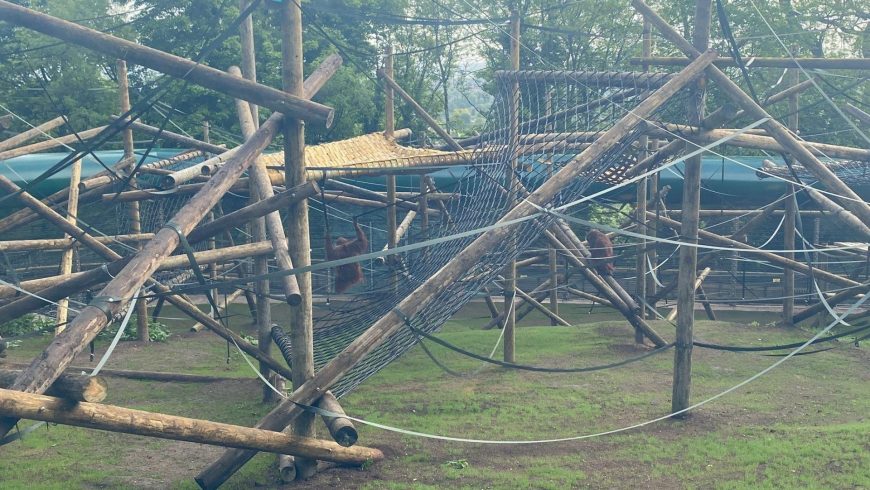
For those who for some reason assume that Dudley's new enclosure doesn't contain anything for swinging/brachiation, here's a couple of photos that prove otherwise. Both photos show approximately half of the space.

IMG-20220519-WA0001-870x490.jpg


full


The climbing structure consists of a mixture of wooden poles and a large number of ropes that criss-cross the whole thing. It looks possible for the orangs to traverse the entire structure by using the ropes alone if they wanted to, but of course they have the choice to use whatever they please and go in whatever direction they want to. There's also a couple of hammocks, platforms, and a shelter, plus 3 large nets for them to brachiate along.

I'd also say that the structure is quite open, not dense, crowded or tightly packed as some climbing structures at other zoos might be.

Monkey World
With regards to the appearance of MW's outdoor orang enclosures being described as looking "hideous" and "industrial", although it's not that extreme or as big a deal to me, I tend to agree somewhat. I guess it comes from two things: the fact the ropes/firehoses are red in colour rather than green, and the use of the long plastic tubing (which I can't imagine the orangs using, apart from the ones that have been used to form a shelter).
 
Last edited:
I'd also like to talk about the very plausible idea that orangs are more likely to use any climbing structure if there is the motivation for them to do so.

Lets assume that an orang's biggest/most frequent motivation for climbing is to find food.

Now imagine you are a zookeeper with a bucket full of food.

You want your orangs to get off the ground and use their climbing frame. You will use food (their biggest motivation) to do this.

You walk into the outdoor enclosure. Where will you place the food?


Which of the outdoor enclosures in each of the photos above is it physically possible to place and hide food all over the climbing structures? In which ones is it possible to create motivation for them to use it? The ones with more poles and platforms perhaps?

Could improved husbandry and enrichment sometimes overtake aesthetics and "what they do in the wild"?
 
Blackpool
Very sad to hear the moat has led to an animal's death in the past and shocked that it is still in place afterwards. Those smooth sides leading down to the water look very slippery and I imagine make it impossible to climb back up if an orang does fall in. Don't moats with sides like that usually have ropes or chains leading down into the water so that an animal can grab hold and climb out if they do end up in trouble?

Colchester

It does seem strange for a zoo as good as Colchester (not a world-class zoo by any stretch but one that's likely to be in most people's top 10 UK zoos) to have such a poor orangutan outdoor enclosure. The enclosure would be considered substandard in its own right but it's that perimeter wall and the poor wellbeing it brings that sends it plummeting down people's lists. They seem to have built themselves into a corner with it, unable to improve it even if they wanted to thanks to its awkward location, apart from perhaps extending it Southwards; squeezing it between the church ruins and the service road into what looks like a staff carpark. (However, I don't see why they can't immediately knock down that opaque wall and replace it with some mesh fencing to give the orangs some sense of the outside world).

Other than that, the only way for a new outdoor orangutan enclosure at Colchester would be to build one in another part of the zoo grounds (although that would of course require an expensive new house too). However, the impression I get from Colchester is that there is very little space anywhere to build anything new of significant scale, with every nook and cranny being taken up with an exhibit of some kind. This route would therefore mean losing several existing enclosures (some of which may not be a big loss). Another option if the zoo wanted to construct entirely new orangutan facilities would be to commandeer a large chunk of the existing visitor's carpark .

Dudley

For those who for some reason assume that Dudley's new enclosure doesn't contain anything for swinging/brachiation, here's a couple of photos that prove otherwise. Both photos show approximately half of the space.

IMG-20220519-WA0001-870x490.jpg


full


The climbing structure consists of a mixture of wooden poles and a large number of ropes that criss-cross the whole thing. It looks possible for the orangs to traverse the entire structure by using the ropes alone if they wanted to, but of course they have the choice to use whatever they please and go in whatever direction they want to. There's also a couple of hammocks, platforms, and a shelter, plus 3 large nets for them to brachiate along.

I'd also say that the structure is quite open, not dense, crowded or tightly packed as some climbing structures at other zoos might be.

Monkey World
With regards to the appearance of MW's outdoor orang enclosures being described as looking "hideous" and "industrial", although it's not that extreme or as big a deal to me, I tend to agree somewhat. I guess it comes from two things: the fact the ropes/firehoses are red in colour rather than green, and the use of the long plastic tubing (which I can't imagine the orangs using, apart from the ones that have been used to form a shelter).
Great to see some closer photos of the Dudley exhibit - it looks much better from this perspective and will be nice to see if any plant life develops over the next few years.
 
I'd also like to talk about the very plausible idea that orangs are more likely to use any climbing structure if there is the motivation for them to do so.

Lets assume that an orang's biggest/most frequent motivation for climbing is to find food.

Now imagine you are a zookeeper with a bucket full of food.

You want your orangs to get off the ground and use their climbing frame. You will use food (their biggest motivation) to do this.

You walk into the outdoor enclosure. Where will you place the food?


Which of the outdoor enclosures in each of the photos above is it physically possible to place and hide food all over the climbing structures? In which ones is it possible to create motivation for them to use it? The ones with more poles and platforms perhaps?

Could improved husbandry and enrichment sometimes overtake aesthetics and "what they do in the wild"?
I've imagined myself with my bucket in all these enclosures. As far as I can see, I need to be good at throwing upwards and aiming for hammocks and platforms (unless there are some pulley systems that I don't know about).So probably every day the food would be in the same place. Wingham has netting over the enclosure but I don't know if it's safe to throw food on to that for the orangs to pull through, like they do in some indoor enclosures.
 
As far as I can see, I need to be good at throwing upwards and aiming for hammocks and platforms

I wonder if scatter feeds of the future will consist of zookeepers taking control of drones to distribute food to high or difficult to access parts of the climbing structure.

(unless there are some pulley systems that I don't know about).So probably every day the food would be in the same place.

A pulley system is a good idea and likewise I don't know if any of the enclosures have them. However, like you say the food would always be in the same place, which I imagine doesn't do anything for mental stimulation (the same applies if food is placed in the same few hammocks every day - the orangs already know exactly where it will be). On top of that, given how good orangs are at dismantling things, any pulley system would have to be very robustly engineered.


It is strange how the designs of all the orang enclosures in the UK are so different from one another. Even ones of similar age don't seem to follow a familiar trend. OK budgets for different zoos may be vastly different, but you'd expect one to be a scaled up or down version of another.

A lot of the UK orang outdoor enclosures also include a feature that is unique to it...

Blackpool - Large concrete pipes.

Chester (Sumatran) - Large concrete tree (which, on closer viewing of the photo in the first post, doesn't appear connected to the rest of the climbing structure and doesn't look very accessible from the ground - it doesn't have those long straps/'vines' that hang down to the floor as can be seen on Dublin's fake trees).

Colchester - Rock cave on floor.

Monkey World - Long plastic tubes.

Twycross - Enrichment 'termite' mound.

Wingham - Netted enclosure. (Wingham's fake trees are primarily there for structural reasons and have been prettied up to look reminiscent of trees).
 
I wonder if scatter feeds of the future will consist of zookeepers taking control of drones to distribute food to high or difficult to access parts of the climbing structure.


A pulley system is a good idea and likewise I don't know if any of the enclosures have them. However, like you say the food would always be in the same place, which I imagine doesn't do anything for mental stimulation (the same applies if food is placed in the same few hammocks every day - the orangs already know exactly where it will be). On top of that, given how good orangs are at dismantling things, any pulley system would have to be very robustly engineered.


It is strange how the designs of all the orang enclosures in the UK are so different from one another. Even ones of similar age don't seem to follow a familiar trend. OK budgets for different zoos may be vastly different, but you'd expect one to be a scaled up or down version of another.

A lot of the UK orang outdoor enclosures also include a feature that is unique to it...

Blackpool - Large concrete pipes.

Chester (Sumatran) - Large concrete tree (which, on closer viewing of the photo in the first post, doesn't appear connected to the rest of the climbing structure and doesn't look very accessible from the ground - it doesn't have those long straps/'vines' that hang down to the floor as can be seen on Dublin's fake trees).

Colchester - Rock cave on floor.

Monkey World - Long plastic tubes.

Twycross - Enrichment 'termite' mound.

Wingham - Netted enclosure. (Wingham's fake trees are primarily there for structural reasons and have been prettied up to look reminiscent of trees).
A few random thoughts.

Drones to scatter food are a good idea especially as keepers are never going to be able/allowed to climb these structures.

Any self-respecting orang would try to demolish an exposed pulley system so it would have to be enclosed in a tall structure - like Dublin's fake trees and Auckland's towers. A network of them could be combined with TriUK's ideas for 'tree houses'. But whatever the feeding system is, there should be plenty of opportunities for orangs to travel above ground level. Some less sedate ones will do it just for the sheer joy of it (thinking particularly of Mali & Tatty Paignton/Colchester).

Twycross and Blackpool are probably the most similar, having a grassy mound surrounded by a ditch/moat and with climbing poles and ropes in the middle. Monkeyworld is very good at attracting donations so it's possible that the enclosure looks like that because that's what was donated. Jersey, Paignton and Chester are lucky in having large areas with natural features. Colchester is fortunately unique and it's possible they didn't think beyond Rajang's needs.
 
Back
Top