Taronga Zoo Recent history of Taronga and developments etc

Graeme wrote the above article from memory and recently came across his notes from the meeting. He has rewritten it based on these notes. Given the interest shown on this site Graeme has asked me to make the article available here. I've attached it as PDF. It is unlikely to be published, and otherwise Graeme will be lodging copies with the State Library and Taronga Zoo archives.

It may lso be of interest to British members so @TeaLovingDave @Tim May

Pure gold!!

Thank you MRJ.
 
Gorilla House Fire (2000)

I came across an interesting story I hadn’t heard before while reading The Keepers at the Kept (fantastic book by the way), regarding a fire that broke out in the Gorilla House in 2000. I will summarise it below:

The gorilla was exhibit was built in 1996 and was noted to have cost $4 million. In 2000, a leak from the water pipes caused a short circuit and failure of the entire electrical system (sliding doors, sprinklers, lights and sound systems); with a fire originating from the circuit board.

Keepers arrived at 6.30am to find thick black smoke billowing out of the building, where the gorillas were locked inside. Upon gaining access to the building, the keepers discovered the fire was too advanced to fight and due to the electrical failure, the doors to the outside exhibit wouldn’t open (trapping the gorillas).

The keepers climbed onto the roof of the building and smashed the skylight windows, allowing the thick black smoke to escape. The fire crew extinguished the fire and the electrics were restored the next day, allowing the gorillas access to their outside exhibit.

Apart from some lethargy and minor coughing over the days that followed, the gorillas were thankfully unharmed. Their intelligence to convene in the one den where the air was freshest (via wire mesh); as well as the ability of the silverback (Kibabu) to keep the troop calm was credited with saving their lives.

——————————————————

This was the first I’d heard of this incident and am thankful it had the outcome it did. The quick response of Taronga’s staff and the fire crew (and as mentioned above, the commonsense of the gorillas) undoubtedly prevented what could have turned into one of the greatest tragedies in the history of Australasia’s zoo industry.

The troop at the time comprised 10 gorillas:

1.0 Kibabu (1977)
0.1 Mouila (1972)
0.1 Kriba (1979)
0.1 Frala (1981)
0.1 Shinda (1991) Kibabu x Frala
1.0 Haoko (1993) Kibabu x Mouila
0.1 Kijivu (1993) Kibabu x Kriba
0.1 Anguka (1994) Kibabu x Frala
1.0 Shabani (1996) Kibabu x Mouila
0.1 Safiri (1996) Kibabu x Kriba

As a side note, following their export to Prague Zoo in 2001, Shinda and Kijivu survived the devastating flood of 2002, which tragically saw Prague Zoo lose several of their animals (including a young male gorilla).
 
@Zoofan15

Wow what a story thanks for sharing. Thank god for Kinabu's leadership strengths and the groups smart reaction to. Must of been so terrifying for them, and their keepers too of course who were very brave during.

This story has so much impact on the hindsight of the past 24 years when you consider how influential this troop has been on the regional population:

Of the 12.8 living gorillas in Australasian zoos:

0.2 were involved in the above incident (Kriba and Frala)

2.3 were born to Kibabu’s troop in the years that followed (Mbeli, Fataki, Kimya, Fuzu and Kipenzi)

1.0 was born to Frala in Kibali’s troop (Fabumi)

2.2 were born to Kibabu’s offspring (Mjukuu, Kanzi, Mwamba and Kaius)

That’s 12 of the 20 gorillas currently living in the region.

Full credit to their keepers, who truly went above and beyond that day.
 
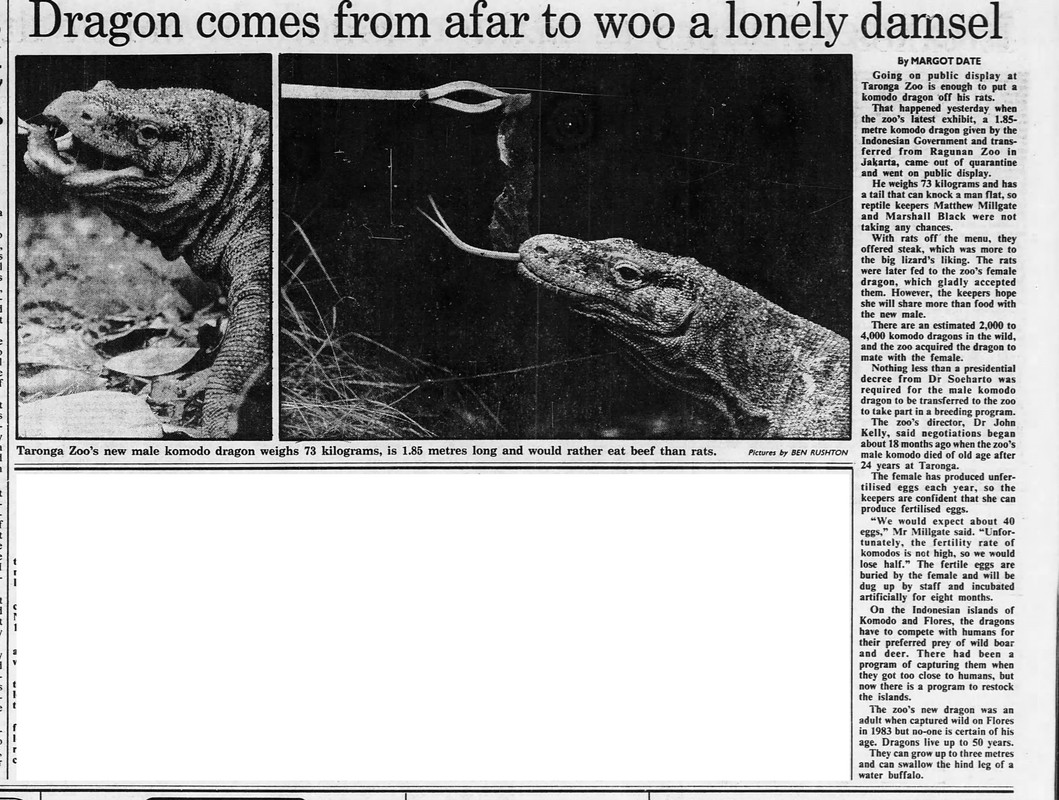
photo from Sydney Morning Herald Thursday March 23 1995 of Tuka the Komodo Dragon's 300m journey along a pathway at Taronga, enticed by chunks of raw beef to what would be his exhibit for over 20 & half years at the now closed reptile house Serpentaria (found out Serpentaria was officially opened to visitors on 6th April 1995 at 12:30pm by NSW state environment minister Pam Allen). Tuka first went on display in his original exhibit on 10th January 1992 after arriving the year before (director Dr Kelly said had been an 18 month long planning for his arrival with Indonesian government following death of previous male dragon Keith). Article also mentions the previous reptile house was opened in 1965 (knew Hallstrom commissioned and designed it, didn't know the year).

Tuka's 300m journey in late March 1995: article written by Bob Beale is titled - 'Goanna's grandaddy is a reptile about town'

Tuka journey's to Serpentaria Taronga March 23 1995 photo Rick Stevens
Living-link-with-the-dinosaurs-the-2-8-metre-Komodo-lizard-sw-aggers-through-the-zoo-photograph.jpg


(source: Living link with the dinosaurs the 2 8 metre Komodo lizard swaggers through the zoo photograph — Postimages & Mar 23, 1995, page 5 - The Sydney Morning Herald at Newspapers.com - Newspapers.com)

Also a 1992 article says Tuka was already an adult when captured in Indonesia in 1981/1982 so sounds like he could of been about 40 when he died much like predecessor Keith.

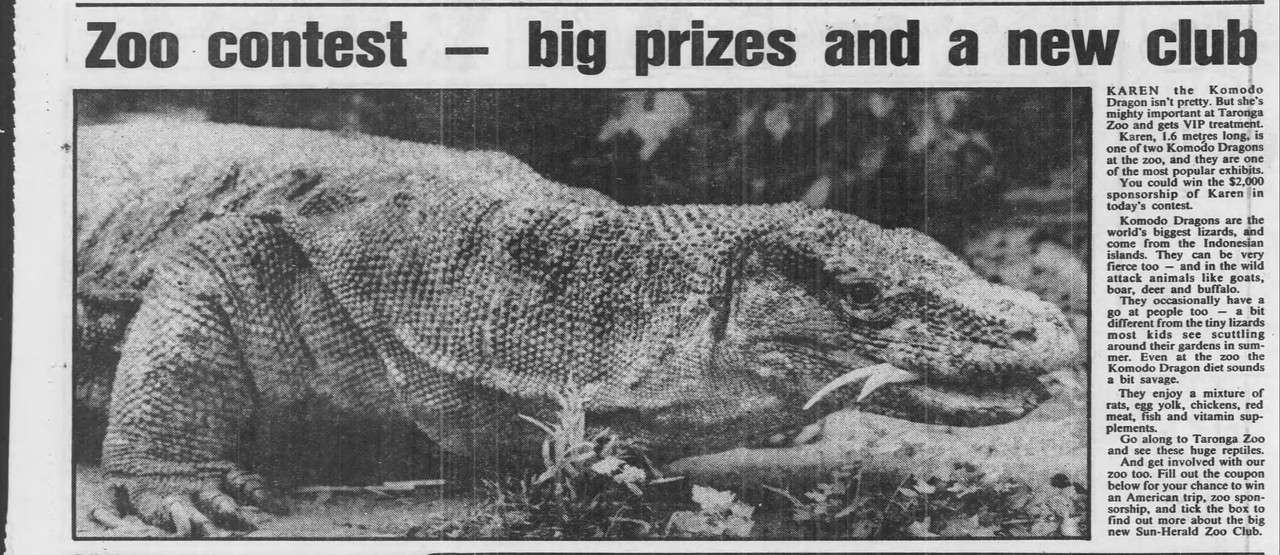
Also apparently female Dina (b 1978) arrived 1981 from Ragunan Zoo was originally named Karen or the other female with her possibly was named Karen initially (1987 article am archiving now too). A few articles from as far back as 1930s about wanting expeditions underway to get Taronga a Komodo (mentioned in 1935 that Rome Zoo had already had one supplied by a deal the notorious head of state Mussolini had organised with animal capturers-traders). Also apparently part of the exchange for Keith the Komodo and his shortlived female counterpart in exchange for Australian animals like Black Swans, a Tiger from Indonesia was also meant to be part of the shipment to Taronga. Whether the Tiger arrived however am completely unsure.
 
Last edited:
*in regards to last Binturong born at Taronga before Indah in 2007 it may of been a male named Binty that may have been born at Taronga in late 1950s (an article mentions he began life at Taronga), at some point he ended up at the now long closed Ponderosa Zoo and Fauna Park (Closed Zoos) that existed out Oakland Junctions near Melbourne Airport. Binty apparently died in December 1987 there, had a heated cage was fed bananas and chicken breast and lived to be 30. A plan to have him taxidermised may have happened but park owners (Mr & Mrs Smart) kept his body in a freezer for at least two months after waiting to raise funds to do so.
 
Not closed yet - I was there on Sunday.

:p

Hix

Serpentaria was closed prior to your visit, with signage indicating the reptiles were being move to ARC. My friend reported it reopened circa 13/07/2024 and has now closed to the public again (as of early this week) for the installation of sound barriers ahead of its demolition.

I’m not sure if the latest closure will be final, but would assume with ARC opening to the public July 1 (as per signage), there will be little reason to delay the demolition of Serpentaria.

Great posts @steveroberts, it was good to learn more about Taronga’s Komodo dragons. :)
 
Love this too, little Indah 0.1 (b 1st April 2007) the baby Binturong's public debut on Wednesday May 30th 2007 photographed here with mum/dam Pepper (mentions her dad/sire Emas too). Actually from a Hawaii newspaper West Hawaii Today on Fri 1st June 2007 by Mark Baker (sources West Hawaii Today 1st June 2007 Mark Baker Associated Press baby Binturong at Taronga Zoo Sydney — Postimages & Jun 01, 2007, page C6 - West Hawaii Today at Newspapers.com - Newspapers.com):

West-Hawaii-Today-1st-June-2007-Mark-Baker-Associated-Press-baby-Binturong-at-Taronga-Zoo-Sydney.jpg
*in regards to last Binturong born at Taronga before Indah in 2007 it may of been a male named Binty that may have been born at Taronga in late 1950s (an article mentions he began life at Taronga), at some point he ended up at the now long closed Ponderosa Zoo and Fauna Park (Closed Zoos) that existed out Oakland Junctions near Melbourne Airport. Binty apparently died in December 1987 there, had a heated cage was fed bananas and chicken breast and lived to be 30. A plan to have him taxidermised may have happened but park owners (Mr & Mrs Smart) kept his body in a freezer for at least two months after waiting to raise funds to do so.

I’d be interested to know if Pepper the Binturong was named by Taronga after David Pepper-Edwards. He previously had one of the Sumatran tiger triplets (born 1995) nicknamed after him.

With regards to the Ponderosa Fauna Park, Taronga also sent a young male Jaguar. Quito was born at Taronga Zoo on 24/05/1984; and was sent to Ponderosa Fauna Park in September 1985. He was the first surviving Jaguar cub born at Taronga Zoo since 1958.
 
I’d be interested to know if Pepper the Binturong was named by Taronga after David Pepper-Edwards. He previously had one of the Sumatran tiger triplets (born 1995) nicknamed after him.

With regards to the Ponderosa Fauna Park, Taronga also sent a young male Jaguar. Quito was born at Taronga Zoo on 24/05/1984; and was sent to Ponderosa Fauna Park in September 1985. He was the first surviving Jaguar cub born at Taronga Zoo since 1958.

That's a good point, I didn't think of that. My instinct would be that Pepper already came to Taronga with her name and was potentially named after the salt-and-pepper (leaning towards the pepper) colouration of binturongs, but I really don't know for sure.

Pepper the tiger had a number of names over the years. He was also named Dougall, I believe when he was at Mogo (after a sponsor which assisted Mogo with acquiring tigers), and was formally known as Lari. I recall a picture book about zoo babies during my childhood, which indeed referred to Selatan's 1995 triplets as Ramalon, Juara and Pepper.

David Pepper-Edwards was certainly a legendary figure at Taronga Zoo. I was researching his wife's name (she also worked at Taronga, and I believe they hyphenated their surnames upon marriage) and found out that he served for New Zealand in the Vietnam War in his late teens prior to moving to Australia: David Lesley Pepper-Edwards
 
Pepper the tiger had a number of names over the years. He was also named Dougall, I believe when he was at Mogo (after a sponsor which assisted Mogo with acquiring tigers), and was formally known as Lari. I recall a picture book about zoo babies during my childhood, which indeed referred to Selatan's 1995 triplets as Ramalon, Juara and Pepper.

It wouldn’t surprise me if Taronga’s Sumatran tiger triplets (born October 1995) were named in reference to the upcoming Sydney Olympics: Juara (champion), Lari (race) and Ramalon (future). The first two names are self-explanatory; and the third could be a reference to the games being held in 2000 (the new millennium).

I recall reading that book as a child too. I vaguely remember the tiger cubs and Haako the gorilla, who was a juvenile when the book was published.
David Pepper-Edwards was certainly a legendary figure at Taronga Zoo. I was researching his wife's name (she also worked at Taronga, and I believe they hyphenated their surnames upon marriage) and found out that he served for New Zealand in the Vietnam War in his late teens prior to moving to Australia: David Lesley Pepper-Edwards

David Pepper-Edwards had an equally eventful career at Auckland Zoo, where he worked from 1968-1979. In his final year at the zoo, he dove into a creek to rescue a newborn hippopotamus calf that had been swept out the exhibit by a high current and had managed to swim between the grills. It’s mother, Faith, was the same hippopotamus that had escaped two years prior. She rejected the calf after interference from her own mother, Bonnie.

David-Pepper Edwards also fell into Auckland Zoo’s Hippopotamus Exhibit attempting to retrieve a visitor’s camera, as detailed in A Tiger by the Tail. He was immediately turned on by Bonnie, but rescued by another keeper, who distracted her using a rake.
 
@Abbey

Thats really interesting great research, they really sounded like a really cool couple. Salt 'n pepper fur coloration is a spot on observation about Binturong's fur coloration. I would of thought the same as @Zoofan15 if had known about the Pepper-Edwards duo in terms of naming.

@Abbey @Zoofan15 I didnt know Lari/Dougal was originally named Pepper or was named that first after being named Lari.

@Zoofan15 Ah so that's where Quito went (I first learnt about him from you circa 5-6 years ago on here when discussing Ali and Wendy Jaguars possibly on this thread, fsr I thought he went to Melbourne Zoo).

@Osedax funnily enough visited Serpentaria straight after it opened and have zero memory of seeing any arachnids or insects in it (was very young maybe distracted by attention drawn to reptiles all shapes and sizes and colors + giant salamanders & frogs).

@Zoofan15 - Oh wow re Juara (champion), Lari (race) and Ramalon (future). I think you've just found the answer to their namings, great stuff man.

+ wow Pepper-Edwards at Auckland with the Hippos, what experiences hey
 
Last edited:
@Zoofan15 Ah so that's where Quito went (I first learnt about him from you circa 5-6 years ago on here when discussing Ali and Wendy Jaguars possibly on this thread, fsr I thought he went to Melbourne Zoo).

Quito’s younger brother, Maya (born 1987 at Taronga Zoo) was transferred to Melbourne Zoo in 1989, where he died in 2008. Quito and Maya were both melanistic like their father, Ali.

Ali and his brother, Branco, came to Australia together from Rotterdam Zoo in 1979. Branco was also melanistic and lived at Adelaide Zoo until his death in 2000. His mates were females bred at Melbourne.

There was a real boom in Jaguar breeding throughout the region’s zoos in the 1970’s and 1980’s. Auckland Zoo imported a breeding pair in 1969, who produced many cubs, including Wendy who was sent to Taronga Zoo. Melbourne Zoo also bred several litters throughout the 1970’s; but by the 1980’s, breeding slowed as it became a challenge to place surplus offspring (Auckland, Taronga and Melbourne were all breeding).
 
Back
Top